Tax plans would boost schools but leave social safety net vulnerable

By Kevin Yamamura, Sacramento Bee

As education groups battle over which California tax initiative would give the biggest boost to schools, advocates for low-income residents fear safety-net programs remain vulnerable no matter what happens on the ballot in November.

Proponents for three competing tax measures are focusing heavily on schools because voters prioritize education funding most. But it remains an open question how other programs will fare.

Gov. Jerry Brown’s proposal raises several billion dollars for the state’s general fund that he says would help protect schools from severe reductions. But he has proposed deep cuts in welfare-to-work and child care in the first year even if his taxes pass.

Two rival plans largely bypass the state to send money directly to schools and counties. They leave unanswered how the state would close an estimated $9.2 billion deficit through June 2013.

“If tax revenues aren’t available to help balance the budget … it puts pressure on higher education, on health and social service programs, on parks,” said Jean Ross, executive director of the California Budget Project, which advocates for low-income residents. “It puts pressure on everything that isn’t constitutionally protected.”

Read the whole story


Reno mail processing plant to stay open

By Lenita Powers, Reno Gazette-Journal

Northern Nevadans won’t see an extra day tacked on to their mail delivery, and almost 300 people will keep their jobs following the announcement today that the Reno Main Post Office will remain open.

U.S. Postal Service officials and Senate Majority Leader Harry Reid, D-Nev., were scheduled to make the announcement this morning in Washington, D.C.

“The loss of the Reno mail processing plant would have been devastating to Northern Nevada,” Reid said in a statement released through his office.

“Once this processing plant was fairly evaluated, I felt confident the Postal Service would arrive at the same conclusion I did: Trucking Nevada’s mail to Sacramento made little sense,” Reid, the Senate majority leader, said.

“I am pleased that we were able to protect Nevada jobs and ensure that Nevadans continue to receive their mail in a timely manner,” he said.

This is the same officer where mail from the South Shore is first routed.

To streamline its network and save money, the U.S. Postal Service has been studying the possible closure of 250 distribution centers across the nation, including Reno’s.

Read the whole story


South Tahoe council told economic recovery is years away

By Kathryn Reed

South Lake Tahoe’s economy won’t improve until the country’s does.

That was the message Brad Schiller, an economics professor at UNR, delivered to the South Lake Tahoe City Council on Feb. 21.

“South Lake Tahoe’s economy cannot recover on its own,” Schiller said. “That is not to say local policies don’t have some impact.”

Schiller was invited at the urging of Councilman Tom Davis. But he didn’t have any words of wisdom beyond, “I would encourage the council to adopt a pro business perspective.”

He doesn’t foresee the country returning to full employment for at least six years. That would mean dealing with the 8.3 percent unemployment rate. However, Schiller didn’t mention the percent of unemployed in the city limits is 15 and if that figure might take longer to reduce.

In other action the council:

• Received a rebate check for more than $8,000 from Liberty Energy for retrofits. The city is expected to see a savings of $10,000 a year.

• Was told by Tom Wendell, Sustainability Commission member, the council could soon expect to see an agenda item about banning plastic bags in town.


S. Tahoe residents express dislike for parking meters

By Kathryn Reed

Metered street parking, parking garages, reconfiguring streets, changing public perception about paid parking, paying attention to public transit-walkers-cyclists, and approving future projects with adequate parking were all broached in the daytime meeting.

Most in the audience agreed more parking and paid parking are likely to be more prevalent in South Tahoe in the near future. And they agreed it would be the locals, who are used to free parking, who will probably be the hardest to convince this is what’s needed.

How prophetic those two paragraphs from an Oct. 22, 2010, Lake Tahoe News article are.

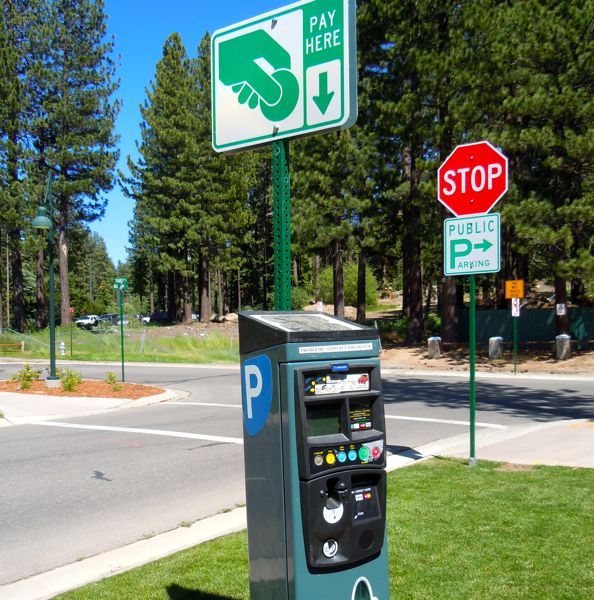
On Feb. 22 – 16 months later – nearly 40 people filled a room at the South Lake Tahoe Rec Center to voice their opinions about the city’s proposal to install parking meters in various locations in town and initiate a residential permit system for the section of the Al Tahoe neighborhood closest to Regan Beach.
Parking meters near Stateline generated an average of $4,000 a month for South Lake Tahoe between July-December 2011. Photo/LTN

Many were loud and boisterous, interrupting Community Service Officer Bob Albertazzi as he tried to answer each question during the 90-minute session. People said they just learned of the meter situation. They said they plan to give the City Council an earful when the issue is back on the agenda March 6.

Meters were on the Feb. 7 council agenda, but were tabled a month to allow time to gather more input from the community. None of the three people who objected to the meters at the council meeting spoke Wednesday night, even though two were in the audience.

The city is banking on generating $300,000 from the meters. That’s revenue that is in the 2011-12 budget. The areas proposed to get kiosks are Regan Beach, Stateline Beach, Venice Drive between Tahoe Keys Boulevard and Tahoe Keys Marina, and Saddle Road between Ski Run Boulevard and Wildwood Avenue.

While Albertazzi said it is not a done deal to put in meters, meters are part of the strategic and business plans, and the five-year budget the council approved in spring 2011. If the council votes not to put in the meters, it must either find other revenue or cut services or staff.

Issues people have with the idea ran the gamut.

One man spoke of how he left the Bay Area because of things like this. He doesn’t want Tahoe to change. He said meters would change the complexion of the community.

JoAnn Conner, president of the South Tahoe Chamber of Commerce, said things have changed since Frank Globin owned all of the land that makes up the Al Tahoe neighborhood.

“It’s not like it was when he was here,” Conner said. “What would you like the city to do?”

He said it’s not his job to find solutions.

Judy Cefalu expressed concerns about people being able to find a place to park on Fourth of July to watch the fireworks.

One person balked at having to get extra passes from the city for guests if he were to have a party.

Some believe if paid parking goes in at Regan Beach, all of Al Tahoe should be permitted so the neighborhood doesn’t fill up with beach-goers looking for a free spot.

John Cefalu is worried beach-goers will park on Harrison Avenue or neighboring streets, which would take away parking for business customers.

People want Heavenly Mountain Resort to provide parking for its employees and not have the city allow for this to happen for free.

People are worried with two part-time employees handling parking issues that enforcement in the neighborhoods will be lacking.

Others are concerned the details have not been worked out – like specifics of permits, how long an illegally parked car will stay before its towed, and the number of permits each household will receive.

Many said the amount of revenue is not worth the consternation the meters will create. While some wonder if South Lake will be the most expensive place in the basin when it comes to lake access.

Albertazzi wrapped things up by saying, “The issue is revenue. Things have changed in South Lake Tahoe. No one has alternatives, so therefore we are trying things. We can’t sit back and do nothing and continue to have services deteriorate.”

——————-

Council meeting:

March 6 at 9am at Lake Tahoe Airport. Agenda will be posted online 72 hours before the meeting.



State looking at building tunnels to divert water

By Matt Weiser, Sacramento Bee

On a clear day, it’s plain to see why many of California’s leading water officials want to get their hands on Peter Stone’s property.

From his driveway along the Sacramento River south of Freeport, the view to the east offers a peek at the snow-capped Sierra Nevada. When that snow melts, it flows relentlessly by, just across the levee road from Stone’s front windows.

From the state and federal governments’ point of view, his 20-acre property in the Sacramento-San Joaquin Delta is an ideal spot for one of the five large pumping stations they’re proposing to feed what may be the largest water tunnel ever contemplated in North America.

Even in a state known for building some of the world’s largest waterworks, the plan is audacious. Twin 33-foot-diameter tunnels would carry a portion of the Sacramento River’s flow deep under the Delta on a 37-mile path underground to the present head of the California Aqueduct, near Tracy.

Pumps that now serve that aqueduct and its nearby federal counterpart kill millions of fish every year and are blamed for altering the habitat of the estuary itself, once among the world’s most productive fisheries.

The tunnel project is intended to move the intakes upstream, to locations presumed to be less harmful to fish and their habitat. It would also secure the freshwater diversions from threats such as earthquakes, floods and sea level rise, ensuring that the 25 million Californians who depend upon that water do not go without.

Those risks are considered inevitable, so the DWR and its partner water agencies view the project as vital to the state’s economy and well- being.

To make it happen, all of those water ratepayers, from the Silicon Valley to San Diego, likely will have to pay higher bills. The project must also survive a maze of potential construction troubles.

Digging a couple of tunnels sounds simple on its face. In reality, the project would turn much of the Delta into a vast construction zone for at least a decade, and permanently industrialize numerous scenic locations that have always been quietly rural.

“This is certainly what we consider a megaproject,” said Richard Sanchez, chief of engineering at the California Department of Water Resources, the project’s primary sponsor. “And it’s something that is certainly several orders of magnitude above what we normally do here in California as far as water projects. It would be a huge undertaking if we move forward.”

The tunnel is the centerpiece of the Bay Delta Conservation Plan, an effort to balance water demand and wildlife protection. After three years of often-contentious meetings and innumerable studies, a draft environmental impact report is anticipated later this year.

The DWR is expected to make a formal decision in 2013 on whether to proceed. It would be subject to approval by state and federal wildlife agencies.

Read the whole story


Fight over taxing comped casino meals enters next stage

By Steve Green, Las Vegas Sun

Boyd Gaming Corp. of Las Vegas, as expected, has filed a lawsuit to overturn rulings by the state Tax Commission requiring it to pay sales taxes on complimentary meals provided to employees and customers.

The Tax Commission ruled in January that the comped meals were taxable “retail sales.” The decision came as the panel rejected a $21 million refund sought by Boyd Gaming, a big casino operator with such properties as Sam’s Town and the Orleans.

It’s believed the ruling against Boyd will also result in the rejection of $225 million in potential refunds for other casino operators.

Carson City attorney John Bartlett, representing Boyd Gaming, last week filed a “petition for judicial review” of the decision in Clark County District Court in Las Vegas.

Read the whole story


Nevada strives to make progress on improving the economy

By Jason Hildago, Reno Gazette-Journal

Nevada received positive marks for sharpening its focus on economic development, but lack of action on its outdated tax structure earned the state a failing grade in the effort to create a new, more viable economy in less than a decade.

One year after a group of community leaders from the public and private sectors released recommendations for revitalizing the state economy as part of the Reno Gazette-Journal’s Reno 2020 project, participants say an increased emphasis on public-private partnerships has Nevada’s efforts off to a good start.

But continued sluggishness from the downturn combined with lingering fiscal and structural issues means the Silver State still faces a tough slog toward recovery, experts said.

One positive is Nevada’s renewed commitment to economic development. The overhaul includes the creation of a cabinet-level entity, the Nevada Governor’s Office of Economic Development (GOED), and several regional development agencies. The moves are part of a push by the state to increase total Nevada employment by 50,000 jobs at the end of 2014 – a job growth rate of a little over 1.5 percent.

The changes also set the foundation for a new economy that is less reliant on traditional sectors such as gaming and tourism.

Gov. Brian Sandoval’s tone reflected the sense of urgency from a state suffering from a 12.6 percent jobless rate in December as he talked about the new statewide push earlier this month.

“This effort is regional in nature and we want to have the broadest participation possible,” said Sandoval as he unveiled a three-year economic development plan for the state. “This is a historic collaboration between state and local government, education and business – everybody is at the table. We all have to push forward together or we’re not getting anywhere.”

Read the whole story


Vail Resorts buys Kirkwood Mountain for $18 million

By Kathryn Reed

Vail Resorts has added a third Lake Tahoe area ski resort to its portfolio – Kirkwood Mountain Resort.

The $18 million acquisition was announced today.

Pending approval of the U.S. Forest Service, which owns the bulk of the land that is mostly in Amador and Alpine counties – with a slice in El Dorado County, the deal will go through. The Colorado-based ski company will take over the resort, retail operations at the base and rights to develop an area near Timber Creek at the base of chairs 7 and 9.

Kirkwood is Vail Resort's third Tahoe area ski resort. Photo/LTN file

The immediate change for skiers is anyone with a Heavenly or Northstar pass may ski at Kirkwood and anyone with a Kirkwood pass may ski at Heavenly or Northstar.

“Kirkwood skiers have a lot of passion because it is a really special place. One of the biggest things in our mind is to respect what Kirkwood is – the vibe, the small community feel. We really want to make sure we support that,” Blaise Carrig, co-president of Vail Resort’s Mountain Division, told Lake Tahoe News.

Kirkwood is much more of a big-mountain resort with its steeps compared to Heavenly (which Vail acquired in 2001) and Northstar (which Vail purchased in 2010).

The Wood, as locals call it, also attracts a different type of skier than Heavenly or Northstar. It’s more of a rugged individual who makes the nearly hour drive from South Lake Tahoe to Kirkwood over two mountain passes. After all, it’s a skull and cross bones that represent The Wall.

Plus, the snow at Kirkwood is usually deeper – nearly 800 inches last season – lighter and more constant than in Tahoe because of where the resort is located.

Kirkwood, though, needs some help to get to the next level in terms of infrastructure and improving the guest experience. It has two high-speed quad chairlifts, with one accessing beginner terrain.

“With every asset we look at what needs there are to improve the experience for the guests. We don’t have any specific plans at the moment,” Carrig said.

He said the sudden and dramatic improvements Vail Resorts did for this season at Northstar with the addition of a mid-mountain lodge and high-speed quad chairlift will not likely come as quickly to Kirkwood.

No dining facility at Kirkwood is memorable in a good way. The retail is basic.

Kirkwood’s master plan calls for substantial on-mountain improvements as well as real estate development.

Carrig said he is aware of the master plan, but it will take time to prioritize what to do first.

He and Casey Blann, who heads mountain operations at Heavenly, will lead the management team at Kirkwood for the time being.

David Likins, who has been CEO of Kirkwood, will take on the same title at Kirkwood Mountain Development. That is the company that retains the rights to most of the real estate holdings at Kirkwood.

“This is a great day,” Likins told Lake Tahoe News. “Vail will get us to the next level of user and guest experience. They operate fantastic resorts throughout the West.”

Likins also said Vail’s desire to retain the uniqueness of Kirkwood was important before he would agree to the sale.

Vail is not worried about the price or reliability of power that has plagued Kirkwood in the past. State-of-the-art diesel generators are expected to be online in two weeks. These replace the plant that burned to the ground in January 2010.

Kirkwood Mountain Public Utility District is its own entity since July. Mountain Utilities was an arm of Mountain Springs Kirkwood, the umbrella firm that had owned the ski resort as well.


Slew of water quality projects to improve Hwy. 50 in S. Tahoe

By Kathryn Reed

Expect traffic delays through much of the South Shore for the next several summers. This is because Caltrans has significant projects on the books.

Michael Cook with Caltrans was at the Feb. 21 South Lake Tahoe City Council meeting to give an update on what his agency is doing. The Trout Creek to Ski Run Boulevard project that started last summer is expected to wrap up in October.

While Southwest Gas is not expected to add to the congestion this summer like it did in 2011 with work on Pioneer Trail, significant delays will be unavoidable before July 4 and after Labor Day.

Nancy Kerry, who was acting city manager while Tony O’Rourke was out Tuesday, suggested Caltrans reach out to the chambers of commerce much like the transportation department did before Echo Summit was closed last year. This would be so businesses would know what to expect in terms of work in front of their business, limitations to driveways and other impacts.

Last summer many businesses on Harrison Avenue experienced a significant drop in business because people could not conveniently get to their location.

Caltrans also has a 72-hour obligation to let businesses know of road closures affecting their business.

Councilman Tom Davis asked what happens to parking near Tep’s restaurant and the neighboring businesses.

Cook said what is there will go away to accommodate the curb, gutters and sidewalk.

“There’s not room for both,” Cook said in reference to parking and improvements.

In 2013, Caltrans will widen Highway 50 in the area of Lake Tahoe Airport.

In 2014, Caltrans expects to begin work on the water quality project from the Y to Cascade Road on Highway 89. Also starting that summer are upgrades from Trout Creek to the Y. That is likely to be a three-year project.

All of these are considered water quality projects, with the emphasis of reducing sediment from reaching Lake Tahoe. At the same time some bike paths, sidewalks and lighting will be added.

What doesn’t have a timetable is the adaptive traffic signal project. Funding is the problem – there isn’t any.

Councilwoman Angela Swanson brought up the possibility of getting local transportation dollars to help with it – specifically Congestion Mitigation and Air Quality funds.

Some of the technology will be put in while Caltrans is working on the highway. The idea is one day traffic lights on the South Shore will be synchronized.


El Dorado County Grand Jury funding issue remains unresolved

A February court date to determine whether the El Dorado County Grand Jury will be funded at the level it wants or if the Board of Supervisors can enforce the budget it approved last year has been pushed back to mid-March.

The Board of Supervisors on Jan. 24 augmented the grand jury budget by $12,000.

It’s possible the topic will be on the Board of Supervisors’ agenda Feb. 28, as well.

Lake Tahoe News first reported on this Feb. 1.

— Lake Tahoe News staff report