North Shore man dies from injuries sustained in avalanche

A 29-year-old Olympic Valley man caught in an avalanche Thursday near Alpine Meadows has died from his injuries at Tahoe Forest Hospital in Truckee.

Benjamin Brackett was skiing with two friends March 1 when they triggered the slide. They were climbing with skins on their skis about 500 vertical feet below Stanford Rock when the avalanche occurred.

This video from KTVU Channel 2 explains the difficulty rescue teams have in getting people out of the backcountry in a timely manner.

The area the trio was skiing in is considered extremely rugged. It is on the backside of Alpine, but not in the ski resort’s boundaries.

The Sierra Avalanche Center on March 1 called the avalanche danger “considerable”.

— Kathryn Reed


S. Lake Tahoe keeps parking free at city beaches

By Kathryn Reed

Anti-parking meter advocates have won. At least for now.

“I don’t think parking is off the table, but it is off the table for the moment,” South Lake Tahoe Mayor Claire Fortier told Lake Tahoe News.

The City Council was expected to vote on the issue March 6. Now it won’t be on the agenda.

“Why bother have it go to a vote if there is no real resonance with the council and the community?” Fortier asked.

But it had resonated with this five-member council for the past year. They approved the parking plan last spring via the strategic plan, business plan and five-year budget. They reinforced the decision last fall with the approval of the current budget.

Now they and city staff are backpedaling.

At a Feb. 22 meeting, residents, second homeowners and business people spoke out against installing meters in various places in town, saying it will change the complexion of the town, hurt businesses and put vehicles in neighborhoods that normally wouldn’t be there.

While the city has $300,000 in revenue in the current budget from parking, that amount is not wiped off the books by this decision. That is because money is still coming in from the meters near Heavenly Village and parking citations.

To make up the shortfall the city is counting on the business license tax passing in June to bring in about $200,000. That is not in the 2011-12 budget.

“Ninety-eight percent of the businesses would see a reduction and the automatic CPI goes away. The increase comes from large businesses paying their fair share,” Nancy Kerry, de facto assistant city manager, said.

What happens if that $200,000 doesn’t come in is an unknown.

——

Next City Council meeting info:

• March 6, 9am

• Lake Tahoe Airport

• Council will be discussing how to improve the roads.

• Here is the agenda.


Buoy battle at Tahoe escalates despite TRPA court victory

By Kathryn Reed

The Tahoe Regional Planning Agency must use better science and environmental analysis to prove increasing the number of buoys and piers in Lake Tahoe will not harm the alpine waters.

Although it was the TRPA that essentially was on the winning side of a decision that came out of the Ninth Circuit Court of Appeals on Feb. 29, it is not a clear-cut victory.

Some believe more buoys on Lake Tahoe will bring more boats and more pollution. Photo/LTN file

In some ways, the League to Save Lake Tahoe won, too.

It was the League that filed the original lawsuit. The conservation group took issue with TRPA’s plan that would have allowed an additional 128 private piers and 1,822 buoys to the already existing 768 piers and nearly 4,500 buoys.

It is estimated this would create an additional 62,000 boat trips each year on Lake Tahoe.

“The amount of pollution you get out of a boat is dramatically more than you get out of a car,” Carl Young, program manager for the League, told Lake Tahoe News. “The reality of it is when you put a buoy on the lake, it’s not just a buoy. It’s the boat connected to it. When boats are used on the lake, they have certain impacts.”

TRPA is tasked with improving lake clarity. The irony is this court decision came out the same day the lake clarity report was released. While a dinner plate of sorts can be seen to a greater depth than in 2010, the clarity has stayed essentially the same in the last decade despite more than $1.5 billion being spent on clarity efforts.

While Tahoe led the charge a decade ago in banning the old polluting two-stroke engines, TRPA staff and board members don’t routinely talk about how boats pollute Lake Tahoe. But the League contends boats pollute the lake more dramatically than cars do through air pollution. Car emissions, what comes out of woodstoves — those are topics TRPA is vocal about.

The shorezone issue has been contentious for nearly 24 years and became even more so after the Governing Board of the TRPA adopted a shorezone plan in October 2008. That month the League and Sierra Club filed suit in U.S. District Court in Sacramento.

The bi-state regulatory agency appealed the September 2010 decision by U.S. District Judge Lawrence Karlton that struck down the TRPA’s shorezone ordinance.

The San Francisco-based appellate court on Wednesday did not overturn the entire District Court decision, but instead ruled on a segment of it.

TRPA must provide better, thorough environmental documentation as to why illegal buoys should be allowed in the baseline analysis.

“What we have with this ruling is a process for moving a shorezone policy forward with a more thorough analysis and we will be reviewing our options,” Kristi Boosman, spokeswoman for TRPA, told Lake Tahoe News.

But with the focus of the agency being on the Regional Plan update, in particular the draft environmental impact statement coming out at the end of the month, it’s not likely the TRPA will address the shorezone in the immediate future.

The League will wait to see what the TRPA comes up with before it makes a move. According to Young, his group from the get-go wanted better analysis and is happy the court is mandating TRPA provide it.

“What the Ninth Circuit did was overturn that portion of Judge Karlton’s ruling saying the agency basically could use potentially illegal buoys, but it needs to justify why it would be included and analyze the impacts,” Young said.


House passes water bill favoring California farmers

By Michael Doyle, McClatchy

WASHINGTON – The House on Wednesday approved an ambitious California water bill that favors farmers, splits the state and pressures the U.S. Senate.

In a highly partisan vote, the Republican-controlled House approved the legislation that would lengthen irrigation contracts, override state law and boost deliveries to farms south of the Sacramento-San Joaquin Delta. Most dramatically, the bill replaces one San Joaquin River restoration plan with something far less ambitious.

“Flushing water into San Francisco Bay is not helping to recover species, and people are suffering needlessly,” said bill author Rep. Devin Nunes, R-Visalia, adding later that his bill “gives (water) reliability, not only to farms but to the environment.”

Approved 246-175, the bill marked one of the few times the full House has confronted California’s water woes. The nearly five-hour debate, though, also underscored how the bill has magnified rather than ameliorated regional and personal differences.

“This is a power grab,” said Rep. John Garamendi, D-Walnut Grove. “It’s a water grab, and it’s an imposition of the federal government over the state.”

The bill faces an uncertain future. Democratic Sens. Dianne Feinstein and Barbara Boxer both oppose the legislation, as does the Brown administration in Sacramento, and the Obama administration has threatened a presidential veto.

Read the whole story


3 skiers survive avalanche near Alpine Meadows

Updated: March 1 7:25pm

By Kathryn Reed

Three skiers in the backcountry near Alpine Meadows triggered an avalanche Thursday that caused one man to be brought out in a basket by a rescue team.

The names of the three have not been released.

They were climbing with skins on their skis about 500 vertical feet below Stanford Rock when the slide occurred.

Dena Erwin, spokeswoman for Placer County Sheriff’s Office, told Lake Tahoe News that officers at the rescue site said the skiers believe they caused the avalanche. But she did not know how wide the slide was.

This area is considered extremely rugged. It is on the backside of Alpine, but not in the ski resort’s boundaries.

The Sierra Avalanche Center on March 1 rated this a “considerable” avalanche danger day. This is typical after a substantial snowfall on a slick surface.

One of the three men was able to ski out to call for help, while the other skier stayed with their injured friend.

The call came into the sheriff’s department about 2pm. The skier was  hauled out of the backcountry close to 5pm. Erwin said he  was in critical condition when he was taken to Tahoe Forest Hospital in Truckee

Also assisting with the rescue were members of Tahoe Nordic Search and Rescue.


Twin sisters found dead in their S. Tahoe home

By Kathryn Reed

An autopsy Feb. 29 on twin sisters who had lived in South Lake Tahoe since the 1970s revealed nothing suspicious about their deaths. However, exact cause of death is still pending.

The names of the two 73-year-olds will be released when identification is conclusive.

El Dorado County sheriff’s volunteers did a welfare check on the April Drive residence Feb. 25. When no one answered deputies made entry the following day and found the two deceased women.

Coroner Matt Harwood said one of the sisters had been dead four to six weeks, with the death of the other woman more recent. He told Lake Tahoe News foul play, murder-suicide and carbon monoxide poisoning have been ruled out. He said at this time it appears the cause of death for both is natural.

“We’ve spoken to a handful of neighbors and we are starting to piece these peoples lives together,” Harwood said.


Supreme Court ruling gives Incline Village tax-dispute statewide implications

By Brian Duggan, Reno Gazette-Journal

The Nevada Supreme Court is requiring the State Board of Equalization to stage public hearings over creating a uniform way for all Nevada counties to assess property values.

The action is the result of a unanimous court decision on Friday in favor of Incline Village property taxpayers, collectively known as the Village League to Save Incline Assets.

In July, the property owners won a separate legal case against Washoe County, resulting in $40 million in property tax refunds to about 8,700 property owners in the North Lake Tahoe community.

The justices agreed the county had used unconstitutional property assessment methods about a decade ago.

This latest decision stems from Incline Village residents who live in Washoe County paying more in property taxes than other Lake Tahoe residents who have similar homes near Lake Tahoe, but live in adjacent Douglas County. Washoe County officials, in turn, say it’s possible the Douglas County residents don’t pay enough.

David Creekman, Washoe County’s chief deputy district attorney, said the Supreme Court decision placed no blame on the county or the assessor.

Instead, the justices said it is the state that is not performing its duties under Nevada law, namely ensuring Nevada’s 17 county assessors are valuing properties using similar standards.

“Once again the Supreme Court has recognized the state of Nevada and the world of property valuations have not performed their duties,” Creekman said Monday.

In their decision, the justices wrote the Board of Equalization, “has not held a public hearing during which taxpayers could air their grievances with the equalization process, nor has it affirmatively acted to equalize property values.”

Without those hearings, the justices said the Incline Village residents were denied an ability to protest the assessment methods of Washoe County and Douglas County.

Read the whole story


LTUSD, TTUSD closed; several more inches of snow coming

With a forecast of more snow for most of Thursday, officials from Lake Tahoe Unified and Tahoe Truckee Unified school districts have canceled classes for today.

Lake Tahoe Community College is open.

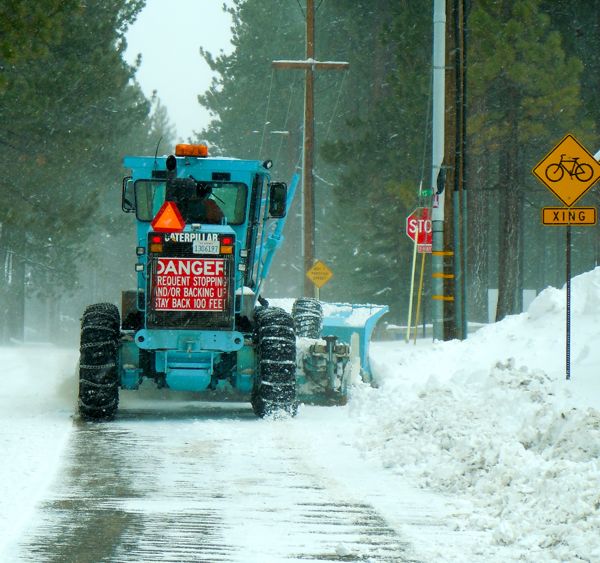
Snowplows are finally being put to work in Tahoe. Photo/Kathryn Reed

A winter storm advisory is in effect for the Lake Tahoe Basin through noon March 1. The heaviest snow is expected to taper off by 10am.

While not much fell over night on the South Shore, snow totals are likely to climb today with 4 to 8 inches forecast below 7,000 feet and 5 to 10 inches above that point.

Winds continue to rage, with sustained blowing at 20 to 30 mph and gusts of 50 mph. The top of the mountains will have wind speeds of 100 mph.

Driving is likely to be dangerous at times with whiteout conditions and snow piling up. For specific road information, click on the state icons on the home page of Lake Tahoe News.

Wind is also going to affect operations at ski resorts, so call ahead to know what is open or check the ski report on Lake Tahoe News that is up by 8 each morning. Mount Rose will be closed today.

The sun is expected to return Friday and be around through the weekend.

— Lake Tahoe News staff report


Tahoe’s clarity — a billion dollar scientific experiment

By Kathryn Reed

Stabilized is the word being used to describe what is going on with the clarity of Lake Tahoe. It took $1.5 billion to get to that point.

That is the amount of money spent, according to the Tahoe Regional Planning Agency, on environmental improvement projects between the inception of the program in 1997 and 2010. In 1997, the depth the Secchi dish, which looks like a white dinner plate, could be seen was 64.1 feet. In 2010 the depth was 64.4 feet.

On Feb. 29 the 2011 clarity data was released, showing a clarity depth of 68.9 feet – or an improvement of 4.5 feet in one year. 2010, though, was the second worst reading since records began to be kept in the late 1960s, having decreased by 3.7 feet from 2009.
It has taken $1.5 billion to stabilize Lake Tahoe's clarity. Photo/LTN file

The back-and-forth nature of the readings amounts to little change in the last decade. In 2000, the disk could be seen at a depth of 67.3 inches.

“We feel it’s positive news because we’re at the point of stabilizing,” Kristi Boosman, TRPA spokeswoman, told Lake Tahoe News. “It would have been a whole lot worse had we not made the investment we did.”

But there is no proof that statement is true.

That money – mostly from the feds through the Southern Nevada Public Lands Management Act – is about to run out. That means another funding source needs to be found. Public-private partnerships are touted as the answer, but what exactly that looks like and who will be in either category remains to be seen.

Lake Tahoe clarity readings: 2011: 68.9 feet (21 meters) 2010: 64.4 feet (19.6 meters) 2009: 68.1 feet (20.8 meters) 2008: 69.6 feet (21.2 meters) 2007: 70.1 feet (21.4 meters) 2006: 67.7 feet (20.6 meters) 2005: 72.4 feet (22.1 meters) 2004: 73.6 feet (22.4 meters) 2003: 71 feet (21.6 meters) 2002: 78 feet (23.8 meters) 2001: 73.6 meters (22.4 meters) 2000: 67.3 feet (20.5 meters) Source: TRPA

“We always have to ask ourselves if we are getting results from the dollars because they are public dollars,” Harold Singer, executive director of Lahontan Regional Water Quality Control Board said. His agency is tasked with managing water issues on the California side of the basin, though Lahontan’s jurisdiction is much greater than Tahoe.

“You can’t tie year-to-year clarity readings to the landscape. You have to look at long-term trends,” Singer told Lake Tahoe News. Otherwise it’s just looking at what was going on that one year instead of at the big picture, he said.

The surprise with the year-over-year improvement was 2011 was a heavy snow year, which in turn created a ton of runoff. This usually means more sediment reaches the lake to cloud the water, with an expected outcome of diminished clarity.

Geoffrey Schladow, director of the UC Davis Tahoe Environmental Research Center, in a statement said, “The factors that contribute to lake clarity are complex, and are not necessarily linked to factors occurring in the current year. Understanding what controls the long-term trends is at the heart of what we are attempting to do.”

TERC along with TRPA released the report.

But one of the problems is no one is sure what is working and what isn’t. For years nutrients like nitrogen and phosphorous were seen as the big bugaboos. Now it’s fine sediment.

While TRPA has come up with a top 10 list of what individuals can do to help with lake clarity, there is no overall top 10 list of projects that could or should be implemented.

No one has identified the top areas contributing to the degradation of lake clarity. The mantra is “urban upland” – or the old developed areas in the basin.

This means that instead of taking a concerted approach to fixing the biggest polluters, the powers that be have cast a broad net to fix the problem. So, the next billion dollars that is spent on lake clarity may not be spent in the most efficient manner because after all of these years no one has prioritized what needs to be fixed to get the best return on investment.

Goals from 2008-18 are outlined on Page 14 of this document. But they are neither specific nor detailed.

TRPA also supplied this information with accomplishments through 2006. It says how the money was spent, not whether it did any good in terms of lake clarity.

Even though the goal of TRPA and the states is to have Lake Tahoe’s clarity be 97 feet by 2076, no detailed plan to reach that goal has been put in place by now. TRPA was created more than 40 years ago with the main emphasis to protect the waters of Lake Tahoe.



S. Tahoe convention center project out of bankruptcy

By Kathryn Reed

The hole – as the 11-plus acre site on the state line in South Lake Tahoe is known – is out of bankruptcy.

After a 4½-hour hearing Wednesday in Sacramento, the judge dismissed the case.

“We are definitely in a better place because we don’t have to get approval from the bankruptcy court (about a project). We hope in the next month or two we would get together (with the property owners) and see where we go,” City Attorney Patrick Enright told Lake Tahoe News.

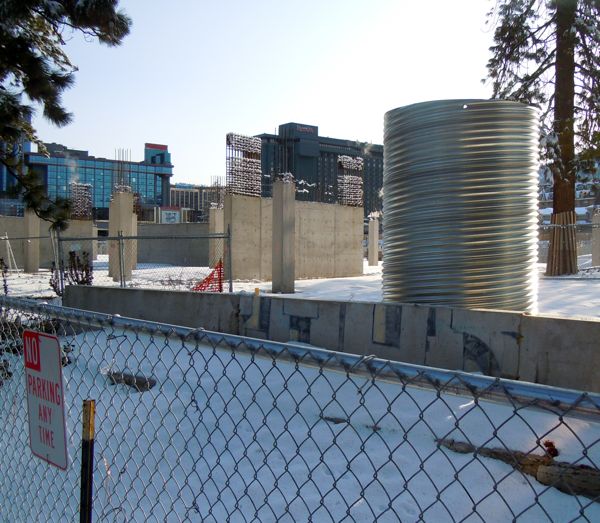
The convention center property is out of bankruptcy as of Feb. 29. Photo/LTN file

Randy Lane, the principal of Lake Tahoe Development Company of Zephyr Cove, was not available for comment Feb. 29.

It is his company that in October 2009 filed for bankruptcy. But it was the City Council two years before that allowed him to break ground without having a final parcel map filed or secured financing in place.

No final map means there are 29 parcels to deal with – most of which are covered with rebar and concrete.

Now four entities own the 29 parcels. Sixteen have been foreclosed on, four are in the process and the remaining nine are owned by Lake Tahoe Development Company, with Owens Financial having the first deed of trust on those nine. This means Owens could foreclose on the properties at any time.

It is now up to the four property owners to figure out what to do with the land. It’s possible one could buy out the others or all could sell to another entity.

While many have said the convention center, two boutique hotels, retail and open space planned for the property across from Heavenly Village on the Harveys side of Highway 50 should be scrapped, that is the project that was approved. Permits would allow for alterations, but not a change to the footprint. It was supposed to be the largest project in the city limits at more than $400 million.

TRPA said the permit expires in nine months. If the next developer has to start from scratch with permitting, it will cost time and dollars.