Tahoe transportation gurus keep trying to connect the lake

By Kathryn Reed

STATELINE – Ten ideas to provide year-round transportation linking the North and South shores have been whittled to three, with two involving ferry service and one a bus route.

Advocates believe a ferry on Lake Tahoe could provide 3,500 daily boardings, operate eight hours a day during the height of summer, take about 45 minutes with a layover of 15 minutes, and make 12 roundtrips a day.

Today, no consistent year-round public transit service exists between the North and South shores.
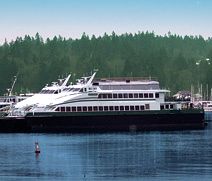
This ferry is what the Tahoe Transporation District shows on its website as a possible boat to ply the waters of Lake Tahoe.

Five community members showed up at a meeting Tuesday night on the South Shore to hear what is going on with water transit on Tahoe. Another meeting is slated for tonight on the North Shore.

Lake Tahoe News asked officials if year-round public transit between the North and South shores is something they want or something the public is demanding.

Alfred Knotts, who is leading the project for the Tahoe Transportation District, said, “We have to show the feds there is public demand.” That is because the feds are funding part of the study and are hoped to be a source of money for whatever alternative is picked.

The Federal Transit Administration has given TTD a $500,000 grant that is paying for this study and the public relations associated with it.

A travel mode survey was conducted in October 2010 that is being used to gauge how locals and tourists move around the Lake Tahoe Basin. That survey revealed 17 percent of the 123,000 daily trips are made between the North and South shores.

The survey also says 81 percent of the daily trips are from full-time residents, while the remaining 19 percent are made by visitors.

It’s mostly tourists who transportation officials believe would use the ferry service.

While buses are one component that will be studied, that aspect of the equation was not discussed at the Tuesday meeting.

Still to be studied is whether a ferry would produce more emissions than these people would spew in a land vehicle. After all, lake clarity is supposed to be the mantra of all entities in the basin.

What’s proposed

Alternatives 1, 2 and 6 are what will be studied. Alternative 1 is direct ferry service between South Lake Tahoe and Tahoe City. Alternative 2 is ferry service between South Lake Tahoe, Tahoe City and Kings Beach. Alternative 6 is bus service between South Lake Tahoe and Kings Beach via the East Shore.

Matthew Taunton with HDR consultants in Phoenix, who is working with TTD on the proposals, said alternative No. 1 would be the cheapest ferry proposal because it only has two terminals.

But he also said at other meetings there is community support for Alternative 2 because it goes more places.

Boats being looked at cost about $11 million, with an operating cost of at least $1.2 million a year.

More analysis will be done on the three ideas to come up with a preferred alternative. After that, the environmental analysis begins on the preferred alternative.

Knotts said whatever idea is pursued will connect with land-based transportation. That includes TART on the North Shore and BlueGo on the South Shore, even though the latter has never had consistent routes and is not used by tourists.

How parking will work, or getting people to ferries remains to be figured out.

It’s expected whatever system is proposed will need to be subsidized – possibly as a public-private venture.

“This would diversify and connect our markets in ways that do not exist,” Knotts said.

Not a new idea

Water transit on Lake Tahoe is not new. It has been talked about at least since 1987. And it has been tried several times. Nothing has stayed afloat for long.

In the early 1990s, Hornblower Cruises ran the Meteor. A Plexiglas cover made winter travel chilly between South Lake Tahoe and Tahoe City. The first trip with skiers was in January 2002.

Ironically, it was named after the historic logging steamer that sank in Lake Tahoe in 1940 after 65 years of service.

A 46-foot double-decker cabin was expected to be the solution in 2003 to transport people between the five marinas operated by Bob Hassett. Now he uses not much more than a dinghy to move people between the South Shore marinas he operates – Timber Cove, Camp Richardson and Lakeside. Hassett started that shuttle in 2002.

Last summer Hassett started a larger boat shuttle between Camp Rich and Meeks Bay.

A 2003 proposal by Caltrans that was adopted by the Tahoe Regional Planning Agency says, “Discussions of a water ferry option generally led to the conclusion that a bicycle water ferry is a unique and potentially viable option for bicycle recreation and transit, but that there are two distinct paths to its development: 1) in terms of bicycle transit, increased bicycle access on ferries and improved ferry stops/service should be part of the broader scope of improving waterborne transit throughout the Tahoe Basin and 2) in terms of a unique recreational activity, a bicycle-only ferry pilot project could be implemented and run by a local nonprofit or bicycle advocacy group.”

In 2005, $8 million was approved by the feds for water transit on Lake Tahoe.

“That was an authorization and not an appropriation, meaning if we meet FTA’s criteria, we could be eligible for an appropriation to fulfill what was authorized,” Carl Hasty, TTD executive director, told Lake Tahoe News on March 6.

South Lake Tahoe’s 2008 draft Sustainability Vision has a goal to “create regular/dependable waterborne transit for residents and visitors.” That hasn’t happened.

The Blue Warrior shuttle on the North Shore in summer 2010 didn’t last long.

A consultant in November 2010 recommended water transit begin the following summer – but that didn’t happen.

Tahoe Transportation District in December 2010 thought it could have some water service functioning this summer.

Fifteen months later, Knotts would not give a date when a ferry might ply the waters of Lake Tahoe.

Funding of this project is nowhere to be found at this time. The California water bond that keeps being taken off the table once was going to help fund waterborne transit at Lake Tahoe. It still could. But some people in this Los Angeles Times article, called that idea “pork”.

——-

 Info:

• Meeting – March 7 at 6pm at 221 Fairway, Tahoe City (the Tahoe City PUD office).

• Alternatives and the PowerPoint from the meetings iare expected to be posted on TTD’s website.


California lawmakers have no problem saying yes to gifts

By Jim Sanders, Sacramento Bee

Finally some good news for California lawmakers who have seen their pay and approval rating fall in recent years: Special-interest perks are up.

Lawmakers and constitutional officers accepted more than $750,000 in food, travel or other gifts last year, shattering the roughly $520,000 received the prior year, according to financial disclosures Friday to the Fair Political Practices Commission.

Gifts ranged from overseas trips and golf rounds to tickets to Disneyland or Sacramento Kings games, with givers consisting of Indian tribes, energy firms, law enforcement groups and many other powerful Capitol players.

The rise in handouts follows several years of belt-tightening imposed by California’s independent salary-setting commission, which has cut lawmakers’ pay from $116,208 to $95,291, eliminated their cars and reduced per diem payments.

Phillip Ung of California Common Cause said the rise in gifts suggests that lawmakers feel no stigma about taking from interests that often seek their votes on legislation.

“It’s disappointing,” Ung said. “Voters send public officials to Sacramento to solve the issues in front of the state, not to cash in perks that special interests hand them. And they seem to be cashing in quite a bit.”

Read the whole story


4 South Tahoe men cited for illegal snowmobiling

While on patrol the night of March 2 officers found fresh snowmobile tracks directly underneath closure signs. One rider fled the scene, abandoning his snowmobile, which was towed and impounded, according the Forest Service officials.

The four snowmobilers, ages 23, 23, 45 and 52, are residents of South Lake Tahoe. They were issued notices to appear before the federal magistrate in Sacramento. Their names have not been released.

If found guilty, each could have to pay a $5,000 fine and be behind bars for six months.

“Respecting closures helps protect natural resources and reduces conflicts between snowmobilers and other winter users,” Cheva Heck, USFS spokeswoman, said in a press release. “Enforcement of closed areas plays a critical role in the Forest Service winter recreation program in the Lake Tahoe Basin.”

This is the second weekend in a row snowmobilers have been cited for riding in a restricted area.

Free maps explaining snowmobiling opportunities in the Lake Tahoe Basin are available from the Forest Supervisor’s Office, 35 College Drive, South Lake Tahoe or by by calling (530) 543.2694, or on the LTBMU’s website.

— Lake Tahoe News staff report


South Bay snowboarder dies at Heavenly

By Kathryn Reed

A 31-year-old Campbell snowboarder died at Heavenly Mountain Resort from what appears to be a medical condition and not an accident on the slopes.

Michael Aron Kvalheim had been riding with his wife when he collapsed on High Five, an intermediate run.

“He had taken a couple tumbles, but nothing significant,” El Dorado County sheriff’s Lt. Les Lovell told Lake Tahoe News.

Lovell said nothing indicates blunt force trauma played a role in the March 3 death. Results from the March 5 autopsy are pending, but Lovell expects a medical condition to surface as to why Kvalheim died.

Kvalheim was wearing a helmet.

Ski patrol was notified about 2:50pm Saturday that Kvalheim was unresponsive. He was taken down the tram to the first aid station at the base of the terminal. Heavenly officials said a doctor from Barton Memorial Hospital pronounced Kvalheim dead at the scene.

This is the third death this month involving people playing in the outdoors in and around Lake Tahoe. On March 2 a Minden man died in a snowmobiling induced avalanche. On March 1 an Olympic Valley backcountry skier died from injuries sustained in an avalanche.


U.S. Indian gaming revenue rises slightly

By Howard Stutz, Las Vegas Review-Journal

Following a one-year slide, gaming revenues produced by the nation’s Indian casino market grew 1.3 percent in 2010 to $26.73 billion, the highest single-year figure ever produced by the segment of the American gambling industry.

The increase came about despite a 2.5 percent decrease in gaming revenues in California, the nation’s largest Indian gaming state, and a 4 percent decline in Connecticut, the third-largest producer of Indian gaming revenues.

“The positives were that you had smaller states carrying more weight and that balanced things out,” said Irvine economist Alan Meister, the author of the Indian Gaming Industry Report produced by Casino City Press. The 10th-annual look at Indian gaming numbers, facts and figures, is being released today.

The numbers cover 2010 because its takes Meister a year to gather the results. State-by-state tribal gaming revenues are not released to the public on a monthly basis as they are for the commercial casino industry.

Meister found that 2010 turned into a rebound year for Indian gaming overall after revenues fell 1 percent in 2009, the first year gaming declined in the Indian market. From 1989 through 2006, Indian gaming typically reported double-digit year-over-year gaming revenue increases.

“In the wake of the Great Recession, Indian gaming, like much of the U.S. economy, showed signs of recovery in 2010,” Meister wrote in the report’s executive summary.

In an interview Monday, Meister said the continued declines in California and Connecticut were offset by marked increases from Oklahoma, up 3.9 percent, and Washington, which reported a 7.5 percent gaming revenue increase.

Read the whole story


Drop in skier visits brings Vail Resorts revenue down

By L. Wayne Hicks, Denver Business Journal

Vail Resorts Inc. Tuesday reported 14.6 percent fewer skier visits to its mountain resorts in the second quarter, which ended Jan. 31, and every other indicator decreased as well.

The Broomfield-based company, whose holdings include ski resorts in Vail, Breckenridge, Keystone and Beaver Creek in Colorado, and Heavenly and Northstar in California, counted 2.9 million skier visits in the quarter, off from nearly 3.4 million a year earlier.

Numbers were down for each of Vail Resort’s revenue streams — mountain, lodging and real estate – pulling the company’s total revenue down to $373.3 million from $395.1 million a year earlier. Vail Resorts posted a profit of $46.4 million for the quarter, off from $54.5 million in the second quarter of 2011.

Rob Katz, CEO of Vail Resorts, said in a statement that the company’s Colorado resorts “have seen the lowest snowfall levels in over 30 years …” He also pointed out that Vail Resorts “reported only modest declines across our major revenue lines in what many would consider a worst-case weather scenario, which followed last season’s record-setting snowfall.”

Read the whole story


NLTRA puts up money to help acquire Tahoe City golf course

Funding for Tahoe City Public Utility District to buy the golf course on the north side of the downtown business corridor is coming together.

North Lake Tahoe Resort Association plans for contribute up to $2.6 million toward the acquisition.

Placer County officials will work with NLTRA on financing options to ensure the golf course contribution does not affect funding for other North Lake Tahoe projects, including the Kings Beach Commercial Core Improvement Project.

TCPUD has an agreement to purchase the golf course for $5 million and is negotiating a final sales price with the family that currently owns the course.

The resort association’s investment would come from transient occupancy tax revenue Placer County collects in North Lake Tahoe and distributes to the association for transportation and infrastructure projects, tourism marketing and visitor information services. Under the association’s TOT agreement with the county, infrastructure expenditures must be approved by the Board of Supervisors.

The golf course site includes five parcels that cover approximately 45 acres, making it the largest land holding in Tahoe City.

A community visioning and planning process will be used to help determine the property’s long-term use.

Tahoe City PUD has lined up several potential partners to help finance the golf course acquisition. Placer County is expected to consider a direct contribution of $100,000 in park dedication fees and $200,000 from its open space fund at a future board meeting.

 — Lake Tahoe News staff report


Identities of twin sisters released

The twin 73-year-old sisters who were found dead in their South Lake Tahoe home last month have been identified as Patricia and Joan Miller.

A definitive cause of death has not been determined, however, foul play has been ruled out.

El Dorado County sheriff’s deputies have released their names in hopes of locating next of kin.

Friends and neighbors have told deputies the sisters were entertainers in the Bay Area, regularly appearing on the weekly television show “The Hoffman Hayride” in the 1950s. They also entertained troops at several military bases. And their mother played the piano for them.

The Millers were originally from Portland. Neither ever married.

Anyone with information regarding Patricia and Joan Miller is asked to contact Detective Matt Harwood at (530) 573.3015.

— Lake Tahoe News staff report


Minden snowmobiler dies in avalanche

By Kathryn Reed

A Minden man died March 2 after his snowmobile was buried in an avalanche in the Blue Lakes area off Highway 88.

Daniel Kuhner, 35, was riding with friends when the sleds triggered the avalanche that was about 150-feet-wide.

Because of the unstable snow his body could not be recovered until the following day. Kirkwood Ski Patrol used explosives to stabilize the area, which in turn triggered a second avalanche in the vicinity of the initial slide.

“Friends snowmobiling with the victim utilized their avalanche beacons, snow probes and shovels to locate and dig out the victim from beneath 3 to 4 feet of snow. The friends rode their snowmobiles back to the Blue Lakes Snow Park to report the incident and that the victim was obviously deceased,” according to the Alpine County Sheriff’s Office.

The avalanche occurred about 3:30pm March 2.

“The avalanche carried him down the slope and into trees. The slide buried the snowmobiler,” according to the Sierra Avalanche Center.

This is the second avalanche death this month in the Sierra. A North Shore man died from injuries he sustained when he triggered an avalanche while skiing in the backcountry near Alpine Meadows.


Casino group fighting gaming tax increase

By Cy Ryan, Las Vegas Sun

CARSON CITY — The Nevada Resort Association, a group of major casino owners, says an initiative petition to raise gaming taxes is confusing and fails to tell the voter the full story.

The petition doesn’t provide any insight into how much money will be generated or who will pay the fees.

The association, represented by attorney Matt Griffin, filed papers on Wednesday in District Court to support its lawsuit arguing that the petition should be declared defective.

Las Vegas businessman Monte Miller filed the initiative petition with the secretary of states office on Feb. 7 to boost the gambling tax on big casinos from 6 percent to 9 percent on gross revenue.

Attorney Maggie McLetchie, a spokeswoman for Miller, said she was “not surprised” and expected the Resort Association would “do all they could to keep this out of the hands of the voters.”

Read the whole story