Mixed verdict for American River canyon restaurant owner

By Carlos Alcalá, Sacramento Bee

An El Dorado County jury on Thursday found embattled restaurateur Kevin Cairns not guilty of any of the three felonies with which he had been charged, but did convict him on five misdemeanor counts,

The mixed verdict was the conclusion of a weeklong trial in which Cairns, who ran a restaurant east of Pollock Pines on Highway 50, was accused of assaulting people in his parking lot on multiple occasions beginning in November 2010.

Cairns acknowledged shaking a stick at one car of people, throwing a traffic cone at another and yelling at a third until they left, but denied his behavior was illegal.

The jury found Cairns not guilty of felony assault in two of the cases, but found him guilty of misdemeanor assaults.

Likewise, jurors found him not guilty of felony vandalism, for striking a truck with a stick, but guilty of misdemeanor vandalism.

Cairns was also convicted of misdemeanors of disturbing the peace and exhibiting a deadly weapon, the stick he had brandished.

Those convictions carry possible sentences of up to a year in jail.

Read the whole story


Snowboarder dies at China Peak resort

By Alex Tavlian, Fresno Bee

A 30-year-old man died at China Peak Ski Resort after falling head-first into deep snow on the slopes, resort officials said Sunday.

The man was snowboarding alone on one of the slopes when he fell head-first into deep snow and suffocated, China Peak owner and general manager Tim Cohee said. Another visitor to the resort saw the base of the man’s snowboard sticking out of the snow and pulled him out a few minutes after he fell in.

“It’s tragic,” Cohee said. “You have to be careful in this snowfall. That’s why we always tell people to go with a buddy.”

The death is the first of the year at China Peak, he said. A similar accident occurred at the resort last year, in which another snowboarder fell into deep snow head-first.

Sheriff’s deputies are investigating the accident, Fresno County Sheriff’s Lt. John Reynolds said. The Fresno County Coroner’s Office was also dispatched to the resort.


DA investigating El Dorado County fire chief’s credit card habits

By CBS13

CBS13 has learned that Garden Valley Fire Chief Bill Dekker is under investigation by the El Dorado County District Attorney’s Office.

In an interview with CBS13, District Attorney Vern Pierson told On The Money he has opened a criminal investigation focusing on the fire chief’s purchases on the fire department’s credit card.

CBS13 has obtained copies of the questionable credit card billings, which include $3,400 in charges to something called Willingness to Change – a drug and alcohol treatment center – according to the website.

The billings came from Bill Dekker, on the Garden Valley Fire Department’s credit card.

“I’ve never seen anything like that in my 17 years as county auditor,” said Joe Harn, El Dorado County’s fiscal watchdog.

Harn has been scrutinizing the Garden Valley Fire Protection District’s spending and credit card purchases.

“I don’t understand why it would be the burden of the taxpayers in Garden Valley to pick up this $3,400 charge for alcohol and or drug counseling,” Harn told CBS 13.

Read the whole story


Lake Valley may absorb South Lake Tahoe Fire Department

By Kathryn Reed

South Lake Tahoe residents may no longer have a fire department to call their own. That is because talks are under way for the city department to be run by Lake Valley Fire Protection District.

Lake Valley, which is overseen by a five-member board, voted this month to proceed with a consolidation feasibility study of the two fire departments. South Lake Tahoe City Council members are slated to vote March 20 to go forward with the same study.
Lake Tahoe News furnished a slew of questions to both entities. Both agencies said they would not answer those questions until the council votes Tuesday and/or until the study progresses.

“We are probably looking at least a four- to six-month process to study the pros and cons of this,” City Manager Tony O’Rourke said.

Financial issues

Lake Valley has three sources of revenue – property taxes, developer fees and Measure M. The latter is a June 1986 voter approved tax that charges property owners $10 or $20 per year depending on whether a structure is on the parcel.

If the merger goes through, it is unknown how the new LVFPD would be funded, or how the discrepancy of some members of the service district being taxed and others not being taxed would be rectified.

Property taxes are the department’s primary source of income.

City residents don’t have a separate fire tax or fee. The fire department’s annual budget is $5.7 million, according to the city’s website. This comes out of the general fund, which gets its dollars primarily from property, sales and hotel taxes.

Lake Valley Fire Chief Gareth Harris in a letter dated March 8 to the City Council proposes the city use property tax dollars to fund its share of fire services for its residents to the tune of $6.526 million.

What the additional $800,000 the city would pay for compared to what is in this year’s budget is unknown because Lake Valley and the city are not answering questions. Nor is it known what other services might be cut by the city to make up this difference.

The city, though, is saving money this fiscal year by having the police chief take on the roll of fire chief, too. The council also eliminated the three battalion chief positions and is contracting with Lake Valley for fire marshal services.

Harris in his letter says he came up with the figure by taking 16.7 percent of 1 percent of the 2011-12 assessed tax roll of city properties that total $3,903,077,660.

Harris’ budget outline in his letter says to cover the city’s fire expenses it would take $6,999,5000.

What isn’t known is if the city were to pay $6.526 million as Harris suggests, if county residents are then subsidizing city fire costs to the tune of nearly a half million dollars.

Some particulars

O’Rourke told Lake Tahoe News, “We are looking also at different spectrums from contracting to a JPA to a full consolidation. We are going to look at it from multiple angles.”

However, the letter from Harris, which is included in the city’s fire consolidation staff report, has some specific details about how his department would be taking over the city department. He goes so far as to detail how the city would need to pay one-time startup costs of $787,000 that would pay for new uniforms for city firefighters, stationery, station signage and vehicle insignias.

The bulk of that figure — $534,000 – would be to buy out city employees’ sick, comp and vacation time.

In that total figure is $5,000 for public relations; what that entails is a mystery as well.

It is also not known where that one-time fee would come from.

Equipment upgrades are part of what’s being talked about.

Harris’ letter states, “This proposal also includes the replacement of two of the city’s first out fire engines and the ladder truck. This will be accomplished by a financed lease/purchase of the apparatus. In addition, both Station 3 and Station 2 will be remodeled and updated to accommodate the new ladder truck and meet current fire station design codes and requirements.”

The board of directors, according to Harris’ letter, would remain intact, with “residents of South Lake Tahoe … eligible to run for a seat on the board of directors at the next fire district election just like any other resident in the unincorporated county area.”

According to a clearly not updated Lake Valley fire website, the board of directors and their terms are:

• Dave Huber, Dec. 1, 2006-Dec. 3, 2010

• Robert Bettencourt, Dec. 5, 2008-Dec. 7-2012

• Gregory Herback, Dec. 5-2008-Dec. 3, 2010

• Robert Rossi, June 10, 2010-Dec. 3, 2010

• Ryan Wagoner, Dec. 5-2008-Dec. 7, 2012.

A little history

Lake Valley fire has been in existence since 1947. Most people think of it as the area serving Meyers. It covers approximately 83 square miles.

South Lake Tahoe’s department was formed in 1965 when the city was incorporated.

“They actually wanted to be part of the city. They were in the city boundaries at the time,” Laurel Ames said of the firefighters.

Ames was one of six members on the city’s incorporation committee. (The others were Wink Ames, Tom and Betty Mitchell, and Vaughn and Mary Burlingham.)

“When we incorporated we were controlled by very strict state incorporation laws,” Ames told Lake Tahoe News.

The only real leeway was with the boundaries. With no money to pay a surveyor, known landmarks were used. But it took court action (Ames v. County of El Dorado) and precedent setting law to figure out how to count landowners.

Ames said the ruling came out in their favor which said whoever was legally allowed to sign for all the other members became in name the landowner of the lot for incorporation purposes.

Another person involved with the early years of South Lake Tahoe said a reason to incorporate was to “control our own destiny”. Incorporation was tried three times – though not all came to a vote – before it was approved.

Now the destiny may change without the voters having a say.

That’s another of those unanswered questions – if the voters of either jurisdiction would have a say in the fire department consolidations or if the two governing boards have ultimate authority.




California candidates set to battle in new political landscape

By Jean Merl, Los Angeles Times

Filing has closed, the candidate lists are final and the curtain has risen on California’s reconstructed political stage, where the contests for 153 congressional and legislative seats will play out for the first time under new rules and in altered districts.

Look for intraparty fights that will last into the November runoffs, a likely lack of third-party candidates on the fall ballot and, possibly, a larger number of contested seats, compliments of a new primary system and a redrawing of political maps that did not seek to protect incumbents.

Voters authorized the two new wrinkles in this year’s elections. In 2010 they approved Proposition 14, which requires that all candidates, regardless of party, appear on a single ballot received by all voters. Only the candidates who finish first and second in the June 5 primary will move on to the Nov. 6 general election, all but eliminating the chances of most third-party candidates, who used to be granted a spot on the runoff ballot no matter how poorly they fared in the primary.

In 2008, voters stripped the Legislature of the responsibility for redrawing political boundaries for state Senate, Assembly and Board of Equalization seats and gave the job to an independent citizens commission. Two years later, voters added California congressional districts to the commission’s task.

The citizens group was charged with adjusting boundaries for population shifts since the previous census, and was prohibited from taking into account a lawmaker’s home and voter registration — rules aimed at eliminating the gerrymandering that the Legislature had done to protect incumbents.

Read the whole story


Sac County man dies at Sierra, avalanche injures Kirkwood skier

Updated: 9:45pm March 18, 2012

By Kathryn Reed

One person died and another was seriously injured at two Lake Tahoe area ski resorts March 18.

Yiwei Hu, 54, of Gold River died at Sierra-at-Tahoe, according to El Dorado County sheriff’s deputies, after he fell into a deep hole created by an underflow of water in the Castle Creek area.

“When patrol arrived (at 1:20pm) they initiated life-saving procedures, but were unable to resuscitate the skier,” Sierra spokesman Steve Hemphill told Lake Tahoe News.

Castle Creek is in the trees off Castle run, which is accessed from the Grandview chairlift.

While Tahoe resorts have received multiple feet of snow in less than a week, tree skiing has been sketchy at best until now. It has been snowing all day at Sierra.

At Kirkwood Mountain Resort an avalanche occurred in Sentinel Bowl at 2:14pm. This area is in-bounds. One person was able to ride out to alert ski patrol of the slide, while his friend was trapped.

With snow falling all day, helicopter transport was not an option. Lake Valley paramedics brought the person, whose name is not being released, to Barton Memorial Hospital. Alpine County Sheriff’s Department said they would not release details until Monday.

Michael Dalzell, spokesman for Kirkwood, said he does not have details on the slide and it has not been classified.

The Sierra Avalanche Center rated the slide danger as moderate for Sunday.

Dalzell said Chair 6 was closed as soon as the avalanche was reported. Crews worked in the area to test the snow stability, with the all clear coming at 4:33pm.

Kirkwood in the last 24 hours received between 12 and 18 inches of snow, with nearly 5 feet in the last week.


Nevada adds fee for home-based businesses

By Sean Whaley, Nevada News Bureau

CARSON CITY – A regulation requiring thousands of home-based businesses to pay a $200 annual fee won approval from a legislative panel.

Secretary of State Ross Miller has been trying to get the regulation approved for several months, but has seen the regulation stymied by strong opposition from some Nevada residents and Republican lawmakers who argued the regulation exceeded his authority.

The regulation affects home-based businesses operating as limited liability companies and corporations that earn less than $27,000. It does not apply to individuals operating businesses out of their homes.

The Legislative Commission’s Subcommittee to Review Regulations, made up of four Democrats and two Republicans, approved the regulation on a party-line vote. The same subcommittee deferred action on the regulation in December, sending it to the full 12-member Legislative Commission for action.

That panel, made up of an equal number of Republicans and Democrats, failed to act on the proposed rule at a meeting on Feb. 15.

The subcommittee took up the regulation again this month. The approval means the regulation can now take effect.

Sen. Michael Roberson, R-Las Vegas, a member of the subcommittee, asked how Miller could be given the authority to collect the fee from a new class of businesses since there is no clear legislative authority to do so.

“That’s been my argument, that we are now forcing home-based businesses, including people who sell Tupperware or whatever product or service, even though they don’t open their home up to the public; they now have to make the difficult choice of waiving the legal protection of our LLC statute or facing this tax increase,” Roberson said. “And I do not think this is the time in our economy in this state to be doing that, and putting those smallest home-based businesses in that difficult position.”

Roberson said the panel should request an official written opinion from Attorney General Catherine Cortez Masto on the issue before taking a vote.

But Assemblywoman Debbie Smith, D-Sparks, said lawmakers rely on their own legal counsel and that she was comfortable with the advice from Legislative Counsel Brenda Erdoes that the approval of the regulation on a simple majority vote was proper.

Erdoes said the panel did not have the authority to request such an opinion from the attorney general.

Roberson then asked Miller to request the legal opinion, saying there appeared to be confusion as to what the attorney general’s office position is on the issue.

The regulation will require home-based businesses that are on file with Miller’s office as limited liability companies and corporations to pay the business license fee. The companies had previously paid the fee, but an interpretation provided to Miller’s office by a deputy attorney general in 2009 had exempted them from paying the fee. Miller said that interpretation was a mistake.

The action by the legislative subcommittee was condemned by the group Nevada Families/Eagle Forum.

“This regulation is taxation by regulation,” said Janine Hansen, in a statement on behalf of the organizations. “The process violates the Nevada Constitution which requires a two-thirds vote of the Legislature to impose a tax, and it violates the separation of powers.”

“It is appalling that Ross Miller would seek to impose, by regulation, what he could not get through the Legislature,” Hansen said.

She was referring to Assembly Bill 78, which was approved by the Legislature in the 2011 session but never made it to Gov. Brian Sandoval for his signature.

Erdoes told the subcommittee that there was no two-thirds vote requirement to approve the regulation. The two-thirds requirement applies to the Legislature, not the subcommittee, she said.

Erdoes said a bill passed in the 2009 session, approved with a two-thirds majority, gave Miller’s office the authority to adopt regulations needed to collect the fee. The failure of AB78 to win approval in 2011 has no effect on the regulation, she said.

Following the vote, Miller said: “My office will be enforcing the home-based business exemption in accordance with the original intent of the Legislature, which will level the playing field for the many businesses that have been compliant and paying the appropriate fees.”

The regulation clarifies that the home-based business exemption applies only to natural persons, i.e. sole proprietors or general partnerships who meet the requirements of the exemption.


PG&E fined for El Dorado fire

By Denny Walsh, Sacramento Bee

Once again, human error has cost Pacific Gas and Electric Co. millions of dollars.

It was announced Thursday that the utility giant and two companies working for it paid $29.5 million to the federal government to settle lawsuits over two forest fires in 2004.

The old bugaboo of carelessness combined with high-voltage power transmission lines caused the fires in national forests, this time in El Dorado and Trinity counties.

Since 2009, PG&E has shelled out at least $16 million to state and federal governments in connection with wildfires.

“These fires cause lots of damage, and some of the harm cannot be remedied with money,” said U.S. Attorney Benjamin Wagner in announcing the most recent settlements at a Thursday news conference.

Read the whole story


STPUD ratepayer info to remain confidential

On a 4-1 vote, the South Tahoe Public Utility District board decided not to release ratepayer information to the Citizens Alliance for Responsible Government.

John Runnels, one of the most vocal members of the group, in January first approached the board about wanting addresses for water and sewer customers. The voted was pushed out to March 15 when all five board members would be present.

Runnels spoke at the meeting this week for the need to be able to deliver unbiased information to ratepayers, saying what comes from the district is tainted.

In particular Runnels and his group want to send info to ratepayers about Proposition 218 – the state law that mandates public utility districts notify customers when rates may be increasing. Such a notice will be in the mail to STPUD customers next week. Runnels has called  the district’s information proganda.

Also speaking at the meeting Thursday for the need to release the ratepayer info was John Cefalu. It was his son and board member Chris Cefalu who was the lone vote to release the data.

“The law requires that for an agency to release customer data they must make the finding that the public benefit must clearly outweigh the negative and the board could not make that finding,” Dennis Cocking, South Tahoe PUD spokesman told Lake Tahoe News.

In the past Runnels had publicly stated the district intentionally provided misinformation. He was asked to provide the documentation. He was unable to do so.

— Lake Tahoe News staff report


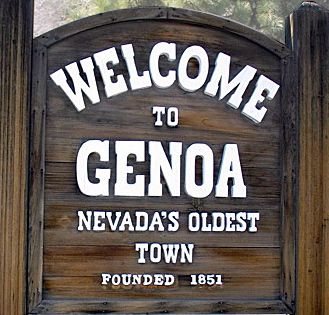
Nevada’s oldest town strives to keep its roots as it changes

By Anne Knowles

The more things change, the more Genoa wants to stay the same.

That’s the idea, so to speak, behind Destination Genoa, the project to update Nevada’s first town while maintaining its historic integrity and appeal.

The project is a key piece of Douglas County’s economic vitality plan, the county’s nearly 2-year-old, 12-pronged strategy to jumpstart its economy.

“We refer to Genoa as the glue or the hub,” said Dave Whitgob, chair of the Genoa Town Board and designated “champion” of Destination Genoa. “We have committed to make a collaborative effort to draw attention to South Lake Tahoe, Minden and Gardnerville as well.”

Whitgob heads up the Destination Genoa team, which he has affectionately dubbed the “posse,” that includes Randy Falcke, Chad Coons, Dan Aynesworh, Genoa Town Manager Sheryl Gonzales and Lisa Granahan, Douglas County economic vitality manager.

The project is being funded with more than $1.5 million from Douglas County’s Redevelopment Agency as well as money from the town and private donations. It consists of several pieces, some of which, like the 1.3-mile trail between David Walley’s Hot Springs Resort and the center of town, should be done by year end. The biggest piece – the downtown improvement project – is nearing design completion and is slated to break ground this summer with a ribbon cutting in spring 2013.

The goal is to bring to town more businesses and more tourists. At an update on the economic vitality plan last month, Aynesworth said the town has recently added seven businesses, including three restaurants, a 46 percent spike, while room nights recently went up 6 percent.

Destination Genoa takes elements from previous plans, such as the 10-year-old Genoa Main Street Master Plan, that for one reason or another never got off the ground.

“The difference is all the work Sheryl (Gonzales) did to coordinate public outreach,” said Whitgob, which got nearly everyone in town on board this time.

That outreach included two public meetings with public comment as well several meetings with the historical commission and ongoing dialog with the town’s businesses. Last fall about two dozen people showed up to take a walking tour outlining the plans.

The downtown improvement project is being designed by Sandra Wendel & Associates, a landscape architect in Gardnerville, and Resource Concepts Inc., a civil engineering firm with offices in Carson City and Zephyr Cove. Gonzales said the design would be completed within weeks, then permits would be applied for and the various pieces would go out to bid, with the goal of breaking ground sometime this summer. This is an artist rendering of what may occur.

The downtown face lift includes new streetlights, walkway, signage and parking.

Six to 10 reproduction streetlights will join a handful of existing historic lights downtown. The lights have to be custom made, despite availability of some old ones, to comply with Nevada Department of Transportation’s “dark skies” rules which require that the lights do not reflect back into the sky, obscuring views of the night sky and stars.

A new, 4- to 6-foot cobblestone walkway will begin at the southern end of town and run to at least Candy Dance Lane, Gonzales said. The walkway will meld with the 8- to 10-foot Walley’s Trail made of asphalt.

Landscaping using all native plants, signage and some seating will be placed on Mill and Nixon streets to create corners.

“The southeast corner of Main Street and Genoa Lane with the island with the utility and light will go away and that will become a four-way intersection,” Gonzales said.

A non-asphalt parking lot will be added at the north end of town, where the county owns the right-of-way, as well additional designated parking will be created by finishing off the rough edges of Nixon, Mill and Carson streets.

In addition, at least three informational kiosks will be placed around town to help guide visitors to local businesses and sites.

The town has spent $20,000 and is working with Nevada Energy and affected businesses to take down four electrical poles and run the utilities underground.

The Walley’s trail, made possible with easements granted by Walley’s, should be open by Candy Dance, the town’s signature event every September, which brings in the bulk of the revenue that funds the town’s annual budget.

A separate project by The Nature Conservancy will double the length of that trail, extending it to the conservancy’s Whit Hall Interpretive Center on Genoa Lane. In May, the Carson Valley Trails Association expects to open 16 miles of trails called the Genoa Trail System, including the Discovery Trail and the Sierra Canyon Trail, a 9.6 mile trail that connects to the Tahoe Rim Trail.

Private entities are working on other Destination Genoa pieces. The nonprofit that manages the town’s cemetery is working on a beautification project being funded by Sparks casino owner John Ascuaga. And a new town sign made of a covered wagon is being paid for by the Greater Genoa Business Association with the cover being made and donated by North Sails, the Minden-based sail manufacturer. The sign should be installed just off Highway 395 by the town’s third annual Cowboy Poetry & Music Festival in April.