Study: Water supply will add to world’s instability

By Renee Schoof, McClatchy Newspapers

WASHINGTON – Floods and water shortages in the next 30 years will make it hard for many countries to keep up with growing demand for fresh water, particularly in South Asia, the Middle East and North Africa, the U.S. intelligence community reported Thursday.

Water problems in the next decade will add to instability in countries that are important to U.S. national security, the report said. Floods and shortages also will make it hard for some countries to grow enough food or produce enough energy, creating risk for global food markets and slowing economic growth.

“I think it’s fair to say the intelligence community’s findings are sobering,” said Secretary of State Hillary Rodham Clinton, who requested the report last year. “These threats are real and they do raise serious security concerns.”

Clinton, speaking at an event to mark World Water Day, announced a new U.S. Water Partnership, made up of private companies, philanthropy and advocacy groups, academics and government. The group will coordinate efforts to solve water problems and make U.S. expertise more accessible.

Read the whole story


Permanent location to rehab wildlife in LTWC’s sights

By Kathryn Reed

MEYERS – If it’s true getting a step in the door is the hardest part to realizing a dream, then that step may have literally been taken this month by the Lake Tahoe Wildlife Care board of directors based on where they conducted their meeting.

They met in a house at the bottom of the Old Meyers Grade in what is now a vacation rental. But that nearly 3,700-square-foot house on those 16-plus acres that back up to U.S. Forest Service property is on land zoned recreational/commercial and comes with 130,000-square-feet of coverage. That could make all the dreams of the Millhams come to fruition.

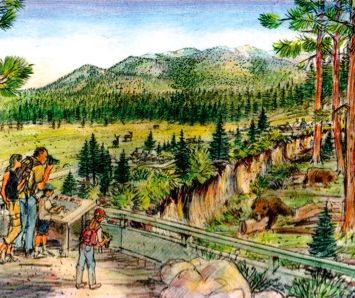
A conceptual drawing of what the bear facility at Lake Tahoe Wildlife Rehabilitation and Education Center could look like.

For 34 years, Tom and Cheryl Millham have been operating the animal rehabilitation center. The animals are in cages in their back yard. They function with a special use permit from El Dorado County.

They are tired. They want to enjoy their retirement by not being tied to the phone to rescue animals, care for them and then release them.

While in many ways they are a mom-and-pop operation, Cheryl Millham’s knowledge is coveted. She is often asked to be a guest lecturer. She knows how migration patterns have changed over the decades; she knows what animals were here 30 years ago are no longer here. She is a wealth of information.

The Millhams work closely with the state Department of Fish and Game, especially with bear releases. Another cub is slated to go back into the wild this week near San Luis Obispo.

But the Millhams have had their dreams dashed before. Parcels have come and gone as possible locations. Not only do they want to move their operation, but also expand it to include a larger education center, a place to have conferences, and a sanctuary to let the animals that cannot be released call home.

The board is hoping this was the first of many meetings in a permanent home.

“This is the closest now to having a done deal,” Tom Millham told Lake Tahoe News. And even now the deal is far from being done.

Before the nonprofit is on the deed, the money needs to be secured for the property that is listed at $1.99 million. This is less than the $5 million the owners wanted in 2007.

“They are open to being creative,” Rene Brejc, who is listing the property, said of the trust that owns the property.

Tom Davis, who is on the LTWC board, pointed out that how the center has operated for the past 34 years is not how will be able to operate in the next 34 years. He said veterinarian officials from UC Davis have expressed an interest in having a teaching component at the center about wildlife.

Talk that night was about how perhaps a foundation or investors need to be sought and a significant fundraising drive initiated.

Beyond the payment for the property, significant improvements need to be made – from parking, to building cages, to upgrading the water system.

The property now uses a well, but with the type of facility the Millhams envision, officials would require the center serviced by South Tahoe Public Utility District. This would help it better comply with fire regulations as well.

Jumping through county and Tahoe Regional Planning Agency hoops could be problematic. Preliminary discussions with both agencies have taken place.

There have been meetings where planning officials have said they worry about how much soil a 300-pound bear will compact at the wildlife center. This, despite the fact that bears and other wildlife roam the woods everyday without any apparent degradation to Lake Tahoe’s clarity. And plenty of hefty people compact soil, too, and they aren’t told to stop doing that.

El Dorado County Supervisor Norma Santiago, who was at the board meeting, said she would not let the county be a stumbling block. She is also on the TRPA Governing Board.

Julie Regan with TRPA, when contacted by Lake Tahoe News, said, “It’s important to find a solution that works. (LTWC) is an important community asset. When El Dorado County brings forward their local area plan, I’m sure they would want to look at what land use changes would come after the adoption of the Regional Plan.”

While other places have facilities like what the Millhams and the LTWC board envision, one does not exist in the Lake Tahoe Basin.

Mike Dill with Aspen Environmental Services along with the Millhams has met with TRPA and county officials. Issues like needing to fence the entire property could be a stumbling block. The fact that TRPA does not allow accessory uses for entities falling under “public health and safety” is another issue. The building permit expires this fall.

It has been agreed a bridge that would hold the weight of a golf cart could be built across Echo Creek.

Despite the hurdles, the Millhams, board members, the consultant, the county supervisor and the real estate agent agreed on two things – Lake Tahoe Wild Care would not close and a solution would be found.


LTUSD on verge of creating winter sports academy

By Kathryn Reed

Prom, football games, hanging with friends, a diploma. In part, that’s what high school is all about.

But in Lake Tahoe, where some of the world’s best skiers and snowboarders call home, they don’t have those high school memories because they were on the slopes more than they were in the classroom. And some leave town to be able to get the training and education they want. That all might change for the next generation of Olympians and X Games competitors who hail from the South Shore.

On Tuesday night, the Lake Tahoe Unified School District board of education will have a one-hour study session about creating the South Lake Tahoe Mountain Sports Academy, with a vote to be taken later that night.

LTUSD expects to partner with Sierra-at-Tahoe, and Tahoe Sports and Entertainment, owners of the South Lake Tahoe Ice Rink.

(Board member Judy Cefalu won’t be able to vote because her son, Chris Cefalu, is president of Tahoe Sports and Entertainment.)

The idea would be to create a schedule for students where they are at South Tahoe High School in the morning and on the slopes or ice in the afternoon.

“We have had to send a few of our alpine racers to Sugar Bowl to balance their education,” John Rice, general manager at Sierra, told Lake Tahoe News. This program would keep them on the South Shore.

Sugar Bowl is the closest academy, with one near Vail and others on the East Coast.

Sierra has a proven history of turning out world-class athletes – Travis Cabral, Travis Ramos, and Jamie and Joanie Anderson, to name a few.

Moving, ditching classes or home schooling are the choices skiers and snowboarders have today.

Maddie Bowman, who will lead the Pledge of Alliance at the March 27 meeting, is the rare exception of being a world-class athlete (silver in the superpipe at this year’s Winter X Games and second overall in the Dew Tour rankings) and skiing for the high school team.

LTUSD Superintendent Jim Tarwater said parents and students for years have been asking for an academy.

“The timing is right. We have the strong educational facilities,” Tarwater said in reference to the infrastructure and associated programs that have come with the 2008-voter approved Measure G.

The academy, which could be running by the start of the 2012-13 school year, would come under the district’s alternative education program. Amy Jackson would likely be the counselor for the students. Between 20 and 30 kids are expected to enroll initially, with it growing from there.

It’s anticipated students from the West Slope and Sacramento area may also be initial registrants. The district does not foresee getting into the business of housing academy kids.

While the cost of the programs is not finalized, the district will neither make money nor incur additional costs. But it will realize average daily attendance dollars – the way California schools receive money from the state.

Rice expects the ski-snowboard program to cost less than $10,000 per year. Tarwater said the hockey academy will be closer to $15,000. (Neither Chris Cefalu nor Van Oleson of TSE returned a phone call.)

Incorporated into the fee will be the cost of busing students to their training locations and back.

Rice provided the following rough schedule for student-athletes:

Fall: September-November (first quarter)

Conditioning begins school calendar year

Baseline physical condition test (possibly tie into sports medicine component that will open at STHS in fall 2013)

Winter: December-January (second quarter)

Daily on mountain training

Events as qualified and registered

Spring: January-March (third quarter)

Daily on mountain training

Events, competition

Summer: March-June (fourth quarter) (resort closes mid-April)

School sports medicine lab, media

End of season progress report, summer training plan

Voluntary participation: social events, soccer, volleyball, beach days.

Tarwater said by breaking the academy into quarters it will mean being able to compress some of the academics during the time when the slopes are bare.

Another component could be to integrate various aspects of the high school curriculum into the academy – for instance having students interested in digital media film the racers and tying in sports medicine classes.

Rice envisions working with Lake Tahoe Community College on backcountry awareness for academy students. He also anticipates this type of academy helping athletes secure scholarships to compete at the college level.

Meeting info: Study session about the proposed academy begins at 5pm March 27. A vote on the proposal is farther down on the agenda. The meeting is at the district office on Al Tahoe Boulevard in South Lake Tahoe.



USFS in legal fight over coverup of employee who may have used pot

By Denny Walsh, Sacramento Bee

The Moonlight Fire was the U.S. Forest Service’s worst nightmare.

For two weeks in September 2007 it raged like a fire-breathing dragon across 65,000 acres in Plumas and Lassen counties, devouring everything in its path, including 46,000 acres of lush national forest.

But there is an additional troubling dimension to this catastrophe, one that, like the fire itself, still haunts the Forest Service. From the start, there was a recognition of potential legal complications if it became known that a Forest Service patrol officer claimed another agency employee may have been smoking marijuana while he manned the lookout tower closest to the site where the fire started.

That fear has now been realized. A timber company being sued for causing the fire has filed documents in court that reveal the government tried to cover up the claim, causing dissension within the Forest Service.

Long before the devastating wildfire was contained, federal and state investigators were satisfied that a bulldozer belonging to a company harvesting timber for Sierra Pacific Industries hit a rock and a spark flew into dry duff on private property.

Sierra Pacific and the logger, Howell’s Forest Harvesting, strongly dispute that.

The final report on the fire, publicly released on June 30, 2009, included no mention of suspected marijuana use by the Red Rock lookout the day the fire started.

In court papers, Sierra Pacific lawyers describe the report as “completely sanitized.”

Read the whole story


Drug giant settles its CalPERS probe that involves Stateline man

By Dale Kasler, Sacramento Bee

Caught up in the CalPERS bribery case, a drug-benefits supplier will pay $2.75 million to settle an investigation into its dealings with the man at the heart of the scandal.

Medco Health Solutions of Franklin Lakes, N.J., agreed to the settlement Friday with California Attorney General Kamala Harris. The company didn’t admit any wrongdoing and said the settlement was helpful “in clearing Medco’s good name.”

Company spokesman Lowell Weiner and the AG’s office said the settlement amount represents the state’s cost to investigate.

“There has been no finding that anybody at Medco did anything wrong at any time,” said Weiner.

Still, the company’s decision to hire Stateline businessman Alfred Villalobos – the man accused of bribing CalPERS officials – was costly.

It destroyed Medco’s lucrative relationship with Cal-PERS and may have prompted other clients to drop the pharmaceutical giant.

Medco agreed to be sold last summer.

As for CalPERS, the settlement marks the latest chapter in a scandal that has dogged the nation’s largest public pension fund since 2009.

Read the whole story


Teens told to pay restitution fine in Ray May Fire

Two 15-year-old boys have been ordered to pay $10,000 in restitution fines for starting the Ray May Fire.

The August fire burned 3,628 acres south of Gardnerville and caused more than $2.8 million in damage.

Earlier the judge had sentenced the teens to probation and ordered them to do 500 hours of fire-related community service.

— Lake Tahoe News staff report


Consolidated Reno-area fire departments going their separate ways

By Brian Duggan, Reno Gazette-Journal

Reno officials continued to push on Wednesday for a “regionalized” fire service plan that fell apart when it was presented to Washoe County Commissioners last month.

That $45 million plan would have consolidated fire services in Reno, the Truckee Meadows Fire Protection District and the Sierra Fire Protection District under an independent fire board and reopened all labor contracts with firefighters if the county and city agreed to it.

Commissioners ultimately nixed it, saying they couldn’t live with the plan’s $2.1 million deficit closed by reducing payments to the county’s fire services reserve funds.

Reno Fire Chief Michael Hernandez said while the plan wasn’t perfect the fact that labor contracts would be renegotiated would result in cost savings.

“Every single article is on the line and that’s where management and the financial analysts sit with the bargaining groups and say this is the pot of money that we have,” Hernandez said. “We have to live within our means.”

Dennis Jacobsen, the president of the International Association of Fire Fighters Local 731, agreed every article would be open to negotiation because the fire fighters would be creating a new agreement with a new fire department.

“We would certainly want to maintain our benefits and rights to our members that we’ve worked so hard on, but we would also look at it with an eye of sustainability,” Jacobsen said. “We understand that.”

Meanwhile, the news conference on Wednesday marked latest salvo in the ongoing divorce between Reno and Washoe County.

Since 2000, the county has paid the city about $11 million a year to provide fire services in the Truckee Meadows Fire Protection District made up of county neighborhoods that surround the city.

That agreement will come to an end on July 1 when the county is expected to stand up its own fire department.

Read the whole story


Study scrutinizes Nevada’s ‘green’ jobs initiatives

By Sean Whaley, Nevada News Bureau

A report questions the value of tax incentives and regulations approved by many states around the country, including Nevada, to create “green jobs,” noting that subsidies used for such programs can take away revenue for other needs such as public education.

“States face a hard and fast budget constraint; they cannot deficit spend or take on debt for general operating expenses,” said Bryan Leonard of State Budget Solutions in his report, “Green Jobs Don’t Grow on Trees.”

“This means that every dollar spent by states on green job training programs, grants to green firms, or subsidies for renewable energy producers is a dollar that cannot be spent on teachers’ salaries, educational tools, or social safety nets,” he said.

“Our study showed that green programs are incredibly expensive for states who aren’t in a position to know which investment will pay off and which won’t,” said Bob Williams, president of State Budget Solutions.

Nevada State Office of Energy Director Stacey Crowley said she doesn’t necessarily agree with all the views of the article, but she noted that two of Leonard’s recommendations – to use Energy Service Companies (ESCOs) and allow for renewable power purchase agreements – are both being used in Nevada.

Private sector ESCOs contract to come into a client’s operation and find opportunities for energy savings, pay for the necessary renovations, and then receive some contracted portion of the resulting energy savings as compensation. Renewable power purchase agreements use private firms to install solar panels on a host’s property and the host purchases the resulting solar power at a contracted rate usually set at or below prevailing energy rates. The contracted firm bears all the cost and risk associated with the installation and maintenance of the solar equipment.

“It goes to show you that we are looking at as many options as we can to try to get projects funded in innovative ways that don’t use taxpayer money,” Crowley said. “It is a problem we need to try to address. And that is trying to get all energy projects, clean energy projects, done in a way that has the least impact on ratepayers and taxpayers as possible. So that’s a goal that I think everybody can agree on.”

The State Budge Solutions report examines each state’s green jobs statistics, including Nevada, where Leonard identified seven separate financial incentives for green jobs. Three of the seven are property tax exemptions.

Nevada also received just over $1.1 billion for “energy and environment” projects from its federal American Recovery and Reinvestment Act funding.

Leonard said Nevada came in 11th among states for such projects, meaning there has been a lot of investment by the federal government in green jobs in the state compared to others.

Nevada has also established a goal of having 25 percent of its energy consumption coming from alternative energy by 2025.

Leonard said the average number of financial incentives is eight per state, with New York leading the way with 22 different incentives.

They range from tax credits and rebates for homeowners who install renewable energy systems or purchase Energy Star appliances, to multimillion dollar grants to wind farms and green manufacturing firms.

Tax credits are tricky because they add up quickly and create less obvious budgetary problems because they do not show up in the “expense” column and instead amount to foregone revenue,” he said in his report.

In a telephone interview, Leonard said: “Under certain circumstances is probably makes sense to do things that have real economic costs because it is important. But I think that it is just a pipe dream to think that you can enact these policies that raise the cost of doing business, raise energy costs, and somehow that is going to create economic growth.

“That’s the real problem right now is that there is this whole idea of the green economy, that we can improve environmental quality by raising costs on businesses and that somehow is going to create jobs. I think that is pretty counter-intuitive.”

Leonard said Nevada is in the middle of the pack of states for both policies and outcomes.

Crowley said the costs associated with tax breaks and regulations identified in the article don’t reflect “avoided costs,” like not having to build new and expensive power plants because of energy efficiencies. Other costs are associated with EPA regulations that can be avoided by producing clean energy, she said.

Crowley also noted that the subsidies provided for oil and natural gas far outweigh those given for alternative energy projects.

A little more than one year into the job, she said: “I am sure that there is a lot of potential here. What we need to do is just balance that with the other impacts that are affected by this. We’re very sensitive to the fact that rates are high in this state and that we need to make sure we’re doing the best we can to keep them reasonable. And there isn’t a silver bullet.”

Crowley said her office is working to help ensure green energy development in Nevada is sustainable and does not suffer the fate of the state’s housing market.

Leonard said in the conclusion of his article: “Green growth proponents are convinced that if they could only offer the right subsidies, their agenda would prevail. Unfortunately, subsidies are doomed to fail because they try to make fundamentally economic decisions through the political process.

“State officials, no matter how well-informed they are, simply don’t know what demand for green products will look like or what the opportunity cost of differently technologies may be. Examples like Solyndra, Evergreen Solar, and Cascade Grains illustrate the enormous costs when the government gets it wrong. Far from being the exception, failed investments are by far the more likely result when state governments try to steer the market.”

Nevada has seen a taxpayer funded green energy product fall on tough times as well.

Amonix reported in January that it was laying off about 200 people from its solar panel manufacturing plant in North Las Vegas. Amonix received $5.9 million in federal ARRA funding to build the plant, which opened in May, 2011.


Tahoe bears won’t be part of Nevada hunt

By Jeff Delong, Reno Gazette-Journal

Black bears will not be hunted in the Lake Tahoe Basin and a swath of the Carson Range near Mount Rose during the coming summer, Nevada wildlife officials decided today.

After two days of hearing from those opposed to and in favor of the hunt, the Nevada Wildlife Commission selected hunt boundaries that exclude the Tahoe Basin and the Mount Rose area south of Thomas Creek.

“I just truly believe that it’s reasonable,” Commissioner David McNinch said of a proposal supporters said may diminish controversy over the hunt and at the same time possibly position the hunt to withstand scrutiny during the 2013 Legislature.

Read the whole story


Sand Harbor parking, kayak access concern beach-goers

By Anne Knowles

CARSON CITY – Capacity and kayakers top the list of issues to be addressed in the Lake Tahoe Nevada State Park general management plan update.

The Nevada Division of State Parks had meetings this week with interested agencies and the public to get input on the blueprint for managing the park that runs along the East Shore of Lake Tahoe, from Incline Village to Spooner Lake, and contains the popular Sand Harbor beach and miles of hiking trails.

Bus access to Sand Harbor may ease parking issues. Photo/LTN file

The update, which will revise the current plan done in 1990, will cover everything from natural resources to recreation as well as fiscal management of the park. The division plans to produce a draft by the end of this summer, followed by a 30-day review period with another public meeting, and a final version by the end of the year.

First on the list of challenges is Sand Harbor beach, which on summer days quickly fills up, causing cars to back up on Highway 28 and creating a public safety hazard.

“Capacity at Sand Harbor is a huge issue for us,” Jay Howard, park supervisor III at Lake Tahoe Nevada State Park, told about 100 people during the public meeting. “We close the gates as soon as it is full and may reopen them at 3(pm), but we don’t have the staff to open, close, open, and close the gates.”

Inadequate staffing is a problem that may not be resolved any time soon due to budget constraints. In the last two years, the Nevada parks division has cut staff in department offices and the state’s 25 parks by 60 percent.

“It’s a challenge, but we have found some opportunities,” said Dana Dapolito, environmental planner with California Tahoe Conservancy, who attended the meeting the Nevada parks division hosted for agencies. “What it has done is made us more creative in pursuing public-private partnerships.”

CTC, while it operates in California, is interested in what Nevada State Parks does because the two agencies jointly run Van Sickle Bi-State Park on the South Shore. A general management plan for it was created in 2005.

To address the capacity problem on the East Shore, the Tahoe Transportation District is launching a shuttle bus service between Incline Village and Sand Harbor. Scheduled to start in mid-June, the service will run two to three 40-foot buses with room for people and gear back and forth between the sites. Tickets are expected to cost $3.

Howard said the location of the Incline Village bus stop is still being worked out because it will need adequate parking.

If successful, the East Shore Express will be extended to Spooner Lake, taking in Chimney Beach where parking is also is short supply, said Howard.

Meanwhile, a 1.5-mile zone around the entrance to Sand Harbor is being marked to deter people from parking on Highway 28, said Howard. Signs going up before the summer season will clearly delineate the area and warn drivers of a $115 fine for parking there.

Howard said the division will monitor for overcrowding at Sand Harbor, but he expects attendance to remain about the same as people deterred by fines along the highway will be replaced in equal numbers by beachgoers who take the shuttle bus to the beach.

Sand Harbor has another capacity conundrum: kayakers. Kayakers must use the boat launch, where parking is limited, because kayaks are a hard-bottomed boat which cannot be launched from swimming beaches.

“There are only 14 places to park,” said Lola Mitchell, an Incline Village resident and kayaker who attended the meeting. “So we need new access. They are talking about letting them access the beach.”

Howard said a designated launch for kayaks and paddleboards – another hard-bottomed vessel — on the beach is being considered but nothing has been decided yet.

Paddleboards are competing with kayaks in popularity and visitors are requesting the park add a concession for renting the boards, said Curtis Appling, principal with Ascent Environmental, a Sacramento-based environmental planning firm hired by the parks division to develop the general management plan.

During the public meeting, at a series of information stations for different parts of the park, the division was writing down concerns and suggestions from the public. At the Sand Harbor station, for example, one attendee suggested requiring reservations to reduce traffic jams. At the station for the Spooner Lake backcountry, mountain bikers said visibility is poor on the path dedicated to bikes.

Another issue of concern to the division and public alike is fuels management and indentifying priority areas, such as Tunnel Creek, where ladder fuels in dense forested areas can develop. The division’s plan is to control it through hand thinning and controlled burns.

Howard said the agencies that met with the division at a separate meeting voiced concerns about fuels management as well, and about protection of certain species including bald eagles, mountain beaver and Northern Goshawk.

Officials said information on the developing general management plan would be posted at the parks division website.