North Shore voters being asked to keep TOT rate in place

North Lake Tahoe’s Measure F is up for renewal on the June 5 ballot. If approved, it would retain the 2 percent transient occupancy tax that funds public improvement projects and services, such as beaches, bike trails and parks.

The 2 percent tax applied to hotel rooms was first approved by voters in 1996 and subsequently renewed in 2002.

About $30 million from this TOT has been invested in the community, with another $160 million able to be generated in matching local, state and federal funding.

Projects benefiting from the additional hotel tax include: Squaw Valley Community Park, North Tahoe Regional Park, Commons Beach, Tahoe Vista Recreation Area, as well as bike trails in Tahoe City, Midway Bridge to Squaw Valley and along the West Shore.

TOT dollars have also been used for the North Lake Tahoe Express Airport Shuttle, winter and summer free Night Rider Shuttles, seasonal traffic management programs, improved public bus service and a welcome center at the Reno-Tahoe International Airport.

To pass, Measure F requires a 50 percent plus one vote. The measure would expire in 2022.

North Lake Tahoe has a 10 percent TOT, 2 percent of which is for public improvement projects and services. It’s just the 2 percent that is up for renewal. The remaining 8 percent is what is collected by Placer County and does not require voter approval.

— Lake Tahoe News staff report


Student union designed to tie STHS campus together

By Kathryn Reed

South Lake Tahoe is getting a conference center after all.

While it’s on the campus of South Tahoe High School, it is a joint-use facility that is partly funded with a grant South Lake Tahoe helped secure.

It’s like a mini-convention center – especially with all the high-tech features being built in. Drop down screens, smart boards, blackout privacy curtains, and Wi-Fi are included, plus dividers to make it one, two or three rooms. Maximum capacity will be about 150 people seated.

Workers are on schedule to complete the STHS student union by next school year. Photos/Kathryn Reed

With meeting rooms named Cascade, Angora and Fallen Leaf, it will be hard for people to not remember they are on the South Shore.

Natural light will flood the rooms as windows more than 30-feet high flank the south wall.

For now, while work by employees of SMC Contractors and their subs continues inside under shrink wrap, the views are only of the interior work that needs to be finished. When it’s done, the outside view will be of the courtyard area in the center of campus.

The white covering will come off in a couple months, but still, scaffolding will remain as work wraps up. The doors will open for the 2012-13 school year.

Principal Ivone Larson envisions the building, along with the other offerings the school can provide, to be attractive to outside organizations. Of course there will be a rental fee, though the city may use the meeting space for free.

With renovation of the gym complete, another source of income could be  tournaments, with the idea cash would flow into town via hotel rooms and restaurants being full.

The building under construction has real plumbing – which means flush toilets. Those will be accessible to teams using the tennis courts and softball field. Athletes will no longer be relegated to using porta-potties.

A door will limit people just to the restrooms so they can’t meander through the whole building when they aren’t supposed to be in it.

This is the fourth new building at South Tahoe High School – all from the $64.5 million Measure G bond that was approved by voters in 2008. Matching funds have increased the total amount closer to $100 million – all for facilities that will be built throughout Lake Tahoe Unified, with the bulk being at the high school.

The gym and boiler room have been overhauled as well. The sports medicine building should break ground this summer. It will be situated behind the Gold Gym and to the right of the student union.

“We’re calling it a student union because it has the feel of a college,” Larson said while giving a tour of the building Wednesday.

Student clubs are expected to use the rooms regularly. Cheerleaders are excited about the high ceilings so they can do all of their jumps.

Besides the rooms, the biggest area will be for eating. This building will literally unify the student body. Finally, everyone will be able to eat indoors at the same time in one place.

For now, there is no talk of making STHS a closed campus – just to freshmen, as is the rule today.

Larson believes with the number of students receiving a free or reduced lunch growing (it’s about 50 percent at STHS) that more people will keep staying on campus.

Shelley Giannotta, food services director, hopes they’ll be staying because of the expanded food choices she anticipates being able to deliver.

For those who want to be connected even during the lunch break, that will be possible. Much like airports, power outlets are being built in so people can multitask. With students using netbooks for much of the their school work, not to mention needing batteries charged for other devices, plugs will be built into some of the pillars where bar height tables and chairs will go in.

Specifics on the furniture are still being worked out. Steve Morales, who is in charge of district facilities, expects the school board to have a furniture bid to review at a meeting in May.

At the March 27 board meeting, is was unanimously agreed to go forward with the final Measure G bond sales of $16.7 million to allow construction to meet the time lines that are in place. Also at the meeting, the board signed off on the completion of the gym renovation.

——

Here is a video from a group of educators who were in town from Sacramento last week to see what all is going on in LTUSD.

ngg_shortcode_0_placeholder (Click on photos to enlarge.)


California lawmakers’ salaries highest in nation

By Jim Sanders, Sacramento Bee

Salaries for California lawmakers remain the nation’s highest despite years of budget crisis and a belt-tightening backlash that sparked legislative pay cuts three years ago.

For voters eager to target lawmakers as scapegoats for the state’s massive problems, California’s top ranking is sure to fuel debate this week over whether to cut deeper into legislative paychecks.

State-by-state pay statistics will be weighed Friday by the state’s California Citizens Compensation Commission, a seven-member panel appointed by the governor to set pay for legislators and other statewide elected officials.

Salaries don’t tell the whole story. California’s $95,291- per-year legislative pay does not reflect other cuts made to compensation in the past three years, including stripping lawmakers of cars and slashing their payments for Sacramento living expenses from $173 to $142 a day.

California clearly leads the nation in legislative base pay, followed by Pennsylvania, $82,026, and New York, $79,500.

Read the whole story


Sports academy to be offered in S. Tahoe starting this fall

By Kathryn Reed

In a 4-0 decision, the Lake Tahoe Unified School District board voted to launch the South Lake Tahoe Mountain Sports Academy.

Board member Judy Cefalu was recused because her son, Chris Cefalu, is one of the owners of Tahoe Sports & Entertainment. TSE will bring the hockey and figure skating components to the academy.

Sierra-at-Tahoe will be the mountain where skiers and snowboarders will train.

While all the particulars have not been worked out, the plan is for the academy to be running at the start of the school year in the fall.

“When we first went to the city, education was a component of it,” Chris Cefalu told the board. His company took over operation of the South Lake Tahoe Ice Arena last summer with the idea of increasing opportunities on the ice.

He envisions a handful of people being involved the first year, growing to maybe 10 in year two, and possibly having enough youths to field a team in year three. These would be traveling teams. The hockey season runs August-January.

Amy Jackson, who has a background in competitive figure skating, will be the counselor for the students. She works at Mount Tallac High.

“I do understand the mentality of competitive athletes. They do need flexibility from teachers and support staff,” Jackson told the board during the March 27 meeting.

Academic components would be structured to fit the schedule of the respective sports involved.

Board member Sue Novasel during the study session before the meeting and during comments before the vote was taken kept bringing up concerns about possible NIAA issues and wanting Heavenly Mountain Resort – where she skis – to be involved.

Employees from Heavenly Resort and Heavenly Foundation were in the audience Tuesday night. It was a packed room for the study session, with about two dozen people.

As for the high school sports issue, the academy is about training high caliber athletes. While some in the academy may ride for South Tahoe High, the academy is not about the high school ski team, plus there are no high school hockey teams in the NIAA.

Maddie Bowman, a South Tahoe High senior who took silver in the superpipe at this year’s Winter X Games and is second overall in the Dew Tour rankings, told the board, “I think this is a good idea.” She said an academy would help student-athletes be more successful.

Educators believe the academy could grow to include other sports and involve all grade levels.


Raley’s takes tough line with union workers

By Dale Kasler, Sacramento Bee

Raley’s is ramping up the pressure on its workers to swallow contract savings, taking steps that could provoke the first strike in the supermarket chain’s 77-year history.

Fed up with months of fruitless labor negotiations, Raley’s refused late Friday to extend the contract with a Bay Area unit of the United Food and Commercial Workers.

The move doesn’t necessarily translate into a strike. Workers will continue to be paid under the terms of the old contract, a situation that could continue indefinitely.

In fact, negotiations will be held almost every day this week, and Raley’s expressed optimism Monday that labor peace is possible.

“I believe we can reach an agreement by the end of this week,” said Chief Executive Michael Teel in a memo to employees.

But Teel said “we are entering the most critical week for negotiations to date.” His decision not to extend the contract with San Jose’s UFCW Local 5 contract has escalated the tension between the West Sacramento grocer and its workers.

Local 5 remains willing to negotiate, but Raley’s move leaves it “no choice but to prepare for a labor dispute,” said local President Ron Lind in a written statement.

The absence of a contract affects 1,700 members of Local 5, mostly workers at Raley’s Nob Hill Foods subsidiary.

That could spread. UFCW 8-Golden State, covering Sacramento and the Central Valley, pledged to stand with the Bay Area unit and not accept a contract extension unless Raley’s backs off. Local 8’s Raley’s contract expires Friday night at midnight. (The contract at Raley’s Bel Air subsidiary runs out May 29.)

Read the whole story


Timeshare resale scams surging

By Claudia Buck, Sacramento Bee

Hey, buddy. Wanna sell your timeshare?

Here and nationwide, that pitch is increasingly hitting thousands of timeshare owners trying to unload their unused or unwanted properties. Frequently, they’re getting swindled, part of a recurring scam that takes $2,000 or more in upfront fees for timeshare sales that never happen, say local, state and federal officials.

Doug and Armelita Stoddard are among them. The Yuba City couple spent about $15,000 for a one-bedroom, one-week timeshare in the Napa Valley years ago. They’ve rarely used it.

So last summer, when Doug was laid off from his home health nursing job, he started looking online for a place to sell his Napa timeshare. Stoddard figured the $10,000 or so he’d likely get would help with the couple’s bills and mortgage payments while he looked for a new job.

After searching online, he got a call from AAA Timeshare Inc., an Orlando, Fla.-based company. Within weeks, a company salesman announced he’d found a buyer but needed $3,000 – in two cashier’s checks – to cover “paperwork and processing fees.”

Stoddard sent the checks by overnight delivery. “They were so convincing,” recalls the 58-year-old nurse.

“They had an answer for every skeptical question I had.”

But as soon as the checks went out, the company essentially disappeared. The salesman stopped answering emails or calls. Repeated phone messages to the company went unreturned. The company’s website was unresponsive.

Read the whole story


Drug use — students learn consequences of their choices

By Kathryn Reed

Ten middle school students died at Lake Tahoe Community College on Tuesday as their classmates watched. Then they went to the funeral and staring back them in the coffin was a reflection of themselves.

Gritty. Gripping. Impactful.

That’s what the Drug Store Project is all about. Now in its ninth year, the program is designed to teach sixth-graders about the consequences of doing drugs. One of them being death.

It's not real here -- but the consequences of drug use and abuse could result in death. Photos/Kathryn Reed

While no one actually died March 27, the 10 groups do go through a series of vignettes that show what can happen if they become involved with drugs. Death is one of those consequences.

Lisa Huard, who was the safe schools coordinator for Lake Tahoe Unified School District when she began the program, started with seventh-graders. A few years ago it was switched to sixth-graders. With how young children are exposed to drugs, she envisions fifth-graders being part of Drug Store Project.

(Now Tahoe Youth & Family Services is the lead agency, with Huard still at the helm.)

Students in Douglas and Alpine counties also participate in the nearly all-day event.

The premise is a student, who is handpicked to do so, swipes a baggie of drugs from a table where narcotics officers are giving a lesson.

In one group it was Harmony, a sixth-grader at South Tahoe Middle School, who was cuffed and hauled off to juvi hall.

While “the hall” is clearly not the real deal, the probation officers working it are. They talk about the used underwear kids must put on. They’ve been washed. But they sure aren’t white anymore.

That isn’t just some woman in a black robe at the front of the room or some other woman acting like an attorney. That’s El Dorado County Superior Court Judge Suzanne Kingsbury and El Dorado County Assistant District Attorney Lisa Serafini.

That’s one of the powerful things about Drug Store Project – adults are doing their job, even if it’s in scripted form. Those are real handcuffs, real guns, people with real authority to put someone behind bars as well as to counsel them.

Harmony is told to go to counseling at Tahoe Youth & Family Services.

But then she leaves, goes to a pharm party – where prescription drugs are handed out like candy. She doesn’t leave on her own.

Paramedics wheel her out on a gurney. A California Highway Patrol officer arrests the 18-year-old who is hosting this party.

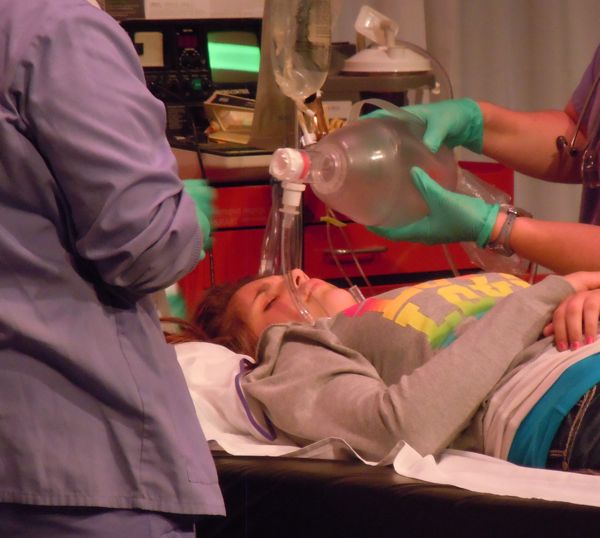
Harmony’s group is now assembled in the dark college theater. She comes in on a gurney with an IV in her and breathing apparatus. CPR is not working.

The spotlight is on her.

She dies.

Not a sound comes from her classmates.

She is left there with a white sheet covering her body.

Her classmates leave to attend her funeral.

While a real minister gives the eulogy, when the students go to view Harmony’s body what they see instead is themselves. A mirror is there instead of Harmony.

The point: do what Harmony did and they could wind up in a coffin.

True story

While this was make believe, the next venue wasn’t.

Molly Cocking is standing behind a table full of medical devices. Those tools helped save her life.

The summer before her sophomore year at South Tahoe High School she drank to the point of having a blood alcohol content of 0.25. In the morning, when she woke up at Barton Memorial Hospital, her BAC was 0.16 – still twice the legal limit for an adult.

Now age 26 and an emergency room nurse at Carson Tahoe Hospital, Cocking retells her night of horror – at least what she remembers of it. Her parents were told she might not make it through the night.

She credits friends with saving her life – for not letting her sleep it off, for calling for help.

Cocking was told if they had not done that, it’s likely she would have died.

She didn’t preach about not ingesting drugs or alcohol, but she did encourage them to not do what she did. What Cocking imparted was some of the most practical advice for the day – don’t pick up a drink (even it was yours to start with) if there is any chance someone could have slipped something into it, and if you are going to drink or do drugs, be sure it’s around people you trust so if something happens, there is someone there to help.

Cocking’s story could be a standalone event.

All the pieces

Drug Store Project is a collaborative effort. While Huard is the organizer, more than 150 volunteers help. Harrah’s donates about $8,000 worth of food. Embassy Suites offers a night of lodging to the California National Guard.

The college donates the space.

Agencies donate personnel and equipment – like the Tahoe Douglas bomb squad, Calstar, law enforcement and others.

But the $13,000 it costs in cash to put the event on seems each year to get more difficult to find. The school district stopped doing the program several years ago. TY&FS relies on a grant.

And it’s not just this one day. TY&FS will be in classrooms Thursday to debrief the kids. This age group needs time to process things like this, thus the reason for waiting a day to go to their schools. About 350 students go through the program each year.

Surveys will be sent to parents. The hope is this triggers conversations in homes.

For more information, go online.

ngg_shortcode_1_placeholder (Click on photos to enlarge.)



Lake Tahoe to receive measurable snow

Crocuses are blooming in the basin. Robins are confused. Spring is the season according to the calendar. And snow is about to pile up. It must be Lake Tahoe in March.

A winter weather advisory is in effect until 11am March 28. Wednesday’s commute is expected to be difficult – slick roads, blowing snow and nasty roads.

The fountain at Heavenly Village should be covered in snow soon. Photo/LTN

Click the state icons on the home page of Lake Tahoe News to know what the road conditions are like.

The National Weather Service is calling for 8-16 inches of snow above 7,000 feet and 4-8 inches at lake level.

The wind will continue to howl through much of Wednesday, which could bring waves as high as  4 feet.

Thursday and Friday are expected to be mostly sunny, with rain arriving Friday night and turning to snow on Saturday.

— Lake Tahoe News staff report


Company abruptly stops marketing controversial crop fumigant

By Steve Chawkins and Diana Marcum, Los Angeles Times

A years-long environmental battle ended abruptly when the company producing a fumigant for strawberries and other crops yanked it from U.S. distribution, bringing relief to activists and raising concern among growers.

Methyl iodide, meant to replace an ozone-depleting fumigant being phased out by an international treaty, was believed to have little effect on air quality. But some scientists say it can cause cancer, brain damage and miscarriages among workers who handle it and can be a threat to ground water.

In California, which produces 90% of the nation’s strawberries, environmental advocates reacted enthusiastically Wednesday to the announcement by Tokyo-based Arysta LifeScience Inc.

“This way is more powerful than a court victory. It’s a concession. It’s them walking,” said Greg Loarie, lead attorney in a lawsuit attacking the process California used to approve the chemical in 2010.

“Today I’m really happy,” said 19-year-old Gabriela Rincon, who joined marches against the chemical and told her parents, both pickers in the Salinas area, about the risk. “It feels like someone finally listened to us about something really important.”

An Arysta spokeswoman said the decision late Tuesday to abandon U.S. production and marketing of the company’s trademarked Midas fumigant was financial. Arysta will continue to market the chemical outside the U.S.

In 2011, the first full year it was available as a replacement for methyl bromide, only one strawberry grower used it, on a small plot outside Santa Maria, according to the California Strawberry Commission.

Several pepper farmers in the Central Valley also reportedly applied the chemical. Its chilly reception among growers contrasted sharply with the urgency expressed by state officials in 2010, when then-Gov. Arnold Schwarzenegger deemed its approval an “emergency.”

For some growers, the legal risk of using a compound that had generated intense notoriety proved too great.

Read the whole story


TSA revises rules for older travelers

By Bart Jansen, USA Today

Airline passengers who are at least 75 years old will be able to keep their shoes and light jackets on at security checkpoints at four airports, the Transportation Security Administration recently said.

The changes are similar to those adopted in September for children up to 12 and will reduce — but not eliminate — pat-downs for the elderly. The test will begin at Chicago’s O’Hare, Denver, Orlando and Portland, airports. If an alarm sounds, elderly passengers may be asked to remove their shoes. A full-body scan is an option for all passengers who can stand still for five seconds. Elderly passengers will be allowed a second chance if a full-body scanner spots anything suspicious.

The changes are part of TSA Administrator John Pistole’s strategy for focusing more attention on potentially riskier passengers. The agency eased screening for children, for frequent fliers at specific airports who voluntarily give background information under the Pre-check program and for pilots in uniform at certain airports.

Read the whole story