Second suspect arrested in North Shore burglary ring

A Reno resident is the second person arrested in connection with a burglary ring that involved Incline Village and Truckee.

Washoe County sheriff’s detectives said Jason Greene, 30, pawned three guns. Green is an ex-felon and under state and federal law he is prohibited from possessing firearms. Greene was convicted in 2006 by a Washoe County court for felony possession of narcotics.

Detectives identified items allegedly pawned by Greene as being stolen from a residence in Incline Village in January.

Greene was arrested April 4 in Reno. A subsequent search of his residence revealed two handguns and a shotgun, belonging to Greene, detectives said.

Greene was arrested on 12 counts.

Detectives are continuing the investigation and are attempting to identify the legitimate owners of the six firearms.

— Lake Tahoe News staff report


Entire Swiss Chalet center up for sale

By Kathryn Reed

The Baumanns might be getting out of the restaurant business.

Kurt Baumann opened the Swiss Chalet restaurant in South Lake Tahoe in 1957. In 1959, he met his future bride who started working as a waitress.

Baumann brothers looking for a buyer for Swiss Chalet. Photo/LTN

The two were married for 44 years before Kurt died in 2004. Ruth died last year.

Since that time their sons, Peter and Ralph, have been running the restaurant. Besides the restaurant, they own the Swiss Chalet Village at the corner of Highway 50 and Sierra Boulevard.

Last month they put the whole center, including the restaurant, on the market for $2.8 million.

“We are not selling. We are just inquiring,” Peter Baumann told Lake Tahoe News. He would not elaborate other than to say they are taking inquiries about the center as a whole as well as just the restaurant.

Ralph Baumann essentially said the same thing: “We are only exploring our options.”

Listing agent Craig Robinson with Von Kaenel Real Estate in the South Bay would not speak without his clients’ permission.


S. Tahoe council re-enters ‘convention center’ fray

By Kathryn Reed

While the South Lake Tahoe City Council has always said the convention center project is not a city project, all of a sudden the electeds want to be involved with filling in the hole.

City staff has been on the periphery as the project languished in bankruptcy for more than two years. The council, though, has not publicly been involved until now.

It's unknown if the concrete and rebar at the hole are structually sound. Photo/LTN file

Councilmen Hal Cole and Bruce Grego on Tuesday were appointed to an ad hoc committee with City Manager Tony O’Rourke and City Attorney Pat Enright. They have been tasked with conversing with the parties involved with the defunct project near the state line about how to get a plan together before permits expire.

Had a performance bond been required for what was supposed to be a $410 million project, the city might not have the eyesore it has.

The July 11, 2006, Owner Participation Agreement – the contract between the city and Lake Tahoe Development Company – says, “It is typical of development projects like this one for cities/agency’s [sic] to request the participant to have performance and labor & materials bonds. This insures [sic] that the project once started will be completed. However, the developer is concerned that this will add to the overall cost of the project and point out that the agency will have no financial obligation if the convention center and public improvements are not completed. In addition, the participant’s construction lender will be monitoring the project very closely and will help assure that the project will be completed. The requirement for obtaining these bonds is not included in this agreement.”

Cole, who is a contractor by trade, told this reporter years ago there is no such thing as a performance bond. This was when he was on the council before this stint and while agreements were getting approved.

Market study

Cole along with then Councilman John Upton are the only two councilmembers who are known to have seen the market study that was done in 1995 that “proved” South Lake Tahoe needed a convention center.

The document was not released to the media until last year.

This study is what the electeds based their decision on to go forward with the project at the time – a study the majority never saw. It’s a study that was commissioned by Lew Feldman, the attorney for the developer. Coopers & Lybrand out of Texas put it together.

While in many ways reporting on the study is old news, Lake Tahoe News is the first news source to do so.

It is important to know what has happened in the past and who was involved so perhaps history doesn’t repeat itself.

It’s possible the town is better off with an empty lot instead of more empty buildings. After all, no one saw the recession coming – at least no one associated with this project.

From 470 surveys of regional-state-national event planners this is what they said of the likelihood of having an event in South Lake Tahoe:

        National      Regional            State    Corporate
Definitely yes

10%

15%

22%

15%

Highly likely

4%

16%

7%

8%

Possibly

29%

20%

25%

28%

Unlikely

29%

16%

21%

20%

Definitely no

28%

33%

25%

29%

Source: Coopers&Lybrand


Those are some of the numbers used by city officials to say a convention center was a must-have building for South Lake Tahoe.

The study says 79 percent of the reasons entities would not choose South Lake Tahoe – like air service, gambling next door, preference of a large city – could not be overcome.

The city was supposed to have a 50-year lease to operate the convention center. This was going to be how it made money in addition to the increase in hotel and sales taxes.

But the market study says, “… the potential convention facility in South Lake Tahoe is estimated to incur an operating deficit in its fifth year of operations, the first year of stabilized operations, of approximately $67,000 (1995 dollars). This level of operating shortfall is consistent with or slightly less than the results of similar facilities throughout the country. Furthermore, the financial analysis assumes a significant level of spectator events held in the facility. Without the income that could be generated by such activity, the annual operating deficit could increase by up to $250,000.”

What was released to the public and is in the report is the $11.4 million per year that was anticipated in spending by people using the facilities – on hotel rooms, food, entertainment and transportation.

The study further states half of the dollars spent would be in California and half in Nevada.

Event organizers, according to the study, ranked room quality and size, number of rooms, and food service quality as top criteria for determining where to have a convention or meeting.

Something that was never budgeted is money to lure conventions to South Lake. But it was a component of the study.

“The marketing of conventions, trade shows and other events requires a substantial amount of time and resources,” the study says.

The South Shore doesn’t have a convention bureau.

With the Reno airport being a little more than an hour away – without traffic and snow – that, too, could be an issue with potential attendees, the report says.

Had the project been completed, it was expected to compete with mid-sized state and regional facilities.

The project was sold to the public as though the center would be available for community events. The study called for 60 events (national-regional association events, corporate meetings, state association events, public shows, spectator events) that would cover 204 days. The public shows equaled two events over seven days.

As the process went on, parking was never resolved. The project never had enough spaces to store the number of vehicles expected at the site. Harveys was going to be the place to park. But that agreement was never secured even though construction began.

The study says, “The availability of adequate parking is an important factor in accommodating local and state conventions, trade shows, public shows and certain corporate events. A relatively high percentage of attendees within the local and state event market would likely drive to a convention facility.”

Current day issues

Once the project emerged from bankruptcy court earlier this year the clock on the Tahoe Regional Planning Agency permit started ticking. It runs out at the end of the year. To start that process all over will be costly and time consuming; potential roadblocks to a developer.

While the 11-plus acre parcel near Harveys and Heavenly Village has sat idle for years because Lake Tahoe Development Company filed bankruptcy in 2009, the future is murky.

Randy Lane of LTDC still owns nine of the parcels. The entire project is 29 parcels because the city allowed concrete to be poured without a final parcel map on file. Sixteen have been foreclosed on, with four in the process. A notice of default has been filed on two of those four, with the sale slated for June 1 in Placerville.

Another twist to the case is the lawsuit filed late last year by Harry Segal who believes he should be a primary creditor and not secondary. That case will be heard in Placerville in El Dorado County Superior Court.

At the April 3 council meeting it was agreed the five want to have a public session with the key players at the second May meeting to hash out what can be done with the property. Cole asked for staff to provide an update on the condition of the concrete and rebar as well as details about the TRPA permit.

He said it’s critical decisions are made this summer about the future of the site.

But the city doesn’t own the land – which at one time with the improvements that are in place had a value of more than $100 million – nor does it have the wherewithal to buy it. So, while the property is in the city limits, the council has as much control over getting movement on the site as it does to resolve the tenant issues at the Y.




Regional fire chiefs worry about structures near wildland

By Jeff Delong, Reno Gazette-Journal

More people are moving into areas abutting wooded and brushy terrain of the wild, putting more lives and property at risk of wildfire in a situation made more dangerous by a warming climate.

Such was a central message issued to a convention of fire chiefs in Reno last week to discuss issues associated with fire danger in the so-called wildland-urban interface. The five-day conference occurred in a community where nearly 60 homes were destroyed by a pair of dangerous wintertime blazes within a two-month period and at a time a deadly wildfire was burning on the outskirts of Denver.

Expect more of the same in the years ahead, experts told the chiefs during a discussion of wildfire conditions of the future.

“We have a very dangerous situation on our hands,” said Arthur “Butch” Blazer, former state forester for New Mexico and currently deputy undersecretary for natural resources and the environment for the U.S. Department of Agriculture.

Decades of suppressing fire have resulted in overgrown forests ready to burn, while a warming climate is making for longer, larger and more intense fire seasons, attendees of the conference hosted by the International Association of Fire Chiefs were told.

Complicating that hazardous combination is the growing number of people moving into the urban-wildland boundary where the risk of damaging wildfire is greatest, said Faith Ann Heinsch, a research ecologist with the U.S. Forest Service based at a fire sciences laboratory in Montana.

More than 9 percent of homes nationwide are now located within the wildland-urban interface, with the number rising to 50 percent in 19 states, Heinsch said.

Read the whole story


2 businesses not open at S. Tahoe Y because of landlords

By Kathryn Reed

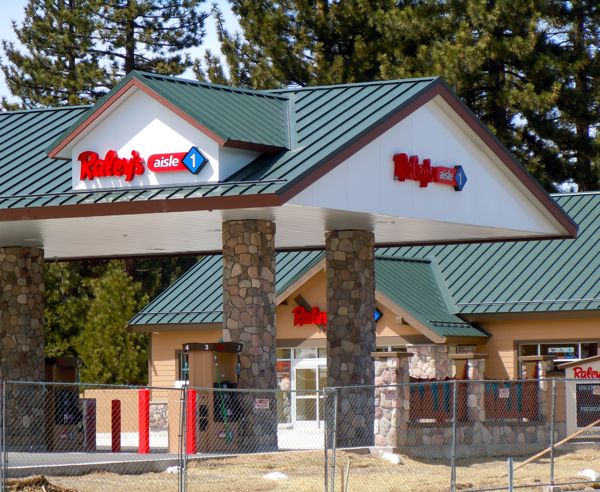
Landlords are holding up the opening of the new gas station at the Y in South Lake Tahoe as well as the T.J. Maxx store.

While improvements to both buildings are nearly complete, the tenants are not allowed to open their doors.

The issue with the gas station – which is owned by Raley’s – is one of the driveways is on a separate parcel. The smaller parcel, where the station is, has one owner and the main shopping center is land owned by someone else.

Driveway issues are keeping the gas station at the Y in South Tahoe from opening. Photo/LTN

Even though Seven Springs, which owns the center, has Raley’s the grocery store as its anchor tenant, it is not playing nice. Seven Springs wants $10,000 a month from the gas station to allow people to use the right-of-way.

The South Lake Tahoe Planning Commission is expected to discuss the driveway configuration at its April 12 meeting.

Kitty corner to this land dispute is the issue with whether T.J. Maxx will ever move in.

The store, which wants to open, is still fine-tuning things with the property owners.

The tenant permit is ready to go. All they have to do is pick it up from the city. The city has also approved the sign application.


S. Tahoe tries to make special events less of a problem

By Kathryn Reed

An angry citizenry prompted South Lake Tahoe officials to look closely at how it handles special events.

Guidelines were thoroughly discussed April 3 during a City Council workshop at which six members of the public gave their input, plus one letter was read into the record.

New Year’s Eve weekend’s SnowGlobe music festival, which definitely helped the economy, rattled so many houses that some nerves are still frayed more than three months later.

December's SnowGlobe music fest forced South Tahoe's hand to formalize special event guidelines. Photo/LTN file

The council at the April 17 meeting is expected to adopt guidelines for special events.

The problem with SnowGlobe was the sound – not of music per se – but the excessive bass associated with the type of music that spilled from the community ball fields at Lake Tahoe Community College.

To prevent a repeat of those problems, the city is considering imposing rules that call for special events to be between 10am and 10pm, with decibel levels of no more than 95.

“Ninety-five dbA is restrictive. Most cities are generic,” City Manager Tony O’Rourke said. But he also said it’s easier to relax rules than to implement them after the fact – thus the reason he supports the 95dbA.

He pointed out how the Tahoe Regional Planning Agency’s noise rules call for sound not to exceed a certain limit over a sustained 24-hour period. Based on that criterion, the booming sound from SnowGlobe did not violate TRPA rules.

In doing research, South Tahoe officials found two cities with decibel limits higher than what is being proposed locally. Aspen and West Palm Beach have limits of 100dbA.

With these being guidelines and not an ordinance, it means staff has more flexibility. For instance, it’s likely another New Year’s Eve event could have an end time of 12:30am so revelers could celebrate the new year. But to avoid another SnowGlobe incident, either speakers will be positioned differently, or acts will be scheduled so the less deafening ones come on last.

Having a say in the schedule is part of the guidelines.

Some discussion Tuesday centered on whether the city should charge a permit fee.

It was pointed out by staff as well as B Gorman, CEO of the Lake Tahoe South Shore Chamber of Commerce, that it takes most events a handful of years before they turn a profit.

“People have no idea how expensive events are,” Gorman said, relaying how people after year two of Sample the Sierra asked where the proceeds are going. The $30,000-plus spent on tents and other materials for the event are still being paid off.

Money for the city comes via hotel and sales taxes.

Gorman suggested in addition to city staff, that someone like Carol Chaplin, head of Lake Tahoe Visitors Authority, be on the events committee.

While Councilmembers Claire Fortier and Tom Davis liked that idea, Councilwoman Angela Swanson said someone less entrenched in the business, like a member of the city’s recreation commission, should be involved.

That issue was not resolved at the meeting.

Where events can be conducted was another issue brought up at the meeting.

“Venues are our biggest obstacle,” Stan Sherer, community services director, said.

The South Shore is an obvious draw because of its natural beauty, easy drive from the Bay Area and Central Valley, and proximity to Reno-Tahoe International Airport. But locations for events are lacking.

A baseball tournament coming to the area in the summer is using fields throughout the basin and in Gardnerville.

Cody Bass wants to bring a festival on the scale of Outside Lands that is staged in Golden Gate Park in San Francisco. He envisions the way to do that is to convert Bijou Community Golf Course into a music venue. He’d like that to happen Labor Day weekend.

JoAnn Conner, president of South Tahoe Chamber of Commerce, would like the city to look at the number of similar events it allows at a given site – for example how many crafts fairs are at South Tahoe Middle School.

Councilman Hal Cole, remembering the contentious nature of meetings regarding arts events, said he is not ready to revisit that issue.

Another aspect of future events is a waste management plan will be required, with the goal of being zero waste.


Weekend rescues prompt warning from El Dorado County

By Cathy Locke, Sacramento Bee

Citing two incidents that occurred last weekend, El Dorado County sheriff’s search and rescue officials urge people venturing into the back country to carefully prepare and plan for their travels.

On Satruday, Robert Barber of San Diego had gone for a walk in the woods off Kiowa Street in South Lake Tahoe when a fast-moving weather front moved into the Tahoe area, creating blizzard-like conditions. About 2pm, Barber became disoriented because of almost zero visibility caused by the heavy snowfall, according to a sheriff’s department news release.

When he could not find his bearings, Barber called 911. Global positioning system technology was used to narrow down Barber’s location, and search and rescue personnel, along with a search and rescue dog, located him about three-quarters of a mile from area residences.

Officials said Barber was cold but in good condition.

About 7:15pm the same day, search and rescue personnel responded to another 911 call, this one regarding three snowmobilers who became lost in the storm. The three men from the Tahoe area began their trip in the Meyers area and planned to return before the approaching storm arrived. But it began snowing heavily before they were able to make it out of the back county.

Read the whole story


Could Nevada’s ‘stand your ground’ law spark a Trayvon-like case?

By Karoun Demirjian, Las Vegas Sun

As the country tries to understand how Trayvon Martin — a hoodie-clad 17-year-old armed with nothing more than a cellphone, can of iced tea and bag of Skittles — was shot to death in Florida in February without anyone being charged, every possible culprit is being considered.

There’s the shooter, neighborhood watch captain George Zimmerman, who has offered a questionable claim of self-defense, and the conduct of Sanford law enforcement officials who decided not to prosecute.

But some of the sharpest outcry has focused on Florida’s “stand your ground” law, which justifies use of deadly force in self-defense, with no obligation to first attempt to retreat.

In Las Vegas, officials and academics are taking a close look at the Martin case, and for good reason: Nevada recently passed a law nearly identical to Florida’s, leading many to believe a similar tragedy could play out in the Silver State.

“The circumstances are ripe for a Trayvon situation to happen here,” said Sylvia Lazos, a law professor at UNLV’s Boyd School of Law. “We have a lot of crime. We have a lot of people with guns. We have a lot of people who are untrained. We have to watch it. … These combinations can be quite toxic.”

Nevada is one of 25 states, according to the Legal Community Against Violence, with a law allowing individuals to use deadly force when they feel threatened with no obligation to stand down or try to avoid violence once reasonable fear is established.

Nevada’s “stand your ground” law was approved by the 2011 Legislature and took effect in October. It allows that as long as a person who feels threatened didn’t initiate the altercation and isn’t doing anything criminal, that person can stand and use deadly force and it would be considered “justifiable homicide.”

Read the whole story


Water content inching up, but still well below normal

By Kathryn Reed

PHILLIPS STATION – “By no means are we in great shape, but be we are nowhere near as fragile as we were last month.”

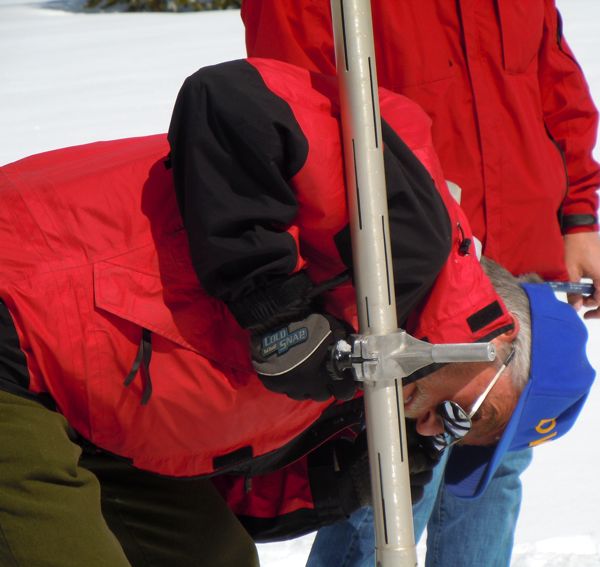
That is the assessment of the water content in the Sierra Nevada by Frank Gehrke. Gehrke, who works for the state Department of Water Resources, was at the base of Sierra-at-Tahoe along Highway 50 on Monday for the penultimate snow survey of the season.

Usually by the April survey talk begins of a diminishing snowpack. This year, the readings keep increasing. Considering the first reading this season on Jan. 3 at Phillips Station Gehrke collected dirt in his instruments, things have improved dramatically.

Frank Gehrke takes a reading April 2 near Phillips Station. Photo/Kathryn Reed

Still, this location is at 39 percent of its long-term average, with water content of 11 inches and snow depth of 31 inches. A year ago, the water content was 43.5 inches, snow depth 124.2 inches and 154 percent of normal.

For April 2, 2012, the state is 55 percent of its average. While this is not good, water gurus are staying afloat from the abundance of moisture from winter 2010-11. Lake Oroville, the State Water Project’s principal reservoir, is 107 percent of average and Lake Shasta, the federal Central Valley Project’s largest reservoir, is at 104 percent of average.

This bodes wells as the snowpack traditionally begins to diminish with the start of April because of fewer storms and warmer temperatures increasing snowmelt.

Gehrke was breaking trail on his cross country skis as the media followed alongside. Under the blue sky and sunshine the snow sparkled like diamonds, almost as though it knows it has a value that no banker will trade for a greenback.

Tahoe merchants know snow depths can be measured in dollars. On one of the best ski days of the season it was easy to find a parking spot at Sierra-at-Tahoe. Stashes of powder could be found a day after the storm, while others enjoyed the rarely groomed Clipper run. Even at 10am corduroy was scattered about.

It was an interesting Monday morning seeing how important snow is to so many facets of the California landscape and economy.

Another storm that is likely to arrive tonight in the greater Lake Tahoe area (that could last into Thursday) is good news for the overall water situation in the state. First, it means more moisture. Second, the cooler temps will slow the snowmelt. The longer water stays in its frozen form, the better for storage reasons. It means not needing to irrigate, flooding being less of a concern, and evaporation not occurring as soon.

And it’s good news for the greater Lake Tahoe economy. Businesses dependent on snow can hope to salvage a season that has been rocky in so many ways.

Location

Elevation

Snow Depth

Water Content

% of Long Term Average

Alpha

7,600 feet

  44 inches

15.9 inches

48

Phillips Station

6,800 feet

      31 inches

11 inches

                           39
Lyons Creek

6,700 feet

   52.4 inches

  19.1 inches

61

Tamarack Flat

6,500 feet

   44.9 inches

 13.6 inches

50

Source: Department of Water Resources


Suspect in 1980 S. Lake Tahoe murder case behind bars

By Kathryn Reed

A nearly 32-year-old South Lake Tahoe murder case may have been solved with the arrest of a 50-year-old Carmichael man.

Andrew Sanford was booked into the Sacramento County Jail in the death of Richard Swanson on March 28. Sanford, who would haven been 19 at the time, was a resident of South Lake Tahoe then.

Swanson was a 16-year-old South Tahoe boy working at the Shell station that used to be at the corner of highways 50 and 89 at the Y. The station was robbed and Swanson left for dead.

Richard Swanson was 16 in 1980 when he was killed at the now defunct Shell station at the Y in South Lake Tahoe.

For years the case went nowhere. That changed in 2006.

Ron and Sharon Swanson made a heartfelt plea to the City Council at the time asking them to allocate more resources to the police department so the person responsible for their son’s Aug. 14, 1980, death would be caught and justice served.

Then Police Chief Terry Daniels and Mayor Kathay Lovell met with the Swansons to talk about what could be done. The council approved additional resources.

When Chuck Owens retired from the department he was hired by Daniels to work the Swanson case, with money allocated by the council.

Even though today’s council stopped the allocation, current Police Chief Brian Uhler saw the need to keep the investigation going. Tips were coming in.

The El Dorado County District Attorney’s Office in Placerville will be handling the case. Most likely that is where the case will be tried, much like the Jaycee Lee Dugard case, even though both crimes were committed in the basin.

Trish Kelliher with the DA’s office did not return a phone call.

Assisting with the case was the FBI. They have been working it more diligently since the Swansons, who now live in Tuolumne County, pleaded for officers to reopen the case.

“It’s good to have a milestone here with an arrest,” FBI agent Chris Campion told Lake Tahoe News.

Neither Uhler nor police Lt. David Stevenson had details on what the suspect has been doing with his life for the past 30-plus years. It’s also not known if they knew each other.

“We don’t want to really get into any details that might be discussed as part of the trial because of our desire to have a successful prosecution,” Uhler told Lake Tahoe News.

From this killing the local Secret Witness program was formed. The seed money was always to go to the person who helped solve the Swanson murder.

“This case and the Jaycee case were really the two cases that shook this community to the core. It really changed how we thought about this community. They were just two kids,” Lovell told Lake Tahoe News. She has been on the Secret Witness board for the past 15 years.

The Shell station also has a history for her family. Her brother owned it before the killing took place and had worked there as a teenager, much like Swanson did.

“It was very eerie for us to have it happen,” Lovell said.

Campion said for now details about what led to the arrest are not being released.