Living in Lake Tahoe increases risk of getting skin cancer

By Kathryn Reed

Cancer is still one of those words that people think should be whispered, or that it should not be said outside of a close-knit circle. Even worse, people think the diagnosis is an automatic death sentence.

Yes, cancer attacks various parts of the body and to different degrees. Yes, a lot more needs to be known about the causes, a lot more research done to find cures, more people should get the tests that would render an early diagnosis, and people could be living a life that perhaps would prevent them from getting certain cancers.

For now, the one thing that most people won’t be immune from is having cancer touch their lives – be it a personal diagnosis, that of a family member, a friend or a colleague.

One application of sunscreen is not enough.

I’ve experienced all of those.

My father is proof you don’t die from cancer. He had colon cancer; did the whole chemo thing. He lived for many years before he died two years ago this month from a heart attack.

My good friend has cancer. She had 18 chemo treatments. The last one may have been this week. We’ll know after a CAT scan later this month how the drugs she’s been infused with have attacked the cancer.

In the last six months I have had two basal cell skin cancer spots removed – one from my calf, one from my neck. (In the world of skin cancer, I have the good kind.)

Maybe my dad’s diet had something to do with his colon cancer. Maybe my friend’s choices in life had something to do with her diagnosis. I’m sure my fair skin exposed (overexposed?) to the sun brought on my growths.

But the problem with cancer is there isn’t always a definitive cause – not yet, any way.

I went to a lecture this week by Ronald Gemberling, a plastic surgeon affiliated with Barton Health, to hear what he had to say about skin cancer.

While he gave some information, much of the presentation was showing disturbing pictures of people with melanoma – the bad skin cancer. Perhaps it’s because he is a surgeon paid to work on those types of things that he thought it necessary to spend more time talking about “fixing” things than preventing them.

An alarming statistic to me was learning how prevalent skin cancer is. In 2011 in the United States there were more than 2 million skin cancer cases. All other cancers tallied 1.6 million cases.

Gemberling said with people living longer it contributes to doctors seeing more patients with skin cancer. It’s one of those diseases that creep up on you.

I’ve already damaged my skin from years of sun bathing, playing tennis without sun protection, not wearing a hat and believing I looked so much better with a tan than with my pasty-white Scandinavian skin.

Still, having chunks of my skin removed was a wake-up call. I now own a wide brimmed hat to protect my face and neck from sun. I’m putting sun block on my face more often. I’m working up to every day – that’s a memory issue.

Gemberling (who is not my doctor) said it’s important to choose a block and not merely a sunscreen. He also says 15 SPF is all that is needed.

That last part contradicts things I’ve read and what my sister, Pam Valentine, who is a nurse practitioner and for years specialized in oncology, tells me. She and the doctors she works with recommend SPF 50 “because you are getting better coverage and blocking more of the UV rays.”

SPF stands for sun protection factor.

The theory is the more protection, the better. And look for products that work on keeping out UVA and UVB rays. Most only repel the latter.

Gemberling and Valentine agree whatever level is used it needs to be reapplied and that there is no such thing as water- or sweat-proof sunscreens.

Living at higher elevations like Lake Tahoe has its own set of problems. Gemberling said for every 1,000 feet in elevation it increases the risk of getting skin cancer by 4 percent. With Tahoe being at 6,200 feet, just living here means a greater chance of getting skin cancer than if one resides in the Bay Area.

Gemberling said two in five people living in Lake Tahoe would get skin cancer. That’s 40 percent of the population.


Gay marriage lawsuit presses for survivor benefits

By Barbara Bradley Hagerty, NPR

Herbert Burtis met the person he wanted to marry in college, in 1948. But since the object of his affection was another man, they had to wait until 2004 for the ceremony, when Massachusetts legalized same-sex marriages.

“It’s a long engagement,” Burtis says, laughing. “We thought it was time that we made each other honest people.”

His spouse, John Ferris, died four years ago. When Burtis went to the Social Security office to apply for survivor benefits, the clerk told him the federal government did not recognize his marriage.

“You feel like, ‘Why am I a second-class citizen?’ ” the 82-year-old Burtis says. “I thought our marriage license was a legal document. And if it’s legal for a man and a woman, it should be legal for a man and a man. And I couldn’t see why there would be prejudice in that.”

Burtis is one of 17 gay men and women who are asking a federal court in Boston to clear up the confusion. On Wednesday, the First Circuit Court of Appeals will begin hearings on whether the Defense of Marriage Act, or DOMA, is unconstitutional.

Read the whole story


ACLU: Local police tracking cellphones without warrants

By Suzy Khimm, Washington Post

Local police departments across the country are tracking cellphones without a warrant, according to documents obtained by the American Civil Liberties Union.

The ACLU surveyed about 200 state and local law enforcement agencies across the country and found that only a handful of them said they obtained “warrants based on probable cause” before tracking cellphones. Most other agencies had laxer standards for tracking cellphones. In Lincoln, Neb., for instance, local police can obtain the GPS location of cellphone users “without demonstrating probable cause,” the group said in a statement.

As a result, the ACLU concludes that there are “unclear or inconsistent legal standards from town to town that frequently fall short of probable cause,” questioning whether the practice is constitutional.

Read the whole story


How women, girls are faring in education, jobs in Calif.

By Los Angeles Times

California women have made significant strides in recent years, obtaining college and graduate degrees at a higher rate than men, for instance, but they still lag their male counterparts when it comes to leadership roles, earning power, and proficiency in advanced science and math, a new report shows.

The analysis, released Thursday, takes a wide-ranging look at how women and girls are faring across California. It points to recent achievements in some areas but highlights continuing inequities in many others, including women’s low representation in elected office, in high-paying science and technology careers, and in the top ranks of the state’s major public companies.

The analysis is believed to be the first to attempt a comprehensive look at the status of California’s women and girls, based on such factors as poverty, education, employment, leadership, and mental and physical health. It was produced by faculty, staff and students at Mount St. Mary’s College, a Los Angeles liberal arts institution that primarily enrolls women. Researchers worked on the project for a year, compiling data from multiple sources, including the U.S. Census and various state agencies.

“As a women’s college, we have a deep interest in the forces that shape women’s lives,” Mount St. Mary’s President Ann McElaney-Johnson said. “We see it as part of our role to shine a light on the opportunities for women, and on the inequities women continue to face.”

The findings in many cases echo broad trends outlined in a national report, “Women in America: Indicators of Social and Economic Well-Being,” and other recent studies. Like those, it found that women have a distance to go in many areas to reach parity with men.

The report highlighted continuing gaps between the performance of boys and girls on mandated state tests in math and some areas of science, although not biology, where girls have pulled even. But the gender gap for advanced algebra, geometry, physics and chemistry has remained fairly constant in recent years, with girls tending to fall further behind as they reach more advanced math and science subjects.

The reasons for the gaps include different preparation and course-taking patterns in high school and college, said University of California, Los Angeles education professor Linda Sax, who studies gender differences in college students.

Read the whole story


Tourism officials urge changes to lure more visitors to U.S.

By Richard N. Velotta, Las Vegas Sun

Agents with the U.S. Customs and Border Protection and the Transportation Security Administration will be ordered to put on their happy faces as part of a bid to make the United States a friendlier place to visit.

Sen. Harry Reid and Interior Secretary Ken Salazar were in Las Vegas for a Wednesday morning tourism roundtable meeting with industry leaders to explain some of the initiatives of Brand USA and to get suggestions on how the nation could do a better job of welcoming foreign tourists to the country.

Reid was one of the key proponents of the Travel Promotion Act that led to the formation of Brand USA, a corporation formed from a public-private partnership that will market the United States abroad.

Stephen Cloobeck, chairman of Brand USA and CEO of Las Vegas-based Diamond Resorts International, also attended the roundtable and said some of the advertising messages would be unveiled April 22 during the U.S. Travel Association’s International Pow Wow in Los Angeles.

About 40 industry and political leaders were invited to the roundtable, which was closed to the public.

Read the whole story


Meyers restarts process to be a more livable community

By Kathryn Reed

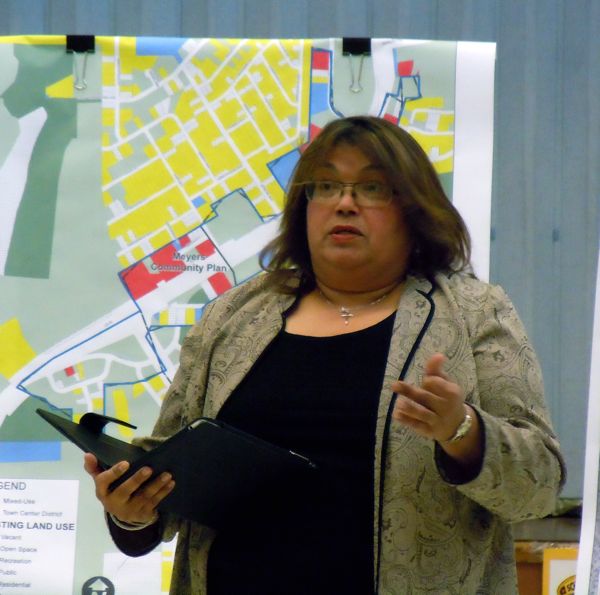
MEYERS – Another meeting, another plan, another promise the next document won’t sit on the shelf, but instead will actually be implemented.

That last part kept being pounded into the more than 40 people who attended the Meyers Roundtable meeting this week. But only a fraction of those people are ordinary citizens of this enclave at the base of Echo Summit. The rest have jobs with El Dorado County, Tahoe Regional Planning Agency, or other planning-design-consulting firms.

County Supervisor Norma Santiago, after the more than two-hour meeting on April 4, told Lake Tahoe News, “The teams will define the projects they want to implement so then we can shop for funding to pay for it.” (Santiago is also on the TRPA Governing Board.)

El Dorado County Supervisor Norma Santiago talks about plans for Meyers. Photo/Kathryn Reed

She said the now much-outdated community plan never came to fruition because there was no funding.

Sue Novasel, who leads the roundtable, was instrumental in getting the 18-year-old document off the ground. Back then teams worked on various components. That same way of doing things is going to be implemented this year.

The old document has things like walkable, livable communities – just phrased differently. It talks about a town eager to have connectivity through bike paths.

The original Meyers Community Plan came out in October 1993, with revisions made five years later. That document says, “The community plan for Meyers is intended to serve as the comprehensive land use and development plan through the year 1997.” The current Meyers plan may be accessed via the TRPA’s website.

The problem isn’t what is in the document – in fact, much of it will likely be used in the revision. It may just need to be tweaked to use today’s language and incorporate 21st century building requirements.

The problem is the plan has served as nothing more than a paperweight.

Community plans are one of those TRPA mandates. While in some ways they are slated to disappear if the Regional Plan update is approved at the end of the year, they are just going to be replaced with action plans that come with different criteria and mandates.

“The local community is determining their own character,” is how TRPA COO Ed Gurowitz described the new, friendlier agency and its proposed Regional Plan.

He said with Meyers starting now and intending to have its plan done as the Regional Plan comes to fruition, this particular South Shore plan could be a model for other jurisdictions around the lake.

Michael Ward, who is with the Lake Tahoe Prosperity Center and working with the Tahoe Sustainable Communities Program, spoke to the group assembled at the magnet school about the grant his group is using to help Meyers. He was evasive about the exact dollar amount that will be allocated to Meyers. Ward kept saying this is seed money that could attract other money. But for that to happen a real plan approved by TRPA that outlines priorities needs to be in place.

In the coming months a series of workshops-meetings will be scheduled so the people of Meyers can plot a course of action, with the goal being action – not just another plan.


Tahoe City Golf Course officially changes hands

On April 3, more than 200 people turned out at the Tahoe City Golf Course to honor the Bechdolt family and the legacy they have created, and to celebrate the new public ownership of the Tahoe City Golf Course.

The direct descendants of Carl Jr. and Elsie Bechdolt all received special plaques honoring the family’s contributions and legacy to the Tahoe City Community. All funding partners — Placer County, North Lake Tahoe Resort Association, Truckee Tahoe Airport District and Tahoe City Public Utility District — were recognized for their contributions to the acquisition of the golf course property.

The Tahoe City Golf Course is now under ownership of the TCPUD. A five-year lease has been signed with Duncan Golf Management to operate the golf course, bar and restaurant. The nine-hole public course will open when weather permits.


Zephyr Cove businessman indicted on federal drug charges

Justin Woodcock, who owns RastaCam in Zephyr Cove, was indicted on federal drug charges.

The 29-year-old allegedly landed a plane in Alliance, Neb., on March 9 that contained 175 pounds of marijuana.

The lyrics saying, “Jolly weed makes me feel so fine,” boom from his business’ website.

The website says Woodcock has a degree in aeronautical science and that he has a commercial pilot’s license.

If convicted, Woodstock could be in prison for 20 years, fined $1 million and have his plane confiscated.

 — Lake Tahoe News staff report


Why Nevada is a lottery-free state

By David McGrath Schwartz, Las Vegas Sun

Watching Nevadans form long lines across the California border last week, hoping to strike it rich gambling, would seem akin to Idahoans emigrating for potatoes or Wisconsinites taking a road trip for cheese. Gambling is, more than anything else, supposed to be Nevada’s franchise.

But California offers something Nevada doesn’t: lottery tickets.

Record lottery ticket sales of $1.5 billion last week for a jackpot of $640 million once again raises the question of why Nevada doesn’t participate in a lottery.

“Nevada is sending people out of state to gamble,” said Assemblyman Paul Aizley, D-Las Vegas, who authored a resolution in 2009 to change the state’s constitution. “That, to me, is crazy.”

Casinos see it differently. A lottery in Nevada would be, in their mind, competition.

The Nevada Constitution has prohibited lotteries since it was ratified in 1864. Over the past 30 years, efforts to change that have been squashed by the gaming industry at the Legislature. (Voters did change the constitution in 1990 to allow charitable groups and not-for-profits to hold small lotteries — think church raffles.)

Since 1975, the Legislature has considered a lottery resolution almost every session to start the ball rolling on a five-year process to amend the constitution. It has yet to pass.

A lottery in Nevada would bring in between $30 million and $50 million a year, according to one Legislative analysis done in 2005. Another study, by the Governor Kenny Guinn’s Task Force on Tax Policy, estimated in 2002 that it would net the state $40 million to $70 million a year.

Read the whole story


Nevada seeks aviation designation

By Reno Gazette-Journal

The Nevada Governor’s Office of Economic Development formed a 15-member panel Monday to seek “Center of Excellence” status from the Federal Aviation Administration for unmanned aerial systems.

Earning the designation will give the state and its higher education institutions access to financial grants from the FAA for use in setting up one of six regional research centers across the country. Such a center will help bolster Nevada’s aerospace sector and create quality, high-paying jobs, according to the state’s economic development office.

Read the whole story