S. Tahoe man with DUI history indicted for murder

By Cathy Locke, Sacramento Bee

A man with multiple convictions for driving under the influence has been indicted for murder in the September death of a South Lake Tahoe man.

An El Dorado County criminal grand jury on Thursday returned an indictment against Larry L. Halverson, 60, charging him with murder and other offenses in connection with the death 51-year-old Patrick Purnell, according to an El Dorado County District Attorney’s Office news release. Purnell died when he was struck by a car driven by Halverson, who investigators allege was under the combined influence of alcohol and cocaine at the time.

Halverson did not immediately stop but returned to the scene later. At the time, authorities said, his driver’s license was both revoked and suspended for prior DUI convictions.

Purnell was crossing Ski Run Boulevard in South Lake Tahoe near the intersection with Highway 50 when he was struck, officials said. He was transported to Renown Hospital, where he later died as a result of his injuries.

Read the whole story


Saturday postal delivery saved; election year cited

By David Lightman and James Rosen, Sacramento Bee

WASHINGTON — Saturday postal delivery could continue for at least two years. And the closing of post offices in smaller communities may not happen as quickly as advertised.

The Senate on Wednesday approved legislation that would slow the U.S. Postal Service’s effort to make such changes. By a 62-37 vote, it sent a strong bipartisan message that, though the system is ailing financially, it’s not good politics, especially in an election year, to take a scythe to popular parts of the Postal Service.

“We don’t allow for what might be called shock therapy for the Postal Service because we don’t think it will work,” said Senate Homeland Security and Government Affairs Committee Chairman Joe Lieberman, a Connecticut independent and an architect of the bipartisan bill.

Not everyone agrees, and the plan still has to navigate a difficult road in the Republican-dominated House of Representatives. One proposal by key GOP lawmakers would set up a commission to devise a plan to consolidate and perhaps close certain post offices. The measure would give postal officials the option of ending Saturday service within six months of the bill’s enactment.

Many lawmakers in both chambers still see ending Saturday delivery as an important, timely and necessary cost-cutting move.

“It is clear the Postal Service must make drastic changes,” argued Sen. Bob Corker, R-Tenn.

The Postal Service has been struggling, battered by the 2007-09 economic recession and customers’ increasing reliance on electronic communication. First-class mail has dropped 25 percent in the last five years. Postal officials have proposed several strategies, including ending Saturday service and studying whether to close about 3,700 of the nation’s 31,509 post offices, and consolidate or close 234 of the 431 processing facilities. Many of the targeted post offices are in smaller, more rural areas, and lawmakers from affected states are howling.

Read the whole story


Meyers Landfill bill doubles to $13 mil.; case back in court

By Kathryn Reed

Cleaning up the old Meyers Landfill is costing more than twice what was expected – for a total of more than $13 million. The doubling of the cost has also created another lawsuit between the U.S. Forest Service and El Dorado County.

El Dorado County Board of Supervisors this month approved taking $6.3 million from the General Fund Contingency to pay for the cost overruns.

The April 17 staff report to the board says, “Failure to pay back this temporary loan will adversely impact other services provided by General Fund appropriations.”

Meyers Landfill cleanup is costing more than $13 million. Photo/USFS

Gerri Silva, director of environmental management for the county, expects the $6,313,156 to cover everything related to the actual work on the project. By the end of the summer the restoration to the site off Pioneer Trail should be complete.

The Meyers Landfill was used from 1947-71. Twenty years later the feds sued a slew of entities for cleanup costs. Vinyl chloride, a carcinogen produced when household waste breaks down, was the main contaminant under the sealed plot, although methane and other gases posed problems.

Those lawsuits lasted for years and cost the various agencies – mostly public, with a few private companies involved – millions of dollars. Those millions aren’t even part of the $13 million to fix the land so it is usable again and deal with the toxins so they don’t threaten people or the environment.

The entire disturbed area is more than 20 acres. Originally, the liner was to cover 7 acres, with what’s called the plateau area encompassing another 4 acres.

Because debris was found in a larger area than expected, the cost to remediate the site grew. But the county does not believe it should have to incur the expense because when the federal court case was settled it was the USFS plan that El Dorado County had to follow, with the Forest Service saying what the cost would be and where the cleanup would take place.

Silva said the original budget was $5.5 million, which the county’s insurance company covered.

“The Forest Service gave us 100 percent of the remedial design. They included what they thought it would cost, but there was a lot more waste there that had to be relocated,” Silva told Lake Tahoe News.

To recoup its expenses, the county took the feds to court. (No matter who wins, all of this is taxpayer money.)

The federal court granted the county’s motion for construction, enforcement, and modification of the partial consent decree. The Forest Service appealed this to the Ninth Circuit Court of Appeals. The next set of court briefs are due May 11.

According to the county, “If affirmed by the Court of Appeals, a hearing will be scheduled to determine the potential amount of the additional construction costs due to the large number of issues, errors, and omissions with the final 100 percent remedial design the county may recover from the U.S Forest Service.”

The Lake Tahoe Forest Service office deferred comment to the U.S. Department of Justice in Washington, D.C. However, because the matter is ongoing litigation, Wyn Hornbuckle declined to answer the following Lake Tahoe News questions:

• The cost of the project is more than twice what the Forest Service said it would cost when the agency came up with the design and told the county what to do. How do you account for this?

• How do you expect another agency to pay this when it’s your plans that seem not to be working?

• What does the USFS attribute the cost overruns to?

The county and USFS agree the land could be open to the public in August.

“Everything is contingent on site conditions and how well the vegetation is growing and how the cover system is settling in,” Cheva Heck, spokeswoman for Lake Tahoe Basin Management Unit, said. “We could reopen Garbage Dump Road as soon as August of this year; once the construction equipment and trailers are off the site. If it takes longer for vegetation to re-establish, the site could remain closed for more than a year. Our intention is to reopen the site to dispersed recreation like biking, hiking, dog-walking and similar activities.”

This will be the third summer contractors have been working on the Meyers Landfill.


South Tahoe city manager offered job in Washington

By Kathryn Reed

South Lake Tahoe City Manager Tony O’Rourke has been offered the same job in Yakima, Wash.

O’Rourke, who signed a three-year contract with South Tahoe that started in August 2010, told Lake Tahoe News he will take the weekend to decide about what to do regarding the job offer. He expects to make a decision early next week.

The Yakima City Council voted 7-0 on April 27 to hire O’Rourke.

South Lake Tahoe City Manager Tony O'Rourke has been offered a job in Washington. Photo/LTN

Still to be negotiated are the terms of the contract. It is possible if wages and benefits don’t meet O’Rourke’s liking, he could turn down the offer.

He said he would be talking with South Lake Tahoe’s council this weekend, too.

“A decision will be made soon. I want to be fair to both parties,” O’Rourke said.

There is no penalty per his contract if he leaves South Lake Tahoe early. He is “supposed” to give 90-days notice, but it is entirely up to the council when it would let him out of the contract.

However, on the flip side, had the council wanted to fire O’Rourke, he would have been entitled to nine months severance pay – 50 percent more than former City Manager Dave Jinkens had in his contract.

O’Rourke, 57, has been looking for another job for several months.

Earlier this month he told Lake Tahoe News, “For the long term I need to find a solution to this personal issue.”

While he has been a lightning rod in his short tenure in South Lake Tahoe, the council has had his back, collectively agreeing he has done what the city needed.

Nancy Kerry, who earlier this month was officially given the title that puts her second in command and the top city official when O’Rourke is out of town, on Friday night told Lake Tahoe News it would be inappropriate to speak about O’Rourke’s job offer until she had spoken with him and the council.

Mayor Claire Fortier, who also was not aware of the O’Rourke’s job offer until Lake Tahoe News called, said, “South Lake Tahoe will be fine. Tony has created a very strong senior management team that is very capable of filling the void until we have the next city manager.”

O’Rourke echoed that sentiment.

“We really have an outstanding senior staff,” O’Rourke said.

For the council and city as a whole, he said, “What they need now is more civility and consistency. The heavy lifting has been done.”


Gym, art classes may be rationed at community colleges

By Erica Perez, California Watch

As constrained budgets and course cuts have made it harder for many students to get the classes they need, the California Community Colleges are taking further steps toward rationing course offerings and focusing resources on students who are pursuing degrees, certificates, transfer or career goals.

Two proposed regulatory changes are headed to the Board of Governors in coming months. One would bar students from repeating the same physical education or arts class more than once on the state’s dime.

Another proposal would give enrollment priority systemwide to students who are seeking degrees, transfer, certificates or career objectives – and would bump others to the end of the line, including most students who have racked up more than 100 units, students who stay too long on academic probation and those who veer off their academic plan.

The colleges already took one step toward limiting class repeats in July, when they cut off state funding for students to repeat most courses more than three times. That change didn’t affect arts or physical education courses, however.

Read the whole story


California’s population growth expected to slowdown

By Rebecca Trounson, Los Angeles Times

California’s population will grow more slowly in the next few decades than it has in the past — and that is good for the state’s still-struggling economy, according to a new USC report.

The study projects that the state’s population, now 37.3 million, will continue to increase at a healthy clip — about 1 percent annually — for years to come. But at least through 2050, we are unlikely to see the boom rates of recent decades, especially the 1980s.

“This is more manageable growth and that’s good news for California,” said Dowell Myers, a USC demography and urban planning professor who co-wrote the report with colleague John Pitkin. “We’re returning to a more normal rate of growth.”

The cooling pace means the state, city and county governments and other entities will have more time to prepare for a bigger population than they did in years past, allowing for more effective planning, Myers and other experts said. That could ensure that new roads and parks, for example, are put in areas where they are most needed and where growth is likely to be sustained, they said.

The researchers said the slowdown will mainly stem from a sharp drop in immigration to California, part of a nationwide trend detailed in other recent studies.

Although the slower pace of growth may be a net positive for California, it will require revisions to an array of public and private plans, including for schools, water projects, transportation, hospitals, highways and other infrastructure.

“Those of us who’ve been here for a while think of California as a place that’s grow, grow, grow — and go, go, go — but this shows that we’re not that anymore,” Hans Johnson, a demographer with the Public Policy Institute of California, said of the USC study released Tuesday. “We’re now more typical of the rest of the nation.”

Read the whole story


Teens using hand sanitizers to get drunk

By Anna Gorman, Los Angeles Times

Six teenagers have shown up in two San Fernando Valley emergency rooms in the last few months with alcohol poisoning after drinking hand sanitizer, worrying public health officials who say the cases could signal a dangerous trend.

Some of the teenagers used salt to separate the alcohol from the sanitizer, making a potent drink that is similar to a shot of hard liquor.

“All it takes is just a few swallows and you have a drunk teenager,” said Cyrus Rangan, director of the toxicology bureau for the county public health department and a medical toxicology consultant for Children’s Hospital Los Angeles. “There is no question that it is dangerous.”

Although there have been only a handful of cases, Rangan said the practice could easily become a larger problem. Bottles of hand sanitizer are inexpensive and accessible, and teenagers can find distillation instructions on the Internet.

“It is kind of scary that they go to that extent to get a shot of essentially hard liquor,” Rangan said.

In addition to the teenagers who intentionally drank the sanitizer, younger children also have accidentally ingested it in the past.

Read the whole story


TRPA draft EIS Regional Plan update showdown begins

By Kathryn Reed

STATELINE – Sixty days. That’s how long people have to review and comment on the environmental documents associated with the Tahoe Regional Planning Agency’s Regional Plan update as well as the transportation update.

About an hour of Thursday’s Governing Board meeting was devoted to discussing how long the comment period should be on the environment impact statements. While some wanted the maximum 90-day period, the board voted on a 60-day limit with the idea the vote on the EIS will happen before the end of the year and there will be more time for public meetings. Board members Mara Bresnick and Ryan High, the alternate for Ross Miller, voted against the 60 days.

Those in the conservation community asked for the 90 days, visually demonstrating the task ahead for all who want to participate in the process by bringing to the podium the volumes of binders that contain close to 3,000 pages of information. All of the docs are on the TRPA’s website.

TRPA Governing Board member Claire Fortier of South Lake Tahoe listens to deliberations April 26. Photos/Kathryn Reed

Before the April 26 vote, board member Claire Fortier said, “The folks who want the delay are the same people who were at the Regional Plan committee meetings.”

Fortier, who is also the mayor of South Lake Tahoe, was one of the six members of the committee who came up with the proposed Regional Plan update.

Regional Plan draft EIS

Five alternatives are in the EIS, with alternative 3 the preferred alternative. TRPA staff describes alternative 2 as what the conservation community wants. Conservationists say that is not true.

“We provided a 256-page Conservation Alternative to the TRPA. That alternative was discussed with the staff over a number of months,” Laurel Ames, with the Tahoe Area Sierra Club, told Lake Tahoe News. “We were shocked to find our alternative eviscerated and allegedly replicated as current alternative No. 2. The EIS analysis of alternative No. 2 does not reflect our alternative.”

The “we” also includes the League to Save Lake Tahoe, Friends of the West Shore and other conservation groups.

Sydney Coatsworth with Ascent Environmental Inc., the firm that prepared the draft EIS, described the alternatives in basic terms as follows:

• Alternative 1 would keep things as they are – using the current Regional Plan that was adopted in 2007. This comes with 86 residential allocations, 874 residential bonus units, 383,579 square feet of commercial floor area, and 342 tourist accommodation units.

• Alternative 2 is described as low development with increased regulation. It calls for 2,600 residential allocations, 200,000 square feet of CFA, maximum coverage of 50 percent on high capability land in community plan areas. Existing height rules stay in place except in some high-density locations.

• Alternative 3 is called highly incentivized redevelopment. Coverage and development transfer ratios are based on sensitivity between areas, allows coverage transfer across the nine hydrological related areas, and has changes to density and height standards. There are three tiers for height, the maximum being 197 feet in the Stateline casino corridor. (That is the current height of Harveys and Harrah’s Lake Tahoe. For the Stateline casino properties to get a permit to redevelop, they must conform to rules in the Regional Plan. If this alternative is adopted, then they would. Those casinos were built before there was a Regional Plan.) This alternative also has 2,600 residential allocations and 200,000 square feet of CFA. It exempts non-motorized trails from being categorized as coverage.

• Alternative 4 is labeled as reduced development with incentivized redevelopment. It comes with 4,000 residential allocations, 400,000 square feet of CFA, 200 TAUs, and 70 percent coverage on parcels in community plans.

• Alternative 5 has a similar rate of development and regulatory structure as the 1987 plan. It comes with 5,200 residential allocations, 600,000 square feet of CFA and 400 TAUs.

Fourteen environmental topics are analyzed in the EIS. Chapter 2 details the alternatives. The 14 are land use, transportation, air quality, green house gas-climate change, noise, geology-soils-coverage, hydrology-water quality, scenic resources, biological resources, recreation, population-employment-housing, public services-utilities, hazards-public safety, and cultural resources.

Chapter 3 focuses on the analysis. Two designations not often, if ever, found in an EIS are labeled as B for beneficial and SU for sufficient-unavoidable.

What people are saying

Several times during the past two days of TRPA board meetings it was stressed how the Regional Plan update and the EIS are drafts. Comments on the Regional Plan will be taken until the day the board votes on it in December. The EIS has 59 days left for people to comment.

TRPA Executive Director Joanne Marchetta repeatedly said the plan update would get on a four- to five-year cycle – no more of this every 20-year process – or 25, as is the case now. The idea is to be able apply adaptive management techniques to the plan – so changes can essentially be made on the fly to things not working instead of waiting years after that realization.

Seventeen people during the public comment period spoke about the draft EIS.

Dan Siegel with the California Attorney General's Office goes over his notes at the April 26 TRPA meeting.

First out of the gate was Dan Siegel, California deputy attorney general.

“I believe the draft has serious legal defects,” Siegel said. In particular he took issue with delegating authority to local jurisdictions, coverage rules, and the allowance of new development.

Ames, with the Sierra Club, spoke of the desire for better stormwater rules, in particular the need to use infiltration techniques instead of collection basins.

Jennifer Quashnick, who has worked for the Sierra Club, questioned why when so many people touted the economic benefits of the plan why there is no feasibility study associated with it to prove that point.

On the other side, advocating for the adoption of alternative 3, were attorney Lew Feldman, Carl Ribaudo of SMG Marketing, consultant Gary Midkiff, Richard Shaw of Design Workshop, Clint Purvance of Barton Health, Blake Riva of East-West Partners, Chuck Sharer of Edgewood Companies, Hilary Roverud with the city of South Lake Tahoe, B Gorman of Lake Tahoe South Shore Chamber of Commerce, and Carol Chaplin of Lake Tahoe Visitors Authority.

Formation of the plan

To come up with the draft Regional plan the committee met 15 times, with unanimous agreement coming on 145 items.

Fourteen of the items that will need to be resolved between now and December are:

• Transfers of planning and permit review responsibility to local government

• Options for stormwater management implementation

• Annual release system for residential allocations, bonus units, and non-residential development allowances

• Transfer of coverage across hydrologically related area boundaries

• Tourist accommodation unit transfers

• Development and subdivision authorized in the recreation district

• Building height in the high density tourist district

• An eight-hour ozone threshold standard

• Level of service allowances when alternative transportation modes are available

• Distribution requirements of air quality impact fees

• Restrictions on biomass burning facilities within the basin

• Numeric restoration targets and trails for stream environmental zones

• Coverage or other permanent land disturbances in stream environmental zones

• Airport activities and nuisance abatement requirements

• Ridgeline and viewshed protection and scenic mitigation

• Maintaining and restoring the scenic qualities of the natural appearing landscape.


TTUSD rescinds layoff notices

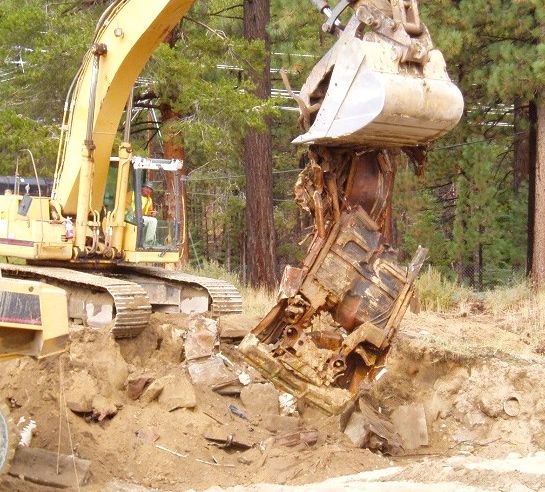
Layoffs at Tahoe Truckee Unified School District have been rescinded by a unanimous vote of the board.

The tentative agreement between the district and the Tahoe Truckee Education Association allowed for the vote to go forward April 25.

The new agreement includes provisions for an early retirement incentive and two to three furlough days next year. The agreement also includes a reduction of six teaching positions – a result attributed to enrollment decline that will likely be absorbed by the retirements.

 — Lake Tahoe News staff report


Firefighters ready to deal with what’s expected to be busy season

By Jeff Delong, Reno Gazette-Journal

Fifteen thousand firefighters are ready to deal with what’s expected to be a busy season for wildfire, with Nevada and the Sierra among areas in the country at high risk this year, two top cabinet officers said Thursday.

Agriculture Secretary Tom Vilsack and Interior Secretary Ken Salazar headed up a telephone news briefing on the 2012 wildfire outlook, predicting fire activity similar to last year, when more than 74,000 fires burned some 8.7 million acres nationwide.

“We believe we are prepared,” Salazar said of the coming fire season.

Much of the drought-stricken Southwest is at high risk of fire, as are the western slopes of the Rockies, said Ed Delgado of the National Interagency Fire Center in Boise, Idaho.

A near record-dry winter also put the interior mountains of California, including the Sierra, and the Western Great Basin of Nevada at high potential for dangerous fire.

Representatives of the Western Great Basin Predictive Services Center recently predicted more than 600,000 acres of Nevada will likely burn during this year’s fire season.

They said fire conditions typically found in mid-summer exist already. The Reno area was hit with two unseasonable fires in November and January, burning more than 5,000 acres and 50 homes.

Read the whole story