Placer County expands alcohol ban during July 4 holiday

The Placer County Board of Supervisors voted unanimously to ban alcohol on the banks of the Truckee River from July 1-6 each year.

At the meeting last week in Kings Beach, board members also voted to adopt an ordinance that will include Chambers Landing Beach in the Fourth of July weekend alcohol ban.

Since 2008, Placer County has prohibited the possession of open alcohol containers during the Fourth of July weekend alongside the river from Lake Tahoe to Alpine Meadows. The ban was a response to alcohol-related problems created by the many rafters who descend on the river during the holiday weekend.

The Truckee River ban prohibits possession of open alcoholic containers on both sides of the river from its outfall at Lake Tahoe in Tahoe City to the upstream edge of the Alpine Meadows Bridge during the holiday weekend. The ban extends 3 feet up from the river’s high water mark on each bank, including islands and bridges. The Fanny Bridge in Tahoe City is the only bridge excluded from the ban.

State law bans the possession of alcoholic beverages on the river and any of its islands during the Fourth of July weekend. The state has jurisdiction over the river because it is considered a navigable waterway.

Violations of the ban are punishable by a fine not to exceed $150 for the first violation, $500 for the second violation and $1,000 for the third violation occurring in any calendar year.


S. Tahoe, Reno motorcyclists die on Highway 49

By Bill Lindelof, Sacramento Bee

Riders of two motorcycles died when one bike went out of control and the other took evasive action to avoid collision in Sierra County on Sunday.

The California Highway Patrol said that a motorcyclist from South Lake Tahoe was heading southbound about 3pm Sunday on Highway 49 just north of the Convict Flat Campground between Camptonville and Downieville when he lost control of his vehicle.

The motorcycle slid on its side into the northbound lane at the same time another motorcyclist from Reno was approaching. The Reno motorcyclist, in an attempt to avoid collision, traveled onto the right shoulder and crashed into a guardrail.

Both motorcyclists died at the scene.


Cost to travel by plane continues to soar

By Charisse Jones, USA Today

If you’re flying this summer, you’ll probably pay more than you did last year. And the price for a ticket to ride will likely keep rising for months to come.

Summer fares for trips in the USA are up 3 percent on average over last year and 18 percent compared with 2010, according to booking site Travelocity.

It is going to cost more this summer compared to a year ago. Photo/LTN

The increase is steeper for international trips, with the average ticket costing 20 percent more than it did two years ago.

Airlines will likely push prices as high as they can, fare watchers say. “I would expect about a hike attempt a month, with about half being successful,” says Rick Seaney of Farecompare.com, which tracks ticket prices.

Airlines already have tried to boost fares six times this year, and three have succeeded, Seaney says. The next attempt likely will come before Memorial Day, the start of the prime summer travel season.

Read the whole story


Concerts, kayaks, food — all part of Lakeview Commons

By Kathryn Reed

It will neither be Julie Andrews making the hills come alive with the sound of music nor the bass of bands from SnowGlobe. Instead, a mix of jazz, reggae and blues are expected to resonate from Lakeview Commons this summer.

OnCourse Events has been granted a permit to bring music to the South Lake Tahoe venue. Every Thursday starting June 28 through Sept. 6 from 4-8:30pm a different band will perform on a temporary stage that will be built in the sand. Spectators can sit – for free – on the terraced area or up top where there are picnic tables.

“I want to introduce locals to different music,” Rob Giustina, with OnCourse Events, told Lake Tahoe News. He expects most acts will be from out of the area. However, the first band is likely to be Jump Start, though local, they don’t often play in the basin.
Free concerts on Thursdays are coming to Lakeview Commons starting in late June. Photos/Kathryn Reed

Giustina is more often associated with competition event productions. But as someone who was born and raised here, he wants to help the town resurrect itself in terms of fun and economics.

“I wanted to be proactive in saving our community,” Giustina said.

He expects to make money on the summer concert series selling booth space at $75 a pop for a 10-foot-by-10-foot spot. Artists, nonprofits – he will consider them all. Vendors will be at the top of the commons area.

Until the city votes on who will be operating the food part of the Lakeview Commons, Giustina is holding off on deciding what type of food will be sold. He doesn’t want to compete with the concessionaire, but instead complement or have his vendors be completely different. But he also hopes to have a beer garden.

Bids for the food concessionaire closed April 27. It’s possible the City Council could make a decision at its May 17 meeting.

For people wanting to be part of Giustina’s Live at Lakeview Commons Concert Series, email him at rob@oncourseevents.com.

Giustina is encouraging people arrive by bike. A valet will be operating for storage purposes during the concert.

As for what the city plans to do at Lakeview Commons, the rest rooms and drinking fountain should be in operation any day. Bathrooms will always be a seasonal operation based on demand, and the water will operate when the threat of frozen pipes is eliminated.

On the May 1 council agenda is an item to award the nonmotorized concessionaire to Standup Paddle, which has a shop on Harrison Avenue.

“Whoever gets the contract will have to do their own tenant improvements,” Stan Sherer, community services director, told Lake Tahoe News. The city will take a percentage of the gross profits, with it topping out at 12 percent.

In addition to the rental of paddleboards, kayaks and canoes will also be available.

Per the original plans when the $6.5 million Lakeview Commons project was conceived, people will also be able to store their nonmotorized craft at the boathouse for a fee.

Right now garbage cans without lids are scattered about Lakeview Commons. Sherer said those will be converted to bear-proof containers soon. A bid on the project is on Tuesday’s council agenda.

Landscapers will be back out there this week to finish the plantings.

Sherer told Lake Tahoe News his intent is to make the area accessible to dogs – legally. Plenty of people take their dogs to the commons and El Dorado Beach, but that is violating the current law.

Something that perplexes Sherer is why in the original plans there was no place to dump ashes from the barbecues.

“It’s not just having a facility to empty the briquettes, it’s will they use them or will they try to dispose of them someplace else,” Sherer said people who are barbecuing. The fear of someplace is it could cause a fire or contaminate Lake Tahoe.

A solution as of last week had not been found. And they are being used. Smoke has been seen wafting from the grounds on the unseasonably warm days.

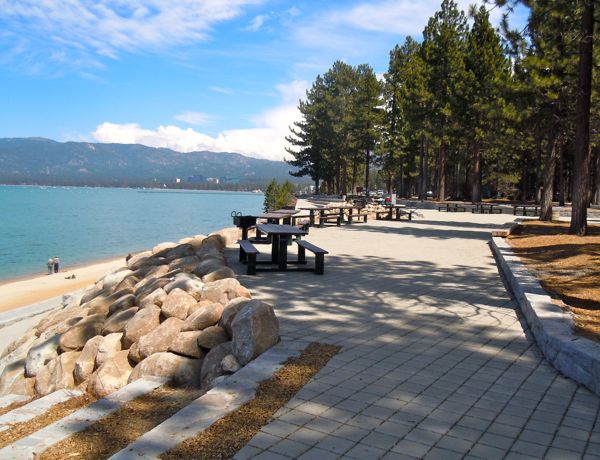
While the area has been transformed and looks nothing like it once did, all the boulders on the north end mean beachgoers can no longer walk very far. It used to be people could walk to Ski Run Marina and beyond.

A pipe on El Dorado Beach that used to be ghastly, especially as water drained directly into Lake Tahoe, is still there. Only now sand covers part of the upper part of the metal, and boulders and branches cover the lower section. Gunk, well, it still flows into the lake from Highway 50.

On June 20 at 2pm there will be a grand opening – again – of Lakeview Commons. This time Secretary of Natural Resources John Laird is supposed to attend the dedication, as will members of the California Tahoe Conservancy and its board. It was CTC money that funded the project.

What name it will be dedicated as, well, that remains to be seen.

A beach party will follow at 3pm.

ngg_shortcode_0_placeholder (Click on photos to enlarge.)


Nevada businesses say Amazon deal levels playing field

By Bill O’Driscoll, Reno Gazette-Journal

An even playing field, that’s all book-seller Christine Kelly wants.

Kelly has operated Sundance Bookstore and Music in Reno for 26 years, and she and has watched online retailing’s rise in part from not charging sales tax while she and other brick-and-mortar business owners must do so under the law. In Washoe County, that means 7.725 percent more on her customers’ bills.

Now it appears that competitive bump will be leveled off. Starting in January 2014, online retail giant Amazon.com Inc., which has 20 U.S. distribution centers including sites in Fernley and North Las Vegas, will collect sales tax on purchases originating in Nevada.

“I believe in competition, different forms of commerce,” Kelly said in hailing Amazon’s plan announced last week. “But it’s gotta be balanced and fair. I’ve no problem paying taxes, it just needs to be applied fairly. This elephant has been in our living room for a long time.”

The issue of taxing Internet-based sales, especially collecting from out-of-state retailers, has long been difficult for states to resolve — as well as to enforce.

In Nevada, “We have had voluntary collection where a number of companies have agreed to collect tax on merchandise they ship to the state,” said Carole Vilardo, president of the Nevada Taxpayers Association.

Read the whole story


Nevada analyzing runaway truck ramps

By Jeff Delong, Reno Gazette-Journal

No one yet knows what course of events forced Eric Holton to steer his speeding truck onto a gravel escape ramp on the Mount Rose Highway on Monday.

What is clear is that things had already gone terribly wrong. It’s the last thing any trucker wants to do.

“You talk to most truck drivers and they tell you they are going to do anything possible to avoid using one of those ramps,” said Thor Dyson, district engineer for the Nevada Department of Transportation.

“They know bad things are going to happen,” Dyson said. “They may or may not make it through it.”

Holton didn’t. While the runaway truck ramp near the junction of Nevada 28 apparently did its job – halting the big rig in a spray of dust and gravel – the truck’s load of building material smashed forward into the driver’s cab, killing him instantly.

The Nevada Highway Patrol continues its investigation into Monday’s accident that killed the 31-year-old Gardnerville resident, including what forced the driver to use the ramp in the first place.

But the accident focused new attention on the Mount Rose ramp – the site of a horrific fatal truck crash nearly two years ago – and on the state’s three other ramps installed to give drivers a last option during a worst-case scenario.

The Nevada Department of Transportation is currently conducting a study into the state’s four highway escape ramps, an effort initiated in the wake of the June 2010 accident. Trucker Frederick Douglas Matthews died when his speeding lumber truck launched off the end of the ramp and smashed into an Incline Village home nearby, exploding into flames. Investigators later determined the truck had faulty brakes.

Read the whole story


Fallen Leaf Lake adding boat rentals, making marina repairs

By Kathryn Reed

While the actual road to Fallen Leaf Lake is a rougher ride than it has ever been, the operations of the community service district are smoother.

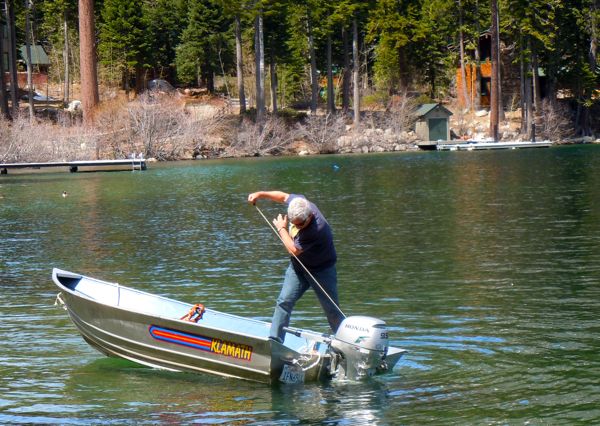
Sid Bazett, who is a part-time resident of the South Shore enclave at the edge of Desolation Wilderness off Highway 89, didn’t let the fact that the docks aren’t in stop him from launching his boat on a sunny Saturday afternoon.

About an hour later on April 28, the board that runs the operations of the lake met at Lake Tahoe Airport.

Sid Bazett gets an early start April 28 to the boating season at Fallen Leaf Lake. Photos/Kathryn Reed

The three board members – Tom Bacchetti, Wanda Knowacki and Stephanie Neidig – agreed to spend the money to repair the breakwater logs and launch dock.

Knowacki described a storm in early December as “unusually violent” which resulted in the damage. Emergency fixes were made to make it safe, but now a more permanent solution is needed prior to the start of the season – which is usually Memorial Day weekend.

California Land Management, the concessionaire for the Fallen Leaf Lake marina and store, is liable for the first $5,000 per the contract. It’s estimated the district will need close to $6,000 to complete the repairs.

John Rich, who for years was the concessionaire at the lake, will do this.

It was mentioned that the district is doing fine financially after a good year with CLM operating the concession. The money for the repairs will come out of the district’s operating budget.

CLM’s contract for another year was approved Saturday. A change is that the operator, which also runs the U.S. Forest Service owned campground at the other end of the lake, will be allowed eight slips instead of six for rental boats.

Larry Chapman, assistant director of operations for CLM, told the board, “We think we can do more business (with rentals). All the slips have not been rented in the past.”

He rents fishing boats and pontoon boats.

The board also agreed to increase the maximum horsepower allowed on the pontoons from 15 to 40. To start with Chapman is going to try using high altitude props to increase power. The reason to do this is for safety concerns because the limited horsepower isn’t enough for a boat full of people to get back to the marina on a windy afternoon.

The Fallen Leaf Protective Association is paying for a Tahoe Resource Conservation District employee to be in charge of boat inspections Thursday-Monday, 8am-5pm from May 24-Sept. 10.

In May, CLM staff will be trained by TRCD and Tahoe Regional Planning Agency employees how to use the hot wash decontamination apparatus that is designed to keep invasive species out of Fallen Leaf Lake. Fallen Leaf, unlike Lake Tahoe, has zero invasives in it.

Chapman said the goal is to have the operations going the weekend or week before Memorial Day so locals can get their boats in the water before the masses descend.

As for the three-member board, they agreed to fill the two vacancies by appointment. They are hoping to be able to do so at the June meeting.

James Kelly, a part-time resident participating by phone, was against doing so by appointment.

“Residents are disenfranchised and we are out of the loop,” Kelly said.

Board President Bacchetti said he believes the whole voting issue at the lake has been clarified, even for people whose property is on U.S. Forest Service land. The whole voting brouhaha at Fallen Leaf Lake has gone from the District Attorney level to the Attorney General’s Office. Allegations of voter fraud have embroiled the district for a couple years.

At issue were people voting at Fallen Leaf Lake who voted elsewhere – which is illegal – or not claiming the lake residence as what it is.

“If you claim your domicile at Fallen Leaf Lake, the district attorney says you are able to vote,” Bacchetti said. “There is a difference between a domicile and permanent residence.”

The board appointments will be until the next election in November 2013.

A key reason to get people on the board soon is that four votes are needed to pass the budget.

ngg_shortcode_1_placeholder (Click on photos to enlarge.)


Dissecting demographics key to knowing Tahoe visitors

By Kathryn Reed

STATELINE – Paying attention to what the population looks like is critical to knowing who to market Tahoe to.

That was the overriding message of Emilyn Sheffield. She was one of two presenters at the annual Lake Tahoe Visitors Authority-Lake Tahoe South Shore Chamber of Commerce tourism conference on Thursday.

Sheffield, who is a professor at CSU Chico, also brought 20 of her students to the South Shore. They spent several days in the area essentially testing the tourist product.

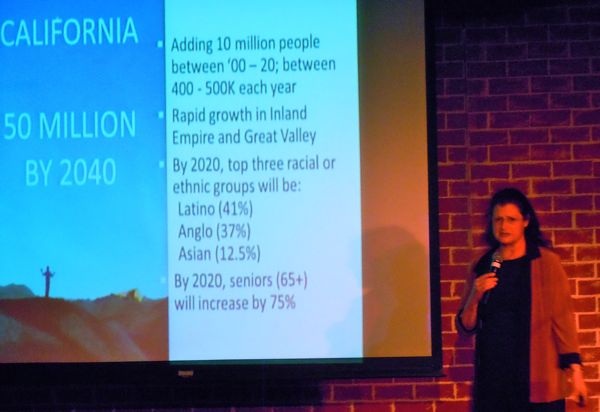
Professor Emilyn Sheffield suggests ways South Shore tourism officials can draw more people to the area. Photo/Kathryn Reed

The other speaker was Ralf Garrison, director of MTRiP – Mountain Travel Research Program. Much of the information was the same that he delivered at the Mountain Travel Symposium at the Resort at Squaw Creek earlier this month.

The two-hour event April 26 at Harveys drew a crowd of about 100 people.

Using information from the Census to project trends in demographics, Sheffield said it’s important tourism leaders in Lake Tahoe realize that California’s population by 2020 is expected to be 41 percent Latino, 37 percent Anglo and 12.5 percent Asian.

She said while Tahoe has relied on Anglos in the past, this cannot continue unless the region wants to be an exclusive enclave.

Sheffield added that while the Tahoe South website redesign looks good, it needs more.

“You only see Anglos. You need more diversity of photos and more diversity of spokespeople,” Sheffield said. Too many white people on the website was her complaint. People who travel want to see people who like them doing what they might do in whatever location it is.

Sheffield added that growth in the Asian market could be good because historically they are interested in gaming. But she said Hispanics overall don’t like the snow, so it’s good the area has four seasons.

Sheffield suggested three things for the South Shore to focus on:

• Recapture the Baby Boomers by reconnecting with them through their values of peace, love and harmony with nature. She added that if hotels are not pet-friendly, they would lose this group.

• Rethink what accommodations are like. Boomers and Hispanics are traveling not as couples, but multigenerational. This means two rooms, two bathrooms in a single unit. Sheffield said they tend to rent houses instead of condos. With the Latinos, they like to go places where people know how to speak Spanish.

• While the millennials have meager means today, they are the future. “Expect them to be loyal,” Sheffield said. That’s why they should be lured to Tahoe today. She said they may only have $200 to spend in a weekend, but they will spend it all. Hostel-like accommodations may be the answer for lodging, then the rest will be spent on food and entertainment. And for this generation, make sure there are enough plugs for all of their digital devices.

Garrison pointed out how tourism businesses need to look beyond the traditional people they market to. He said a resort in the Tahoe area during January had an 80 percent spike in ski school business – when there was no snow.

The resort was attracting beginner skiers who felt safe to drive the mountain roads.

“So it shows there are different ways to market,” Garrison said.


Reduced funding for Nevada Homeland Security division

By Sean Whaley, Nevada News Bureau

CARSON CITY — Nevada’s Homeland Security Commission this week adopted a drastically reduced plan to continue the fight against potential terrorist attacks, leaving six ongoing programs without funding because of declining federal support.

Led by Commission Chairman and Gov. Brian Sandoval, the panel of law enforcement and other emergency services providers unanimously adopted a plan that will see $4.3 million in total federal funding this year, a 60 percent reduction in funding from 2011 when Nevada received $10.8 million.

The commission approved funding for 10 projects and programs, including its three threat analysis, or “fusion” centers, but another 11 received no funding. Six of the 11 were to sustain existing programs, from the Washoe County Silver Shield program to the Carson City Regional Citizen Corps. Silver Shield programs are those designed to protect critical infrastructure, from water systems to government operations.

The projects receiving funding were the result of a collaborative effort by the statewide commission.

The federal funding comes via two programs: the Urban Area Security Initiative and the State Homeland Security Program through the U.S. Department of Homeland Security. Federal support for both programs was reduced significantly this year. The UASI funding totaled $2.66 million, down from $5.7 million last year, and the SHSP funding totaled $1.65 million, down from $5.14 million in 2011.

Even so, Rick Martin, program manager for the state Division of Emergency Management, said the funding priorities developed by commission members and support staff and funded today will keep Nevada safe.


Police chiefs focus on disparities in gun violence

By Erica Goode, New York Times

WASHINGTON — In a single week last April, three people were killed with guns in Philadelphia, 14 more were shot and wounded, 68 robberies were carried out at gunpoint and a total of 144 crimes involving firearms were reported.

During that same week in San Diego, a city of roughly the same size with far fewer police officers, there were no gun-related homicides, two people wounded by gunshots, four robberies committed at gunpoint and a total of only 20 gun-related crimes.

What made the difference? About 250 police chiefs from around the country debated this question and gun violence more generally at a meeting here this week, taking as their focus a survey of crimes occurring in six cities — Philadelphia, San Diego, Milwaukee, Minneapolis, Austin, and Toronto — over a seven-day period in April 2011. The survey was carried out by the Police Executive Research Forum, a nonprofit police research group that sponsored the session as part of its two-day annual meeting.

Coming two months after the shooting death of Trayvon Martin in Florida, the wide-ranging discussion encompassed the proliferation of laws that make it easier to own, carry and use a gun; the role of gangs and narcotics; the characteristics of perpetrators and victims; and the need for more aggressive prosecution and greater investment in technology to trace and identify firearms.

If there was a central message to be drawn from the survey, it was that gun violence is tightly concentrated in the poorest urban neighborhoods, its victims mostly minorities, who receive little attention from politicians and the news media.

“Nobody in this room, unless you’re from Sanford, Fla., would even know the name of Trayvon Martin if it was a black kid that had shot Trayvon Martin,” said Police Commissioner Charles H. Ramsey of Philadelphia, who is African-American.

“It happens every single day in Philadelphia. It happens every single day in cities across the country, but if it’s a black killing a black,” no one cares, Commissioner Ramsey continued, noting that the week studied by the forum was less violent than many other weeks in Philadelphia. “Our streets are bleeding, and they’re bleeding profusely.”

The survey found that, using conservative estimates, the cost to taxpayers of the crimes committed with firearms during the week of April 4 to April 10 was more than $38 million in medical care, social services, criminal justice costs and other expenses.

Read the whole story