Gaming industry gross revenue up 3% nationwide

By Richard N. Velotta, Las Vegas Sun

The gaming industry is getting healthier nationwide with gross gaming revenue and tax revenue up from the 492 commercial casinos and 517 card rooms operating in the United States, the American Gaming Association says.

The Washington-based organization issued its annual “State of the States: The AGA Survey of Casino Entertainment” report on commercial casino operations on Wednesday.

Casino industry in U.S. improving. Photo/LTN

It’s the 14th AGA report comparing key casino data from the 15 states that have commercial casinos, 13 with so-called “racinos” at horse and dog tracks, 29 states with tribal casinos and five states allowing card rooms.

This year’s edition also includes a survey of elected officials and civic leaders in gaming jurisdictions on the overall impact of casinos on their communities.

This year’s report says gross gaming revenue was up 3 percent over 2010 to $35.6 billion in 2011. In the previous year, revenue increased by less than 1 percent.

Tax revenue climbed 4.5 percent to $7.93 billion in 2011 and the industry directly employed 339,000 people who earned $12.9 billion in wages, tips and benefits. While the industry touts the number of jobs in provides, the total number of jobs in 2011 was down 0.4 percent from a year ago.

The report provides a comparative snapshot of commercial casinos and indicates that the Las Vegas Strip remains the top U.S. casino market with $6.07 billion in gross gaming revenue. Three of the top 20 markets are in Nevada with Las Vegas’ Boulder Strip the No. 10 market ($778.9 million in revenue) and Reno-Sparks at No. 14 ($663.3 million).

Read the whole story


Raley’s contract extended; mediation to begin Monday

By Sacramento Business Journal

The union representing Raley’s workers announced Tuesday night it had agreed to a contract extension and mediation in an effort to avoid a strike against the West Sacramento-based supermarket chain.

Citing what it called a joint statement by leaders of United Food and Commercial Workers and Raley’s president and chief executive officer Michael Teel, the union said the contract would be extended to June 6.

The contract expired Oct. 8 and had been extended repeatedly. It lapsed April 30. The agreement covers workers at Raley’s, Bel Air and Nob Hill Foods stores.

Read the whole story


State deciding on site for courthouse in Placerville

By Carlos Alcalá, Sacramento Bee

The California Administrative Office of the Courts will host a public hearing May 15 in Placerville on a site under consideration for a new El Dorado County Courthouse.

The county’s current Superior Court operations in Placerville are split between two locations, both of which have significant deficiencies.

Criminal trials in the original Main Street Courthouse require defendants to be walked through the same areas used by jurors and witnesses.

A new location is proposed for 300 Forni Road, near the jail.

Read the whole story


Police making effort to cleanup South Lake Tahoe

By Kathryn Reed

Taking possession of a rundown house in the city limits may provide funding to better enhance the look of areas throughout South Lake Tahoe.

That is the goal of Police Chief Brian Uhler.

Code enforcement and graffiti eradication in large part fall under his department’s purview. But time and money are limited. And the problems keep increasing.

An open dumpster and one with graffiti on it sits outside the Forest Manor apartments in South Lake Tahoe. Photo/LTN

A surge in graffiti is typical this time of year. Those who tag don’t like being in the snow and cold. They seem to hibernate a bit in the winter.

Uhler says much of what is showing up on buildings and other locations is not gang related. An area on Ski Run Boulevard and Pioneer Trail was hit a few weeks ago that resulted in the arrest of two teenagers and four others who may be behind bars soon, he said.

“F— the cops” has been seen on both ends of town – near the would-be convention center and on the might-be TJ Maxx.

“We have someone who has some dislike for us,” Uhler said of those tags. “Someone out there feels the need to express that.”

Profanity gets covered up the quickest.

But what Uhler hopes to do is take the property on Chris Drive that the owner gave to the city, sell it and use the money to hire a full-time code enforcement officer who would be driving a vehicle bought with the property proceeds that is fully equipped to abate graffiti.

A few things need to happen first.

Firefighters plan to use the structure to train on after asbestos and any other hazards are removed. Then the debris will be hauled away and the lot put on the market.

Plus, the council needs to approve of how the money would be spent.

At one time city officials talked about turning this lot into a pocket park, but upon further discussion it was deemed not to be the best location for open space and would be more beneficial to the city to sell it – which also means getting property taxes.

A part-time code enforcement officer is in the process of being hired, with the idea that person’s work will pay for his job. The same would be true if Uhler is able to convince higher ups to hire a full time enforcer.

Uhler wants to take each of the five councilmembers on a tour of the city so they see firsthand what officers see. Then he wants consensus on what they want done.

The city has ordinances on the books about signs, trash, graffiti and other items that would fall under code enforcement, but the council recently has been a bit wishy-washy and tends to side with people who appeal the decisions made by staff.

“There are interpretations as they relate to aesthetics, but trash and debris piled up and loose are clearly violations of our ordinance,” Uhler said. “We will go after general piles of trash, junk, boxes. There are things piled up in places all along the Highway 50 corridor. Then we’ll go into neighborhoods. Our effort is to make our town more closely be aligned with the beauty of our natural environment.”


O’Rourke packing bags for Washington

By Kathryn Reed

South Lake Tahoe City Manager Tony O’Rourke expects to be on the city’s payroll through July 1, with his first day as city manager of Yakima, Wash., the following day.

“It’s difficult to depart, but I’m looking forward to the opportunities and challenges,” O’Rourke told Lake Tahoe News.

Tony O'Rourke

The Yakima council on May 8 voted 5-1 to approve O’Rourke’s contract. He will be making $175,000 – the same salary he has in Tahoe.

According to the Yakima Herald-Republic, the councilman who voted no to the contract supports O’Rourke, just not the six months of severance pay he would get if voters approve a switch to a strong mayor form of government. O’Rourke had a nine month severance clause in his contract here.

O’Rourke said he has vacation time left on the books so it’s possible he will not be at his desk through June.

At the May 15 City Council meeting the Tahoe electeds are expected to appoint an interim city manager and discuss the recruitment process for a permanent leader.

“The headhunter approach has been put out there, but I’m not sure that’s the best way, but I also don’t know,” Mayor Claire Fortier told Lake Tahoe News.

She said the discussion next Tuesday will be in open session. Fortier said the council wants someone on board sooner rather than later.

Another component to the hiring is that the terms for Councilmen Bruce Grego and Hal Cole are up in December after the Nov. 6 election. Grego has indicated he plans to seek another term, while Cole has not decided.


Tahoe Resources listed on NYSE, rings opening bell

By Kellene Stockwell, Channel 2 News

A local mining company celebrated its stock going public by ringing the opening bell at the New Stock Exchange on Tuesday.

Tahoe Resources Inc. is already listed on the Toronto Stock Exchange as THO. It’s listed as TAHO on the NYSE, and is a member of the S&P/TSX Composite and TSX Global Mining indices.

The company’s president and CEO Kevin McArthur says he’s happy to bring shares to the U.S. market to widen their shareholder base.

Read the whole story


Study: Travelers not interested in paying higher taxes, fees

By Bonnie Eslinger, Palo Alto Daily News

A nationwide survey of convention, trade show and meeting industry professionals concludes they would have second thoughts about holding an event in the Bay Area if San Mateo County voters approve June 5 ballot measures that would raise the hotel tax and start taxing commercial parking lot and car rental businesses in unincorporated areas, as well as at San Francisco International Airport.

The poll, conducted by the U.S. Travel Association, says that more than 40 percent of 366 respondents would “definitely” search for a new meeting destination or “reconsider” holding their next meeting or event in the Bay Area, according to a press release the organization released Thursday. In addition, 25 percent said they would have to cut back on their meeting expenses if they held an event in the region.

U.S. Travel Association COO Geoff Freeman said there’s a tipping point, even for popular destinations, when tourism professionals can’t justify spending more there than in other locations fighting for their dollars. That’s how New York lost some of its travel business he said.

San Mateo County is showing a “pure disregard for visitors,” Freeman said. Asked why the association got involved in the county’s affairs, Freeman said it has been keeping an eye and ear out in recent years for such taxes, which have become more common in the current economy.

The Board of Supervisors voted in February to place the tax measures on the June ballot.

Read the whole story


CTA president tells Tahoe educators it’s time to unify

By Kathryn Reed

When those in education take a stance against colleagues – as in administrators vs. unions, K-12 v. community colleges, classified vs. certificated – the message the public hears is disenfranchisement among the ranks.

“We are more defined by what separates us than what binds us,” Dean Vogel told a group of educators Monday night at Lake Tahoe Community College.

Vogel, who has been president of the California Teachers Association for nearly a year, was invited to speak by the college’s Classified Employees Union and Faculty Association. The former just unionized and joined the CTA.

CTA President Dean Vogel speaks May 7 at Lake Tahoe Community College. Photo/Kathryn Reed

“What we don’t do enough of is coming together and talking in groups like this,” Vogel said.

An array of people was in the college theater – from K-12 teachers to LTCC’s president to a college board member.

Vogel said it’s time people in the profession start having conversations with parents and the community as a whole so they know what is going on, so they understand what is happening in the classroom, the impact of decisions by people who are far removed from the classroom, and what funding cuts mean.

“I’ve yet to meet a teacher who says all this testing stuff makes good sense,” Vogel said.

But he says when he meets with Arne Duncan, U.S. secretary of Education, and others in Washington the talk is all about testing.

“They don’t understand they have the capacity to stop this,” Vogel said of the nonstop testing of students. “The argument always is you have to assess kids. They don’t understand what that means.”

Computer based assessment of students could be a federal mandate in 2015. But the technology is not there for everyone.

Vogel added that policymakers have talked about funding universities based on how students test out. He touched on how a degree from a CSU or UC used to be within reach for a middle class family. Now it can be $35,000 – what Stanford used to cost.

Money and testing are the two words that permeate discussions about education. Students and learning seem to have been lost in the conversation.

That may not change as another election season gets under way.

Vogel said it’s critical the education community tap into the 73 percent of voters who are happy with their schools. Vogel said it’s important to look at people who have voted in the past five elections. Those are solid voters.

With Gov. Jerry Brown expected to release the May revised budget for 2012-13 next week, all eyes are on Sacramento. But already those in education know the coffers will be diminished if voters say nay to the governor’s proposal on the November ballot. That is money to keep funding levels – not something to add to the bottom line.


Sandoval outlines how he wants to reform education

By Sean Whaley, Nevada News Bureau

CARSON CITY -– Establishing school choice for parents and ending social promotion for students are two top priorities in Gov. Brian Sandoval’s education reform agenda for the 2013 legislative session, an administration official said.

Linking pay to performance and providing professional development to ensure students have the best possible classroom teachers is a third major priority, said Dale Erquiaga, senior adviser to Sandoval.

Erquiaga briefed the Nevada State Public School Charter Authority last week on the governor’s education reform agenda being readied for the next session.

Erquiaga said Sandoval is a strong believer in parental choice for schools and that he will again pursue that objective. Whether it will be through a voucher system or by providing opportunity scholarships directly to parents to pick a private or public school has yet to be determined, he said.

Implementing a voucher program would likely require a change to the state constitution, a time consuming process. A scholarship option might circumvent the need for a constitutional change. Florida implemented school choice by giving tax breaks to corporations that provide scholarships to parents for private school, including those operated by religious organizations.

“Fortunately though, we now, really for the first time, have a superintendent of public instruction who supports those concepts and will be working hand-in-hand with the governor’s office to present the best bill,” he said in an interview after his briefing. “The superintendent the governor has hired is a national expert with a national network, and we’re going to bring all of that intellect to bear on providing the very best bill that we can.”

James Guthrie, formerly the senior fellow and director of education policy studies at the George W. Bush Institute in Dallas, Texas, was named by Sandoval as the new state superintendent of public instruction in March. He started his job April 2.

Erquiaga said Sandoval was disappointed that the 2011 Legislature failed to act on his proposal to end social promotion. His bill would have required children to be reading proficient by the end of third grade or they would not advance to the fourth grade.

The bill had a hearing but never made it out of the Democrat-controlled Assembly.

“We already provide class size reduction dollars in grades one, two and three,” Erquiaga said. “We have smaller class sizes and it is the intent of those dollars that those children receive the special attention. And yet we’re still passing on thousands of children who can’t read. We’re dooming them to failure.

“We may need to draw a bright line in the sand there,” he said.

Ensuring that each classroom has a highly effective teacher is Sandoval’s other major priority, Erquiaga said.

“We have a performance pay framework but the new superintendent has great ideas around a career ladder so that teachers can see a progression in their career and so we’re really going to look at that as well,” he said.

“We recognize that if we have an effective or highly effective teacher in the classroom, there is almost no better gift that we could give a child than that,” Erquiaga said.

The intention is to reward highly effective educators, including principals, and find ways to keep them, he said.

One element of Sandoval’s education agenda that was well received by the Charter Authority was the idea that many of the existing separate funds designated for specific needs such as textbooks, be placed instead in performance-based block grants that would give school districts more flexibility in how to use the money. Charter schools would be eligible for these block grants as well, Erquiaga said. A bill to accomplish this was introduced in the 2011 session but did not win approval.

The State Public School Charter Authority, itself created by the 2011 Legislature and viewed as a major education reform success by Sandoval, will have at least one bill draft, he said. The authority, created to focus on the creation and oversight of quality charter schools in Nevada, met today and had a discussion about what proposals to bring to the 2013 Legislature.

One of the key issues for the Charter Authority is the creation of “performance-based” charter contracts, which would link accountability to outcomes.

Erquiaga said Sandoval is a strong supporter of accountability throughout the public education system.



Survey: Drug Store Project makes a difference with kids

By Kathryn Reed

“I am concerned about kids my age (12) to be taking drugs and that they can cause death, lung problems, liver problems, and to make you look older than you are.”

That is what a sixth-grader on the South Shore said after attending the Drug Store Project this spring.

While plenty of people believe drug and alcohol education should be the responsibility of parents, the reality is that is not happening.

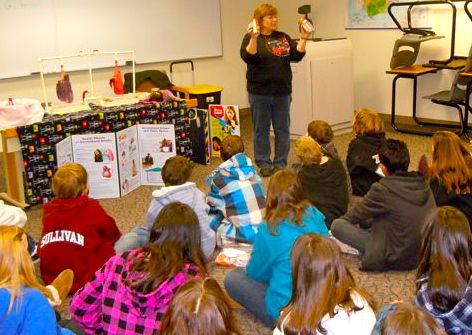
Students learn about gateway drugs in the Drug Store Project. Photo/LTN file

More than half the students at South Tahoe Middle, Zephyr Cove and St. Theresa schools said they get most of their information about drugs at school. About 20 percent get the info from their parents, while the next largest “educator” is TV, movies and books.

“The comments for me are the most important. You can tell from those they are not getting drug prevention in the schools,” Lisa Huard, who puts on the Drug Store project each year, told Lake Tahoe News. “They should know what gateway drugs are. They should know them by name. They should have that before they ever get to sixth grade.”

Huard was the safety coordinator for Lake Tahoe Unified School District until the position was eliminated a handful of years ago. She continues to do that work on a contract basis for Tahoe Truckee Unified.

Tahoe Youth & Family Services is now the lead agency for Drug Store Project.

These are the LTUSD drug and alcohol curriculum guidelines provided by the district. Superintendent Jim Tarwater was not available to talk about what is actually being taught in the classroom now that the emphasis is on ensuring students test well to meet state and federal requirements.

However, South Tahoe Middle School Principal Beth Delacour said, “What Lisa (Huard) does is amazing. It changes kids lives and it makes them think. I think Drug Store Project is really valuable. It gives them a glimpse of reality and helps them think.”

“One thing I learned was that one minute you’re trying to be cool, the next minute your parents are called to come to the hospital and the doctors have to tell your parent ‘we’re sorry, but your child’s gone’ and then your parents don’t know what to do. So my point is don’t do drugs. Never ever. One try could kill you.” – South Shore sixth-grader

The daylong event talks about how tobacco, alcohol and marijuana can lead to the use of stronger, more dangerous drugs. But it also talks about the danger of these three drugs are.

“The concern I have in the last two years has been the increase of kids with the acceptability of pot and saying it is not a bad thing,” Huard said. “People don’t want to see our kids drinking, but they don’t seem to be alarmed with marijuana because they smoke it.”

At an age when children are not mature enough to fully understand the consequences of their actions, they are getting conflicting information about what is OK to put in their bodies. They want to emulate the adults in their lives. They may see the marijuana shops dispensing medicinal marijuana, so youngsters see pot solely as a legal drug.

On the student survey one of the biggest differences in pre- and post-event answers was with the response to: Prescription drugs from someone’s doctor are safe to take. Almost half thought this was true before Drug Store Project, while more than three-quarters knew afterward that taking drugs prescribed for someone else could be lethal.

“I learned that most likely seven people in my class will be addicted to drugs by the time they graduate from high school.” – South Shore sixth-grader

Huard said, “It all centers around destructive behavior. They need to know what it does to their body. They need to be provided the opportunity to make better decisions. The majority of our kids, who if they knew more, they would make different choices.”