Pot bill passes California Assembly, Senate may extinguish it

By Peter Hecht, Sacramento Bee

A drive to regulate California marijuana dispensaries won a key victory Thursday, raising the hopes of advocates who argue that state oversight is critical to staving off federal raids on California’s medical cannabis industry.

The state Assembly voted 41-28 to pass a bill to create a California policing agency to license marijuana stores and oversee a state-sanctioned medical pot industry from growers to delivery drivers to marijuana testing labs.

Since October, raids on California medical marijuana outlets and threats of federal prosecution against operators and landlords have shuttered scores of dispensaries across the state, including nearly 100 in Sacramento County.

Assembly Bill 2312 by Assemblyman Tom Ammiano, D-San Francisco, faces a difficult road to passage through the Senate and desk of Gov. Jerry Brown. The bill, which would create a Bureau of Medical Marijuana Enforcement in the state Department of Consumer Affairs, drew no formal law enforcement support.

The legislation has been blasted by critics as short on specifics as to how California can govern hundreds of dispensaries and thousands of workers in a state medical pot trade once valued at $1.5 billion or more.

Read the whole story


Truckee makes top 10 list for expensive places to live

If people didn’t already know it, U.S. News & World Report confirmed it — Truckee is one of the most expensive places to live.

The Northern California city comes in at No. 8.

The magazine says, “Everyone from librarians to shop owners feel the economic pinch of working and living in Truckee. The monthly cost of living for couples with a child younger than 6 years old equaled $8,321 in 2010, while couples with two or more older children paid $9,323. Homeowners and renters spent $8,689 and $6,962 respectively, C2ER reveals.”

And the report says it can cost $1,370 to relocate from Sacramento to Truckee.

“Relocation Expense: Workers might spend as little as $280 (if moving to a spot with one bedroom) and as much as $1,370 (for five bedrooms) when relocating within the Sunshine State this June. That’s about how much it costs to move from Sacramento to Truckee.”

The most expensive cities are: 1. Manhattan, 2. Brooklyn, 3. Honolulu, 4. San Francisco, 5. Queens, N.Y., 6. San Jose, 7. Stamford, Conn., 8. Truckee, 9. Washington, D.C. area, 10. Newport Beach.

— Lake Tahoe News staff report


Raley’s workers taking vote on whether to strike

Publisher’s note: The two South Lake Tahoe Raley’s are part of Local 8. The strike vote is being taken June 3-4 at Embassy Suites.

By Dale Kasler, Sacramento Bee

Raley’s, trying to head off a strike vote, is warning its union workers about more store closures and other consequences if they walk out.

With members of the United Food and Commercial Workers about to vote to authorize the first strike against Raley’s, company Chief Executive Michael Teel said the grocery chain plans to hire replacement workers to keep stores open if a work stoppage occurs.

Even with replacements, Raley’s expects to close “select underperforming store locations” – and many of those would likely close for good – Teel said in a memo to workers.

Raley’s has already announced four store shutdowns this year, saying it needs labor concessions to become more competitive with nonunion rivals such as Wal-Mart. In his letter to UFCW members, Teel said the West Sacramento chain is a “family-owned business that is fighting for survival in a struggling economy and competitive environment.”

Members of UFCW Local 8, based in Roseville and covering much of the Central Valley, are scheduled to hold strike-authorization meetings starting today. It isn’t known when results of the vote will be available.

The union said employees of Raley’s Bel Air subsidiary won’t vote because their contract doesn’t expire until June 30. The union’s contracts with Raley’s and Nob Hill employees expire Wednesday.

Read the whole story


No arrests ever made in Angora Fire

By Kathryn Reed

Even if someone were arrested or admits to having been responsible for the Angora Fire, he or she may never be punished other than through their own guilt or if vigilantism takes over.

Angora Fire — 5 years later

It would depend on the state and/or federal charges that could potentially be levied against the person or persons if he or she would be brought to justice. Various statutes of limitations have passed or are close to passing.

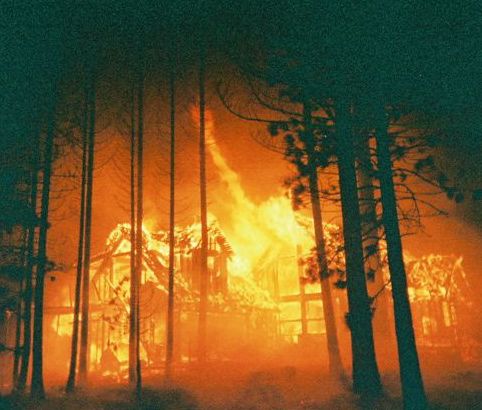
Hundreds of people were interviewed after the June 24, 2007, fire that reduced 254 houses to ashes. It was almost immediate that fire investigators located the ignition point near Seneca Pond in the Upper Truckee neighborhood on the outskirts of South Lake Tahoe.

“On the second day of the fire a group of us narrowed it to the general origin area,” Beth Brady, fire investigator with the Lake Tahoe Basin Management Unit, told Lake Tahoe News.

While a person of interest was questioned extensively, not enough evidence could be secured to arrest that person.

“We often go after wildfires civilly instead of criminally. It has to do with intent,” explained Lauren Horwood with the U.S. Attorney’s Office in Sacramento. “Arson is willful, deliberate. If it’s negligence, that is different than a crime.”

The El Dorado County District Attorney’s Office is now the lead agency on the investigation. Investigator Bill Dillard told Lake Tahoe News tips still occasionally come in and all are followed up.

What the area near where the Angora Fire started in 2007 looks like five years later. Photo/LTN

“In this particular case I have a strong suspect lead, but I don’t feel like there is enough probable cause to go forward,” Dillard said.

Finding the origin

Because of the intensity of the fire Brady and others were not able to get into the Seneca Pond area the first day. But she knew based on reports from firefighters first on the scene and the fire’s behavior where it was likely to have started before stepping into the forest.

With the houses already destroyed, this blaze was significant on Day 1. A high-level fire investigator was brought in to see if he would narrow the ignition area to Seneca as well without being told what others were thinking. He came to the same conclusion.

Investigators use a process adopted by the National Fire Protection Association to track down where a fire started.

“We work our way backward following burn patterns and marks left on trees and rocks,” Brady explained. Witness statements factor in as well.

After the larger perimeter is established, investigators begin looking for micro indicators of the fire’s origin.

“We still look for marks left, but we could be on our hands and knees looking at individual pebbles or grass stems,” Brady said.

Angora was determined to have started by a campfire that was not fully extinguished. This is a locals spot; a known spot for young people to party. Seneca is a decent size pond about a quarter mile in from the houses on Seneca Road. Beyond it are some large granite boulders, with the largest one being the closest to where the campfire was.

“At this particular campfire there was limited forensic evidence, but there were certain characteristics of the campfire that were unique. But for the integrity of the case we don’t want to describe what they were,” Brady said. “I will say it did not have evidence of a large party fire we see in the woods … where there is a big bonfire and lots of beer bottles around.”

Without being shown where the starting point was or being a fire investigator, it would be impossible to know where the location is.

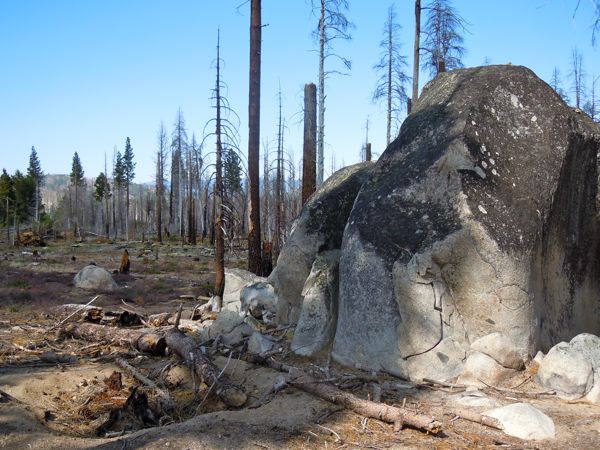
But looking around, surveying the area today, lush green is just to the south of the spot. The winds swirled that Sunday, bringing the fire close to the streets that lead to this play area before flames whipped north up Angora Ridge and through the neighborhood just below it. So many trees here and elsewhere in the burn area are white. The bark is gone. It’s like they are skeletons of a forest.

“I hope and pray that one day we will find out who is responsible and we hold them responsible so there is closure for this community,” Dillard said.

——

Note: Anyone with information regarding the Angora Fire investigation is encouraged to contact Bill Dillard at william.dillard@edcgov.us or (530) 903.8041.


Further containment in Douglas County fire

Updated June 2, 2012 9:50pm:

The Preacher Mine Fire is estimated to be 55 percent. contained; still at 1,070 acres burned. The fire has not grown since 3:30pm Saturday.

Mop up has started on the interior of the fire.

The River Bend Fire was contained June 2 at 8pm at 11 acres.

—–

Updated June 2, 2012, 3pm:

The Preacher Mine Fire in Douglas County as of 2pm Saturday had grown to about 1,070 acres, with 35 percent containment.

Today’s efforts are primarily focused on the north and east sectors. Four helicopters are providing water drops.

Due to the number of emergency vehicles on the roads in the area of the fire, civilian vehicle traffic has been blocked at the intersection of Pinenut Road No. 2 and Out-R-Way. Only people who reside in the neighborhood are allowed access into the restricted area.

The Ray May 2 Fire was contained at 43 acres. It is currently in mop-up status. Estimated time of control is 8pm June 3.

——–

Firefighting crews made considerable progress on the Preacher Mine Fire overnight. A significant containment was made along the south and west sectors of the fire, and today’s efforts will focus on the north and east sectors.

The 700-acre fire in Douglas County is estimated to be approximately 30 percent contained.

Four helicopters will be providing water drops.

No homes are immediately threatened by the fire, however there are about 40 houses in the rural area where the fire is burning. Evacuation is voluntary.


USFS moves Lake Tahoe logging for woodpecker; still criticized

By Scott Sonner, AP

U.S. Forest Service officials have agreed to move post-Angora Fire logging operations farther away from nests with rare, black-backed woodpecker chicks at the request of conservationists who’ve been fighting the overall project for years.

But John Muir Project members — who have documented one nest in the path of the logging and suspect there are more — say the no-cut buffers the agency is implementing are far too small to protect one of the rarest birds in the Sierra Nevada.

“No credible black-backed woodpecker scientist would say it is enough — not even close,” said Chad Hanson, a wildlife ecologist and executive director of the group who has filed a petition seeking protection of the bird under the U.S. Endangered Species Act.
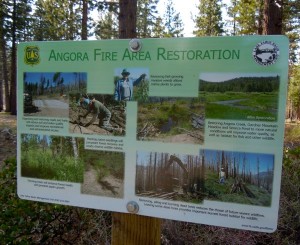
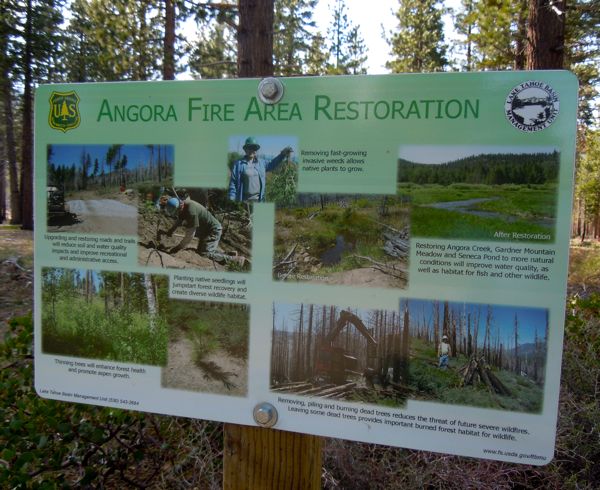
A sign at the end of Seneca Road explains restoration efforts by the U.S. Forest Service in the Angora burn. Photo/LTN

“It will kill them just as surely as logging right up to the nest tree,” he said.

Lawyers for the Forest Service told the group recently its proposed 60-acre buffers around each nest would undermine the 1,400-acre project’s goals of restoring the forest and reducing future catastrophic risks where the Angora Fire destroyed 254 homes in South Lake Tahoe in 2007.

But Deputy Forest Supervisor Jeff Marsolais said Friday the agency and the private logging contractor agreed to move the fuels reduction operations at least 10 acres away from the nesting area until the chicks leave the nest. One acre is a little less than the size of a football field.

“The relocation shows our ongoing commitment to balance ecosystem values and our intent to maintain efficient operations in completing our Angora restoration efforts,” Marsolais said in a statement the agency provided to the Associated Press late Friday.

In addition to no logging within 10 to 12 acres of the identified nest tree, an additional 25 acres of habitat will be preserved within one-quarter mile of the tree, until the chicks “fledge,” USFS spokeswoman Cheva Heck said.

The area includes some of the last of the 156 acres of forest that remains uncut in the overall 1,400-acre project first proposed in early 2009 and under way for more than a year.

A federal judge in Sacramento earlier rejected a request for an injunction to block the logging filed by the John Muir Project and its parent Earth Island Institute.

The 9th U.S. Circuit Court of Appeals currently is considering their appeal claiming the Forest Service’s environmental assessment ignores the agency’s own science suggesting the project will harm the bird without effectively reducing long-term fire threats.

Hanson said the Forest Service’s science consistently shows one pair of black-backed woodpeckers needs 100 to 200 acres of good habitat with a minimum 60-acre core for foraging. He said the latest logging will come so close to the nest tree that the noise alone may cause the adult birds to abandon the nest.

Rachel Fazio, a lawyer for the group who argued its case in the 9th Circuit last month in San Francisco, said it made no sense to rush to log the last remnants of the project area given it was more than 90 percent complete and therefore, based on the agency’s arguments, had already reduced fire threats accordingly.

Fazio said the chicks may “fledge” — or fly for the first time — within about three weeks but would remain dependent on their parents weeks longer and be especially vulnerable to predators.

“It will just be a little island of habitat so that maybe the birds survive for a week or so,” she said.

Hanson said the additional 25 acres of habitat retained within a quarter mile — approximately 400 meters — is too far away for a bird that historically won’t travel more than 150 meters at a time in unsheltered forest for fear of becoming someone else’s dinner.

Hanson said the Forest Service took the same approach — unsuccessfully — with a post-fire logging project in the neighboring Eldorado National Forest, leaving uncut three 40- to 50-acre patches of black-backed woodpecker habitat after the 2004 Freds Fire near Kyburz.

“They tested this exact theory before, and it didn’t work,” he said. “No one has been able to find woodpeckers near any of those patches since then.”

Heck said the agency is leaving intact about 1,168 acres of burned forest for the woodpeckers and other wildlife — approximately 43 percent of the area charred to varying degrees over more than 3,000 acres.

But Fazio said that less than 800 acres of that 1,168 is considered suitable for the black-backed woodpeckers, which are highly dependent on the most intensely burned forest habitat for the beetle larvae they peck from the bark.

Heck said she couldn’t comment directly on that claim because it’s part of the ongoing litigation. She said the district court has denied the group’s request for an injunction blocking the logging “citing the project’s benefits to the public interest.”

Bill would ban incarceration questions on job applications

By David Bienick, KCRA-TV

SACRAMENTO — The California Assembly has approved a bill that would ban cities and counties from asking about criminal history on initial job applications.

The bill, known as AB 1831, passed the Assembly Tuesday by a vote of 41-31.

The bill’s author is Roger Dickinson, a Democrat from Sacramento.

“Employment is the single biggest thing we can do to help people reintegrate into the community,” Dickinson told KCRA 3.

Dickinson noted that his legislation would only apply to city and county governments, not to private employers.

He also said it would only apply to the first step of the application process.

“But if a person then makes it through that initial screening, the city or county can subsequently ask about criminal history,” said Dickinson.

Read the whole story


Nevada takes steps toward repealing antiquated state laws

By Sean Whaley, Nevada News Bureau

CARSON CITY – Two years ago it was the metric system. Now it’s communists.

The Legislative Commission this week took the first step toward repealing several antiquated statutes, including a provision of state law dating to the “Red Scare” days of the 1950s directed at the Communist Party.

The statute, NRS 613.360, is titled “Actions permitted against member of Communist Party or related organization.” It says that an unlawful employment practice “does not include any action or measure taken by an employer, labor organization, joint labor-management committee or employment agency with respect to an individual who is a member of the Communist Party of the United States or of any other organization required to register as a Communist-action or Communist-front organization by final order of the Subversive Activities Control Board pursuant to the Subversive Activities Control Act of 1950.”

Scott Young, a research analyst for the Legislative Counsel Bureau, said the section was dependent in part upon the federal statute, the Subversive Activities Control Act, the provisions of which have either been struck down by the U.S. Supreme Court or repealed by Congress. As a result, the state law no longer has any force or effect, he said.

It is also known as the McCarran Act for then-Nevada Sen. Pat McCarran, D-Nev.

“This is essentially a relic from the Cold War when there was concern about activities of the Communist Party and undermining freedoms in the West,” Young said.

The statute was one of five provisions recommended for repeal by the 2013 Legislature based on a state law requiring a biennial review of state statutes to look for outdated and antiquated laws. The recommendations were based on the requirements of the law, NRS 220.085, and do not reflect any advocacy by legislative staff.

Another statute recommended for repeal created the Columbia Basin Interstate Compact Commission in 1951. The compact was never adopted by the states of Washington and Oregon, Young said. There is no likelihood the statute will ever become useful, he said. Nevada was originally included because the Owyhee River is a tributary of the Snake River, which in turn is a tributary of the Columbia, Young said.

The Legislative Commission voted to move forward with the bills needed to repeal the obsolete provisions of state law.

“It’s good to get rid of some obsolete statutes,” said commission Chairman Sen. Steven Horsford, D-Las Vegas.

Two years ago the Legislative Commission agreed to introduce a bill to repeal the statute creating the state’s Advisory Council on the Metric System. The bill was passed in the 2011 legislative session.

The seven-member council was created in 1981 when the federal government was moving forward with a program of getting the states to convert to the metric system. Congress in 1975 passed the Metric Conversion Act to plan for the conversion. That effort was derailed in 1982 when President Ronald Reagan eliminated funding for the conversion effort.


Timber Cove Best Western under new ownership

By Kathryn Reed

The Best Western at Timber Cove changed hands this week and a new restaurant on the pier is open.

Bob Maloff, who died a year ago, had left the South Lake Tahoe hotel, including the pier that juts far into Lake Tahoe, to his estate. Urbana Holdings based in Georgia is now the owner.

Hotel General Manager Peter Evenhuis told Lake Tahoe News no changes will be made to the hotel in the immediate future.

Pulled pork sliders at Bistro on the Pier in South Lake Tahoe are filling, but not the best. Photo/LTN

However, Urbana Holdings is likely to make some substantial changes to the property based on the company’s description on its website: “Urbana’s mission is to acquire, develop and operate investment caliber real estate projects and redevelop and renovate projects with the potential to become investment caliber. Targeted investments include office, multi-family, hotel and mixed-use projects. Urbana emphasizes the renovation and redevelopment of real estate properties that are not typically the focus of institutional or local entrepreneurial buyers. Once Urbana has completed the development or redevelopment process, the projects are better suited for a more passive investor such as a pension fund, REIT or insurance company.”

Evenhuis invited Lake Tahoe News to dine at Bistro on the Pier this week knowing this reporter is a vegetarian. (The dining was on LTN’s expense.)

When the waitress was asked what the chef would fix for a vegetarian, she asked, “Do you eat chicken?”

The Caesar salad ($8) was swimming in dressing; the pulled pork sliders ($9) were drenched in barbecue sauce. The quantities of both, though, were ample – making the price reasonable.

Sue said, “That’s the worst menu I’ve ever seen.”

Three salads are on the menu and four entrees. The beer and wine choices are limited, though there is a full bar.

One couple came in, looked at the menu, saw that it in no way resembled Blue Water Bistro – the independent restaurant the estate shutdown to open this one – and left.

While no one could mess with the view of Lake Tahoe from this location, especially on a warm night with not a ripple on the water, it’s not enough to get Lake Tahoe News to return to this bistro.

No sign on Highway 50 or the pier lets people know the bistro exists.

Evenhuis said the old Mama’s Red Tomato restaurant that had been out front and that is now used to serve hotel guests breakfast is likely to become a café for the public. He didn’t say when. However, a waiter on Wednesday night told other patrons a restaurant will open in that spot in two weeks.


Lightning caused fires burning in Northern Nevada

Several fires are burning out of control in Northern Nevada — all presumably caused by lightning strikes on June 1.

The largest is the Preacher Mine Fire at 500 acres as of Friday night. This is where most resources are being used.

“There are several homes in this remote rural area, however no structures have burned. Resident notifications continue,” Douglas County sheriff’s Sgt. Jim Halsey said.

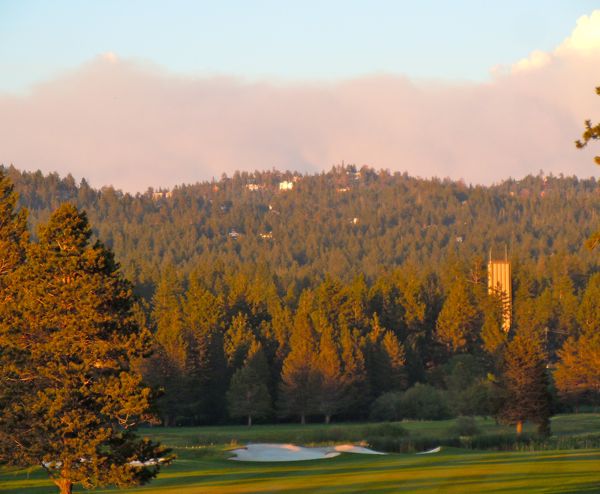
Smoke from fires in the valley side of Douglas Valley are visible from Edgewood Tahoe on June 1. Photo/LTN

Air crews were on the scene dumping water on the first fire reported in Douglas County on Friday afternoon. The Pineview Estates Fire has grown to approximately 50 acres, and is burning in a southerly direction. This is also being called the Ray May 2 fire because it is in the location where a fire burned earlier this year.

There is a brush fire near Pyramid Lake burning toward Marble Bluff Mountain. The River Bend Fire (20 acres) is burning in brush/river bottom.

Units have responded to the Ranch Fire (one-quarter acre) in the Rosachi Ranch area in the Sweetwater Range, north of Bridgeport and to the Bald Fire (3 acres) northeast of Holbrook Junction.

Smoke from the fires has been visible in the Lake Tahoe Basin.

While the winds were calm and no lightning was reported in the basin Friday afternoon, winds picked up over the hill as the day went on, which helped fan the flames.

— Lake Tahoe News staff report