Nevada gaming win up, but not in Stateline

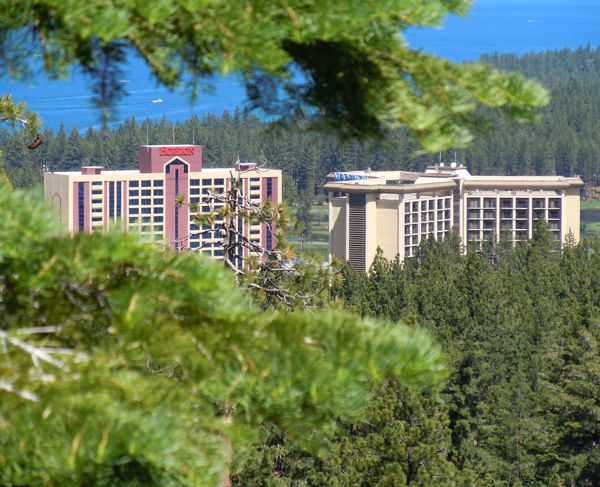
Stateline casinos did not pull their weight when it came to April gaming numbers.

Those five properties were down 4 percent, or almost $14 million, compared to 2011. However, Nevada as a whole posted a 6.16 percent increase in year-over-year revenues with $856 million brought in, the state Gaming Control Board said June 12.

Reno numbers were even worse that South Tahoe, with a decline of 19 percent or $38 million.

 — Lake Tahoe News staff report


Fallen Leaf Lake moving on despite lingering voter issue

By Kathryn Reed

FALLEN LEAF LAKE – Who can vote at Fallen Leaf Lake continues to be a murky issue, but clarity was brought to the boat inspection process.

The board of this community services district met Saturday at this lake that sits on the edge of Desolation Wilderness.

What was learned just this month is that the board missed the deadline to be able to appoint two members to fill out the five-member board. Now it is up to El Dorado County to either appoint two people or call for an election. If the latter were to occur, the vote could be on the November ballot.

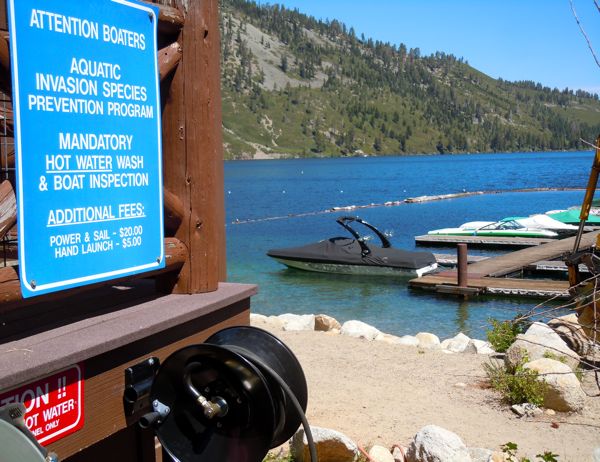
Full decontamination of boats is not offered at Fallen Leaf Lake. Photo/Kathryn Reed

Two people applied for the board – Joan Cathcart and Larry Calof. The board has recommended to the county that these two be appointed.

Mike Cathcart, who is an attorney but was not offering legal advice to anyone at the meeting or to the board, said the main issue with who can vote in the district centers on a local U.S. Forest Service interpretation. Whoever is named as the primary permitee of a USFS parcel is not allowed to vote.

Cathcart said that issue still needs to be resolved, adding that he has calls into Forest Service officials outside the basin.

“We need to make everyone who wants to vote to feel comfortable to do so without the threat of losing their permit,” Cathcart said.

As for the definition of domicile, Cathcart said the district attorney “recognizes that second homes can be domiciles.”

The voting issue has caused much consternation among those who have homes at Fallen Leaf Lake. The differing sides came together last year trying to get Assemblywoman Beth Gaines, R-Roseville, to carry legislation that would determine who had the right to vote. It never came to a vote. And Gaines, after the November election, because of redistricting won’t be the rep in the Assembly for this area even if she wins.

Who can vote also determines who can be on the board. A board members needs to be a registered voter in the Fallen Leaf Lake Community Services District.

While there has been talk of dismantling the CSD and creating a homeowners association, this is easier said than done. Legal settlements from 20 to 30 years ago play a role in what can take place.

But the board is moving forward with the job at hand — to oversee the marina, store and fire department.

Aquatic invasive species

Fallen Leaf Lake will continue to use its apparatus near the boat launch to clean the exterior of all boats. Being able to pump 1 gallon of 140-degree water a minute is sufficient to wash away any potential invasives that are on the watercraft.

However, being able to pump 5 gallons of 140-degree water in a minute is what’s needed to cleanse a motor of any quagga mussels that may have become attached to the vessel.

Because the marina does not have that capability any boat that cannot prove it was last launched at Fallen Leaf or Lake Tahoe will have to be inspected in Meyers – the nearest decontamination station. About 10 boats last season had to make the trip back to Meyers.

Fallen Leaf Lake has zero aquatic invasive species, unlike Lake Tahoe that has Asian clams, milfoil and other undesirables.

In other action:

• Jeanne Lear with South Tahoe Refuse explained how residents can use the blue bag recycling program.

• The preliminary budget for 2012-13 was talked about. Fire Chief Gary Gerren talked about how this fire season is likely to be bad, with conditions much like 2007, so he has requested more funds for more staffing and training. The final budget will need funding for the election if one were to occur.

• The swim platform should be in the water in the next two to three weeks.

• The concessionaire has brought in more than $50,000, with the marina and store open for less than a month. That is $50,000 more than this time last year.


El Dorado County supe wants better cooperation with state, feds

By Carlos Alcalá, Sacramento Bee

El Dorado County Supervisor Ray Nutting is hoping his county can wield the word “coordination” like David wielded his slingshot.

Nutting has been frustrated with decisions from the big guys – the state and federal government.

The state has curbed dredge mining in the creeks of his county – the very name of which suggests gold – and imposed fire protection fees that he has likened to illegal taxes.

The federal government has closed popular off-road vehicle routes and limited grazing on federal lands, decisions he feels hurt the economy.

By invoking a concept known as “coordination,” Nutting expects the county can get higher authorities to come to the table as equals before they make decisions that affect El Dorado County.

He is asking his fellow supervisors Tuesday to approve an advisory committee to help “coordinate activity to assure consistency with our local plans and policies as required by congressional mandate.”

Advocates – including an Idaho group called Trademark America – say “coordination” is covered under federal rules and requires authorities to coordinate their plans with agencies on a local level.

“This is not fighting the federal government,” Nutting said. “We’re not forcing it, it’s the law.”

There are disagreements, though, on what that law requires.

Read the whole story


Public participation lacking in mapping future of Tahoe park

By Jessie Marchesseau

The turnout for the trails workshop in Incline Village hosted by the Nevada Division of State Parks was underwhelming at best. Eight people showed up to voice their opinions.

“It’s kind of everybody’s backyard; I thought there would be more people there,” said Mark Kimbrough, recreation and trails consultant helping with the development of the new general management plan for Lake Tahoe Nevada State Park.

Hosts nearly outnumbered the attendees, with representatives from the Tahoe Rim Trail Association, Nevada State Parks, Incline Village General Improvement District and the Incline Village trails committee in attendance.

Nevada parks officials are trying to figure out the future of Spooner Lake and other Lake Tahoe entities. Photo/LTN file

NDSP organized the June 7 workshop in an effort to solicit feedback and encourage public input on the new trails map for Sand Harbor, Van Sickle Bi-State Park, and the Marlette Hobart and Spooner backcountry areas.

Initially, the workshop was going to include discussions on the possibility of opening some of the trails currently restricted to foot traffic up to mountain bikes. This has been a contentious topic among trail users and could have resulted in a crowd. But Kimbrough said that plan was recently dropped, something to which he attributes the low turnout.

Park planners were also hoping for some ideas on what people would like to see happen concerning the winter season operation of Spooner Lake. The concessionaire who has been running the cross country ski operation there for the last 27 years has decided not to renew his contract, leaving recreation for future winters at Spooner up in the air.

Jay Howard, park supervisor for Lake Tahoe Nevada State Park said the snow accumulation at Spooner is unpredictable, making a cross country ski area hard to maintain. He was hoping the workshop would spawn some ideas of what to do with the area in the future, however only three of the attendees had even visited the ski area and no one had any new ideas of what to do with it.

For now, it is likely the building will remain in place, but empty, leaving the option for a ski area or something to return in the future.

The new general plan is set to be in place before the end of the year, replacing the current plan developed more than 20 years ago. This was the second of three public workshops for residents to offer their input on the future of Lake Tahoe Nevada State Park.

The third and final workshop will be within a next few months to present the chosen plan alternatives to the public.

Anyone who has ideas or comments concerning changes, additions, facilities or anything else related to the new general management plan is encouraged to send their input to ltnsp.gmpcomments@ascentenvironmental.com.


Union battle moves from Wisconsin to California

By Jon Ortiz, Sacramento Bee

Labor unions and business interests have been quietly raising millions of dollars and testing campaign messages for months, girding for a brawl over a November ballot measure that could fundamentally shift political power in Sacramento.

Now, on the heels of an election that saw unions handed a major defeat last week in Wisconsin, the opposing camps in California soon will launch a campaign battle likely to consume $50 million or more in political spending.

“Unions have just two channels of influence,” said Daniel J.B. Mitchell of the Anderson Graduate School of Management at UCLA, “collective bargaining and the political side, so this initiative is extremely important to them.”

The measure, which has not yet received a proposition number, would ban both unions and corporations from contributing directly to candidates, although both sides could still freely spend money on their own independent efforts.

Another provision forbids both sides from using money gathered from payroll deductions for political purposes. It promises to gut the power of labor unions because they raise nearly all of their money for political and other purposes via payroll-deducted dues from their members’ paychecks.

Corporations, by contrast, raise the bulk of their campaign money from donations given by top executives and drawn from company treasuries.

Last year, public-sector and general-trade unions contributed $2.7 million to California political candidates and causes, according to campaign finance tracker FollowTheMoney.org. Business interests, from the telecommunications industry and hospitals to computer firms and beer companies, gave $4.3 million.

“The public has got to read between the lines on this thing,” said Ken Murch, chief negotiator and lobbyist for the California Association of Psychiatric Technicians. “The deception is that this levels the political playing field. It doesn’t.”

Proponents include conservatives such as former Los Angeles Mayor Richard Riordan and former Univision CEO Jerry Perenchio, who has given $250,000 to the measure. They contend it handcuffs business and labor interests equally by applying the same contribution limitations to both sides.

Read the whole story


El Dorado, Placer counties to receive Caltrans funding

Some of $350 million in grants Caltrans was awarded to improve public transit will be going to El Dorado and Placer counties.

An estimated 80 projects throughout California include upgrading transit service, purchasing eco-friendly buses, modernizing transit stations and creating jobs. The grants are funded through Proposition 1B, the 2006 voter-approved transportation bond, which is providing $3.6 billion over a 10-year period to improve public transit in California.

Some of the projects include:

• El Dorado County — $540,000 for El Dorado County Transit Authority to install electronic fare boxes.

• Placer County — $163,399 for Placer County Department of Public Works for the Placer County bus stop improvements and $1 million for Placer County Transportation Planning Agency to expand the Rocklin Multi-Modal Station Park-n-Ride lot.

 — Lake Tahoe News staff report


Cutbacks would challenge emergency response for the next Angora

By Jessie Marchesseau

If another Angora Fire happened today, would there be enough resources available to fight it?

Angora Fire -- 5 years later

The simple answer is no.

“There would be no number of firefighters that we could employ that would be able to fight that kind of disaster,” said Chief Brian Uhler of the South Lake Tahoe Fire Department.

Representatives from other fire districts in the basin seem to concur.

“That fire was conditions-based; it wouldn’t have mattered if we had helis waiting at the airport,” said Kit Bailey, forest fire chief for the USFS Lake Tahoe Basin Management Unit.

The helicopters that would have been used to attack the fire from the front were grounded. Crews were left to battle the blaze on foot and in engines with winds gusting up to 50 miles per hour. The helicopters eventually made it up, but by then the fire had gone from manageable to massive.

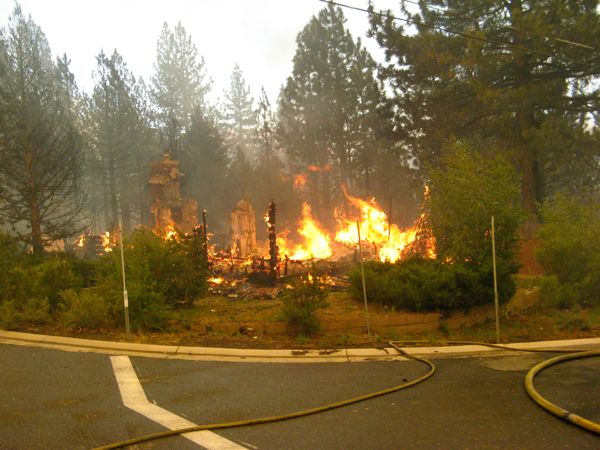
Helicopters from outside the area fight the Angora Fire. Photos/Lake Valley Fire

In the end, 1,900 firefighters, and 12 helicopters fought the Angora Fire, not to mention numerous engines, dozers, water tenders and air tankers. They came from all over the Western United States. And if it happened today, they would come again.

In disaster situations such as the Angora Fire, fire departments rely on mutual aid agreements with other fire districts. They essentially agree to help each other in times of need. In fact, Gareth Harris, fire chief for the Lake Valley Fire Protection District, said those agreements have been improved and streamlined since Angora, and response time from cooperating districts would be even faster today.

An automatic aid agreement within the basin ensures that every firefighter in the Lake Tahoe Basin will be available to help for the first 24 hours. This gives units from farther away time to arrive with no lag in initial response.

However, the help received from neighboring districts may not be what it once was. Recent budget cuts have taken their toll on fire departments. South Shore crews including LVFPD, SLTFD and the LTBMU have managed to keep the same number of firefighters on staff, offsetting the cutbacks elsewhere. While SLTFD did lose four upper management employees, they managed to retain the number of firefighters.

Lines of fire hoses can't extinguish each house on fire.

“The Forest Service hasn’t seen any reduction in capability at the local level or the regional level,” Bailey said. “I think we’re as well positioned as we can be, not just on the federal level, but on the local level, too.”

Other fire districts were not so lucky.

Three years ago, the North Lake Tahoe Fire Protection District had three 20-person wildland fire crews. That number is now cut in half. CalFire has had to reduce its number of seasonal firefighters from up to 3,000 in previous years to 1,700.

But Janet Upton, deputy director of CalFire, told Lake Tahoe News she believes this reduction will not impact their effectiveness.

Upton said the staff reductions are offset by improvements in technology since 2007. The 21 administrative units across the state can now track detailed weather patterns and predict those “perfect storms” like the one during the Angora Fire up to 72 hours in advance. The department can then shuffle resources from an area with low fire danger, to higher risk locations. They can cancel days off and have crews work overtime

“If the threat is there, we are staffed to meet it,” Upton said.

She does admit, however, that staff reductions will likely impact their initial attack on a fire. Transporting crews from the other side of the state takes time, and relying on mutual aid agreements means waiting on crews from other districts.

In the event of another major fire, some districts in the basin may have to rely on improved aid agreements combined with developments in fire and weather technology to combat reductions in manpower caused by budget woes. The South Shore, however, having retained its firefighting forces, can bank on an equal, if not improved ability to launch an attack on the next Angora Fire.


Insurance companies make the difference in recovery process for Angora residents

By Linda Fine Conaboy

Not only did the people living within the boundaries of the huge swath of the Angora Fire suffer titanic losses to the rampaging fire, they also, when the dust settled, had to begin the process of working with their insurance companies. They found, when it comes to fire insurance, not all outcomes are painted with the same brush.
Angora Fire -- 5 years later

Imagine the overwhelming intensity of this situation: More than $145 million in damage; 254 homes destroyed; 26 homes damaged; 3,000 evacuations.

Estimates are the Angora Fire was among the top half-dozen most costly fires in the United States with the price tag to fight the fire topping $20 million, while losses to the local economy estimated to be even more.

According to a report from KCRA.com, the California Department of Insurance received more than 60 consumer complaints about insurance companies in the aftermath of the 2007 fire.

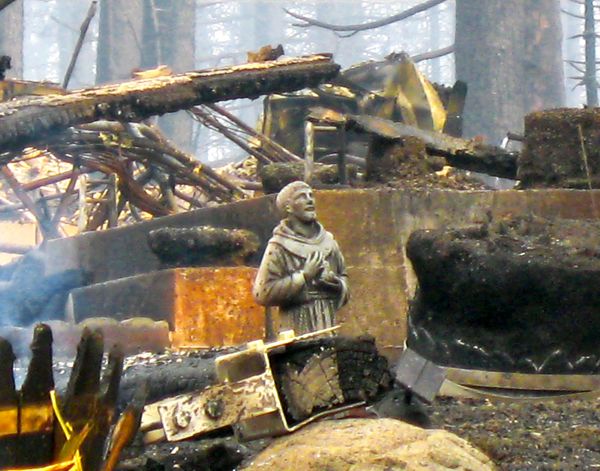
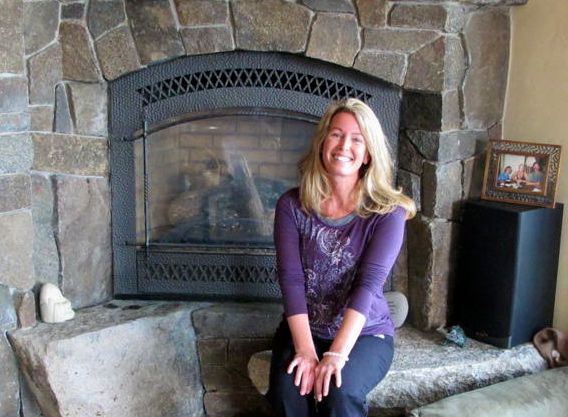
Tony Colombo and his wife, Tara Brennan, lost their home to this fire.

“It disintegrated,” Colombo said. “All the way down to the foundation. We had about 90 pine trees and shrubs, deciduous trees, a fenced yard and a beautiful, soft lawn that we played croquet on.”

Unfortunately, Colombo told Lake Tahoe News, we were underinsured. “We had changed agents, so consequently, we were underinsured by about $400,000. [The fire] was a financial catastrophe, but the physical and emotional damage was the worst.”

Tony Colombo and Tara Brennan rebuilt on Mount Olympia Circle. Photo/Linda Fine Conaboy

Colombo, who previously owned Colombo’s Burgers a Go-Go on Emerald Bay Road, sold it and found what he called his dream job with plans to retire in 2010. After the fire and the downturn in the economy, Brennan sold her business, Pandora’s Trunk, also on Emerald Bay Road.

Now, however, the part-time dream job is no longer reality. For the time being, life is somewhat of a challenge and retirement is not looming in the near future. Colombo is a driver for BlueGo, South Shore’s public transit service, a job he says he loves, while Brennan is the floor manager at High Chaparral Western Wear.

All is not lost for them, however. The couple decided to sue their insurance company — State Farm Insurance — and finally settled out of court a week before the trial was to commence.

“It was immensely worthwhile,” Colombo said. “Otherwise, we would have gone bankrupt and had to leave the area.

“But here’s what’s ironic. I’m still with them. We just don’t want to look for another company. There are four of us out here with them, but I’m the only one who went to litigation.”

An agent’s perspective

Dick Horn has been with State Farm Insurance for 29 years and worked at the South Lake Tahoe office for 19 of those years. He said he handles about 2,400 fire policies in South Lake Tahoe, Carson City and Gardnerville.

“During the fire I had the same number of policies. There were 52 homes damaged with State Farm Insurance and I had about half of them,” he said.

“I knew we were in serious trouble [when the fire started] because of the high winds. It got into the tree tops and there was no stopping it until the wind died.”

So many items lost in the fire did not have a true price tag because sentimental value is priceless. Photo/USFS

Horn said the first thing he and other agents did was man their office and hold on tight to see what they could do to help. “We knew we had access to shelter, from Harvey’s to rental homes, for our clients. I have authority out of my office to write some pretty healthy checks for food, clothing, shelter, etc. I wrote quite a few of those checks.”

The fire started on a Sunday, Horn recalled, and by noon he and others had moved a big motor home into their parking lot to serve as a disaster shelter. “We also rented a building to serve as a disaster claims office. For nine months it was staffed with claims adjusters, estimators, logistics staff and secretaries.

“At first you can’t believe it, then realization sets in,” he said of the fire victims. “It takes time to get their lifestyle back. There’s some counseling to be done as an agent. I found myself in a role of assisting clients with claims people, contractors, adjusters, city officials and had to go to fire meetings, too. I helped people get new driver’s licenses. You lose all of your personal papers.”

Horn had high praise for Guy Lease, president of Lake Tahoe Community College at the time. “He really came through. He threw open the doors for as long as necessary for people who needed a place to meet; a place to contact FEMA or the state or whoever.”

Since the fire, Horn’s company is much more sensitive to wildfire now. “Now we have locations, not just South Lake Tahoe, but throughout California that are designated as wildfire areas. This means these places have a higher propensity or risk for fire, so they require, for me, extra underwriting (exposure to risk).”

Here’s a list of some of the new considerations for fire insurance underwriting, put into place since the Angora Fire:

• how far away are trees and brush from a home

• roofing; no wood shingles, must be Class A or metal roofing

• windows; no plastic/vinyl window casings

• siding must be fire resistant

• decks must be enclosed around their perimeter.

In order to be more proactive, Horn said he now inspects and photographs every home he insures. “We’re trying to be fire wise,” he said.

In Horn’s estimation, 99 percent of his clients were pleased with the service they received. “It was a well-choreographed claims situation. Other governmental agencies have come to Tahoe to see what we did.”

AAA was one of the insurance company’s that received a tremendous amount of praise after the fire because of the way claims people handled the situation – including writing checks before any paperwork was officially filed.

But it’s five years later and the company has gone – at least physically – from the basin. The South Lake Tahoe and Kings Beach offices have closed in that time. And now Matt Skryja with AAA won’t even give Lake Tahoe News an interview.

Proving your worth

Joe and Lisa McAvoy lost their home in the fire and have since rebuilt, although on a different parcel. The McAvoys said ultimately they were pleased with their claims coverage and the way it was handled, even though it took a year to go through the process.

“We had to haggle for a long time,” Joe McAvoy said. Besides fighting fires for a living, Joe is also a cabinetmaker, and with Lisa, did most of the planning and construction of both of their homes — pre-fire and post-fire.

“We showed them that the home couldn’t be rebuilt for what they wanted to pay.

We showed them photos of the craftsmanship involved in our house. We finally showed them what it would cost to rebuild, although it was really tough to get them to see the true costs.”

Although, in Joe McAvoy’s words, the adjuster was a “good guy” and a “straight shooter,” it took a year of haggling, topped off by six months dealing with El Dorado County and another nearly two years to rebuild.

Lisa MacAvoy in her rebuilt home. Photo/Linda Fine Conaboy

“The adjuster said we probably wouldn’t like him when this is all done, but at least after all the stress of it, it turned out good in the end. They finally paid the policy that I was paying for. The adjuster kept saying it’s going to take time. You have to inventory every single thing in your house from the forks and spoons, when you bought them and for how much.

“But there were groups of people who came up from San Diego who had been in a fire and they had drawn up inventory sheets. So instead of starting from scratch, we had a road map. At least the blender and replacement costs were on the list,” he laughed.

He said eventually his insurance company came through and they’re still insured with the same company. “You end up doing what they say. My company ended up doing what was right, but the process was arduous. I think there should be a better way. But if we didn’t have insurance, we’d be starting over from scratch.”

Damage claims hard to process

Suzanne Kingsbury isn’t entirely pleased with her insurance company either. The Kingsbury home didn’t burn down, but it did suffer extensive smoke and heat damage that necessitated they vacate for six months.

“Everything we owned went to smoke rehab,” the El Dorado County Superior Court judge told Lake Tahoe News. “What an ordeal. I had no clothes and no belongings.”

Kingsbury said her experience with the insurance company was interesting to say the least. “The adjuster came out and made an assessment; all the restoration people were there too. As time moved on, the insurance company balked and the restoration folks disappeared.

“All of our neighbors were insured by the same company, but they had different adjusters. When we all compared notes, we found we were not being treated equitably. Interestingly, we all were accused of conspiring. We had a meeting with the insurance company and the end result was a different adjuster — service improved immediately.”

For Kingsbury and her husband, the fire and their return from it became a multi-year project including painting, repainting and new siding. “It seemed like everything that was done had to be re-done multiple times, but our insurance company finally hung with us. I know people who had fabulous experiences and then there were those who did nothing but fight with their companies.”

When you’re in a trauma situation it makes it impossible to properly deal with insurance companies and fight with them, Kingsbury said. “Some people threw their hands up and couldn’t deal with it.”

Fortunately, Kingsbury’s husband is retired and handled much of the legwork.

Rebuilding was important

Delicia Spees is seemingly is a poster child for all people involved in the Angora Fire. The Spees’ family home burned to the ground; in fact, there was only one neighbor in her vicinity who didn’t lose a home.

“We never considered not rebuilding,” she said. “I have mixed emotions about our insurance company. We were underinsured by a whole lot; I didn’t have a mortgage then and I do now.”

She said it took a while to work with her insurance company because it didn’t have a local presence. “We had our home for 34 years and had done extensive remodeling, but our agent never talked to us about upgrading to cover the additions. Up to that time, most of us lived in la-la land and didn’t talk about insurance.

“We’ve learned to be quite pro-active now and have definitely changed companies. You’d think the insurance company would contact you about upgrades.”

Spees continued: “My jewelry, my mom’s jewelry, my kids’ things are all gone. That’s what kills you. Insurance didn’t cover that. What I learned though, are monetary things come back. We lost no lives in the fire. I love this town — so generous. I lost my children’s things, but in reality, I now have a beautiful home and a job.

“Losing a human is tragic; losing a home is losing monetary things — just stuff that you were going to clear out anyway. Life isn’t fair, but it doesn’t pick on you; you go forward and you’re lucky to have anything.”

Things to consider

To help navigate the insurance recovery process, the Insurance Information Network of California offers the following advice to those whose property has been damaged or destroyed:

• Call your insurance agent or insurance company and report the damage. Most homeowner policies cover additional living expenses and will advance money if there is a need for temporary shelter, food or clothing.

• If your home or business has been damaged but not destroyed, make temporary repairs where possible to prevent any further damage. Save receipts for supplies and materials purchases as the insurance company will reimburse for any reasonable expense for those temporary repairs.

• Prepare for the adjuster’s inspection. Take the time to inspect the property in advance and note anything that you would like the adjuster to see. Provide the adjuster with a list of the damaged items, photographs, receipts, bills and other relevant paperwork. Doing so will help the adjuster correctly determine the value of destroyed property information or how to create an inventory. Free inventory software is also available at the IINC website.

It is important for those filing an insurance claim to maintain a calendar of benchmark dates for decisions on rebuilding and completing the recovery process.

To view a copy of the brochure, Settling Insurance Claims after a Disaster, visit the IINC website.


California government unions move to squeeze out private contractors

By Jon Ortiz, Sacramento Bee

With California facing yet another budget crisis that threatens state jobs and pay, employee unions are moving on several fronts to push use of civil service workers instead of private contractors for state government work.

Unions had a say in Gov. Jerry Brown’s 2012-13 budget revision last month, which proposes axing outside contracting for a range of work, from computer consulting to custodial services.

State employee unions also threw their weight behind recent legislation that, among other things, would have given civil service employees first crack at all state government jobs. The measure failed but is likely to resurface.

Last month, the state attorneys’ union successfully contested a multimillion-dollar contract with a private law firm for legal services.

“We’ve got a bunch more (cases) in the pipeline,” said Patrick Whalen, general counsel for California Attorneys, Administrative Law Judges and Hearing Officers in State Employment, or CASE. “When it’s crunch time, you look for every penny you can.”

The union efforts have intensified the debate over privatizing government functions, especially with California confronting a budget deficit of at least $15.7 billion through June 2013. Brown has suggested closing some of that gap by eliminating thousands of state jobs next year and putting roughly 214,000 employees on a four-day workweek schedule that would cut their pay by 5 percent.

In that same vein, Brown and labor leaders say curbing what the state spends on contractors would save money.

Read the whole story


Technology makes it difficult to escape campaign ads

By Scott Canon, Kansas City Star

This is the year you’re going to shut out the shouting and the charges and the ominously cheesy voice-overs of campaign commercials. Right?

You’ll hit the fast-forward button on your DVR when the spots commence. Or you’ll look away from the commercials while you fiddle with your smartphone or explore what’s on that handy iPad.

Sorry. There’s no escape.

Squads of campaign commandos hired by pols looking for your vote will chase you down.

With increasing sophistication, political organizations are fast adopting the tricks of retailers who’ve learned how to learn more about you. They’re tracking your digital footprints to better wave ads that will push your buttons, getting you outraged and out to the polls. They’re going online with talking points increasingly targeted to win elections niche by niche.

Been shopping online for a new gun? When you go to a news website, that could trigger an ad about a candidate’s fealty to the 2nd Amendment. Use the Web to identify that bird building a nest in your cottonwood tree? Don’t be surprised to see an electronic banner on HuffingtonPost.com trumpeting the same politician’s endorsement from the Sierra Club.

Electronic “cookies” usually invisible to you pile up in your Web browser, surmising your interests and announcing them to political campaigns. In turn, campaign managers use those clues to microtarget messages aimed to persuade or motivate you.

Read the whole story