LTUSD budget leaves 1% in reserves

By Kathryn Reed

Lake Tahoe Unified School District is essentially creating parallel budgets because of items on the November ballot that would affect the bottom line. But the reality is the board will be asked at its June 26 meeting to approve just one budget for the 2012-13 school year.

CFO Deb Yates on June 12 presented the board with the most up-to-date numbers, though they seem to change several times within a week based on projections coming from Sacramento.

The state’s budget deadline is June 15. The deficit currently sits at $15.7 billion. A capital insider told Lake Tahoe News on June 13 it’s likely Republicans won’t be given a copy of the budget before a vote it taken and that deliberations will start late in the day Friday to make it look like lawmakers were working all day and into the night on it.

LTUSD is not alone as it struggles to figure out what its ledger should look like when the state keeps changing its numbers. If money matters were still calculated on paper with pencil, there would be a hole from all the eraser marks. That in turn would be a perfect metaphor for the hole the state is creating for schools, cities and counties.

If Gov. Jerry Brown’s tax plan doesn’t work in November, LTUSD will be out $1.6 million.

The state has added 15 days to the five already allowed that districts may cut the school year by. If the November ballot measure fails, LTUSD could be looking at cutting a dozen school days for 2012-13 to close its budget gap.

LTUSD is spending down its reserve, keeping about 1 percent – the minimum allowed. This compares to the state average of a 16 percent reserve.

The district is also wondering where the $80,000 in redevelopment money it’s supposed to receive from the city’s successor agency is. Yates said she sent a letter last week inquiring about it.

Another potential problem for the district is average daily attendance numbers are at 3,592 when the estimate was 3,652. If this holds true, it could mean $175,000 less from the state. However, enrollment is steady. But how the state calculates what it pays per student is how many show up on average, not how many are enrolled.

The LTUSD board will meet June 26 at 6pm to approve the final 2012-13 budget to meet its deadline even if the state doesn’t meet its requirements.

In other action:

• The district this year is not automatically promoting students. South Tahoe Middle School started monitoring 115 at-risk students. Of those, 12 seventh-graders will be retained and nine eight-graders.



Burglary suspect forces Sierra House to be on lockdown

Students and staff at Sierra House Elementary School had some unexpected excitement this last week of school.

The school was on lockdown Wednesday afternoon when a nearby resident saw an uninvited visitor in her home.

“We set up a perimeter around the house to contain the suspect, and called the school to have them lockdown until we could arrest the suspect,” El Dorado County sheriff’s Lt. Pete Van Arnum said.

A resident of Musgrave Court, which is a couple blocks from the South Lake Tahoe school that is on Marshall Trail, saw a man in her house going through drawers. She called deputies from a neighbor’s house.

Arrested at the scene on suspicion of burglary was 39-year-old Brett Bartee.

 — Lake Tahoe News staff report


Colleges court California students

By Stephen Ceasar, Los Angeles Times

Their pitches were simple and tailored to the audience.

Come to my college, the out-of-state recruiters recently told high school students in Lakewood, and you will be taught in small classes and you’ll graduate in four years. We’ll even throw in a few thousand dollars just for being from California. And at one school, you won’t even be far from an In-N-Out Burger.

Their attempt at wooing California high schoolers was a not-so-subtle move in a state whose public universities have been hit with severe budget cuts — $1.6 billion in 10 years — leading to tuition hikes, enrollment caps and fewer courses.

Meanwhile, nearby out-of-state colleges have reaped the benefits.

Neighboring states have seen an influx of California students enrolling in their universities, and colleges have significantly bolstered their recruiting efforts in the state. By enrolling Californians, not only do these schools receive non-resident tuition, they increase the diversity of their campuses as well.

Some schools have doubled the number of Californians in their freshman classes. Washington State University enrolled 132 freshmen from California in 2011, twice as many as the year before. The University of Arizona and Arizona State University each have boasted freshman classes with more than 1,000 Californians in recent years.


Villalobos sues casinos for return of debt payments to add to bankruptcy estate

By Dale Kasler, Sacramento Bee

Alfred Villalobos, the central figure in the California Public Employees’ Retirement System bribery investigation, has won and lost millions gambling in Nevada’s casinos.

Now he’s suing two of his favorite haunts for $600,000, demanding his money back.

The lawsuits, filed last week in U.S. Bankruptcy Court, are an outgrowth of the Lake Tahoe businessman’s 2-year-old bankruptcy case.

Villalobos is trying to retrieve money he paid to the two casinos to settle gambling debts in April 2010, about two months before he filed for Chapter 11 protection.

Villalobos wants the Eldorado Hotel Casino in Reno to return $500,000. He wants $100,000 back from the MontBleu Resort Casino & Spa at Lake Tahoe.

If Villalobos wins, he doesn’t keep the money. The funds would be distributed among his various unsecured creditors.

So why is he bothering to sue? Because he has little choice. A debtor has a legal obligation to make sure creditors are paid as much as possible – and everyone is treated fairly.

Read the whole story


LTUSD not in agreement regarding equality of ball fields

By Kathryn Reed

Lake Tahoe Unified School District is going to come up with a list of priorities for the ball fields it owns to give the committee recommending how to spend $500,000 of taxpayer money.

The district owns all the fields where children and adults play softball-baseball-soccer on the California side of the South Shore except for the one by Lake Tahoe Community College. The city of South Lake Tahoe, though, owns some of the improvements.

At issue Tuesday night at the school board meeting was whether the softball field still under construction at South Tahoe High is of equal caliber to what the boys play baseball on.

Board member Sue Novasel emphatically and repeatedly said they are not equal.

“It should be equal, which would be a fence and lighting,” Novasel told her fellow board members June 12.

Even with the 4-0 approval (Judy Cefalu was absent) to allocate $160,557 from the special reserve fund to pay for improvements, that doesn’t buy a fence or lights for the softball field.

Facilities Director Steve Morales is of the belief that what has been done and the worked slated to be done will comply with the Office of Civil Rights complaint filed in 2010 against the school district.

“It’s not a regulation size softball field and is a regulation baseball field,” Novasel countered.

The Title IX issue was not resolved at the meeting.

Morales and Novasel will make a list of what the district would like improved, with the high school softball field likely to be at the top.

The fields committee of the Measure R joint powers agreement will meet June 25 at 4pm at Lake Tahoe Airport. This group is running out of time to have a plan of action together before the JPA board meets July 27 to hear proposals and possibly vote on how to spend the half million dollars for field upgrades.


Placer County wrestles with declining revenues

The Placer County Board of Supervisors adopted a proposed 2012-13 budget this month, a move that ensures the county will have a balanced spending plan in place when the next fiscal year begins July 1.

Development of the five-year strategy is part of the board’s ongoing efforts to protect the county’s fiscal health and preserve core services despite revenue losses caused by the economic slowdown and state budget crisis. The strategy also will seek to ensure that board priorities are met over the next five years.

A draft strategy will be presented to the board in the coming weeks.

The plan will look at ways to:

Reprioritize revenues to more fully implement board priorities;

Pursue strategies that will allow the county to best meet resident needs with limited resources;

Reduce the use of one-time revenues for ongoing operations; and

Increase the General Fund reserve to position the county to withstand the next economic downturn.

By adopting the proposed budget, board members completed the first of the county’s two-phase budget-development process. The board is scheduled to have budget workshops Aug. 16-17, have a public hearing on a proposed final budget Sept. 11 and adopt a final budget Sept. 25.

Interim County Executive Officer Holly Heinzen emphasized the $690.1 million proposed budget will preserve core services to the public, but notes the county continues to face budget challenges in such areas as library services, fire protection, deferred building maintenance and capital infrastructure needs.

The proposed budget is $59.2 million or 7.9 percent lower than the 2011-12 budget, largely due to a $53.9 million reduction in the county infrastructure budget. Infrastructure funding was higher a year ago because of two major projects: a seismic retrofit and paint job under way on the Foresthill Bridge and construction of a jail at the county’s Bill Santucci Justice Center in Roseville.

Property tax revenue, the county’s leading source of discretionary revenue, is projected to drop by 1.1 percent next fiscal year. That would result in a cumulative loss of $16.4 million, or 12.4 percent, in property tax revenue since the 2007-08 fiscal year.

Since 2007, the general fund budget has dropped $17.8 million, or 4.8 percent, and the size of the county workforce is down 15.4 percent to approximately 2,150 filled positions as a result of the hiring freeze.


Students help environment, learn about yesteryear Tahoe

By Kathryn Reed

CAMP RICHARDSON – Ridding the swales between Tallac and Taylor creeks of invasive species could help reverse the decline of native fish species so in future years third- and fourth-graders might be able to see what the Washoe were accustomed to harvesting from Lake Tahoe.

Back in the day when Washoe summered at the lake and wintered in the Carson Valley, there was a two-week period when they could wade knee-deep into the lake and come out with a basket full of fish.

“There was a seasonal abundance that Lake Tahoe would provide,” Joy Barney, conservation education coordinator with the U.S. Forest Service, explained.

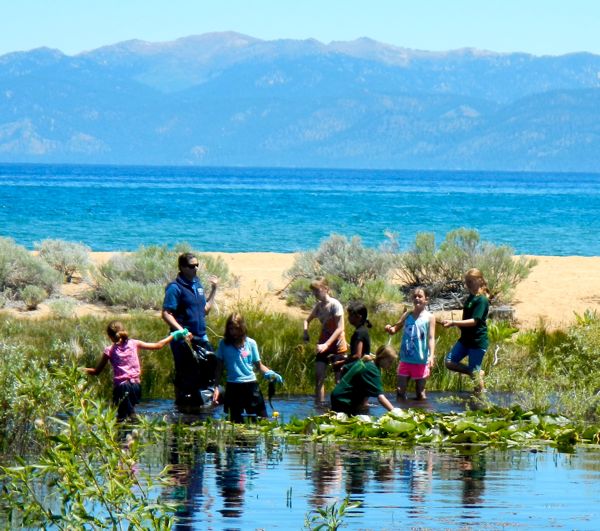
Fifth-graders from the magnet school on June 12 pull milfoil from the swale at Baldwin Beach. Photos/Kathryn Reed

Part of what fourth-graders were learning Tuesday is the historic food web and then comparing it to today.

Speckled dace, tui chub, Lahontan, redsides, Tahoe sucker – while all these fish still exist in Lake Tahoe, their numbers are dwindling because of invasive species.

Meandering through the various old estates that are now owned by the Forest Service, the children are broken into groups to be taught Trees are Terrific, Ways of the Washoe (which has been approved by the tribe) and Founding Families.

For many of the youngsters, this is their first trip to this part of the South Shore. The same could be said for some of the parent chaperones.

Valhalla to Baldwin Beach became an outdoor classroom on June 12 for third-, fourth- and fifth-graders from the environmental magnet school. Third- and fourth-graders in Lake Tahoe Unified and Incline have been spending time at the Tallac Historic Site learning outside the classroom — but using curriculum that meets state requirements.

“The overall theme of the day for the Children’s Forest program is that people and the environment are and always have been intricately connected,” Barney told Lake Tahoe News.

At Baldwin on this particular day are the fifth-graders from the Meyers school. Looking at this small body of water that sits at the edge of the parking lot it seems like a swamp that rational people would not willingly venture into. The beach separates this unattractive wet area from Lake Tahoe.

While the swale is natural in its formation, what isn’t native is what’s living in it – Eurasian milfoil and bullfrogs.

Students are pulling the milfoil out by hand.

“It feels slimy (in the water), but when it comes out, it feels like a leaf plant,” student Summer Furrer says.

She pulled out about 10 handfuls that went into one of the seven garbage bags her class collected.

Part of the class helped put a large black mat that is something like permeable landscaping cloth at the bottom, center part of the swale. This will essentially smother the milfoil, while allowing for oxygen to get to the macro invertebrates that might be under the covering.

What stopping the photosynthesis process does is one of the educational components of the day.

Forrest McCann is articulate beyond his years – clearly demonstrating some adults are not smarter than a fifth-grader.

Part of Barney’s time in the classroom that preceded the field trip was to talk about interpretive signs – what they are good for, how to write one and how to illustrate one.

McCann’s “Save the Swale” sign is so good that it may become the actual sign the Forest Service posts to educate people who come to the area.

This is one of four swales in the area.

Some students are in waders and booties, some are in shorts. All are getting wet to some degree. The deepest part of this particular swale is 3½ feet. Measuring the swale was part of the job for the day – and one way it became a math lesson.

While the students this day are not dealing with the estimated 500,000 bullfrogs that call this area between Tallac and Taylor creek waterways home, they know it would be better if they literally croaked.

“The bullfrogs are bad because they eat native species and make the water dirty,” McCann said.

Sarah Muskopf, aquatics biologist with the Forest Service, is the mastermind behind this particular project. In her waders, she is in the water with the students to help and educate at the same time.

She explains the three treatments going on – hand pulling, the fabric liner and then the jute, which is a rope-like mat that will not have to be removed.

The learning process will continue in the fall when other students will remove the fabric barrier to see if it worked to get rid of the milfoil.

“Even when the whole swale is treated, it will need to be maintained,” Muskopf explained. “It’s like weeds in a yard, it’s never a done deal.”

ngg_shortcode_0_placeholder (Click on photos to enlarge.)


Douglas County’s Kite bounced from Assembly

Three-time Douglas County commissioner and current assemblyman for the area Kelly Kite lost his seat Tuesday night.

Jim Wheeler won the Republican primary for Assembly District 39 with 2,397 votes (41.54 percent). Kite had 2,012 votes (34.87 percent), and Gary Schmidt 1,361 votes (23.59 percent). Wheeler will face Independent American candidate David Schumann in November.

In the Douglas County Commission race, Barry Penzel came in with 46.21 percent of the votes (2,515), Michael Olson 38.37 percent (2,088), and Dianne Humble 839 (15.42 percent).

The Las Vegas Sun reports, “The establishment GOP candidates for state Senate made a clean sweep Tuesday over the more conservative candidates, giving Republican leaders the races they wanted in their effort to take over the state’s upper house. Senate Republicans need to win four out of five competitive seats in November to take back control of the state’s upper house for the first time since 2007.”

Nevada News Bureau says, “The big surprise of the night in the primary may have been the overwhelming defeat of state Sen. John Lee, D-North Las Vegas, in the Democratic primary against newcomer Patricia Spearman. Spearman had 63 percent of the vote to 37 percent for Lee.”

 — Lake Tahoe News staff report


Strategist brought in to help resolve Raleys’ union-management strife

By Dale Kasler, Sacramento Bee

After a week of strike talk and increasing bitterness, Northern California supermarket workers have called in a strategist from their union’s international headquarters to help with stalled contract negotiations.

William McDonough, director of bargaining for the United Food and Commercial Workers, came to the Bay Area on Monday at the invitation of the three UFCW locals in Northern California.

Union officials and labor experts said it’s common to bring in reinforcements when negotiations aren’t going well. The Northern California supermarket talks have dragged on since last fall.

“This is getting late in the game in the bargaining, so it’s not unusual,” said Mike Henneberry, a spokesman for UFCW Local 5 in San Jose. He said McDonough helped the union obtain a new contract in Southern California last fall after eight months of negotiations.

McDonough’s arrival in Northern California followed one of the most difficult weeks yet in the contract talks.

First, Raley’s workers voted to authorize a strike against the West Sacramento grocery chain. Then, a three-hour bargaining session Friday ended with the UFCW and Raley’s seemingly farther apart than ever.

Read the whole story


Americans saw wealth plummet 40% between 2007-10, Federal Reserve says

By Ylan Q. Mui, Washington Post

The recent recession wiped out nearly two decades of Americans’ wealth, according to government data released Monday, with ­middle-class families bearing the brunt of the decline.

The Federal Reserve said the median net worth of families plunged by 39 percent in just three years, from $126,400 in 2007 to $77,300 in 2010. That puts Americans roughly on par with where they were in 1992.

The data represent one of the most detailed looks at how the economic downturn altered the landscape of family finance. Over a span of three years, Americans watched progress that took almost a generation to accumulate evaporate. The promise of retirement built on the inevitable rise of the stock market proved illusory for most. Homeownership, once heralded as a pathway to wealth, became an albatross.

The findings underscore the depth of the wounds of the financial crisis and how far many families remain from healing. If the recession set Americans back 20 years, economists say, the road forward is sure to be a long one. And so far, the country has seen only a halting recovery.

“It’s hard to overstate how serious the collapse in the economy was,” said Mark Zandi, chief economist for Moody’s Analytics. “We were in free fall.”

Read the whole story