STPUD tested as it keeps water flowing during fire

By Dennis Cocking

The South Tahoe Public Utility District was formed in 1950 to provide wastewater collection and treatment for the then very small community of South Lake Tahoe. Drinking water in South Tahoe’s early years was supplied by private domestic wells or from small privately owned water companies. Well more than two dozen private companies existed on the South Shore in the 1960s and three of them still exist today.
Angora Fire -- 5 years later

With the passage of the Safe Drinking Water Act of 1974, many of these privately owned systems realized the cost and difficulty meeting the act’s requirements and sought to sell their companies to the district. Since joint water and wastewater agencies are commonplace in California, the district was the likely entity to purchase these smaller systems. Slowly these small systems were cobbled together into the system the district operates today.

Unfortunately, little thought was given to adequate water flows for firefighting since many of the systems were built with surplus 2-inch galvanized steel pipe available in large quantities after World War II. The flows provided by these systems were adequate for domestic use, but woefully inadequate for structure or wildland fires.

Fast forward to Oct. 19, 1991, in the Oakland Hills. An incompletely extinguished grass fire explodes in a three-day fire storm that ultimately consumed 1,520 acres, 3,354 single family dwellings, 437 condos or apartments, injured 150, and killed 25 individuals. Economic damages were estimated in excess of $1.5 billion. Water agencies across the state and beyond had a wake-up call and realized they could be in a similar situation with regards to fire flows.

While fire flows are not mandated by law, in early 1992 the district’s board of directors proposed an aggressive water infrastructure replacement program to increase the firefighting capability of the systems that it had inherited as a matter of sound public policy. Public meetings were held, public support obtained, and the district embarked on a system-wide replacement of undersized waterlines, installation of fire hydrants, construction of new larger water storage tanks, construction of booster pump stations, and auxiliary power generation capability projects that continues to this day. While the district’s Engineering Department estimates at least an additional decade to complete this undertaking, the district is light years from where it was in the early 1990s.

South Tahoe PUD crews on June 25, 2007, check on the Boulder Mountain water storage tank. Photos/STPUD

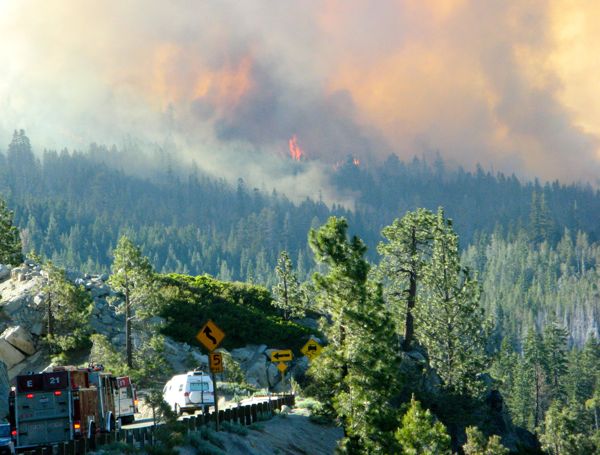
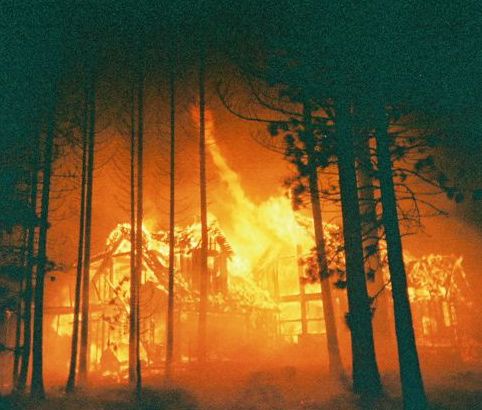
The experience the district gained during the Angora Fire has shaped future water supply projects, operational procedures, and long-range planning as it pertains to water supply. The district, like the vast majority of South Tahoe residents, had never experienced a wildfire of this magnitude and maintaining fire flows became priority No. 1. The Angora Fire, generally regarded as the worst fire experienced within the Lake Tahoe Basin in well over a century, tested the water distribution system as well as the dedicated employees who maintain and operate it. District employees literally were in the middle of the firefight trying to make sure water tanks and fire pumps continued to work and supply water to the fire crews. By the luck of the draw, in the decade prior to the fire, more than $18 million of district customer funds were spent on water supply infrastructure improvements in the Angora area including, most significantly, the auxiliary fire pump station located at Lake Tahoe Boulevard and Boulder Mountain Road. This critical pump station, which has emergency power generating capability, continued to operate despite the almost immediate loss of power due to the fire. Had this significant investment in upgraded infrastructure not been made, it is likely the fire could have been far worse than it was.

During the 24-hour period from the start of the fire on June 24, 2007, until June 25, the district produced 17.6 million gallons of water. Average water production at that time of the year is about 10 MGD. From June 24 through June 30 the district produced a record 89.91 million gallons of water. Even with that volume of production on June 24 the pumps continued to run at full capacity just to maintain demand levels. Early on the morning of June 25, district crews, following firefighters’ observations, discovered the reason that the pumps could not keep up with demand was that each home that was destroyed was an active three-quarter inch (the most common residential connection size) water leak. Multiply that by 254 and it becomes very significant. District crews immediately began to shut off water services that could be quickly located and crimp off those that could not be readily located.

The fire nearly consumed the STPUD pump and control building at Boulder Mountain.

Within hours, water storage tank levels and water pressures began to rise to more normal parameters. USFS Angora Fire Incident Commander Rich Hawkins stated at a fire status briefing that it was highly unusual, at a fire of this size, to not completely run out of water at some point. He noted that the district was able to keep firefighters in water, albeit some low pressures at times, for the duration of the fire. When the fire threatened to move behind Gardner Mountain and jump Highway 89, it was a challenge to access our facilities as residents attempted to evacuate their homes. Nevertheless, once the fire was fully contained, demands on the water distribution system returned to normal.

In the wake of the Angora Fire, California Gov. Arnold Schwarzenegger and Nevada Gov. Jim Gibbons commissioned the Blue Ribbon Fire Commission. One of the commission’s recommendations was greater funding support by federal and state agencies for improved water infrastructure for firefighting in the Lake Tahoe Basin. In 2009, the district acted as lead agency to form the Lake Tahoe Community Fire Protection Partnership. The partnership is comprised of the public water agencies in the Lake Tahoe Basin, both in California and Nevada. The mission of the partnership is to seek federal funding to replace undersized and inadequate water supply infrastructure in the Tahoe basin. Since 2009, the partnership, in concert with the U.S. Forest Service, has secured $12 million in federal funding. Matched 50-50 with local funding, nearly $24 million in critical water supply projects all with a nexus to fire protection, have been completed. Lake Tahoe is a safer place as a result of the success of this local-federal partnership.
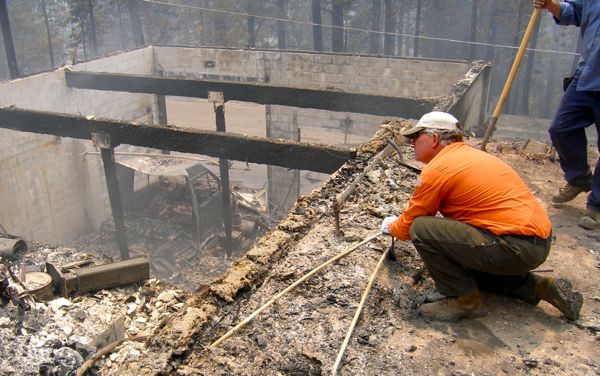
District crews crimp water supply lines in the burn area.

Operational-planning lessons learned:

• Waterline replacement projects took on a higher priority in overall Capital Improvement Plan

• Increased emphasis on water distribution and redundancy of the water system

• Increased water production capacity became a higher priority

• Order of projects were changed in the CIP

• Viewed distribution vulnerability more critically

• Added water storage projects and increased sizing of water storage projects

• Moved to install fire hydrants at 500 foot intervals on all lines 6 inches or larger

• Re-evaluated and reprioritized waterline replacement projects

• Determined in future emergencies to insert district staff into incident command structure earlier

While no water agency wants to have their emergency management plan challenged in the real world, the district has taken the opportunity to learn from the events of the Angora Fire and made planning and operational changes that reflect the lessons learned.

Dennis Cocking is the public information officer for South Tahoe Public Utility District.


University study delves into specifics of Angora Fire

By Susan Wood

A first-of-its-kind study examining behavior and protocol surrounding a major wildland blaze features Lake Tahoe’s most significant — the Angora Fire of 2007, which consumed 254 homes, forced the evacuation of more than 3,000 residents and caused about $160 million in damage over nine days starting June 24.

Angora Fire -- 5 years later

As the five-year anniversary approaches, South Shore residents will be asked in a 30-minute phone survey their views of how well the community responded to and coped with the disaster. This is for the University of Colorado study that is funded by the National Science Foundation. The research also examines the Lake Arrowhead area, which endured its own large fire disaster in 2007. Both regions are considered rural, remote and tourism-based economies.

“What we were looking for were two rural communities that had a significant event and comparable character,” study analyst Jeannette Sutton, who works in the Colorado Springs-based university’s Trauma, Health and Hazards Center, told Lake Tahoe News.

Sutton spearheaded the research, which last year wrapped up its participant questionnaire of which this reporter took part in. The Q&A brought the study group to South Lake Tahoe where selected participants within categories from public safety and mental health to media and leadership were asked about the effectiveness of fire prevention efforts before the major blaze and how well the town recovered. The research also evaluated a predominant theme: whether information dissemination was adequate enough.

“Information online was a really big question,” Sutton told Lake Tahoe News in a recent phone interview. “Then, we had to look at how people could get information if they can’t access the Internet.”

While the Angora Fire peaked that Sunday, the research discovered citizens failed to get emergency broadcast updates, and no local radio stations covered the disaster. In addition, perceptions were expressed by people in the two study areas who believed print newspapers “lacked significant online presence, real time information” and concentrated more on “human interest stories”.

At the time of the Lake Tahoe disaster, the Sierra Nevada Media Group of which the Tahoe Daily Tribune is a part of tried to keep up online with pertinent, real-time updates but split its time on its print versions. (Lake Tahoe News did not exist in 2007.) There were times when citizens voiced concerns of feeling lost. At the outset, even initial phone calls channeled to the California Highway Patrol Truckee dispatch center within minutes of seeing the huge plume of smoke were met with pessimism over whether the wildfire sparked by an illegal campfire near Seneca Pond along the North Upper Truckee Road was actually a control burn.

Since then, local leaders and public safety officials have agreed systems need to be put into place to prevent the lack of real-time information from not reaching citizens from happening again. At least South Lake Tahoe city police dispatch was on top of the catastrophe with all hands on deck and longtime dispatch supervisor Leona Allen demonstrating grace under pressure while her home burned.

A university study is looking into various aspects of Angora, including response time. Photos/Lake Valley Fire

Stories abound of how citizens and their leaders coped with the stress and angst of such a disaster, and the study served to examine that.

As the city put up a command center at Lake Tahoe Airport in council chambers, an evacuation center was set up at the city Parks and Recreation building. Within days, town hall meetings were scheduled at the South Tahoe Middle School. Lake Tahoe Community College posted a list of houses that had burned, partially or completely. LTCC also collaborated with the American Red Cross on recovery efforts. A communitywide fund to aid in the recovery was established, and fundraisers with donation centers were organized for those in need.

Help was there, but this was no easy time for the community.

“We were looking at different themes in both areas and will survey the two communities to see the contrasting of how the community adapted,” said Jessica Lambert, who created the study as part of her post-doctoral work at the Colorado university.

Another theme presented itself in the research. For both lake areas, factors influenced the magnitude of the fires. Lake Arrowhead had a massive bark beetle infestation in 2007. The South Lake Tahoe area endured “restrictive environmental policies aimed at protecting natural resources,” the study’s summary concluded.

For that, a bistate Blue Ribbon Commission was formed to evaluate such policies with then Republican Govs. Arnold Schwarzenegger of California and Jim Gibbons of Nevada overseeing the effort.

Years later, the U.S. Forest Service has worked with local fire agencies and councils to conduct fuel reduction projects. Shortly after the Angora Fire started, “slash piles” – the buildup of brush and ladder fuels to be set in control burns — became the enemy of the community vernacular as citizens complained they contributed to increasing the wildland blaze.

Residents of Lake Tahoe will be part of a study about wildfires.

Resilience stood out in the research as the psychology of dealing with a disaster also concluded the two communities’ citizenry accepts catastrophe as part of its life for “hearty mountain folk” who “choose to live remotely, while connected to the land, trees and mountains.” Those interviewed painted a picture of resiliency; as even “strong fluctuations in (a) tourism economy requires a resolve to remain (here) during difficult periods.”

When the study is complete, which will be after the citizen surveys are taken, the document is intended to serve as a model for other fire-prone communities of how to prevent a wildfire, but also how to respond when it does happen.

According to Lambert, “The goal is to learn more about factors that contribute to resilience in rural communities that face disasters. I think the hope is that findings could be used to inform policy.”


Janitor sentenced to 50 years for killing Placerville principal

By Peter Hecht, Sacramento Bee

A Placerville elementary school janitor on Friday was sentenced to 50 years to life in prison for gunning down the school’s beloved principal.

John Luebbers, 45, was convicted April 24 of first-degree murder in the Feb. 2, 2011, shooting of his 20-year friend and golfing partner, Louisiana Schnell School Principal Sam LaCara, 50.

El Dorado Superior Court Judge James R. Wagoner imposed the mandatory sentence of 25 years to life on the murder count, plus a 25-year sentencing enhancement for use of a firearm during the killing.

According to testimony in the trial, Luebbers, the school’s lead custodian, became livid over interviews for a night janitor. Luebbers, who had been golfing with LaCara just days earlier, preferred one candidate and the principal and school district preferred another.

Read the whole story


People increasingly leaving pets in hot vehicles

An alarming increase in “dog in hot vehicle” reports this spring has the Washoe County Regional Animal Services reminding pet owners that leaving a pet in an enclosed vehicle, even for a short time, can be a deadly idea.

In May, dispatchers received 68 high priority calls for dogs left in an enclosed vehicle during hot temperatures. This is more than five times the number reported during May 2011, when there were 13 calls for dogs in vehicles.

So far there have been no pet fatalities as a result of pets being left in hot cars.

“When it gets to the point where an animal’s well-being is threatened, Animal Control Officers will take the necessary steps, as obligated by the law, to save an endangered animal by removing it from the vehicle. Even if they have to break a window to do it,” Regional Animal Services Manager Barry Brode said. “Our goal is to prevent this from happening by getting this important message out to the public now.”

Temperatures inside a closed automobile can easily rise to 20 degrees or warmer than outside temperatures. This could prove deadly to a pet.

The public is encouraged to report distressed animals locked in hot cars immediately by contacting Washoe County Regional Animal Services dispatch at (775) 322.3647.


$92.1 bil. budget deal ensures Calif. lawmakers get paid

By Chris Megerian and Anthony York, Los Angeles Times

SACRAMENTO — California lawmakers narrowly met a constitutional deadline to pass a state budget Friday, but their work is not finished as they continue a tug-of-war with Gov. Jerry Brown over just how deeply to cut social services in the $92.1-billion plan.

The budget — pushed through the Legislature by Democrats without a single Republican vote — makes fewer cuts to welfare and child care than the governor had sought and funds those programs through accounting maneuvers he opposes.

Once Brown receives the budget, he has 12 days to sign it into law, trim some spending unilaterally, or veto the entire plan and send it back to the Legislature for revisions.

On Friday, the governor signaled only that he would continue negotiating with Democratic leaders. The spending plan can be modified with follow-up legislation.

“We’re still not there yet,” said Brown spokesman Gil Duran.

Passage of the budget seemed to be almost a non-event in the Capitol compared to years past — in part because it was only a prelude to the battle at the polls in November, when Brown and his allies will try to persuade voters to approve billions in new taxes.

The budget passed Friday leaves a hole of more than $8 billion, which Democrats hope will be filled by temporary increases in both the state sales tax and income tax on the wealthy. If Brown’s tax proposals are rejected, California’s public schools would bear the brunt of the pain, and the academic year in some districts could be shortened by three weeks.

Read the whole story


Departure of 3 top California educators leaves vacuum

By Carla Rivera, Los Angeles Times

Three of California’s highest-ranking, most influential educators announced within the span of a few weeks that they would be leaving their posts, creating a vacuum in the state’s higher education system at a time of unprecedented challenges.

The impending departures of Charles B. Reed and Jack Scott, chancellors of California State University and the California Community Colleges, as well as UC Berkeley Chancellor Robert Birgeneau, have invited intense scrutiny and questions about whether the three institutions can entice visionary leaders willing to contend with a litany of issues:

Steep cuts in state support. Navigating California’s byzantine political landscape and vast array of ethnic and cultural constituencies. Keeping campus gates open for the hundreds of thousands of college graduates who will be needed to fill the state’s workforce.

The stakes for California and the nation are high, said state Sen. Alan Lowenthal, D-Long Beach, who chairs the state Senate Committee on Education.

“We have the finest system in the world, no matter what its shortcomings,” Lowenthal said. “We’ve had an affordable higher education system that has spurred the U.S. economy. For years California has led the way, and we need more than ever to have the best of the best as leadership. But it’s a tough job.”

And some say it will not be as easy to find leaders as in the past. At a time of uncertainty and dwindling resources, “an intelligent person would think carefully about taking such a position,” said Michael Tanner, chief academic officer and vice president of the Association of Public and Land-grant Universities.

Read the whole story


Cold Creek reroute in High Meadow turns back the clock

By Kathryn Reed

Disturbances are still visible, but High Meadow no longer looks like the construction site it has for the past two summers.

Instead, the meadow is a verdant green that if on this particular Sunday weren’t so chilly, would be inviting to lounge in. It looks ideal for Frisbee. On a hot summer day the creek would beckon to soak ones feet in after the arduous climb. The meadow is at 7,843 feet – a 1,500-foot elevation gain from lake level.

Looming to the left is Monument Peak at 10, 067 feet. This is the mountain on the boundary of Heavenly Mountain Resort.

Cold Creek reroute through High Meadow will be done in October. Photo/Kathryn Reed

Looking toward the route for Star Lake are the well-known South Shore icons Jobs, Jobs Sister and Freel peaks. Pockets of snow dot the mountains almost like icing.

At the edge of the meadow is a creek – the realigned portion of Cold Creek. Barely a trickle of water is flowing.

Part of the reason why the meadow is such a lush green in June is because it’s getting a little help beyond what Mother Nature has done.

“The sprinklers we set up to irrigate the constructed channel to help the vegetation along since we’ve had such a dry spring,” explained Stephanie Heller, hydrologist with the Forest Service. “We’ll be introducing flow into the constructed channel in mid-July, after that the irrigation will no longer be needed because we expect groundwater levels to come up very quickly.”

Two years ago the U.S. Forest Service began a major project to reroute Cold Creek to its natural meander. By Oct. 15 it’s expected to be completed.

“We still need to construct the channel and a grade control weir at the downstream end of the project, construct connections of the constructed channels to the existing streams, fill the existing Mainstem channel, and construct in-channel log structures on the East Fork tributary of Cold Creek,” Heller told Lake Tahoe News.

The final touches will include decommissioning all temporary roads and staging areas associated with the project. Water is still flowing through the old channel.

A towering mound of dirt and piles of logs that look big enough to build a cabin make the entrance to the meadow seem less than idyllic. That’s all part of the restoration project. The dirt came from the first year of the project. It will be used to fill in the old channel, according to Heller.

“The logs will be used for a variety of different purposes when we complete construction. For example, logs will be incorporated into the grade control weir at the bottom of the project, logs will be placed in the backfill of the existing Mainstem and in floodplain areas to break up flow paths and created habitat complexity, and logs will be used to construct in-stream debris jam structures in the East Fork Tributary,” Heller said.

Eighty of the 280 acres of this Sierra meadow have been restored.

The $2 million restoration is being paid for with money from the Southern Nevada Public Land Management Act.

The goal of the project is to have Cold Creek meander like it did before cattle grazed in the meadow, willows will sprout from the bank, the dead beetle-infested lodgepoles will be hauled away, and wildlife will return to the area.


’60 Minutes’ delving into medical marijuana issue

By Brittany Anas, Daily Camera

Boulder County District Attorney Stan Garnett dished his views on Colorado’s medical marijuana laws to CBS’s “60 Minutes” on Monday after the television newsmagazine sent a crew to town to interview the prosecutor for an upcoming segment.

“My emphasis is always public safety,” Garnett said in an interview prior to Monday’s taping. “I don’t see the public safety benefit in prosecuting law-abiding dispensaries or making low-level marijuana cases much of a priority.”

Garnett — who was interviewed by “60 Minutes” correspondent Steve Kroft in a Boulder courtroom — said he is under the impression the segment will be about the business of medical marijuana in Colorado, and that it also will include interviews with dispensary owners. He said he expects the segment to air in the fall.

Kevin Tedesco, a publicist for “60 Minutes,” declined to comment on the piece.

“We don’t discuss stories we’re working on,” he said.

Read the whole story


Minden firm awarded contract by USFS for air tanker

By Bill Gabbert, Wildfire Today

Following the president’s signing June 13 of the bill that waived the 30-day notification period for informing Congress about new air tanker contracts, the U.S. Forest Service announced it has awarded new exclusive use contracts for seven additional air tankers.

Four companies will provide three next generation air tankers in 2012 and four in 2013:

Tanker 40, a BAe-146, during tests. Photo/Tronos

Minden Air Corporation will provide one BAe-146 in 2012 and 1 BAe-146 in 2013;

Neptune Aviation Services, Inc. will provide one BAe-146s in 2012;

Aero Air, LLC will provide two MD87s in 2013; and

Aero Flite, Inc. of Kingman, Arizona will provide one Avro RJ85 in 2013.

The AVRO RJ85 is a variant of the 3,000-gallon BAe-146 with more efficient jet engines, produced between 1993 and 2002.

The MD-87 is a variant of the MD-80, a twin-engine jet, and as an airliner carried 114 to 139 passengers. It was produced from 1987 to 1992 and cruises at about 500 mph, similar to the BAe-146. There are estimates that the MD-87 will carry 4,000 gallons of retardant, but that is not confirmed.

Neptune and Minden previously held the only exclusive use contracts this year for large air tankers. Neptune now has seven P2Vs and one BAe-146 under contract, and Minden has two P2Vs, however one of Minden’s P2V’s was damaged June 3 when the the landing gear failed to fully extend while landing. On the same day, two pilots were killed when one of Neptune’s P2Vs crashed in Utah. Neptune’s Tanker 40, the only BAe-146 presently working as an air tanker, began service in the fall of 2011 and is still under interim approval from the Interagency Air Tanker Board.

Read the whole story


10-hour standoff at South Tahoe hotel ends peacefully

An Auburn woman was taken into custody Thursday morning by South Lake Tahoe police officers after a 10-hour standoff.

Jennifer Lynn Trezona had barricaded herself in a room at the Pine Cone Acre Motel on Emerald Bay Road in South Lake Tahoe the night before.

Jennifer Lynn Trezona

Police throughout the region on June 13 had received notice from Auburn officers that the 49-year-old woman was suicidal and to be on the look out for her. Her vehicle was found in the South Lake Tahoe hotel parking lot Wednesday at 6:30pm.

“They discovered what room Trezona was in and went to check her welfare. When the officers attempted contact, Trezona brandished a handgun at them and then immediately barricaded herself inside the motel room,” South Tahoe police Lt. Brian Williams said in a press release.

Crisis negotiators were brought in.

El Dorado and Douglas county provided sheriff’s deputies to help at various times during the standoff.

Trezona eventually surrendered at 5am June 14.

She was booked on felony charges of brandishing a weapon at a peace officer.

 — Lake Tahoe News staff report