Research paper: El Dorado County is dysfunctional

By Carlos Alcalá, Sacramento Bee

Development planning in El Dorado County is dysfunctional, according to an academic paper published this month by two scholars from UC Davis.

Past practices and politics mean that the county may not, on its own, be able to create plans for growth that will be sustainable in the long run, according to the paper, titled, “Gold Country: the politics of landscape in exurban El Dorado County, California.”

“El Dorado County represents a very dysfunctional politics. It is kind of the cutting edge of dysfunction,” said Stephen M. Wheeler, a professor of landscape architecture.

Wheeler was the faculty adviser to co-author Craig Beebe, who wrote a 200-page master’s thesis from which the paper was excerpted for publication in the University of Arizona’s Journal of Political Ecology.

Although Beebe was less biting in his comments, he said his research into county documents and news accounts – supported by interviews – confirmed the basic conclusion.

“What we’re most critical about is that the planning there has been so difficult and so unproductive, basically,” Beebe said in a phone interview from Oregon, where he now works for a land-use planning nonprofit.

One example is the 14-year struggle to develop a general plan for the county, approved in 2004 and facing some revisions right now.

Read the whole story


Air Force in Tahoe practicing rescue jumps

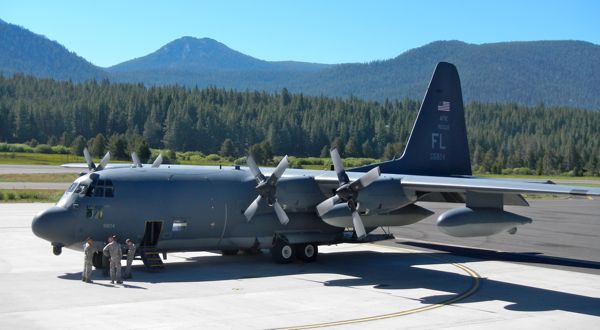
An Air Force C-130 that landed at Lake Tahoe Airport on Saturday is expected to depart the afternoon of June 19.

The crew is on the South Shore practicing high altitude para rescue jumping.

The military is in South Lake Tahoe. Photo/LTN

“Para rescue jumpers are medics that jump out of an airplane to attend to wounded that can’t be reached via vehicle,” airport Manager Sherry Miller told Lake Tahoe News.

It’s possible the crew and plane will be back Aug. 25 for the Lake in the Sky Air Show.

— Lake Tahoe News staff report


19-year-old cyclist hit by pickup in South Lake Tahoe

A South Lake Tahoe teenager was airlifted to a Reno hospital after being hit by a truck while she was riding her bike Monday morning.

The extent of Anna Molina’s injuries is unknown, though officers said her external injuries were severe enough to warrant CalStar being called in to land at Heavenly Mountain Resort – where the 19-year-old was taken via ambulance.

Officers late Monday afternoon were still trying to ascertain if the cyclist and motorist stopped at the intersection of Tamarack and Blackwood avenues. The June 18 collision occurred about 11:45am.

Molina was cycling with her sister west on Tamarack when a Chevy pickup going north on Blackwood at about 20 mph hit her bike.

The name of the 17-year-old driver has not been released. Officers said she would be cited for a misdemeanor violation of driving while unlicensed.

Molina was lodged under the truck until it veered off the side of the road onto rocks, which lifted the weight of the truck off Molina’s body. She was speaking to medical crews when they arrived and before she was taken to Renown Medical Center in Reno.

Neither alcohol nor drugs appear to be a factor, officers said.

— Lake Tahoe News staff report


South Tahoe man shot; suspect on the loose

A shooting Sunday night in South Lake Tahoe that appears to be gang related has left a teenager with serious injuries, though not life-threatening, and the suspect on the loose.

The 19-year-old victim from South Lake Tahoe was taken to Renown Medical Center in Reno after the 11:30pm incident June 17.

South Tahoe Police Chief Brian Uhler told Lake Tahoe News it’s not known how the two men know each other. He added that other people were in the suspect’s vehicle, but they have not been identified. The shooter is just described as a white male.

South Tahoe officers were at the hospital Monday afternoon interviewing the victim.

The only description on the suspect vehicle is that it was a light colored SUV – but nothing more for police to help track down the shooter.

“The victim was struck with at least one shotgun blast to the back side of his body as he attempted to take cover under a vehicle. Several shotgun pellets struck the victim in the back of his head, among other regions of his body,” South Lake Tahoe police Lt. Brian Williams said in a press release.

The shooting occurred in the 2600 block of Sussex Avenue, an area where the victim often hung out. Williams told Lake Tahoe News officers were not called until about 20 minutes after the shooting even though a house in the area had a window shot out.

Witnesses told officers the suspect got out of his vehicle with a shotgun and approached the victim on foot. The victim ran, but not before being struck by the bird shot.

 — Lake Tahoe News staff report


California to stop buying electricity from Nevada coal-burning power plant

By Matt Weiser, Sacramento Bee

The state Department of Water Resources will stop buying electricity from a coal-burning power plant in Nevada next year as part of a plan to reduce its greenhouse gas emissions.

The department has been a leaseholder in the Reid Gardner Power Station in Moapa Valley, Nev., for 30 years. DWR holds a two-thirds interest in one of four generating units at the plant, located about an hour north of Las Vegas and owned by NV Energy, a publicly traded utility company.

Electricity from the plant primarily serves DWR’s State Water Project, the nation’s largest water diversion system and the single largest energy consumer in California. The electricity required to pump water out of the Sacramento-San Joaquin Delta and over the Tehachapi Mountains is responsible for 2 to 3 percent of all the energy demand in California, said John Andrew, assistant deputy director at DWR.

DWR will not renew its contract at Reid Gardner when it expires in 2013, Andrew said, one of several measures in a Climate Action Plan released by the department this month.

Read the whole story


STPUD changing how water is distributed in Alpine County

By Kathryn Reed

WOODFORDS – Mark Twain was ahead of his time in so many ways, but as it relates to today, his quote, “Whiskey is for drinking; water is for fighting” may be the most important.

To avoid future fights over the clear liquid, the South Tahoe Public Utility District is being innovative in its approach to trying to stay ahead of the curve, while following the state and federal regulations it must comply with.

The Porter Cologne Act of the 1960s mandates all treated sewage and wastewater be exported out of the Lake Tahoe Basin no matter how clean it is. Some say this water from the South Tahoe PUD is better than what comes out of spigots in San Diego that people are drinking every day.
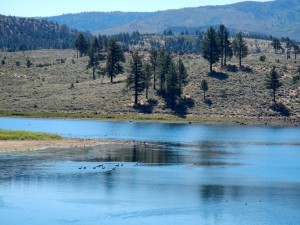
Harvey Place Reservoir in Alpine County is where treated wastewater from South Tahoe Public Utility District is stored. Photos/Kathryn Reed

And while district officials thought one day treated wastewater would be able to be used for irrigation in the basin, that day has not come nor is it likely to happen in the foreseeable future.

Considering recyclable water in Palm Springs sells for $3,000 an acre-foot, this stuff is valuable.

And the district wants to tap into it. For years it has been giving away 2,000 acre-feet of treated water to farmers in Alpine County. It’s been a mutually beneficial arrangement with farmers getting water for free and the district able to unload water for free.

But things are likely going to change when the current five-year agreement expires in 2015. That irrigation water for farmers in the Diamond and Ward valleys may go from free to fee.

(Current law prohibits treated California water from being used in Nevada, but the district is working to change those rules because Silver State farmers are interested in using this water.)

The future for STPUD

This summer begins the first of three phases of a project that will ultimately allow South Tahoe PUD the ability to generate power to run the irrigation system on the land it owns in the Diamond Valley as well as eventually sell power back onto the grid.

“Water is more and more valuable,” South Tahoe Public Utility District spokesman Dennis Cocking said last week while giving Lake Tahoe News a tour of its ranch in the Diamond Valley as well as the farms that benefit from the South Shore’s treated wastewater. “Water is no longer cheap and plentiful.”

The utility district bought the old Heise Ranch seven years ago after seeing the writing on the wall that farmers were starting to divvy up their land and therefore there may not be a place for this treated water. Laws require the treated water be sprayed on 100-acre parcels or larger.

Hal Bird with the district is in large part responsible for having the vision for the district to purchase the land and get on the road of being less dependent on others. The goal is self-sufficiency. He is also behind the improvements to make this land function at its highest level.

The original farmhouse is being restored and will one day be his office.

Most of the roads on the farm are dirt or gravel. It looks much like a working ranch. There is no evidence this land belongs to a water-sewer district and not to a bona fide farmer.

Besides giving water to farmers, for Alpine County to say OK to the STPUD-farmers’ agreement, the district had to make other concessions – like creating a fresh water fishery at Indian Creek Reservoir, stocking it every year with 15,000 pounds of trout and other commitments.

Had it not been for the federal mandate to pump the water away from Lake Tahoe, STPUD ratepayers would not be funding these improvements to Alpine County. Plus, 38.9 percent of each STPUD sewer bill goes to meet the demands of the Porter Cologne Act.

Alpine County residents weren’t thrilled at first with the idea of taking Tahoe’s wastewater. “We don’t want Tahoe’s crap” were common bumper stickers.

Now, though, the relationship between the county and STPUD is amicable.

Before the hydropower project truly gets under way the Army Corps of Engineers must sign off on the old Heise property not being a wetlands. That is expected in the next year. The land is drying out now – proof it is not a natural wetlands.

The pipes are being put in this summer. Inside them will be turbines that generate power. The in-conduit line generates the hydropower, Cocking explains.

“It’s a great way to get our feet wet in hydropower,” he said.

California keeps mandating power companies acquire more and more power from renewable sources. What South Tahoe PUD generates could help Liberty Energy fulfill this mandate.

Power from this project may be generated in 2014.

(In large part the 5 percent sewer rate the board approved in May that will take effect July 1 is paying for this project by being the money needed to pay back a low interest loan the district has secured from the state.)

Along the lines being installed will be three pivot irrigation systems that will allow for some of the acreage to be irrigated. The alfalfa could be sold or used as pasture land for cattle. Even now some of the district’s land is filled with cows munching away on the grasses or just lounging in this fertile valley – looking like they are sunbathing in this idyllic spot of the Sierra.

Transporting wastewater

The export line leading from the plant in the middle of South Lake Tahoe goes into Meyers, then along Highway 89 over Luther Pass, down to Diamond Valley where it comes out into a creek before going into the Harvey Place Reservoir. This effluent travels 26 miles.

The late Hubert Brons – a farmer, Alpine County supervisor, and Lahontan Water Quality Control board member – came up with the idea of the reservoir as a holding pen of sorts for water for farmers.

Devices were created so the treated water from STPUD did and still does not flow back into the Carson River – a main source of water for farmers.

As Cocking said, one would think with 5 million gallons a day of water coming out of the pipes, it would be a turbulent affair. Instead it looks like a good flowing mountain stream. And it looks like any other stream – like fresh water that one could use to fill her water bottle with.

The export line started working April 1, 1968. A lot of leaks sprung in the 1980s, necessitating most of the portions within the basin to be replaced in the 1990s. No longer does it go through Grass Lake, but instead skirts this area near the top of Luther Pass.

Grass Lake is one of a handful of identified peatlands areas in the Sierra, with another being the Sagehen Valley near Truckee.

Getting the wastewater pipeline out of this marshy area was of environmental significance.

In the 1990s, Tim Leslie, who at time represented the Tahoe area in the California state Senate, helped STPUD secure a variance to the Porter Cologne Act that allowed for six fire hydrants to be put in along Grass Lake Road that could be tapped in the event of a catastrophic fire. Lake Valley and U.S. Forest Service fire crews have access to those hydrants.

At the end of that road is the Luther Pass Pump Station where two huge tanks sit empty – and ideally always would. But just in case power and all back up power fails the 400,000 gallons intended for the other side of the hill would flow back into the tanks. This is designed to prevent a spill that would contaminate the Upper Truckee River as well as nearby land.

Inside the pump house is the equipment needed to get the effluent over the pass. This water is going up 1,200 vertical feet in six miles.

From Harvey Place Reservoir the water goes out the Diamond Ditch, which if one looks closely enough can be seen along the hillside. It then flows into the Diamond and Ward valleys for farmers to divert as needed.

ngg_shortcode_0_placeholder (Click on photos to enlarge.)


Proposal for El Dorado County coordination committee moves forward

By Carlos Alcalá, Sacramento Bee

Efforts to create an El Dorado County advisory committee for “coordination” will move forward, after the Board of Supervisors on Tuesday gave qualified approval to a proposal by Supervisor Ray Nutting.

Coordination refers to an effort by the county to have an earlier and more effective say in federal and state policy decisions in the county, particularly regarding use of public lands.

Supervisors did not approve establishing a committee, as Nutting has proposed, but asked staff to work with Nutting and Tim Roffe – Nutting’s designated coordination expert – to develop a more concrete proposal.

Nutting and Roffe’s concept would be a committee of local experts who would offer input to the other governmental bodies, based on policies established by supervisors.

The matter is due to return to the board in late July.


Amador County casino debate reignited

By Peter Hecht, Sacramento Bee

The last time the town of Plymouth and its 980 residents felt so agitated about the prospect of an Indian casino rising on their golden meadows, voters recalled the mayor and two other City Council members.

Jon Colburn made sure one of those getting the boot was his own brother, then-council member Gary Colburn.

“I helped run it,” Jon Colburn, 72, said of the 2004 recall. “The people were pissed off. They gave their opinion and the council said, ‘We don’t care.’ ”

Now, rural Amador County faces the possibility of having not one but three tribal casinos – a development that has reignited tensions and the Colburn family feud in Plymouth.

On May 25, the U.S. Bureau of Indian Affairs ruled that the Ione Band of Miwok Indians has the right to take 228 acres into trust as tribal land to build a proposed $250 million gambling resort just off Highway 49 in Plymouth.

The decision comes as Amador, a county of 38,000 residents east of Sacramento that is home to the Jackson Rancheria Casino & Hotel, has been fighting a mostly losing legal battle to stop a third tribe – the Buena Vista Rancheria – from building a casino near the town of Ione.

In Plymouth, Gary Colburn, now 74, had joined City Council colleagues in 2004 in supporting negotiations with the Ione Band on an $85 million, 20-year agreement aimed at offsetting the effects of the tribe’s planned casino, a 120,000-square-foot structure with a five-story hotel and events center.

That effort, born of the belief that the town couldn’t stop the casino and should bargain for concessions, made Gary Colburn an ex-council member.

Now the issue is back, five years after Amador County unsuccessfully sued the federal government over the Plymouth project and six years after 84 percent of Amador voters declared in an advisory vote that they didn’t want more casinos in the county.

Read the whole story


Big ad money flowing into Nevada for presidential campaign

By Charlie Cook, National Reader

Everyone who avidly follows politics has his or her own list of the true “swing states” in this presidential election. The lists that really matter, however, are the ones kept by top strategists for the Obama and Romney campaigns, and the ones kept by the one large Democratic and five Republican-oriented super PACs and by other major presidential advertisers this year. Figures compiled by Elizabeth Wilner of Kantar Media’s Campaign Media Analysis Group show that, beginning on April 10—the day Rick Santorum dropped his presidential bid, effectively making Mitt Romney the Republican nominee—and through May 29, there have been 63,793 television spots run in 57 out of the nation’s 210 media markets.

CMAG figures look at all broadcast and cable, national, and local television ads in each of those 210 media markets. They are analyzed by CMAG’s staff and divided by the number of Electoral College votes that each state has. Nevada ranked first with $677,332 per Electoral College vote. Iowa came in second with $496,088, and Ohio was third with $467,068. In fourth place was Virginia with $331,680, followed by Colorado with $313,653. New Hampshire came in sixth with $283,342, and North Carolina came in seventh with $237,329. In eighth and ninth places, respectively, were Pennsylvania at $204,670 and Florida at $101,107. These data potentially call into question the Romney campaign’s seriousness about contesting Pennsylvania and about how long Democrats plan to compete for Florida.

According to Wilner, $8,407,220 was the total aired from April 10 to May 29 in Ohio alone—tops on the national list in total general-election television spending so far. Virginia was in second place with $4,311,840; Pennsylvania came in third with $4,093,400; and Nevada fell into fourth place with $4,063,990. Ranking fifth, sixth, and seventh were North Carolina with $3,559,940; Iowa with $2,976,530 (including spending in neighboring Omaha); and Florida with $2,932,110. Colorado came next with $2,822,880, followed by New Hampshire with $1,133,370.

Read the whole story


Lawmaker will take her vagina comments to Capitol steps

By Huffington Post

LANSING, Mich. — A Michigan lawmaker barred from speaking in the state House after she used the word “vagina” during a debate on an anti-abortion bill will participate in a performance of the Tony Award-winning play, “The Vagina Monologues,” on the state Capitol steps.

Michigan Democratic Party fundraiser Laura Hornshaw said Saturday in an email that Monday evening’s performance was planned in response to Rep. Lisa Brown not being allowed to speak on the House floor Thursday.

Read the whole story