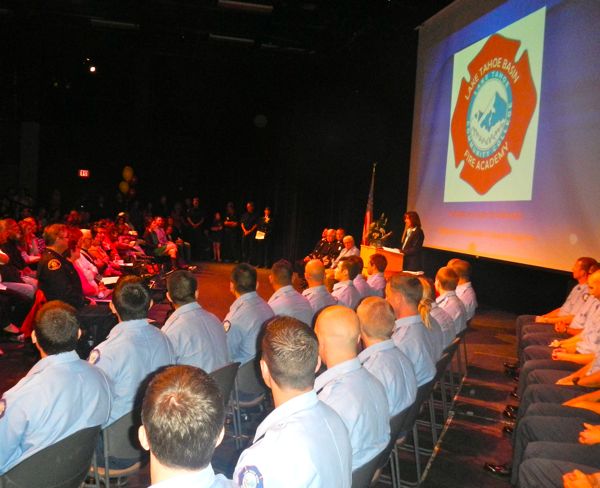
Lake Tahoe fire academy grads ready for front line
By Kathryn Reed
Steven Nichols didn’t have time for graduation. He had a job to do. To fight a fire in Colorado.
But his presence was clearly felt at Lake Tahoe Basin Fire Academy’s graduation June 23. He is one of 32 graduates of this year’s program that is run through Lake Tahoe Community College in cooperation with the basin’s various fire departments.
“This cadet will probably go on to be a fire chief,” Leona Allen, one of the academy coordinators, said as she talked about Nichols and why he was receiving the leadership award.
The sixth class of the Lake Tahoe Basin Fire Academy graduates June 23. Photos/Kathryn Reed
That honor and the motivation award winners are voted on by their peers. Nichols received both awards.
This is the sixth class to graduate from the program – and the largest. Twenty of them are from the basin, with one from Mexico and another from Germany.
Dressed in navy blue slacks, neatly pressed shirts with the academy badge, and black boots that looked shiny enough to see one’s reflection in, the cadets have coalesced into a family during the past 10 months. Some look barely old enough to shave, while others are already parents. Among the 32, two are women.
Their motto as a class is – Together We Rise.
With more than 650 hours of instruction, they are ready for entry-level firefighting jobs. They’ve been to the top of the 100-plus foot ladder truck, in Lake Tahoe on ice (this is the only California fire academy that teaches ice water rescue), turned SUVs into convertibles on extrication day, and of course, have willingly walked into burning buildings.
A video of their 10-month journey was shown in Duke Theatre on the college campus. This gave the standing-room-only audience of friends and family a chance to see what their loved one had been enduring all this time.
While all spoke of the hard work, there was a sense of camaraderie among them that was nearly palpable.
“What a firefighter does is change the outcome,” Ben Sharit, chief of the Tahoe Douglas Fire Protection District, told those in attendance.
He told the cadets to keep challenging themselves, to never stop learning. He also said, once in the fire service, learning is a continual part of the job.
Sharit said there would be structures they will be asked to save and they will wonder why.
“To somebody, it’s all they have,” Sharit said. He said when you see the gratitude in someone’s eyes it all seems worthwhile.
ngg_shortcode_0_placeholder (Click on photos to enlarge.)
El Dorado County judge tied to firm grand jury probed
By Kathryn Reed
When the El Dorado County Grand Jury report comes out in the next week an item about the Pioneer Fire Protection District will seem a bit vague to those not in the know. This is because the consulting firm in question has not been named.
The firm in question is Dan Dellinger Consulting.
The Pioneer Fire Protection District hired the consultants after Dellinger listed Superior Court Judge Steven Bailey as a reference.
It appears Bailey did not want the general public to know about his dealings with Dellinger and did what he could to ensure the ties would not come to light.
Last summer the grand jury started looking into the small rural fire district’s hiring of Dan Dellinger Consulting, which is run by Dan Dellinger and Cris Alarcon.
(Alarcon was arrested Feb. 6, 2012, by El Dorado County sheriff’s deputies on suspicion of using a false license plate and using a false vehicle registration. In March, Alarcon was arraigned on 14 charges. He has pleaded not guilty to the charges and is scheduled to be back in court in July.)
The original contract between Pioneer fire and the consulting firm was modified in August 2011 because the original contract appeared to contain services for illegal campaign activity in violation of California Government Code Sections 8314 and 54964.
The grand jury prepared a draft report on the entire matter and submitted it for review to Bailey. Bailey is the presiding judge of the grand jury and has been for a few years.
He never recused himself from this matter despite having ties to Dellinger. Bailey was not available for comment. But Bailey also has ties to others in the county. Bailey is the brother-in-law of county Supervisor Ron Briggs and son-in-law of former state Sen. John Briggs. The elder Briggs is famous for the 1978 proposition called the Briggs Initiative that had it passed, would have meant all employees in California’s education system who are gay or lesbian and their supporters would have been fired.
It’s not just Bailey to whom this consulting firm is tied to. Dan Dellinger Consulting in the past has managed the political campaigns of Sheriff John D’Agostini and county Supervisor Ray Nutting. The consulting firm is currently providing advice to Superior Court Judge Warren Stracener for his November election bid. Former Gov. Arnold Schwarzenegger appointed Stracener to the bench.
Dellinger is also in the same camp as Rico Oller, who represented Lake Tahoe in the California Assembly and Senate, and who is trying to be this area’s assemblyman again. Years ago, Dellinger and Oller were involved in a questionable incident involving the killing of a bear.
What gets convoluted is how it came to pass that Dan Dellinger Consulting is not mentioned by name in the report. When it came time to decide which of the two versions of the grand jury report involving Dellinger was to be the final one that would be printed Bailey was out of the office.
El Dorado County Superior Court Judge Suzanne Kingsbury told Lake Tahoe News she was given the reports one day and told to make a decision that day. She does not know what the urgency was. But it was Bailey who asked her to read the reports. Both work in the courthouse in South Lake Tahoe.
“All I did was read two different versions and selected the one that was better written,” Kingsbury told Lake Tahoe News on June 24. “I didn’t edit anything. I read two different versions, pure and simple. One had attachments with extraneous writing. I didn’t know where that came from.”
Without supporting documentation to the handwritten items, Kingsbury said it was not publishable on those grounds. The naming of people was not a concern to her.
But who wrote on the documents is not known, but presumably it was Bailey who marred the documents because grand jury foreman Ted Long told Lake Tahoe News the originals went to Bailey and they came back “edited to pieces.”
Kingsbury said she made no edits.
For a number of months the grand jury had been debating whether to include Dellinger’s name in the report. Libel and slander were reasons for concern, though Long said that can be the case with any investigation.
Long sent an email to Lake Tahoe News and others (that LTN has not edited), that says, “After review Kingsbury invoking penal code section 929 was concerned about potential libel/slander actions, choice to remove the attachments and the specific mention of Dillinger Consulting.”
That code deals with the slander-libel issues.
But Kingsbury is adamant her decision “didn’t involve section 929.”
Also on June 24, Long spoke with Lake Tahoe News, stating that Kingsbury invoked 929 as her reason. However, he admitted that Kingsbury neither told him this in writing nor verbally, but that he surmised there could be no other reason for picking the report she picked. He was not aware the version with Dellinger’s name had handwritten notes on it because it didn’t when it left the grand jury office.
Ruling could slow pace of Indian casino development
By Steve Green, Las Vegas Sun
Wall Street analysts say a U.S. Supreme Court ruling could stall development of some Indian casinos around the country — a situation that casino opponents are already seizing upon.
The court on this month allowed a lawsuit to proceed in which a foe of the Gun Lake Casino in Michigan, David Patchak, is challenging the federal government’s decision to take land into trust on behalf of the Gun Lake tribe — a key step in establishment of Indian reservations and casinos.
The Gun Lake casino was developed in partnership with Station Casinos LLC of Las Vegas, which has a 50 percent interest in the casino management company. It opened in February 2011. Gun Lake won’t be affected anytime soon — if at all — by the court ruling since the court didn’t rule on the merits of the casino foe’s lawsuit. It simply allowed his suit to proceed.
Nevertheless, analysts at Fitch Ratings on Tuesday said the ruling could have ”several key credit implications for the gaming sector.”
The ruling is likely to increase challenges from Indian casino foes to land-into-trust decisions for tribes, Fitch said.
That’s partly because it lengthens the statute of limitations for court review of such decisions from 30 days to six years, the Fitch analysts said in a report.
”Raising capital for Native American casino projects could become more difficult/expensive, as investors are likely to have heightened concern about potential challenges regarding land-into-trust decisions,” Fitch said.
But in a bit of good news for established Indian gaming operations, the decision may benefit them by delaying competing projects, Fitch said.
Some of the tribes that could be affected are the Graton Rancheria and North Fork Rancheria in California, Fitch said.
New TSA security screening showing only generic outline coming to Reno
By Bill O’Driscoll, Reno Gazette-Journal
The Transportation Security Administration is preparing a new screening device at Reno-Tahoe International Airport that will show only a generic outline of a person and not passenger-specific images.
The Advanced Imaging Technology unit will be used at the airport’s second-floor north Concourse C checkpoint only while the airport undergoes a major renovation which by spring 2013 will merge the Concourse B and C security screening areas into one location on the ground floor.
Concourse C is the gateway to US Air, Alaska, American and United airlines. Concourse B, serving 65 percent of all airport passenger traffic, is the route to Delta and Southwest airlines gates.
In a news release today, TSA officials said the agency has installed more than 720 of the full-body scanners at more than 180 airports nationwide to screen passengers for metallic and non-metallic threats, including explosives, without physical contact.
An airport official said the new machinery will reflect more stick-figure outlines, replacing scanners that have been criticized on privacy grounds for showing individual body outlines.
“It makes people feel better about going through with no accurate depiction of their body,” said Brian Kulpin, spokesman for Reno-Tahoe International Airport.
Hired guns stake their ground in Raley’s labor negotiations
By Dale Kasler, Sacramento Bee
On one side is a third-generation union man, leader of a labor empire stretching from the Oregon border to Death Valley.
On the other is a veteran labor-relations consultant and Republican politico with a history of tangling with unions in the public and private sectors.
Little wonder they have trouble getting along.
Jacques Loveall and Bob Tiernan are two of the leading actors in the labor drama that’s gripped Northern California’s supermarket industry over the past few months. They couldn’t come from more radically different backgrounds.
Loveall, 50, a self-described “union man for life,” is president of United Food and Commercial Workers Local 8-Golden State in Roseville. He succeeded his father as local president and signs every message to his membership with the slogan, “Solidarity Works!”
Tiernan, 57, leads the contract negotiating team at Raley’s. A lawyer by trade, he’s a former Republican legislator and state GOP chairman from Oregon. He once helped a small Berkeley supermarket chain dislodge its union. He joined Raley’s about a year ago.
Nine months of bargaining on a new contract have left labor and management in a tense and increasingly bitter standoff. It could lead to the first strike in Raley’s 77-year history.
In a recent memo to his members, Loveall referred to Tiernan as a “small-time union buster,” a reference to Tiernan’s work in Berkeley. Loveall also said Tiernan “is in over his head.”
Tiernan said last week he’s no union buster – just someone trying to help Raley’s regain its competitive edge in a grueling business. He said Loveall “seems either to have a lack of knowledge or refuses to acknowledge that Raley’s needs to control its costs.”
Raley’s has declared an impasse in order to put more pressure on the union. Workers voted to authorize a strike. A walkout doesn’t appear to be imminent, but no negotiations have been held since June 8. Both sides say they won’t let the situation go on for much longer.
“We need it over,” Tiernan said.
Loveall and Tiernan, of course, aren’t the only participants in this rift. Two other UFCW locals are involved, Local 5 in San Jose and Local 648 in San Francisco. And two other grocery chains are struggling to negotiate contracts with the union, Save Mart and Safeway.
Save Mart might actually be closer than Raley’s to a strike. Local 5 officials last week said talks with the Modesto grocer had reached a “crisis situation” and the local has scheduled a strike-authorization vote for this week.
2 Republicans on November ballot for area Assembly seat
By Jim Sanders, Sacramento Bee
Andy Pugno came from behind Friday to win a spot on the November ballot, but he must decide whether to keep a promise to support his Assembly opponent, fellow Republican Beth Gaines.
Pugno overtook Democrat Regy Bronner by about 800 votes, largely on the strength of Placer County provisional, write-in and other ballots received on Election Day and counted the past two weeks, ending with a final tally Friday.
The 6th Assembly District extends into Sacramento and El Dorado counties, which finished their vote count days ago.
Pugno, a Folsom attorney, won the right to fight Assemblywoman Gaines, of Rocklin, in what could be a rerun of the costly, fiery, no-holds-barred race that rocked the newly drawn Assembly district in recent months.
Gaines, a Rocklin resident, easily finished first in the primary for a seat to represent the largely Republican district, based in Placer County but stretching into Folsom, Fair Oaks, Orangevale and El Dorado Hills. However, this seat will no longer stretch into South Lake Tahoe.
S. Tahoe dispatch sends units within seconds to Angora
CHP won’t talk about Truckee dispatch investigation
By Kathryn Reed
Within 13 seconds of the first call that came into the South Lake Tahoe dispatch center at 2:09:13pm on June 24, 2007, fire units were alerted.
Angora Fire -- 5 years later
Leona Allen doesn’t know how many calls she received that first day. Working alone in the dispatch center on what was supposed to be a day off, what she does remember is the first call, her husband saying her 90-year-old dad was safely evacuated (his house later burned to the ground), the call not on Day 1 from Barton Skilled Nursing asking her to help move her mom because they were evacuating and having to say she could not leave work – which she didn’t leave for five days.
It wasn’t long into that Sunday five years ago that Allen learned her house was also one of the 254 that was consumed by flames.
Much controversy has centered on whether the flames could have been doused faster had the California Highway Patrol dispatch in Truckee not told callers it was a control burn, which meant those dispatchers didn’t dispatch resources.
An investigation followed, but the results are not known. Allen, who was involved with the investigation, doesn’t even know the outcome. She said a Truckee dispatcher called her asking if there was a control burn, to which Allen said, “No.”
Lake Tahoe News submitted a public records request to CHP seeking the report on the investigation. This is the state agency’s written response, “The department is unable [to] provide you with the requested ‘report from the investigation.’ The investigative reports are personnel documents, prepared as inquiries into the performance of department dispatch personnel. Pursuant to the Public Records Act, disclosure is not required of records that are ‘personnel, medical, or similar files, the disclosure of which would constitute an unwarranted invasion of personal privacy.’ (Government Code Section 6254(c)). The mandatory, rather than voluntary, contribution of involved personnel creates a privacy interest in the information that courts will recognize; see, e.g., California First Amendment Coalition v. Superior Court (1998) 67 Cal.App.4th 159.”
No one in Truckee or at the Sacramento headquarters would say if anyone was disciplined or if any policies were changed. Nor would anyone say why the dispatchers thought there was a control burn on the South Shore at that time.
All agencies on the South Shore that would have had the authority to ignite a prescribed fire say there were no controlled burns on June 24, 2007.
Every 911 call is logged into the computer aided dispatch system.
Residents to this day are still thanking firefighters for their efforts. Photo/LTN
Lake Tahoe News also sought the transcripts of the 911 calls from the Truckee office on June 24, 2007. CHP late last week said a recording could be provided. But FedEx was not able to get the disc to Tahoe by Saturday. When LTN receives it and if the audio is of publishable quality, we will release them.
Where a 911 call goes depends on the phone carrier and if the caller is on a cell or landline. In the past five years, more cell calls go to the area the caller is in instead of the nearest CHP dispatch.
El Dorado County Sheriff’s Office is dispatched out of Placerville.
“They monitor us, so the deputies knew immediately and took on the evacuations. They just reacted. I didn’t even have to call. It’s why we all listen to each other,” Allen told Lake Tahoe News. (Allen eventually left her dispatch job and now works for Lake Valley Fire Protection District as the communications specialist.)
The South Tahoe office dispatches South Lake Tahoe police and fire, Lake Valley fire, and Fallen Leaf Lake fire.
The California Highway Patrol, Tahoe Douglas fire, Nevada Highway Patrol – they all came without being asked.
Allen’s co-workers started showing up without being called in.
In addition to the mounting calls from people reporting what became known as the Angora Fire, during that first hour there were 10 emergency medical calls, including a structure fire that had nothing to do with Angora.
No confusing this plume of smoke with a control burn. Photo/Lake Valley Fire
Two dispatchers had to evacuate, but immediately returned to work. Twelve-hour shifts were the norm for five days. Cots were set up. Food brought in.
“I remember going to the first briefing with the Forest Service on Day 2 and I was still in the same clothes as when I started,” Allen said.
It wasn’t long before the fire was of such a magnitude that it was no longer considered a local event.
“When a fire gets so large that the local dispatch center cannot handle it, it is turned over to an emergency communication center in Camino, Gardnerville or Minden,” Allen explained.
When the feds get involved – which was the case because most of the land belonged to the U.S. Forest Service – and emergency aid agreements are triggered, a dispatch center for that specific fire is created. This happened on that first day of Angora.
Still, the local calls were coming in to the South Lake Tahoe center. All sorts of calls came in — one man said he knew how to fly a helicopter better and that the guys in the air were doing it all wrong. People called wanting to know if they should evacuate.
A big flip chart was set up in the center so the dispatchers could record what callers were offering (things like hotel rooms, a place for horses) and who to contact. Red Cross was provided all this info.
The little details that are huge to people in the middle of a tragedy were being coordinated by these men and women, like finding a home for 12 displaced bunnies.
Firefighters would call in with addresses of houses gone. The dispatchers had to keep working knowing the homes of family and friends were nothing but ash.
Allen says the only thing she would have done differently regarding the fire was to have commended her dispatchers sooner.
“The quality of a good dispatcher is maintaining your composure and quality of work when you know the vortex of fire is just down the road,” Allen said.
PeopleSoft founder Duffield not content to be retired in Tahoe
By Ashlee Vance, Bloomberg Businessweek
At 71, Dave Duffield ought to be retired. He’s spent a half-century starting technology companies and is worth billions. He has a $35 million Dassault Falcon 900EX jet, homes in the Bay Area and Palm Springs, and a seven-building vacation compound on Lake Tahoe with plenty of space for his wife of 28 years and their 10 children, the youngest of whom is an adopted daughter, age 2. On a sizzling June afternoon, Duffield stands in his hangar at an airfield east of San Francisco before a flight to Reno-Tahoe International Airport. “I just bought this Chevy Camaro,” Duffield says, gesturing to the black car parked next to his jet. “It’s probably the only one around with a baby seat in the back.”
Duffield did take a break from the tech game, briefly. After his most successful company, PeopleSoft, was acquired in 2004 for $10.3 billion, he unofficially retired. With his thin frame and rich head of silver hair, he’d sit in a rocking chair on his porch in Tahoe overlooking the lake. The relaxing, family-filled glide into his golden years lasted about three months. “I was rocking away and getting bored,” Duffield says. When he told his wife, Cheryl, that he was starting another business software company, later named Workday, she cried, but didn’t try to stop him. “She understood the higher calling,” Duffield says.
One of the first things Duffield and his Workday co-founder Aneel Bhusri will tell you is that their company is not a revenge plot against Larry Ellison, the founder and chief executive of Oracle (ORCL). It was Ellison who bought PeopleSoft eight years ago—a hostile takeover by the most hostile guy in tech. Ellison lowballed PeopleSoft’s shareholders, threatened to fire thousands of the company’s employees, and insulted Craig Conway, then PeopleSoft’s CEO. “It’s normal for Larry to do that kind of thing,” Duffield says, sitting back in one of his plane’s beige leather seats. “He threatened to shoot Craig’s dog at one point.” Bhusri, 46, sitting next to Duffield, cuts him off. “We don’t think about Larry or have any animosity,” he says, which will be a refrain over the next few hours. Back on message, Duffield adds, “You have to bless Larry’s heart for giving us this opportunity. I would never have been part of this Workday thing without Larry.”
The “Workday thing” threatens to upend the business—or enterprise—software market. It sells software that corporations use to keep track of their employees and finances. Normally such applications are expensive, a pain to use, and, because they become so entwined in a company’s operations, rely on a kind of monopoly of inertia. Workday’s software for filing expenses or approving a hire, on the other hand, is about as easy to use as Facebook (FB). It’s an example of cloud computing, selling software as a Web-based service rather than a product customers install in their own computing centers.
Workday now has 310 corporate customers, from Sallie Mae to Chiquita (CQB). The company won’t disclose its revenue, though people familiar with Workday’s financial performance say its bookings (a reflection of the value of multiyear deals) should reach $500 million this year. Investors, including Michael Dell, founder and CEO of Dell (DELL), and Jeff Bezos, founder and CEO of Amazon.com (AMZN), have backed it with $250 million in funding, valuing the company at more than $2 billion. Their reward could come soon: Workday is expected to file for an initial public offering this month.
What does Ellison think of all this? He declined to comment for this story, but said, “I won’t mention Workday by name,” during a June 6 press conference at Oracle’s Redwood Shores (Calif.) headquarters. Oracle used the event to, at long last, unveil its competitor to Workday, called Oracle Cloud, and Ellison did in fact mention the company often by name in order to dismiss it.
Together, Duffield and Bhusri own a little more than 50 percent of Workday, and they see the company as their chance to fulfill a grand vision. Business software should not be arcane and ugly. It should have spit and polish and be tuned for the cloud-computing and mobile revolutions. Make the software good enough and mortals—rather than HR and accounting specialists—will be able to use it and learn more about their business and their co-workers. Duffield says Workday could be bigger than PeopleSoft. “You don’t know this when you’re young, but over time you see that great companies are usually built at a special point in time,” he says. That time, it goes without saying, is now.
Enterprise software makes the corporate world tick. Oracle and SAP (SAP) sell applications that track everything from inventory to insurance policies to health-care plans. It’s a huge business. Bhusri figures the market for HR software alone is about $10 billion a year, while financial application sales run about $30 billion per year. As it happens, the purveyors of such software aren’t known for their warm relations with customers. “Just picking the right mix of stuff is complex and fraught with issues,” says David Smoley, chief information officer of Flextronics International (FLEX), the giant electronics manufacturer and Workday customer. “Oh, and by the way, the motivation of an Oracle or SAP is to sell you a huge pile of software.”
It’s not uncommon for a buyer to spend years installing a new version of Oracle or SAP software. The process requires the purchase of an expensive, long-term license and a ton of computer hardware. Then you need a team of experts to make the components work together and another team of experts to configure and customize the system for every peculiarity of a company. Year after year, Oracle and SAP levy maintenance fees to keep these customized machines humming. Call it a “thanks for being our customer” tax. For years, software makers would offer discounts to customers if they bought long-term licenses for, say, 40,000 expected employees instead of the 20,000 current employees. “You spend $25 million instead of $20 million for what’s billed as this super, smoking deal that will give you room to grow,” Smoley says.
Title IX didn’t erase stigma of girls taking shop classes
By Claudio Sanchez, NPR
Forty years ago, former President Richard Nixon signed Title IX, which said no person shall, on the basis of sex, be excluded from any education program or activity. Vocational education courses that barred girls — such as auto mechanics, carpentry and plumbing — became available for everyone. But it’s still hard to find girls in classes once viewed as “for boys only.”
Zoe Shipley, 15, has a passion for cars and tinkering with engines.
“It’s just kind of cool to learn how to fix a car or learn about it,” she says.
Zoe is also the only girl in her automotive technology course, so she’s been teased a lot.
“They would call me grease monkey,” she says. “I’m like, so what? At least I have the option to choose what I want to do, you know what I mean?”
That’s what Title IX did. The law removed the policies and practices that kept female students from courses and programs once reserved for male students.
“All our electives here are totally open to all of our kids. We don’t force any boys or girls to do anything,” says Tom Evans, the principal at Eastern Technical High, a magnet school in Essex, Md.
Students can choose from 12 career majors, including construction, information technology, engineering and Zoe’s choice: automotive technology.
Evans unlocks the big double doors that open up to a cavernous garage. Six- and eight-cylinder car engines sit in the middle of the room next to several cars and a row of computers that have been stored for the summer.
If you think about it, Evans says, this school is proof that Title IX accomplished what it set out to do in education. And yet, he says, Zoe is the exception, not the rule.
“I’ve seen Zoe in action in her automotive class. She’s not going to let anybody push her around academically or intimidate her in any way,” he says.
The same is true of the four girls in the school’s construction management program that offers electrical and plumbing classes. That’s it. In a school that’s over half female, a total of five girls are in two traditionally male courses.
“I think in some of the fields, just the nature of the work that kids see going on in those fields, isn’t going to attract that many women. Automotive technology isn’t a field that you see women in,” Evans says.
That would quickly change if there was a demand for more female mechanics and plumbers, Evans says, like there is now for female engineers.
“We make a serious attempt at getting girls into engineering. We recruit girls from all over the county, and that’s paid off a little bit,” he says, “but engineering by itself is a field where I think women are starting to see female engineers.”
Zoe says that’s why her family tried and failed to get her to switch from automotive technology to the engineering program.
“But I think it would be cool if I owned my own shop, like a car shop,” Zoe says.
Study: Medical marijuana does not increase teen drug use
By Katherine Bindley, Huffington Post
Marijuana use among teens has been on the rise for some time–it’s become more popular than smoking cigarettes in recent years–but a provocative new study shows that legalizing pot for medical purposes doesn’t increase the chance that teens will abuse it or certain other drugs.
“There is anecdotal evidence that medical marijuana is finding its way into the hands of teenagers, but there’s no statistical evidence that legalization increases the probability of use,” Daniel I. Rees, an economics professor at the University of Colorado Denver who worked on the study, said in a written statement.
Rees and his team looked at nationally representative data from high school students from 1993 through 2009–medical marijuana was legal in 13 states during that time–and found that legalization didn’t affect marijuana use at school. According to study co-author Benjamine Hansen, assistant professor of economics at the University of Oregon, the data showed the opposite: There was often an inverse relationship between legalization and marijuana use.
What’s more, the researchers found no evidence that medical marijuana legalization led to an increase alcohol or cocaine use.
“This result is important given that the federal government has recently intensified its efforts to close medical marijuana dispensaries,” Hansen said in the statement.