Airport creates environmental dogfight at 6,200 feet

Publisher’s note: This is the second of three stories looking at the past, present and future of Lake Tahoe Airport.

By Joann Eisenbrandt

In the mid-1800s, white trappers and settlers spilled over from the gold mining encampments of the California Mother Lode and changed Lake Tahoe forever. Attempts to designate the lake as a national park failed in 1905 and again in 1935 because private enterprise and development already dotted the lake’s entire perimeter. The focus then turned to how its human inhabitants could interact with the Tahoe environment without destroying it. In many ways, the Lake Tahoe Airport has become a poster child for this struggle.
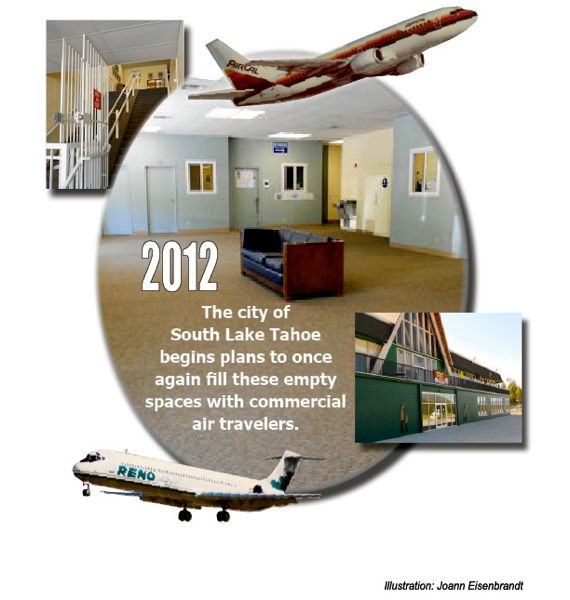
The 1992 Lake Tahoe Airport Master Plan Settlement Agreement, which has regulated commercial air service at Tahoe for the last two decades, expires this October. There has been no scheduled commercial service to Tahoe since 2000, but the city is actively laying the groundwork for its return, rekindling the debate over its positive and negative impacts.

In 1985, while the pre-Settlement Agreement distrust and fighting was still raging, California Deputy Attorney General Ken Williams explained to this reporter, “The problem is that things at Tahoe tend to polarize so fast. Once you get into a tug-of-war like that, it’s very hard to let go of the rope.”

Tahoe’s major stakeholders ― South Lake Tahoe, Tahoe Regional Planning Agency, California Attorney General’s Office, League to Save Lake Tahoe and with regard to the airport, the FAA ― all clearly recognize the basin’s two inseparable yet polarizing issues, environmental preservation and economic survival. As Julie Regan, TRPA’s external affairs chief, told Lake Tahoe News, “Our entire Regional Plan is based on restoring the lake and revitalizing our community. We’re supportive of progress to help the economy, but we live in a fragile environment. We need an economic boost that is also compatible with sustaining the special environment we live in and the serenity of Lake Tahoe.”

Darcie Goodman-Collins, executive director of the League to Save Lake Tahoe, says something similar, “This is really a false dichotomy. Without a clear blue lake, there can’t be a healthy economy at Tahoe, so the two must go hand-in-hand. Economic vitality is important in any community because it enables investments in environmental restoration and protection. … The challenge is building an economy that will both thrive over the long term and benefit the lake.”

South Lake Tahoe City Manager Nancy Kerry agrees, “We look at what law governs airport operations and how do environmental concerns fit in with airplane regulations. We have things we want to do to help our community find a better life. We all live in Tahoe and work here. We all love Lake Tahoe.”
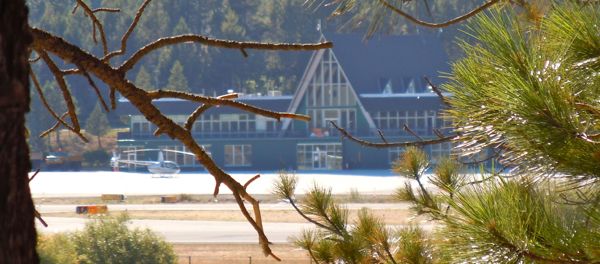
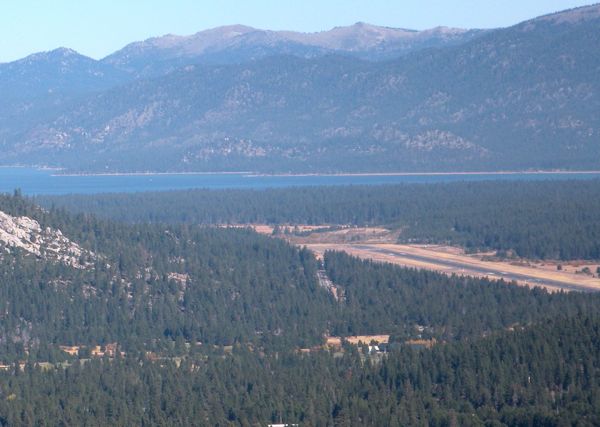
For some, it's hard to see the benefit of Lake Tahoe Airport through the trees -- literally and figuratively. Photos/LTN file

But loving the lake and letting go of the rope can be two different things, especially when the future of Tahoe is seen as hanging in the balance. Even now, the line between cooperation and lawsuits remains a thin one. In April 2011, the League expressed its concerns over the future of the airport in a letter to the city Planning Commission regarding the city’s General Plan update, “The city of South Lake Tahoe General Plan EIR must provide more information about plans for the South Lake Tahoe Airport and the impacts it would create. The city is pursuing airport development, but the EIR does not provide enough information about potential air quality and noise impacts that would result from the planned development.”

The League’s lawsuit was subsequently dismissed in February 2012, when the two parties reached a settlement agreement. The issues surrounding the Lake Tahoe Airport remain unsettled.

First of all, noise

Noise isn’t just sound. It’s unwanted sound. Just mention “SnowGlobe” and you realize how noise can send otherwise calm people into a frenzy. Understanding the emotional underpinnings of noise is as important as understanding the statistical measurement of noise itself. As the FAA recognizes in its Aviation Noise Effects Advisory Circular, “It is not possible to state simply that a given noise level from a given noise source will elicit a particular community reaction … an individual’s attitudes, beliefs and values may greatly influence the degree to which a person considers a given sound annoying.”
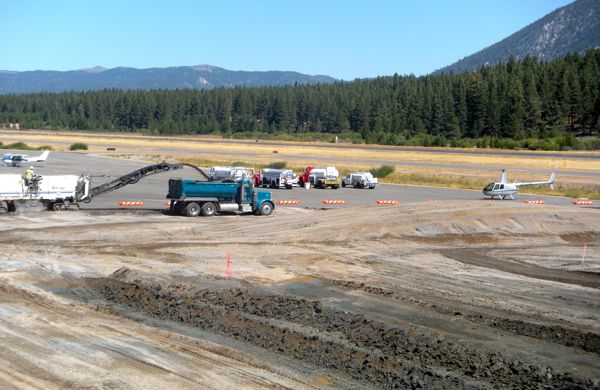
FAA mandates the runway be kept in good working order.

Technically, noise events, quantified in decibels (dB), are measured as “intrusions” over the existing background or “ambient” noise levels, which have been estimated to be much as 20 decibels lower in a rural setting, such as Tahoe. Acoustics, the science of noise measurement, is complex, and depends on a number of precise factors, and different agencies such as the FAA, California Division of Aeronautics and TRPA have all developed descriptors for time-measured noise events.

The 1992 Settlement Agreement contains specific aircraft arrival and departure decibel limits, and a monitoring and complaint system to track them. There has been significant disagreement over the decibel levels, but the reason why discussions have turned so quickly into emotionally charged ones is the fact that such noise itself is seen by many as totally inappropriate in Tahoe’s unique environment. As one respondent to a phone survey done by this reporter in 1988 put it succinctly, “It’s sick to have an airport in beautiful country like this.”

TRPA’s Regional Plan update pinpoints noise as a significant impact that needs to be tracked and mitigated. “High noise levels can reduce the public’s enjoyment of the natural environment, impact quality of life for residents, and disturb native wildlife.” The TRPA Compact requires the adoption of “environmental threshold carrying capacities” for the Lake Tahoe region. These are the minimum standards TRPA believes are needed to maintain the lake’s scenic and natural values. One of those carrying capacity standards is for noise.

Noise can be measured as a maximum single-event level or as a cumulative noise level over time. TRPA has established Environmental Threshold Carrying Capacity Noise Standards for both – a Single Event Noise Level (SEL) for single, non-repetitive events and a Community Noise Equivalent Level (CNEL), which averages cumulative noise levels in a specific “noise contour” over a 24-hour period with extra penalties assigned to nighttime aircraft noise events. These noise standards are measured in decibels as A-weighted (dBA), de-emphasizing very high and very low frequency sounds in the same way they are perceived by the human ear.

TRPA’s noise standards for commercial aircraft have been disputed by the city since it first took over the airport from El Dorado County in 1983. At that time, the city contended that TRPA’s dBA limits for commercial aircraft takeoffs and arrivals were taken arbitrarily from FAA Advisory Circular 36-3B, ― which establishes noise standards by aircraft type ― with the express intention of banning specific aircraft from Tahoe whose test ratings showed they couldn’t meet TRPA’s then single-event daytime standard of 84dBA, while allowing others. TRPA planners disagreed, stating they “drew the line” based on the best-available technology of the time, the DC-9-80, which could meet that standard.

In the 2012 Regional Plan Update Goals and Policies, TRPA’s single-event noise thresholds for commercial aircraft are 86 dBA arrival and 80 dBA departure daytime, and 77.1 dBA nighttime (8pm to 8am) with a CNEL level in areas impacted by the airport of 60dBA.

Noise was clearly a defining issue leading up to the 1992 Settlement Agreement. The city believes it should be less of a problem today. Airport Director Sherry Miller says comparing commercial aircraft from 1992 with today’s new generation like, “comparing apples and oranges. Technology has changed. Airplanes are quieter and less polluting.”

Mayor Pro Tem and Airport Commission Chairman Tom Davis agrees. “Aircraft have changed to Stage 3. I really don’t see noise as an issue now. We’re looking for regional service, not big jets. Like the Quad400 at 68 decibels and there are even quieter ones. The technology is there.”

Michael Golden, president of Mountain West Aviation, the fixed-base operator at the airport, explains, “The environmental impacts of flight in general are far less than those of motorized transportation. It uses the least energy and is the most environmentally friendly. Because of the rising costs of fuel, aircraft had to become more efficient to meet the market demand, and making them more efficient made them quieter. As speed increases, you need more power to battle the wind resistance, so there were changes to engines and airframes, using air foils at the wing tips. Aircraft noise is not just the sound of the engines, but the sound of the aircraft moving through the air. The more efficient it is, the quieter it is.”

FAR (Federal Air Regulations) Part 150 establishes the FAA’s system for measuring airport and background noise, determining the exposure of individuals to noise and creating a standardized airport noise control and compatibility planning program. It works in conjunction with FAR Part 36 that “contains noise certification standards for most airplane types, generally requiring newly designed and manufactured aircraft to be significantly quieter than older aircraft.” Part 150 requires the airport to develop noise exposure maps ― “noise contours” ― that spread out in rings from the actual airport itself and show different acceptable CNEL noise levels for different land uses.

That requirement is met by the Lake Tahoe Airport Comprehensive Land Use Plan that establishes the airport’s planning boundaries and creates a land use plan defining compatible land uses for future development around the airport. It includes noise restrictions and regulations from the 1992 Settlement Agreement and recognizes, “The Lake Tahoe Airport is an extremely noise sensitive airport. … The impact of aircraft noise on the basin can and should play a role in decisions made regarding the development of the airport and its surrounding area.”

The League to Save Lake Tahoe questioned how well aircraft noise impacts could actually be mitigated. Its November 2006 Lake Tahoe Airport Impacts Report says, “Larger commercial and corporate aircraft are generally louder than smaller aircraft, which directly and negatively impact all who live, work or visit near the airport or flight path.”
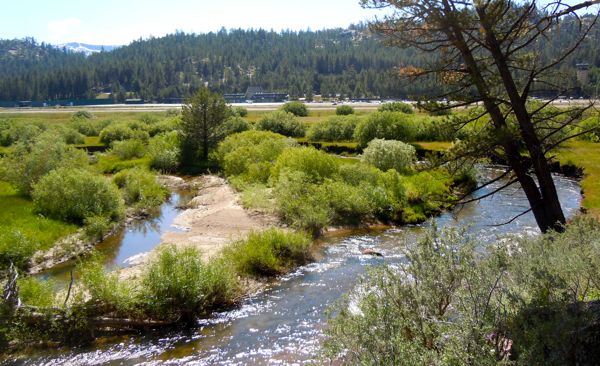
Lake Tahoe Airport is next to the Upper Truckee River.

In its April 2011 letter challenging parts of the city’s General Plan update, the League continued to remain skeptical that “airport noise will not create a significant impact. What data is available to assert that current air traffic noise does not already impact the TRPA noise threshold and that the any future increase in air travel to and from the Lake Tahoe Airport will not further impact the TRPA noise threshold?”

Every five years since 1987, TRPA has produced a “Threshold Evaluation Report” assessing the effectiveness of its Regional Plan. The latest 2011 Report was peer reviewed by an independent panel of scientists coordinated by the Tahoe Science Consortium. Regarding noise, it found, “the approach used to assess and report Single Event and Cumulative Noise Event conditions to be overly complex and recommend that it be comprehensively reviewed and simplified … as applied and interpreted, achieving adopted standards is infeasible. Enforcement too is challenging due to the transient nature of sources of noise and limited enforcement mechanisms to achieve adopted standards. Noise standards and assessment methodology should be reviewed and considered for adjustments.”

The TRPA’s Regan explains the airport was “essentially carved out of the RPU because it’s a specific set of concerns,” including noise, which will be addressed more fully and updated on a separate track. She estimated this process might take several years. Such a re-evaluation of TRPA’s noise thresholds and assessment methods could be a potentially significant change in the approach to noise measurement and enforcement. It is unknown exactly how events will play out if the city begins the process to reinitiate commercial service before a fresh look at TRPA’s noise thresholds has been completed.

Even with improved measurement methods, removing the emotional component of the noise issue will be difficult as it cuts to the heart of the “who speaks for Tahoe” question. Noise is not just sound. It’s unwanted sound. And unwanted all the more by many because it’s happening at the lake.

Air quality, water quality and VMT

Just as there is a TRPA threshold for noise, there are also thresholds for air and water quality and the requirement for mitigation measures for projects that might impact them. TRPA and the League to Save Lake Tahoe view automobiles as a major source of the emissions which create those pollutants in the air which eventually affect the lake’s clarity – imagine that endless chain of cars creeping slowly from Stateline to Echo Summit at the end this holiday weekend. How many miles cars travel in the basin or VMT (vehicle miles traveled) is seen as having a direct impact on air and water quality. The TRPA Compact has the goal of reducing yearly VMT 10 percent from its 1981 base-year levels.

But what if more of those visitors came by airplane? And what if air travel was part of an integrated regional transportation system? Would the drop in VMT from cars offset any pollutants, specifically nitrous oxides (NOx), created by the aircraft themselves?

The League says, “No.” Its Lake Tahoe Airport Impacts Report contends the “re-introduction of commercial air service to the South Lake Tahoe airport would likely emit far more air pollution into the basin than if the expected passengers instead drove automobiles to the basin,” and goes on, “Contamination from lead additives still widely used in aviation fuel near the airport can result from leaks or spills and from the lead-based aviation fuel particulates being blown into the surrounding meadow, forest and waterway.”

In the League’s April 2011 letter challenging the city’s General Plan update, it added, “State, federal and TRPA standards for ozone are currently out of compliance in the Tahoe basin. Ozone is detrimental to human and environmental health. Ozone precursors resulting from airport operations are overlooked in these findings and must be considered. Additionally, CO and particulate are produced by airport operations.”

Airport Director Miller believes advancements in aircraft technology have greatly mitigated such impacts. “All I can tell you is that the aircraft we will be attracting are a new generation and produce significantly less pollution. Research of a 1980’s B-727 versus a 2012 Q-400 will show you the difference. With older 727s there was some environmental destruction. They were huge pollution producers. You could follow their grey exhaust trail as they took off. That’s rare now. I can see why there was so much upheaval over air service in the past.”

Air pollution also affects water quality. TRPA’s goal is to “reduce nutrient and sediment loads for surface runoff, groundwater and atmospheric sources to meet 1967 to 1971 levels of algae and water transparency measured in Lake Tahoe.” The Lake Tahoe Total Daily Maximum Load (TMDL) identifies fine sediment particles, nitrogen, and phosphorus that are discharged into the lake from land-based and atmospheric sources that add nutrients to the lake and impact water clarity. Because most of these come from automobiles, reducing VMT is seen as a key to reducing water pollution as well.

Kristi Boosman, TRPA public information officer, adds, “We are looking at what science says about major pollutants. We are dealing with a holistic system, not silos. Our RPU takes that into consideration. The health of each part of the system is critical to the health of the lake. That’s the definition of sustainability.”

The city believes commercial air service will mean less automobile travel, less VMT and consequently, less pollution. For TRPA, Regan explains, “Commercial service as a VMT reducer is an open question. We need to do a more detailed analysis of where the airport fits into the VMT question. General aviation is not reducing VMT at this point, but there’s a variable because we don’t know about commercial service.”

But how is the airport’s VMT scorecard produced? Whether commercial service has a positive VMT “savings,” depends on the ratio of “diverted” passengers – those who would have driven to Tahoe if there’d been no air service to “induced” passengers – those who came because there was air service. Also factored in is the transportation mode that visitors arriving by air use once they are here – rental car, bus, shuttle – and how much VMT they accrue in the mode they’ve chosen while in the basin.

A July 1984 study by Kyung-Il Ghymn from UNR showed 69 percent of airline passengers were “diverted,” producing a significant savings of 89.9 VMT from each air carrier operation. These figures were based on flights by AirCal’s 737-300s, with much larger passenger loads than are being anticipated under any current return to commercial service. The League and the California Attorney General’s Office questioned these figures, pointing to when and where the survey was done – on a holiday weekend at the airport― saying this produced a pre-selected, non-scientific sample.

The city views the airport’s VMT-reducing role as important within a larger coordinated basinwide transportation system context. Still, the question remains how many flights using smaller regional aircraft would be required to create a significant VMT reduction and would any “savings” be overshadowed by the airport’s negative environmental impacts.

Financial impacts

Setting the environmental question aside for now, will commercial service provide an economic benefit to the larger Tahoe economy? The 1984 Ghymn study also included a Passenger Profile Study that tracked visitors’ length of stay and daily expenditure patterns. It concluded that with average stays of 5.4 days and daily expenditures of $67 the gross annual expenditure by commercial airline visitors was just more than $31 million. Factoring in expenditures by general aviation visitors and payroll figures from airport tenants, the report put the total impact at $57 million in 1984 dollars.

A voting precinct is one of the airport's main uses.

A survey, not restricted to airline passengers, was done by the Marketing Council, predecessor to the Lake Tahoe Visitors Authority, in 1985, and many other South Shore visitor surveys have been done by various agencies since. These surveys not only make predictions on direct impacts ― actual dollars spent ― but also use a multiplier to gauge the “rollover” or “trickle down” effects as those dollars are re-spent throughout the larger Tahoe community. Not everyone agrees on whether the money actually trickles down throughout the local economy or just goes directly to the casinos, ski resorts and other large California or Nevada properties.

In 1989, Laurel Ames, then consultant to the League, told this reporter, “My guess is that the amount of dollars spent on the airport could be circulated, or even thrown out of cars going down Highway 50 and have a better effect and be spread more evenly throughout the economy.”

City Manager Kerry sees it differently. “The airport is in South Lake Tahoe. You could make the argument there’s no trickle down benefit if the airport was in Zephyr Cove. We are the direct beneficiaries of this airport. People get off the plane, take a taxi, car or bus and go through our town … statistics back up the fact that people are no longer coming here just for the casinos, they come here for vacations.”

In 2007, the city commissioned RCC Associates, a Boulder, Colo.-based firm, to do an off-airport economic impact study. It used five scenarios with varying start dates for the return of commercial service, varying levels of enplanements and varying speeds at which yearly enplanement levels would rise at the airport through December 2012, using newer Boeing 737 138-seat and Bombardier Q400 70-seat aircraft, as well as one scenario with general aviation service only.

All of the scenarios with commercial service projected enplanements ranging from 300,000 to 430,000 passengers annually, with cumulative direct and multiplier impacts over the years of service ranging from about $111 million to just more than $1 billion, with the city “capturing” 40 percent to 60 percent of visitor spending. The report included the disclaimer that it was, “not intended to provide a definitive estimate of the likely economic impacts of TVL” because of “the lack of recent operating history at TVL, and the inherent margin of error in the many modeling assumptions which are required to project economic impact,” but was meant as a “jumping off point” to facilitate discussion of the airport’s potential economic impacts. (TVL is the FFA’s designation for Lake Tahoe Airport.)

Some of the report’s 2007 assumptions are no longer valid, such as the low awareness by visitors of the proximity of the Reno airport, whose aggressive Tahoe-linked marketing has greatly increased that awareness; the willingness of travelers to spend more for the convenience of flying directly into Tahoe, which didn’t anticipate the economic downturn; and the attractiveness of redevelopment and the convention center, which many never be completed.

The city points to Mammoth as a contemporary example of commercial service-generated economic impacts. It is also a mountain airport, with regional service provided by Bombardier Q-400 turbo-prop aircraft – the city’s preferred choice. Kerry states that, “Mammoth estimates that (commercial) air service brings in $220 million a year.”

While Mammoth Airport Manager Bill Manning did not confirm an exact figure, he told Lake Tahoe News, “We’ve done a lot of analysis on it. Last year we did a study. If you take enplanements, what’s spent per day, say $500, for five days and use an economic multiplier, it’s simple to come up with the economic impact.”

Mammoth Airport’s annual enplanements are about 35,000. He added, “It’s huge for the local population to be able to get out of here and get back; to start a business and be able to get to L.A.”

The study was privately financed, so more specific details were not available.

With all such studies, how one looks at the results depends on how accurate one thinks the raw data is, how valid the sample of respondents is and how appropriately the survey questions themselves were framed. Even if one accepts the results, are they offset by the costs of running and maintaining the airport itself?

The city currently spends close to $500,000 annually keeping the Lake Tahoe Airport open. This figure will decrease to about $300,000, Kerry says, once the hangars that were built are paid off and start bringing in revenue. She adds, “Most airports are not moneymakers,” nor are they expected to be. The addition of commercial service, she believes, will eventually help the airport reach break-even.

The League, in its 2006 analysis of the airport, brings it back to the question of tradeoffs, “Do the economic and transportation benefits from the Lake Tahoe Airport outweigh the costs to the environment, such as air and water pollution, and community, such as noise and tax subsidies?”

Noise. VMT. Air quality. Water quality. Economic vs. environmental impacts. All of these issues will play a part in the process as the city moves toward returning commercial service to Tahoe. How much each of will impact that process, and how closely the process itself it will resemble the conflicts over commercial service of the past, will remain unknown until the city has presented a more fully defined plan.

 Part three on July 7: What’s the same as 20 years ago and what’s different and how that will affect the city’s search for commercial service.




S. Tahoe council updated on post-Angora public safety procedures

By Anne Knowles

El Dorado County is considering a cloud-based reverse 911 system to replace its seriously flawed existing system.

Brian Uhler, South Lake Tahoe Police-Fire Chief, told the South Lake Tahoe City Council on Tuesday that the new system would be paid for with federal Homeland Security monies and will soon be presented to the county for approval.

The system would be operated on the Web – in the cloud – by a private vendor and significantly improve performance from the current system, which took several hours to send out calls during the Angora Fire, Uhler told Lake Tahoe News.

The council suggested other ways communications could be beefed up, based on the experience of the 2007 Angora Fire.

“The best communication I saw was through the radio stations,” said Councilman Tom Davis, who suggested law enforcement coordinate with local radio stations to be sure they were kept in the communications loop.

Uhler said an extensive study on evacuation procedures was underway after an initial effort that excluded highway patrols from California and Nevada forced them to start over with input from the two states’ departments.

He also said Caltrans sign readers on Highway 50 will be critical to providing up-to-the-minute information for drivers during an emergency or evacuation.

Councilwoman Angela Swanson asked if the Caltrans signs could be used during red flag days in the basin, to warn people of extremely dry and dangerous conditions. Uhler suggested she ask Michael Cook, Caltran’s senior transportation engineer, who made a separate presentation on several Highway 50 projects. Cook said he would find the council a Caltrans contact to answer that question.

Cook provided an update on five Caltrans Highway 50 construction projects. He said two of the projects – Trout Creek to Ski Run Boulevard and west of Ski Run to Wildwood Avenue – should be completed this year. The latter project was recently awarded to Granite Construction and work should begin by July 19, he said.

Cook said the South Lake Tahoe Airport to Junction 50/89 project will go out to bid soon and be completed next year while the Junction 50/89 to Trout Creek project, originally scheduled for next year, has been pushed out to 2014.

The council also approved the 10-year contract with Tahoe Sports and Entertainment for management and operations of the ice rink.

A letter to the Tahoe Transportation District stating the council does not support the use of eminent domain for the Highway 50 South Shore Community Revitalization Project was also approved. The letter also requests the TTD conduct public workshops, using a “neutral facilitator” to discuss the most viable project alternatives; include at least three alternatives for environmental review; and consider the city’s comments on the proposed Relocation Plan.


Arrests made in post-fireworks crowd control incident

Several people were arrested or cited after the Douglas County Sheriff’s Office and the South Lake Tahoe Police Department responded to a crowd control incident on the Stateline Avenue sidewalk between Harrah’s Casino and Embassy Suites Hotel after the Fourth of July fireworks display.

DCSO took the original call and said they were assisting a man who was not breathing after being involved in a fight when several people in the crowd began yelling at and pushing the officers. The police detained two men and called for assistance after the crowd of mostly teenagers swelled to more than 100 people. Approximately 15 DCSO deputies responded, including officers from patrol and crowd control teams deployed at Nevada Beach and Round Hill, DCSO Sgt. Jim Halsey told Lake Tahoe News.

About 15 SLTPD officers also responded.

“We responded with everyone we could get there because it was a dangerous situation,” said SLTPD Lt. Brian Williams. “It was turning into a mob scenario.”

SLTPD arrested or cited several people for criminal violations, including battery on a peace officer. One DCSO deputy sustained an injury to his knee.

The DCSO said crowds at the beaches and elsewhere during the holiday presented fewer problems. During the entire day, 21 persons were arrested by DCSO police with charges of battery, trespassing, larceny, minor consuming alcohol and other charges.

SLTPD said it made 22 arrests, including five for DUI, nine for public intoxication and other alcohol-related offenses and two for drug offenses. During the same time period, from noon on July 4 to 6am today, 201 calls for service came in, primarily in response to fights, said SLTPD.

— Lake Tahoe News staff report


New state laws protect women

By Leticia Ordaz, KCRA-TV

SACRAMENTO – Effective Sunday, California has more than a dozen new laws, including an anti-bullying law and a new law requiring insurance companies to cover maternity care.

Individual health insurance plans are now required to provide coverage to women who are pregnant.

Currently, in California more than 200,000 women of child-bearing age have insurance plans that do not cover maternity care.

Supporters said the new law will make sure all women get proper prenatal care and have healthier babies.

Women can now take up to four months of maternity leave.

Read the whole story 


‘Lights on the Lake’ caps off busy Independence Day

Beaches and boats were packed for South Lake Tahoe’s “Lights on the Lake” Fourth of July firework display last evening.

"Lights on the Lake" seen from Lakeview Commons. Photos/Howie Nave

Starting just before 10pm, the 24-minute display was set to digitized streamed music by KRLT 93.9 and KOWL1490.

The annual fireworks display received a lot of national attention this year, being recommended by several travel and news sites, including ABC News, MSN and The Discovery Channel.

The event capped off an Independence Day that started with the city’s first July 4 parade to honor American veterans and their families, followed by an afternoon barbecue at the Recreation Complex.

The parade, which traveled the two-mile stretch of Highway 50 between Stateline and Rufus Allen Boulevard starting at 10am, featured more than 30 vehicles, most decorated with flags for the holiday, and hundreds of spectators lining the highway waving flags.

"Lights on the Lake" finale.

The festivities continue through the busy weekend, including the Live at Lakeview Summer Music Series starting today from 4-8:30pm at Lakeview Commons; “God of Carnage,”  at the Valhalla Boathouse Theater July 5-7  at 7:30pm each evening; the Cool Car, Truck, and Motorcycle Cruise at the Heavenly Village, Stateline from 5-8pm July 6; Squaw Valley’s 11th annual Soaring Kites and Music Festival July 7, noon-5pm; and the Truckee Tahoe Air Fair & Family Festival, July 7 from 7am to 4pm and featuring fly-bys and hot air balloons.

 — Lake Tahoe News staff report


Lawsuits grounded commercial service in Tahoe for 20 years

Publisher’s note: This is the first of three stories looking at the past, present and future of Lake Tahoe Airport.

By Joann Eisenbrandt

South Lake Tahoe wants commercial airline service to return to Lake Tahoe Airport. This isn’t news, but it’s moved to the forefront with the expiration this October of the 1992 Lake Tahoe Airport Master Plan Settlement Agreement ― a complex document that has formed the regulatory framework of commercial service at the airport for the last 20 years.

The answer to why this is significant today lies in the past.

The 1992 Lake Tahoe Airport Master Plan Settlement Agreement’s goal was to put to rest a swarm of counterpunching lawsuits and years of acrimonious fighting over the levels, value of and right to control commercial air service at the Lake Tahoe Airport during the mid-1980s and early-90s. At a settlement conference on Sept. 21, 1992, the warring stakeholders ― South Lake Tahoe, California Attorney General’s Office, Tahoe Regional Planning Agency, League to Save Lake Tahoe and Federal Aviation Administration ― symbolically buried the well-bloodied hatchet.

The lawsuits were dismissed and replaced with the minutely-detailed three-stage Settlement Agreement establishing tightly-controlled parameters for commercial service including: the allowed decibel levels of incoming and departing flights; enforcement of a list of presumptively-banned aircraft which could not meet those noise standards; annual noise level averages surrounding the airport; a tiered increase in the number of allowed yearly enplanements; environmentally-focused facility improvements; ongoing studies to determine traffic counts and vehicle miles traveled; a list of environmental mitigations and public education the city must perform; limits on and fees for rental cars; and an upgraded noise monitoring, reporting and complaint system, to name just a few.

On the surface, this was a fight over commercial airline service, but at its heart it was part of the larger struggle to answer the quintessential Tahoe question, “To whom does Tahoe belong?” and its corollary, “Who should be in charge of crafting the blueprint for its future?”

Scheduled jet service into the Lake Tahoe Airport ended in August 2000 when Allegiant Air, the last of a string of commercial and commuter airlines flying under the guidelines of the Settlement Agreement, ceased service. Then, as now, the city viewed the airport as an integral component of Tahoe’s economic survival. Mayor Pro Tem and Airport Commission Chairman Tom Davis, an active participant throughout the airport’s troubled history, realizes, “There’s valid skepticism in town about this airport, but we have a vision. I challenge the naysayers who don’t have a solution. There’s now a whole generation behind us that knows we need a balance…. We have the airport. We have the asset. We just need an airline.”

City Manager Nancy Kerry agrees, “We have this facility. What is its best and highest use? A general aviation airport is just a waste of space. We need to invest now so we’re ready when the economy recovers. It will have very minimal impact on the environment, but have a great impact on the economy.”

Not everyone has seen it quite that way. In a 2006 Lake Tahoe Airport Impacts Report, the League to Save Lake Tahoe asked, “Is the Lake Tahoe Airport, particularly commercial air service, part of the solution or part of the problem in terms of meeting the widely-supported goal of transporting people to and from the Lake Tahoe Basin in ways that have fewer environmental impacts? Do the economic and transportation benefits from the Lake Tahoe Airport outweigh the costs to the environment, such as air and water pollution, and community, such as noise and tax subsidies?”

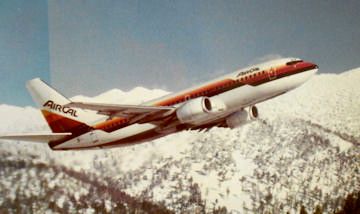
AirCal was one of several commercial airlines that used to have regular flights into Lake Tahoe Airport. Photo/Provided

But who should speak for Tahoe? In 1989, Tom Martens, then executive director of the League to Save Lake Tahoe, told this reporter, “Tahoe belongs to the people of the United States and of the states of California and Nevada, more than to the local people unfortunately … because Congress and the states of California and Nevada declared it a national resource. They did that because of local mismanagement, so what may once have belonged to the local folks, doesn’t anymore, and probably never will. Without regulation from outside, Tahoe would have been gone.”

Taking a look back

In the 1940s, Lake Tahoe was a sparsely populated, quiet summer getaway. There was no city of South Lake Tahoe, no TRPA, no League to Save Lake Tahoe, few year-round residents, no visible conflict between economy and environment, and no commercial-service airport.

Following World War II, the lake’s population began to expand, and with the 1960 Squaw Valley Winter Olympics, everything changed. A building boom to accommodate the influx of visitors brought a spurt of residential and commercial development, especially on parcels fronting Highway 50. Motels and shopping centers began to dot the landscape. Highways 50 and 80 were built and improved. In late summer 1959, with funding assistance from the FAA, El Dorado County built and began operation of Lake Tahoe Airport.

In 1965, residents of the Al Tahoe, Bijou, Tahoe Valley and Stateline areas, concerned over excessive urbanization and the lack of land-use controls or a formal local government, voted to incorporate South Lake Tahoe. Other residents, worried that the new city was “owned” by developers, looked outside the basin for regional controls, beginning the path to today’s TRPA. In December 1965, the League to Save Lake Tahoe was formed.

The battle lines were drawn. The real fight for Tahoe began, and the fundamental question, “To whom does Tahoe belong?” took its place as the unseen but powerful “elephant in the room” in every subsequent discussion regarding Lake Tahoe’s future.

From its beginnings in 1959, the airport was served by myriad charter, commuter and commercial air service. The initial 5,900-foot runway was expanded to its current 8,541 feet in late 1962. The airport hit its peak service levels in the late 1970s, reaching close to 300,000 enplanements in 1978.

But the rumblings of trouble to come had begun. In 1977, AirCal (later American Airlines) first began scheduled commercial service to the then county-run airport. The California Attorney General’s Office, the chief law enforcement office of the state, sued AirCal, the Public Utilities Commission and the Civil Aeronautics Board on behalf of CTRPA (California Tahoe Regional Planning Agency – TRPA’s precursor) for their failure to comply with the requirements of the California Environmental Quality Act.

CEQA is the California statute, originally enacted in 1970 as a corollary to the federal NEPA (National Environmental Policy Act). Unlike the TRPA Regional Plan, CEQA does not set specific environmental thresholds to be met. Instead, it requires public decision-makers consider and define the environmental impacts before approving a “project,” such as commercial air service, and if significant, build in ways to mitigate them.

South Lake Tahoe took over operations of the airport from El Dorado County in 1983. Photo/LTN file

Further complicating things, in1978 the federal Airline Deregulation Act was passed, eliminating the control of the Civil Aeronautics Board over domestic air routes after Dec. 31, 1981, giving air carriers the right to provide, or stop providing, service on any routes they chose. In December 1980, a restructured bi-state TRPA enacted its Regional Plan.

City steps in

By then, feeling the effects of airline deregulation, yearly enplanements at the county-run airport had dropped to just more than 33,000, the physical plant was deteriorating and the airport was costing the county much more than it provided in revenue. Viewing the airport as a vital link to the outside world, and fearing that under the county it would not be maintained, the city began negotiations to take it over.

On Oct. 5, 1983, the city assumed operation of the airport from El Dorado County and with it the obligation to complete the county’s stalled master plan. The AG’s Office agreed to a 90-day exemption for the county’s completion of the CEQA-mandated documents, partly due to the earlier massive landslide on Highway 50.

On Oct. 11, the city approved a six-month lease with AirCal at their existing flight levels, telling the AG’s Office that within that timeframe they would have a completed Airport Master Plan. The CEQA process requires preparation of either a negative declaration or an environmental impact report, saying in the first case that the project creates no negative environmental consequences, or in the second, that if it does, sufficient mitigation measures will be in place to adequately offset them. The third option, a mitigated negative declaration, affirms that even though a project creates some impacts that cannot be fully mitigated, the project is so necessary for the larger public good that it still must go forward.

In March 1984, the city filed a negative declaration for the AirCal flights. TRPA noted concerns over noise, offsite parking impacts, traffic, and the danger of fuel spills in a stream environment zone, among others.

The lawsuits started whizzing. The AG’s Office sued the city over perceived inadequacies in the environmental document. The California AG’s Office had already sued TRPA stating that certain elements of its Regional Plan were inadequate. The city contended the Federal Airline Deregulation Act took away the power from any agency except the federal government, specifically the FAA, or the city to impose environmental thresholds, and sued TRPA saying it had no jurisdiction over the Lake Tahoe Airport, and even if it did, its standards, specifically those in relation to aircraft noise, were arbitrarily arrived at.

In May 1984, Judge Edward Garcia of the U.S. District Court, Eastern District of California filed a restraining order halting development in the basin in response to the AG’s lawsuit, preventing TRPA from approving “projects” such as AirCal’s flights. That December, the city prepared a draft EIR for an increase in weekly AirCal flights to 35, again finding the flights created no significant environmental impacts. The AG’s Office then sued the city stating this environmental document was also inadequate.

Progress stalls

Lake Tahoe Airport was now securely entangled in the “who speaks for Tahoe” debate. Attempts to settle the overlapping lawsuits individually were unsuccessful. Work on the Airport Master Plan ticked on, but slowly. Caught in the meat grinder of remarkably bad timing, a small Bay Area startup airline, Westates, began the complex and expensive environmental process to serve Lake Tahoe, but was blown out of the air by cost overruns and never began service.

In spring 1986, an Airport Consensus Group was formed in hopes of resolving the issues, and agreed to an Interim Service Agreement (ISA) for short periods during the summer and winter peak seasons of 1987, to monitor and evaluate the noise levels and other impacts of the expanded airline service. Pending litigation was put on hold. The suits over TRPA’s Regional Plan had been dropped, a revised Regional Plan approved and the building moratorium lifted.

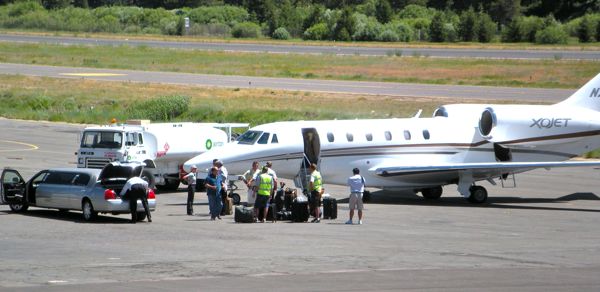
Today it is mostly private jets that use Lake Tahoe Airport. Photo/LTN file

In July 1987, during the ISA’s summer segment, the FAA wrote a letter to the city expressing its concerns that in striving to “beat the box” … “Aircraft pilots attempting to reduce the noise levels of their aircraft as they fly over a monitoring station may engage in maneuvers which are not consistent with the highest order of safety.” The parties to the ISA, while denying any safety issues, became spooked by the prospect of liability. No winter ISA segment was held.

In 1987, AirCal became part of American Airlines. American terminated service to the Lake Tahoe Airport in 1991, with the smaller commuter American Eagle continuing. The Settlement Agreement was signed in September 1992 and American Eagle suspended service in November of that year. In the years that followed, a cavalcade of attempts at reinstituting commercial and commuter service had short-lived success: United Air and Alpha Air-Trans World Express in 1992, Reno Air from December 1994 to September 1995 under a $1 million privately-funded subsidy by the Tahoe Airline Guarantee Corporation; Sierra Expressway from 1995 to 1996; Allegiant Air from June-October 1999 and briefly in August 2000; and Tahoe Air from June-November 1999.

Soon after, questions arose over continued funding for air traffic control services at the airport tower. In 1997, the FAA had determined Lake Tahoe Airport had fallen below the critical 1 percent service level required for FAA funding. With a lack of commercial service, the airport had scored a 0.1. The city struggled to retain the tower and its air traffic control services through various combinations of FAA funding, state grants and city contributions, but in 2004 it closed.

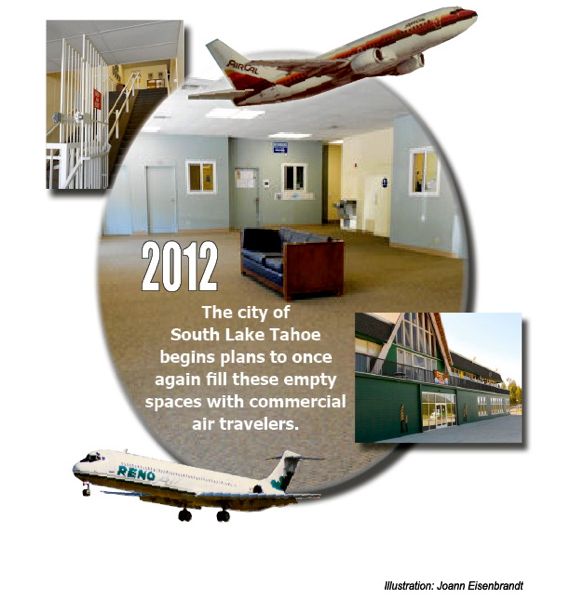
Today there is no scheduled commercial service and the tower sits empty. General aviation services are provided by the fixed-base operator, Mountain West Aviation, helicopter flights by Reno Tahoe Helicopters, flight training by Lake Tahoe Flight School and food by the Flight Deck Restaurant. South Lake Tahoe administrative offices now quietly occupy much of the space previously overrun with the noisy jostling of arriving and departing passengers and the whining of a large, shiny metal baggage carousel.

The city has continued to contend during the 20-year term of the Settlement Agreement, that commercial service is a vital part of the airport’s reason for being. For 20 years, many have just as strongly disagreed. Now, as the expiration of the 1992 Settlement Agreement this fall comes clearly into focus, a blast of fresh air has reignited the long-smoldering debate over this polarizing issue and the questions that lie beneath it, “To whom does Tahoe belong?” and “Who should be in charge of crafting the blueprint for its future?”

Part two on July 6: The issues that have made reaching a consensus on commercial airline service so difficult.


Local firefighters fight Colorado blaze, meet president

By Edward Ortiz, Sacramento Bee

It isn’t every day you get to fight the nation’s largest fire and meet the president.

That’s what happened to Placerville resident and firefighter Matt McKurtis and other members of the Eldorado National Forest and Lake Tahoe Basin firefighting units of the U.S. Forest Service, who are working the fire line at the Waldo Canyon fire in Colorado.

The meeting with the president was captured in a photograph that ran on Saturday’s front page of The Bee. The firefighters in the photo were not identified, but their Forest Service colleagues back home recognized them immediately.

“We knew that our firefighters had met the president so we were keeping an eye out to see if the photo would appear anywhere,” said Beth Brady, a Forest Service fire prevention specialist at Lake Tahoe.

The Northern California units were involved, with many others, in saving several homes in the Colorado Springs area.

Read the whole story


Inaugural parade drives by like a firecracker flash

By Anne Knowles

If you arrived for the start of the holiday parade at Stateline past 10:15am, you were in for a letdown.

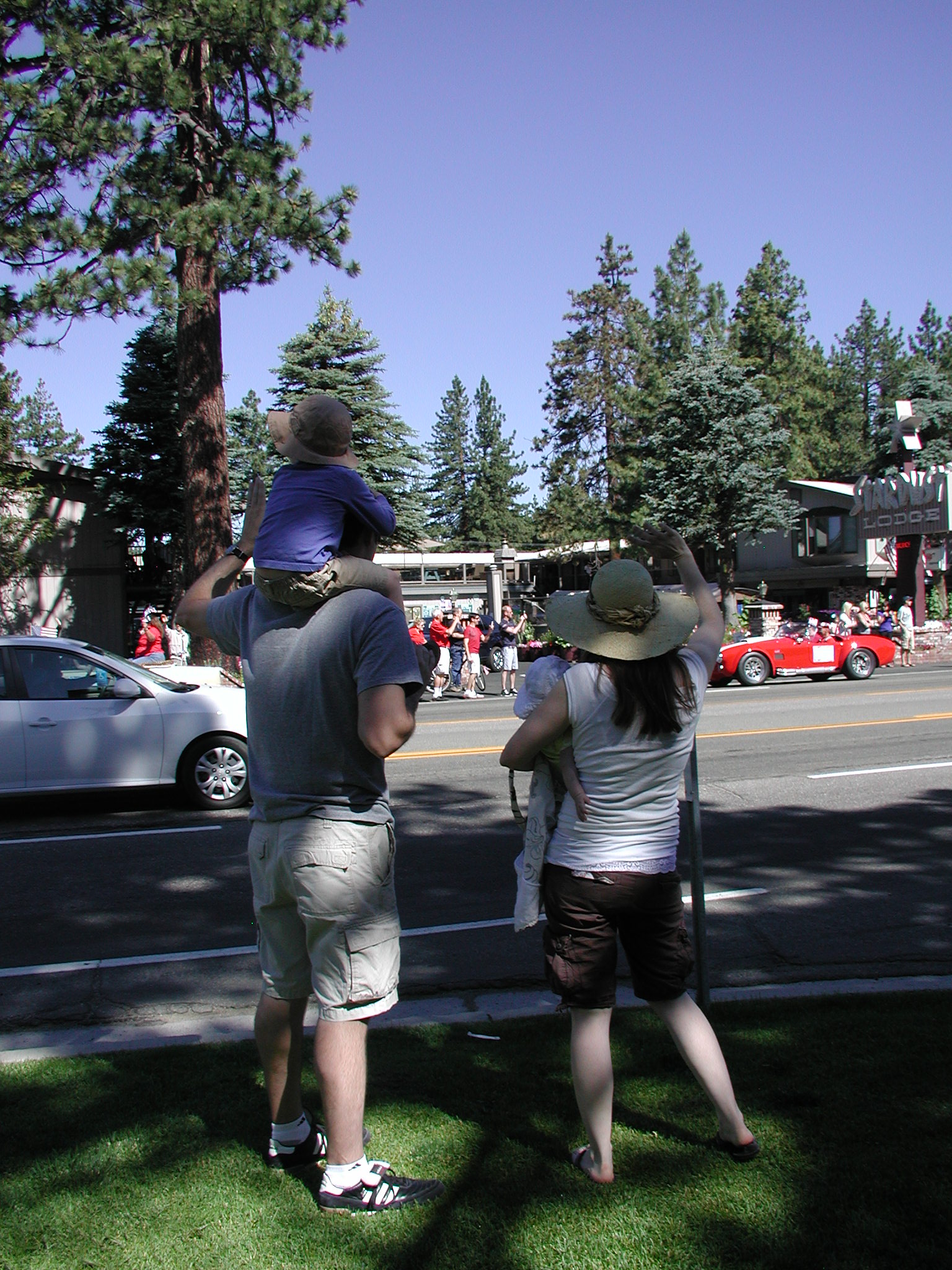
The Cowley-Crawford family from Sacramento watching the 4th of July parade.

South Lake Tahoe’s inaugural Fourth of July parade started on time and ended quickly.

The parade began promptly at 10am and the 30 or so participating vehicles traveled a two-mile stretch of Highway 50 in the right-hand westbound lane at near-normal speed. In fact, if you planted yourself at the end of the route, at Rufus Allen Boulevard, at 11am, you were probably out of luck, too.

But a smattering of parade watchers lining the highway seemed to enjoy the hour of holiday fanfare.

“Want to see the fire truck come,” yelled young Will Cowley-Crawford, sitting on the shoulders of his father, Brett, to get a bird’s eye view of the parade. “It’s coming, girls!”

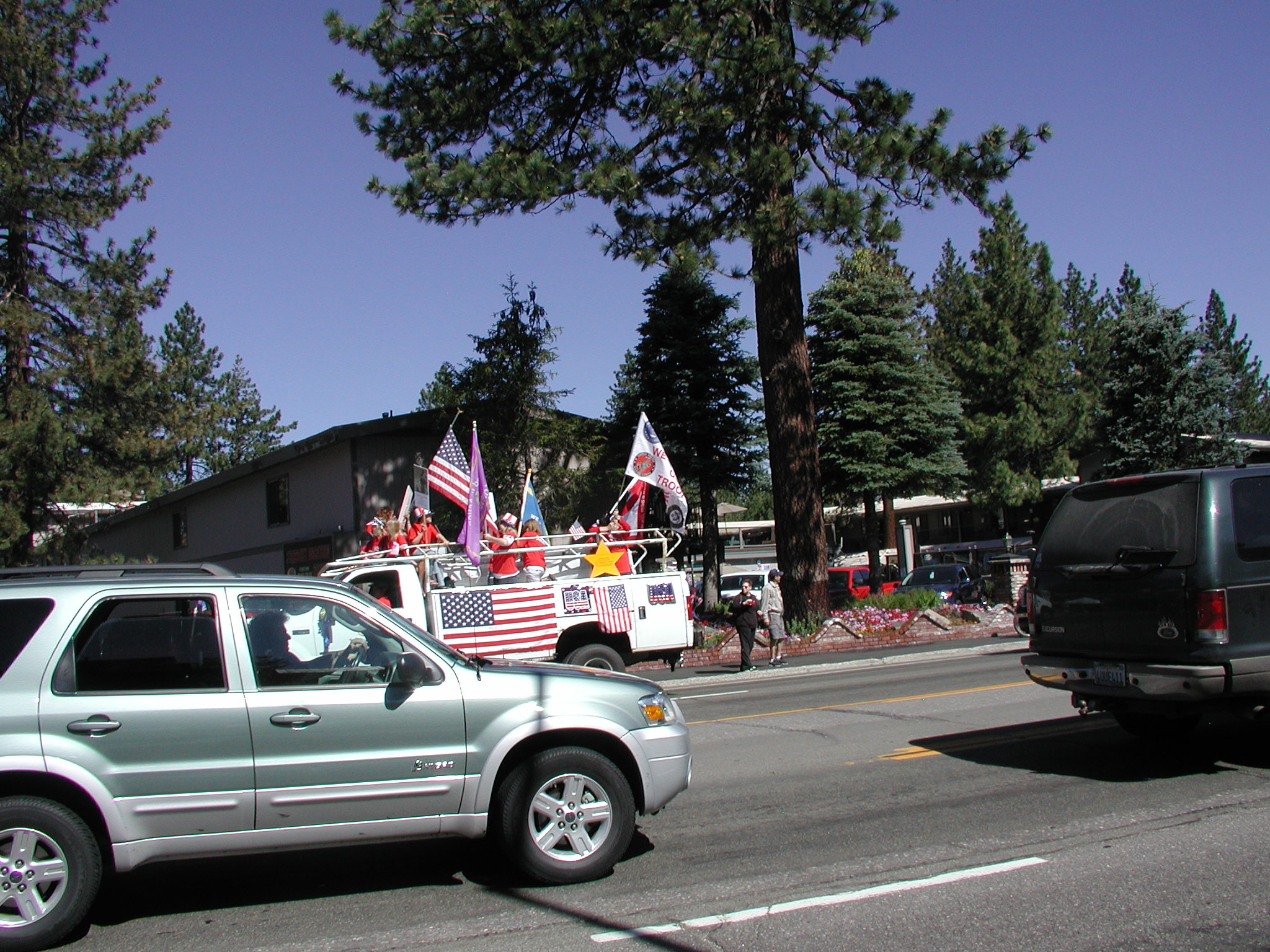
A decorated parade vehicle being passed by ongoing traffic.

The “girls” were Will’s mother Millie and infant sister Claire, all visiting from Sacramento for the 4th.

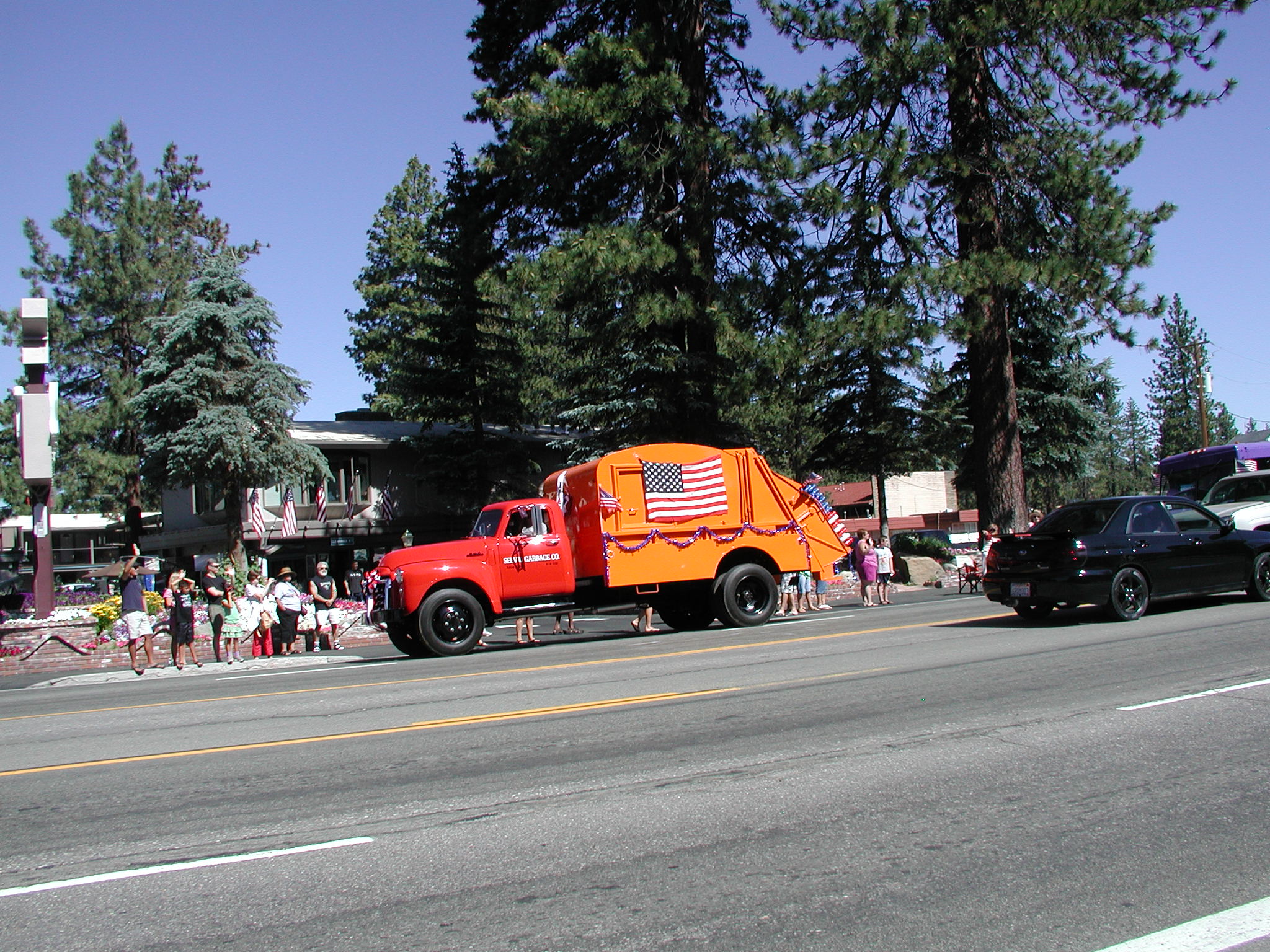
The fire truck and several cars carrying waving members of the South Lake Tahoe City Council were the first parade vehicles to breeze by. They were followed by cars festooned with flags, a military truck and colorful garbage truck among others.

And also flying by was plenty of other Highway 50 traffic, coming and going, for other Independence Day festivities.

An orange garbage truck added color to the parade.

“It was a wonderful first parade,” said a woman from Stoneham, Mass., visiting with her granddaughter from San Francisco. “Hopefully, the fireworks will be better.”

“The parade was a little short but nice,” chimed in her granddaughter.

Lori Rhinebeck, visiting from Visalia, Calif., had high hopes for the parade before it started.

“I hope the casinos have floats and throw chips at the adults,” said Rhinebeck.

No such luck.


Rising sea levels unavoidable, say scientists

By Nina Chestney, Reuters

Rising sea levels cannot be stopped over the next several hundred years, even if deep emissions cuts lower global average temperatures, but they can be slowed down, climate scientists said in a study on Sunday.

A lot of climate research shows that rising greenhouse gas emissions are responsible for increasing global average surface temperatures by about 0.17 degrees Celsius a decade from 1980-2010 and for a sea level rise of about 2.3mm a year from 2005-2010 as ice caps and glaciers melt.

Rising sea levels threaten about a tenth of the world’s population who live in low-lying areas and islands which are at risk of flooding, including the Caribbean, Maldives and Asia-Pacific island groups.

More than 180 countries are negotiating a new global climate pact which will come into force by 2020 and force all nations to cut emissions to limit warming to below 2 degrees Celsius this century – a level scientists say is the minimum required to avert catastrophic effects.

Read the whole story


‘Super fires’ in California’s future, says USFS scientist

By Edward Ortiz, Sacramento Bee

Intense and deeply destructive “super fires,” like Colorado’s current Waldo Canyon fire, which has claimed two lives and burned 350 homes, are almost assured in Northern California’s future, according to a U.S. Forest Service scientist.

“Typically we’re seeing an earlier fire season and that fire season is lasting longer,” said Malcolm North, plant ecologist with the Pacific Southwest Research Station of the U.S. Forest Service. North works out of the station’s Davis office.

The culprits, said North, are weather fluctuations and climate change. He said the warmer temperatures and drier winters seen recently in the region are creating ideal conditions for intense and hard-to-control fires like the Colorado fire.

“What we’re seeing now is that snow reserves are less in the Sierras and runoff is happening earlier in the year,” he said.

That creates drier conditions in areas where fires burn hottest – the forests. The most difficult to deal with are “crown fires,” whose flames travel from one tree to another, usually at high speed. It is common for crown fires to move at 30 mph, North said.

Read the whole story