U.S. Olympic team to field more women than men

By Mary Pilon, New York Times

The news that the United States will send more women than men to compete on its Olympic team in London reflects a turnaround in women’s participation in the modern Games that’s evolved over the past century.

The 530-member U.S. Olympic team is comprised of 269 women and 261 men, spanning 25 different sports.

In 2008, the U.S. sent 306 men and 282 women to Beijing (588 total) and 279 men and 254 women (533 total) went to Athens, according to the International Society of Olympic Historians. In 2000, 332 men went to Sydney and 253 women for a total of 586 athletes.

Women also represent both ends of the age spectrum of the U.S. 2012 team. Karen O’Connor, a 54-year-old equestrian, will be the oldest member of the team, and swimmer Katie Ledecky, 15, is the youngest. (The average age for the team is 27, according to the U.S.O.C.) There are 54 dads and 13 moms on the team.

Read the whole story


Recreation opportunities on USFS land in Tahoe a concern

By Kathryn Reed

Playing in the outdoors is clearly what is important to people who live on the South Shore.

During two public meetings Tuesday at the U.S. Forest Service office in South Lake Tahoe the nearly 70 people at each session wanted to talk about and ask questions regarding recreation.

(There are two more meetings today in Kings Beach.)

The Forest Service is taking public comments until Aug. 30 on the draft Forest Plan that is expected to be a working document for up to 15 years. (The current plan is from 1988.) A final plan with a preferred alternative could be released in early 2013, with a record of decision expected in fall 2013.

Four alternatives are in the plan, with B being what the Forest Service is favoring. Plan A keeps the status quo, while plans C and D create new wilderness areas. It’s possible the final environmental document could meld various alternatives as well as include new items based on public input.

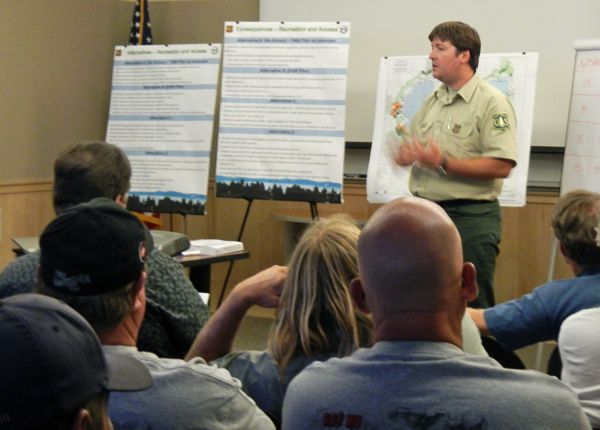
Deputy Forest Supervisor Jeff Marsolais talks July 17 about the draft Forest Plan. Photo/Kathryn Reed

Jeff Marsolais, deputy forest supervisor for Lake Tahoe Basin Management Unit, told Lake Tahoe News, “Alternative B really reflects a balanced approach to all aspects of managing public lands in the basin.”

He said this alternative is consistent with how the Forest Service currently manages its thousands of acres, but provides more flexibility and new thinking.

Between the two sessions the Sierra Club, Sierra Forest Legacy, Sierra Nevada Alliance, California Wilderness Coalition, Defenders of Wildlife, Friends of the River-California Wilderness Project, and Snowlands Network issued a joint press release. Collectively they would like stronger protections for the forest and watersheds. The groups support additional wilderness designations.

Alternatives C and D would do just that. The former includes the Dardanelles-Meiss Meadows area and the latter would also have Freel Peak as wilderness.

When land is designated wilderness it means mechanical recreation is forbidden – this includes bicycles.

Several people at the evening session wore T-shirts that said “Say No to Alternative D”. These people are concerned snowmobiling opportunities are going to be eliminated. And they would be with alternatives C and D. Even if the Forest Service wants a wilderness area, Congress must make that designation.

Then there were the people with stickers that read, “Protect our forests”.

Water enthusiasts were represented by guys who just arrived on dry land based on being dressed in wetsuits.

In addition to the recreation group, the breakout sessions included watersheds, biological resources and forest vegetation-fuels management.

Alternative B allows for more terrain to use managed fire – meaning letting a fire that was started naturally (lightning) be allowed to burn. This technique would only be used if there would be environmental benefits and no safety issues.

For instance, when the Showers Fire occurred 10 years ago, is was suppressed based on policy that is still in effect today. If plan B were the law, that fire would have been allowed to burn naturally – the way Mother Nature intended.

However, Randy Striplin with the Forest Service stressed that a fire would be monitored daily, so if conditions change, suppression may be the ultimate answer.

Alternative D would eliminate the wildland urban interface as an area to be treated for fuels reduction after 10 years.

Any project currently on the books will proceed no matter what alternative is chosen. This includes the South Shore fuels reduction project that just started and will take about eight years to complete, as well as restoration to the Upper Truckee River.

Assumptions were made in creating the alternatives – like money from Washington isn’t going to increase, visitors to the Lake Tahoe Basin would increase 1.4 percent a year, and climate change will impact the ecosystem in the forest.

——–

Notes:

• Today’s sessions are at the North Tahoe Conference Center, 8318 North Lake Blvd., Kings Beach, from 2-4pm and 6-8pm.

• An online session will be July 19 from 1-3pm. More information on how to participate in the webinar is available at the USFS website.

The draft EIS is online. It includes an executive summary. It is near the bottom, middle of the page.


Physicians make money acting as pharmacy to patients

By Barry Meier and Katie Thomas, New York Times

When a pharmacy sells the heartburn drug Zantac, each pill costs about 35 cents. But doctors dispensing it to patients in their offices have charged 10 times that price, or $3.25 a pill.

The same goes, insurers say, for a popular muscle relaxant known as Soma. From a pharmacy, the per-pill price is 60 cents. Sold by a doctor, it can cost more than five times that, or $3.33.

At a time of soaring health care bills, doctors, middlemen and drug distributors are adding hundreds of millions of dollars annually to the costs borne by insurance companies, employers and taxpayers, experts say, through a little-known practice called physician dispensing.

Most common among physicians who treat injured workers, it is a twist on a typical doctor’s visit. Instead of sending patients to drugstores to get prescriptions filled, doctors sell the drugs in their offices to patients who walk out the door with them. Doctors can make tens of thousands of dollars a year operating their own in-office pharmacies. The practice has become so profitable that private equity firms are buying stakes in the businesses and political lobbying over the issue is fierce.

Read the whole story


South Lake Tahoe is close to having just 1 pot shop

By Kathryn Reed

The clarity of where medical marijuana in South Lake Tahoe stands is like walking into a room of pot smokers. Something smells funny and the air is murky.

Accusations flew Tuesday during the City Council meeting, with it clear the electeds are fed up with what they consider is illegal activity occurring at some of the dispensaries.

Most of the anger was leveled at Patient2Patient, which had its permit revoked July 11. Unless the collective wins the Aug. 7 appeal before the council, the dispensary will have to close its doors that day or another date specified by the council.

Patient2Patient would have to close if the owners lose their Aug. 7 appeal before the South Lake Tahoe City Council. Photo/LTN

City Manager Nancy Kerry was looking for direction from the council to make sure the four who were there (Councilwoman Angela Swanson was absent for most of the meeting) wanted the medical marijuana ordinance enforced. To this, the four said “yes” without any reservation.

The ordinance was passed in September 2011.

At the July 3 meeting staff was directed to look into whether Patient2Patient and Tahoe Wellness Collective were in compliance with the ordinance. Both had already been sent a letter June 1 saying they had 10 days to comply or face permit revocation. Though they did nothing to come into compliance, then City Manager Tony O’Rourke allowed the two establishments to keep their doors open.

But Gino DiMatteo, who owns City of Angels 2, at the July 3 meeting told the council his colleagues at the other two collectives were still not in compliance and asked why when he had a valid permit and all the paperwork signed off he was being treated differently.

While DiMatteo never mentioned the 14th Amendment, that is in fact what he was invoking – that he be treated equally.

It was at the meeting earlier this month that the council reversed course and denied DiMatteo the ability to move. He has to move because his landlord wants him out this month because of threats from the U.S. Attorney General’s Office, not because of any infraction with the city.

At the July 17 meeting, DiMatteo refused to talk to Lake Tahoe News.

“We haven’t canceled escrow, but it’s on the market,” listing agent Claudette Miles of Coldwell Banker-McKinney told Lake Tahoe News in reference to the building DiMatteo was planning to purchase. She says DiMatteo still wants to buy the property and the sellers are interested in selling, but “it’s a complicated situation.”

Tahoe Wellness Collective came into compliance July 6.

City building inspector Dave Walker went to Patient2Patient July 9 and July 10 to check on construction of the firewall. No work had been performed.

The next day Kerry issues the notice revoking the collective’s permit. Later on July 11, Kerry and Walker are asked to look again. What they find on July 13 is the firewall work was done wrong by an unlicensed contractor.

On top of that, Patient2Patient was growing marijuana upstairs in an area not permitted for that activity. This is being done with grow lights and no firewall. If a fire were to occur, it could wipe out a swath of Lake Tahoe Boulevard.

Despite all of this, the collective is allowed to operate until the Aug. 7 appeal.

Nine people spoke at the July 17 meeting – all saying the collectives are necessary.

While the council supports medical marijuana, it does not like what is going on. In fact, Councilman Hal Cole said the collectives are potentially hurting their clients.

“You are putting people in this town in danger of losing their medicine. You are putting their health in jeopardy,” Cole said.

He was the most vocal and heated. But all four expressed frustration with the drug task force report that came out at the July 3 meeting regarding increased pot activity because of the collectives, the need for the post office to hire a specialist because of the reported drug activity, and then the police report involving Patient2Patient owner Matt Triglia that was made known Tuesday.

The report from December 2011 says Triglia was in Missouri in a rented RV that had specialized Nevada plates when he was pulled over for a traffic infraction. Subsequently the report says $85,000 in cash was seized. The officer wrote, “I observed several bundles of money in rubber bands that had been heat sealed in a plastic bag. The packaging method was very commonly associated with that of currency and narcotic smugglers.”

In some states, like Missouri, it’s not uncommon for goods to be seized and no charges to be filed, which happened in the Triglia case.

While Triglia confirmed the date of birth and Social Security number on the report were his, he told the council he was not in Missouri and this report was not about him. The report also describes his wife’s tattoos.

After the meeting he told Kerry and others who were listening that he would be calling his attorney.

It’s possible that in three weeks South Lake Tahoe will have only one medical marijuana collective.


Sandoval weighing Medicaid expansion in Nevada

By Sean Whaley, Nevada News Bureau

CARSON CITY – Nevada officials are busy preparing cost and enrollment estimates so Gov. Brian Sandoval will have reliable information before deciding whether to expand Medicaid following the U.S. Supreme Court ruling last month upholding much of the Affordable Care Act.

But even if Sandoval does not expand Medicaid to 138 percent of the federal poverty level as provided for in the law, the program is expected to grow significantly as Nevadans who are now eligible but not enrolled decide to sign up when the health insurance mandate takes effect on Jan 1, 2014.

The effective date is in the middle of the first year of the upcoming two-year budget now being prepared by the Sandoval administration. The Legislature will take up the budget, and the Medicaid issue, when the 2013 session starts in February.

State officials are readying data for Sandoval to make a Medicaid decision

Mike Willden, director of the Department of Health and Human Services, and state Budget Director Jeff Mohlenkamp, are gathering the data to show the anticipated effects on the state budget of these two distinct Medicaid groups.

“Our goal is to have the numbers over to the governor by the end of next week,” Willden said. “We’re just not ready to give out numbers yet and I don’t want to give out bad numbers. There are 10 moving parts.”

Mohlenkamp said the court threw everybody “a bit of a curve,” when it decided states do not have to opt into an expanded Medicaid program.

“So we’re now in the process of analyzing what that looks like, the pros and cons of that, the financial impact on the state of the options, and, is it absolutely straightforward; you either opt in or opt out,” he said. “Or are there other options within the Supreme Court ruling that we can consider.”

When the Supreme Court said the federal government could not penalize states if they do not choose to opt into the Medicaid expansion, Sandoval’s initial comment was that the state could not afford to do so. But he is awaiting the information before deciding how to proceed.

“This is going to be a governor’s office decision,” Mohlenkamp said. “The governor will make the decision as to the policy of the state going forward. He has not yet made that decision. He’s looking for a very critical analysis of what the options are and the pros and cons for the state.”

The bigger cost to the state general fund will likely come from those eligible but not enrolled in Medicaid, because the state share of adding those individuals is projected to be 38 percent in 2014, compared to a 62 percent share from the federal government.

This cost to the strapped state budget will occur whether or not an expansion is approved by the Nevada Legislature.

All of the analysis is dependent on the implementation of the federal health care law. Republican members of Congress and GOP presumptive presidential nominee Mitt Romney want to repeal the law.

Federal funding will pay for 100 percent of any Medicaid expansion for the first three calendar years beginning in 2014, with the state required to pick up a percentage of the cost beginning in 2017. The first year state cost is 5 percent, in 2018 the state cost is 6 percent, in 2019 the state cost is 7 percent, and in 2020, the state cost is 10 percent.

But Willden said there are also administrative costs to the state that are not fully covered by the expansion but instead are shared between the federal government and the state at a 50-50 match. They include information technology costs and the cost to hire new eligibility workers, for example, he said.

“And so we’re trying to again cost out for the governor, clear through 2020, because there are state costs involved in those out years even though everybody says it’s 100 percent federal the first three,” Willden said. “There are state costs in the out years, there are also state costs associated with the administrative costs for the new eligibles.”

There will be some savings because mentally ill people now being treated by the state at full cost to the state general fund will be Medicaid eligible, and there will be some savings to the counties because they now use county general fund money to pay for medical care for individuals who would become Medicaid eligible, he said.

The counties are analyzing that potential impact, Willden said.

Another question that is being researched with federal officials is whether the opt-in option would require a full commitment to the 138 percent of poverty level, of if some lesser level could be pursued, he said.

“The goal is to try to get all of this to come together in the next couple of weeks,” Willden said. “That way the governor would have enough information to at least review on the opt in, opt out opportunity.”

If Medicaid is expanded in Nevada, new participants will be childless adults, who are not covered by the state program now, Willden said. The other expansion will come from parent caretakers of children who are covered at 75 percent of poverty now.

Medicaid now covers primarily low-income children, the disabled, pregnant women and seniors. These groups are now covered at different poverty rates ranging from 100 percent to 138 percent.

State Sen. Ben Kieckhefer, R-Reno, who will be involved in the Medicaid issues in 2013 as a member of the Senate Finance Committee, said Sandoval is taking a prudent course because there are so many unanswered questions given the Supreme Court’s surprise decision allowing states to opt out of the expansion.

A critical question is what happens with the generous federal funding after 2020 and as Congress and the President grapple with unsustainable spending on federal programs, he said.

“It is a very good deal in the first couple of years,” Kieckhefer said. “I mean the feds pay 100 percent of the medical costs for the first three years. That’s a great deal. It then goes down to 90 percent after the fifth year. And there is nothing that mandates that that goes on forever.

“So I think the stronger concern is, how does the federal government continue to justify paying 90 percent of those costs as it’s trying to deal with the massive federal deficit and reducing that deficit,” he said. “And I think that there is a strong likelihood that eventually the feds start shifting that cost burden back to the states and that’s a risk that the state needs to weigh.”

Assembly Ways and Means Chairwoman Debbie Smith, D-Sparks, said her plan is to have an overview of the court ruling from staff at the Legislature’s Interim Finance Committee on Aug. 23.

“I want to just make sure that we have a really good understanding of what all the possibilities and ramifications are,” she said. “I want that to be the first informational piece and then we can go from there.”

Another variable in the assessment is the Silver State Health Insurance Exchange now being readied in Nevada where residents will be able to shop for health insurance beginning Oct. 1, 2013. Nevadans between 100 percent and 400 percent of the federal poverty level will be eligible for subsidies when they purchase insurance.

The ACA rules appear to indicate that if Medicaid is not expanded, Nevadans who would have been covered in an expansion could go to the Exchange and receive a tax credit as long as all other requirements are met.

The Exchange is gearing up now with federal funds, but the state will have to pick up the cost of its operation when federal grants run out in 2015, Willden said.

Another issue is whether there are enough doctors and other medical providers to offer services to an expanded population, he said.

Willden said in May that as many as 150,000 additional Nevadans would be eligible for Medicaid if the law was upheld by the court, but that estimate was two years old and was made before the court said states could opt out of the expansion.

He estimated that bringing new residents onto the rolls would cost the state general fund an estimated $574 million between now and 2020.

But Kieckhefer said only $63 million of that cost estimate was due to the Medicaid expansion. The rest was due to those already eligible who were expected to enroll as a result of the mandate to obtain insurance.



Truckee police survey merchants for tobacco sales to juveniles

The Truckee Police Department, in conjunction with the Nevada County Tobacco Use Prevention Project, conducted a non-enforcement under-age tobacco purchase operation in Truckee on July 9.

Of the 17 merchants contacted, two sold tobacco to underage purchasers, according to Capt. Harwood Mitchell.

The two merchants that sold tobacco to the juveniles will be cited as a result of this initial operation.

All of the merchants will be receiving letters telling them that the police department had conducted the operation and whether they are doing well on their compliance or need improvement.

— Lake Tahoe News staff report


50% containment of Placer County fire

By KCRA-TV

FORESTHILL — Firefighters hit the halfway mark in containing the wildfire burning in remote Placer County, crews said Tuesday morning.

The numbers now stand at 2,650 acres burned, with 50 percent containment. About 170 homes remain threatened.

CalFire crews made significant progress Monday on the Robbers Fire, which ignited last Wednesday in a rugged canyon between the communities of Colfax and Foresthill.

Firefighters were helped by relatively high humidity and mild temperatures.

Winds, however, picked up Monday afternoon, with the line of the blaze most active in the north and northeastern flanks.

Read the whole story


Campfire blamed for small blaze in Truckee

A man accused of allowing a campfire to grow into a small vegetation fire has been arrested in Truckee.

Truckee police have not released the name of the man arrested July 15 after the 3pm blaze broke out.

The fire was behind the Old Gateway business complex on Donner Pass Road. The fire burned about a 20 foot by 100 foot area of forested land.

 — Lake Tahoe News staff report


Advocates lobby for second boat wash at Fallen Leaf Lake, agencies in basin cry poor

By Jessie Marchesseau

Fallen Leaf Lake is clean. That is, it is still free of aquatic invasive species.

The Fallen Leaf Protection Association would like to keep it that way. Members of the Lake Tahoe Aquatic Invasive Species Program, made up of dozens of organizations including the TRPA, TRCD and USFS, would also like to keep it that way. However, coming to an agreement on the best way to go about it has proven to be a daunting task.

Aquatic invasive species, including Eurasian watermilfoil and Asian clams, have already been identified in Lake Tahoe and Donner Lake. Spooner, Martis, Bucks and Lilly Lake have also fallen victim to the watermilfoil. But other area lakes including Echo, Boca, Stampede, Prosser and Fallen Leaf have all managed to keep their free and clean status.

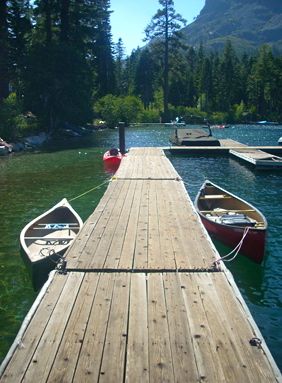
Some people would like it mandatory for non-motorized watercraft to be inspected before entering Fallen Leaf Lake. Photos/Jessie Marchesseau

Once infected, these species are nearly impossible to eradicate and are costly to control. The communities surrounding Lake Mead spend more than $20 million a year in an effort to control one of the worst AIS infestations in the U.S. These invasive creatures can affect water clarity, native plant and animal life, clog water intake pipes and, if the infestation is bad enough, even affect water potability.

In 2011, the roving non-motorized watercraft inspector at Fallen Leaf Lake logged 428 inspections. Of those, 18 were not clean, drained and dry (the most effective method for preventing transport of AIS). However, more than half came from infested waters or waters whose AIS status was unknown. Each one of these watercraft poses a threat to the waters of Fallen Leaf Lake. For this reason, members of the FLPA do not believe the current system of prevention is good enough.

Under the present plan, boat inspections are mandatory for motorized boats entering Lake Tahoe, Echo Lake and Fallen Leaf. Fallen Leaf also has a mandatory boat wash at its marina where every watercraft, motorized or not, is thoroughly washed with hot water by trained personnel.

“Everyone is real cooperative,” Jerry Giese, weekend harbor master at the Fallen Leaf Lake Marina, told Lake Tahoe News. “Nobody wants to be the one to put something in the lake.”

In addition to the boat wash at the south end of the lake, USFS personnel screen everyone entering the campground at the north end of the lake with any type of watercraft. They ask how long it’s been since it was in the water, how long it has been dry and what water it has been in within the last month. The personnel write all this down, along with the license plate of the vehicle and check their list of infected waters. If the boat came from infected water, they call the AIS hotline set up by Tahoe Resource Conservation District and send the guest to the boat inspection station in Meyers.

The TRCD and Fallen Leaf Lake Community Services District also share the cost of a full-time roving non-motorized watercraft inspector. She roams the campground, boat launches, and other areas inspecting watercraft and educating paddlers about AIS and the measures necessary to prevent infestation.

The FLPA has been pushing for years to install a second boat wash at the north end of the lake specifically for non-motorized watercraft. It is already mandatory for all motorized boats to be washed; they want to extend that mandate to non-motorized.

The U.S. Forest Service, which owns the campground, and other members of the non-motorized watercraft working group have been reluctant to approve the group’s proposal and have denied it a number of times, including this spring.

“No one in the working group was dead set against the idea or thought it was a bad idea,” said Ted Thayer, aquatic invasive species program manager for the Tahoe Regional Planning Agency.

However, Thayer and other members of the working group stated that as a whole they believe adding the additional wash would not be the most effective use of limited public funds. They decided sticking with the current plan of education and outreach is a more effective strategy.

Mike Kraft said the community members had originally offered to foot the bill for the wash as well as provide personnel to run it when they first proposed the idea years ago. The money has since been put to other uses. But some members of the working group thought it might be just what they need to get their plan passed at this point.

Fallen Leaf Lake's boat wash is at the marina.

“It would be a great reason to revisit it, if the Protection District could provide funds, so there would be no burden to the group,” said Patrick Stone, invasive species control project manager at the TRPA.

For now, paddlers will have to clean, drain and dry their own boats before heading to Fallen Leaf or drive to the south end of the lake where marina personnel are more than happy to do it for free.

To learn more about preventing the spread of AIS and become a registered self-inspector, go online.


Nevada man dies during Sierra Recon event

A 39-year-old Sparks man died during the Sierra Recon challenge on Saturday.

Joseph Axtman collapsed on the course near the base lodge at Sierra-at-Tahoe on July 14.

“He was going up a portion of the course and just collapsed,” El Dorado County sheriff’s Lt. Pete Van Arnum told Lake Tahoe News.

Medical personnel were not able to revive him at the event.

The multi-distance obstacle race is organized by the Tahoe Tri Club, not the ski resort.

Van Arnum said the victim had been competing with his wife, who had stopped earlier. She relayed to authorities that her husband had complained of chest pain in the last few months, but doctors did not find any heart problems.

An autopsy is likely to take place Tuesday.

 — Lake Tahoe News staff report