Sherer loses job 1 week after sparring with South Lake Tahoe City Council

By Kathryn Reed

South Lake Tahoe Community Services Director Stan Sherer was fired Monday.

“It’s kind of a shocker. I really can’t talk about it,” Sherer told Lake Tahoe News the night of July 23.

Sherer came on board with the city in January 2011 to lead the Parks and Recreation Department. During consolidation because of budget shortfalls his job responsibilities increased, department title was changed, as was his job title. And his department was reduced in staffing significantly.

Stan Sherer

He was verbally chastised by the City Council as last week’s meeting regarding a long-term contract he approved without the electeds knowledge.

Asked if that was why the city let him go, Sherer said no. However, the first inkling he had that there was trouble was when he met July 20 with City Manager Nancy Kerry. He would not divulge the details of that conversation.

Kerry, when reached July 23, was tight-lipped as well.

“His employment with the city was terminated effective today,” Kerry told Lake Tahoe News. She would not elaborate because it’s a personnel matter.

Sherer had come to South Lake Tahoe from Sparks, where he had worked in that city’s rec department for 16 years.

“I really wanted to make a difference up there,” Sherer said. “I appreciated my time there and wish I had more time to make a difference.”


Taxpayers on hook for environmental lawsuits

By Asher Price, Austin American Statesman

In 2010, having successfully pressed the U.S. Fish and Wildlife Service to consider listing as endangered six colorfully named freshwater mussels, at least one in Central Texas, Houston lawyer Peter Thompson set about getting paid.

Eventually, Thompson and an attorney for WildEarth Guardians, the New Mexico-based environmental group that led the effort and for whom Thompson served as a Texas-based counsel, were paid a total of $9,549.55 by the federal government for their work, at least 70 hours, government and attorneys’ records show.

That amounts to $136.41 an hour, far less than typical corporate rates.

Attorney pay in endangered species cases recently has come under fire.

Fresh from a successful battle to keep a West Texas lizard from endangered status, Jerry Patterson, Texas’ land commissioner, told the American-Statesman that suits under the Endangered Species Act too often “are not driven by science; they’re driven by litigation.”

Patterson also said as much at a U.S. House Natural Resources Hearing in June titled “Taxpayer-Funded Litigation: Benefiting Lawyers and Harming Species, Jobs and Schools.”

Amplifying that position was committee chairman Doc Hastings, R-Wash., who said in an opening statement that the Endangered Species Act was forcing “taxpayers to reward an army of environmental lawyers to exploit vague definitions and deadlines that realistically cannot be met.”

Hasting’s feelings about the act aside, he’s right about who pays environmental attorneys in successful cases: When lawyers for environmental groups push the federal government to list a species as endangered — and win — the government picks up the tab.

But environmental law experts say working to press the government to list species as endangered is not the way to line one’s pockets.

From 2004 to 2010, the Fish and Wildlife Service paid attorney fees of about $1.5 million in 26 cases, according to the U.S. Government Accountability Office. The office also found the U.S. Treasury Department paid $14.2 million from 2003 to 2010 to a range of plaintiffs in environmental cases involving the Environmental Protection Agency.

The government pays attorneys out of a fund at the Treasury Department or from an agency’s appropriations. By statute, the federal government pays attorney fees in a successful suit, the premise being that the cost of litigation should not dissuade potential plaintiffs from righting government action — or a lack thereof.

Read the whole story


Increasing number of women diagnosed with lung cancer

By San Diego Union-Tribune

Historically, lung cancer has been viewed as a disease of men. Over the past 50 years, however, there has been a dramatic increase in the incidence of lung cancer in women – even as lung cancer rates in men have declined.

Lung cancer is now the most common cause of cancer death in American women, accounting for more than one-quarter of all cancer deaths. In 2010, there were 105,770 new cases of lung cancer in women, with more than 71,080 deaths – more than breast, uterine and ovarian cancer deaths combined.

The rise in female lung cancer incidence has long been attributed to more women using tobacco, but 20 percent of women who develop lung cancer have never smoked. In the United States, 15 percent to 20 percent of lung cancers occur in people who have never smoked, but interestingly, 70 percent to 80 percent of “never-smokers” with lung cancer are women.

We asked Patricia Thistlethwaite, a cardiothoracic surgeon at the UC San Diego and the first female program director of thoracic surgery in the nation, to shed more light on what the U.S. Surgeon General’s office has called a “contemporary epidemic.”

Q: Does anything explain the rise in cases of lung cancer in women, but not men?

A: Several factors may be contributing to the increased prevalence.

First, before 1940 few women in the United States smoked, but the integration of women into the workplace during World War II led to an increase in tobacco consumption. The prevalence of smoking in American women peaked in 1965 at 33 percent and remains at 22 percent today. In contrast, more than half of American men smoked before 1965, but the prevalence has decreased to 23 percent today. Thus, over time, there has been a more marked decrease in smoking in men compared to women.

Second, there has been a significant increase in two types of lung cancer in women: bronchoalveolar carcinoma and adenocarcinoma, which has not been seen in the male population in this country. Both of these types of lung cancer occur in younger, nonsmoking individuals, particularly women. The cause for the huge increase is not known and is being studied.

Third, there are important molecular differences in lung cancers that are suspected to be responsible for increased susceptibility in women. Women exhibit decreased DNA repair capability and increased mutations in specific cancer genes such as p53, epidermal growth factor receptor (EGFR), and K-ras. Mutations in these genes are found at a much higher frequency in adenocarcinomas, particularly in women.

Finally, one of the most obvious biologic differences between men and women is hormonal and related to estrogen, a recognized factor in the development of other types of cancer. The role of estrogen and synthetic estrogens in lung cancer in women is under investigation and somewhat controversial. Estrogens have been shown to stimulate growth of lung cancer cells in tissue culture, yet clinical studies suggest that estrogen-progesterone supplementation probably promotes lung cancer rather than just estrogen alone.

Read the whole story


Rat poison in remote Sierra pot gardens linked to rare wildlife deaths

By Andrew Becker, California Watch

Toxic chemicals used to rid rodents from illicit marijuana gardens in the Sierra Nevada range and elsewhere in California may have inadvertently poisoned dozens of vulnerable weasel-like mammals called fishers, according to a new study released this month.

Biologists from UC Davis, the nonprofit Integral Ecology Research Center, and state and federal land agencies found that nearly 80 percent of a sample size of fishers found dead in the wild were exposed directly or indirectly to anticoagulant rodenticides – rat poison. They point to illegal marijuana cultivation as a likely culprit for the introduction of the chemicals to remote areas where the animals live.

Fishers are members of the weasel family and formerly ranged across the northern forests of North America. But logging and fur trappers lured by their once-valuable pelts drove the fishers’ numbers down, wiping them out in some parts of the United States. The sample group of the rare animals, which could be listed for protection under the Endangered Species Act, were found over a five-year period ending in 2011 in Northern California and in the southern Sierra Nevada range. Some of the dead animals were found in remote wilderness areas with no roads or campground access.

The study, which documented exposure to such poisons in fishers for the first time, raises questions about the threat to other rare forest predators, such as the Sierra Nevada red fox, wolverine, gray wolf and various owl species. It also raises questions about the long-term environmental impacts from marijuana gardens treated with the poisons, which have become increasingly toxic as rodents build resistance to the chemicals. Nearly all of the fishers that died after coming into contact with the anticoagulants were exposed to highly toxic versions of the chemical.

Read the whole story


Animal shelter expense puts Truckee in the red

The Truckee Town Council has adopted the 2012-13 budget that results in a deficit of $965,000.

Revenues for the general fund are set at $17.8 million, while budgeted expenditures are approximately $18.8 million.

Officials say the deficit is due to the one-time expenditure of funds for construction of the animal shelter. Town Council approved the budget for the project despite the construction bids coming in overbudget by approximately $2 million.

The Humane Society has committed to contributing half of all project costs, including half of the budget overage of approximately $1 million.

The new animal shelter is one of the 70 projects that is included in the five-year capital improvement program budget. The total budget of the 70 projects is $92.4 million over five years.

For the third year in a row, the town is budgeting a decrease in property tax revenue (down 4 percent, or $330,000).

— Lake Tahoe News staff report


University study questions USFS beliefs about fires

By Scott Sonner, AP

Scientists using field notes from surveys first conducted by the government before the Civil War believe they’ve gained a better understanding of how Western wildfires behaved historically.

Researchers at the University of Wyoming studied historical fire patterns across millions of acres of dry Western forests. Their findings challenge the current operating protocol of the U.S. Forest Service and other agencies that today’s fires are burning hotter and more frequently than in the past.

Combing through 13,000 firsthand descriptions of forests and retracing steps covering more than 250 miles in three states, where teams of government land surveyors first set out in the mid-1800s to map the nation’s wild lands, the researchers said they found evidence forests then were much denser than previously believed.
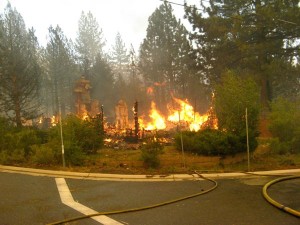
The 2007 Angora Fire ravaged the South Shore of Lake Tahoe. Photo/Lake Valley Fire

“More highly intense fire is not occurring now than historically in dry forests,” said William Baker, who teaches fire ecology and landscape ecology in Laramie, Wyo., where he’s been doing research more than 20 years. “These forests were much more diverse and experienced a much wider mixture of fire than we thought in the past, including substantial amounts of high-severity fire.”

If he’s right, he and others say it means fuel-reduction programs aimed at removing trees and shrubs in the name of easing fire threats are creating artificial conditions that likely make dry forests less resilient.

“It means we need to rethink our management of Western dry forests,” said Baker, a member of a U.S. Fish and Wildlife Service working group that is developing plans to help bolster northern spotted owl populations in dry forests.

Baker’s conclusions have drawn sharp criticism from other longtime researchers who believe that decades of fire suppression have led to more densely tangled forests and more intense fires, the position advanced by the Forest Service.

“I have yet to hear any knowledgeable forest or fire ecologist or forest manager say they are convinced by the main interpretations in that (Wyoming) paper,” said Thomas Swetnam, a professor of dendrochronology and director of the Laboratory of Tree Ring Research at the University of Arizona. “I doubt it will gain much traction in the scientific or management communities.”

The Forest Service did not immediately respond to a request for comment.

Baker said the historic government land surveys provided researchers with a surprisingly detailed and precise record.

The studies conducted by Baker and others over the past two years focused on parts of Colorado, Oregon and Arizona, but were indicative of dry forest types stretching from the Rockies to the Sierra Nevada previously thought to be “open and park-like” and typically enduring only cycles of frequent, low-severity fire.

“The major surprising finding was … areas of high density of forest and higher severity fires in really all dry forests across the West,” said Mark Williams, who co-authored two of the three studies with Baker.

“The notes are pretty descriptive,” said Williams. “You can look for where the fire started and ended. We were actually walking the same lines, collecting fire scars from trees.”

Wallace Covington, the director of the Ecological Restoration Institute at Northern Arizona University, takes no issue with the Wyoming duo’s data collection or statistical analysis but said some of Baker’s conclusions don’t follow from his data. Covington first testified before Congress in 2002 about the urgent need to thin forests to guard against catastrophic wildfires and insists it’s still necessary.

Others say the Wyoming studies are important new information in an emerging field of research.

Jennifer Marlon, a Yale University paleoecologist, said a study she recently led on the impact of climate change on forests over thousands of years appeared to be largely consistent “with Baker’s idea that there were large, severe fires even in dry forests historically.”

The fire record her team built for the Western U.S. for the past 3,000 years shows “that fires during the 20th century generally are actually fewer and smaller than ever before given current climate conditions,” said Marlon, who emphasized the role of climate on wildfire.

“The general trend from high fire in the 1800s to very low fire in the 1900s is strong and clear from three independent datasets,” she said. “Open park-like conditions may have indeed occurred after the ‘peak’ in burning during the mid-1800s.”

Baker and Williams contend that past studies of forest structure and fires were not so much wrong as “incomplete” because that they placed too much emphasis on anecdotal references, sampled too small of areas and often concentrated on old-growth stands more resistant to fire.

One of the earliest references to the open nature of the forests is found in a 1943 study by Harold Weaver, a forester from Oregon State who characterized forests in Oregon’s eastern Cascades as “like a park, with clean-boled trees and grassy forest floor.”

An updated view was summarized in the 2012 spring edition of California Forests: “Human fire suppression activity during the past 100 years have created dense, more crowded forests and shifted the fire regime in Sierran mixed conifer forests from one of frequent, low-level fire to one where high intensity wildfires are more common,” wrote John Battles, chairman of ecosystem sciences in Department of Environmental Science, Policy and Management at the University of California, Berkeley

Williams said the Wyoming studies have significant implications for wildlife that depends on post-fire habitat, such as the black-backed woodpecker, which has survived for millions of years by eating beetle larvae in burned trees.

Four conservation groups filed a petition with the U.S. Interior Department in May seeking Endangered Species Act protection for the bird in the Sierra Nevada, Oregon’s Eastern Cascades and the Black Hills of eastern Wyoming and western South Dakota.

The new studies provide the first “real, direct data'” showing that more forests burned historically, creating more post-fire forest habitat, said Chad Hanson, a forest ecologist and director of the John Muir Project who is helping lead the listing effort and suing the Forest Service to block post-fire logging in woodpecker habitat near Lake Tahoe.

“It indicates the woodpeckers had more habitat historically than they do now,'” Hanson said.

Williams said when he started the study he had “the same general ideas most people have – that the forests were less dense and there were frequent, less severe fires to maintain that structure.”

Now, he believes thinning and post-fire salvage operations should be re-examined and emphasis placed on maintaining high-density stands in certain circumstances that would not threaten people or homes.

“We shouldn’t be managing just for low-density forests,” he said. “We should not be unhappy with – or perhaps even manage for – higher severity fires in the forests.”


Gardnerville area fire brings smoke into Tahoe basin

A fire burning in the Pine Nuts is bringing smoke into the Lake Tahoe Basin.

The Spring Fire started the afternoon of July 22 after lightning struck western Nevada.

More than 1,000 acres have burned as of Sunday night.

“The fire made significant runs through pinon juniper today due to gusty winds near thunderstorms over the area. Access to the fire is difficult due to steep, rocky terrain and limited roads,” according to Sierra Front Interagency Dispatch Center.

 — Lake Tahoe News staff report


S. Tahoe council miffed contract signed without their consent

By Kathryn Reed

South Lake Tahoe City Council members were less than thrilled with finding out a five-year contract for the use of a city building had been approved by a department head and not them.

Stan Sherer, Community Development director, defended his actions on July 17.

“We rent all kinds of facilities. Historically, we haven’t come to the council,” he said.

One of the problems as noted by City Attorney Patrick Enright is, “We don’t have a written policy as to how we lease properties.”

That is going to change per the council’s mandate.

It’s not that the recreation and other department heads won’t be able to rent city property, but they won’t be able to do so on a long-term basis.

The council was in a quandary with how to proceed because Unity at the Lake has been renting the property at 1195 Rufus Allen Blvd. for nearly a year. Rent is $1,700 a month.

Councilman Tom Davis asked what happens if the contract is not ratified by council.

Enright said, “I don’t know. They’ve been there 10 months and have made tenant improvements.”

A contract is signed between Sherer and Unity without its being dated. The lack of date infuriated the council as well.

Sherer said because Unity had been renting city space at the senior center and this group was the only one willing to make substantive improvements to the building, he picked them.

The council voted 3-1 to keep the contract in place. (It expires in October 2016.) Councilman Hal Cole abstained and Councilwoman Angela Swanson was absent.


Gloomy forecast for states even if economy rebounds

By Mary Williams Walsh and Michael Cooper, New York Times

WASHINGTON — The fiscal crisis for states will persist long after the economy rebounds as they confront rising health care costs, underfunded pensions, ignored infrastructure needs, eroding revenues and expected federal budget cuts, according to a report issued here Tuesday by a task force of respected budget experts.

The problems facing states are often masked by lax budget laws and opaque accounting practices, according to the report, an independent analysis of six large states released by the State Budget Crisis Task Force.

It said that the financial collapse of 2008, which caused the most serious fiscal crisis for states since the Great Depression, exposed deep-set financial challenges that will worsen if no action is taken.

“The ability of the states to meet their obligations to public employees, to creditors and most critically to the education and well-being of their citizens is threatened,” warned the chairmen of the task force, Richard Ravitch, a former lieutenant governor of New York, and Paul A. Volcker, a former chairman of the Federal Reserve.

The report added a strong dose of fiscal pessimism just as many states have seen their immediate budget pressures begin to ease. And it called into question how states will restore the services they have cut during the downturn, saying that the loss of jobs in prisons, hospitals, courts and agencies have been more severe than in any of the past nine recessions.

“This is a fundamental shift in the way governments have responded to recessions and appears to signal a willingness to ‘unbuild’ state government in a way that has not been done before,” it said, noting that court systems had cut their hours in many states, delaying actions including divorce settlements and criminal trials.

The report arrived at a delicate political moment. States are deciding whether to expand their Medicaid programs to cover the uninsured poor as part of the new health care law, with the federal government pledging to pay the full cost at first. Public-sector unions feel besieged, as states and cities from Wisconsin to San Jose, have moved to save money on pensions. And Washington’s focus on deficit reduction — with big budget cuts scheduled for after the fall election — has made cuts to state aid inevitable, many governors believe.

Read the whole story


LTUSD board to choose from 4 candidates to fill vacancy

Four people have applied for the vacancy on the Lake Tahoe Unified School District board.

They are Barbara Bannar (former board member, homemaker), Kathy Haven (educator/small business owner), Cathy Giardina (business owner/bookkeeper), and Heather Clelan (property manager).

Interviews will be at the Aug. 7 board meeting. The remaining four members choose the member. Meetings are at that district office, and start at 6pm. The board member will be sworn in Aug. 21. The term runs until December 2013.

The vacancy was created when Judy Cefalu abruptly left without much reason.

— Lake Tahoe News staff report