Dry winter creating wicked fire season

By Max Ehrenfreund, Sacramento Bee

A dry winter has turned into a busy summer for firefighters in California’s wildlands, and the largest and most intense fires of the year may be yet to come.

According to data provided by the U.S. Forest Service, wildfires had already burned 276,252 acres across the state as of last week, excluding the large Rush fire on the Nevada border.

That fire, which started Aug. 12, had burned 270,684 acres of grass, sagebrush and juniper by Sunday evening.

Last weekend, the Ponderosa fire burning outside Shingletown east of Redding destroyed seven houses. The fire has charred 15,000 acres since it started Saturday morning.

This summer follows several wetter, cooler years with fewer fires. By the middle of August last year, fires had burned only 73,868 acres statewide.

Last week, 8,000 firefighters were battling wildfires in California, including the 47,000- acre Chips fire in Plumas County, the 28,000- acre Reading fire in Lassen Volcanic National Park and the Rush fire east of Susanville.

A similar number of firefighters were on the job this week, too.

“Though we’ve already seen an increase in fire activity, the busier parts of the year are still ahead of us,” said California Department of Forestry and Fire Protection spokesman Daniel Berlant.

Read the whole story


South Lake Tahoe close to defaulting on parking garage

By Kathryn Reed

It has been 10 years since the South Lake Tahoe parking garage at Heavenly Village opened. It’s been a financial boondoggle since Day 1. Today it is in technical default and the city is on course to default on the bond payments.

When the area near Stateline was redeveloped, the city of South Lake Tahoe opted to own the parking garage. Throughout the years it has lost various sums of money. Currently, it is operating at about an $80,000 a year loss.

South Lake Tahoe is running out of money to pay the debt on the parking garage at Heavenly Village. Photo/LTN file

The technical default is because revenues are less than expenses. Bondholders are aware of this. But when the fund balance reaches zero or is a negative number, then the whole garage is in default. It’s possible this could occur in the next year if more money is not generated soon.

“Once all of the funds deposited with Bank of New York, Mellon have been depleted, a default on the bonds could occur if yearly parking garage revenue is less than yearly debt service (principal and interest),” Debbie McIntyre, South Lake Tahoe accounting manager, told Lake Tahoe News.

The exact consequences and steps that would be taken if the city defaults on the payments is not known.

“The supplemental reserve is $76,513. The reserve fund is $817,933, which is used during yearly operations,” McIntyre said.

As of July 31, the remaining principal payment was $7.54 million and the remaining interest payments total $5,232,500 for a total remaining balance of $12,772,500. The final payments are due in fiscal year 2027-28.

The original bond from 2002 was $9 million. The soonest the bonds could be refinanced is December 2013, which might be too late, even if it were to help restructure the debt payments.

With California getting rid of redevelopment agencies, this has further complicated the matter in terms of who actually owns the garage.

“The land the garage is on was owned by the [redevelopment agency] and now the successor agency, but the buildings are owned by the [joint powers authority] established for the issuance of the bonds. But regardless, the bondholders have title to the revenue until the debt is paid off, so although regardless of deed, the ownership is the bondholders’,” City Manager Nancy Kerry explained.

“In the case of this property, it is best to leave the ownership with the successor agency and bondholders until the debt is paid.”

To try to prevent complete default, the city is looking at ways to generate more income. But when free unlimited parking is in one direction at the casinos and two-hour free parking is at the center in the other direction, it is hard to convince people paying money for parking is worthwhile.

South Lake Tahoe and Heavenly Mountain Resort last week came to an agreement for people who have season passes to the resort to get a deal on parking. While there was a program in place last year, it did not get implemented until the snow had fallen.

Skiers who have an unlimited ski pass may buy an unrestricted parking pass for $299, while those with restricted ski passes may buy parking passes with blackout dates for $199.

Annual passes — which have nothing to do with the ski resort —  are being lowered to $500.

City officials are also talking to PADMA to see if there are ways to get people to park at the garage and to have more of the Heavenly Village businesses be part of the validation program.

Park Avenue Development Maintenance Association is the organization formed in 2002 to maintain Heavenly Village. The two Marriott properties pay 55 percent collectively, Heavenly Mountain Resort 20 percent, South Lake Tahoe 20 percent, Trans Sierra Investments 2.5 percent, and Cecil’s 2.5 percent for the upkeep for the entire center.



Documents show how state parks moved money around

By Kevin Yamamura, Sacramento Bee

The state Department of Parks and Recreation routinely searched for ways to spend extra money each June despite facing the threat of park closures and forgoing upkeep at its 278 properties, based on newly released transcripts from an internal investigation.

Testimony from 30 interviews with state employees portrays parks administrators who appeared to have the opposite problem from one long described by Gov. Jerry Brown – excess cash left over and not enough ways to spend it.

That was the case in June 2011, when the investigation found former parks administrator Manuel Thomas Lopez tapped some of the funds for a cash buyout of accumulated leave without authorization. The state Resources Agency made transcripts available late Friday from the completed report by Deputy Attorney General Corinne Murphy on Lopez’s actions.

Brown’s administration revealed last month that the parks department had long hidden $54 million without reporting it to the Department of Finance and state lawmakers, who have constitutional authority over spending in California. In the past year, private donors and other government agencies have contributed under the impression the parks department did not have a dime to spare. Longtime state parks director Ruth Coleman and other top officials resigned last month.

The documents depict a department that wanted to keep secret a reserve of its own special funds to hedge against future financial problems while securing – and spending – as much state general fund money each year as it could.

Department of Finance spokesman H.D. Palmer said his office was unaware that parks officials had hidden funds until July. Finance and the state Department of Justice are investigating further.

“I’m not going to get into what (our audit) is going to conclude, other than there was something very much awry in the way parks was working their budget operations,” Palmer said.

In the documents, Cheryl Taylor, a former state parks budget director, described a cat-and-mouse game that parks officials played with finance officials to protect their department’s share of general fund money.

The parks department is funded by fee revenues and taxpayer dollars. Taylor suggested parks officials kept a hidden surplus in the fee-based State Parks and Recreation Fund because they feared the Finance Department and lawmakers would cut the share of department funds that comes from taxpayers.

Read the whole story


Lack of exercise may be a medical condition

By Eliza Barclay, NPR

Doctors need to prescribe exercise to patients who don’t get enough exercise, a Mayo Clinic expert says.

“You’ve got a bad case of deconditioning,” the doctor says.

Actually, it would be the rare doctor who would say that to anyone. And though it might sound like something to do with hair, in fact, deconditioning is a familiar and more profound problem: the decidedly unnatural state of being physically inactive.

At some point in the last few decades, the human race went from being a species that is active most of the time to one that is increasingly sedentary. The Lancet recently called it an “inactivity pandemic,” responsible for 1 in 10 deaths worldwide. That’s a major shift, and a major public health problem, many researchers have pointed out. Inactivity is linked to heart disease, diabetes and some types of cancer.

Now Michael Joyner, a physiologist at the Mayo Clinic, argues in a commentary out this month in the Journal of Physiology that one way to deal with the problem is to make physical inactivity a mainstream medical diagnosis. It’s one of the most common preventable causes of illness and death, and Joynes writes, there is “one universally effective treatment for it — exercise training.”

Shots called up Joyner to get him to elaborate a little more on just why doctors need to get more involved with this problem.

“The entire medical research industrial complex is oriented towards inactivity,” he tells us. Insurance companies will reimburse patients for pills for diseases related to inactivity, but rarely for gym memberships. “Physicians really need to start defining the physically active state as normal,” he says.

Read the whole story


Nevada retailers expect back-to-school sales to increase

By Sean Whaley, Nevada News Bureau

Nevada retailers and their online counterparts expect to see $245 million in spending on back-to-school merchandise for public school children this year, a 15.4 percent increase over spending levels in 2011, the Retail Association of Nevada reported this week.

College spending in Nevada is expected to generate another $134 million in what is as the second biggest consumer event for retailers behind the winter holidays, according to the National Retail Federation. The NRF reports that combined K-12 and college spending will reach $83.8 billion this year.

“Parents want to make sure their kids have everything they need to start the new school year and are willing to spend more than ever on school-related necessities,” said Mary Lau, president of RAN. “However, the economy remains a concern in most households, which will have an impact on the way families shop. Bargain-hunting will remain important to budget-conscious consumers.”

According to the latest survey results from the NRF, families nationwide with children in grades K-12 are expected to spend an average of $689 on clothing, backpacks and other supplies. The latest estimate is a 14.1-percent increase from the estimated $604 spent last year.

According to demographics released by Nielsen Marketplace, there are approximately 1 million households in Nevada, and 34 percent (or 355,000 households) have one or more children in grades K-12. Assuming national trends as reported by the NRF generally hold true for Nevada families, total spending in the state will reach approximately $245 million. Due to an increase in both the count of families with children entering elementary or middle school, and an increase in spending per family, back-to-school spending in the state is expected to increase 15.4 percent compared to last year when total spending was an estimated $212 million.

As for college-bound students, the NRF estimates families will spend an average of $907 on new clothes, dormitory or apartment furniture and other college supplies. Compared to last year’s estimate of $809, college spending is expected to increase 12.2 percent.

Utilizing the latest estimate of Nevada residents who will be enrolled in undergraduate and graduate degree programs within and outside of Nevada in the coming school year released by the U.S. Census Bureau’s American Community Survey, aggregate back-to-school spending on college supplies is expected to increase this year as well. Again, assuming Nevada residents follow national trends, college spending is estimated to reach $134 million, compared to $120 million in 2011.

Bryan Wachter, director of government affairs for RAN, said back-to-school spending is exceeded only by the Christmas holiday season.

“Back-to-school is for a specific purpose, and we feel we can measure it pretty accurately,” he said.

Wachter said clothing and electronics, from calculators to laptops to phones, are the big spending categories.

“Electronics, not quite but almost, total clothing,” he said. “The average person is going to spend about $250 per student on clothing and we’re going to spend about $225 on electronics.”

The spending increase is due in part to some increased confidence among Nevadans that their jobs are more secure, Wachter said.

The Internet is continuing to grow as a preferred shopping “destination” for back-to-school items. Approximately 39.6 percent of consumers will be using the Internet to shop for needed supplies, nearly double the 2007 estimate. That said, discount stores are expected to be the most popular shopping destination, with 67.1 percent of consumers planning to shop there. Department stores followed with 59.9 percent.


Audit: Caltrans spent millions on unnecessary house repairs

By Jack Dolan, Los Angeles Times

California transportation officials have spent millions of dollars making overpriced, unjustified repairs to houses the state owns in and around Pasadena, according to an audit released Thursday.

Caltrans bought the houses decades ago to bulldoze for the long-planned, never built extension of the 710 Freeway. The agency has spent $22.5 million since 2008 to maintain the homes, but transportation officials are “unable to demonstrate that the repairs were necessary, reasonable or cost-effective,” according to the report by the California State Auditor, which was sparked by a Times investigation.

The state is also losing $22 million per year because tenants, including 15 state employees, are paying far below market rates for rent. Other homes, some of which have been recognized as historical landmarks, have been boarded up and empty for years.

For one of those vacant houses, state officials recently estimated it should have cost $56,000 to repair a roof and replace the garage. But the cost soared to more than $184,000 after it was expended to include “miscellaneous interior repairs” — a coat of paint and upgrades to two bathrooms. “Caltrans could provide no evidence of the need for additional work,” the investigators said.

In a six-page response to the audit, Caltrans officials did not dispute the findings and vowed to inspect houses before and after repairs are done in the future to ensure work is performed properly.

What to do with the hundreds of houses spanning a corridor through Pasadena, South Pasadena and Los Angeles has vexed state officials since the plans for the freeway extension stalled years ago. The properties could be sold, but buying them back would be expensive if the road plan ever gets revived. So state officials settled on renting at least some of them, often cheaply, to boost the supply of low-income housing.

Read the whole story


Privacy advocates worry about monitoring of government workers

By Lisa Rein, Washington Post

When the Food and Drug Administration started spying on a group of agency scientists, it installed monitoring software on their laptop computers to capture their communications.

The software, sold by SpectorSoft of Vero Beach, Fla., could do more than vacuum up the scientists’ e-mails as they complained to lawmakers and others about medical devices they thought were dangerous. It could be programmed to intercept a tweet or Facebook post. It could snap screen shots of their computers. It could even track an employee’s keystrokes, retrieve files from hard drives or search for keywords.

“Every activity, in complete detail,” SpectorSoft’s Web site says about its best-selling product, Spector 360, which the company says it has sold to dozens of federal agencies.

Government workers have long known their bosses can look over their shoulder to monitor their computer activity. But now, prompted by the WikiLeaks scandal and concerns over unauthorized disclosures, the government is secretly capturing a far richer, more granular picture of their communications, in real time.

Federal workers’ personal computers are also increasingly seen as fair game, experts said.

Nonintelligence agencies spent $5.6 billion in fiscal 2011 to safeguard their classified information with hardware, software, personnel and other methods, up from $4.7 billion in fiscal 2010, according to the Information Security Oversight Office. Although only a portion of the money — the amount is not specified — was spent on monitoring for insider threats, industry experts say virtually every arm of the government conducts some form of sophisticated electronic monitoring.

“It used to be, to get all of an agency’s records out you needed a truck,” said Jason Radgowsky, director of information security and privacy for District-based Tantus Technologies, which evaluates monitoring systems for the Federal Aviation Administration, the Export-Import Bank and the National Institutes of Health. “Now you can put everything on a little USB thumb drive.”

The stepped-up monitoring is raising red flags for privacy advocates, who have cited the potential for abuse. Among other concerns, they say they are alarmed that the government has monitored federal workers — including the FDA scientists, starting in 2010 — when they use Gmail, Yahoo or other personal email accounts on government computers.

Although the FDA has said it acted out of concern that the scientists were improperly sharing trade secrets, the scientists have argued in a lawsuit that they were targeted because they were blowing the whistle on what they thought had been an unethical review process.

Read the whole story


Amodei: Green energy not worth higher electric bills

By Sean Whaley, Nevada News Bureau

CARSON CITY – Rep. Mark Amodei, R-Nev., said this week that any “green energy” policy that leads to higher electric bills for Nevadans who are looking for work in tough economic times is the wrong energy policy for the state.

“Nobody is anti-green,” he said. “We struggle to compete with the cost of a kilowatt hour when we talk about economic development. And economic development has something to do with jobs.”

If federal money is going to be spent on research and development to make wind, solar and geothermal energy more competitive that’s one issue, Amodei said.

“But if those, when they get done, go to sell into the grid and that increases rates, especially right now when things are they way they are in Nevada, and competition for sustainable living wage jobs is what it is in the Inter-mountain West, I think that’s the wrong energy policy,” he said.

Nevada’s 2nd Congressional District representative made his comments to Sam Shad in an interview on the “Nevada NewsMakers” television program in response to recent comments from Sen. Harry Reid saying that NV Energy’s Reid Gardner coal plant in Clark County should be shut down. Reid has also urged NV Energy to support a $5 billion solar project that a Chinese company ENN Mojave Energy, wants to build near Laughlin.

An NV Energy official told the Las Vegas Review-Journal last week that the utility has no plans to purchase more renewable energy at this time because it has exceeded the state’s requirement that 15 percent of its portfolio originate from green energy sources.

Amodei also questioned the effectiveness of federal financial support for green energy projects.

“If you go to the Department of Energy and you look in the last few years, they provided $1.5 billion, Sam, $1.5 billion in loan guarantees, to those projects in Nevada,” he said. “And while it’s great news for all the construction folks, I get that, in terms of the long-term jobs, it has created 137 long-term jobs throughout the state. That’s $22 million a job, Sam, in loan guarantees.”

Amodei appeared to get his math wrong, however, with a closer estimate being $11 million a job based on 137 jobs and loan guarantees of $1.5 billion.

The Nevada Policy Research Institute last week released its own analysis of the renewable energy sector in Nevada and found that over $1.3 billion in federal funds funneled into geothermal, solar and wind projects since 2009 has yielded and is projected to yield 288 permanent, full-time jobs, or $4.6 million per job.

Amodei said Gov. Brian Sandoval could create more jobs in Nevada if given a $1.5 billion bank to do so.

Reid was also successful several years ago in getting NV Energy to terminate the construction of a coal-fired plant near Ely in eastern Nevada. NV Energy announced in 2009 it was stopping work on the $5 billion project. Two coal plants had been planned for the area by the utility.

Amodei said the project was able to meet all environmental and air quality requirements.

“These folks have complied with all of the objective regulations and permitting requirements, and you’ve got somebody (Reid) coming in, going, ‘forget about the rules, I’m going to impose my will,’ ” Amodei said.


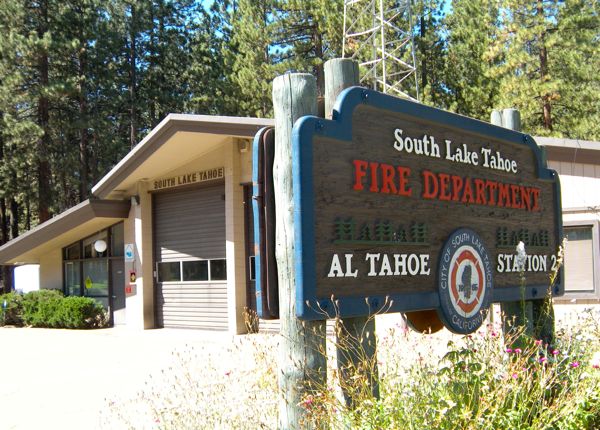
2-person fire station in South Tahoe may temporarily close

By Kathryn Reed

Fire station No. 2 has been the subject of conversations for years because it’s so old (circa 1940s when it was part of the Lake Valley Fire Department) and inadequate.

A proposal being floated is to test closing the station for five days. At any given time only two people staff the building that is located on Highway 50 across from South Tahoe Middle School. An engineer and captain are there.

Under the plan South Lake Tahoe Fire Chief Brian Uhler is contemplating the captain would go to Station 3 (by the Y) and the engineer to Station 1 (at Ski Run Boulevard-Pioneer Trail). Stations 1 and 3 have four people now.

South Lake Tahoe fire Station 2 may be closed on a trial basis. Photo/LTN file

By having two captains in one station, one would be in charge of the rig, the other the whole city.

When the three division chief positions were eliminated late last year it created a scenario where the incident commander is also in charge of an engine. This does not create an effective, safe way to handle emergency calls.

Uhler relayed how last week Engine 3 went to a rescue off Highway 89. The crew hiked in about 1.5 miles and lost radio contact. The shift commander was supposed to be in overall command of the city and he was out of reach.

Uhler is in consultations with staff to see if moving out of Station 2 would be worth the experiment. Debriefing afterward would determine if this would be something worth doing on a long-term basis.

“Response time will suffer in the sense of getting an engine on the scene,” Uhler told Lake Tahoe News if staffing is eliminated at Station 2.

As it is, one engine with two guys can’t do much other than put out a trash can fire, lay lines and wait for others to arrive, so Uhler doesn’t see the change hindering the ability to put out a fire. Ambulance service does not change if staffing at Station 2 changes.

In 2009, former Fire Chief Lorenzo Gigliotti talked about getting rid of that station and building a facility at Lake Tahoe Community College. That concept is back on the table as the college looks for ways to expand its programs.

With new leadership at the college, the city and elsewhere, the reality of creating a training facility is more likely.

In 2009, then LTCC President Paul Killpatrick told this reporter he was concerned about having a training facility on campus because it is surrounded by forest.

Having a station at the college off Al Tahoe Boulevard would put firefighters in the same area they are now.

Problems with the current Station 2 include vehicle storage issues, no accessibility for the disabled, a dangerous situation for emergency vehicles to merge into traffic on Highway 50, conditions are lousy and modernization is out of the question.

Uhler expects to decide next week if he is going to do the trial closure at Station 2.


Fish and Game continues to investigate Homewood bear shooting

By Ravali Reddy, Sacramento Bee

The California Department of Fish and Game continues to seek information about the shooting of a bear that was found dead on a beach in Homewood late last month.

BEAR.jpegThe investigation has revealed that Sunny, a black bear, was shot at close range. The type of wound the bear suffered is believed to have caused a significant loss of blood, which was found at the site where she was killed.

The investigating warden was not able to locate blood or evidence of a discharged firearm at any of the properties surrounding the area where the bear was found. Fish and Game is following leads, including tips from the Tahoe community, and will submit a final report to the Placer County District Attorney once the investigation is finished.

The Humane Society of the United States and The Humane Society Wildlife Land Trust have added a reward of up to $2,500 to a previously posted reward of $3,000 for information leading to the arrest of individuals responsible for the killing.

Anyone with information about this case is encouraged to contact CalTIP at 888.334-2258. Callers may remain anonymous.