Grego: Expand recreation, reduce unemployment, make TRPA accountable

Publisher’s note: This is one of five Q&A profiles of a South Lake Tahoe City Council candidate running in the Nov. 6 election.

Name: Bruce Grego

Age: 59

How long have you lived in South Lake Tahoe?: 45 years

Bruce Grego

Work/volunteer experience: Work History: I grew-up helping operate my parents’ motel for 30 years between 1967 to 1997; practicing attorney in this community since 1980.

Volunteer experience: In the 1970s, active with groups opposed to TRPA; about 1974, participated in a committee to support a local initiative to require an elected city clerk and city treasurer; in the late ’70s participated in a city of South Lake Tahoe planning committee known as the 20-20 Committee (a citizens’ planning committee addressing issues for the next 20 years); for about eight years in the 1980s I was a member of the city of South Lake Tahoe Planning Commission; was appointed by the City Council in 1989 to complete a term of a vacant City Council position; 2008, I was elected as a member of the city of South Lake Tahoe City Council and I am currently a member of said body. During my time on the council I have been appointed to a number of governmental bodies, such as the Tahoe Transportation Commission and LAFCO, and I have attended City Council meetings on a regular basis.

Why are you running for City Council?: To continue with the work I began four years ago and to address the many challenges that face us in the coming years. Also see my comments throughout this response.

What is your vision for South Lake Tahoe, the South Shore and the entire Lake Tahoe Basin?: Better roads and sidewalks, more recreational opportunities for our citizens, local control of land use, and expansion of our economic base.

What are the three best things about South Lake Tahoe?: Our people, our community and our environment.

What three things would you like to change in South Lake Tahoe and how will you go about changing them?: 1. Land use continues to be a key factor in determining our future. TRPA continues to dominate our land use policies in our community and in this basin even though no one is elected to the board. In March 2011, I alone began to engage the Nevada Legislature about the future of TRPA. On March 15, 2011, I attended a subcommittee of the Nevada Legislature and called for TRPA to be locally elected as opposed to appointments; I told the Nevada sub-committee that TRPA has caused our community to be stagnate and left with a 1969 design infrastructure unable to compete with other recreational areas; that we have been denied our civil rights; and I proposed, that without changes, that Nevada deny any funding of the TRPA. From that speech I was invited by state senators and assemblymembers to become involved in the passage of Nevada Bill SB271. I eventually was able to obtain the endorsement of the South Lake Tahoe City Council; and I contacted both our Congressman Tom McClintock and then Assemblyman Ted Gaines to endorse this bill, which they subsequently did. I wish to continue this effort for another four years. SB271 calls for Nevada’s withdrawal from TRPA if TRPA fails to reform. I intend to see that substantial changes occur. Without flexibility in land use, positive changes in our community cannot easily occur.

2. Reduce unemployment. We are tied to the national economy, however, further promotion of special events, broadening our economic base, and maintaining city services should continue to be our focus. Also, as stated above, sensible land use policies can promote the development of new businesses in our community.

3. Expand recreational activities for our youth. The renovation of the recreation center should be a priority for the city in the next four years.

What would you do to balance the budget?: I have voted for a balanced budget for the city of South Lake Tahoe for the last four years. The city of South Lake Tahoe continues to have a balanced budget. We must spend within our means.

What would you like to see in a recreation master plan?: More recreation opportunities for our youth, more parks, and another dog park. Find funding to renovate our Recreation Center on Rufus Allen.

Promoting recreation was touted two years as a means to stimulate the local economy. Nothing has been done in that time. What will you do so that same sentence can’t be said two years from now?: This is a leading question, it assumes nothing has been done. I disagree with your conclusion. Since I took office, Lakeview Commons at El Dorado Beach and Bonanza Park have been established. There is no doubt that Lakeview Commons has been successful and a model for other such development. The ice rink has been leased to private parties with the objective of making it a world-class facility.

What types of recreation do you enjoy in Lake Tahoe?: Probably not enough … with operating my own business and attending to council duties. I like helping people. I enjoy solving problems, and making sure justice is done. I like what I do. On a more personal level, I like attending special events, attending the Shakespeare Festival and Treat Street, shopping at our local flea market and collecting Tahoe memorabilia. I also enjoy fishing with the grandchildren.

How will South Lake Tahoe be different in four years after the end of your term?: I cannot promise to remake the entire town in four years; only the promise that I will continue to keep our city in the right direction. Always looking for opportunities to better our community. I will continue to work for reasonable land use policies controlled by the people affected by those policies; continue with road improvement that we started this year; continue to push back against the agencies; continue to seek solutions to complete Project 3, the Hole.

Being on the council requires working with four others. Give readers an example of how you work well others in difficult situations with differing opinions: The last two years have clearly demonstrated that I have worked well with the other councilmembers. We have voted together often, and we have disagreed without being disagreeable. Example: see the two or more televised council meetings each month that I participated in that involved every issue that faces our community. I work well with my colleagues in the other governmental agencies that I have been appointed to by the City Council, such as the Tahoe Transportation Commission and LAFCO.

An example of a difficult situation. Even though I have opposed the operation of marijuana dispensaries in our city, when this issue first was addressed, the council created a subcommittee of two councilmembers to work with citizens for and against this issue for the purpose of proposing an ordinance regulating the dispensaries. Bill Crawford and I made up this subcommittee, and for many months we, with other appointed members, had public and open discussions with marijuana supporters during the process of making recommendations for a proposed ordinance to the council. I fulfilled the charge by the council, even though I fundamentally opposed the continuation of the dispensaries. And even though Bill Crawford and I had disagreements on the council, we worked together on this subcommittee.

What are your opinions about the following issues and/or entities?:

• Loop road – First of all, in responding to this issue, I am including in this response issues relating to the Project 3, the Hole at Stateline, and the South Shore Vision Plan. What is the most fundamental concern that affects these three issues, and this election? It is electing persons to the council that are independent and whose sole allegiance is to the people of South Lake Tahoe. Why? In the past large developments have occurred at the expense of small business and our community (small business employ many local people). The South Shore Vision Plan and the current Loop Road proposal seeks to remove additional businesses in our community as well as many residential properties, and redirect traffic. Consider the past: a) Randy Lane was able to destroy blocks of small businesses and financially impact the city’s tax revenue based upon a development proposal not adequately funded. Until I was elected in December 2008, no one at the city was aware that Randy Lane had not purchased the properties within the Project 3 (the Hole) free of debt, and acquired said properties with mortgages; this among other things, prevented a consolidation of the properties that was a prerequisite for development. b) PADMA, the common interest maintenance entity for Heavenly Village mandates approximately $130,000 annual contribution from the city of South Lake Tahoe in perpetuity because the city owns the sidewalks and the restroom and signed an agreement to such effect; c) Heavenly Valley has an agreement with the city that their ski tickets sold at Heavenly Village would not be taxed for about 20 years. Why are these sweetheart deals being made? Not because these corporations are bad (there are good people that work for them), but because the persons you have been electing have not been independent and/or have not been able to resist the continued advocacy and lobbying effects by such corporations. In spring 2009, Randy Lane sought from the council support to sell public bonds for the purpose of funding Randy Lane’s project in the sum of $25 million. I opposed this request because it made no financial sense, and it would have impaired the city’s future credit standing. Ultimately, the entire council rejected his proposal for a $25 million “loan”. I demonstrated the independence required to have a seat on the council. I have opposed efforts by special interest groups for projects that are not in the interest of our community. One of the current issues facing our city is the Loop Road. I do not support this proposal for the following reasons: the use of eminent domain/condemnation to achieve the ownership of the loop road corridor, the destruction of small businesses and residence in our community, and the redirection of traffic away from our city’s business centers. I believe we need to revitalize the Stateline area though a vision type plan, but no plan will be approved by me unless the benefits are fairly distributed, and the city’s interest are protected. Another issue: Presently, some of the major investors are seeking to acquire other holdings in Project 3, the Hole at Stateline. The council has sought to encourage development at the Hole, and has spoken to developers and property owners alike. We have to make sure that any permits issued for the project address all concerns, including, and most important, that the new developer/owner has sufficient resources to proceed. Independence, reviewing projects on their merits, and looking out for you is a summary of my history and voting record on the City Council in the last four years, and will continue to be my objective, if you grant me another term.

• Hole at Stateline – see above.

• Tahoe Valley Plan – No question … I support the Tahoe Valley Plan that calls for consolidation and concentration of commercial land uses. The revitalization of the Y is equally important to the Stateline.

• Giving money to any chamber or tourism bureau – I support the current practice, that with the exception of some special events, the city does not provide funding for these bureaus. They provide an important service to our community, but this is not the role of our council. But it is equally important to note: that we have increased contributions by city employees; we have reduced the number of employees by 30 percent; we continue to keep a balanced budget; we continue to maintain city services to the public, and the general duties of this city is much greater than most (i.e. addressing land use issues with TRPA and other agencies in the basin). My point is that making any additional contribution to the chamber and tourism bureau will take money from essential city services, and I cannot support that.

• Benefits, including pensions, for city staff – See above. Based upon the pattern set by prior councils, our contracts with the labor units for city employees are not annual contracts. Nevertheless, the council has obtain concessions on those contracts, making employees more responsible for health care and pension costs, and I am determined to bring such contracts in line with what we can afford.

• Tahoe Regional Planning Agency – see above.

• Lahontan Regional Water Quality Control Board – At the first strategic conference of the council in 2009, each member of the council proposed goals and objectives. My proposed objective was that the City Council have a “foreign policy” — not to deal with other nations — but to interact with our neighbor governments and to reach out to Sacramento and Carson City. We have not only been able to impact TRPA, but for the first time in memory, Placer County, El Dorado County and the city of South Lake Tahoe have joined together to oppose Lahontan’s water quality proposals (BMPs).

• South Shore Vision Plan – see above.

• Lake Tahoe Airport – I believe we should support commercial operation at the airport.

Why should voters vote for you over someone else?: Proven record of accomplishments. Independent, not tied to special interests. A decision-maker. Not afraid to take a position not supported by the rest of the council. I do look “outside the box”.

Four years ago you said you would change how the TRPA Governing Board is elected. You haven’t done so. Any comment?: I still support an elected board by the people in the basin. I believe that land use, water quality issues, transportation, and other environmental issues should be decided by elected local governments, and not bureaucratic, appointed boards of special interest groups controlled by staff with no understanding of economics or the needs of our community. Our community’s 1969 stagnate design is a “tribute” to the misdirection of TRPA and other land use agencies in the basin. We have been locked in to old infrastructures and obsolescent. Four years ago, many commentators and many citizens questioned whether I could fulfill the promise of trying to establish an elected TRPA board or, for that matter, impact the direction of the TRPA in any manner whatsoever. I hope that you recall that in 2009, I, standing alone, proposed a resolution demanding an elected board, and no one else on the council would second my motion. Or when I, on March 15, 2011, standing alone at the Nevada Legislature took the initiative to attack TRPA’s land use policies, and demanded a cut off of all funding to the TRPA. Look at the situation today. As a direct result of the passage of SB271, where TRPA’s very existence has been threatened, TRPA has finally engaged local government, and the proposed regional plan update addresses some of the important concerns of local government. We are even going to have a test case for drive up windows for pharmacies. Look at the situation today, not only was I able to have the City Council (the only California elected body to support SB271), but we are, the City Council, actively engaged in addressing TRPA regulations and addressing other environmental regulation. There is no doubt that TRPA finally began the process of a long past due Regional Plan update, if not for SB271. There was no concerted effort by the City Council to “push back” against the agencies prior to my election to the council. We have a very different perspective on the council today on land use issues than four years ago, and I believe that I caused this difference to occur. The accomplishments to date are just a beginning. We must do much more to bring sensible land use policies in the basin and keep the pressure on TRPA.

Is there a person or business you would not take a campaign contribution from?: Yes.

Tell readers something about yourself that they may not already know: I have a mole on my left knee. My point is, citizens have observed me over the last four years, and have contacted me to discuss concerns and to show support of my decisions on council. I have been transparent. You have seen how I have made decisions, and you have seen my concerns for you. It is important in this election that you examine the history of the new candidates for office. Can they make decisions, have they worked for industries that have or will seek “sweetheart” deals from the city, can they be independent, and how long have they participated in public affairs? I ask for your support in November.



Cash rules when it comes to home buying

By Hudson Sangree and Phillip Reese, Sacramento Bee

Homebuyers trying to take advantage of the current ultra-low mortgage rates are likely to discover an unpleasant truth: They’re competing with lots of other buyers who can pay all cash.

The cash buyers aren’t just rental investors, who have occupied the lower end of the market for months. They include those seeking midpriced homes for themselves or their grown children.

How do they have that much cash? Some sold higher-priced houses in the Bay Area. Some liquidated stocks. Others pulled it out of savings.

The number of cash buyers means those with loans are at a disadvantage in a market where inventory is extremely tight and decent homes draw multiple offers.

“Cash is king,” said Eric Pine, an agent with Lyon Real Estate in Folsom, who represents both cash buyers and those with traditional financing who have seen their offers repeatedly turned down.

Sellers prefer cash because it creates certainty and speeds up the process. It also eliminates the need for appraisers, who have become more conservative since the housing bubble burst and often deliver low estimates, agents said.

Low appraisals further complicate the process for borrowers, who already face stricter standards from lenders.

Pine’s suggestion to would-be buyers: Ask relatives for cash. “In order to compete,” he said. “You have to get family members to pony up.”

Read the whole story


Nevada, Washoe County looking to settle property tax dispute

By Sean Whaley, Nevada News Bureau

CARSON CITY – The state Board of Examiners on Tuesday will consider settling a dispute with Washoe County over $21.5 million in local property tax revenue taken by the 2009 Legislature to balance the state budget.

The proposed settlement would provide an immediate payment of $1.25 million to the county, with another $6 million being allocated later for major road maintenance projects.

Washoe County submitted the claim to the Board of Examiners in September 2011, citing a Nevada Supreme Court ruling in May 2011 that said the Nevada Legislature improperly took $62 million in 2010 from the Clark County Clean Water Coalition fund to balance the state budget. That ruling forced Gov. Brian Sandoval to reconfigure his proposed 2012-13 state budget by extending a set of taxes that had been scheduled to expire on June 30, 2011.

The county argued the court ruling applied to the funds taken by lawmakers in 2009 as well.

Clark County also submitted a claim, seeking $102.5 million in property taxes also taken by the 2009 Legislature. But the county in June opted to sue rather than continue settlement negotiations with state officials.

Sandoval said in June he was disappointed at the decision of the Clark County Commission to take the matter to court and he questioned whether the amount of the claim was accurate.

“We’ve been trying to work with Clark County, again, for months,” he said in an interview on the Nevada NewsMakers television program. “And I was extremely disappointed that they weren’t willing to come to the table to try and resolve this. And those chose to litigate rather than try to work it out.”

The Legislature in 2009 required the state’s two largest counties, Clark and Washoe, to give up 9 cents per $100 in assessed valuation collected in property taxes to the state. The actions by lawmakers in 2009 occurred before Sandoval became governor.

The Board of Examiners is composed of Sandoval, Attorney General Catherine Cortez Masto and Secretary of State Ross Miller. The agenda for the meeting indicates that the state and Washoe County want to settle the matter.


Judges in El Dorado, Placer counties lobby for money for courthouse repairs

By Maria Dinzeo, Courthouse News Service

Members of a Judicial Council committee grilled California trial judges over courthouse construction costs in an effort to fund necessary projects while cutting costs by $390 million.

Judges and officials from 23 local trial courts pleaded for funds from the council’s court facilities working group, complaining of perilously unsafe courthouses that are seismically unfit, overcrowded and lacking access for the disabled.

“The security in our courthouse is somewhat appalling and a recipe for potential disaster,” said Presiding Judge Laurie Earl of Sacramento.

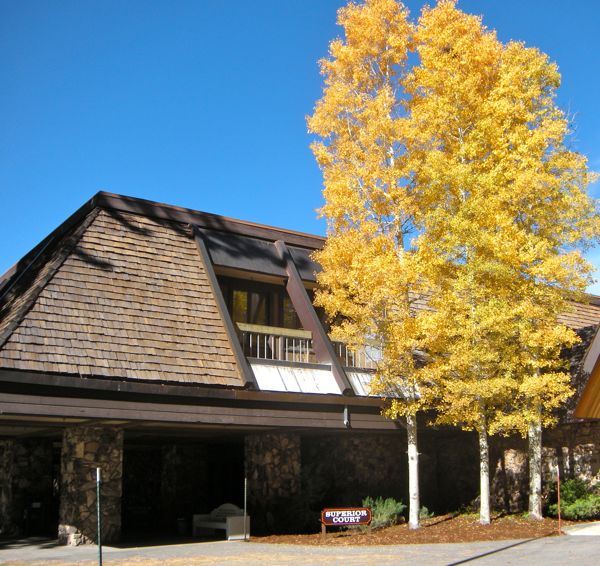
El Dorado County courthouse in South Lake Tahoe needs substantial repairs. Photo/LTN file

Presiding Judge Suzanne Kingsbury of El Dorado County showed the committee a 65-pound corbel that had fallen off the roof of her court. “This is a problem we cannot seem to fix,” she said.

“You’re not contending that the falling corbels is a basis for a new building,” said Appellate Justice Jeffrey Johnson, the committee’s co-chair.

“Absolutely not,” Kingsbury replied. “The lack of [Americans with Disability Act] access, the lack of parking, the asbestos, mold and lack of jury assembly rooms – I could go on for days. The corbels are just documentary evidence of the dilapidated state of the building.”

Presiding Judge Brian Hill of Santa Barbara told the committee that several times a week prisoners are paraded across the street to another courtroom housed at its historic courthouse, just as tourists are unloading from buses out front.

“It’s not unusual to have to bring out additional deputies to protect tourists from intermingling with the inmates,” he said. “It’s almost a feeling of chaos as they cross the street.”

Kern County Executive Officer Terry McNally said two regional courthouses serving very large Central Valley prisons are “ripe for a major security incident.”

The facilities working group was tasked last year with re-assessing the state’s planned courthouse projects after intense scrutiny of the construction program and the outrageous cost of building courthouses in California. With additional cuts this year from the state Legislature, the committee still needs to find $390 million to cut from court construction.

At Wednesday’s meeting, judges on the working group were highly critical of presenting courts and questioned each seemingly unnecessary expenditure.

“What really concerns me is the cost of construction,” Judge Samuel Feng of San Francisco said to Presiding Judge Alan Pineschi of Placer County. “The original construction cost is outrageous. When the public looks at this, it’s going to be absolutely – just bad. At some point, the number is going to come out and I don’t think the cost justifies the number of courtrooms,” he added, referring to the $27 million price tag of a new one-room courthouse in Lake Tahoe.

Pineschi said the cost estimate was unusually high because of the area’s environmental requirements. Because of its alpine location, the new Lake Tahoe courthouse would require a special roof to ward off snow and ice. However, Pineschi said he agreed that the original cost estimate provided by the Administrative Office of the Courts, the bureaucracy in charge of all courthouse building projects, was obscenely high.

“Our goal is to have something that substitutes for this extremely inadequate facility,” he said. “We’re willing to consider anything.”

Committee-member Judge David Power of Solano questioned Kern County’s need for two new three-room courthouses at a cost of $30 million.

“Three courtrooms for $30 million. That’s a lot of money. That’s a lot of investment for just three courtrooms,” he said.

McNally explained that it was the estimate given by the AOC’s Office of Court Construction and Management, but he would be willing to negotiate on price.

“My judges share your concern about the cost of these facilities,” he said. “We’re ready willing and able to sit down with the OCCM to economize.”

Judge David Lampe of Kern County said modifying existing facilities “is likely the most economical.”

“The problem here for us is that the money is a moving target,” he said. “What you’re undertaking seems to be a balance between need and available resources. A husband and wife may have six kids and want a six-bedroom home, but if the income is only $1,000, they’re going to have to balance the revenue with the need.”

“To rephrase the Rolling Stones, you get what you need,” Johnson said.

Lampe replied, “What we’re worried about is if we start looking only at need, then the front-loaded projects are going to absorb a greater share of the cost, and delayed projects will be delayed that much further because the resources may not be there. We’re worried with these non-metropolitan, somewhat rural areas that we’re going to end up with a disparity of facilities.”

“Branch courts are always more expensive,” Power added.

“It’s a very large, diverse community,” McNally said. “It’s not unreasonable to have a decentralized environment.”

The frustrations brought on by meager funding quickly became a point of contention between the committee and the courts. Assistant Presiding Judge Ira Kaufman of Plumas County said his historic 1921 court has no security, and one judge has to share a restroom with the public.

“I think it would be hard to justify to the taxpayers of California to build a new courthouse so a judge doesn’t have to use a public bathroom,” Johnson countered. He added that the bulk of the county’s problems seem to be “personnel” matters, including its rancorous relationship with the county, which owns the courthouse but refuses to put any money into it.

The discussion became heated, with Kaufman saying the committee “wasn’t helping.”

When one committee member said the courthouse was “functional,” Kaufman snapped, “Where did you get that from? Have you been to the courthouse?”

He noted that the county has pledged the courthouse as collateral against a loan, so the state could make no renovations on it.

“We’ve had discussions with the county for many years,” Kaufman said. “All the county buildings have been pledged. The point is, the building doesn’t function. The county isn’t going to fix it. Whether it’s a new courthouse or refurbishing this one, everyone deserves the same access to justice.”

“I’d like a new courthouse for my court also,” Feng chuckled.

Justice Brad Hill, chair of the construction committee, apologized throughout the day for asking the courts to justify their needs.

“I want to apologize for putting the courts through this again,” he said. “You would not be here but for the fact that the Legislature had cut an additional $50 million a year ongoing. That is the unfortunate circumstance we are faced with. This is just one more thing on top of trying to keep your courts open.”


Burglary, tagging spree ends with 2 arrests

Two South Lake Tahoe teenagers were arrested Sept. 8 in connection with a burglary and tagging buildings, signs and vehicles.

More than $3,000 work of spraypaint, markers and cash were stolen from a local store on Sept. 7. Police are neither releasing the address nor the name of the store.

Cans of paint recovered Sept. 8 from a commercial burglary. Photo/Provided

On Saturday, people started called the police department to say their property had been tagged.

The investigation led officers to Silver Dollar Avenue where they conducted a probation search of a residence. Two boys, ages 15 and 16, were hiding in a closet. During the search spray paint and markers that had been taken in the burglary were recovered, according to officers. Officers said the two juveniles admitted to being involved in the burglary and one admitted to tagging buildings, signs and vehicles.

A third juvenile has been identified as a suspect and is on the loose.

The property damage from the graffiti is estimated to be in the thousands of dollars.

Anyone with information, should call (530) 542.6100 or Secret Witness at (530) 541.6800.

 — Lake Tahoe News staff report


Cancer ‘breakthroughs’ cost too much, do too little

By Laura Beil, Newsweek

In his more than 35 years of practice, Dr. Lowell Schnipper has seen a lot of women die from breast cancer. A patient’s options start to dwindle by the time tumor cells set up outposts in the bones, lungs, and other organs, defying all attempts to keep them under control.

But in June, when the government approved Perjeta, Schnipper had something new to offer. The drug is one of an innovative class of drugs known as “targeted therapies.”

As the chief of oncology at Beth Israel Deaconess Medical Center in Boston, Schnipper knew Perjeta was not a cure: added to a standard treatment with Herceptin—another targeted therapy that was hailed as a breakthrough in 1998—Perjeta gives the average woman only about six months more of calm before her disease starts to stir again.

Given the limited benefit, the price was startling. For most women, a full course of the drug combination will cost $188,000—enough, he says, “to give anybody a cold sweat.”

Americans spent more than $23 billion last year for cancer drugs, more than we paid for prescriptions to treat anything else. But many oncologists are starting to question what we are getting in return for that bill, whether the war on cancer has become too much of a race to produce the next blockbuster.

“In general, progress for cancer has been halting and slow,” says David Howard of the Department of Health Policy and Management at Emory University. So far, most new drugs offer only marginal extensions of life and few cures. Howard says new so-called breakthroughs “overpromise and underdeliver.”

Consider the popularity of Avastin, a targeted drug approved for metastatic colon cancer in 2004. A recent study found that almost 70 percent of patients on chemotherapy were receiving Avastin within a year of its release. In clinical trials, the drug increased survival by about five months. The cost? About $10,000 a month.

Treating cancer has never been cheap, but today, the price of each new treatment seems to outpace the one before, with little bearing on its efficacy.

According to figures from insurer United Healthcare, a standard cocktail of drugs for treating lung cancer used to run about $1,000 a month. Today’s regimens cost from more than $6,000 to almost $10,000—for about two more months of life.

“There is no such thing as a cancer drug coming on the market that is some sort of regular drug price,” says Dr. Peter Bach of Memorial Sloan-Kettering Cancer Center in New York, who studies the impact of cancer costs on U.S. health care. “They’re all priced at spectacularly high levels.”

Which leads to an unsettling question: how much is a little more time worth? Would you spend $50,000 for four more months? How about $15,000 for two weeks?

Of three frontiers in cancer treatment, targeted therapies like Perjeta are widely seen as the best hope for a cure. Traditional chemotherapy is notorious for side effects because it wields destruction indiscriminately throughout the body. Targeted therapies are designed to hit cancer cells only. Perjeta, for example, targets a protein produced in excess amounts in some breast cancers; Avastin hinders the ability of a tumor to form new blood vessels to feed itself.

Read the whole story


El Dorado County massage therapist arrested on battery charges

An El Dorado Hills massage therapist has been arrested on charges of false imprisonment and sexual battery.

A woman reported she was receiving a massage from Patrick Lockard at Massage Envy in El Dorado Hills when he held her down and sexually battered her.

Detectives began an investigation to corroborate her statements and eventually arrested Lockard on Sept. 5.

Lockard, 46, lives in Shingle Springs. He has been a massage therapist for 16 years and has been working at Massage Envy in El Dorado Hills for the past two years.

Anyone with additional information, is asked to call (530) 642.4715.


LTCC making ends meet by dipping into reserves

By Kathryn Reed

While the proposed 2012-13 budget for Lake Tahoe Community College is about $800,000 less than the previous year’s budget, the institution continues to rely on reserves to balance the budget.

The $13.7 million budget, which is expected to be adopted at the Sept. 11 board meeting, includes about $732,000 from reserves. The board has advised staff to stick with the 10 percent contingency reserve, which for the next fiscal year would be about $1.376 million.

However, that pot is not one that can continually be tapped because at some point nothing will be left in it if the college keeps using it for everyday expenses.

Lake Tahoe Community College is expected to approve the 2012-13 budget on Sept. 11. Photo/LTN file

LTCC is putting forward a budget that assumes Proposition 30, the governor’s tax initiative on the Nov. 6 ballot, will fail. If it does, it means a $632,000 loss to the college. If it passes, it means less money has to come out of reserves.

(The board on Aug. 28 had the first reading of a resolution supporting Proposition 30.)

Supplies and services have been cut to cope with the shortfall. Adjunct faculty hours have been reduced, which will mean changes in course selections for students. And the library will close at 7pm instead of 8pm.

Another issue the college is wrestling with is meeting the state education code rule that says at least 50 percent of the budget must go directly toward the classroom. LTCC has historically been on the cusp, but with the 12-13 budget may not meet that requirement.

“We are digging deep into those numbers. If we are going to be less than 50 percent, we have to file an exclusion with the board by Sept. 15,” Jeff DeFranco, vice president of administrative services, told Lake Tahoe News.

The faculty has been notified the 50 percent mandate is likely not going to be met. The issue is expected to be discussed at Tuesday’s meeting. If the board approves a budget not meeting the 50 percent rule, the state chancellor’s office must be notified by Dec. 1. DeFranco said the college will need to show the state it has a plan to get back into compliance.

He said part of the plan includes realizing in fiscal year 2013-14 the full benefit of the 11 early retirements. With only one of the positions being a faculty member (Steve Adams), this did nothing to help attain the compliance with the 50 percent rule. The other retirements include one administrator and nine classified employees.

Eighty percent of the budget is allocated for employee salaries and benefits. In the 2011-12 budget $11,702,727 was budgeted for salaries-benefits, with the actual closer to $11,013,091. For fiscal year 2012-13, wages-benies come in a $10,954,505.

Net personnel savings come by not filling a dean position, but adding support staff. In 2013-14, the retirements will save the two-year college $430,000.

DeFranco, who has been at LTCC a matter of months, is working through the numbers to make them easier to discern, and looking long-term instead year-to-year.

A detailed report on how Connect Ed, the college’s community education program that was launched a year ago, is expected at the Sept. 11 meeting.

But the college has some pressing capital expenses to think about, too. The phone system is failing. A facilities master plan is expected to be discussed at the Sept. 25 board meeting.

—-

Note: Public hearing on the proposed 2012-13 final budget will be Sept. 11, 6:20pm, at Lake Tahoe Community College board room.


Few environmental bills make it out of California Legislature

By Paul Rogers, San Jose Mercury News

Environmental groups and their supporters hoping for a new wave of green laws from the Legislature this year ended up with barely a ripple.

From a statewide effort to ban plastic bags, to limits on foam food packaging, most of the top environmental bills of the 2012 session died.

Environmental groups did score a few wins. They beat back an effort by industry to rewrite the California Environmental Quality Act, or CEQA, the landmark law that requires environmental studies of major projects. And lawmakers passed a bill over the furious objections of hunters to ban the use of dogs in bear and bobcat hunting.

But for the most part environmentalists came away disappointed when the Legislature adjourned for the year early Saturday morning.

“We had some modest success. But I felt like we were playing defense more than offense,” said Ann Notthoff, California advocacy director for the Natural Resources Defense Council.

Considering that Democrats control both the Senate and Assembly, polls show the public generally supports tough environmental standards, and Gov. Jerry Brown has spent 40 years as an advocate for renewable energy and conservation rules, what happened?

Three things, experts say: the bad economy, the huge state budget deficit and newly drawn political districts.

Read the whole story


DiMatteo denied bail

Gino DiMatteo was denied bail at a hearing Sept. 7 in Placerville.

The South Lake Tahoe resident accused of bribing City Councilwoman Angela Swanson and being in possession of drugs for sale is next scheduled to be in court on Sept. 10.

DiMatteo’s bail is $27,500 for each of the four counts. However, there is an addendum that allows a judge to deny bail if it is believed the money that would be used to post bail would come from felonious activities.

Deputy District Attorney Jame Clinchard, who is prosecuting the case, was not available for comment.

Charges against Swanson have not been filed, nor will the DA’s Office say if any are likely to be.

 — Lake Tahoe News staff report