Members of defunct transit system accused of fraud by bankruptcy court trustee

By Kathryn Reed

Former members of South Tahoe Area Transit Authority, Tahoe Regional Planning Agency, and the law firm of Feldman, Shaw & McLaughlin received more bad news this month from the U.S. Bankruptcy Court in Reno.

David Thompson, the federal bankruptcy trustee, filed a complaint against STATA’s member agencies in which he states that STATA’s members “sought to hinder, delay, and defraud” MV Transportation’s collection of funds that STATA owed MV by depositing more than $1 million of STATA’s funds in a Feldman Client Trust Account.

STATA failed to list the cash in the Feldman Client Trust Account in its bankruptcy filing. Mike McLaughlin was the attorney for STATA.

While transit officials on the South Shore fight over millions of dollars, older bus riders in South Lake Tahoe sit in the sun or snow, depending on the season, without a shelter at BlueGo bus stops. Photo/LTN

The trustee report dated Sept. 7 says that trust account was used to pay TRC, the operator of the BlueGo bus system that replaced MV.

The complaint also states that STATA’s board of directors participated in a scheme to wrongfully transfer STATA’s assets to the Tahoe Transportation District in order to avoid paying MV the money the Fairfield-based company was owed. It also says the records are so poorly kept that it is hard to know what money was transferred when. Depending on when the transfers were made, “they are fraudulent,” Thompson writes.

TRPA’s staff recommended STATA hire MV Transportation to provide transit services – primarily the BlueGo buses. The STATA board did so in November 2008.

According to the trustee, STATA immediately asked MV to provide a higher level of service than STATA could afford. Almost immediately STATA had trouble paying MV for the services it provided.

According to the federal bankruptcy trustee, STATA owed MV approximately $3 million by June 2010. That is the month STATA terminated its contract with MV Transportation. Unwilling to pay MV the money it was owed, STATA filed for bankruptcy in September 2010, disbanded by the end of that year and essentially merged with Tahoe Transportation District.

In the complaint, the trustee states that the participation agreement requires member agencies to contribute additional funds in the event of any budget shortfalls.

The trustee’s complaint asks the court to approve specific judgments against member agencies and others as follows: Feldman, Shaw & McLaughlin, $1,035,197; Tahoe Transportation District, $142,000; South Lake Tahoe, $193,779; Heavenly Mountain Resort, $558,336; Harveys, $26,085; MontBleu, $6,133; Horizon, $3,800; Douglas County, $20,000; and Transit Resource Center of Nevada, $692,669.

In reviewing the court documents, it appears the trustee also asked the court to approve a judgment against all of STATA’s members including the El Dorado County and the TRPA in the amount of $2.29 million, plus interest for which all members would be jointly responsible.

El Dorado County had settled its case with MV, but the trustee is dragging that public body back into the mix by questioning whether that settlement agreement was legal.

No mention of the trustee report was made during the open session of TTD’s Sept. 14 meeting, though it was listed as a closed session item.

Ironically, at that meeting John Busskohl with Keolis Transit America gave a report about how things have been going with BlueGo since taking over the operations July 8, 2011.

Busskohl said when his firm took over 60 percent of the fleet was out of service, but that has since been rectified. Three terminals instead of one are being used. An automatic vehicle location system has been installed. This summer’s East Shore Express was deemed a success.

Financials, according to TTD Executive Carl Hasty, are positive. The financials for the past year will be revealed and discussed at the October TTD board meeting.

As for the STATA case, the defendants now have an opportunity to respond to the charges leveled by the court trustee. U.S. Bankruptcy Court Judge Gregg Zive in November could make a decision to dismiss the case or send it to trial.


Washoe County, state tax revenue dispute resolved

By Sean Whaley, Nevada News Bureau

CARSON CITY – The state Board of Examiners voted to settle a legal dispute with Washoe County over local tax revenue taken by the 2009 Legislature to balance the state budget.

The settlement provides an immediate payment of $1.25 million to the county, with another $6 million being allocated later for major road maintenance projects. As part of the agreement, the road projects will be moved up in the state’s funding priorities.

The original legal claim submitted in 2011 was for $21.4 million, but the county later revised its demand to about $17.9 million.

Gov. Brian Sandoval, a member of the board, called it a good deal for the state since the projects to be paid for with state highway funds have already been approved for funding by the state Transportation Department. The agreement also makes it clear there is no admission by either side that there is fault or a legal liability for the settlement, he said.

The cash portion of the settlement equates to about 7 cents on the dollar, Sandoval noted.

If the highway piece of the settlement is included, the deal provides about 40 percent of what the county had sought in its revised request, said state Budget Director Jeff Mohlenkamp.

“It’s a good settlement and I think it’s important to recognize, as I said, that there was no admission of liability by either party,” Sandoval said after this week’s meeting. “I don’t think it’s ever a good idea to be having litigation or disputes between governmental entities.”

Washoe County submitted the claim last year, citing a Nevada Supreme Court ruling in May 2011 that said the Nevada Legislature improperly took $62 million in 2010 from the Clark County Clean Water Coalition fund to balance the state budget. The county said the ruling applied to actions taken by lawmakers in 2009 as well.

Clark County has also submitted a claim based on the same legal decision, and is seeking $102.5 million in local taxes also taken by the 2009 Legislature. But the county in June opted to sue rather than continue with negotiations.

Even so, Sandoval said today that negotiations continue with the county to resolve the dispute, which occurred prior to his term as governor.

But the state has just recently received a new claim, from the city of Reno, based on the same Supreme Court ruling.

Reno City Manager Andrew Clinger appeared before the board to briefly discuss the claim filed for $2 million. The settlement with Washoe County approved today did not provide any direct benefit to the city, he said.

Sandoval said the claim will be reviewed by the Attorney General’s Office as has been done with the other requests.


Deer mice being killed in Yosemite because of hantavirus outbreak

By Reuters

Yosemite National Park has begun trapping and killing deer mice whose growing numbers may have helped create the conditions that led to a hantavirus outbreak that has infected eight park visitors, killing three, public health officials said on Tuesday.

Yosemite officials in recent weeks have warned some 22,000 people who stayed in the park in California over the summer that they may have been exposed to the rodent-borne lung disease, which kills over a third of those infected.

The U.S. Centers for Disease Control and Prevention has also sounded a worldwide alert, saying visitors to the park’s popular Curry Village lodging area between June and August may be at risk. Park officials have closed nearly 100 tent cabins in Curry Village infested with deer mice, which carry the virus.

“From an ecological perspective, it appears that there was an unnaturally high population of rodents in the area. We are being proactive and reducing the population,” Danielle Buttke, a veterinary epidemiologist for the National Park Service, told Reuters.

Buttke said the mice were being trapped in several areas of the park for monitoring purposes but believed they were being killed only in the Curry Village area, using snap traps.

Seven of the eight people confirmed to have been infected are believed to have contracted the virus in the village, while one stayed elsewhere in the park.

Public health officials trapped three times as many deer mice in the park’s Tuolumne Meadows last week than were caught in a 2008 period, indicating that the deer mice population has grown, said Dr. Vicki Kramer, chief of vector-borne diseases at the state Public Health Department.

Dr. Charles Chiu, an infectious disease specialist at UC San Francisco, said the growing deer mice population might help explain the outbreak.

“This could be an explanation for why we’re seeing this particular cluster,” Chiu said. “What you may have is the perfect storm of conditions: increasing prevalence of deer mice and campers with the same or common exposure to (lodging) infested with deer mice.”

Officials are concerned that more Yosemite visitors could still fall ill because the virus can incubate for up to six weeks after exposure. There is no cure for the syndrome but early detection and hospital care increase survival rates.

The virus can lead to severe breathing difficulties and death. Early flu-like symptoms include headache, fever, muscle aches, shortness of breath and coughing.

Last month, authorities began trapping rodents in Yosemite to examine whether deer mice there were more likely to be infected with the hantavirus than deer mice elsewhere, Buttke said, but found they were not.

When authorities first identified the Yosemite hantavirus outbreak, rangers balked at the idea of trying to exterminate the deer mice, arguing that the mice play an important role in the Yosemite ecosystem.

But when they realized the deer mice population had swelled, they decided to thin it in an effort to rebalance the ecosystem, Buttke said. She theorized that weather combined with visitors bringing in food led to Yosemite’s abundance of deer mice.

Deer mice release hantavirus in their urine and droppings. People can contract the virus when they breath contaminated air. Children rarely contract the virus, probably because it is often transmitted when adults sweep or vacuum droppings or cut and stack wood.

People usually contract the virus in small, confined spaces with poor ventilation. They also can become infected by eating contaminated food, touching tainted surfaces or being bitten by infected rodents.

The disease has killed 65 Californians and some 600 Americans since hantavirus was identified in 1993, but it has never been known to be transmitted between humans.


Smokers being offered incentives to not light up

By Cynthia H. Craft, Sacramento Bee

The federal health care overhaul is a complex structure woven through with carrots and sticks, incentives and disincentives.

Physicians get payments to implement sleek new electronic health records systems. Hospitals get penalized financially if too many patients require readmittance.

Now, in California, an Affordable Care Act grant is offering select Medi-Cal enrollees $20 retail gift cards in a leading-edge, anti-smoking trial. All they must do is call the California Smokers’ Helpline and complete the sign-up protocol to participate in telephone counseling sessions.

Skeptics may dub it dialing for dollars. But experts say the program may show monetary incentives to be an important tool in improving health and reducing the growth of health care costs in the long run.

An initial pilot project already finished in Sacramento showed positive results, doubling the number of calls to the Smokers’ Helpline, said Elisa Tong, an associate professor at UC Davis Medical Center and a member of the outreach team for the project.

Sacramento was a natural place to begin because it has an “embarrassingly high” number of Medi-Cal enrollees with health complications who smoke, Tong said. Medi-Cal is California’s version of the federal Medicaid program for people with low incomes or who have certain disabilities.

Compared with the statewide average of about 12 percent, 35 percent of at-risk Medi-Cal consumers in Sacramento are smokers.

California’s Department of Health Care Services recently expanded the pilot project statewide, to further test the effectiveness of offering financial incentives. Researchers involved in the project will identify Medi-Cal patients with chronic conditions and invite them to take part.

Within that group, some will be selected in a randomized, controlled trial to receive certificates of completion that can be traded for free nicotine patches. Another slice of the larger group will be eligible to receive $10 retail gift cards for each relapse-prevention call they complete to the hotline.

Also being tested is another tier of incentives for those who tried but were unable to quit smoking. This would allow a selected number of beneficiaries to receive up to $40 to re-enroll.

Broadly speaking, the California project is but one of many layers of carrots and sticks nestled in the Affordable Care Act with the aim of re-engineering the nation’s health care system into one of better outcomes, fewer mistakes and lower costs.

California received a federal grant of $10 million to pay for the program, which will target 75,000 Medi-Cal members over five years of incentives and study.

The state was deemed well-positioned for the project because the California Smokers’ Helpline has been up and running for 20 years at the University of California, San Diego.

Controls and tracking methods are in place to prevent fraud, Tong said, and the trained hotline counselors are able to weed out profiteers who may be attracted to the program by the $20 gift cards.

The gift cards are good at major retailers such as Walmart, Target and Safeway, said Norman Williams, deputy director for public affairs at the state Department of Health Care Services. Williams said it makes sense to seek out ailing Medi-Cal members who smoke to try to change their behavior.

“If you have a chronic disease, we are going to pay especially close attention to you,” Williams said, noting that treating tobacco-related disease absorbs 11 percent, or $15 billion, of Medi-Cal’s budget.

Tong hopes the hotline program will take hold in California’s rural areas, which have smoking rates among Medi-Cal enrollees as high as 45 percent.

“It’s long overdue in rural California,” she said. “We need to address this quickly.”

A 2004 study in the American Journal of Preventive Medicine determined that economic incentives to change consumers’ preventive health behaviors worked 73 percent of the time.

“Economic incentives are effective in the short run for simple preventive care, and distinct, well-defined behavioral goals,” according to the abstract of the study. “Small incentives can produce finite changes, but it is not clear what size of incentive is needed to yield a major sustained effect.”

Tong said California researchers hope to pull together a comprehensive picture of what combination of financial incentives are most effective at changing behavior.

Already, she said, the project is “helping to generate a lot of discussion about how this program can become a model for the nation.”


Hantavirus remains a mysterious disease despite recent incidents

By Kate Mather and Anna Gorman, Los Angeles Times

LOS ANGELES – In his 30-plus years as a doctor, Bruce Tempest had never seen anything like it.

A Navajo man having trouble breathing showed up at the emergency room of a small hospital in Gallup, N.M. Less than an hour later, he was dead. The man had been young, athletic and otherwise healthy. His fiancee had died days before, also from sudden breathing problems.

“This is something different,” Tempest, now 76, remembered thinking of the 1993 illnesses. “It just doesn’t fit.”

Tempest contacted area doctors, looking for other cases. Then he asked the University of New Mexico for help. Soon, the patients were being flown to Albuquerque. They arrived with chills and aches but soon were in complete respiratory distress. Physicians were at a loss: Was it sepsis? Influenza? Bubonic plague?

Doctors had a medical mystery, and they knew it had to be solved quickly. Patients were showing up at the hospital “not feeling well one day and being dead the next,” said Gregory Glass, an epidemiologist at Johns Hopkins University.

When the cases hit television, a lucky clue came in. A doctor called and said the illness sounded a lot like a virus he had observed in Korea in the 1950s. It was called hantavirus.

This summer’s hantavirus outbreak in Yosemite National Park is as a sobering reminder: Mystery still surrounds the disease.

“The biggest mystery is we don’t have a good explanation,” said Barbara Knust, a U.S. Centers for Disease Control and Prevention epidemiologist. “For Yosemite, why this year of all years is there an increased number of cases?”

Nearly 20 years after being identified in the U.S., hantavirus is better understood but no less vexing. Researchers now know it causes hantavirus pulmonary syndrome, a severe respiratory disease. It is transmitted through the droppings and urine of deer mice, and not through person-to-person contact. Treated early, patients have a better chance of survival. But there is no cure, and more than one-third of patients die.

The Yosemite cases follow the pattern: Three of the eight visitors who fell ill died. Health officials have called the Yosemite outbreak unprecedented – more than one hantavirus infection from the same location in the same year is very rare.

The National Park Service has closed the cabins believed to be at the heart of the outbreak. State and federal scientists are scouring the park, trapping mice and conducting laboratory tests. Public health officials are warning doctors worldwide to watch for possible symptoms, which can be confused with the flu and can take weeks to show up.

And the California Department of Public Health said the risk of new cases remains, even as the summer surge of visitors wanes.

“These are not isolated cases in the hospitals in the mountains,” said Daniel Uslan, assistant professor of infectious diseases at the UCLA medical school. “These are potentially people coming back to Los Angeles or other urban centers where doctors are perhaps not as aware of the infection.”

Officials investigating the Yosemite cases have more to go on than a lucky tip. But just like in 1993, they are under pressure to quickly learn more about a disease that is pervasive and deadly.

As patients continued dying in the Four Corners region, doctors and epidemiologists had to accomplish three monumental tasks: pinpoint the cause of the illness, determine why only some people were getting it and track down its origin.

The CDC analyzed tissue from survivors and those who had died. Researchers tested for antibodies against viruses and hoped for a hit, said Glass, the Johns Hopkins epidemiologist. When they tried hantavirus, they got a match.

Still, they didn’t know why certain people got sick and others didn’t. Paul Ettestad, part of the CDC team, visited homes throughout the Four Corners and asked relatives what the victims did in the days before they got sick. He also compared the victims’ homes with neighbors’ homes.

Researchers also tried to find the source of the disease. Knowing that rodents carried hantavirus, they trapped hundreds of small mammals and found the virus in nearly one-third of the deer mice, according to the CDC. By year-end, scientists isolated the specific type of hantavirus that caused the Four Corners cases and grew it in a laboratory.

“From an epidemiologist’s point of view, this was amazing,” Glass said. “We use it as a textbook case of how to do a really good epidemiology.”

The CDC started tracking every case of hantavirus pulmonary syndrome across the U.S. In 1993, 48 people became ill. From 1994 to 2011, an average of 28 people got the disease each year.

Cases are more common in the Southwest but still are rare, said Elisabeth Lawaczeck, a public health veterinarian for the state of Colorado. “You have to be in the wrong place, in the wrong time, do the wrong thing – and inhale,” she said.

Scientists still don’t know why certain deer mice get hantavirus or how they spread it. And even though deer mice are ubiquitous, they haven’t figured out why outbreaks occur in certain areas at certain times.

The Four Corners cases were eventually linked to heavy rainfall that year, which meant more vegetation – and more food – for deer mice, causing a population boom. There were 10 times more deer mice in the Four Corners in May 1993 than a year earlier, according to the CDC.

Yosemite may provide more clues in the long-running hantavirus mystery. Public health officials and epidemiologists are compiling information about the cases, hoping they can determine the deadly combination of factors that led to the outbreak.

The construction of the cabins in Curry Village – with more insulation and less ventilation – may have contributed, said Stan Deresinksi, an infectious disease specialist at Stanford University School of Medicine. Seven of Yosemite’s eight hantavirus cases originated in those cabins.

Or perhaps there was something different about this year’s deer mouse population. Were there more of them? Were they clustered closer to humans? Whatever the reason, experts warn that deer mice aren’t going anywhere, so hantavirus isn’t either.

“The Sierra are their home, and there are 4 million visitors a year to Yosemite,” Deresinksi said. “It is amazing there haven’t been more cases.”


TTD board, staff ready to take fresh approach with loop road

By Kathryn Reed

STATELINE – Wiping the slate clean. That was one of the overriding messages the Tahoe Transportation District staff and board wanted people on all sides of the loop road to hear and embrace.

That doesn’t mean the proposed reroute of Highway 50 through the South Shore that has caused so much consternation has gone away. What is means is more ideas will be studied in addition to what was originally on the table.

While a loop road has been talked about since the 1980s, this is one of the few times it has gotten this far in the planning process.

A goal of a loop road -- wherever it goes -- is to make the route through the Stateline casinos a city street so the area would be more pedestrian friendly. Photo/LTN file

Better communication with the public is also a main objective as plans go forward. So many people believed decisions were being made without public input – especially the property owners who would be relocated.

To help move things forward the TTD board on Sept. 14 approved $810,828 for public planning process facilitation, preliminary engineering and design, environmental studies, and economic analysis. This brings the contract with Wood Rodgers to $2,810,828.

TTD Executive Director Carl Hasty said the additional money is available through grants. And he said, “The dollar amount reflects a worst case.” In other words, it could cost less to do the work.

Board member Norma Santiago, who represents El Dorado County, asked how the economic analysis is different from what has been done with the South Shore Vision Plan.

Hasty explained the vision plan economic study covers a larger geographic area and the study TTD has done just involved road analysis. The new study will look at the impact – good and/or bad – on businesses if the loop road were to be put in.

LSA Associates will be responsible for the environmental studies. Economic Planning System Inc. will do the economic study. Wood Rodgers will do the public outreach, preliminary engineering and technical studies.

Hasty noted the South Lake Tahoe City Council wants part of the outreach to include a public workshop that the city would televise.

TTD is the lead agency, but all the residents, housing and businesses that would need to be relocated or go by the wayside are in South Lake Tahoe. Previous city councils have agreed not to use eminent domain again. It would take a four-fifths vote to change that policy. But if all the property owners agree to sell and Caltrans signs off on the project, the city would not have much, if any, power to stop to project from going forward.

On the Sept. 18 City Council meeting is an item about the loop road.

Councilwoman Angela Swanson, who is the city’s rep on the TTD board, said with the council on Tuesday discussing the loop road, Tahoe Regional Planning Agency Regional Plan update, and whether to pursue the Tahoe Valley or Stateline plan, that clarity should emerge as to what the city envisions for the future. Swanson said it is her belief the council will pick the Stateline plan to pursue first, but acknowledged it still requires a vote.

Councilmen Bruce Grego, who is the city’s alternate on the TTD board, and Hal Cole were in the audience. It is unusual for councilmembers to attend meetings like this where one of their colleagues is on the board.

Grego was one of the six members of the public who spoke Friday morning. He is concerned public perception will be that the slate isn’t really wiped clean because the contentious route is still on the table.

It’s on the table so it can be thoroughly vetted – as in beyond the public emotion meter.

Hasty made it clear no additional alternatives have been worked on to date – but they will be going forward. Getting the board to approve the allocation of money and having an outreach plan were the priorities of the past few months.


Snowboarding pioneer Tom Sims leaves lasting legacy

By Pat Bridges, Snowboarder

On Sept. 12, snowboarding pioneer Tom Sims passed away after suffering a heart attack. Tom’s legacy looms large for anyone who has ever aspired to achieve a sideways descent down snow-covered slopes.

Born Dec. 6, 1950, in Haddon Field, N.J., Tom has often relayed the story of how he conceived of and created the first snowboard while only 13 years old in his junior high school woodshop class.

After traveling to the West Coast, Tom was introduced to surfing and skateboarding and eventually relocated to California and became immersed in what is today known as the action sports lifestyle, going on to create Sims Skateboards and sponsoring Lester Kasai, Jeff Phillips, and Christian Hosoi.

During the early 1980s as the founder of Sims Snowboards, Tom took the initiative of lobbying an apprehensive ski community to allow snowboarders on their hallowed slopes. Given the litigious paranoia of the era, this was no easy task.

Due to the diligence of Tom Sims, Jake Burton, and others, one-by-one, ski resorts began to accept the fledgling sport. According to an interview Tom gave in 1995, “The world has woken up and realized that the best way and most enjoyable way down a mountain is on a snowboard. Prior to 1985, I had to beg a ski area owner to let me on their precious chairlifts. The same guy that kicked me off the hill 10 years ago now begs me for a board for his grandson.”

In addition to his innovative snowboard equipment designs, which include the first kick tails, pro models, women’s specific decks, and folding highbacks, Tom Sims created the world’s first halfpipe of snow at Soda Springs ski area in Lake Tahoe, was featured riding in the opening of the 1985 James Bond film “A View To A Kill,” earned national and world downhill championship titles, and founded one of the most iconic snowboard brands of all time which sponsored influential riders including Terry Kidwell, Shaun Palmer, Chris Roach, Noah Salasnek, Tara Dakides, Marc Frank Montoya, John Jackson, Craig Kelly, Tina Basich, Shannon Dunn, Kurt Wastell, Todd Richards, and an unending list of other notable pro snowboarders.

Nearly five decades after first testing his invention, Tom Sims continued to be an avid snowboarder and the virtues he brought to our sport still ring true. According to Sims, “Riding, just pure riding, is what snowboarding is all about.”


Amazon to charge California customers sales tax starting this week

By Dale Kasler, Sacramento Bee

Spurred on by fanatically loyal shoppers like Christine Dugger of Sacramento, e-commerce giant Amazon.com is doing something it spent years trying to avoid.

On Saturday, Amazon will begin collecting sales tax from California customers.

The move will erase some of the price advantage Amazon enjoys over brick-and-mortar stores. But it will allow Amazon to blanket the state with distribution centers – the better to speed orders to consumers such as Dugger.

“I get anywhere from two to four shipments a week,” said Dugger, a new mom who shops Amazon exclusively for diapers, formula, sippy cups and other baby supplies.

With shoppers craving overnight and even same-day delivery, Amazon plans to build a network of warehouses, or fulfillment centers, in California. The first two will be in Patterson, southwest of Modesto, and San Bernardino.

Before the centers could open, the company had to make a deal with Gov. Jerry Brown. So it bowed to political pressure, backing a law requiring Internet merchants to collect sales tax if they have a warehouse or other major physical presence in the state.

Amazon essentially traded taxes for warehouse space.

“They’ve taken a pretty calculated approach,” said Scot Wingo, chief executive of e-commerce technology company ChannelAdvisor. “It’s worth it to bite the bullet, collect the taxes (and) get a fulfillment center within a day of LA, Sacramento and San Francisco.”

It’s doubtful that other online merchants will start collecting when the law takes effect Saturday. They maintain they don’t have a physical presence in California.

Amazon, more than other Internet retailers, is in a rush to build warehouses.

That’s true outside California, too, prompting Amazon to give ground on the tax issue in multiple states. The company still drives a hard bargain where it can, but is gradually conceding that the era of Internet sales tax is at hand.

In Texas, Amazon closed a Dallas-area warehouse last year rather than collect sales tax. But two months ago, it started collecting the tax and promised to create 2,500 jobs over four years.

In South Carolina, the company agreed to build two warehouses after being granted a five-year tax holiday. After lawmakers killed the deal last year, Amazon halted construction – until the Legislature reversed course.

Amazon is also lobbying Congress in support of a nationwide law that would give states clear authority to tax Internet sales.

Amazon realized it was losing the political battle over taxes and “turned this into a strategic advantage,” said Bryan Gildenberg, an e-commerce analyst with Boston consultant Kantar Retail.

“Kudos to Amazon for making … a really good lemonade out of this brand of lemons,” he said.

Amazon will open at least eight fulfillment centers in the United States this fall, including one in San Bernardino, expanding its distribution capacity by around 25 percent. The Patterson facility opens next spring.

The company offers same-day delivery in 10 U.S. cities, such as New York and Chicago. Wingo said same-day service likely will come to the Bay Area and Southern California once San Bernardino and Patterson are operational. Sacramento is less certain.

Shrinking delivery times is increasingly important in online retailing, Wingo said. Shoppers don’t mind waiting a few days for computers or TV sets, but they want quick turnarounds on smaller items. And they’re willing to pay for speed.

Dugger, like about 10 percent of Amazon’s customers, belongs to Amazon Prime, in which shoppers pay a $79 annual fee and get free two-day delivery on most items.

To her delight, some of the shipments “come the next day,” said the McGeorge School of Law student. “That’s a huge benefit to us.”

Dugger said paying sales tax is her civic duty. Others don’t see it that way, and might stop buying from Amazon once the company starts collecting.

Spencer Christy, a Sacramentan who spends $600 a year buying college textbooks on Amazon, said he’ll now shop elsewhere.

“When you’re a poor college student like me, you have to pinch every penny,” said Christy, a student at Cal Poly, San Luis Obispo.

Overall, however, experts say Amazon’s new strategy will boost sales. Its prices will still be lower than most competitors’, and its speed will enhance customer loyalty.

Building more warehouses does more than just quicken deliveries; it also reduces shipping costs.

“We’re trying to get geographically closer to customers,” Amazon Chief Financial Officer Tom Szkutak told investment analysts recently. Company officials weren’t available to discuss the warehouse strategy for this story.

Geography has always been important to Amazon.

The U.S. Supreme Court ruled years ago that catalog retailers couldn’t be forced to collect sales tax unless they had a physical presence in the state. It’s the reason Amazon’s home office is in Seattle, and not the Bay Area – the company didn’t want to collect sales tax in the state with the most customers.

California legislators for years pursued Amazon on the tax issue anyway, crafting bills aimed at getting around the Supreme Court case. Not only did Amazon represent an estimated $150 million in annual tax revenue, brick-and-mortar stores complained that online retailers had an unfair edge by not collecting tax.

The Legislature passed two bills taxing e-commerce; they were vetoed by former Govs. Gray Davis and Arnold Schwarzenegger.

Last year, though, Brown sided with lawmakers. He signed a bill that said a retailer’s California “affiliates” amounted to a physical presence, satisfying court requirements. Affiliates are websites that earn fees by referring visitors to Internet retailers.

Amazon refused to collect the tax and fired its affiliates. It also launched a ballot fight to overturn the law.

Then the company backed off and agreed to a compromise. The Legislature passed a new law. Amazon would collect the tax, following a one-year grace period that runs out Saturday.

Amazon rehired its affiliates and promised to bring 10,000 jobs to California. The Patterson and San Bernardino warehouses, announced in May, will employ 2,000 workers combined.

Will many other e-retailers collect the tax? Not likely.

The state has queried 200 Internet merchants. About 20 have responded, saying they won’t collect taxes because they don’t have a physical presence in California, said George Runner, a member of the Board of Equalization, the state’s sales tax agency.

That’s a concern for brick-and-mortar retailers, who believe all Internet merchants should have to collect.

“The playing field isn’t level,” said Rachelle Bernstein, tax counsel at the National Retail Federation.

As it opens new warehouses, Amazon has made deals in the past year to collect sales taxes in eight more states, bringing the total to 13.

California: Begins on Saturday.

Nevada: Begins in 2014.

New Jersey: Begins in July 2013.

Pennsylvania: Began on Sept. 1.

South Carolina: Begins in 2016.

Tennessee: Begins in 2014.

Texas: Began on July 1.

Virginia: Begins in September 2013.


Woman bit by dog while walking at West Slope lake

El Dorado County Animal Services is searching for the owner of an all-white male pit bull that bit a woman Sept. 10 at approximately 6:30pm while she was walking on the trail at Jenkinson Lake in Sly Park.

The incident occurred when the dog, on a long leash and jogging with its owner, approached the woman and bit her on her hip. The owner of the pit bull was accompanied by a young adult female who also had a pit bull on a leash. The second pit bull was black and white.

The owner of the biting pit bull was a young adult male in his early 20s, about 6-feet-3, with dark hair, who gave his name as Nathan, but refused to provide any other information.

While the woman’s injuries were not life threatening, Animal Services officers are actively looking for the dog’s owner to verify the dog is current on its rabies vaccinations. Without this verification, the woman may need to have post-exposure rabies treatments.

Anyone with information is asked to contact Animal Services at (530) 621.5795.


Clarity emerging in future of STHS softball field

By Kathryn Reed

“When I took this job three years ago, I was told it was called the Field of Dreams. I think it’s a Field of Nightmares.”

That is what Steve Kolesnik, South Tahoe High School softball coach, told the Lake Tahoe Unified School District board of education Sept. 11.

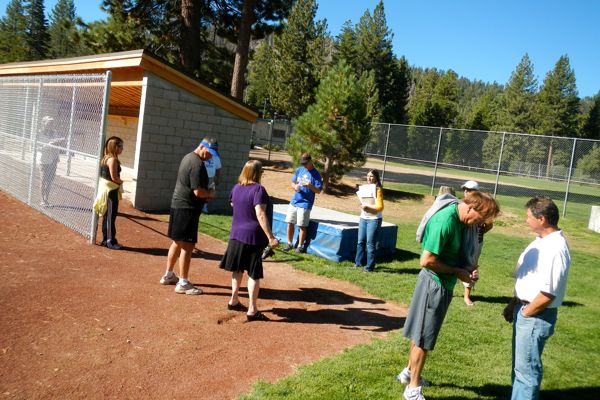
Consensus was found Sept. 13 about the STHS softball field by a diverse group. Photos/Kathryn Reed

While it may never evolve into what Kolesnik wants, movement came Thursday during a meeting where a diverse group assembled to find consensus. After two hours it was agreed by all in the room that the high school’s physical education program and athletic teams are what matters most when it comes to who uses that field and how it is used.

Also agreed to was erecting a 6- to 8-foot portable fence 200 feet into the outfield and that the staff restroom being built in the concession stand can be used by the public.

LTUSD Facilities Director Steve Morales, at the direction of the group, has been tasked with finding out what the cost of a second restroom, which could contain more than one toilet, would cost. He is also going to evaluate whether putting it next to the concession stand or inside by the restroom under construction or by the portables would be more feasible.

Softball, baseball and tennis have access to the restrooms in the newly built Student Union because they can be locked off from the main building. But there are those who believe walking 140 yards is too far during a game.

It was decided that incorporated into the rental of the field will be the price to erect and dismantle the fence. Mostly likely it will remain up for the high school team from the time snow melts to the third week of June. This will also allow for ASA to finish the spring season.

At the Sept. 13 meeting that was facilitated by STHS Principal Ivone Larson were Morales, Kolesnik, Don Borges (former athletic director at STHS and current PE instructor), Joann Allister (PE, former softball coach), Doug Russell (AD), Julie Cain (PE), Kevin Hennessee (PE), and Marilyn Breisacher (JPA fields committee, ASA softball).

They all signed the paper Larson was writing the agreement on so no one could say later that they disapproved.

Ball field improvements, who uses them and who pays for them has been the subject of much discussion since the South Shore (California side only) Measure R was approved a year ago that changed how Measure S funds could be distributed. Compromise, until Thursday, has been lacking.

Several factors have created the critical mass situation:

• Improvements to the high school softball field – including dugouts, backstop, concession stand, scorekeeper’s booth – were built without the athletic director or softball coach being asked to give input.

• The state Office of Civil Rights involvement because of Title IX equity issues. Those are legally supposed to be resolved this fall – at least a plan for equity is supposed to be completed.

• The Fields Advisory Committee of the South Lake Tahoe Recreation Facilities Joint Powers Authority plays a role because it will recommend to the JPA board how to spend $500,000 in taxpayer money. (This is the Measure R money.) The committee is meeting Monday to discuss funding, but the school district won’t have its request in by then.

• The LTUSD board at the Sept. 11 meeting tabled the item that originally called for $52,300 from Measure R dollars to pay for installation of a PA system, portable outfield fencing, concrete asphalt walkways, and walkway to Student Union. The board told those who spoke about the softball field to get together and come up with another recommendation in time for a special board meeting Sept. 25. (That is how the Sept. 13 meeting came about.)

More issues about the high school field remain outstanding – definitively where batting cages and bullpen go.

And there is no guarantee the fields committee will recommend to fund improvements at STHS or that the board that ultimately makes that decision will do so. The JPA board is slated to meet in January to distribute a portion of the money.

The Office of Civil Rights needs to sign off on plans as well.

——–

Things to know:

• The fields committee next meets Sept. 17 from 4-6pm at Lake Tahoe Airport.

• LTUSD board next meets Sept. 25 at 4pm at the district office.

ngg_shortcode_0_placeholder (Click on photos to enlarge.)