Asian clams winning at Lake George

By Brian Nearing, Times Union

LAKE GEORGE — Two years and $1.5 million later, efforts to rid the Queen of American Lakes of a harmful invasive clam seem to have failed. With fast-breeding Asian clams now spreading, the best hope is to keep their numbers in check — a costly fight that could last for years — and wait for a breakthrough eradication technique.

That was the grim assessment last week by the lake’s Asian Clam Rapid Response Task Force, a group of state, municipal, civic and environmental groups that has spearheaded work to eradicate clam beds by smothering them under weighted underwater mats.

The setback in the battle against the clams comes as the Lake George Park Commission, the state agency in charge of protecting the lake, also is racing to create a plan to reduce the risk of future aquatic invaders being brought in by recreational boaters, who likely transported the Asian clam from other infested water bodies in bilge water or bait wells. Widespread clam infestation in the lake could mean diminished tourism, business and property values. Clams have already caused some of those problems in Lake Tahoe, on the California-Nevada border, where beds now cover several hundred acres.

Thriving in sunlit, shallow, sandy lake bottoms, the tiny mollusks pose a major threat to the lake’s legendary gin-clear waters, which drive vibrant tourism, boating and recreational fishing industries.

Large clam colonies can foul beach waters because their excretions fuel massive algae blooms. Fast-breeding hermaphrodites, clams can quickly multiply into the millions and, when dead, wash up on beaches, where their razor-sharp shells make walking dangerous.

Read the whole story


Brown signs bill to keep state parks open for 2 years

By Patrick McGreevy, Los Angeles Times

SACRAMENTO — Gov. Jerry Brown signed legislation Tuesday setting a two-year moratorium on closing state parks in the wake of a scandal in which some parks officials hid surplus funds while facilities were threatened with being shuttered.

The legislation by Assemblyman Bob Blumenfield, D-Woodland Hills, was in response to the discovery in July that some parks officials had concealed about $54 million in unspent funds even as the governor was proposing to close 70 parks because of a budget shortfall.

“Rogue bureaucrats lied to all of us,” Blumenfield said Tuesday. “The governor acted swiftly and appropriately to remove them. Now, after signing this bill, we can move forward.”

The bill provides $10 million to match private donations to keep specific parks open, an additional $10 million to other parks at risk of closure, and a like amount to address maintenance needs that threatened to close some parks.

In addition, the state Park and Recreation Commission will get more money under AB1478 to oversee management of the Parks and Recreation Department to help ensure there are no more financial shenanigans.

The governor also signed a bill that requires the parks department to create a plan for increasing private revenue for state sites. It would allow Californians to apply a portion of their state tax refund to the parks in exchange for an annual park pass.

Assemblyman Jared Huffman, D-San Rafael, wrote the measure, AB1589, which also requires more accurate and transparent accounting for park system finances. The changes provide “a serious ‘reset’ to an agency that desperately needs it,” Huffman said.

Brown also signed another Huffman measure reshaping the state Department of Fish and Game to provide greater emphasis on conservation, including a change in its name to the Department of Fish and Wildlife.

The bill — which some Republicans opposed as an attempt to de-emphasize hunting — also provides for creating an environmental crimes task force to help prosecute crimes against wildlife, and authorizes the department to partner with nonprofit groups and accept funds for additional conservation programs. Brown signed AB 2402 “to improve the management of state fish and wildlife resources,” according to a statement by his office.

In all, the governor signed 49 bills Tuesday, including legislation protecting tenants in properties that wind up in foreclosure or default.

One measure allows a tenant holding a lease to keep possession of the rental unit until the lease expires. Assemblywoman Nancy Skinner, D-Berkeley, wrote that bill, AB2610. The governor also signed a bill requiring rental applicants to be given notice if a property owner is in default on the mortgage of a home before a lease is approved. Sen. Joe Simitian, D-Palo Alto, is the author of SB1191.


Ex-CHP officer arrested by El Dorado deputies

A former California Highway Patrol officer has been arrested in El Dorado County on stolen property charges.

During the past several weeks, El Dorado County sheriff’s detectives have been working numerous burglary investigations throughout the county involving stolen firearms.

Detectives on Sept. 26 searched a residence at 4500 Wendsan Lane in Placerville.

Deputies said former CHP Officer Michael Rupley was in possession of stolen firearms. He was booked into the El Dorado County Jail on charges of receiving stolen property.

— Lake Tahoe News staff report


Governor signs bill to fund quagga mussel inspection program

By Lisa Lien-Mager, Association of California Water Agencies

Gov. Jerry Brown has signed ACWA-sponsored legislation designed to combat the spread of invasive quagga mussels.

SB215, authored by Sen. Bob Huff, R-Diamond Bar, extends the sunset of the successful mussel inspection program led by the Department of Fish and Game and the Department of Food and Agriculture. Previously set to expire at the end of this year, the mussel inspection program was first created in 2007 to allow the state to conduct inspections of vehicles and water bodies and order quarantines of any infested water bodies. The law also authorizes the state to implement measures to prevent and eradicate infestations, including education.

Quagga mussels are an invasive nonnative species that breed very fast, have no known predators, and can quickly colonize new areas within California waters. Once they infest a water body, they cover piers, boat launches, and water intake facilities. There is no effective eradication method, and the cost to manually remove these mussels from water intake screens and pipes is millions of dollars per year for the state’s water system operators.

The state has created an ongoing prevention and education program to help keep these unwanted guests away, including a marketing campaign to get recreational boaters and others to pay attention to the hidden cargo that they may be carrying. The cost to run the program and inspections is estimated at close to $10 million total for both departments combined through the end of 2014.

Despite the price tag during a difficult budget year, the Legislature determined the short-term investment of special funds was worth the cost to help avoid a long-term serious infestation in state waters that could cost billions of dollars in damage and repair costs.

“We are pleased that Gov. Brown and the Legislature recognized the importance of continuing this aggressive program to combat the spread of invasive quagga mussels,” said ACWA Executive Director Timothy Quinn in a statement. “S 215 will ensure that the current and effective efforts continue uninterrupted.”


Brown OKs election-day voter registration for future contests

By Patrick McGreevy, Los Angeles Times

Californians will someday be able to register to vote on election day under legislation signed into law Monday by Gov. Jerry Brown.

Assemblyman Mike Feuer, D-Los Angele,) wrote the measure to increase voter participation in elections. The current law says voters must register at least 15 days before an election.

“Voting — the sacred right of every citizen — should be simple and convenient,” Brown said in a statement. “While other states try to restrict voters with new laws that burden the process, California allows voters to register online — and even on Election Day.”

The measure becomes law Jan. 1, 2013, but election-day voter registration will not begin until after the California secretary of state begins operating Vote-Cal, a much delayed statewide voter database, which will allow real-time verification of whether applicants are registered in other counties.

VoteCal is not expected to be up and running until 2015, said Nicole Winger, a spokeswoman for the secretary of state.

“This new law will help assure that all eligible Californians will have the chance to determine who speaks for them in Washington, Sacramento and their hometowns,” Feuer said in a statement Monday. “By recognizing the importance of increasing voter turnout in our state, we are improving the democratic process in California.”

The measure was opposed by many Republican lawmakers, including Assemblyman Tim Donnelly of San Bernardino, who felt the change, combined with a new online voter registration system, would lead to voter fraud. “A free and secure election system is the bedrock of a constitutional Republic,” Donnelly said. “Along with the new motor-voter process of registration, same-day registration and the new online registration system, our elections are becoming less and less secure.”

Brown’s signature will allow California to join 10 other states that allow some form of election-day registration, including Connecticut, Idaho, Minnesota and Wisconsin.


Ritz-Carlton drives Placer County economic needle up

By Susan Wood

TRUCKEE – After logging almost three years on the slopes of Northstar, the Ritz-Carlton, Lake Tahoe has shown how easy it is to mix business with pleasure.

That’s because some may say the only AAA five-diamond hotel in the Tahoe region has been good for guests, village retailers and even Placer County by contributing to local government coffers.

Per Placer County records, transient occupancy tax collected from the Ritz guests and about 500 other condo and single-family units in and around Northstar and Martis Valley (situated east of the mountain) almost tripled to $1.1 million from the quarter ending in December 2009 to the next that wrapped up March 31.

Ritz-Carlton, Lake Tahoe is helping Placer County's economy when it comes to hotel and sales taxes. Photos/Kathryn Reed

Of course, the winter season is always strongest. But more telling, tax revenue collected in that same quarter in 2011 at the height of the ski season went up yet again by almost $150,000. Granted, the ski resort had much help from Mother Nature, who provided a banner winter. Still, this is all despite a pesky recession that officially started two years before the resort opened in December 2009.

Sales tax figures almost doubled to $98,989 in the first quarter since the Ritz-Carlton came onto the Sierra Nevada scene. (This statistic also includes the primary retail sales hub of the Northstar Village.)

“(The hotel) has definitely had an impact on our business,” said Kelsey Tedrini, manager of Helly Hansen.

Tedrini said her Northstar Village store fields calls from the Ritz-Carlton concierge staff helping guests get “last minute things” like a pair of socks. In one instance, a staffer retrieved the item for the guest.

“It’s a snowball effect. At least it gets people in the store,” she said. “Of course, last year was a little slower, but I think it’s been best for business. It’s the Ritz Carlton. It’s totally professional.”

A hospitality business must use all its resources and advantages to get its share of the tourism dollar, which has seen more and more competition around the world (even with brands like the Ritz-Carlton recently expanding to opening its first hotel in Austria).

Income levels of the wealthy have gone up, making travel attainable. But a recession can make all markets more frugal.

With North Lake Tahoe occupancy rate percentages averaging in the mid-40s in 2012, according to Mountain Travel Research, some hoteliers have found it necessary to lower daily rates despite a decade of growth year after year. The average between 2011 and 2012 for the period ending in July went down 1.5 percent to $209 in North Lake Tahoe. By comparison, Ritz-Carlton rooms start at $239 per night for advance purchases on an October weekend and climb to $4,500 for the Sugar Pine Suite.

Hotels that offer more amenities and host or participate in more regional events that appeal to markets ranging from the recreational warrior to the supreme foodie will come out on top in the long haul.

“Certainly, over the last few years, all segments (of our business) have been impacted (with the recession), but we continue to be optimistic that we’ve turned the corner and travel has turned the corner,” Ritz-Carlton, Lake Tahoe Market Director Steven Holt told Lake Tahoe News on a recent meeting in the Ritz Destination Club lounge during the Lake Tahoe Autumn Food and Wine Festival.

Holt, who oversees the public relations for all Northern California properties of the global company, added Lake Tahoe’s efforts remain in making the resort more four-season by “connecting the lake” to the mountain between the hotel concierge staff and managers of activity and recreation outlets.

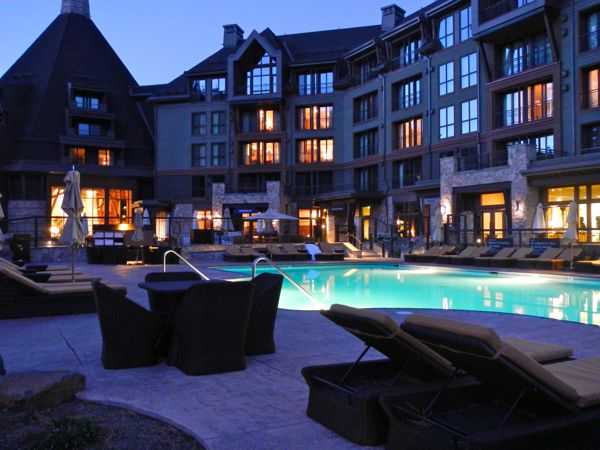
For example, guests lounging in any of the Ritz-Carlton’s plentiful seating areas in and out of the hotel are likely to catch hikers taking a jaunt across the mountain (some with their dogs because the hotel is pet friendly), or are alongside gnarly mountain bikers screaming straight down the slopes. Swimmers may take laps in one of the hotel’s three pools on the massive, split-level patio. Gym rats can enjoy a view of all this on one of the numerous exercise machines.

Windows are big on Tahoe’s Ritz-Carlton property – with 170 hotel rooms, 23 private residences and 25 Destination Club lodging facilities. The warm sun provides enough heat to three-quarters of the building, making it energy efficient enough to qualify as a first-level LEED-certified benefit. The $300 million resort hotel earned the prestigious distinction from the U.S. Green Business Council a year after it opened by recycling more than 16,000 tons of construction waste, installing treatment basins to capture stormwater runoff, putting in bicycle racks and lockers for employees and using the massive onsite boulders in its retaining wall that climbs up the mountain next to the new road. That effort – along with about two dozen others such as the mere building of a special gondola – showed the difficulty and resulting success of the project that took three years to build.

“It took a year and a half just to build the road,” Holt recalled.

But no one said living and staying in Tahoe is easy. The destination has its own distinct charm and character, as Holt pointed out in comparing the style to the Ritz hotel at Bachelor Gulch at Beaver Creek ski resort in Avon, Colo.

“We want to see the experience (of the hotel) be specific to the place. Here, California has its own style,” Holt said, as a few Club guests sauntered in and out of the special, fifth-floor room in their shorts and T-shirts for the breakfast buffet. Cookies were neatly stacked in drawers to munch on later in the day.

Guests of the Ritz-Carlton should not go hungry with the hotel’s eatery options and planned events. There’s even a rooftop garden created by Guest Relations Manager Mitch Penning, who plants a plethora of various vegetables including six types of lettuce and edible flowers that may be found all over the property, right down to floating in a cocktail glass.

“Culinary is extremely strong now,” Holt said, when asked what role food-oriented events play in spurring occupancy.

Nine specialty events in September were scheduled. They range in taste from Pints and Pies at the Manzanita fine-dining restaurant where James Beard Award-winning chef Traci Des Jardins provides her magic touch. “Beer and a Burger” is offered at the casual MountainBlue café. Master cooking classes are slated there on the weekends. “The Art of the Cocktail” educates the amateur libation maker in the Living Room. This dining offering is just like that – where falling asleep in one of cushy chairs or chaise lounges at the pool would be understandable in a land that brings new meaning to relaxing and rejuvenating.

(Note: From the Living Room menu, ordering the roasted vegetable wrap at the pool hits the spot.)

If you’re into s’mores for dessert, there’s a fire pit calling your name on the expansive patio area.

“This is awesome,” said one woman as she discovered the lower-level hot tub and fire pit. The small hidden cove is inviting enough after soaking in the tub to lounge in a robe and sandals in front of the fire while listening to the slopeside night sounds.

If that type of lounging isn’t enough for utter relaxation, a 17,000-square-foot spa serves up a full page of treatments and services – including an herbal milk bath and massage running $185 for 50 minutes. Every little whim of the guest is considered.

A testament to finishing touches at the luxury resort, even the artwork in the rooms and in the common areas adds to the experience of the place. For instance, a trio of paintings featuring pup tents in one of the hallways makes one feel at home in the Sierra Nevada.

Albeit modern, the rooms offer a mountain motif décor, with a full set of bathroom and hall closet supplies to answer the occasional whims of the guests. (Note: One thing missing – an electrical outlet at the desk.)

Around the property, water dispensers keep guests hydrated during warm days – especially for the multitude of guests who come up from the flatlands of Sacramento and the San Francisco Bay Area and need to acclimate.

Then, there’s the staff – who make courteous customer service such a mantra that one forgets being in the Lake Tahoe region. It must be due to how the hotel chain starts its days. Holt claims that the 45,000-plus people who work for the chain share in a half-hour session designed to point out “service stories” highlighting where staff members went out of their way to help a guest.

“The high quality and elevated level of service the Ritz-Carlton is known for delivering to its guests makes it a good match for Northstar,” said Jessica VanPernis, spokeswoman for Northstar. She mentioned that since Vail bought the ski resort two years ago the hotelier makes a good fit for the ski resort giant.

Northstar has long evolved into a destination village with various lodging options most notably through East West Partners condo projects. They include: the Northstar Lodge – a Hyatt timeshare; Tahoe Mountain Resorts and One Village Place – both ownership properties that may go into a rental pool.

The hotel provides an elegant, non-ownership place for guests to take part in the Tahoe, California lifestyle.

—-

Details:

Directions: From South Lake Tahoe, take Highway 50 east. Take Highway 28 at the top of Spooner Summit. Turn right onto Highway 267 in Kings Beach. Turn left onto Highlands View Road. (This is the street before the main entrance for Northstar.) Wind around until you see the hotel on your left.

Phone: (530) 562.3000

Website

ngg_shortcode_0_placeholder (Click on photos to enlarge.)


Vail Resorts income drops, season pass sales rise

By Beth Potter, Boulder County Business Report

BROOMFIELD, Colo. – Vail Resorts Inc. reported income of $16.5 million for its fiscal year, and ski pass sales are up for the coming ski season, according to an earnings statement released Sept. 25.

Broomfield-based Vail Resorts said income fell from $34.5 million for the previous fiscal year.

Revenue revenue was $1.02 billion for fiscal 2012 compared with $1.17 million for fiscal 2011, a 12.2 percent decrease.

The company’s subsidiaries operate Vail, Beaver Creek, Breckenridge and Keystone ski areas in Colorado and Heavenly, Northstar and Kirkwood ski areas in the Lake Tahoe area.

Unseasonably warm weather during the 2011-12 ski season kept skiers away from the mountains. Skier visits were down to 6.1 million from 7 million at the resorts in 2010-11, according to Vail Resorts.

“I am very proud of our results, given that the 2011-2012 ski season was the most challenging winter in the history of the United States ski industry,” Rob Katz, Vail Resorts’ chief executive, said in a press statement.

“The strength of our growing season pass business and the comprehensive and differentiated experience we provide at our resorts stabilized our revenues in the face of very challenging weather, Katz said.

About 178,000 season ski passes have been sold for the upcoming 2012-13 season, an increase of 17 percent from the same time last year, Katz said in the press statement. Season pass calculations were adjusted as if the Kirkwood ski area were owned in both periods, according to the press statement.

Company subsidiary RockResorts operates hotel properties around the world. Vail Resorts Development Co. is the company’s real estate arm.


Truckee resident in jail on pot cultivation charges

A Truckee resident was arrested for allegedly growing marijuana at his residence in his in the Glenshire subdivision on Saxon Way.

On the morning of Sept. 20, officers searched the house. They said they found, “The entire interior of the three-bedroom house had been converted into a marijuana growing operation.”

About 40 marijuana plants were in various stages of development and about half that many were ready for harvest, officers said.

Arrested at the scene on charges of illegal cultivation of marijuana was Michael Morrow, 25, of Truckee. Morrow was also on felony probation out of Placer County for a previous conviction of illegal marijuana cultivation, and he was also charged with violation of probation.

 — Lake Tahoe News staff report


Sand Harbor bus shuttle will return for second summer

By AP

INCLINE VILLAGE — The new shuttle bus system at Lake Tahoe’s Sand Harbor State Park has been declared a success and is coming back again next summer, albeit with a possible tweak or two to better target peak demand.

Ridership totaled 12,155 on the East Shore Express during 81 days of operation between the park and nearby Incline Village, the Tahoe Transportation District said.

Daily ridership averaged 150 for the season, from June 15 through Labor Day weekend. June was the slowest, with big spikes later for weekends and holidays – the biggest on July 3 with 1,430 riders.

Running daily in 20-minute intervals from 9am to 6pm, the shuttle is part of an effort to help slow erosion around the lake, ease congestion and improve safety along Highway 28.

The roundtrip tickets including park entry fee cost $3 for adults, $1.50 for children.

Jay Howard, park supervisor of Lake Tahoe Nevada State Park, which includes Sand Harbor, said the shuttle has “vastly” improved safety on the highway, especially for bicyclists and pedestrians.

Along with the new shuttle service came a prohibition on summer walk-up visitors, a move designed to keep pedestrian flow off the roadway hugging the lake’s shore.


Lake Tahoe motorcyclist dies near Northstar

By Barbara Barte Osborn, Sacramento Bee

TRUCKEE — A 56-year-old Lake Tahoe man died Saturday after his motorcycle struck a pickup driven by a Citrus Heights man on Highway 267.

Mark C. Steffy of Crystal Bay died from injuries sustained when he was ejected from his motorcycle, according to the California Highway Patrol report. He was pronounced dead at the scene of the accident by Northstar fire personnel.

The accident occurred at 8:41am Sept. 22 south of Mt. Watson Road on Highway 267, the road between Kings Beach and Truckee.

According to the report, Steffy was traveling northbound behind a pickup driven by Brian M. Brodsky, 30, of Citrus Heights, when they encountered slow-moving traffic.

As Steffy began to pass over solid double yellow lines, traveling northbound in the southbound lanes, Brodsky began to turn left into the Tahoe Rim Trail parking area, the report said.

The motorcycle collided with the pickup’s driver-side door, causing Steffy to be ejected.

Brodsky received minor injuries, “cuts and scratches,” the report said.

The Highway Patrol is investigating the accident.