Hospitals less safe than most people think

By Marty Makary, Newsweek

When I was a medical student, modern medicine began to seem as dangerous and dishonest as it was miraculous and precise. The defining moment came when I saw a sweet old lady I cared about die after a procedure she didn’t need and didn’t want.

I had been assigned to follow Ms. Banks, whose scans revealed advanced ovarian cancer. Despite the poor prognosis, the conventional treatment is major surgery to remove the uterus, cervix, fallopian tubes, and ovaries. But I got to know Ms. Banks, and she told me that she just wanted to spend time with her family and do a few more things before she died. I explained to her that she could be passing up a potential, albeit unlikely, cure; then at the morning staff meeting I tried to communicate her wishes to forgo both a biopsy and treatment. I was shredded up, down, and sideways.

The drive for the doctors to do a biopsy was like a train no one could stop. Eventually, by overstating the benefits and understating the risks, the doctors convinced Ms. Banks to undergo the biopsy to confirm her diagnosis. Then, during the procedure, the biopsy needle accidentally punctured a major blood vessel, which resulted in an added six-week stay in the hospital, marked by blood transfusions, multiple CAT scans, and malnutrition, since most of the time she was not able to eat. Those six hellish weeks turned out to be six of her last nine on earth. Despite the apparent problems with her care, information about her preventable complication and prolonged hospitalization were never presented in our staff meeting or reviewed internally in the same way that other industries learn from their bad outcomes. I realized that hospitals did not have to disclose their outcomes to anyone, even when they were much worse than the national average. In fact, when I explained to the head attending surgeon what happened and recounted Ms. Banks’s objections to the biopsy, I was told that sometimes patients don’t know what they want and we need to decide for them.

A host of new studies examining the current state of health care indicates that approximately one in every five medications, tests, and procedures is likely unnecessary. What other industry misses the mark that often? Others put that number even higher. Harvey Fineberg, M.D., president of the Institute of Medicine and former dean of the Harvard School of Public Health, has said that between 30 percent and 40 percent of our entire health-care expenditure is paying for fraud and unnecessary treatment. While patients are encouraged to think that the health-care system is competent and wise, it’s actually more like the Wild West. The shocking truth is that some prestigious hospitals participating in a national collaborative to measure surgical complications have four to five times more complications as other hospitals. And even within good hospitals, there are pockets of poorly performing services.

A new generation of doctors has been developing fair and simple ways to measure how well patients do at individual hospitals. In hospital-speak, we call the information “sensitive data”—data that would tell you which hospitals have much worse outcomes than others.

It’s the kind of data that, if you had access to it, would help you know just where to find the best care. But you don’t. And that is precisely the problem with the entire system: because a hospital’s outcomes are hidden from the public, neither consumers nor payers have any way of measuring whether the medicine they provide is good, adequate, or even safe. Much as the financial crisis was incubated when bank executives turned a blind eye to the ugly details about their mortgage-backed securities, so too does medicine’s lack of accountability create an institutional culture that results in overtreatment, increased risk, and runaway costs.

Politicians debate different ways to pay for our broken system. But if we are going to get serious about reducing health-care costs—and improving health-care outcomes—we need to address the 20 percent of medical care that is unnecessary and dangerous. The public should demand disclosure of a hospital’s patient-outcome statistics. After all, we have information on a car’s safety record to inform our decision about which car to buy. But when it comes to choosing medical care, the consumer is left to walk in blind. While we currently have a free market for health care, the competition is at the wrong level. Many patients tell me they choose their medical care based on parking. For an industry that represents one sixth of the U.S. economy, we can do better than that.

Read the whole story


Court: Red Hawk Casino receiving excessive amount of water

By Denny Walsh, Sacramento Bee

The El Dorado Irrigation District is supplying an unlawfully excessive amount of water to the Red Hawk Casino in El Dorado County, a state appeals court ruled Thursday.

The district based its 2008 agreement to supply 95 gallons of water per minute to the casino’s owner, the Shingle Springs Band of Miwok Indians, on two legally flawed premises, a three-justice panel declared in a 36-page published opinion.

A residents’ group, Voices for Rural Living, challenged the agreement.

Thursday’s opinion affirms an earlier ruling by El Dorado Superior Court Judge Kenneth J. Melikian, except for the remedy. The judge exceeded his authority in directing the district to prepare an environmental impact report in compliance with the California Environmental Quality Act, the panel said.

“How an agency complies with CEQA is a matter first left to the agency’s discretion,” the justices said. “We thus will reverse (Melikian), but only on this point to allow (him) to set aside EID’s decision and remand the matter to EID for further consideration.”

The irrigation district claimed the memorandum of understanding between it and the tribe did not require an environmental review because it fell under a CEQA exemption for small construction projects.

The district and the tribe relied on the fact that the only necessary physical adjustments were relocating a meter and installing pipeline linking it to a water main.

But the appellate panel found that selling that much water to the tribe carries environmental risks apparently not considered by EID officials.

The project’s scope – providing an amount equal to 216 additional residences – “obviously is a fact that distinguishes (it) from the type of projects contemplated by the exemption,” the panel said.

“EID apparently did not give any consideration to (the) possibility of additional shortages of water during a drought due to climate change when it determined how much of its supply was unallocated and available for use. Its analysis was based simply on past historical use and supply. It thus ignored evidence in the record suggesting it already lacked sufficient water to meet its expected demand during a drought, even when it delivers the reduced levels of water it plans to deliver.”

The opinion was authored by Associate Justice George Nicholson, with Acting Presiding Justice Cole Blease and Associate Justice Elena J. Duarte concurring.

They were equally unforgiving about the irrigation district’s conclusion that restrictions imposed in 1989 by the El Dorado County Local Agency Formation Commission on how much water could be sold to the tribe are unconstitutional.

The tribe and EID entered into an annexation agreement, subject to LAFCO approval, that brought the tribe’s 160-acre parcel along Highway 50 between Shingle Springs and Placerville into the district’s service area.

LAFCO authorized water only for residential and related uses, and only in an amount necessary to serve no more than 40 residential lots.

The appellate justices noted the Legislature has vested area LAFCOs “with the sole and exclusive authority to approve annexations of territory into special districts. This authority includes the power to impose conditions of approval on an annexation.”

California law makes these conditions enforceable and a public agency “has no discretion to disregard them,” the justices said.

They also included a reminder for EID: What is and is not constitutional are issues “to be resolved by the judiciary.”


Highway 28 plan — safe road for drivers, recreationists

By Anne Knowles

CARSON CITY – A dozen Nevada and federal agencies are developing a plan they say will make the East Shore of Lake Tahoe a safer and more accessible recreational destination for motorists, cyclists and pedestrians alike.

The plan covers about 13 miles of Highway 28, from Incline Village to Spooner Lake, and is an update to the 2000 corridor management plan for the area.

A 2- to 3-mile stretch from Crystal Bay already is being undertaken locally by Washoe County and will include a separated bikeway, new signage, traffic calming and enhanced line of site at intersections.

Improvements are already happening on Highway 28, like the roundabout put in this season at the base of Mount Rose Highway. Photo/LTN

The agencies are relying on local efforts like the Crystal Bay plan and other studies, and then working to fill in the gaps, according to Derek Kirkland, capital program specialist with the Tahoe Transportation District in Stateline, one of the participating agencies.

“One of the thoughts being considered in the plan is to relocate the unsafe shoulder parking to various off-highway locations within the corridor and provide more convenient access to popular recreational destinations,” Kirkland said, “and create multi-modal connections through shared use paths separated from the highway as well as transit service for the entire corridor.”

The Highway 28 plan could end up including transportation service from as far away as Reno as well as new parking lots, hiking and biking trails and road improvements such as new signage and guard rails to boost safety, improve lake clarity and attract new visitors.

The agencies are seeking public comment on the project during four public meetings. Three meetings – in south Reno, at UNR and in Carson City – were this past week and the final meeting, at The Chateau in Incline Village, is scheduled Oct. 9 from 5-7:30pm.

Three of the four meetings were outside the basin because the majority of the visitors to the corridor are from Reno, as well as Carson City and Carson Valley, Kirkland said.

There is also a website to post suggestions and ideas through Oct. 29. At the website, people can type comments on virtual sticky notes and attach the notes anywhere on a map of the area. Visitors can also read and “like” comments left by others.

The effort started last year with the launch of the East Shore Express bus service between Incline Village and Sand Harbor State Park, which was designed to reduce car traffic and parking along the highway during the busy summer season.

The service, which had 12,000 rides between June 15 and Sept. 3, resulted in about 162 fewer cars parked along the shoulder of Highway 28 on peak summer days, according to the TTD, which used LSC Transportation Consultants to count cars during busy days in August.

Kirkland said the goal is to extend the bus service to Spooner Lake. To fund that, service on Monday and Tuesday may be reduced in the future to free up the limited money. Currently, two buses run every 20 minutes from 9am to 6pm between Incline Village and Sand Harbor during the summer. The service is funded by grants from the U.S. Forest Service and the Nevada Department of Transportation as well as fares, which are $3 for adults and $1.50 for children.

Bike trails from Lake Shore Boulevard to Sand Harbor are also being studied and will soon undergo environmental review with construction slated for 2014. Loomis Engineering in Carson City is designing the trail and a draft document for public comment should be available this winter or spring, said Nanette Hansel, senior environmental planner with Ascent Environmental in Stateline.

The trail, designated for now as the North Demonstration Project, would be part of the Stateline-to-Stateline bike trail. The first mile of the South Demonstration Project, from Kahle Drive to Elks Point Road, is expected to be completed this month and the next portion, from Elks Point to Round Hills Pine Beach, will begin next summer.

Kirkland said they are also talking to the Mt. Rose ski resort about using its parking lot in the summer and providing transportation from there to the corridor.

“Students (at UNR) want a bus from Reno to the lake,” he said.

For the future, the agencies are considering adding parking lots along the Highway 28 route to reduce shoulder parking, adding trailheads to make it easier to access beaches, more bike trails, and signage and guard trails both for safety and aesthetics.

“One option is getting rid of all shoulder parking with new parking lots,” Kirkland said. “Not taking away parking but relocating it.”

Shoulder parking, said Kirkland, contributes to road erosion and poses dangers to drivers, bike riders and walkers alike.

But it will be close to impossible to find land to build parking lots, said North Swanson, a resident of Cave Rock who attended the Carson City public meeting on Oct. 4.

“It’s steeper than heck on both sides,” said Swanson. “Frankly, our concern is they will take away our parking. We’ve fought the battle for parking for 25 years.”

Swanson is a coordinator for Tahoe Area Naturists and appealed a USFS plan to enlarge its lots that he said would have reduced parking from 500 spots on the highway shoulder to 50 parking lot spaces.

Shelly Aldean, a Carson City supervisor who also attended the meeting, said she was in favor of plans that cut down on car traffic and its ill environmental effect.

“Anything that reduces congestion, idling time and removes people from the shoulders,” Aldean said. “We need a multifaceted approach.”

This Highway 28 diagram outlines some of the plans.


Gaming officials believe industry is growing

By Richard N. Velotta, Las Vegas Sun

Representatives of six gaming companies are optimistic about what the future holds for the industry with expansion and technological advancements leading growth in the next five years.

While executives aren’t predicting any major resort openings on the horizon, they are enthusiastic about the potential for new venues internationally and using technology to more effectively market to younger players.

Most of the panelists also view the legalization of Internet poker as a potential driver for more customers in their brick-and-mortar casinos.

Comments were made Wednesday at the third day of the four-day Global Gaming Expo at the Venetian. Representatives of Las Vegas companies MGM Resorts International, Las Vegas Sands and Bally Technologies were among the speakers addressing a broad range of topics on the state of the industry.

Patti Hart, CEO of gaming equipment manufacturer International Game Technology, said she’s optimistic about growth because gaming is expected to spread throughout Asia after the successes of Macau and Singapore. She said her company also is continuing efforts to personalize casino experiences with software programs that provide more interactivity between casinos and their customers to appeal to a market of young players comfortable with the portable computer devices they use.

Michael Leven, president and chief operating officer of Las Vegas Sands, and Jim Murren, CEO of MGM Resorts International, said a number of Asian countries — Vietnam, Cambodia, Thailand, Taiwan, South Korea and Japan — are considering casino-centered integrated resorts after seeing how well operations in Macau and Singapore have performed. Sands and MGM have resorts in Macau, Sands is the market leader in Singapore and MGM is building a nongaming resort in Vietnam and is exploring prospects in the Canadian province of Ontario. Sands also has focused attention on a Las Vegas-style resort in Spain.

Panelists expect the legalization of Internet poker in the United States would lead to expansion of gaming in land-based casinos in the same way that the expansion of gaming in other states and on Indian reservations ultimately led to growth for Las Vegas.

Leven added, however, that his boss, Sands CEO Sheldon Adelson, opposes the legalization of Internet poker because he fears the inability to control underage gambling and because the investment necessary to get enough online customers to make a venture lucrative would diminish its profitability.

“There are three concerns with online gaming which we as a company have studied in-depth,” Leven said. “One is the profitability of it when there are so many people in line. Today, there are a few people in the market nationally that make a lot of money. We believe that when everybody gets in that the cost of acquisition of customers in the online gaming marketplace will go up dramatically so profitability is going to go down. So it’s not going to be a free lunch for everybody where everybody wins.

“Secondly, we believe there is some danger particularly with at the college-student level and with young adults where potentially we can’t control the irresponsibility of their gaming. I think Sheldon has been outspoken about it, but he has not, to my knowledge, talked with any senator or anybody in government about how to vote on the issue. He has just vocalized that he is worried about that particular control problem.

“The third issue is simply a matter of wealth distribution,” he said. “How much money is available in the market? Will it affect Las Vegas casinos? We don’t really think so. But will it affect some of the Indian casinos or casinos in some of the smaller markets? We think it will have some impact because some of the money will not be available to be played in those markets.”

Leven also said the industry’s desire for federal oversight in online poker could also lead to more government intrusion and lower profits because the federal government tends to build bureaucracies when developing regulatory agencies.


Ex-employees sue disability attorney

By Anne Gonzales, Sacramento Bee

A prominent Carmichael quadriplegic attorney who sues small businesses for disability access violations has been sued by employees alleging wrongful termination, sexual harassment and a hostile work environment.

The four female workers say they were hired as legal assistants but were first “forced to go through personal care training,” including taking off their boss’s underwear and putting on his swim trunks, according to the suit filed in Sacramento Superior Court in August.

Calls to attorney Scott Johnson’s office for comment were not answered.

Johnson has been in Lake Tahoe for several years suing small businesses who are out of ADA compliance.

The employees, who worked for the law office operated out of Johnson’s Carmichael home, also were uncomfortable with some of Johnson’s business practices in gathering evidence for lawsuits and his payments to students to sign declarations, according to the suit.

The workers were trained to care for their boss in case a personal attendant was not present. During the training, they helped Johnson out of bed, undressed him, put on his swimsuit, carried him to a hot tub, then removed him from the tub, took off his wet trunks, dried him off and rubbed lotion on him before dressing him, the suit says.

The plaintiffs also claimed that Johnson aimed cameras on them in the office, including one trained on an employee’s breasts, and placed a camera in the restroom, keeping tabs on them through a 72-inch screen TV in his upstairs bedroom and a mobile application on his cellphone.

The plaintiffs – Jenna Doeuk, Esra Jones, Monthica Kem and Micaela Lucas – say they lost their jobs Aug. 9, after protesting the working conditions. They seek economic, general and punitive damages, along with court costs and attorney’s fees.

The plaintiffs worked for Johnson at his firm, Disabled Access, for anywhere from one to five years.

The suit alleges the workers were forced to go into businesses to see if they were in violation of the Americans with Disabilities Act. Johnson has built a legal career around threatening to sue hundreds of businesses for noncompliance with the ADA, typically settling for undisclosed amounts after fixes or upgrades were made.

In a recent local case, Ford’s Real Hamburgers in Sacramento closed last weekend, citing a slowdown in business and a Johnson suit over alleged ADA violations.

The plaintiffs said they felt like they were “committing fraud” by visiting businesses “under the ruse” of seeking the businesses’ goods or services. They also used restrooms to check for violations, sometimes while Johnson waited outside in his van.

They claimed Johnson would sometimes merely drive by businesses that were potential lawsuit targets. He also would find disabled students in housing complexes he was interested in suing, the lawsuit alleges, and paid up to $150 month toward their rent. In one instance, he asked a student to sign a declaration of some kind.

The employees also complained that Johnson made sexual comments, stared at their breasts and buttocks, asked them about their bathroom habits, displayed racy calendars, required them to help him change his dress shirts and made them do his son’s homework.


Brothers plead guilty to poaching pregnant deer in Douglas County

By AP

Two Nevada brothers have pleaded guilty to poaching a pregnant deer near their home in Douglas County.

Nevada Department of Wildlife Game Warden Rob Buonamici says the mule deer was pregnant with twins when Gonzalo Cossio and Jesus Cossio-Pitones illegally shot the animal near Holbrook Junction in March.

He says they harvested, gutted and cleaned the animal before a citizen saw them disposing of the carcass and alerted authorities.

Cossio has been sentenced to 90 days in jail. His brother, Cossio-Pitones, had to forfeit the weapon used to kill the deer. He’s also prohibited from possessing a firearm, or purchasing any hunting license or tag.


California gas prices increase substantially

By Ronald D. White and Dalina Castellanos, Los Angeles Times

Skyrocketing gasoline prices caused some local service stations to shut off their pumps Thursday while others shocked customers with overnight price increases of 30 cents or more.

California’s fuel industry isn’t running out of gasoline — supplies are only 2.5 percent lower than this time last year — but recent refinery and pipeline mishaps sent wholesale prices to all-time highs this week. As a result, some station owners weren’t buying fuel for fear they couldn’t sell it. Those who did buy simply kicked prices higher and bet customers would understand.

“If this keeps up, I’ll be looking at $5-a-gallon gas by next Thursday,” said Ali Mazarei, who owns an Arco station in Riverside County. On Thursday, Mazarei was charging $4.52 for a gallon of regular gasoline, up from $4.27 on Wednesday and $4.21 on Tuesday.

“I really don’t have any choice here, and I won’t be making money at $4.52 a gallon,” he said.

Some fuel stops had already crossed the $5 threshold.

On Thursday afternoon, the Low-P station in Calabasas was selling regular gasoline for $5.69 a gallon in cash, or $5.79 for credit card purchases. In addition to the high prices, the pumps displayed hand-lettered signs reading: “We are sorry, it is not our fault.”

The station, whose name is short for “low price,” is usually full of drivers attracted by the high-profile location at Calabasas Road and Parkway Calabasas, right off the 101 Freeway. But customers thinned out as prices soared.

Low-P has to pay more “because we’re an independent gas station” that lacks the buying power of its big-brand counterparts, said owner John Rabi, who paid $40,000 for a 9,000-gallon load that day, up from $32,000 a few days before.

Some drivers didn’t pick up on the price right away.

“Holy shoot! I didn’t notice that earlier,” Aaron Belcher, 38, said as he ripped his Visa card from the reader. “This is ridiculous.”

Tiffany Lemme, who spent $50.29 on less than nine gallons, said she was shocked on a recent trip to Miami when she paid $5.30 a gallon.

“I thought that was crazy, but this is insane,” the 31-year-old Woodland Hills resident said.

Many stations closed their pumps as soon as they ran out of the fuel they’d bought more cheaply. Some owners worried that if they paid the current wholesale price, they would be stuck selling that gas at a loss when prices fell.

Several Costco gas stations, including those in Marina del Rey, Tustin and Inglewood, closed Thursday. A manager in Inglewood said the only nearby Costco outlets that hadn’t run out of gas were in Hawthorne and Torrance.

A sign at one Costco apologized: “We do not know when we will be resupplied.”

On Thursday, the wholesale price of California gasoline hit a record-setting $4.39 a gallon, said Tom Kloza, chief oil analyst for the Oil Price Information Service in New Jersey. The wholesale price surpassed even the retail price: California filling stations were charging $4.315 on average Thursday, according to AAA’s daily survey. That was up more than 8 cents from Wednesday.

Analysts attributed the increase to mishaps that have befallen some of the state’s 14 refineries, which operate with little margin for error because few facilities outside California make the state’s cleaner-burning gasoline.

“Most recently there has been a problem with an oil pipeline that supplies gasoline for Tesoro, Valero and Shell stations,” said Patrick DeHaan, senior petroleum analyst for GasBuddy.com, a price-tracking website. A power outage Monday forced the temporary shutdown of Exxon Mobil’s Torrance refinery, DeHaan said. The August fire at Chevron Corp.’s Richmond refinery was also cited.

Kloza added that there was an element of panic in the run-up in wholesale prices, with buyers fearing more refinery problems.

“There is a sense out there that this might not just be the typical run of bad timing and bad luck in terms of refinery outages,” Kloza said. “People are beginning to wonder whether something else might be involved. Has the heat been a factor? Is the electrical grid holding up? Are these refineries just a little too old?”

How long will the high prices last? That depends on whether more problems occur, fuel price expert Bob van der Valk said.

A form of relief might come if the state’s refineries are allowed to switch to the cheaper winter blend of gasoline in the next few days rather than having to wait until the end of October, he said.

“The California Energy Commission received a request for that from the California Independent Oil Marketers Assn.,” Van der Valk said. “However, Southern California is currently enduring a heat wave, and air quality will be given primary consideration before any final decision is made.”

The summer blend is designed to reduce evaporation of pollutants during warm weather.


S. Tahoe arson suspect turns himself in

A South Lake Tahoe resident was arrested late Thursday on aggravated arson and burglary charges.

Police officers say Eric Almdale, who lives in a trailer at 885 James Ave., admitted to starting the blaze on Oct. 4 at 11:18pm. Officers in a press release said, “(Almdale was) distraught over family matters and matters concerning the owner of the trailer.”

Geraldine McClure lives in the same unit. According to police, heavy smoke in the residence woke her up. Initially she did not know if her roommate, Almdale, was still inside. Police searched the trailer after the fire was out and no one else was there.

Not much later Almdale allegedly called 911 to turn himself in.

Almdale was being held on $1.05 million bail.

— Lake Tahoe News staff report


Embassy Suites in South Tahoe on the auction block

By Kathryn Reed

Embassy Suites South Lake Tahoe may not exist after Oct. 24.

That is the date a trustee sale is scheduled in Placerville.

Lake Tahoe News first reported in July about how the property near the state line is in financial trouble. It is directly across from the would-be convention center.

Embassy Suites South Lake Tahoe has a troubled past and present. Photo/LTN file

Max Saito with Ken Corp., the Japanese company that owns the parcel, did not return multiple phone calls.

Dominic Acolino, general manager of Embassy Suites, did not return multiple phone calls either. Embassy is a subsidiary of Hilton Hotels.

The building, fixtures even the plants are for sale. It is possible that if someone buys the property, that it could continue to operate as is. It is also possible the note could be paid and the auction never takes place. It’s also possible the doors will close.

City Manager Nancy Kerry said the hotel is still paying its transient occupancy tax. This hotel generates the largest percentage of hotel tax on an annual basis of all South Shore properties.

El Dorado County Auditor Joe Harn said Embassy is up-to-date on paying its property taxes.


‘Secret’ convention center deal may cost S. Tahoe $1.8 mil.

By Kathryn Reed

South Lake Tahoe officials have always claimed there is no city money involved in the failed convention center project. Depending on the outcome of a lawsuit in El Dorado County Superior Court, that statement could prove to be wrong to the tune of approximately $1.8 million.

This is because on March 9, 2007, then City Manager Dave Jinkens along with the city’s outside redevelopment attorney, Stacey Sheston, signed an indemnity agreement that puts the defunct Redevelopment Agency, which is now the city because it’s the successor agency to the Redevelopment Agency – on the hook for this amount. The original indemnity was for $3 million, but the difference involved two other properties that are not part of this lawsuit.
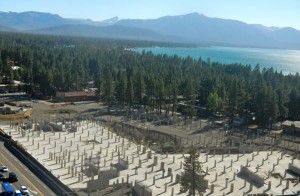
Concrete and rebar -- it's what South Lake Tahoe locals call The Hole. Photo/LTN

Jinkens was acting as executive director of the South Tahoe Redevelopment Agency at the time he signed the document. He wore two hats, as did councilmembers – they were the City Council and the board of directors for the Redevelopment Agency.

The agreement protected Placer Title Company and Stewart Title Company on loans of more than $3 million that were brokered by Z Loan & Investment and Lake Tahoe Development Company that involved three assessor’s parcels numbers.

Z Loan is considered a hard-money lender. A hard-money lender provides a “bridge loan” and is usually used when traditional financing cannot be secured. This is what Randy Lane and John Serpa, who ran Lake Tahoe Development Company, were in need of to acquire all of the property to build what was supposed to be a more than $400 million hotel-convention center project on the eastern edge of South Lake Tahoe at the state line.

Lane told Lake Tahoe News the need for this type of lender was necessary because traditional financing wasn’t possible because of what he intended to do with the property – acquire buildings and tear them down.

“A lot of [traditional loan] agreements say you won’t do anything that adversely affects their collateral,” Lane explained.

In addition to needing money to buy the properties, Lane was borrowing against the properties before he owned them.

“For the city to say that it never had any financial exposure on the project is just untrue,” attorney David Becker told Lake Tahoe News.

Bankruptcy has since left the more than 11-acre site a pile of rebar and concrete whose integrity is in question after years of exposure to the elements, with not all of the 19 parcels foreclosed on, and Owens Financial – who has the most money on the table – proposing retail along Highway 50 and nothing behind it.

According to Julie Regan at the Tahoe Regional Planning Agency, “The convention center permit has an approved construction schedule which is valid at least through October 2016.”

Pending lawsuit

The lawsuit that could saddle South Lake Tahoe with the $1.8 million bill involves Harry Segal and Janice Halpern-Segal suing Fidelity National Title Company.

“The Segal family is suing to prove that Randy Lane’s loan should not have been made against their property before the Segals actually sold their property to Mr. Lane. The lender (Z Loan) made their loan to Randy Lane six months prior to the Segals agreeing to sell their property to Mr. Lane,” David Becker, the Segals’ attorney, told Lake Tahoe News.

Becker was not their attorney at the time they were selling their property.

The Segals carried the paper for the sale to Lane. However, Lane and the title companies contend the Z Loan lien takes priority over the Segal lien, even though Lane did not own the property he pledged as security.

“The artificial title, made possible by the city’s indemnity, created a false appearance that Mr. Lane owned the title. Had the city properly publicized the back-door deals, somebody may have caught how risky it was for the Segals to sell their property to Mr. Lane,” Becker said.

This was at a time when Jenny Lane, Randy Lane’s daughter, worked for Stewart Title.

Dina Reed (no relation to this reporter) was Jenny Lane’s assistant when this was taking place. She is now manager of the Stateline branch of Stewart Title. She says there is nothing illegal or unethical about a client’s daughter working on her dad’s paperwork, and that multiple eyes would be on the documents.

Reed said indemnity agreements like this occur with any type of construction deals, even for a residential house.

Debbie Landerkin, manager of Placer Title, deferred all comments to her legal counsel.

Jody in Placer Title’s legal department wouldn’t provide her last name. She was more curious about how LTN obtained the document than answering questions.

“That document would not be something I could discuss with you because it is not a public document,” Jody said.

Landerkin’s signature is on supplemental joint escrow instructions involving the Segal property. So are Jinkens and Lane’s. That was signed two days prior to the indemnity agreement being signed. At that time Landerkin was dating Bruce Budman who was South Lake Tahoe’s finance director.

The city could have indemnified itself and had Lake Tahoe Development Company take the risk instead of potentially jeopardizing taxpayer money – as might be the case depending on the outcome of the lawsuit.

“Everything that could go wrong in the Segal-Lane transaction did go wrong. And it all started with the city’s indemnity,” Becker said.

South Lake Tahoe City Attorney Patrick Enright told Lake Tahoe News, “If there was a judgment against the agency, it would be a liability of the South Tahoe Redevelopment Successor Agency, not the city of South Lake Tahoe.”

What he failed to add is that the current City Council acts as that successor agency – so the city is liable.

Enright said he became aware of the lawsuit in August 2011.

A trial date for the Segal case is expected to be picked Oct. 29.

At this time it is not public how much money the Segals have received, if any, from Lane. They owned a business on land owned by a different party. The parcel was obtained by eminent domain, which was orchestrated through the city.

However, the Segals told Lake Tahoe News, “The money for our retirement was lost as well as the future financial security of our children.”

Who knew what

In 2004, when Marriott Corp. was contemplating being the convention center developer the hospitality company and the city agreed neither wanted to indemnify the project because they did not want to subject themselves to potential legal claims.

But things clearly changed three years later, but no one in power remembers or knew about that change.

Jinkens emailed Lake Tahoe News, “I do not recall the agreement specifically and because I retired in August 2010, I do not readily have access to city records. I speculate, but I am not certain by memory, that the agreement had something to do with the RDA’s use of eminent domain to acquire a few (2-4 properties??) of the 29 parcels needed for the convention center project and the requirement that of the title company to verify that the city has a right to acquire the property before the property was transferred to the developer. I am sure that before any documents were signed by city officers that the city’s then legal counsel approved their use.”

Lake Tahoe News asked the city for the documents and provided Jinkens with a route to obtain them to jog his memory. It has been more than a month and he has not gotten back to LTN for further comment.

Cathy DiCamillo was the city attorney at the time. She did not respond to Lake Tahoe News’ inquiries about the matter. But at that time Jinkens was using outside counsel, including special redevelopment attorneys. Jinkens and DiCamillo had such a rocky relationship that they required a “therapist” to help them work together so it’s possible DiCamillo did not know about the transaction. However, her job before working for the city was as an attorney in the same office as Lew Feldman – who was Randy Lane’s attorney throughout this process.

The City Council at the time was comprised of Bill Crawford, Jerry Birdwell, Ted Long, Kathay Lovell and Mike Weber. All responded to LTN except for Weber. The four who responded have no recollection or knowledge of any indemnity agreement entered into by Jinkens.

Current councilmembers – Claire Fortier, Tom Davis, Bruce Grego and Angela Swanson – did not respond to Lake Tahoe News’ questions so it is not known what they know and when they learned about it.

One question was: Why was an owner participation agreement used for this project and not a development agreement?

Councilman Hal Cole answered only that question. He wrote, “In response to your series of questions about the Chateau project I want to add the following. I was hoping Patrick Enright would fill in the blanks for you on all the legal questions as I could only answer what I had firsthand knowledge of. He did not address the OPA issue. My understanding of a Disposition and Development Agreement (DDA) is it is a contract between a developer and a redevelopment agency that involves the sale of agency owned land. This is what we did for the gondola project. We assembled the land, made the map changes and sold the parcels. An Owner Participation Agreement is a contract between a property owner and the redevelopment agency to allow the development of property owned by the owner/developer. It was the city’s expectation that Randy [Lane] would acquire and assemble the land (new map and all) and then use redevelopment financing for the public areas (convention center space, open space and walkways).”

Cole and then City Councilman John Upton served on the committee tasked with negotiating the agreement with Lake Tahoe Development Co. They were the only two councilmembers who ever read the market study that the city hung its hat on saying a convention center was desirable, though the study doesn’t come to that conclusion.

Enright told LTN of the 2007 council, “The city or agency is not aware of when, if ever, individual board members became aware of the agreement. There is no record that the agreement was ever discussed in closed or open session by the Redevelopment Agency board of directors.”