Contentious battle for El Dorado County judgeship

By Loretta Kalb, Sacramento Bee

As judicial races go, the contest in El Dorado County is remarkable – particularly because a sitting judge’s competency has been called into question by a colleague on the bench.

Superior Court Judge Warren C. Stracener was appointed to the bench in December 2010 and is campaigning in the Nov. 6 runoff election to retain the post for a six-year term. His assignment: juvenile criminal and dependency law.

Joseph Hoffman, an attorney with experience as a judge pro tem for El Dorado Superior Court, is campaigning to wrest the bench from the incumbent.

Beyond those bare facts, the race for the Superior Court judgeship bears little resemblance to the typical judicial race. Those tend to be nondescript affairs with minimal controversy.

Election angst in this race, by contrast, has swept El Dorado County’s legal leadership, and much of it is directed at the incumbent.

Four sitting judges have taken sides, evenly split between Stracener and Hoffman. One judge openly criticized Stracener at a meeting of leaders in the legal community.

“I have never seen such opposition to a sitting judge the entire time I have been here, since 1979,” observed Ron Dosh, an attorney in private practice who said he wants change on the bench.

There are public criticisms leveled at incumbent Stracener about his competency and slow pace of handling cases – complaints rarely voiced publicly in the judicial realm.

And with El Dorado County’s small-town chemistry that dust-up is magnified.

Superior Court Judge Doug Phimister gave the Bee a particularly brutal assessment of Stracener.

“He doesn’t know the law. At all. None,” he said. “That’s pretty scary.”

Stracener countered that Phimister is wrong.

“This statement that I don’t know the law is absolutely false,” Stracener said. In exchanges with the judge, he said, “I primarily spoke with him about process and procedures and only occasionally about the law.”

Stracener said it’s not uncommon for a judge to have a learning curve when new to the job. And if cases don’t move forward as quickly as some would like, he said, it is because he is diligent and committed to making the best possible decisions.

And Stracener has many backers.

“He’s a good judge,” said El Dorado County Supervisor Ron Briggs. “He has the credentials and the demeanor and the maturity. I think he’s proven himself.”

Stracener has support from sitting Judge Kenneth Melikian.

Steven Bailey, the presiding juvenile court judge in El Dorado County, calls Stracener eminently qualified.

“He may be the brightest judge we have on the bench and the most qualified in terms of experience and capability,” Bailey said. “He is extremely deliberative, making sure that he is giving the right answer in cases that are difficult. Judge Stracener is the perfect fit for that.”

Hoffman, on the other side of the contest, has faced criticisms from the Stracener camp about his legal role on behalf of a former business client later accused of loan fraud.

Hoffman’s former client, El Dorado Hills resident Daniel Chartraw, is under indictment for allegedly defrauding investors and at one time had his funds in the attorney’s trust account.

Hoffman has not been accused of any wrongdoing by prosecutors. Attorneys are required to maintain trust accounts registered with the State Bar for their clients.

Hoffman calls the complaint bogus.

“The bottom line is that it’s very frustrating that the Stracener camp, which should know better, attacks me on a bogus issue they know I can’t possibly discuss because of attorney-client privilege, even for a former client,” Hoffman said.

During the year, the schism between camps has been intense.

The fray has put fear into some lawyers who have privately chosen sides but are afraid to go public – lest they pay the price when they appear in court before the winning candidate after the election.

Stracener was the top vote-getter in a three-way race in the June 5 primary, receiving 42 percent of the vote. He needed a majority to avoid a runoff. Hoffman placed second with 37 percent.

Hoffman has been an attorney for 18 years and has experience in family law, business litigation, business formation and succession and real estate litigation. He co-founded a law firm that now has seven members.

He has served as an El Dorado Superior Court judge pro tem since 2001. And he has served as a private judge – meaning that he is hired by opposing sides to resolve their case.

Stracener lists his experience as an attorney in labor employment law, as a senior litigator for the state, as a legal adviser to the Public Employment Relations Board and in private practice, which included education law. He served as a small claims court judge pro tem in 1997 and 1998.

Stracener supporter John Stelzmiller, former chairman of the county’s Republican Central Committee, describes the incumbent as meticulous, someone who is concerned about each case that comes before him.

“He was told to ask questions of the other judges whenever in doubt, which is a common practice for a new judge,” Stelzmiller said. “So he did that.”

Stelzmiller said he was dismayed when Judge Phimister went public in his criticism of Stracener.

Phimister headed a meeting in the backroom of the Tortilla Flats restaurant on Main Street last spring in which he detailed a list of his concerns with the incumbent.

“In my estimation, it was a low point in Judge Phimister’s background and history,” said Stelzmiller.

Phimister makes no apologies.

“I was trying to energize people, that this guy doesn’t know what he’s doing,” Phimister said. “He’s coming up for re-election, and we need to either get him trained or he must go.”

Also opposing Stracener is Judge Daniel Proud.

Even the district attorney has entered the discourse.

“Given that Judge Stracener was an incumbent judge, I had initially decided to stay out of the race,” said District Attorney Vern Pierson.

“But after a significant percentage of the deputy DAs in our office approached me and expressed great concerns about Stracener’s competency and ability to get through a calendar, I decided to get involved at that point and oppose the incumbent,” Pierson said.

Stracener said he views his opponents as part of the county’s good-old-boy network.

“It’s unfortunate, but it has become political because I am viewed as an outsider in the community,” said Stracener.

“It’s the old-school politics. When (Gov. Arnold) Schwarzenegger appointed me, he didn’t consult with any of the political officials,” he told the Bee in an interview. “Apparently he passed over several others.”

Pierson, who has resided in the county eight years and has been its top prosecutor for 5 1/2 of those, doesn’t buy it.

“The outsider being picked on by the old-boy network is a joke,” Pierson said. “It’s silly. I can’t think of a better way to say that.”



Big money behind California ballot propositions

By Normitsu Onishi, New York Times

SAN FRANCISCO — Next month, California voters will be asked to consider 11 ballot propositions whose passage would carry the full force of law, an exercise in direct democracy that traces back to the Progressive Era of the early 20th century.

Tom Steyer, the founder of Farallon Capital Management, a hedge fund, has spent $22 million on Proposition 39 to rescind a three-year-old tax benefit given to out-of-state companies.

This time around, though, four of them are initiatives of single rich individuals, while others are being challenged by equally wealthy critics pouring in millions of dollars to defeat them — a sign, in this era of “super PACs” and Citizens United, of the increasingly sophisticated use of the populist tool by the wealthy to influence politics in the nation’s most populous state.

Tom Steyer, the founder of Farallon Capital Management, a hedge fund based here, has spent $22 million on Proposition 39 to rescind a three-year-old tax benefit given to out-of-state companies. In an interview, Mr. Steyer said he decided to finance the initiative after leaders in the Democratic-controlled Legislature failed to eliminate the break themselves.

“I’m someone who believes that actually the best thing we can have is a highly respected and competent Legislature,” Steyer said. “But it seemed as if there was a need for somebody to do something, and I have a bad enough temper that I figured I wasn’t going to wait any longer.”

Joining Steyer on their own deep-pocketed crusades are George Joseph, a billionaire insurance executive hoping to change the state’s auto insurance laws; Chris Kelly, a former Facebook executive who has spent $2.1 million on a proposal to crack down on human traffickers that critics say is intended to burnish his own future political prospects; and Molly Munger, the wealthy daughter of Warren E. Buffett’s partner at Berkshire Hathaway, who has mounted a tax initiative aimed at derailing Gov. Jerry Brown’s tax initiative.

To be sure, rich individuals have sponsored ballot initiatives to advance pet projects in the past. But now they are doing so in greater numbers and using their resources to build coalitions with like-minded groups to increase the success rate of their initiatives and actually help set government policy, experts said.

“Their level of giving is something we haven’t seen before,” said Kim Alexander, president of the California Voter Foundation, a private organization that has long tracked the money behind ballot initiatives. “We’ve seen companies giving that much, and unions and PACs that have a lot at stake giving $10, $20 million in an election, but you didn’t see that so much for individual donors. So that’s something that is bringing us to a new level this cycle.”

Supporters say the ballot initiatives will help break the partisan gridlock in Sacramento. Critics say that the increasing involvement of rich individuals perverts the original intent of the initiatives, established by reformers like California’s Gov. Hiram W. Johnson to empower the electorate and curtail the influence of the Gilded Age’s special interests.

“Hiram Johnson would probably be turning over in his grave, since he gave us the initiative process to fight the railroad barons,” said Jamie Court, president of Consumer Watchdog. “There has been no ballot in modern history with this type of concentration of millionaire and billionaire wealth behind it. If this was a reality TV show, we’d call it the billionaire ballot.”

Consumer Watchdog has spent $72,500 to fight the initiative to change auto insurance laws, Proposition 33, which is being bankrolled almost single-handedly by Joseph, the insurance executive. He has funneled $16 million into the initiative, which would lower rates for drivers with continued coverage. Opponents argue that the measure, which could raise rates for drivers who have not maintained coverage, would hurt the poor.

Steyer’s opponents argue that repealing the out-of-state tax break would make California less competitive in attracting businesses from other states. But they appeared to have given up the fight against Proposition 39, having spent a total of just $56,000.

“What was it they say in ‘The Untouchables’?” Steyer said, explaining that he did not regret his lopsided spending. “Don’t take a knife to a gunfight.”

The popularity of ballot initiatives has kept growing since the passing of the landmark Proposition 13 in 1978, which capped property tax rates and cut $5 million in taxes. But the cost of placing an initiative on the ballot and waging a campaign has grown exponentially, so nearly no initiatives have been driven purely by volunteers in recent decades, said Mark Baldassare, president of the Public Policy Institute of California.

An industry of political consultants and signature-gathering companies supports a thriving business in which just placing an initiative on the ballot can cost $3 million.

For the rich, even though voters endorse only a third of ballot initiatives, the process provides a more direct, high-profile way of exercising political influence than running for office or backing a candidate. The potential impact can also go beyond California’s borders because of its history as a bellwether.

“You’re not sure of winning, but if you do, it’s a huge win,” said Thad Kousser, a political scientist at University of California, San Diego. “You can spend $15 million of your own money and change a fundamental law in one of the world’s biggest economies.”

Arnold Schwarzenegger became governor in part after establishing his political credentials by spending $1 million to sponsor an education initiative in 2002. The initiative has since become an attractive option for those with political aspirations.

Kelly, a former chief privacy officer at Facebook who ran unsuccessfully for attorney general of California in 2010, has spent his millions on Proposition 35, which would establish longer sentences for human traffickers. Some, including advocates for human trafficking victims, have opposed the initiative as well intentioned but poorly formed. But none have raised money to challenge it.

Others have questioned the motive behind the initiative, which experts say is the kind that could pass the Legislature.

“It could be something that makes Chris Kelly say: ‘Hey, I brought you this initiative. It was backed by 80 percent of the people, and this is going to help launch my career,’” Kousser said.

Even before Californians vote yes or no, the self-financed initiatives are having an outsize impact on government.

With more than three weeks left before Election Day, Ms. Munger, the daughter of Charles Munger and a civil rights lawyer, has already spent $31 million on her tax-raising initiative, Proposition 38, which could derail Governor Brown’s own tax-increase plan, Proposition 30. Her brother, Charles Jr., a physicist, has funneled $22 million into efforts against the governor’s measure and in support of yet another initiative to outlaw political donations by labor unions.

Nathan Ballard, a spokesman for Proposition 38, which would redirect the extra tax revenues toward education, waved away criticism that rich individuals like Munger have an undue influence through the ballot initiatives. He said that the political establishment behind the governor’s plan was also attacking Munger, whom a leader of the campaign against Proposition 38 compared to Marie Antoinette.

“This is a classic battle between an idealistic outsider and the Praetorian Guard of the status quo,” Ballard said.


Think Pink: Early breast cancer detection saves lives

Publisher’s note: October is Breast Cancer Awareness Month. People are affected by cancer in all sorts of ways and communities do various things to shine a spotlight on various cancers. This is the first of four stories about cancer.

By Kathryn Reed

We had so many requests for mammograms in the next 30 days. It was incredible.

A fellow went home from work, called on the telephone and said I am going to put my wife on the phone and she is going to make an appointment for her mammogram.

In our imaging center where gals come to get mammograms it was unheard of to have men in that department. Today that department is full of support of their woman to have a mammogram. It has become socially acceptable.

Those are the words of Melody Christenson as she told Lake Tahoe News about the evolution of Think Pink. She is on the NorCal Think Pink board of directors.

When Christenson was working for MD Imaging in 1997, she along with oncologist Mike Figueroa of Cancer Care Consultants (now Solace Cancer Care) and Carol Lake of the American Cancer Society created Think Pink.

Today is the 16th annual Think Pink Breast Cancer Awareness Day.

While the movement started in Redding, the cause has spread to be an international drive to educate women about the need for regular mammograms. The Redding people got so many inquiries from people outside the area wanting to dovetail off the Think Pink theme that a video was created so people could start their own event. The video and other info are on the NorCal Think Pink Breast Cancer Awareness website.

“We want to let women know there is no prevention. We don’t have any idea for the cause. Right now (it’s about) early detection, self-breast exams, if they feel a lump or bump, get to their doctor,” Figueroa told Lake Tahoe News. “Early detection is the best protection. That is the message.”

The trio came up with Think Pink as a contrast to the Susan G. Komen Foundation’s Denim Days that were going on 16 years ago. (Komen now is all about pink and not denim.) For one, Figueroa said helping promote Lee jeans had no correlation to breast cancer. Figueroa and Christenson said jeans are a regular clothing item in Redding so every day is denim day.

“In joking around we said if you really want someone to pay attention in Redding, they need to wear pink,” Christenson said. Cowboys and construction workers in pink turn people’s heads.

Today, someone not wearing pink is more likely to turn heads in this city that is ground zero for Think Pink.

Figueroa as director of a cancer center also knew how many women were being diagnosed with stage 3 and 4 breast cancer.

“It was out of proportion with what I thought should be the real numbers,” he said. He knew with awareness, understanding and early mammograms that those numbers could be changed.

Figueroa said in the Redding area the number of women with stage 3 or 4 breast cancer dropped substantially in the first five years of Think Pink and after 10 years those numbers were “tumbling down”. He added if he were to see 50 cases of breast cancer this year, maybe two or three would be stage 4.

“It is one of the cancers you can make a significant difference in the mortality rate if you know about it early,” Christenson said of breast cancer.

There is a 98 percent cure rate for people detected with stage 1 or 2 breast cancer.

Sixteen years ago, the group started handing out 500 bags of promotional material about what women can and should do when it comes to having healthy breasts. Now 40,000 bags are distributed – with a cadre of volunteers starting before the break of dawn.

Bags are handed out in the counties of Shasta, Tehama, Trinity, Modoc and Siskiyou.

Money raised by NorCal Think Pink goes toward education and being able to put on Think Pink Day.

In the first year more than $1,000 was raised by having business owners donate $1 for every employee who wore pink – really wore pink, not just a ribbon.

The board of directors that is responsible for Think Pink works year-round. While today is the big event, activities have been going on all month. After all, October is Breast Cancer Awareness Month.

The event culminates tonight with the Sundial Bridge being bathed in pink lights.

Breast cancer facts from the American Cancer Society and Centers for Disease Control and Protection:

• Excluding cancers of the skin, breast cancer is the most common cancer among women, accounting for nearly 1 in 3 cancers diagnosed in U.S. women.

• Ninety-five percent of new cases and 97 percent of breast cancer deaths occurred in women 40 years of age and older.

• Since 1971, the American Cancer Society has awarded approximately $450.7 million in breast cancer research grants. The society is currently funding $114 million in breast cancer research through more than 200 research study grants.

• In 2008 (the most recent year numbers are available), 210,203 women were diagnosed with breast cancer; 40,589 women died from breast cancer.


Illegal marijuana grow shut down in Markleeville

More than 100 pounds of dried and finished marijuana were confiscated Tuesday from a residence in Markleeville and one person was arrested.

This is the second illegal grow Alpine County sheriff’s deputies have uncovered in a matter of days.

Deputies said they found “an elaborate indoor and outdoor facility for the cultivation, harvesting and processing of marijuana” at 180 Larson Canyon Road.

One-pound packages of marijuana, 20 plants as tall as 6-feet, 30 immature plants, a small number of psilocybin mushrooms, and concentrated marijuana known as hashish were confiscated.

Jason Scott Miller, 37, of Markleeville was arrested Oct. 16 and booked on charges of marijuana cultivation, possession of concentrated cannabis, possession of marijuana for sale and sales of marijuana.

— Lake Tahoe News staff report


Economic topics dominate South Tahoe council meeting

By Kathryn Reed

South Lake Tahoe’s economic vitality is what Tuesday’s City Council meeting was all about.

A variety of agenda items, while separate and not even lumped together, all focused on the city’s future.

Carl Ribaudo with Strategic Marketing Group started the morning off Oct. 16 with a presentation about the economic impact of the South Shore Vision Plan.

Lauren Thomaselli with the city spoke mostly about the success of special events during the summer, but also some of the issues with putting them on.

How to proceed with area plans – which could be an economic stimulus – was resolved.

The last item of the day had to do with partnering with El Dorado County when it comes to developing a recreation plan for the area.

While not all the items required action, it was obvious recreation and entertainment are what the city wants to focus on. This council wants to be instrumental in crafting policy that would ideally be a stimulus for the area.

The five agree the state line cannot be a barrier, especially when tourists cross it without knowing what county or state they are in. But the electeds also are cognizant of wanting to do what’s right by the people who put them in office.

Even Ribaudo said, “Why not call it the California Core?”

So often the Stateline area is referred to as the “casino corridor” when the reality is most of the changes that are proposed are in South Lake Tahoe. This is where Heavenly Village and the gondola for Heavenly Mountain Resort are, and where one-day a project will be built across the street.

Ribaudo’s presentation in large part focused on lodging.

“We are out of sync with our competitors who have a smaller lodging inventory,” Ribaudo told the council.

Much has been said about how the South Shore, South Lake in particular, has more hotel rooms than it will ever fill. And many of those rooms come with a small price, which in turn drives the average daily room rate down. This dominoes into fewer tax dollars, mostly via transient occupancy tax.

When it comes to figuring out what to do on this side of the state line and at the Y, the council wants to simultaneously develop area plans. That’s the name of the new document the Tahoe Regional Planning Agency will require once the Regional Plan update is adopted.

The city and TRPA will share the costs of a planner to make this work. It’s still likely a consultant will need to be hired to do some of the more technical work.

That position is estimated to cost about $100,000. The money will come out of unassigned reserves.

It’s also possible that person could help the city as it develops a recreation master plan.

To that end, the city is contemplating jumping on El Dorado County’s coattails. The county has put up $10,000 for RO Anderson to assess the inventory of the county’s recreation components – public and private assets.

Coleen Shade, with the consulting firm, told the council her firm is also looking at the sphere of influence in regards to inventory, so places like Kahle are part of the equation.

The inventory tally should be done some time in November, if not sooner.

The city’s rec subcommittee of Councilmembers Hal Cole and Angela Swanson will be conferring with City Manager Nancy Kerry and possibly county folks to discuss further what the city could get out of partnering with the county in going forward with finding someone to come up with a recreation master plan.

In other action:

• A report on the rebar and concrete at the never-built convention center site shows it is structurally sound.


BlueGo name for South Shore bus service going away

By Kathryn Reed

When the South Shore bus service known as BlueGo was launched in 2003 it was supposed to be a state-of-the-art system with high-tech computer terminals at kiosks and a name that would tie into what was known as the Blue World ad campaign.

It cost $4 million for the software and equipment for the kiosks that no longer exist. In fact, it only took a matter of months for people to figure out they were a boondoggle.

The ad campaign is long gone and now we are walking on the wild side.

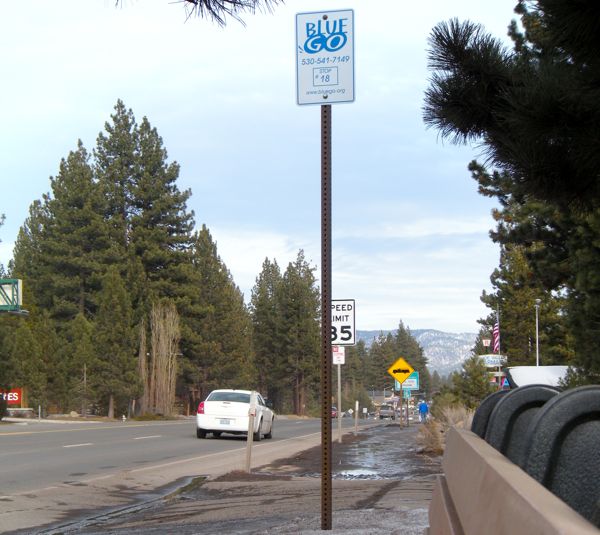
BlueGo has been a questionable name since the get-go. Photo/LTN file

The last piece to disappear is the name BlueGo. After all, no one knows what a BlueGo is. But it’s still not known if a bus symbol might actually be placed on signs so people would know to stand there for public transit.

South Lake Tahoe City Councilwoman Angela Swanson, who is on the board that oversees BlueGo, announced at the Oct. 16 council meeting that a contest will take place to name the bus system.

She directed follow-up questions to Tahoe Transportation District staff.

“We are interested and contemplating changing the name to better fit the service and the future, but we have not worked out the details to answer your questions or give you a time line,” TTD Executive Director Carl Hasty told Lake Tahoe News in an email.

LTN wanted details on the contest, when it starts, and the cost involved to change the name – like painting buses, signs and other things the BlueGo name might be on.

The other things Swanson revealed is that the system has been making money for the past two years and ridership is stable.

TTD officials are slated to be at the Dec. 11 City Council meeting to talk about what a free bus service would entail, the success of the East Shore Express, and ferry service on Lake Tahoe.


California on hook for massive banked vacation payoffs

By Thomas Peele and Daniel J. Willis, San Jose Mercury News

They could leave their hearts in San Francisco – or any of the Golden State’s other big vacation spots – but thousands of California’s state workers won’t even leave their desks.

An analysis of the last three years of government salary data shows state employees are continuing to store up massive banks of vacation, instead of heading to Big Sur or hitting the slopes at Lake Tahoe. They’re cashing in by retiring with whopping final paychecks worth, in some cases, more than $500,000 in unused time off.

From 2009 through 2011, cash-strapped California paid more than $800 million for days off state workers never used – a problem that has grown by tens of millions of dollars in the four years since the San Jose Mercury News first investigated the costly practice.

It’s an accounting liability that private companies work aggressively to avoid, but one that continues to pile up in Sacramento. And the problem grew even worse in recent years when the state tried to save cash by forcing workers to take unpaid furlough days as an emergency budget fix. As a result, banks of unused vacation grew even larger.

“Is the system broken? Obviously the system’s broken,” said Tim Malan, a supervising dentist at Avenal State Prison, who retired in 2009 with 247 days off still on the books, sweetening his final paycheck by an extra $317,000.

Like Malan, more than 4,000 people retired from the state over the past three years with an extra $50,000 or more for unused vacation and comp time, the newspaper’s analysis of pay data from 153 state departments shows. That’s almost four employees cashing out at least that much money every day. An additional 16,302 state workers retired during the three-year period with payments from $10,000 to $50,000 each.

While Malan sees why taxpayers might be bug-eyed at the vacation payouts, he said staffing shortages are largely to blame.

“If you go anywhere on vacation they give you grief for not doing the job,” Malan said. “I had plenty of vacation, and I couldn’t take it. Then I got all this money.”

When asked last month about vacation and comp time payouts, Gov. Jerry Brown downplayed the issue, saying the state makes employees take vacation before it piles up.

But when pressed for a further response, a spokeswoman from Brown’s office acknowledged that the administration intends to tackle what the newspaper’s analysis shows was a $293 million problem in 2011 at a time the governor is asking voters to approve a tax hike at the polls to avoid billions of dollars in cuts. By comparison, the payout was $174million in the 2007-08 fiscal year.

“This problem, like the $26billion deficit, is a carry-over from a prior era,” Elizabeth Ashford wrote in an email. “Employees were furloughed for short-term savings, which has left a long-term debt in the form of accumulated leave.

“We have already cut compensation for state employees by 5 percent and reformed the public pension system, and we’ll fix this problem too.”

The state doesn’t allow employees to cash in vacation time while they are still employed. But earlier this year, several state parks employees were disciplined and one fired after auditors found a secret program that allowed more than 50 parks employees to cash in a combined $270,000 worth of unused time.

This newspaper’s analysis showed the biggest payouts go to state workers with vital jobs, like firefighters, highway patrol officers and doctors at state hospitals or prisons. But others – lawyers, researchers at obscure state commissions, traffic engineers – also got fat checks. Managers are supposed to help workers keep vacation balances under 640 hours or 80 days, and Ashford said 87 percent of current state employees are under that cap.

However, state officials said in interviews, nothing stops employees from exceeding it.

“You can’t force people to take time off. I’ve never been able to do that in my time as a manager,” said Nancy Kincaid, a spokeswoman for the state Correctional Health Care Services department, which provides prison medical care.

But in the private sector, employers cap vacation accruals and make workers take their time off before they can accumulate more.

Twenty-seven people, including 19 prison doctors and dentists, got checks for more than $250,000, and some had more than 500 unused days off on the books when they retired. That’s enough money to reserve a seat on British billionaire Richard Branson’s future Virgin Galactic space flights or book a three-day stay at the $65,000-a-night Royal Penthouse Suite at the Hotel President Wilson in Geneva, the world’s most expensive hotel.

Topping the list was Napa State Hospital psychiatrist Gertrudis Agcaoili, who retired after 33 years with 642 days of accrued vacation and comp time. It cost taxpayers nearly $609,000.

How did she manage to bank so much time?

“It’s none of your business,” Agcaoili said in a brief telephone interview. “I deserve all of it. I worked very hard.”

A representative for the Department of State Hospitals, Wanda Yepez, wouldn’t say how Agcaoili accrued so much time.

“The demands of 24-hour hospital staffing often (make it) difficult for employees to be absent from the workplace in sufficient hours to maintain vacation balances below” 80 days, Yepez wrote in an email. Department records showed Agcaoili took only about 2 weeks of vacation in the five years before she retired, Yepez wrote.

A veteran observer of government spending said six-figure payouts like Agcaoili’s can be crippling and called on the state to revise its personnel policies.

“It’s an unfunded liability and a burden on the taxpayer,” said Thomas Schatz, executive director of Citizens Against Government Waste, a Washington, D.C., watchdog group. “California needs to look very closely at it. They have to enforce the 80-day limit.”

Payouts in state government spiked in 2010, topping $300million, data shows.

Part of the reason is that when former Gov. Arnold Schwarzenegger ordered workers to take as many as three unpaid days off a month in 2009 and 2010, saying it would reduce costs by $1.66 billion, they were still allowed to accrue vacation at their normal rate. That can be as high as 15 hours a month for rank-and-file workers and 16 hours for managers.

But vacation balances climbed even higher because employees were required to take furlough days first, said Lynelle Jolley, who retired last week as the spokeswoman for the Human Resources Department.

When furloughs were enacted, “we knew leave balances went up,” she said.

Some workers with critical jobs, like Highway Patrol officers, firefighters and prison guards, are sometimes restricted from taking time off.

“We have to have coverage 24 hours a day,” said Janet Upton, a spokeswoman for the Department of Forestry and Fire. The department paid $40million for unused time during the three years.

A lot of that time, Upton said, came from the past decade when California experienced 11 of the 20 largest fires in state history.

Three of its retirees topped payouts of $250,000 each, including an administrator, Jay Wickizer, who was paid for 514 vacation days. His job, Upton said, was to restore fire scenes.

But not all employees who were paid for hundreds of vacation hours had critical public safety jobs.

The person with the highest amount of unused vacation during the three-year period analyzed was Seymour Goldstone, a research specialist who retired from the state energy commission in 2010 with 539 vacation days. Goldstone couldn’t be reached; commission spokesman Adam Gottlieb could not immediately explain how the time was accrued.

At state prisons, unused time cost $293 million over the three years analyzed and included time from both corrections officers and health care providers.

Kincaid said many of those professionals were in high demand because of court-ordered improvements to the care provided to inmates. “Some of them worked 20 to 30 years when there were massive vacancies and then they cashed out,” she said.


Small-time pot farmers struggling to stay alive

By Joe Mozingo, Los Angeles Times

LAYTONVILLE — In the mountains of Mendocino County, a middle-aged couple stroll into the cool morning air to plant the year’s crop. Andrew grabs a shovel and begins to dig up rich black garden beds while Anna waters the seedlings, beginning a hallowed annual ritual here in marijuana’s Emerald Triangle.

In the past, planting day was a time of great expectations, maybe for a vacation in Hawaii or Mexico during the rainy months or a new motor home to make deliveries around the country.

But this year, Andrew and Anna are hoping only that their 50 or so marijuana plants will cover the bills. Since the mid-1990s, the price of outdoor-grown marijuana has plummeted from more than $5,000 a pound to less than $2,000, and even as low as $800.

Battered by competition from indoor cultivators around the state and industrial-size operations that have invaded the North Coast counties, many of the small-time pot farmers who created the Emerald Triangle fear that their way of life of the last 40 years is coming to an end.

Their once-quiet communities, with their back-to-nature ethos, are being overrun by outsiders carving massive farms out of the forest. Robberies are commonplace now, and the mountains reverberate with the sounds of chain saws and heavy equipment.

“Every night we hear helicopters now,” Anna said. “It’s people moving big greenhouses and generators into the mountains.”

Andrew, 56, and Anna, 52, who agreed to be interviewed only if they would be identified by their middle names, live in a rambling house down a trail through tanoaks and Douglas firs. Their electricity comes from a windmill and solar panels, their water from a spring. They cook on a wood stove and use an outhouse with a composting toilet to conserve water for their crop.

Though they are not complete back-to-the-landers – they have a nice car, satellite TV and Internet access – they keep their gardens relatively small, tucked in the trees throughout their property.

Among their plants, they post their own medical marijuana cards so that if they’re raided, it looks as though they’re growing under the aegis of state law. But because dispensaries generally prefer the more potent weed grown indoors, they still sell mostly to the black market, where mom-and-pop growers now struggle to compete.

“These big commercial growers have really ruined our business,” Anna said.

Until recently, life in the hills of Mendocino and Humboldt counties had changed little in the decades since hippies from the Bay Area began homesteading here. The pioneers initially grew marijuana for themselves and to make a little money.

Then in the 1980s, cultivation of high-grade seedless marijuana opened the possibility for big money as it brought a higher premium. Many of the farmers cashed in. But many remained small and discreet to avoid attracting the attention of state and federal agents.

They raised their families where they cultivated. They drove beat-up Subarus and small Toyota pickups, pumped their water from wells and chopped their own firewood.

The mountain hamlets operated like breakaway states. Marijuana farmers paid for community centers, fire departments, road maintenance and elementary schools.

Even today, small cannabis-funded volunteer fire stations and primary schools are scattered throughout the ranges. And the local radio station, KMUD, announces the sheriff’s deputies’ movements as part of its public-service mandate.

But the liberalization of marijuana laws in the last decade upended the status quo.

From Oakland to the Inland Empire, people began cultivating indoors on an unprecedented scale at the same time that growers from around the world flooded the North Coast because of its remoteness and deep-rooted counterculture.

Now, with the market glutted, people are simply planting ever-larger crops to make up for the drop in price.

Longtime residents complain that the newcomers cut down trees, grade hillsides, divert creeks to irrigate multi-thousand-plant crops, use heavy pesticides and rat poisons, and run giant, smog-belching diesel generators to illuminate indoor grows. They blaze around in Dodge monster trucks and Cadillac Escalades and don’t contribute to upkeep of the roads or schools.

“They just don’t care,” said Kym Kemp, a teacher and blogger in the mountains of Sohum, as locals call southern Humboldt County. “They’re not thinking, ‘I want my kids to grow up here.’

“Now there are greenhouses the size of a football field that weren’t even there last year,” she added.

Kemp said she feels her region is being colonized and worries about the colorful, off-the-grid people that small cannabis patches long supported.

“So many people who live here are just different,” she said. “They don’t fit in regular society. They couldn’t work 9-to-5 jobs. But they’ve gotten used to raising their kids on middle-class incomes. What are they going to do?”

Tom Evans, 61, a small-time grower in northern Mendocino, said the sense of peace and self-reliance he moved here for 30 years ago is disappearing so fast that he may leave for Mexico.

“It used to be a contest to see who could drive the oldest pickup truck,” said Evans, a former Army helicopter mechanic who sports a woolly gray beard and tie-dyed shirt.

“There’s just been this huge influx of folks who have money on their mind, instead of love of the land. A lot more gun-toters. A lot more attack dogs.”

Evans lives in a small, rented home that generously could be called a fixer-upper. He said he doesn’t have a bank account or credit card, and his Honda Passport has more than 300,000 miles. “It’s ‘make a living, not a killing,'” he said.

His friend, a bear of man who goes by the name Mr. Fuzzy, noted that it’s not only outsiders causing problems.

“You know the weird part, these are our kids too,” he said.

It’s a recurring lament among longtime growers. Some of their own children are going for the large-scale grows, big money and fancy cars.

The larger irony is that the marijuana pioneers are being pushed to the margins by the legalization they long espoused.

“Ultimately, we worry about Winston or Marlboro getting some land and doing their thing,” said Lawrence Ringo, a 55-year-old grower and seed breeder deep in the wilds of Sohum. “We see it time after time in America – big corporations come in and take over.”

Ringo saw the 2010 marijuana initiative, Proposition 19, as a ploy by Bay Area activists to dominate the market with giant warehouse grows in Oakland.

He suspects plenty of people will still want high-quality, organically grown cannabis but fears the big business interests will dictate how marijuana gets regulated. Ringo points out that Colorado, the one state that fully regulates marijuana, helped push most growing indoors and place cultivation under the control of large dispensaries.

“We’re afraid of losing what we’ve been doing for 40 years,” he said.

As competition drives prices down, even chamber-of-commerce types acknowledge that the North Coast economy is at risk. Pot kept things afloat as the logging and fishing industries declined. Restaurants, car dealerships, banks, hotels and dental clinics all depend on marijuana money.

“There’s probably not one business that doesn’t benefit,” said Julie Fulkerson, who founded a home furnishings store and comes from a prominent third-generation Humboldt family.

Walk into the upscale Cecil’s New Orleans Bistro in small-town Garberville in Humboldt County and you’ll find growers in dirty T-shirts unpeeling rolls of $20 bills to pay for martinis and $38 steaks. More soil supply and hydroponics shops line stretches of Highway 101 than gas stations, and trucks laden with bags of soil and fertilizer kick up dust as they make deliveries on the most isolated roads.

During harvest, hardware stores put out huge bins of Fiskars pruning scissors, the preferred tool for marijuana trimmers. Safeway stocks so many turkey bags that an outsider might wonder how such small locales could consume so many birds. The sealable, smell-proof bags are used for storing and transporting weed.

“I wouldn’t survive if it wasn’t for growing,” said Tom Ochner, 54, who runs a country store and rental cabins outside of Covelo (Mendocino County) – a business called the Black Butte River Ranch. “Owners realize this is what makes their business go.”

Concerned about the economics of legalization, Humboldt banker Jennifer Budwig studied the amount of pot money entering the local economy.

Using an extremely high estimate that law enforcement seized 25 percent of the total amount of pot grown in Humboldt, she found that the crop generated at least $1 billion a year – of which $415 million was spent in the county. She said the actual figure could be several times higher.

Legalization “has the potential to be devastating,” she said.

Some small growers, like Anna and Andrew, still hold out hope that they can beat back the deluge of industrial marijuana.

There’s a market, they say, for sun-grown weed among discerning users who appreciate the nuances of regional variety. A grower just down the road said he hoped to start promoting “Mendocino terroir.”

“How can sun-grown not be better medicine?” Anna asked. “If you’re sick, you want something that has chemicals in it? You can’t grow indoor organically. Not to mention the fossil fuels it burns up.”

But even if boutique weed has some potential, the couple still sense that their life in the mountains is changing for good. The next-door neighbor recently had a home-invasion robbery, and a young man down the road was shot in the face during a deal.

Andrew goes back to planting the new crop. He used to have the radio on all day – something to engage his mind during the tedious work.

He doesn’t anymore.

He keeps it quiet, listening for intruders.


Barton on course to be trauma center; severs ties with 4 docs

By Kathryn Reed

While Barton Health officials say money is not the overriding reason to become a trauma center, it is the primary reason they say four doctors as of Jan. 1 will no longer be affiliated with the South Lake Tahoe healthcare system.

Clint Purvance, chief medical officer for Barton Memorial Hospital, said it is hoped the Level 3 trauma designation will be acquired in the first quarter of 2013.

There are four levels of trauma centers, with Level 1 usually reserved for teaching hospitals that are research based. Level 3 requires an emergency room, general surgery, orthopedic and anesthesia be available 24 hours.

“We are not changing the level of care, we are changing the system,” Purvance said. “The delivery of health care is fragmented at best.”

Purvance, with CEO John Williams, spoke with Lake Tahoe News about the changes that are about to occur.

It is the medical practices of Emerald Bay Center for Women’s Health and Tahoe Women’s Care that will not be contractually renewed at the end of the year.

“Even though we did not come to terms with the ob-gyns, they can still practice at Barton. They can use the da Vinci. They can run their own practice,” Williams said. “We just won’t be managing and underwriting their practices.”

Trauma center

It’s not known how many more patients would be able to be cared for locally instead of being flown to Renown Medical Center in Reno (a Level 2 facility) or UC Davis Medical Center in Sacramento (Level 1) if Barton receives the trauma center designation. Officials aren’t releasing projected income from the change either. Nor has it been released if the cost to patients will go up if Barton becomes a trauma center.

For the past year as Barton has worked on its trauma center status, additional equipment has been purchased, employees hired and others trained to meet the demands of the American College of Surgeons. El Dorado County also has criteria for Barton to meet in order to become a trauma center.

“It raises the bar and awareness,” Williams said of being a trauma center. “It’s good for the community image.”

Purvance said the center would create a coordinated care system for patients from the moment they are injured.

As it is now, someone could arrive by ambulance and no one in the ER will know ahead of time what type of care would be required or even that a patient was coming. That would change per trauma center protocol. Barton is talking to its health care partners to put the coordinated system in place.

Even though Barton will be 50 years old next year and has lived without being a trauma center, the health care administrators say the world is changing and things need to change locally.

Even if Obamacare is altered, there is still the California Health Benefit Exchange that providers in the Golden State must adhere to.

Williams said starting in 2014 it will be “value vs. volume when health care reform hits.” Reimbursements are expected to be less, but the number of people with insurance is likely to increase.

Keeping more people at Barton is obviously a moneymaker. But that does not mean patients won’t be flown out even if the hospital is a trauma center.

Neurological trauma with bleeding inside the head, spinal cord injuries, major amputations, burns, and pediatric trauma patients will continue to be airlifted to Reno or Sac.

While trauma centers were in the decline in the 1990s and early 2000s, the reverse has been true the last few years. According to Kaiser Health News, this is in large part because money can be made from being a trauma center.

A Kaiser study show that since 2009 more than 200 trauma center have opened in more than 20 states, with 75 more hospitals seeking approval.

“Trauma centers make money. If a hospital is not making money on trauma, then it’s not structured the right way,” Mike Williams, president of the consulting firm Abaris Group in Martinez told USA Today. “Trauma centers can basically charge whatever they want.”

Women’s care

With Barton being a private hospital, negotiations with individual doctors or groups it contracts with are confidential. Without either side releasing the numbers, it is not known how far apart the hospital administration and the offices of Tahoe Women’s Care and Emerald Bay Center for Women’s Health were.

“Substantial” is how Williams described the difference.

Kelly Shanahan with Emerald Bay Center said, “We basically asked for a continuation of what we have now. The only thing additional was paying our malpractice premium.”

Doctors Gary Willen, Kris Kobalter and Caroline Habaradas with Tahoe Women’s Care did not return a phone call.

This was the administration’s decision, not the board’s.

“I don’t think the board had much of a choice. The administration tried to negotiate in good faith,” Barton board President Guy Lease told Lake Tahoe News.

Shanahan also believes the decision by the administration was personal.

“He doesn’t like us,” Shanahan said of Williams. “I really think it’s about the personalities.”

Obstetrics is not a moneymaker. And with there being a 21 percent decline in births at Barton from 2010 to 2011, the income is on the decline.

While these four docs were costing Barton Health money on the obstetrics side, Shanahan does not believe the g-y-n part of her practice was taken into consideration.

Barton know it needs ob-gyns. Two doctors have been interviewed to replace the four they let go. How many will be hired is an unknown.

Shanahan said the two ob-gyn offices agreed to merge to save money, but that and other concessions were not good enough for Barton.

Barton owns the building Tahoe Women’s Care is in, while Shanahan also owns her. It’s still possible they could consolidate so they can continue to practice medicine locally.

Shanahan foresees having a strictly gynecological practice.

“I kept my office through breast cancer and chemo. I will be damned if this hospital administration makes me shut my doors,” Shanahan told Lake Tahoe News. “I don’t think it is a community hospital. I think it’s corporate.”


Marijuana grow house found in Markleeville, 3 men arrested

Three Markleeville men are accused of growing marijuana at a barn in Alpine County.

“The barn contained two downstairs grow rooms. One room was complete with lights, timers, humidity monitors, fans, a carbon dioxide enrichment system and filtered external ventilation. There was even air conditioning installed and operating in the one grow room that was finished,” Alpine County sheriff’s deputies said in a press release of the Markleeville grow house. “The other room was nearly finished with all of the equipment new and in boxes, ready to be installed. The upstairs of the barn had younger plants growing with three tubs converted to producing hydroponic starter clones. A smaller grow was found in one of the rooms of the residence.”

John Borchard, 23, Stephen Seiller, 25, and Justin Jones, 35, were all taken into custody Oct. 13 on a variety of drug charges.

Deputies said of the house on Spring Canyon Drive in Markleeville that it was one of the most “sophisticated marijuana grows ever found in Alpine County.”

Deputies seized 312 marijuana plants, along with miscellaneous drug paraphernalia and thousands of dollars of growing equipment.

 — Lake Tahoe News staff report