SLTPD celebrating 50 years with community party

South Lake Tahoe Police Department is celebrating its 50th anniversary on May 20 from 2-6pm at Lakeview Commons.

The event will also include the annual awards ceremony honoring SLTPD employees and community members at 4pm.

Booths will include:

  • SWAT – Educational information.
  • K9 – Tara, Ricci and Quatro will be in attendance with their handlers.
  • Marine unit – The police boat will be docked at El Dorado Beach boat ramp and officers will provide demonstrations.
  • History – Historic photos and information.
  • Dispatch – Learn about the proper use of 911.
  • Technology – Learn about the new drone operations program.

Moonshine Crazy will be playing for free. There will also be a barbecue hosted by the police and fire departments. A silent auction will  benefit Live Violence Free.


EDC taking stand on skin cancer

Several agencies in El Dorado County are teaming up to spread the word about the importance of sun safety, especially for children.

The El Dorado County Public Health Division, Placerville’s Community Services Department, Marshall Medical Center and El Dorado Community Health Center are partnering to promote skin cancer prevention and awareness. Skin cancer is one of the most common types of cancers in the United States and accounts for almost 50 percent of all cancer cases.

The Slip, Slop, Slap & Wrap campaign to encourage kids to slip on a shirt, slop on sunscreen, slap on a hat, wrap on sunglasses, and seek shade between 10am and 4pm.

For sun safety tips and additional information, go online.


Hotel robe upgrades making the stay more worthwhile

By Abha Bhattarai, Washington Post

Most hotel rooms are a blur, says Maxwell Young. But there is one part of his stay at the Hotel Palomar in Northwest Washington that he will always remember: the leopard- and zebra-print robes hanging in his room.

“It was like I opened the closet and rays of sunshine poured out,” he said of the bathrobes, which he later raved about on Twitter. (“Snow may have put a crimp in our DC plans, but this zebra robe at @Kimpton Palomar Hotel is really lifting my mood.”)

Young, who works in marketing, spent the rest of his business trip working in his animal print robes. By checkout time, he’d made plans to buy a similar robe for a friend.

As hotel chains look for new ways to attract younger travelers, bathrobes have become one more way to add pizazz to an otherwise predictable stay. Gone are the one-size-fits-all robes of earlier decades. In their place: Seer­sucker, houndstooth and periwinkle blue, all perfectly suited for sharing on social media.

Read the whole story


Craps champions swear it’s more mystique than math

By David Montero, Los Angeles Times
 
Richard Favela rested his hands over the wooden chip tray lining the craps table as the lights from above glinted off rings adorning his lithe, brown fingers.

Favela reached down for the dice and positioned them with great care. Turning them slowly. Methodically. Wholly unsatisfied until he had the white dots facing up the way he liked them. Six on one. Three on the other. They must add up to nine. Always nine. Otherwise the magic would surely end.

A dozen pairs of eyes fixated on him. The four dealers at the table were deferential toward the legend — identifiable to the trained eye by his blue shirt. He would not be rushed.

Read the whole story


Tahoe Tails — Adoptable Pets in South Lake Tahoe

Erin

Erin is a sweet cat, about 8 years old, who is good with polite dogs. She is a little shy to begin with, but she enjoys being petted and getting attention. Erin has incredibly soft fur.

Erin is spayed, microchipped, tested for FIV, and vaccinated. She is at the El Dorado County Animal Services shelter in Meyers, along with many other dogs and cats who are waiting for their new homes. Go to the Tahoe animal shelter’s Facebook page to see photos and descriptions of all pets at the shelter.

Call 530.573.7925 for directions, hours, and other information on adopting a pet.

For spay-neuter assistance for South Tahoe residents, may go online. 

— Karen Kuentz


Best exercise for aging muscles

By Gretchen Reynolds, New York Times

The toll that aging takes on a body extends all the way down to the cellular level. But the damage accrued by cells in older muscles is especially severe, because they do not regenerate easily and they become weaker as their mitochondria, which produce energy, diminish in vigor and number.

A study published this month in Cell Metabolism, however, suggests that certain sorts of workouts may undo some of what the years can do to our mitochondria.

Exercise is good for people, as everyone knows. But scientists have surprisingly little understanding of its cellular impacts and how those might vary by activity and the age of the exerciser.

So researchers at the Mayo Clinic in Rochester, Minn., recently conducted an experiment on the cells of 72 healthy but sedentary men and women who were 30 or younger or older than 64.

Read the whole story


Nevada honors tourism industry leaders

The Nevada Division of Tourism recognized outstanding members of the state’s rural tourism industry at the VolunTourism Awards this month.

Tourism is a $2.3 billion industry in Nevada. Visitation to rural Nevada — all counties except Clark and Washoe — was 5.23 million in 2016, up about 7.9 percent from 2015.

Sue Barton, deputy director of the Lake Tahoe Visitors Authority, earned the Larry J. Friedman Industry Partner of the Year award.

VolunTourism award recipients:

Reno-Tahoe Territory

Bill Henderson, director of sales for the Carson Valley Inn in Minden, has been a passionate participant with the Reno-Tahoe Territory for more than 30 years.

Cowboy Country

Yvonne Stuart, president of the Wells Chamber of Commerce, has been involved with Nevada’s Cowboy Country Territory for several years.

Indian Territory

Billie Jean Guerrero is the director of the Pyramid Lake Museum and Visitors Center for the Pyramid Lake Paiute Tribe.

Las Vegas Territory

Julie Banbury became membership director in midsummer 2016 and immediately upgraded the membership program, providing a more streamlined application process for candidates.

Pony Express Territory

Cindy Beutel works behind the scenes in Eureka to foster community involvement and increase participation in special events.

Nevada Silver Trails Territory

Ray Fox of Certified Folder Display Service, Inc., has provided Nevada Silver Trails with travel brochure distribution services for a number of years.


Possible to have garden-fresh herbs all year

By Melinda Myers

Enjoy herbs all year. Harvest herbs now for garden-fresh meals and preserve a few for next winter.

Snip a few leaves or leaf-covered stems as needed. For the same intensity of flavor, you generally need two to three times more fresh herbs than dried except for rosemary which has an equally strong flavor fresh or dried. Continue harvesting herbs as needed throughout the growing season. And don’t worry about harming the plant because regular harvesting encourages new growth which means more for you to harvest. Just be sure to leave enough foliage to maintain plant growth.

You can remove as much as 50 percent of the foliage from annual herb plants. This is about when the plants near their final height. You can remove up to one-third from established perennial plants that have been in the garden for several months or more. Harvest when the plant has formed buds, but before they open into flowers for the greatest concentration of flavor. This is the perfect time to harvest herbs you plan to preserve.

Preserving herbs from the garden provides fresh-from-the-garden flavor all year. Photo/Bonnie Plants

Use a pair of garden scissors or pruners for faster and easier harvesting. Make your cuts above a set of healthy leaves to keep the plants looking good. Then preserve the flavor and zest of herbs with proper storage and preservation.

Store thin leafy herbs like parsley and cilantro for up to a week in the refrigerator. Place in a jar of water, like a flower arrangement, and loosely cover with a plastic bag. Keep basil out of the fridge to avoid discoloration and others on the counter for quick and frequent use.

Wrap dry thicker-leafed herbs like sage and thyme in a paper towel, set inside a plastic bag and place in a warmer section of the refrigerator.

Freeze sprigs, whole leaves or chopped clean herbs on a cookie sheet. Or pack clean diced herbs in ice cube trays and fill the empty spaces with water. These are great for use in soups and stews. Store the frozen herbs and ice cubes in an airtight container or baggie in the freezer.

Or bundle several stems together, secure with a rubber band and use a spring type clothespin to hang them in a warm dry place to dry. Make your own drying rack from an old embroidery hoop, string and S hooks. Visit Bonnie Plants do-it-yourself Herb Drying Rack project for detailed instructions.

Get creative and use some of your herbs to make a fragrant edible wreath. Use fresh herbs that are flexible and easier to shape into a wreath. They will dry in place and can be harvested as needed.

Speed up the drying process in the microwave. Place herbs on a paper towel-covered paper plate. Start with one to two minutes on high. Repeat for 30 seconds as needed until the herbs are brittle.

Store dried herbs in an airtight plastic or glass jar.

Keep enjoying these fresh-from-the-garden flavors throughout the remainder of the season. And consider preserving a few for you, your family and friends to enjoy throughout the winter.

Gardening expert Melinda Myers has written over 20 gardening books, including “Small Space Gardening” and the “Midwest Gardener’s Handbook.” She hosts “How to Grow Anything: Food Gardening For Everyone” DVD set and the nationally syndicated Melinda’s Garden Moment TV and radio segments.


Founder: Burning Man’s evolution far from over

By Linda Fine Conaboy

INCLINE VILLAGE – Burning Man founding board member Michael Mikel told Lake Tahoe News that Nevada is the last American frontier. “It’s the last place where there’s so much freedom, people can be themselves.”

Mikel is also known by his playa name, Danger Ranger. This month he gave a historical overview of Burning Man at a talk at Sierra Nevada College.

History comes easy to Mikel. His bio says he’s a historian and a futurist. He’s also, for the last two years or so, a proud Nevadan, having migrated to his turn-of-the-century Reno home from the Bay Area.

Mikel and other founding Burners thought Nevada was the ideal place, which is why in 1990 they packed up The Man and trekked him, ensconced in a rented truck, to the Black Rock Dessert, far from his fog-shrouded Baker Beach origins in San Francisco.

The Man, Mikel said, simply outgrew his coastal origins and the desert turned out to be his destiny, a fact proven by the number of people, whether they have attended the desert event or not, know who the tall guy is.

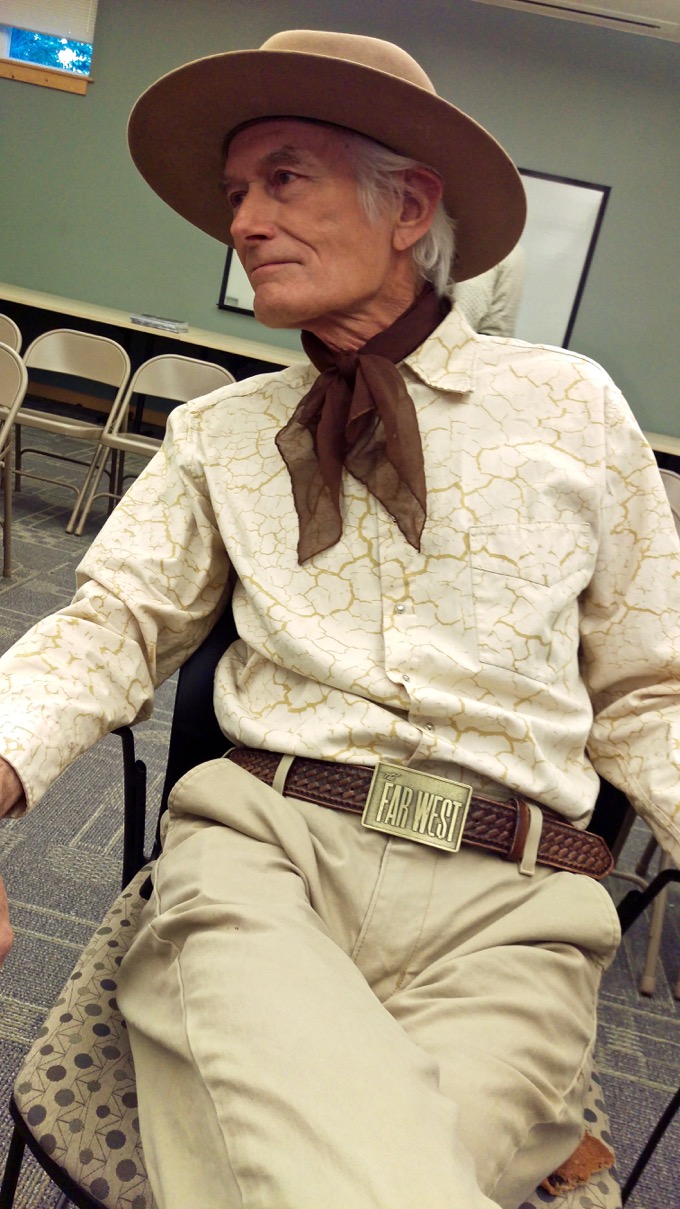
Mikel’s mission on this cold evening at SNC was to lay out for his audience what he calls the five ages of Burning Man. The evening was a most interesting trip through history related by Ranger Danger, who, true to his moniker, dressed as a ranger from his Mounties-style handsome hat to his brown boots, into which he tucked his trousers.

Around his neck, he tied a scarf, nattily offsetting his custom beige shirt with an imprinted pattern depicting the whorls of dry, parched clay that is the Black Rock desert.

Although others disagree with the evolution of Burning Man, according to Mikel, the story unfolds perfectly in five periods. They are: exploration; rapid growth; protectionism; outreach; and the age of scarcity.

The Age of Exploration, from 1986 to 1990, according to Mikel, was actually the precursor of today’s Burning Man, but nobody knew it. It became an underground event full of experimentation with a low barrier to entry—everybody was welcome—resulting in a high rate of participation.
Facts from Michael Mikel:
• Burning Man uses more propane than any other industry in the U.S.
• 6,000 portable toilets are emptied two times each day
• There are regional burns in 34 countries
• In July, Nevada Museum of Art opens a Burning Man exhibit. Upon closing in Reno, it heads to the Smithsonian Museum.
• 5,000 low-income tickets are sold annually at $195 each
• People sky dive in Burning Man, but so far, each has had a ticket
• 5,000 people volunteer at the event.

The first man was 8-feet-tall, doused in gasoline and pulled into place by humans before being set afire on Baker Beach during the summer solstice in 1986.

“It was like a family picnic,” Mikel said, “so the 20 or 30 of us there decided to do it again in 1987.” The following year, The Man was 30-feet -tall and more complicated, and in 1989, with a 40-foot-tall Man, the number of attendees quadrupled; in 1990, the authorities broke up the party and didn’t allow the beach burn.

The Age of Rapid Growth, from 1990 to 1996, saw Burning Man’s new beginnings at Black Rock. “It literally flew out of control,” Mikel said, although only 80 people participated in the first desert burn.

He said this enthusiastic group of desert neophytes had much to learn about life on the playa. For example, their first big lesson was that parachutes, which they erected for shade, are designed to catch the wind. And catching the first playa breeze, off they sailed.

That year (1990) saw people pulling the rope to raise The Man to his full height. In 1991 Crimson Rose, also a founding board member and board secretary, climbed The Man. Crimson Rose founded the Black Rock Arts Foundation as well as the Burning Man Project.

In 1992, there was music and the Black Rock Rangers were born. The group emulating the Texas Rangers, now numbers 800 people. This was also the year of government regulation—they were required to pull a permit. Today, Mikel said, it takes an entire staff to work with Burning Man’s federal landlords.

Subsequent years during this period, saw the first theme camp, which was inundated by extreme weather—lots of airborne dust followed by huge dumps of rain.

The population in 1993 was relatively small, leading to a mandated entry fee of $30 in 1994 to augment costs, the same year the lamplighter ceremony began, witnessed by a surge in population—2,000 people.

Other firsts during this period of rapid growth included the first café, the first communication with the outside world, the first art car and the first trash fence installed to snag garbage as it blew about the playa.

The population of Pershing County, the site of Burning Man, surged each September, making Black Rock City the county’s largest town. Unfortunately, disagreements grew during this era as did the number of auto accidents and resultant deaths.

Wired magazine featured Burning Man on its cover and serious art was becoming popular as was the flow of liquor. The founders decided at this point they needed to adjust the event’s course, shepherding in the Age of Protectionism from 1997 to 2000.

Attendance swelled to upward of 10,000 attendees. Protected boundaries became the norm, as did controlled access to the boundaries, which resulted in far fewer accidents.

Ticket prices increased again, this time to $50 in advance and $65 at the gate. County government became more involved, mandating street signs, fire protection system and numbered parking spaces.

To meet some of the restrictions, Black Rock City developed the now familiar semi-circle used for campers’ parking. A website was designed and even Google got into the act by developing a Burning Man Google Doodle. The leave- no-trace philosophy was implemented, one of the 10 tenets of Burning Man.

With 26,000 participants in year 2000 generating tons of trash, MOOP (matter out of place) patrols became the norm. Radar protecting the perimeter was installed and 2000 became the last year The Man was raised by ropes.

Succeeding ages included the Age of Outreach (2001-2010), which pretty much saw the event go on auto-pilot and the doubling of the population to include many mainstream folks, who perhaps formerly, eschewed the event.

The Age of Outreach also became the age of emergency services—medical and religious services were introduced. Talk about the largest city in Pershing County—2006 boasted a Burning Man population of more than 40,000.

Black Rock Solar, the first nonprofit solar company in the U.S. made its appearance during this age when a group of volunteers installed a 30 kilowatt array on the playa surface in Black Rock City, themed that year as The Green Man. Later, the team moved the array and installed it in Gerlach, donating the solar project to the town’s school system.

The final age, Scarcity, from 2011 to the present is certainly not the end of Burning Man, and certainly a sixth age awaits.

Now, according to Mikel, everybody wants to be a burner. The demand is huge with 70,000 tickets sold by computer via a lottery. “Scarcity raises the price of access,” he said, adding wryly, “sorry, the lifestyle you ordered is out of stock.”

As the founders of Burning Man age, Mikel confirmed that the old-timers are getting ready to turn over the reins to a younger cohort. “I believe the next generation will make us proud,” he said.

He added that although Burning Man has changed over the years, “It is still the most incredible thing on the planet, teaching people how to get along in peace and harmony.”




Memorial service set for Truckee High coach

By Jim Krajewski, Reno Gazette-Journal

A memorial service for Bob Shaffer has been set for 1:30pm May 6 at Surprise Stadium, the football field at Truckee High School.

Shaffer, the former Truckee football coach, was killed in a head-on car accident April 1 outside Sierraville.

Shaffer helped lead the Wolverines to nine state football titles, including four-straight state championships in football. He retired from coaching football in 2013.

He was coaching track and and field this year at Truckee, and was at the Reed Rotary Invitational on the day of the accident.

Read the whole story