Remembrance planned for cyclist who died in SLT

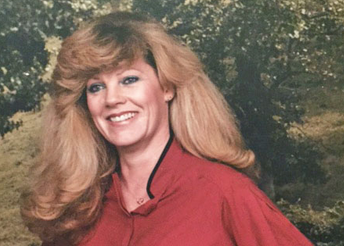
Joseph “Rocky” Heether

Joseph “Rocky” Heether, 64, of South Lake Tahoe is the man who was killed last weekend while riding his bicycle on Highway 50.

There will be celebration of life at Lakeview Commons on May 19 at 6pm.

The cyclist and vehicle were both going west on the highway near Takela Boulevard at about 7:40pm May 13 when the bicyclist cut in front of the driver, according to police reports. The collision is still under investigation.

— Lake Tahoe News staff report


Why potlucks are starting to get political

By Kristin Donnelly, Taste
 
A new generation of chefs and activists are using dinner parties to help refugees and immigrants affected by the election.
It’s dark when we arrive outside the Hopewell Presbyterian Church in Hopewell, N.J., so I follow the burly guy carrying a foil pan of fried turkey. In front of us is a parade of other guests—each carting a covered platter, a vintage Pyrex casserole dish, a slow cooker, or more foil trays. As I enter, the unmistakable odor of church basement hits me along with the Thanksgiving-like smell of the crisped turkey skin.

My husband and I know none of the people around us, but we are here to support Interfaith-RISE, a 1-year-old New Jersey–based organization devoted to helping settle newly arrived refugees. Like many businesses and organizations operating in the aftermath of the election, this one had decided to use communal dining to support the people most affected by tenuous immigration policies.

The event’s focus is more humanitarian than political, but of course my tablemates and I can’t avoid discussing the election that rocked all of our world views. The conversations are similar to those I have with friends daily: We discuss the fears we have and what new policies might mean for immigrants, the environment, racial justice, public education, and the growing wealth gap.

Read the whole story


Poet to give talk, workshop at LTCC

The Writers’ Series at Lake Tahoe Community College will host poet and writer Camille T. Dungy on June 15 at 7pm in the board room.
Dungy will sign copies of her books, which will be for sale at the event, along with answering questions.
 
Dungy is the author of four collections of poetry: “Trophic Cascade” (Wesleyan UP, 2017), “Smith Blue” (Southern Illinois UP, 2011), “Suck on the Marrow” (Red Hen Press, 2010), and “What to Eat, What to Drink, What to Leave for Poison “(Red Hen Press, 2006).

Dungy’s honors include an American Book Award, two Northern California Book Awards, two NAACP Image Award nominations, and a California Book Award silver medal. She is currently a professor in the English Department at Colorado State University.

Dungy will also lead a writing workshop June 16 from 9am-noon in the Aspen Room. This workshop is free to LTCC students, and to students enrolled at South Tahoe High School and Sierra Nevada College. Students must show a valid school ID on the day of the workshop. For all others, the fee is $50 with proceeds going to the LTCC Foundation.


Talking about suicide can be a preventative measure

By Alisa Merino

May is Mental Health Awareness Month and you may have heard the phrase “each mind matters.”

Why does each mind matter? Mental health is something we all have. Just as our bodies need attention, our minds also need nourishment and care. Suicide rates are increasing and there is a relationship between mental illness and suicide. According to the National Alliance on Mental Illness (NAMI), about 90 percent of people who die by suicide have experienced mental health issues.

Alisa Merino

At the Suicide Prevention Network, it is our goal to bring awareness to suicide. This includes recognizing signs and symptoms as well as reducing the stigma.

As community members, we all play a role in reducing the negative associations around suicide and mental illness. It is up to us to be advocates and caregivers who provide support and lifesaving resources for loved ones at risk.

Anyone can be at risk of suicide. Two big risk factors are having life stressors and lacking skills to cope with these stressors. Life stressors may include health, finances, divorce, children, moving, family problems, employment, death of a loved one, or a loss of any kind. Some positive ways to cope with these stressors are exercise, deep breathing, healthy nutrition, appropriate sleep, listening to music, and talking to someone you trust.

Unfortunately, some may find that life stressors are too difficult or some choose negative ways to cope. Signs of suicide may include:

·         Talking about death directly

·         Giving away possessions

·         Engaging in risky behavior (i.e. driving recklessly, coming to work intoxicated)

·         Abusing or consuming excessive amounts of alcohol or drugs

·         Sleeping too much or too little

·         Eating too much or too little

·         Making funeral arrangements

·         Isolating from loved ones

·         Engaging in self-harm (cutting or burning)

·         Feeling hopeless.

If someone you know is displaying these signs or reaching out to you for help, it is important to have a conversation with that person. Here is one script the Suicide Prevention Network recommends to follow:

Step one: Ask. Ask the person directly if he or she is thinking about suicide. “I have noticed you have been acting different and I am really concerned. Are you thinking about suicide?”

Step two: Listen. Hear the person’s story. Listen and offer support without judgment. “It sounds like you are going through a lot. I am so sorry. How can I support you?”

Step three: Connect. Connect the person to resources. “I want to make sure you stay safe; can we call someone so that we can keep you safe?”

Here are prevention and support hotlines that anyone can call for immediate suicide concerns:

·         Suicide Prevention Lifeline
800.273.8255 or text “ANSWER” to 839863

·         24-hour Psychiatric Emergency Services (El Dorado County Mental Health)
Placerville: 530.622.3345
South Lake Tahoe: 530.544.2219

·         Suicide Prevention Network
California or Nevada residents: 775.783.1510.

Other local mental health resources may be found online.

Suicide is everyone’s business and there is support available. May we all be aware of our mental health and well-being so that we can help each other find hope and healing.

Alisa Merino is the program coordinator for the Suicide Prevention Network. The Suicide Prevention Network is a 501(c)3 and offers education, awareness, and supportive services to members of Douglas County and El Dorado County. Community members who have lost a loved one to suicide can attend a Survivor of Suicide Support Group monthly on the fourth Thursday at 6pm at Barton Public Relations office, 2092 Lake Tahoe Blvd., Suite 400 in South Lake Tahoe. The next meeting is May 25.


Book review: Realities of racism in ‘Small Great Things’

By Kathryn Reed

Color matters – even today. The reality behind the headlines tells us as much.

So it should come as no surprise that the world of fiction is also filled with stories about racism. Sara Picoult in her novel “Small Great Things” (2016 Random House) does not shy away from what some would call delicate subject matters.

This was my book club’s May book, which most everyone liked and would recommend.

Instead of weaving the story of the various characters into one narrative, each is separated by his/her own chapters. This is a clever way to ensure their voices, thoughts and feelings are not lost.

A dead baby, a black nurse, a white supremacist dad, and a white public defender who thinks she’s color blind. Their worlds collide across more than 400 pages.

For the most part the story rings true. At times I was angry – at the characters and for representing them.

The legal aspect – more than medical – is most captivating. Predictably it was the trial where the fireworks come.

There were times when the story dragged, and then the end seemed rushed and not well developed. In some ways the twists at the end took away from what had been a good look at complexities of human relations. It almost became contrite.

At the end, Picoult could have skipped the multi-page explanation of why a white woman could write such a book. Authors write fiction every day from perspectives they aren’t intimately involved in. That’s what good writers do — and without calling attention to themselves. She should have let the book speak for itself.


Tahoe Tails — Adoptable Pets in South Lake Tahoe

Gaston

Gaston is a young Skye terrier, an unusual breed for Tahoe; and is perhaps 8 months old.

As a puppy, Gaston is still figuring out what his teeth are used for and he needs basic training. An experienced dog family without young children who will commit to training would be best for him. Skye terriers come from Scotland and were bred to be hunting dogs. Gaston needs a daily short to moderate walk to stay in shape. Regular combing (about twice a week) is all that is needed to keep Gaston looking handsome.

Gaston is neutered, microchipped, tested for heart worm, and vaccinated. He is at the El Dorado County Animal Services shelter in Meyers, along with many other dogs and cats who are waiting for their new homes. Go to the Tahoe animal shelter’s Facebook page to see photos and descriptions of all pets at the shelter.

Call 530.573.7925 for directions, hours, and other information on adopting a pet. For spay-neuter assistance for South Tahoe residents, go online.


Robin Smith — 1943-2017

Robin Smith

Longtime South Lake Tahoe resident and prolific Lake Tahoe News commenter Robin Smith has died. She was 73.

She died May 7, 2017. She was born to Robert and Trina Mattingly on Aug. 14, 1943.

Robin Mattingly made Tahoe her home in the early 1960s. She married John Cristando in 1971; they were married for eight years.

Robin worked for years at the Stateline casinos, starting as a cocktail server, then becoming a black jack dealer. She often talked about the entertainers and stars she would meet, including Elvis and NASA astronaut Walter Schirra.

Robin lived her life true to her convictions. She was a strong and resilient woman, who was known for her many stories of Nevada’s legends and history. Robin had extensive knowledge of Tahoe gaming and history.

Robin later moved to Las Vegas, where she met longtime companion Brandon Smith, whom she was with for 25 years. They later returned to Tahoe to help care for Robin’s four grandchildren.

Robin blessed her close friends and family with bio-rhythm charts, while being a self-proclaimed astrogist.

Robin is survived by son Robert Cristando; daughters Veronica Flaherty, Stephanie Demsar, and Johnna Cristando; brother Bill Mattingly; sister Trina Ann Threlkeld; grandchildren Alexandra, Daniella, Janez Jr. and Lucas.

There will be a private family service.


Million-dollar teachers: Cashing in by selling lessons

By Associated Press

Miss Kindergarten is in the million-dollar club. So are Lovin Lit, the Moffatt Girls and about a dozen other teacher-entrepreneurs who are spinning reading, math, science and social studies into gold by selling their lesson plans online to fellow teachers around the world.

Despite worries from some educators, such online marketplaces are booming, driven by rising standards and the willingness of teachers to pay out of their own pockets for classroom-tested materials.

“I am so thankful and blessed that it came into my life and that my passion and career can kind of mesh into one,” says Miss Kindergarten, aka 32-year-old Hadar Hartstein, of Lake Forest, California, who says she has earned more than $1 million in sales over the past six years, enough to take this year and maybe the next few off from her teaching job to be with her newborn daughter.

Her more than 300 offerings on the popular Teachers Pay Teachers site range from free alphabet flash cards and a $1.50 Popsicle party counting activity to a $120 full-year unit on math and literacy, all of them widely promoted on her blog and social media accounts.

Read the whole story


Monterey Tides awash in ocean splendor

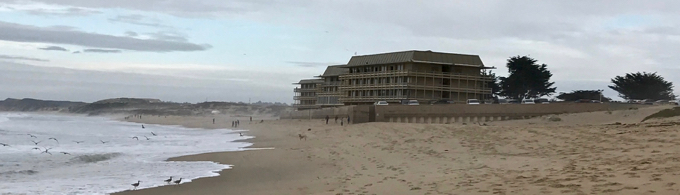
Monterey Tides’ selling point is its location right on the ocean. Photo/Kathryn Reed

By Susan Wood

MONTEREY – From the moment a guest enters the front lobby, waves of serenity and relaxation beckon.

This is how one knows the power of place.

In the case of staying at Monterey Tides, the 180-degree view of the crashing surf onto the beach just below makes it an ideal spot for ocean lovers and families seeking recreation and rejuvenation together. Being there is reflective of knowing that the ebb and flow of life’s ups and downs will roll away – if one adapts and learns how to go with the flow.

Location, location, location. The Tides, a Joie de Vivre hotel since 2015 when it ceased to be a Best Western, is nestled right on the beach off of Sand Dunes Drive. The 196-room boutique hotel comes with the distinction of being the only one smack dab on Monterey Bay. The views are out of this world.

“It’s a best kept secret,” said one hot-tubbing guest who returned for spring break with her Napa family. They rotate their time between the beach and the pool patio.

A San Jose woman used her time at the pool to reminisce about coming there as a little girl with her mother.

“They did a lot of renovation. The rooms are good now,” she said.
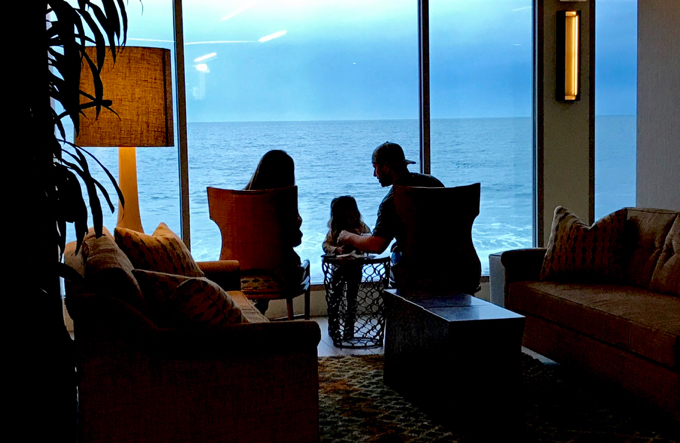
The bar area at Monterey Tides is family friendly; offering stellar views of the ocean. Photo/Kathryn Reed

The San Francisco-based hotel chain immediately embarked upon a $12 million renovation when it took over. The pool area of the hotel grounds is notable as it is warm, inviting and improved. This includes having a new privacy wall that serves as a windbreak from the parking lot. The chaise lounges have special cushions adjustable for either the back or head. Composite decking, the hottest, new surface combining wood and plastic, covers the patio. In early April, the heated pool may be a little too nippy for some – except if you’re comparing the water temperature to the ocean or you’re 10 years old and don’t care.

A few guests tried out the ocean with boogie boards in their wet suits before rinsing off with the convenient outside shower. Most guests opted for the welcoming hot tub at a comfortable 100 degrees considering the air temperature in the mid- to upper 50s can be pervasively chilling.

And that’s why staying at the Tides is highly recommended for May-June and September-October. The summer can be chilly with the inland heat drawing the fog in on the Pacific Coast.

Upgrades are most notable in the lobby and adjoining Bar Sebastian as well as the Vizcaino Waterfront restaurant.

New windows in the rooms should be added to the “to-do” list. The single-pane windows make it impossible to turn off the roar of the ocean and keep the room on the cool side. Or maybe it was just an inefficient heating system that had the thermostat perpetually turned to 80 degrees to maintain a livable room temperature.

As for the mechanical, two-layered blinds they were wonderful They allowed guests to watch the ocean, but no one could see in.

Escaping the cold dampness from the room requires good timing. Most who ventured into the bar next to the lobby had jackets on. But the lobby with its cushy seating and floor-to-ceiling full frontal view of the ocean is the place to be. One never knows when a seal, dolphin or even whale might cruise by.
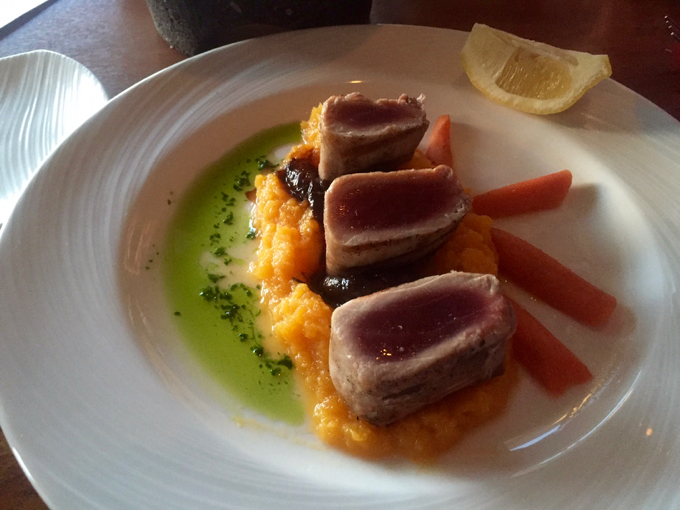
The ahi tuna at Monterey Tides is highly recommended. Photo/Susan Wood

Seeking a higher-level of culinary experience

The views continue to impress upstairs at the remodeled Vizcaino Waterfront Food + Drink, which made its debut on the fourth floor this year. Vizcaino was named after the Spanish explorer Sebastian Vizcaino, who in adding to Monterey’s extensive historical pedigree sailed into Monterey Bay in the early 1600s. The restaurant’s Spanish heritage was inspired with a tasteful décor, larger-than-life ocean view and one of its own at the kitchen helm — Chef Jose Velasquez.

“Chef started at the restaurant over 30 years ago and worked his way from dishwasher to the head spot in the kitchen. He brings his passion for the hotel and the food that he loves to cook to this exciting, new restaurant,” General Manager Brent McNally said.

The restaurant offerings for breakfast, lunch and dinner are innovative, influenced by the chef’s upbringing and, according to Monterey diners, attracts a local clientele.

The ahi tuna was perfectly seared and was delicious with the butternut squash lemon grass puree. And even for a red, the locally-grown Belle Glos Meiomi Pinot Noir paired well with the hardy tuna the server recommended.

The restaurant staff seems a bit rough around the edges, though.

Six interesting cocktails top the beverage menu, but the restaurant ran out of ingredients for two of them. What? Isn’t this Monterey? How about sending out a runner from the numerous staffers watching the open front door?

When asked about vegetarian options, the waiter’s response was: “I don’t know” — a cardinal sin to any restaurant. Apparently, for all the creative oomph the chef gives to the restaurant, he couldn’t have been asked to come up with a vegetarian dish thrown together at the spot? The 12-year server consequently pointed to the one vegetarian item on the appetizer list – the Jicama tacos. Albeit interesting with a beer-battered veggie tempura, they crumbled into a tray that a diner would question whether to eat off of.

At the start of the meal, it’s a nice touch the guacamole served with house made tortilla chips was made at the table – and came in a plentiful batch. Otherwise, the veggie-only diner at the table might have gone away hungry.

However, out of nowhere more than halfway into the meal, someone delivered bread to the table as if it was afterthought. Also forgotten was the beet salad – crisp and tasty – but heavier on the strawberries and lettuce than the main ingredient.

At the end of the meal, try dessert. The crème brûlée hit the spot for two.

A disorganized wait staff aside, the ocean view, décor adorned with old-style barn wood and quiet atmosphere add to pleasantries.
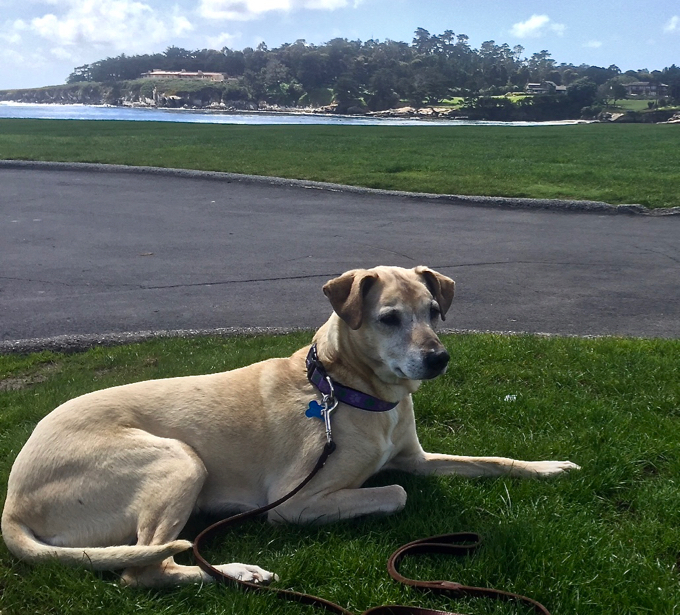
The Monterey area — even Pebble Beach — caters to dogs at hotels, parks and restaurants. Photo/Susan Wood

Monterey: It’s a dog’s life

Four-legged friends are not only welcome at the Monterey Tides, they thrive in and out of the hotel.

First, a welcome board with water and treat bowls for canines is set up near the front entrance. It’s definitely a sign of the times as more and more vacationers seek opportunities to travel with their pets.

Dogs at Monterey Tides have two playgrounds – one out the front door and another out the back. For the latter, watching a dog romping in the sand dunes is like returning to one’s childhood beach experiences.

Out front – which is situated next to Seaside State Beach, a pet area has been established for guests staying at Monterey Tides.

On the other end of the property, a ridgetop bike path that’s ideal for pedestrians giving their pet a change in scenery may take a walker south into town where a host of fun places to go and things to do await a Monterey visitor.

First on the list for a typical tourist is Monterey’s famed Cannery Row with Fisherman’s Wharf, named after its historic industry.

(Note: At Cannery Row, eat out at Louie Linguini’s for a tasty, pleasurable meal and feel free to take your pet.)

For those who appreciate the fine wines of Monterey County, venture into A Taste of Monterey for a flight of tastings by Cassie – who knows a multitude of varietals and wineries like the back of her pouring hand.
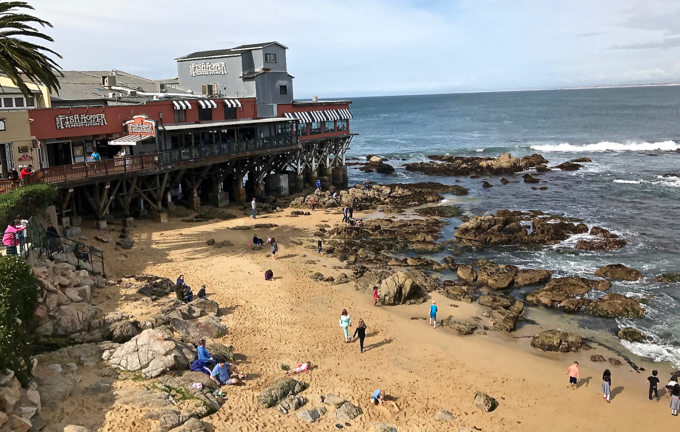
Several Monterey restaurants have outdoor dining with great views. Photo/Kathryn Reed

Out and about on the Central Coast

Beyond the world-renowned Monterey Bay Aquarium, many choices await a Monterey County visitor seeking activities besides eating, drinking and lounging.

Among them, cycling off Carmel Valley Road is always a favorite – with its scenic rolling hills dotted with barns, vineyards and quaint villages. If you’re without your bike, there’s no need to worry. Just call Bay Bikes Carmel off Carmel Valley Road, and they’ll accommodate you with a supply of road, mountain and cruiser bikes for reasonable rental rates.

Hiking is all the rage in the county. And this year’s wet deluge has made checking off waterfalls a sport. Fern Falls at the eastern edge of Garland Ranch Regional Park off of Carmel Valley Road to narrow, winding Hitchcock Canyon Road sets the scenario for one’s sense of adventure. (Note: You must register for a permit two days before from the Monterey Peninsula Regional Park District to enter the easiest way from the privately-owned Hahn Ranch trail easement.)

The 25-foot fall drapes the head of the box canyon and fills a small, crystalline pool at the foot of the cliff. Along the way, look out for newts, as the signs say they may be crossing. A babbling brook runs alongside most of the half-mile trail. 

This spring’s other notable quests with the wet winter are the wildflower hunts – with Monterey County write-ups promising a grand season.

Also at the midpoint of Garland Ranch, lupines abound on the 1.4-mile loop named after the colorful, purple flower.

The 3,464-acre park provides beautiful views and various terrains at the northern tip of the Santa Lucia Range. Terrain ranges from riparian forest to grasslands. Along the 50-plus miles of trails, historic landmarks such as farming and logging remains as well as homestead ruins dot the landscape.

Fern Falls at Garland Ranch Regional Park. Photo/Susan Wood

—–

If you go:

·      Monterey Tides is located two hours south of San Francisco off Highway 1 at 2600 Sand Dunes Drive; call 831.394.3321.

·      Garland Ranch Regional Park is located 15 miles east of Monterey and Carmel off Carmel Valley Road; call the Regional Park District at 831.372.3196.




Road Beat: Chrysler Pacifica — a new type of minivan

The Chrysler Pacifica is redefining what a minivan should be. Photos/Larry Weitzman

By Larry Weitzman

One could almost call the new Pacifica a CUV from where its namesake was pilfered when the prior Pacific model, a CUV, was discontinued, which was too bad as the later models of the prior Pacifica were great vehicles. The new Pacifica minivan has received plenty of fanfare and it is well deserved.

First, is its new innovative design, as it doesn’t quite look like a minivan. It is sleeker, with clever and unique design features such as the tight, sloping window line that is truncated with a reverse flow making the mini look mini. The Pacifica does not look full size, but it is and then some with a huge 122-inch wheelbase and a length of 204 inches. While it looks sleek and short, it isn’t; standing 70-inches tall. Perhaps that is due to its massive width of 80 inches.

Pacific dimensions make it the largest of all the minivans by an inch or two. Its siblings the Dodge Caravan and Chrysler Town and Country, while almost sharing the same wheelbase (the Pacifica is still a half an inch longer there, too), lack the massive track of the Pacifica by 3inches, as the Pacifica rides on one of the widest tracks in autodom at 68.3 inches. That pays dividends in handling.

Under its diminutive hood lies a transversely mounted familiar Chrysler 3.6L high tech, high output V-6 that knocks down 287 hp at 6,400 rpm together with 262 pounds of twist at 4,000 rpm. That engine is connected to a nine-speed auto tranny with a top gear that allows a cruise speed of 70 mph at just 1,600 rpm, meaning great road trip fuel economy.

Performance is outstanding with the Pacific knocking off 0-60 mph in a quick 6.79 seconds. Passing performance is also stellar with simulated runs of 50-70 mph on a level highway of 3.86 seconds and the same run up a six percent grade only slowing that time to 5.77 seconds. Those are numbers usually found in your high performance mid-size V-6 sedan. Towing capacity is a generous 3,600 pounds and its interior payload including 19 gallons of gas (about 120 pounds) is almost 1,600 pounds. That’s big.

Specifications
Price About $30,000 to about $45,000.
Engine
3.6L DOHC 24 valve V-6 287 hp @ 6,400 rpm
262 lb.-ft. of torque @ 4,000 rpm
Redline 6,400 rpm
Hybrid
3.6L DOHC 24 valve V-6 280 Est hp combined hp with the electric power
Battery
16 kWh Li-ion battery
Transmission
Nine-speed torque converter automatic
Configuration
Transverse mounted front engine/front wheel drive
Dimensions
Wheelbase 121.6 inches
Length 203.8 inches
Width 79.6 inches
Height 69.9 inches
Track (f/r) 68.3/68.3 inches
Ground clearance 5.1 inches
Cargo width at rear wheelhouse 48.8 inches
Maximum cargo height 47.6 inches
Total interior volume 197.3 cubic feet
Interior volume (behind first row, 2nd row, 3rd row) 140.5/87.5/32.3 cubic feet
Weight 4,330 pounds (hybrid 4,987 pounds)
GVWR 6005 pounds (hybrid 6,300 pounds)
Payload 1,675 pounds (hybrid 1,313 pounds)
Weight distribution (f/r) 55/45 percent
Tow capacity 3,600 pounds
Fuel capacity 19 Gallons (hybrid 17 gallons)
Wheels (std/opt/opt) 17X7/18X7.5/20X7.5 inches
Tires (std//opt//opt) 235/65X17//235/60X18//245X50X20 inches
Steering lock to lock 3.13 turns
Turning circle 39.7 feet
Drag coefficient 0.300
Performance
0-60 mph 6.79 seconds
50-70 mph 3.86 seconds
50-70 mph uphill (6%) 5.77 seconds
Top Speed Well into triple digits
Fuel economy 18/28/22 mpg city/highway/combined Expect 24-25 mpg overall in rural/suburban country driving. 35 mpg at legal highway speeds.

For the most part, while the nine-speed unit delivered ultra-smooth shifts, a couple of times it was a bit jerky and jumpy when trying to select gears when being quick on and off the throttle. Nail the throttle hard, even with traction control, it still will chirp the tires easily if not downright smoke them for a second. Lots of power here and it’s very responsive. Sometimes you can easily forget your driving a minivan. Maybe that’s a good thing as minivans, despite of their stigma, are the most practical vehicles ever made, especially with Chrysler and their stow and go seating giving you a flat floor in about 30 seconds and the cargo capacity of a small moving van. A Pacifica could be a costly and dangerous tool at Home Depot.

Now to its excellent fuel economy. EPA rates the Pacifica at 18/28/22 mpg city/highway/combined but the numbers achieved in my test of over 800 miles were much higher. At 70 mph on cruise control on a level highway in two directions for 30 miles the Pacifica averaged an amazing 35.4 mpg and the fuel computer is dead nuts on, I checked it. In a round trip to Los Angeles and back it averaged 28.5 mpg. But this wasn’t run at 70 mph, as if you don’t run at least 80 mph on Interstate 5, you’ll get run over by traffic. My average speed on the return which was non-stop for 391 miles achieved in 5 hours and 10 minutes was 76 mph, which means mostly driving at 80 mph and slowing for big trucks going into the passing lanes. Fuel economy was 28.6 mpg by the computer and by the fill-up (13.68 gallons). Part of that is due to the Pacifica’s wind cheating design which has a drag coefficient of 0.300.

So how does a big vehicle like this handle? Better than you would expect. Suspenders are four corner independent. Standard wheels and tires are decent with 17 x 7 inch alloys shod with 235/65 rubber but 18 x 7.5 inch alloys and lower profile 60 series tires are optional, something I might consider depending on price. Chrysler does offer a 20 x 7.5-inch wheel with 245/50 rubber, but I would stick with the 18’s for a better ride and quiet. The reality is the Pacifica is decent handling even when pushed thanks to its well sorted out suspenders and super wide and stable track. There is some body roll, but that’s to be expected when you get this kind of luxo ride quality. And making a 4,300-pound vehicle change directions is no easy feat (weight distribution is good at 55/45 percent front and rear) and Pacifica does it feeling a bit lighter on its feet.

When you consider its super compliant ride qualities and high comfort levels, Pacifica will surprise you again. And steering is reasonably quick at 3.1 turns lock to lock and its turning circle is under 40 feet. Did I mention there is no engine, wind or tire noise and if that isn’t enough it comes with Active Noise Cancellation.

Pacifica also comes with some serious disc brakes with large 13 inch rotors (fronts are ventilated). Of course, it has all the electronic wizardry including a 360-degree Surround View camera, forward collision warning plus, blind sport warning and all the other acronyms. Projector headlights were very good. HIDs are optional see below.

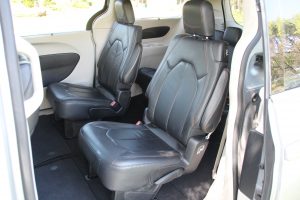
Now to the massive interior which has over 32 cubic feet behind the three place third row rear bench seat and a cargo volume of 140 cubic feet behind the first row very comfortable buckets. Second row is a choice of two buckets or a three-place bench. Either way, second row leg room is bigger than most limos. I would go with the bench unless you need separation with your children. Materials are first rate and the instrumentation complete. The cabin is extremely spacious with shoulder and hip room galore (even the third-row shoulder room is 61 inches), but it drives like it’s a mid-size car, feeling much smaller and lighter on its feet. How did they do that?

But I am not a fan of using a touch screen for all the functions of the radio, Nav, phone, climate and other media hookups. However, while the A/C info is pictured on the large 8.4-inch color screen (good for us Mr. Magoo types), the A/C system controls are easy with buttons and knobs and you don’t have to select the climate icon to operate. Thank Chrysler for small favors. I am sure any 10-year-old could operate the system better than moi.

Pricing for Pacifica starts for the LX at $28,995 to $42,895 for the super loaded Limited with four models in between, the Touring at $30,995, the Touring Plus at $32,360, the Touring-L at $34,995 and the Touring-L-Plus at $38,295. You will have to add $1,095 for destination to those numbers for the train and truck ride from Windsor, Ontario which is located across the Detroit River/Lake St. Clair from Detroit. I’ll make this easy. My driver was the Touring-L which had everything you want including leather seating, fronts heated, a comprehensive safety package and more. If an entertainment package, movies and stuff are necessary then you will have to step it up to the L-Plus. If you want Nappa leather, HID headlights and the stow and vac system and more then it’s the Limited. I’ll buy a good garage vacuum that could probably suck the interior right out of the van, never mind the dirt and dust and still go with the Touring-L. The Pacifica PHEV starts at $41,995 to $44,995.

If you are only driving to work and back with an under 40-mile round trip, then it might make sense as the battery is good for about 33 miles. But if you are making long road trips over 50 miles, go with the conventional model. The hybrid adds about 650 pounds to the weight of the Pacifica as well. Performance should be about the same as will highway fuel economy.

Larry Weitzman has been into cars since he was 5 years old. At 8 he could recite from memory the hp of every car made in the U.S. He has put in thousands of laps on racetracks all over the Western United States.