Road Beat: Alfa Romeo Giulia, a near luxury contender
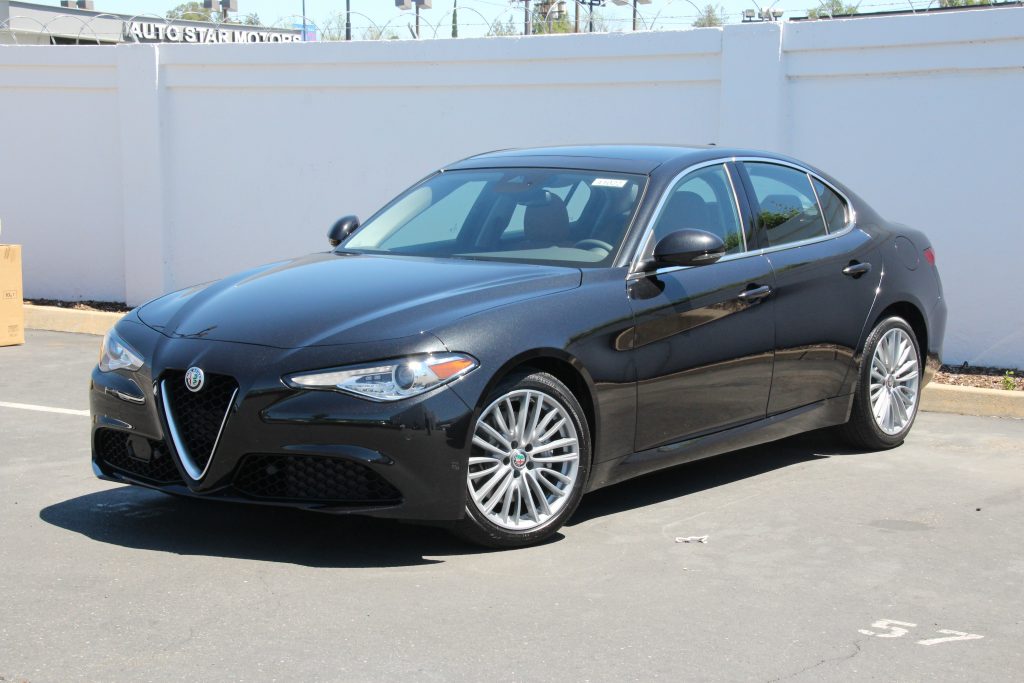
The Alfa Romeo Giulia is turning heads in the luxury car world. Photos/Larry Weitzman

By Larry Weitzman

One of the biggest markets in autodom is the near luxury segment comprised of BMW 2,3 and 4 series, Audi A3 and A4, Mercedes C class, Lexus IS, ES (ES is a front driver), Infiniti Q50 and Cadillac ATS. Alfa Romeo Giulia is the new, near luxury entry into this crowded, highly competitive field so it will take a dazzler to make an impact and, yes, the new Giulia is a dazzler.

It accomplishes this most difficult task with new style, performance and grace giving the discerning buyer a more difficult choice when selecting one of these somewhat practical rides that attempt to provide distinctive style, a dash of luxury, performance, ride, handling and fuel economy a cut above the mundane compact or mid-size automobile, like your run of the mill Camry, Altima and/or Accord.

All of the cars above do that, but with the addition of the new Alfa Giulia, the decision just got more difficult, if not downright unfair. Giulia is a stellar new ride with fabulous Italian styling which is sexier, sinewy, and muscular than the rest of the pack. Overcoming BMW is an extremely difficult proposition with its “ultimate driving machine” reputation, but if any car can do it, Alfa Giulia might be the one. And here’s why.

I have written about the Giulia Quadrifoglio, which is a $70,000 super car version of Giulia that has real, out of the box race track capabilities starting with its 505 hp V-6 turbo engine. The regular Giulia, which is nearly identical to the Quadrifoglio except for the engine, has a starting price for us mere mortals at $37,995. Giulia comes with a no-excuses 2.0L turbo, direct injected inline four that cranks out a substantial 280 hp at low 5,200 rpm and whopping 306 pounds of twist starting from 2,000 rpm. Those numbers mean instantaneous response, especially with the 8-speed auto tranny which shifts like a dual clutch although it uses a torque converter of which engineers are making great strides in feel and efficiency, witness this Alfa.
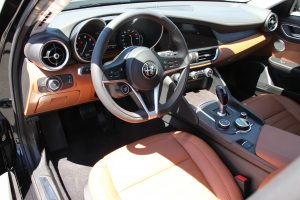
There is no skimping on comfort with the Alfa Romeo Giulia.

My too short of a drive (a couple of hours instead of the half an hour would have been better) demonstrated why this new Alfa is the benchmark in this class of near luxury, premium cars as they like to be called. Performance is at the top of the class with a reported 0-60 mph time of 5.1 seconds from major mags. Response is tremendous at 10 mph or 70 mph. It is the smoothest vehicle as well with an absolutely turbine like feel and a deafening quiet not found in the others. For 99.9 percent of the drivers, the V-6 will supply superfluous power and performance, especially with 306 pounds of torque available with this standard four at just 2,000 rpm.

Fuel economy is rated at 24/33 mpg city/highway, but the Giulia showed just 1,600 rpm at 70 mph when loafing down the highway, which should yield perhaps better than 40 mpg. Hopefully I will get a Giulia shortly to affirm my suspicions. Otherwise those EPA numbers are about average for the class and for that matter it would be about the only thing “average” about the Giulia.

Incredible handling is the result of an advance suspension system with double wishbones up front with a multilink system in the rear, instead of the lesser up front MacPherson struts found elsewhere. One drive, one good corner and you will feel the confidence. As mentioned above, the ride is extremely quiet and smooth.

Inside is the trick Alfa IP, all business with Swiss watch like precision and a proper starter button on the steering wheel, like many race cars. The standard leather interior is sublime and the saddle tan of my tester was gorgeous as well as comfortable with excellent rear seat comfort and legroom provided by the Alfa’s huge 111-inch wheelbase. For a car, just 183 inches long it is a true long distance four passenger car with the 74-inch width, it provides massive shoulder and hip room.

And then there is the voluptuous styling, nothing else comes close to standing out as the looker of the class with curvaceous lines and rippling muscles with perfect proportions including the modern rendition of its timeless and distinctive signature grille. Even the badging is best in class. This makes other near luxo rides mundane, banal, clichéd and ordinary. My adjectives might be repetitive, but worthy. As I said before, the Alfa Romeo Giulia has the panache to elevate it above the others.

Larry Weitzman has been into cars since he was 5 years old. At 8 he could recite from memory the hp of every car made in the U.S. He has put in thousands of laps on racetracks all over the Western United States.


Letterpress studio tour, reception and workshops

Tahoe Letterpress will open its doors for a studio tour and reception on June 16, 5-8pm.

Located at Bona Fide Books in Meyers, the print shop will offer hands-on demonstrations and free hand-printed souvenirs to take home. The event is free and open to the public.

Tahoe Letterpress began informally in 2014 when letterpress printer Steve Robison moved from the Bay Area to South Lake Tahoe with his wife, the book artist Karen Cutter. Bona Fide Books publisher Kim Wyatt had an interest in letterpress, and partnered up with Robison to start the print shop and offer monthly workshops to the public.

Now a working print shop, the mission of Tahoe Letterpress is to provide a letterpress print facility to the public, teach interested people how to use it, encourage individual creativity and build a thriving print community in the mountains of Lake Tahoe. Fun vintage equipment includes platen presses dating to the 1800s, as well as more modern sign presses.

The centerpiece of Tahoe Letterpress is a collection of handset type housed in four wooden type cabinets. The type comes from the Virginia City Territorial Enterprise, the voice of the west during the Comstock era. “Mark Twain was a reporter and editor there and might have even touched this type,” says Robison with a smile.

The recent addition of a Golding Pearl flywheel platen press will expand opportunities for printers. Robison, who has been letterpress printing for more than 50 years, encourages anyone interested in letterpress to come out and “pull a proof.” The art of letterpress printing is more than 500 years old, and he believes the hands-on tactile experience of yesteryear is part of the draw to letterpress printing.

Tahoe Letterpress will offer a four-hour introduction to letterpress workshop June 17, July 22 and Au. 19th. In these workshops, students learn how to use a composing stick, set type and print cards or broadsides. The workshop fee of $50 includes open studio time to work on personal projects.

Sign up online or call call 530.545.1373. Bona Fide Books is located at 1069 Magua St., No. 4, Meyers.


Scientist to talk about benefits of tracking fish

Pete Klimley, director of the UC Davis Biotelemetry Lab, will give a lecture about the sensory physiology in orientation, predator-prey interactions, ultrasonic tracking and telemetry.

Sharks, sturgeon, trout, and other species can be tagged with acoustic transmitters so that they can be detected and tracked. The UC Davis Biotelemetry Laboratory uses simple beacons, which transmit pulses at a fixed rate and are used to identify the presence of an animal, and telemetry transmitters, which can be equipped with sensors for depth, speed and temperature.

These can be used to examine species abundance, movement, feeding habits, diets, residence patterns, and more.

The talk will be June 27 at 6pm at the Tahoe Environmental Research Center in Incline Village. Seating is open at 5:30pm to guests who have preregistered, open seating starts at 5:50pm. Cost is $5. Go online to register.


New app may help Nevada drivers

By Art Marroquin, Las Vegas Review-Journal
 
Drivers could help assemble a map of Nevada’s roads and warn fellow motorists about potential collisions, all through a smartphone app.

The Nevada Center for Advanced Mobility will announce today an attempt to build the first statewide vehicle-to-vehicle network in the United States by encouraging drivers to download a dashcam app developed by Israeli startup Nexar.

The goal, both sides said, is to use crowd-sourcing information as a way to bolster safety and determine “hot spots” where accidents are most likely to happen throughout the state.

Read the whole story


OneJustice bus helps Truckee’s most vulnerable

By Ally Gravina, Moonshine Ink

Becoming a United States citizen technically involves four steps: you must complete an application, appear for a biometrics appointment, attend a naturalization interview, and take an oath. However, each of these steps requires more preparation than simply showing up to the interview or filling out an application. It takes hours of studying, practice tests, and fees.

This spring, 14 law students and five immigration attorneys drove from San Francisco to Truckee in the OneJustice bus to volunteer their time and help 30 community members with one-on-one consultations about immigration programs and naturalization.

OneJustice is a 501(c)3 nonprofit that functions as an innovation lab for legal services. Since 1979 they have prided themselves on providing creative problem-solving and design approaches to increase legal services for those in need.

Read the whole story


Community responds to teenager’s letter

By Marie Wilson, Daily Herald

A Naperville North High School student touched a nerve and sparked a communitywide conversation when she posted an online petition seeking to change the “pressure culture” at her school.

That culture defines one narrow route to success and shames all who can’t or don’t want to follow it as failures, while instilling the belief “there is no worse fate than failure,” junior Tessa Newman wrote late one night after one of her peers died by suicide.

She thought her petition would draw a perfunctory “thank you for sharing” and not much else from the school administration. But she underestimated the stir her words would create.

Read the whole story


Artist to give lecture, workshop at LTCC

Artist Erin Whitman will be at Lake Tahoe Community College or two days of events in June that the entire community is welcome to attend.

Whitman will present a lecture about her work and artistic inspirations on June 8 at 6pm in LTCC’s board room. She is also hosting a hands-on demonstration of her work on June 9 from 2-5pm in Room F101, located in the Fine Arts building.

Both events are free.

Whitman teaches painting at Cuyamaca College in Rancho San Diego. Her more recent artistic work involves large-scale paintings that explore the American landscape.


The expedition that forever affected Tahoe resources

By Abby Stevens, Moonshine Ink

Ever wonder why Lake Tahoe is split down the middle, with one half in California and the other half in Nevada? Are the two states just that good at sharing? The history of the split dates back to the 1840s and the early explorers of the American West, when mapmakers were beginning to chart the unknown territory, and California joined the Union as a state.

Lt. John C. Fremont, an American military officer and later a candidate for the U.S. presidency, was tasked with the first of three government surveying expeditions in 1843, according to the Truckee-Donner Historical Society. His team spent nine months charting the Northwest before finally heading south and coming upon the friendly Paiute tribe that camped on the land by Pyramid Lake, the geographical sink of the Truckee River Basin that sits 71 miles northeast of Lake Tahoe.

Sarah Winnemucca, granddaughter of the chief of the Paiute tribe at the time, writes of the meeting in “Life of Among the Piutes,” “My grandfather met [Fremont], and they were soon friends … Capt. Fremont gave my grandfather the name Capt. Truckee, and he also called the river after him. Truckee is an Indian word, it means all right or very well.”

Read the whole story


Ceremony in S. Lake Tahoe on Memorial Day

The American Legion Post 795 of South Lake Tahoe with members of the American Legion and the Ladies Auxiliary will be hosting the Memorial Day ceremony at Happy Homestead Cemetery on May 29. 

The ceremony will take place at 11am at 1261 Johnson Blvd.

After the ceremony, the public is invited to join Legion and Auxiliary members for cake and refreshments at the American Legion Hall on Highway 50.

Originally known as Decoration Day, Memorial Day originated in the years following the Civil War and became an official federal holiday in 1971.

Members of the Auxiliary will be collecting donations for poppies, which have become a symbol of Memorial Day. On May 26, beginning at 11am, Auxiliary members will be stationed at Grocery Outlet in South Lake Tahoe.

Happy Homestead is the final resting place to more than 560 veterans.


Road Beat: Tesla’s house of cards

By Larry Weitzman

There is an adage in the auto industry, especially among car dealers: “We lose money on every car, but we make it up in volume.” Obviously, if you sell your cars or any product at a loss, more volume just magnifies the loss. That appears to be the business plan of Tesla Inc. (formally known as Tesla Motors), the maker and seller of the much-heralded Tesla electric car.

Now connect the first adage with the dot com bubble saying that in the late 1990s as tech companies were losing ever more money, their stocks prices climbed, the bigger the loss, the bigger the stock price gain and you have the Tesla business model. It is the current description of what is happening to Tesla.

Tesla earnings for the first quarter of 2017 was a loss of $330 million on just $2.7 billion in sales. In the almost five years that the Model S has been in production, Tesla has had only two profitable quarters, which profits were achieved by the sale of fictitious zero emission vehicle credits to other manufacturers. For all prior quarters, Tesla has never made a profit from the sale of their cars which income included the sale of ZEV credits.

In fact, in those two “profitable quarters, the first quarter of 2013, Tesla had earnings of just $11 million but their income included $85 million in ZEV credits so their loss on car sales was in fact $74 million and in the third quarter of 2016 when Tesla reported a profit of $22 million, ZEV credit sales totaled $139 million meaning the loss on car sales was about $117 million.

But the stock continues to climb from about $40 a share in early 2013 when I first wrote about this house of cards and its inability to earn money because electric cars are too expensive and impractical (range anxiety and refueling anxiety) to a current $310; the all-time high was $325. That without the government mandating electric cars and government subsidies, electric cars cannot compete with conventional cars.

Now with that huge loss in the first quarter this year, Tesla stock has climbed to over $300 a share. Tesla’s market cap (total value of its stock) now exceeds the value of GM and Ford. And that begs a question. How many cars did Tesla sell last year (answer: about 76,000). GM and Ford sold about 8 million and 6.7 million cars, respectively. GM earnings for the last five years’ total about $32 billion and for Ford it was about $30 billion. Tesla has lost over $2 billion over the same period and without ZEV credits that loss would have been $600 million more and federal tax credits to buyers totaled about $300 million (state credits would add another $50 million to $100 million as California alone has paid out $38 million), so without direct government help, Tesla losses would have totaled about $3 billion.

Looking at it another way, according to AutoNews, last quarter, GM earned a profit of $1,418 and Ford $1,174 for every car they sold throughout the world. Tesla lost $15,855 for every car it sold. And the market cap of Tesla is about equal to Ford or GM? And we haven’t every discussed the hard assets (land and buildings) of each company. Something doesn’t make “cents” here.

And it’s not like Tesla has some patent or proprietary information. GM is already producing a pure EV, the Chevy Bolt that has a range of about 230 miles with terrific reviews and it retails for about $40,000. Tesla’s not yet in production Model 3 is alleged to have a price of $35,000, but insiders tell us that all Model 3s will sticker for $50,000 or more as they will come optioned up. And even if the price were $60,000, it is questionable whether at that $60K price Tesla will make any money on the Model 3. GM is losing money on the Bolt as well, but their other profitable production allows them to do so. In other words, other GM customers are subsidizing the Bolt.

Tesla’s average sale price is about $108,000 and considering its loss per car, it would need an average sales price of $125,000 per car to break even. Most buyers receive $10,000 back in federal and state tax credits that you pay. Tesla’s most expensive car is the P100D at $140,000 (price went up in the last few weeks from $134,500) and the Model X starts at, $82,500 and goes up to about $100,000 for the 100-kWh Model X. However, the base model S 75D starts at $70,000 going up to $97,500 for the 100D.

If you talk to most people on the street, they believe batteries are improving. The reality is they are not. Battery technology and chemistry is essentially the same for the Tesla sports car of ten years ago, as it is today for the Model S and X. The key word here is chemistry which describes what a battery is, a chemical reaction. There is nothing new under the sun and there is nothing in the foreseeable future to change that unless a new element is discovered which shall be named “Unobtainium.”

Without government mandates and subsidizes, Tesla would have folded years ago, just as other start up battery car companies have done and the Baker Electric car did which owned the car market in 1902. When government subsidies terminate such as the tax credits and ZEV credits, Tecla’s prices will have to increase by as much as $30,000 per vehicle. According to Strategic Vision, Tesla buyers now have an annual average income of $320,000. With respect to Tesla, the poor and middle class are subsidizing the wealthier.

And Elon Musk, who made his first millions selling PayPal to EBay, and who owns about 27 percent of Tesla is now worth over $10 billion. I hope he cashes in on a billion or two while he can.

The problem for any electric car is that batteries do not have sufficient energy density to compete with gasoline or diesel and the refueling process of batteries is time consuming and cumbersome and if everyone used electric cars, without nuclear energy producing the power, the cost per mile for electricity would probably be more expensive than gasoline. And right now, many utilities are subsidizing EV energy costs, meaning that you are paying for that, too.

Let’s hope if and when Tesla folds, we do not hear politicians claiming “It’s too big to fail.”

Larry Weitzman has been into cars since he was 5 years old. At 8 he could recite from memory the hp of every car made in the U.S. He has put in thousands of laps on racetracks all over the Western United States.