Road Beat: 2017 Hyundai Elantra Sport, emphasis on Sport
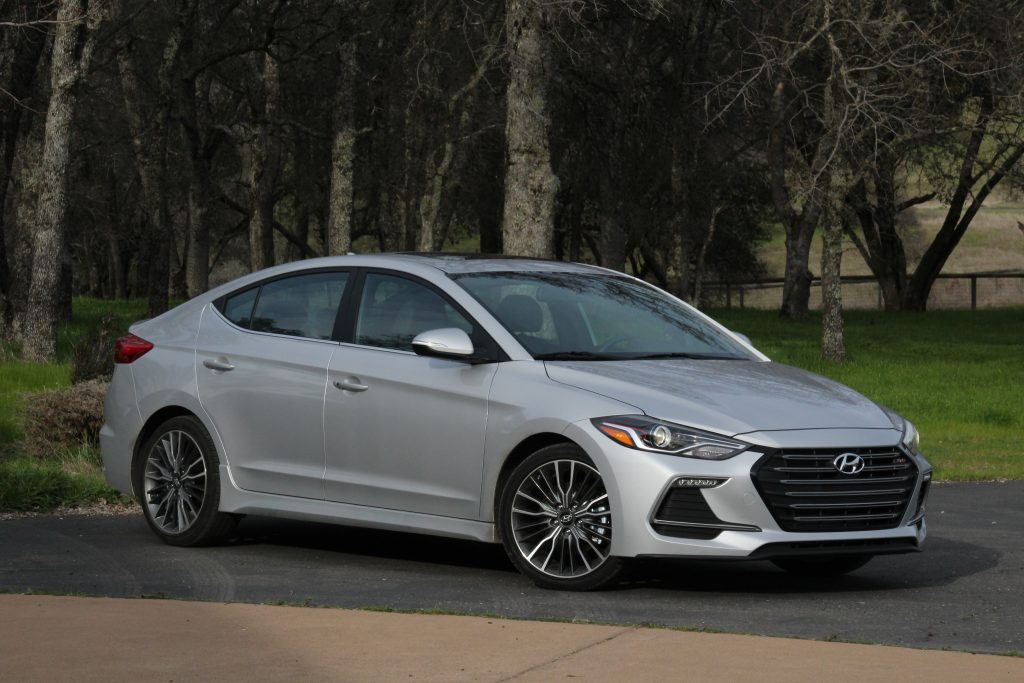
The Hyundai Elantra Sport is fun to drive. Photos/Larry Weitzman

By Larry Weitzman

Most new vehicles with a sport designation are in name only, but not the Hyundai Elantra Sport, which actually means something with respect to the car so named. The Elantra is a highly competitive, grown-up quality compact and the Sport version definitely adds to the driving experience with a more engaging, dynamic feel.

Instead of just adding dress up “sporty” items like red stitching, aluminum pedal applications and better seat bolstering, this Sport adds a whole lot more. First, is the thick, leather flat bottom steering wheel, a pleasure to hold, a more business like gauge cluster and a black headliner. But even more important is the Sport drivetrain and significant steering and suspension upgrades.

The Elantra body is in its best rendition yet, sleek, sporty and defined by its aggressive front grille and slick top line (its only 56 inches high). It is a great looking car with a length of 180 inches and a width of 71 inches also giving it a wide stance.

Powering the Elantra Sport is a high-powered version of the 1.6L direct injected turbo inline DOHE, 16 valve four, knocking down 201 hp at 6,000 rpm and 195 pounds of twist from an off idle 1,500 to 4,500 rpm. This is unquestionably the most powerful Elantra ever. Standard is a six-speed manual but for about a grand more you can get it with a seven-speed dual clutch auto cog-swapper. I would go with the seven-speeder even though my tester was an unbelievably smooth pure manual six-speeder. The DCT gets a four mpg higher EPA fuel economy rating. The manual tranny was so smooth, most up shifting could be down without the clutch.
Specifications
Price $21,650 to about $26,110
Engine
1.6L DOHC, 16 valve direct injected turbo inline four 201 hp @ 6,000 rpm,
195 lb.-ft. of torque at 1,500-4,500 rpm
Transmission
Six speed manual
Seven-speed dual clutch automated manual
Configuration
Transverse mounted front engine/front wheel drive
Dimensions
Wheelbase 106.3 inches
Length 179.9 inches
Width 70.9 inches
Height 56.5 inches
Track (f/r) 60.8/61.4 inches
Ground clearance 5.5 inches
Fuel capacity 14.0 gallons
Trunk capacity 14.4 cubic feet
Passenger cabin volume 95.8 cubic feet
Weight 3,042-3,131 pounds
Steering lock to lock 2.6 turns
Turning circle 34.78 feet
Wheels 18 inch alloys
Tires 225/40X18
Coefficient of drag 0.31
Performance
0-60 mph 6.47 seconds
50-70 mph 3.04 seconds
50-70 uphill 4.11 seconds
Top speed Well into triple digits
Fuel economy EPA rated at 22/30/25 (manual) 26/33/29 (automatic) mpg city/highway/combined. Expect 30-34 mpg in rural country driving with some stop and go. 39 mpg on the highway at legal speeds.

Suspension gets more than just a few tweaks like increased spring and shock rates, a rear stab bar (regular Elantras get front stab bars already, but the Sport front stab bar is thicker) and an entirely new rear suspenders going from a semi-independent coupled torsion beam to a fully independent multilink system. But there is more. Sport also gets a new exhaust system. It is the best sounding four banger in its market class. I didn’t know it until it drove away from my home, as inside it’s still very quiet. But Sport will certainly let the person you are passing the Sport is something special.

How quick and special; the Sport will scamper from 0-60 mph in 6.47 seconds. The DCT might break into the fives. Fifty to 70 mph simulated passing runs on a level highway required just 3.04 seconds and up a steep grade only slowed that time by a second to a miniscule 4.11 seconds with all runs being done in third gear. This is about the quickest compact ever tested by the Road Beat, a car with a base price of $21,650. Throttle response is amazing after 1,500 rpm, even in six gear when it will accelerate without much complaint. Very flexible. It is also one of the quietest and smooth four bangers ever encountered. And as mentioned it makes beautiful music on the outside. This sports absolutely rocks. It’s a box stock car that would be a blast on a racetrack. More on that below.

Sport is an economy vehicle as well even though the EPA numbers say otherwise at a 22/30/25 mpg city/highway/combined rating. In my first 180 miles of driving a fill-up showed the Sport achieved 29.4 mpg and that included all performance testing (at least two dozen full throttle runs) and a trip over the Sierras via Highway 50 to Carson City. The mileage for the round trip was 37.6 mpg. At 70 mph on a level highway the Sport averaged 38.6 mpg and a round trip from Placerville to Roseville with moderate stop and go driving and no mileage on a freeway, the Elantra Sport average 34.7 mpg. I would think the DCT would average about three more mpg. No guilt for this high-performance driver.

Handling is also spectacular. You already know about the trick suspension. Wheels are 18 inch alloys shod with big, wide 225/40 series rubber. Add to that one of the best electric steering racks with incredible off and on center feel and an almost like hydraulic feel that is super quick at 2.6 turns lock to lock. Turn in is extremely quick and it responds with cat-like reflexes. Nothing like having great roll control, communicative steering and copious rubber on the ground. Sport gives you all that in spades with light weight (3,042 pounds) and when you couple that with big, down low power, Sport would be a blast on a racetrack. It makes weekday commuting fun and your weekend track days better. All in one package in which you will never have to buy that expensive fuel at the race track. A full tank might outlast your tires. I have had a Genesis Coupe on the track with a 201 hp four banger turbo engine and I think this Elantra Sport would be its equal, easily.

And then there is the firm ride quality, helped by its bank vault like structure. While supple and compliant, it is extremely well controlled, making the ride feel on the firm side, but a good firm, my kind of firm. While I talked before of its raucous exhaust, it is very quiet inside. The engine spins a high 2,700 rpm at 70 mph so it has good six gear power, a seventh gear dropping that to say 2,300 rpm might even make the cabin more serene and improve highway mpg by an mpg or two. But even at 2,700 rpm in sixth gear, there is no engine, road or wind noise.

Safety of course also makes the Elantra Sport a first place car with all the acronyms including blind-spot detection with the $2,400 package. Brakes are four wheel discs (enlarged front ventilated with one foot rotors) and they are powerful with a strong pedal.

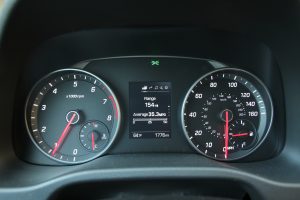
Another first place for this Sport is in the leather interior and well bolstered seats with red stitching everywhere. Nice. The seats are manually adjustable, however. The exclusive Sport instrument binnacle is a nice touch with a big tach/speedo and center info system. The center stack is a model of simplicity and the NAV system with the Premium Package and bigger eight-inch screen is a great addition.

Trunk is a large 14.4 cubic feet and while the Sport looks like it might have a hatchback design, it isn’t. The rear seat is quite usable and comfortable for two, less so for three.

Pricing for this well-equipped Sport begins at a modest $21,650 plus $835 for the boat ride from Ulsan, South Korea. The Premium package, which I recommend, adds another $2,400 and the carpeted floor mats adds another $135 bringing the total damage to a very reasonable $25,010. If you opt for the seven speed dual clutch automated manual, which I would also do, that will add another $1,100. This is the best Elantra yet and easily contends as the best compact right up there with the Mazda 3. Elantra Sport is a truly fun economical driver that can save you money during the week providing superb, fun transportation while also giving you some real weekend exhilaration.

Larry Weitzman has been into cars since he was 5 years old. At 8 he could recite from memory the hp of every car made in the U.S. He has put in thousands of laps on racetracks all over the Western United States.


Tahoe Tails — Adoptable Pets in South Lake Tahoe

Benji

Benji is a 2-year-old Basenji-Shiba Inu mix, as best we can tell. He weighs about 15 pounds, and is a little shy to start. He soon warms up and is very affectionate. He also barks a bit in the kennels, but he is quite sweet when taken out and he wags his tail constantly.

Benji is neutered, microchipped, tested for heart worm, and vaccinated. He is at the El Dorado County Animal Services shelter in Meyers, along with many other dogs and cats who are waiting for their new homes. Go to the Tahoe animal shelter’s Facebook page to see photos and descriptions of all pets at the shelter.

Call 530.573.7925 for directions, hours, and other information on adopting a pet. For spay-neuter assistance for South Tahoe residents, go online.

— Karen Kuentz


Struggle for women to enter the military

By Elizabeth Cobbs

In 1917, U.S. Secretary of War Newton Baker disliked the idea of female workers on Army bases so intensely that he didn’t even want to build toilets for them. They might tarry. Females did not belong in the Army, Baker thought, though the more forward-thinking Navy already had welcomed women into its ranks to replace men in landlubber assignments.

Many adventurous and patriotic young women longed to defend their country during the Great War. They discovered that if they wanted to serve in uniform, they could not merely perform as well as the young men in the American Expeditionary Forces, who sailed to Europe in 1917 to help the Allies defeat the Germans. Women, still denied the vote, would have to perform better. They would have to do something the men could not. America’s ongoing Industrial Revolution gave the “Hello Girls,” as the first female recruits came to be known, their opportunity to serve the nation and earn full rights as citizens.

In May 1917, the month after Congress declared war on Germany, Gen. John Pershing sailed for France. He stuffed his ship’s hold with the newest technologies: Military tackle had undergone a revolution since Pershing served in the Indian wars of the 1880s. Planes had replaced horses. Trucks had overtaken mule trains. Telephone wires had outrun flares and semaphore flags.

Invented in the United States, American telephones reached farther, conveyed more messages on the wire, and reproduced sound with greater fidelity than telephones anywhere else in the world. They were the only military technology in which America enjoyed superiority over both allies and enemies. When the British commanding officer in World War I used an American-built line to place a call from France to England, he exclaimed, “Would you believe it? They actually recognized my voice in London before I told them who I was!”

Commands to advance or retreat, and to fire or stand down, were relayed by phone during the Great War. If America was going to position its immense armies quickly and effectively, it needed experts to handle this critical technology. “The importance of intercommunication in warfare cannot well be exaggerated,” wrote Brig. Gen. George Squier, chief signal officer for the U.S. Army Signal Corps. Without communications for even an hour, “the whole military machine would collapse.”

At home, telephone operating was sex-segregated. Callers rang female operators, who connected nearly every call made. Their job was demanding. With hands darting like hummingbirds, operators connected hundreds of impatient callers each hour. Diligent and quick, they talked with customers while manipulating plugs in a constantly changing pattern.

When Pershing arrived in France, he found male recruits ill-suited for this work. They were inefficient, and prone to frustration when dealing with rude callers. Few doughboys possessed the foreign language skills necessary to cooperate with French telephone operators when making long-distance connections. Necessity required innovation, so Pershing—an innovative thinker who had been nicknamed “Black Jack” after he commanded an African-American regiment on the frontier—departed from precedent, law, and the wishes of the Army itself to recruit women. Before most doughboys arrived, and well after they left, bilingual women served in France. They withstood submarine warfare, cannon fire, influenza, aerial bombardment, and petty-minded bureaucrats to send the word, over there.

Most worked behind the lines in safer regions of France. But one small group, led by Grace Banker, a 25-year-old graduate of Barnard College, followed Pershing from the short but intense Battle of St. Mihiel to the desperately extended Meuse-Argonne Offensive, lasting 47 days. The women ran switchboards 24 hours a day within range of artillery fire that lit up the horizon and shook their equipment. Enemy planes buzzed overhead. A German prisoner of war overturned an oil stove and burned their barracks to the ground. Yet the indomitable women embraced every challenge. The highest aspiration of nearly every female Signal Corps member was to serve as near the battle as possible.

Their efforts, along with those of female Army nurses and private volunteers, helped shape another great debate: whether or not to grant women the vote. World War I altered expectations about citizenship globally. Not only did the Russian, Ottoman, Austro-Hungarian, and German Empires fragment into a dozen new nations, but cracks also ran under the British, French, and Dutch Empires as diverse peoples claimed a right to popular sovereignty. Within older democracies, groups who never had much voice raised theirs with new conviction.

Women, in particular, leveraged the conflict for suffrage. By war’s end, Australia, Canada, Denmark, Finland, Germany, Great Britain, New Zealand, Norway, Russia, Sweden, and 10 other countries had enfranchised females. Not surprisingly, the nation latest to the war was also late to the vote. Accustomed to congratulating itself as the vanguard of democracy, the United States brought up the rear. Its suffrage movement had struggled for 70 years without producing victory. Founders like Susan B. Anthony and Elizabeth Cady Stanton died without seeing their life’s work fulfilled.

But the war—and female recruits’ efforts in battle—changed the mind of one crucial U.S. leader: President Woodrow Wilson. Prior to his election in 1912, he told an aide that he was “definitely and irreconcilably opposed to woman suffrage; woman’s place was in the home, and the type of woman who took an active part in the suffrage agitation was totally abhorrent to him.”

Six years later, at the height of American fighting in France, Wilson told the U.S. Senate that the women’s vote was vital to the “realization of the objects for which the war is being fought.” He hoped America might eventually organize an enduring democratic peace, guaranteed by a League of Nations. But how could the United States lead the free world if it was behind everyone else? Once women’s suffrage was entangled with Wilson’s foreign policy goals, it became necessary, not discretionary. The president made two arguments: The United States could not hold itself aloof from world opinion, and women had amply earned the privileges of citizenship.

“Are we alone to refuse to learn the lesson?” he asked the conservative Senate. Wilson made scant reference to suffragists in his speeches to Congress. Militant activists continued to irk him. But he had come to admire female citizens doing their duty “upon the very skirts and edges of the battle itself.” The war could not be fought without them. “Are we alone to ask and take the utmost women can give—service and sacrifice of every kind—and still say that we do not see what title that gives them?” the president asked. “Shall we admit them only to a partnership of sacrifice and suffering and toil and not to a partnership of privilege and of right?”

When the war ended on November 11, 1918, Grace Banker received the Distinguished Service Medal for assuring “the success of the telephone service during the operations of the First Army against the St. Mihiel salient and the operations to the north of Verdun.” Only 18 out of 16,000 eligible Signal Corps officers received the medal. Grace Banker was one of them. Thirty other women received citations for “exceptionally meritorious and conspicuous services” in the war zone.

Sadly, such recognition was transitory. Once operators returned home in 1919 (two died in France), the Army denied them veterans’ bonuses, victory medals, hospitalization for disabilities, and even a flag on their coffins. As a result, the Hello Girls commenced a new struggle for recognition as veterans that eventually caught the second wave of feminism. In 1979, assisted by the National Organization for Women, thirty-one survivors received their World War I Victory Medals at last.

Yet, every Hello Girl had the satisfaction of knowing she had demonstrated women’s willingness to fulfill the hardest duty of citizenship. As testimony in the Congressional Record for 1918 and 1919 shows, the men who helped pass the Susan B. Anthony Amendment—which finally gave women the right to vote—understood this, too.

“Women have performed more than their part in this great struggle for democracy, freedom, and liberty,” Sen. William Thompson said, echoing many others. In the United States, France, and England, female citizens had produced food, guns, ammunition, planes, and trains. They loaded baggage, drove trucks, operated switchboards, and were ready, “if necessary, to shoulder the gun and march to the front themselves.” Thompson had traveled throughout the war zone. Women, he found, were praised everywhere.

Women’s activism laid the basis for women’s suffrage. World War I secured it. The Hello Girls fought on both fronts.

Author of “The Hello Girls: America’s First Women Soldiers,” Elizabeth Cobbs is the Melbern Glasscock chair at Texas A&M and is a research fellow at Stanford’s Hoover Institution.


Auditions for ‘Nightfall with Edgar Allan Poe’

Proscenium Players Inc. of Carson City is having open auditions for the fall production of “Nightfall with Edgar Allan Poe” by Eric Coble.

Male casting is for four men between the ages of 45-50, two men in their 60s, and one man between 20-30. Female casting is for one woman (or male) 18-30 and 1 woman between 45-50.

Auditions will be cold reading on May 31 at 6:30pm, and June 3 at 11am if necessary.

This production is scheduled for eight shows at the Brewery Arts Center. Performance dates are Sept. 15-17, Sept. 22-24 and Sept. 29-30.

All cast and crew members are required to become PPI members before the first performance.

For more information, to online.


Barton providing physicals for local student athletes

Barton Family Medicine and Barton Community Health Center will provide local student athletes a free sports physical on June 5 at South Tahoe High School.

All high school, middle school, and Pop Warner athletes from the South Tahoe area are eligible to attend the event. Physicals are scheduled at 5:30pm for South Tahoe athletes, 6pm for Pop Warner football players, and 6:30pm for Whittell athletes.  

Students should dress in gym attire and bring their completed (and signed) medical history forms. Forms may be picked up in each school’s front office or through the student’s Pop Warner football coach. A parent or guardian must be present at the physical.

Contact Sue McLaughlin at 530.543.5615 for more information.

The free sports physical does not replace an annual preventative exam. To schedule an annual preventative exam and sports physical, call Barton Family Medicine at 530.543.5660 or Barton Community Health Center at 530.543.5623. Most insurances are accepted and the annual preventative exam may have a copay. 


U.S. workers gave up half of their vacation days last year

By Julia Horowitz, CNN Money
 
Are you dreaming of a summer vacation you know you won’t take?

It’s not just you.

Most U.S. employees don’t use all of their vacation days, and those who do take a break are increasingly likely to work while doing so, according to a report by job site Glassdoor.

Only 23 percent of workers surveyed said they used all of their paid time off in the last 12 months. The average U.S. worker leaves almost half of his or her vacation days on the table.

Read the whole story


Interactive experiences seen as big part of casinos’ futures

By Wayne Parry, AP
 
Getting new customers involved in more interactive experiences is going to be a big part of the future for casinos in the United States and around the world, participants in a major gambling conference predicted Wednesday.

Casino executives, digital experts and payment processors at the conference in Atlantic City agreed casinos need to offer new experiences that directly involve the next generation. This involves new, non-traditional products such as competitive video game contests, skill-based slots, and daily fantasy sports and sports betting in states that allow it.

These would allow casinos to bring in new customers and revenue, the executives and experts said.

Read the whole story


Callie Goodenough — 1938-2017

Carolyn “Callie” Clark Goodenough

A celebration of life for Carolyn “Callie” Clark Goodenough will be June 4 at 3pm at Camp Galilee in Glenbrook.

Callie died from Alzheimer’s complications on Jan. 9, 2017.

She was born on Aug. 27, 1938, in Albuquerque, N.M., to John and Nell Graham. She was the oldest of three children, and, according to her sister, the most mischievous.

The family moved around a bit, finally settling in Newport Beach. Callie earned her bachelor’s degree in elementary education from San Diego State University.

Callie married Phil Sutton in 1962 and had two children, Casey and Scot. She later married Ray Goodenough in 1974.

Callie left the busy city life of Southern California and moved to the beautiful mountains of Lake Tahoe. Once in Lake Tahoe, Callie and Ray founded the Sierra Council on Alcoholism. It was a residential facility where men and women struggling with alcoholism could go for camaraderie, strength, and support. Callie was extremely active in recovery in South Lake Tahoe and the surrounding areas.

In 1980, Callie and Ray were interested in fostering a child. That initial interest of theirs grew and developed into an idea for a group home called Tahoe Turning Point for adjudicated youth. Callie took on a new role as house mother. Callie and Ray offered them a stable environment, a chance to continue their education, and opportunities for outdoor adventure, travel, and lots of fishing.

Callie also worked in the elementary school system in the Primary Intervention Program. She worked one-on-one with children who were going through personal or educational struggles and also worked with teenagers at South Tahoe High School. She also worked for Choices, a local community program assisting mentally and physically challenged adults with general life needs and necessities.

Near and dear to Callie’s heart was her work with O.P.E.N. (Ordinary People meeting Extraordinary Needs). This nonprofit organization works tirelessly finding clients medical equipment, helping with medical co-payments, as well as transporting people to doctor’s appointments, many times spanning from all areas between Reno and San Francisco. Sometimes Callie was just there to listen, offer advice or a prayer and a shoulder to cry on.

Callie was named Soroptomist Woman of Distinction for her dedicated work in the community of South Lake Tahoe. In 2009, Callie and Ray were recognized as Distinguished Champions of the Disabled.

Callie is survived by her husband, Ray; sister Jenny (John) Parsons; daughter Casey (Craig) Watkins; son Scot Sutton; and  grandchildren Bailey, Haley, Wesley, Trevor, Parker and Riley; stepdaughter Kathy (Tom) Rem, and her bonus grandchildren, Sarah and Joshua Rem.

(Note: Carpooling to the service is recommended.)


Mike Franceschini — 1932-2017

Mike Franceschini

Mike Franceschini, a 32-year veteran of Lake Tahoe Unified School District, died May 24, 2017. He was 85.

In 1956, Mike moved to Lake Tahoe. He taught grades four, five and six at Al Tahoe, Bijou, and Tahoe Valley elementary schools in South Lake Tahoe between 1956 and 1988.

He was president of the South Tahoe Educators Association for two years, patrol leader for the Heavenly Mountain Resort ski patrol for two years, and served as commodore of the Lake Tahoe Windjammers for two years.

Mike was born on Washington’s birthday in 1932 in Healdsburg to Myra and Mike Franceschini. His family moved to Newman in the San Joaquin Valley soon thereafter.  

In 1947, as a 15-year-old, Mike sailed to France to attend the World Boy Scout Jamboree in Brussels, Belgium, and while there, he saw the aftermath of World War II.

Mike skied on the College of the Pacific (UOP) ski team and majored in elementary education.

He served in the Army from 1954 to 1956 in Panama.

Mike moved to Ketchum, Idaho, upon retirement and skied daily until a few years ago. He was mentally sharp to the end, but his heart and lungs failed him. Mike died at Bell Mountain Care Facility in Bellevue, Idaho. 

Besides being an avid skier, rock climber, photographer, reader, conversationalist, and sailor, Mike was a soft hearted generous soul. 

Mike is survived by his younger brother, David Franceschini of Manteca; and niece Amy Franceschini of Oslo, Norway.

Mike’s ashes will be spread on Flying Squirrel on Mt. Baldy at Sun Valley.


Health care? Daughters know all about it

By Roni Caryn Rabin, New York Times

As Washington debates the relative merits of Obamacare or Trumpcare, many families have already come up with what is arguably the most reliable form of care in America: It’s called daughter care.

The essential role that daughters play in the American health care system is well known but has received little attention. But some health care analysts are beginning to sound the alarm about the challenges women face as caregivers — not just for children but for aging parents — often while holding full-time jobs.

This month, the medical journal JAMA Neurology highlighted a looming crisis for women and their employers: the growing ranks of dementia patients who will end up relying on family members, typically daughters, for their care.

“The best long-term care insurance in our country is a conscientious daughter,” wrote the authors, all of whom are fellows at Stanford University’s Clinical Excellence Research Center, which studies new methods of health care delivery.

Read the whole story