Road Beat: Lancer SEL-AWC, an underappreciated ride

Mitsubishi is back in the game with the 2017 Lancer SEL-AWC. Photos/Larry Weitzman

By Larry Weitzman

Since the heyday of Mitsubishi when the 3000 GT and Eclipse were halos to a great line of imported automobiles (actually the popular Eclipse was built in Normal, Ill.), it has had some hard times when it was almost “overrun” by the competition and sales fell dramatically. Now Mitsu is in comeback mode, selling more than 100,000 cars in the last two years and climbing by selling value and competence.

Just today as I write this Road Beat, Mitsubishi is introducing a new model CUV, bringing back the Eclipse name combined with “Cross” taking the name “Eclipse Cross.”

Eclipse Cross is an all-new small very aggressive and sporty CUV. It will be powered by a turbocharged 1.5L GDI inline four or a 2.2L turbocharged common rail diesel both with 8-speed trannies, except the gas engine eight-speed is a CVT designed to act like an eight speeder. Dimensions are 173 x 71 x 66-inches length, width and height with emphasis in its very manageable length and muscular wide stance.  Mitsu’s AWD system, a trick new interior and other features make this ride look very exciting. It should be on the market hopefully later this year.

This leads us to the AWC Mitsubishi Lancer, my test vehicle for the week which uses the same All Wheel Control (AWD) system of the new Eclipse Cross. It does perform beautifully, offering front wheel drive, automatic all-wheel drive. You can lock them up as well, all done with a simple rocker switch in the center of the console. Having made an excursion from Placerville to Carson City with snow on the ground, the AWC provided the grip and drivability almost to make the little Lancer feel invincible in such conditions with superb grip and traction.

Specifications
Price $21,995 plus $810 for the boat ride from Japan
Engine
2.4L DOHC, 16 valve inline four cylinder 168 hp @ 6,000 rpm
167 ft.-lbs. of torque @ 4,100 rpm
Transmission
CVT
Configuration
Transverse mounted front engine/AWD
Dimensions
Wheelbase 103.7 inches
Length 180 inches
Width 69.4 inches
Height 58.7 inches
Track (f/r) 60.2/60.2 inches
Ground clearance 5.8 inches
Weight 3,142 pounds
Weight distribution (f/r) 59/41percent
Fuel tank 14.5 gallons
Trunk capacity 12.3 cubic feet
Wheels 18X7 inch alloys
Tires 215/45X18 all season
Steering lock to lock 3.16 turns
Turning circle 32.8 feet
Performance
0-60 mph 7.28 seconds
50-70 mph 4.43 seconds
50-70 mph uphill 7.28 seconds
Top speed: Don’t even consider finding out unless on a race track.
Fuel economy EPA rated at 23/30/26 mpg city/highway combined. Expect 33 mpg on the highway at legal speeds and about 27-28 mpg overall.

The Lancer’s design while still quite pleasant is in need of a makeover. The original shark nose has become less aggressive, but it is still quite contemporary and non-offensive. I have seen some images of new ideas and some of them are quite stunning as Mitsu remakes its image, especially with a large infusion from Nissan which recently bought a significant interest in the company.

But let’s go to the basics, the engine/transmission. Lancer is powered by its version of a World engine, the 2.4L DOHC, 16 valve inline four that cranks out a respectable 168 hp at 6,000 rpm along with 167 pounds of twist at a low 4,100 meaning that while the engine may not have high peak power, it emphasizes is on mid-range where most people do their driving. The power is sent to the front wheels or all wheels if AWC is selected via a silky CVT tranny.

Performance is a bit improved over my last Lancer AWC review with 0-60 mph happening in a quick (for a compact car) 7.28  seconds and a sprint from 50-70 mph (a simulated pass) required 4.43 seconds and the same run up a steep grade (6-7 percent) slowed that time to 7.28 seconds all quick times for a compact car and close to the performance leader of compacts, the FWD Mazda 3. A year ago, the same AWC Lancer had times of 7.39, 4.59 and 7.77 seconds, respectively. There is no explanation for the slight improvement, the vehicles have identical specs except for the 2017 getting slightly bigger (wider and lower aspect ratio) tires. Both vehicles recorded a low 2,100 rpm at 70 mph.

Throttle response is excellent at all speeds and if you get hard into the throttle, you can really feel the thrust on your backside, making the Lancer a bit of a pocket rocket and fun to drive, like the prior turbo Eclipse or 3000 GT. Nice.

EPA fuel economy is rated at 23/30/26 mpg city/highway/combined. The Lancer averaged 27-28 mpg overall in rural, suburban driving. Not the best for a compact car. In my run over the Sierra to Carson City, which is about a 200-mile round trip with some stop and go and errand running in Carson City, the little Lancer averaged 30.1 mpg for the entire trip. On a level highway with the cruise control set at 70 mph the Lancer averaged 32.8 mpg. These numbers are virtually identical to the Lancer AWC in my prior review. Acceptable, but not great.

But great comes next. This Lancer does corners like water in a hose. First is the state of the art suspension, Mac struts up front and a multilink system holding up the rear, suspension not found in most other compacts. It even has stabilizer bars at both ends. New for 2017 are 18 inch alloys shod with some real meats, 215/45 series tires. Weight balance of its 3,142 pounds is 59/41 front to rear, also better than most other small cars. It has no torque steer either.

Another big difference between Mitsu and the competition is the hydraulic rack and pinion steering (most other cars have an electric power rack). It’s not exactly quick at 3.16 turns lock to lock, but it has the best feel and feedback with respect to the steering of any small car. When you add up the creds, the Mitsu flat out gets it done in the twisties with perfect steering feel on and off center. There is no numbness so characteristic with the competition. Cornering attitude remains reasonably flat and those wide, low profile tires hang on like a vice-grip. And when you combine this with all-wheel drive, the Mitsu flat out performs in the dry, wet and even with some snow. On top of all this is the super-tight 32.8 foot turning circle. Very impressive.

While the ride quality is good and like most other small cars, maybe even a bit suppler, Mitsu suffers from more road noise especially on coarse roads. The engine is quiet enough and the wind noise is de minimus, but the road noise issue could use some work. Mind you it is not obtrusive, I drove the Mitsu 500 miles and enjoyed every mile, it could just be quieter. Maybe adding 10 or 20 pounds of sound deadening would do wonders.

Safety doesn’t take a back seat neither. It has most of the acronyms, ABS, TCS, VSC, TPMS, seven airbags, back up camera and more. Real safety is in the driver’s hands anyway by driving well ahead of your vehicle. Headlights are very good on low and high beam.

Inside is a leather interior, seats, steering wheel and, shift knob. The doors have some soft touch materials but while the IP has all the requisite gauges, big tach and speedo with a center info display for the trip computer and other functions, the twin cowl binnacle is looking a bit dated, although extremely functional. Seats are on the firm side, but do a decent job of holding you in place while tangoing in the twisties. Rear seating is adequate for three as long as I am not in the middle. At 12.3 cubes the trunk is of average size but well-shaped.

Now here is the deal. This top of the line loaded Lancer SEL AWC (AWD) lists for just $22,095 (only a $100 increase from 2016) plus $835 for the boat ride from Kurashiki, Japan. My tester had a $1,500 Sun and Sound package meaning a moon roof and some wazoo 710 watt Rockford Fosgate sound system with a huge subwoofer in the trunk. I still have my hearing. With that sound system and 710 watts, that is almost a horse power of sound (746 watts = a hp). Total Monrony is $24,430. Quite the deal for an AWD loaded compact. I would pass on the sun and sound package and keep my skin and hearing intact. If handling and AWD is your deal, this is your ride.

Larry Weitzman has been into cars since he was 5 years old. At 8 he could recite from memory the hp of every car made in the U.S. He has put in thousands of laps on racetracks all over the Western United States.

Series of events to commemorate Angora anniversary

A variety of events related to the 10th anniversary of the Angora Fire are taking place this month.

They include:

June 17 — Wildfire Safety Expo

Community gathering for wildfire prevention and preparedness education. Multiple public agencies and community groups participating. It will be at the TJ Maxx parking lot in South Lake Tahoe from noon-3pm.

June 22-23 — Angora Science Symposium

Updates and presentations on research and science related to the Angora Fire for land managers, scientists, and public representatives to increase understanding about the Angora Fire, the research and management done there after the fire, and lessons learned that can and are being applied in the Tahoe Basin and throughout the Sierra Nevada. Field trips Thursday, symposium Friday. It will be at Lake Tahoe Community College. For more info or to RSVP, email sdkocher@ucanr.edu.

June 24 — Angora Fire First Responder Remembrance Ceremony

Lake Valley Fire Protection District will recognize its firefighters and other agencies and first responders who responded to the Angora Fire. This will be at Station 7, 2211 Keetak St. in Meyers from 8:30-9:30am.

June 24 — Angora Commemoration

Local, state, and federal agency executives, fire chiefs, elected officials, and others will discuss the Angora Fire, the impact the fire had, the resilience and recovery of the Meyers community, lessons learned from the fire, and actions that have been taken and are under way to improve fire prevention and preparedness at Lake Tahoe. This will be at the Grand Hall at Valhalla from 10:30m-noon.

June 25 — Angora Fire Meyers Community Gathering

Lake Valley Fire Protection District and other public agencies and community groups will gather to celebrate the recovery and resilience of the Meyers community at Tahoe Paradise Park from 11am-3pm.


Photos tell history of Japanese in Sierra foothills

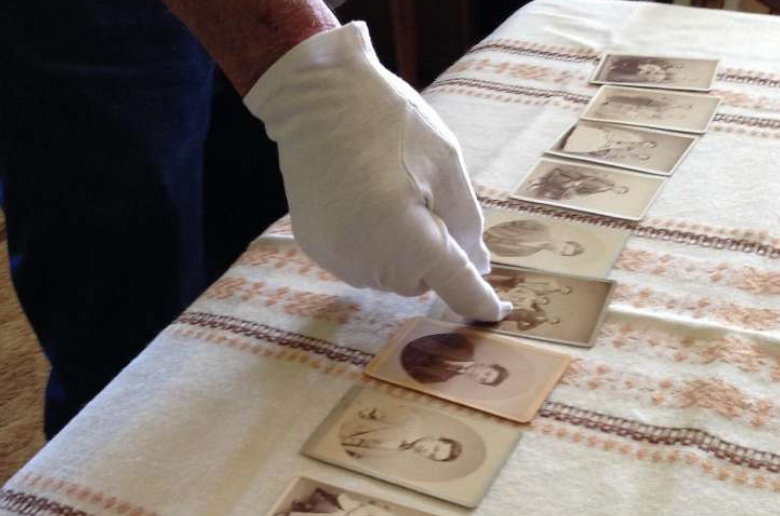
These are some of the photographs the Veerkamp family donated to State Parks. Photo/Provided

By Kurtis Alexander, San Francisco Chronicle

A glimpse into the Placerville area’a extraordinary past emerged last week with a donation of historic photographs chronicling the bittersweet story of America’s first Japanese settlers.

The nearly 150-year-old portraits, which a local family is giving to the state park system, evoke a time when samurai swordsmen and silk traders found refuge from a bloody uprising against Japan’s shogun in California’s Gold Country.

Against an unfamiliar backdrop of mining towns and timber mills, the Japanese refugees built an agricultural community on mulberry trees, tea plants and bamboo shoots. The so-called Wakamatsu Colony didn’t last long, however, owing to drought and a lack of money, but it endures in the history books as an important footnote in California’s cultural evolution.

“Most Japanese believe it was the Plymouth Rock of Japanese immigration,” said Herb Tanimoto, a historian who leads tours of the former colony outside Placerville. “It really opened the door to a much larger influx from Japan.”

Read the whole story


Free food available for kids during summer

Rob Katz, Vail Resorts CEO, and his wife, Elana Amsterdam, donated $125,000 to B&B 4 Kids.

In partnership with the South Lake Tahoe Family Resource Center and Vail Resorts, Bread & Broth’s summer program will ensure South Shore youth have access to food each week by handing out a variety of kid-friendly food every Wednesday morning during the summer break at St. Theresa Church Grace Hall.

It will launch June 21 from 9am-noon, the day after Lake Tahoe Unified School District ends the current school year.

For the past two years, the St. Theresa B&B 4 Kids program has been providing LTUSD K-8 students who struggle with hunger, seven meals and four snacks every weekend throughout the school year. The summer program will extend B&B’s efforts.

Employees from Heavenly and Kirkwood mountain resorts will also be involved with the program by volunteering on Wednesdays to help the B&B volunteers at the food give-away events. The summer B&B 4 Kids program will continue until Aug. 23 when the school year resumes.

Any child up to the age of 18 can come alone, or with their parent or guardian. Food will only be given to parents accompanied by their child.


Women in construction leaving impression in Tahoe

By Alexandra Spychalsky, Moonshine Ink

Construction is a driving force in the Tahoe economy.

The industry is the third largest employer in Tahoe, with 12.6 percent of the local population working at construction-based businesses. And yet, women are underrepresented in the field.

But some women are pioneers in the industry and have risen to the top of their trades, from engineering to architecture, from contracting to sales. They all agree that women face barriers in construction, but assert the industry benefits from the different perspectives that women contribute, and are optimistic about the future.

Patty Heller is the matriarch of Heller Construction, the company she and her husband Bob started together 30 years ago. In the ’70s, Heller worked in interior design retail, and Bob was a carpenter. The two joined professional forces in 1987 to form what is now a multi-generational family business that specializes in building custom homes. Their sons Cody and Dan are a partner and a carpenter with the company, respectively.

Read the whole story


Money Matters: Modest savings can multiply fast

By Rick Gross

It can be easy to overlook the importance of saving for retirement, especially when you’re focused on shorter-term financial priorities such as buying a new car or saving for college.

However, it’s crucial to consider your long-term financial security and make saving for retirement a priority. If you start early and save regularly, even small sums can grow into significant retirement savings. Additional money you save today may have years – or even decades – to grow before you need it for retirement.

Rick Gross

Consider the following two examples to see how saving a dollar a day or an additional one percent could make a big difference in helping you retire with confidence.

Set aside one extra dollar per day

To start, set a goal of saving the equivalent of $1 per day. Or if you’re already saving, strive to save $1 more per day. If you invest this $365 over 30 years, earning an average annual return of 7 percent a year, your dollar-a-day commitment would grow to nearly $34,500. If you extend this commitment to 40 years, the total accumulated more than doubles to just shy of $73,000. That’s a meaningful amount of money when you consider the minimal effort needed to save $1 per day.

Boost savings by 1 percentage point

You can also consider boosting your savings by 1 percentage point. Let’s say you are committed to setting aside 5 percent of your income for retirement. For this example, we’ll assume you began saving when you earned a salary of $30,000 per year in 1987 and your salary rose by 3 percent per year for 30 years. If you continued to save 5 percent of your income and earned a 7 percent average annual return, you would accumulate approximately $208,000 over those three decades.

But what if you choose to boost your savings to 6 percent of your income? Over that 30-year period, you would increase your nest egg to nearly $250,000. One percentage point of additional annual savings could add up to 20 percent more in accumulated savings at the end of 30 years.

It pays to get started

No matter how small the dollar amount or how modest any additional savings may be, your diligence and patience can be rewarded. You don’t need a lump sum of money to start saving. Whether it’s one dollar more or a one percent increase, any amount can help you get closer to achieving your financial goals. Now, the most important part is getting started.

Rick Gross is a financial advisor and private wealth advisor with Ameriprise Financial Services Inc. in South Lake Tahoe.


Edgewood takes lodging at Tahoe to a new level

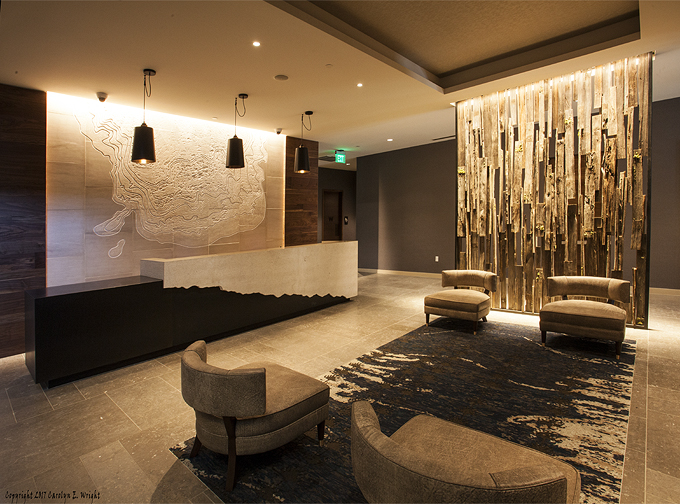
The reception area at Edgewood Lodge is contemporary with a Tahoe flavor. Photo Copyright 2017 Carolyn E. Wright

By Kathryn Reed

STATELINE – Like most backyards, Edgewood Lodge has been designed to be where people will want to hang out.

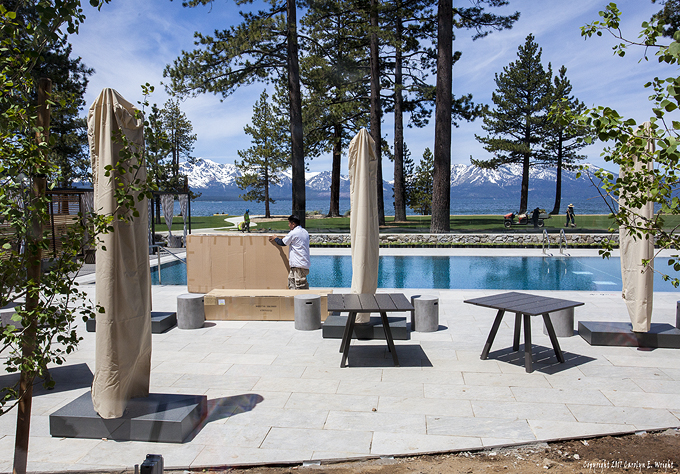
It’s where the infinity-like pool and hot tub are. Monday the pool furniture was being assembled. On the deck between the pool and lodge are multiple fire pits and an array of seating options. Just beyond the pool is a grassy area that looks like an oversized back lawn. Next comes the beach and the icy waters of Lake Tahoe. These are all terraced, creating a better visual.

While the pool, hot tub and fitness center will only be available to hotel guests, much of the property will be open to the public. That means this backyard can be a playground of sorts for everyone.

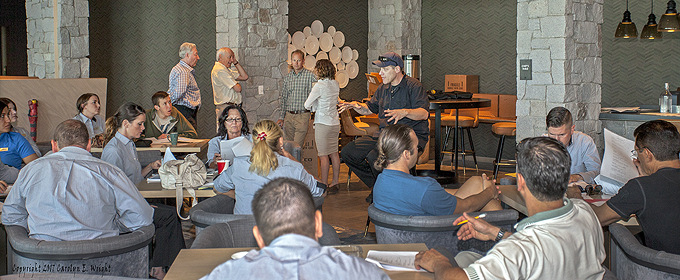
Chef Dave Lofgren preps his staff prior to the June 14 opening. Photo Copyright 2017 Carolyn E. Wright

And if people are inside, the outside is so close.

With what appears to be a wall of windows across the “back porch,” the outdoors is still right there. Mount Tallac is a constant presence.

The Bistro restaurant will spill out onto the outdoor patio with the ability to seat 80. It will serve three meals a day. The kitchen is designed so diners will be able to see their meal being prepared. A chef’s table is off to the side for special events.

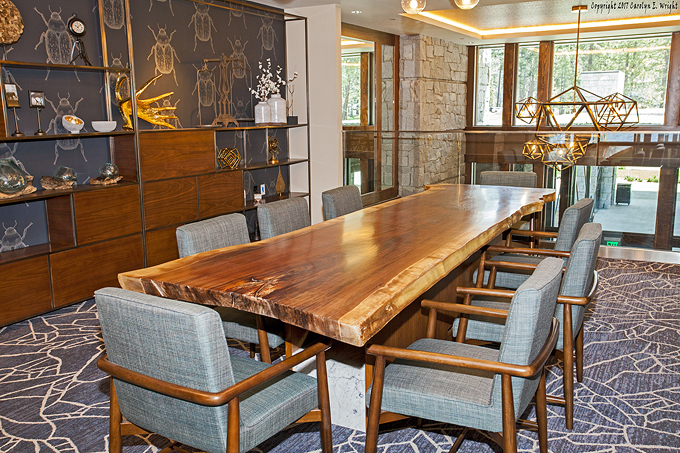
With total seating being about 200, this is the largest of the three restaurants at Edgewood. (The other two are in the clubhouse.) Part of the seating includes a large, ornate wooden table that will be for communal dining.

The bar flows right into the restaurant – and outside.

A small café is near the front of the lodge where to-go items may be purchased.

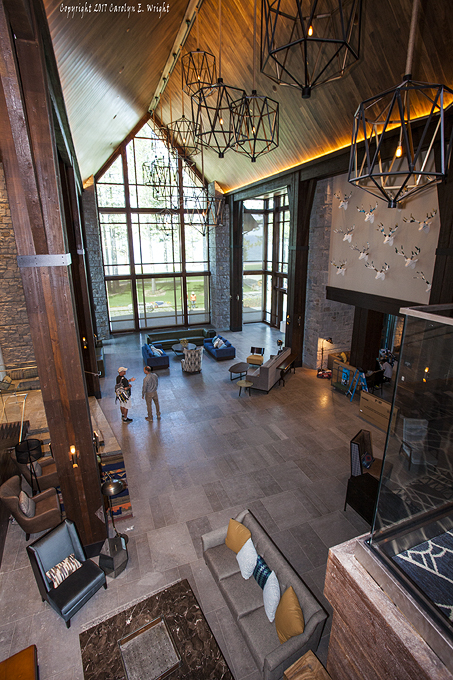
From the second floor looking into the “living room.” Photo Copyright 2017 Carolyn E. Wright

Owners and designers of Edgewood Lodge set out to redefine the tourist experience. Even with contractors and landscapers making last-minute finishing touches before the resort opens June 14, it’s obvious there is nothing else like this in the Lake Tahoe Basin. (Not all of the hotel rooms will be available next week.)

Inside it is intimate, spacious, inviting and warm. The living room, as it’s called, is grand. Styled like a western lodge along the lines of a national park, the grandeur is evident from the moment one sets foot inside. It is destined to be a congregating place to enjoy the view, sit by the fire and decompress. The 42-foot vaulted walnut ceilings add to the majesty.

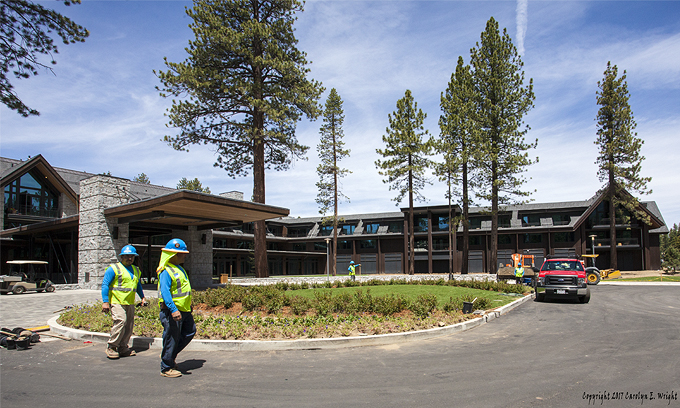
Finishing touches are being made to the front landscaping. Photo Copyright 2017 Carolyn E. Wright

Granite on the walls and elsewhere, along with the stone floor, muted greys and blues, and various uses of wood give the 169,000-square-foot hotel a mountain feel, while still being elegant. The goal was to be relaxed and refined at the same time.

In the living room is a large stone sculpture; each 2-foot by 2-foot section weighing 60 pounds. An artist from the Bay Area carved the piece on site. Another relief out of limestone is at the reception desk. It looks like a topo map of the southern end of Lake Tahoe with the lines going deeper with the depth of the water.

In the same area is a divider, with the wood coming from the property. The moss on it is authentic.

A long table like this one on the second floor will be in the Bistro restaurant for a shared dining experience. Photo Copyright 2017 Carolyn E. Wright

“A number of local contractors did an amazing job on this project,” Patrick Rhamey, executive vice president of Edgewood Companies, told Lake Tahoe News.

While SMC out of Reno was the general contractor on the $100-plus million lodge, Rhamey singled out subs like Jim Eliot who put in the rough timbers made of fir and the exterior wood siding; Bernard Creegan who did the finished carpentry and helped with furniture installation; and Kemper Masonry which mined the rock from Markleeville.

The goal is to attain LEED silver green building designation.

Little artwork adorns the walls in the hotel rooms. The focus instead is on the views out the window. Each king room has the bed oriented to look out the window. A mix of king, double queen and suites fill the top two floors. There is one presidential suite. A standard room, of which there are 127, is about 500-square-feet. Every room has a balcony from which to see the lake, the mountains, the golf course or Round Hill. Sixty-five percent of the hotel rooms have a view of Lake Tahoe.

While there are more than 170 gas fireplaces throughout the structure – one in every hotel room and then some – air conditioning is also important. Edgewood is using lake water to cool the entire building. 

The pool and hot tub are exclusively for hotel guests. Photo Copyright 2017 Carolyn E. Wright

Minden-based Edgewood Companies is operating the 154-hotel instead of having an outside entity run it. It means the need to hire about 200 people to operate the entire facility. Several employees have been promoted from within the company.

Like many businesses in the region, Edgewood has had some difficulty finding workers. Housekeeping in particular has been problematic. Most workers, though, have been hired locally.

Benefits to working for Edgewood include having a meal provided and not having to clock out for breaks.

The only third party entity will be supplying equipment like bikes, skis and kayaks. These will all be available through the on-site adventure center. For those who bring their toys, storage in this area will be available.

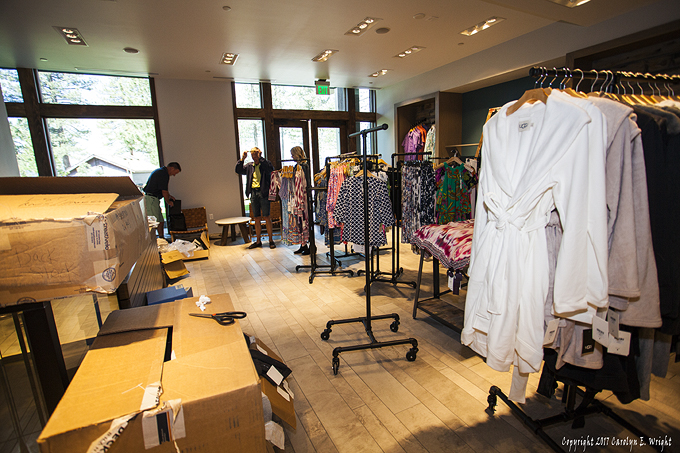
Two retail outlets are on the first floor. Photo Copyright 2017 Carolyn E. Wright

On the bottom level of the three-story building are two clothing stores – one more resort wear, the other athletic apparel.

A full service spa with eight treatment rooms is on the second floor. The hair and nail salon is on one side, the massage-facial area on the other. A steam room is in each of the locker rooms. Then there is a shared quiet-relaxation space. A coed outdoor hot tub looks out to the front of the property and beyond to the slopes of Heavenly.

Free valet parking will be available to anyone visiting the lodge. Another 100-space self-parking area is between the clubhouse and north wing of the lodge. Gone is the old parking lot that fronted the lake.

Once parked there will be little need for guests to drive again. Edgewood will have a shuttle to take people various places.

A 3,000-square-foot banquet area can be divided into three sections for events. Doors off the hallway can open to the front of the building to expand the actual usable space. If the need arises, Edgewood can build another 5,000-square-feet on the main level for meetings and the like.

The goal is to be a five-star complex. Rhamey said it’s more important to have five-star reviews on Yelp and TripAdvisor than to worry about what Forbes or AAA say. Guest service is a huge piece in the ratings war.

“Edgewood Lodge is not going to be a stuffy place,” Rhamey said. “We want to provide exceptional service, be engaging, but not be stuffy or snooty.”


Garden art creates a dynamic landscape

By Melinda Myers

Adding excitement to your garden is easy. You can create instant, year-round color, structure, motion and fun to your landscape with a bit of garden art.

Just like shopping for plants, look for pieces that complement your gardening style. And consider all the benefits each piece of art provides. Many pieces are functional as well as beautiful, helping you get the most from your garden budget.

In centuries past, garden art included statues of gods and beautiful people as well as pieces that mimicked nature’s ornamental qualities. You can still find those traditional garden statues. But these days you will also find colorful pieces made from a variety of weatherproof materials in a variety of styles.

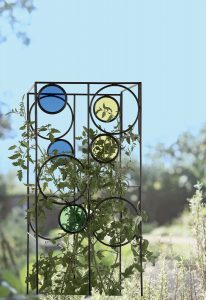
Look for garden art that’s functional as well as beautiful. You no longer need to settle for drab plant supports. Look for items like the Kaleidoscope Tomato Cage made of durable, heavy gauge steel and adorned with colorful weatherproof glass inserts. Train peas and pole beans up colorful and sturdy structures like Kaleidoscope Spiral Supports. These make creating an edible, ornamental landscape a breeze.

The Kaleidoscope Tomato Cage provides a sturdy support for tomato plants while adding color to the landscape. Photo/ Gardener’s Supply Company

Bring your garden to life with garden art that moves in the wind.  Metal wind spinners, mobiles and wind chimes add motion and in some cases sound to the garden.

Try creating a bottle bush using individually mouth-blown art glass globes instead of wine bottles. Select those suited to the outdoors. Strategically place them in the garden, so you can enjoy the way the sunlight plays off the unique, colorful glass.

Add a bit of color and ornamental appeal when purchasing your next birdbath or bench. And don’t forget about other winged visitors. Some garden art, like poppy sways, also capture water for hummingbirds, butterflies and other beneficial insects.

Artfully direct water from the roof using decorative rain chains into a rain barrel or mulched area. Use this century-old technique to slow the flow of water, preventing mulch and mud from splashing onto the house. Those in cold climates will appreciate the beauty of the ice-covered chains in winter.

Extend your enjoyment by lighting up the landscape with solar powered artwork. Set solar stakes donned with birds, roosters or calla lilies throughout the garden. You’ll enjoy their charming style by day and colorful glow at night. Lead your guests to the front door or backyard garden with the help of solar powered Mosaic glass globes.

Include a bit of fun and whimsy in your landscape. Let your garden design and garden art reflect your personality. A flock of funky metal chickens meandering through the garden or school of steel Fish Out of Water Garden Stakes swimming through your perennials may just be the extra character your garden needs.

Take some time this season to finish off an established garden, create a focal point for a new garden or just add new life to an existing landscape. Whatever the reason, you’re sure to enjoy the added beauty only garden art can provide.

Melinda Myers has written more than 20 gardening books, including “Small Space Gardening.”  Myers also hosts the nationally syndicated “Melinda’s Garden Moment” TV and radio segments.


O’Neill, wetsuit pioneer, dies

By Teresa Watanabe, Santa Cruz Sentinel
 
Jack O’Neill, the Santa Cruz entrepreneur who opened one of the world’s first surf shops and pioneered the neoprene wetsuit that helped popularize year-round cold-water surfing, has died. He was 94.

The one-eyed surfing icon, who cut a rakish figure with his black eye patch and bushy beard, died peacefully of natural causes at his Santa Cruz home, waves lapping at his deck, his family said in a statement.

Known for his colorful personality and marketing genius, O’Neill began experimenting in the early 1950s with ways to insulate swimwear so he could stay in the frigid Northern California waters longer. Surfers at the time were using sweaters sprayed with oily water sealant, he recalled in one interview.

He tinkered with foam rubber but switched to neoprene, which was lightweight and flexible. A UC Berkeley physics professor, Hugh Bradner, had created a prototype wetsuit and tested it in icy Lake Tahoe in 1950. O’Neill claims he hit on the idea of using neoprene in wetsuits after seeing the material in the carpeting of an airliner.

Read the whole story


EDC has help for severely mentally ill residents

For El Dorado County residents with the most severe forms of mental illness, the Assisted Outpatient Treatment (AOT) program (also known as the Laura’s Law program), is available.

The program, coordinated through the El Dorado County Behavioral Health Division of the Health and Human Services Agency, gives additional tools to families, agencies and individuals to get people who need mental health treatment into those services.It

It recognizes that some people with the most severe forms of mental illness may need help in understanding that they need treatment.

The AOT program uses a community-based, case management model to assist the seriously mentally ill with placement into mental health treatment. The program works with clients to seek voluntary participation whenever possible, but can utilize the court system if needed to leverage that treatment.

To be eligible for the AOT program, an individual must be evaluated to see if they could benefit from treatment and if they meet specific criteria.

For more information, call 530.573.7970 in South Lake Tahoe.