Money Matters: Talk finances before marriage

By Rick Gross

Rick Gross

While money is a leading cause of marital strife, a recent Ameriprise study found that nearly seven in 10 couples say they have good financial communication. Before wedding planning kicks into high gear, make conversations about your finances a priority. Taking the time today to talk through money matters can create a solid foundation for your collective future.

Use the following six principles to guide your money conversations:

1. Open-minded. Take turns sharing your vision for money management as a married couple. Listen carefully to what your future spouse says is important to him or her. Acknowledge your differences and build on your strengths. If your expectations don’t match up, try to find a compromise. Some couples sidestep conversations about money to avoid feelings of hurt, fear, anger or remorse. Creating a habit of regular communication may help you avoid heated arguments, and can help ensure you’re on the same page financially before you walk down the aisle.

2. Honesty. Financial secrets can destroy trust. Share the specifics of your financial history and current situation if you haven’t already done so. Your future spouse deserves to know if you’re paying off college debt, or if you’ve made any financial mistakes in the past (and how you’ve rectified them). Disclose the good news, too. Divulge details about savings you’ve tucked away or a family trust that helps supplement your income so you both know the sum of where you stand.

3. Forward-thinking. Once you’ve shared your current situation and history, discuss your goals for the future. Be open about what your dreams are, but be ready to compromise. While you don’t have to agree on everything, having shared goals (purchasing a home, saving for college if you choose to have children, retirement, etc.) allows you to combine forces on savings and gives you a road map for spending.

4. Cooperation. To avoid any miscommunications as newlyweds, discuss and assign responsibility for financial roles. Is one of you better at monitoring online accounts and paying bills? Are you both enrolled in a retirement account and taking maximum advantage of employer contributions? Who will be the primary contact for your financial advisor, tax professional or estate planner? Two is better than one when you’re able to divide and conquer financial tasks, but make sure you’re both in the loop on key decisions and money matters.

5. Diligence. Once you’re married, make it a priority to update your financial documents. It takes discipline, but taking care of these housekeeping tasks right away protects you in case something unexpected happens. Several steps to consider:

·       Update financial accounts, insurance policies and credit cards with any name changes, and if needed, add your spouse as an owner and beneficiary to those accounts.

·       Consider combining your bank accounts if it makes sense for your situation.

·       Update or write your will and estate plan to reflect your collective wishes.

·       Amend your tax withholdings, to make sure the right amount is withheld from your paycheck now that you’re married. Consult your tax professional before making changes.

·       Choose your health insurance. If both of your employers offer health insurance, carefully evaluate your coverage options and premiums for the best fit.

Like most things worth achieving, preparing for a lifetime of financial compatibility takes work. If you and your future spouse can commit to the same money values, it may help you create a solid financial foundation.

Rick Gross is a financial advisor and private wealth advisor with Ameriprise Financial Services Inc. in South Lake Tahoe. 


Camp for disabled youth coming to Tahoe area

The Stephen J. Wampler Foundation has moved Camp Wamp into a new home in Tahoe National Forest near Soda Springs.

The campsite was previously home to the Girl Scouts of Northern California. The sale of the 129 acres was completed in late July.

The foundation plans to retrofit and upgrade the property to make it suitable to serve campers with physical disabilities beginning next summer.

Founded in 2000, the Wampler Foundation provides outdoor recreation programs for children with physical disabilities, such as muscular dystrophy, cerebral palsy and spina bifida, at no cost to their families.


Tahoe artists uniting for a common cause

The Tahoe Activist Artists’ exhibit We the People: Tahoe Artists Visualize a World of Conversation and Connection will be Sept. 9, 4-8pm at the Tahoe Mountain Lab in South Lake Tahoe.

Art, live music, film, hands-on activities for kids and artist presentations will be part of the free event. Food and beverages will be available, and a silent auction will take place.

The Tahoe Activist Artists is a community of multidisciplinary artists who formed in response to the current social and political climate to explore a more compassionate world. More than a dozen creators will show paintings, photographs, letterpress, video and illustrations detailing each artist’s response to recent events. Artists presenting their work include Shelley Zentner, Anthony Capaiuolo, Ana Valdez, Daphne Osell, Michele McLean, Tahoe Letterpress and singer-songwriter Addison Liming.

A panel of artists will discuss their process at a moderated talk at 6:30pm. A video collaboration between Zentner and Capaiuolo, “Art & Science in an Age of Unreason,” will be screened during the event. The silent auction will begin at 7pm; in addition to featuring the work on display, a painting by artist Phyllis Shafer will be auctioned with proceeds going to local organizations.

In partnership with ­­­­the High Vibe Society, A March for a Compassionate World will begin at the corner of Highway 50 and Third Street in South Lake Tahoe on Sept. 9 at 3pm and end at the exhibit. The public is invited to participate.

For more info, go online.


Array of venues put out welcome mat for dogs

By Kathryn Reed

Dogs are better than children to go out to eat with. They clean up after you instead of being the ones to make a mess.

This is the season to eat outside with your four-legged family member. The following is a smattering of places that are dog friendly.

The Tavern inside the Tahoe Beach Retreat in South Lake Tahoe has an entire day devoted to dogs. Canines & Cocktails is happening every Tuesday from 4-9pm. Show up with a dog and you get a 25 percent discount. AJ was loving it because not only did she get to be inside, she also was given a doggie treat.

Dexter and AJ relax at Artemis at Ski Run Marina. Photo/Kathryn Reed

She also got to be inside at Artemis at Ski Run Marina in South Lake. This might have been because she was with Dexter who is a legitimate, super-certified therapy dog. They were given his and her water bowls. Carole brought Dexter, her golden retriever, down from Incline for lunch. It was cool this particular June day, so eating in seemed like a better option. There is plenty of outdoor space, though, for canines.

We tried to eat outside at the Cantina in South Tahoe, even got let in the back gate to the patio. But we got tired of sitting there without service so we went to the bar. No one said anything, so she just laid on the floor at our feet.

Julie and I started outside at Revive near Lakeview Commons, but the rain in July chased us indoors. No one seemed to mind; AJ was as close to the door as she could be without actually crossing the threshold. This would be a great place for a dog because of the vast front yard area.

Appropriately, I was with two brothers while eating outside at Brothers Bar and Grill in South Tahoe. Dogs are OK there if they sit in the far back near the horseshoe pit area. It’s dirt/sand back there. It’s possible to enter through the back and not have to go through the restaurant.

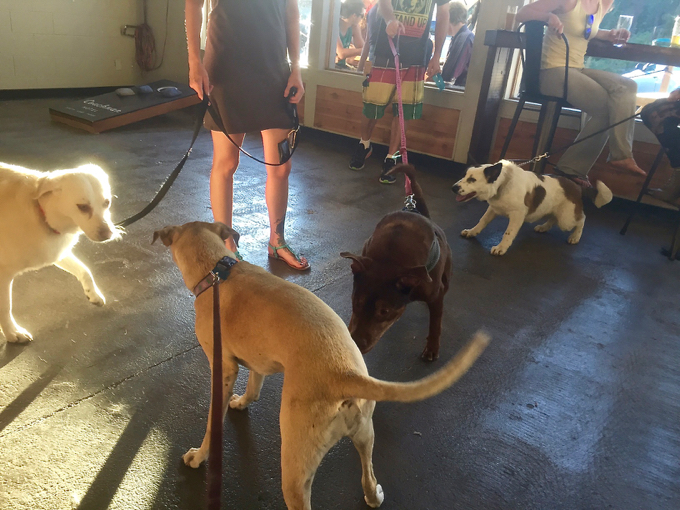
It’s practically a dog party at South Tahoe Brewing Company. Photo/Susan Wood

While the tables outside are somewhat close together at Fireside Pizza at the Village at Squaw Valley, there is still room for dogs. Waitresses will bring your furry friend a bowl of water upon request.

Dogs are welcome on the tram at Squaw, as well as on the deck at High Camp, and throughout the village.

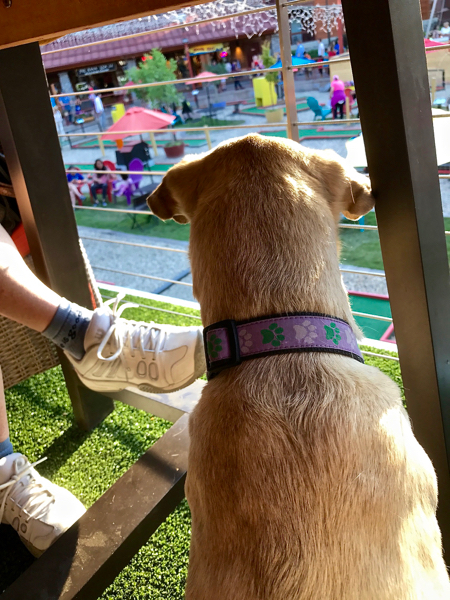
What set Heavenly Village apart was AJ’s water coming in a recyclable to-go container. I liked the idea of a single-user water bowl. Azul and The Loft each did this. The concrete at Azul was ideal for AJ to spread out on after a long hike. She was more restless at The Loft; the fake turf wasn’t to her liking but she did enjoy watching everyone play mini golf.

AJ looks out from under the table at The Loft to the peewee golf course at Heavenly Village. Photo/Kathryn Reed

At AleWorX in the Crossing at the Y in South Tahoe there are almost as many dogs at people. Everyone was getting along great. However, if your dog can’t stomach pizza, beware because the people are a little sloppy. Water for dogs is provided if you ask.

South Lake Brewing Company is another venue where dogs almost outnumber the people. One pup was so well trained it could jump onto a bar stool. This gave him the advantage to see the doggie treats in the beer glass.

At Blue Angel Café in South Lake dogs have the choice of being on grass or wood chips. The food that has fallen is a bit hard to see in the wood chips. Sue ordered three waters; and appropriately two glasses and a bowl were delivered.

Steamers in South Lake Tahoe has a ton of outdoor space. AJ only had to share it with a toddler. The artificial turf was clean, so no worrying about what she might nibble on. Access to the back is through the restaurant.

Another clean spot was Classic Clue in South Lake. There was no random food on the ground for AJ to munch on. (As usual, she did share in the fries that Kim and I were having for dinner.) While AJ had to stretch out on hard asphalt, at dusk it provided her some warmth.

AJ loved being on the lawn at X Crows, the restaurant at Hotel Becket in South Lake Tahoe. Our picnic table was on the edge of the grass and patio. She lapped up the water from her bowl to cool off as the sun was setting.

It was all grass for AJ at the Bear Beach Café in South Lake. Along the outdoor wall is an assortment of self-serve doggie water dishes and a hose to fill them up.

Down the street at MacDuff’s Pub the large umbrellas provide plenty of shade, keeping the wood deck cool for those lying on it. AJ lapped up the attention from the foursome at the table next to us as they kept complimenting her.

At the Getaway Café in Meyers half of the outdoor tables had a dog along for breakfast. The soft rocks appeared to be to all of their liking. And there were plenty of water bowls to go around.

It’s not just restaurants with outside tables that welcome dogs. Seldom does a Bank of the West teller forget to offer AJ a treat.

Almost all pet stores allow dogs. At Pet Supermarket in South Lake Tahoe it’s like nirvana with all the smells. It’s hard to get out of there without buying an individual treat at the front counter. I’m a sucker. At Hot Diggity Dog & Cat in Kings Beach the store dog is stretched out in the doorway, not even a sniff or a wag of the tail as AJ goes by. The two younger dogs want to be let out from behind the gate. Not happening, though. AJ loved their Giants decorated bones.


How severe, ongoing stress affects kids

By Lindsey Tanner, AP

ASHEVILLE, N.C.  — A quiet, unsmiling little girl with big brown eyes crawls inside a carpeted cubicle, hugs a stuffed teddy bear tight, and turns her head away from the noisy classroom.

The safe spaces, quiet times and breathing exercises for her and the other preschoolers at the Verner Center for Early Learning are designed to help kids cope with intense stress so they can learn. But experts hope there’s an even bigger benefit — protecting young bodies and brains from stress so persistent that it becomes toxic.

It’s no secret that growing up in tough circumstances can be hard on kids and lead to behavior and learning problems. But researchers are discovering something different. Many believe that ongoing stress during early childhood — from grinding poverty, neglect, parents’ substance abuse and other adversity — can smolder beneath the skin, harming kids’ brains and other body systems. And research suggests that can lead to some of the major causes of death and disease in adulthood, including heart attacks and diabetes.

Read the whole story


Nonprofit working on internet speed in basin

The Tahoe Prosperity Center continues to work on bringing higher speed internet access to the basin.

There are still areas around the lake that suffer from below average internet speeds, lack of cell coverage and periodic outages due to inclement weather.

The Connected Tahoe Project goal is to bring gigabit level service to the entire Lake Tahoe Basin as means to catalyze economic development, galvanize public safety, healthcare, education and to position the basin to receive the most advanced technologies for internet access now and in the future. 

To date, TPC says it has:

  • Forged productive relationships with key stakeholders in both the public and private sectors.
  • Conducted speed tests in an effort to groundtruth service provider’s advertised speeds.
  • Mapped out areas of the basin where internet speeds and service are at it lowest.

The nonprofit is asking people to take an internet speed test that will provide the group with data.


Trade group updates how it addresses problem gambling

By Thomas Moore, Las Vegas Sun

One of the gaming industry’s largest trade groups announced an updated approach to problem gambling during a roundtable discussion on the issue at UNLV’s international Gaming Institute on Thursday.

Just before the discussion, the American Gaming Association’s (AGA) released its updated Code of Conduct for Responsible Gaming, which guides how the organization’s members — casinos, sports books, manufacturers and related businesses — deal with:

• Promoting responsible gaming

• Preventing underage gambling and unattended minors in casinos

• Serving alcohol responsibly

• Advertising gaming responsibly

• Training employees

• Raising awareness and promoting research into responsible gaming.

Read the whole story


Heavenly’s chief easing into new role

By Kathryn Reed

STATELINE – Arizona and skiing? You, bet. Just ask Mike Goar.

Goar is settling into his new job as chief operating office for Heavenly Mountain Resort. The job responsibilities also come with overseeing Kirkwood Mountain Resort and Northstar.

His office has pictures on the wall of those resorts that were left from his predecessor. Right now the personal touches are missing. Decorating is a distant priority to figuring out who’s who at the resorts and in the community.

This 59-year-old grew up skiing at Sunrise Ski Resort in the White Mountains of Arizona. It has a base elevation of about 9,000 feet. Goar started out as a patroller and groomer at his home mountain while he was in his teens. It was those early years that gave him the skiing bug and desire to have a career in the industry.

The bulk of his career – 27 years – was spent at Solitude in Utah.

Mike Goar is eager to be part of the Lake Tahoe community now that he is COO of Heavenly ski resort. Photo/Kathryn Reed

His tenure with Vail Resort began in 2013 when the company bought Canyons in Utah. He had been general manager of that Utah resort for six years. (Canyons and Park City have since merged into one Vail-owned property.) Goar moved to Keystone in 2015 to be COO of that Colorado resort.

One main difference from his last job is that it was just one resort; in Tahoe he has the responsibility of three, even though Heavenly is his hub.

Goar is taking over for Pete Sonntag, who left earlier this summer to run Whistler Blackcomb. Vail Resorts bought that ski area in 2016.

No big changes are planned for any of the Tahoe area resorts – at least not for the 2017-18 season. Goar plans to meet with local leadership teams and confer with corporate on setting priorities for future capital improvements.

Whatever future changes are made, he told Lake Tahoe News there is no desire by anyone to alter the vibe of each resort.

“They are going to be different for the right reasons,” Goar said. “We are mindful of what each resort stands for.”

Addressing guest concerns about lift lines and what can be done during times of wind hold are being worked on before the start of next ski season.

Goar has skied at all three of Vail’s Tahoe resorts. Other Tahoe area resorts he’s been to include Squaw Valley, Alpine Meadows and Mount Rose.

With the finalization this week of the KSL-Aspen Skiing deal, Goar sees this as a good thing for the industry. He believes it will attract more people to skiing and snowboarding, which is good for all resorts.

While in many ways running a ski resort is the same no matter the location, Goar is cognizant each location has its own idiosyncrasies. He is looking forward to getting to understand the agencies that govern in the greater Lake Tahoe area, and the community members who call this place home.

Goar will be living here with his wife. They have three adult children and two grandchildren. He’s already discovered housing is an issue.

Goar is well aware it’s also an issue for his employees and others in the area. When he was in Keystone it was something he was involved in.

“While there is no project in the pipeline that we are talking about publicly, we are looking at partnerships on employee housing,” Goar said.

Nothing is off the table. It could be new development, refurbishing an existing property or combining resources with other entities desirous of providing housing for workers.

Legalization of recreational marijuana was something he had to contend with in Colorado and will likely be an issue as California allows it starting in January. With the use being illegal on federal land, that makes it easy for the resort operator to just say no. Vail Resorts has a companywide policy banning marijuana use at all of its resorts. He anticipates it will take some education of riders to let them know the rules.

While Keystone has mountain biking in the summer, it does not have the Epic Discovery activities like Heavenly has at the top of the gondola. Goar has experienced a few of the amenities and expects to have tried all the ropes courses, zip lines and other attractions before summer is over.

Beyond work and skiing, Goar is passionate about baseball and is a devout Yankees fan. Hiking, mountain bike riding and golf are the sports he participates in when the snow is gone. He’s looking forward to exploring the local trails.


Dolores Clark — 1934-2017

Dolores Clark

Former Alpine County clerk, Dolores Clark, died June 28, 2017. She was 82.

Dolores Genevieve Luiz was born in Napa Valley on Oct. 12., 1934. She was of Portuguese decent; something she was always very proud of.

She married Norman Gentry in 1956; soon to follow were their two children.

Dolores was a banker for many years.

She reconnected with Jim Clark, who she knew from high school. They married on Christmas Eve 1971. Together they moved from Napa to Markleeville, where they ran a husband and wife team for a small branch of Bank of America.

Dolores became the treasurer and tax collector of the county of Alpine; a job she thoroughly enjoyed.

Dolores and Jim were able to retire and travel extensively and enjoyed every minute of it. She lost Jim on Jan. 28, 2015.

She is survived by her children Elaine Marriott (Larry) and Walter Gentry; grandchildren Dawn Marriott, Joshua Marriott (Teresa), Sara Vaccaro (Anthony), Kaitlyn Gentry and Haley Marriott; great-grandchildren Makala Schroder, Izzabelle Marriott, Madison and Khloe Vaccaro, Skyler Londo and Olive Kluever; two sisters, many nieces, nephews, and countless friends.


Composting stations can be attractive, convenient

By Melinda Myers

Make recycling green debris into compost convenient and attractive. Create a space you and your neighbors will appreciate. And locate composting in a convenient area that is easy to access and manage so you are more likely to do it.

You’ll quickly recoup your initial investment of time and money by spending less time hauling the materials to the recycling center and on soil amendments.

Most important, you’ll boost the health and beauty of your landscape while helping the environment. 

Start by looking for spaces in the landscape or garden where compostable materials can easily be moved into the bin, pile turned, and the finished compost harvested and transported into the garden where it is needed. You found a place to stow the trash cans without ruining the beauty of your landscape or offending your neighbors, so do the same with your compost area.

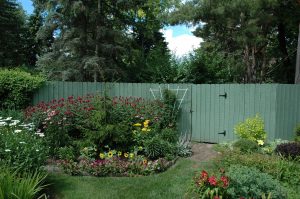
Decorative fences are an effective way to hide composting stations conveniently tucked behind gardens in the landscape. Photo/Melinda Myers LLC

Purchase or build a compost bin that matches your landscape style. Some bins are built to be an attractive addition to the landscape while others are designed to fade into the garden and go unnoticed. Try using materials similar to your fence, shed or other structures. Situate the bin so it appears to be an extension of these or an additional garden feature.

Speed up the composting process by creating a pile at least three feet tall and wide. Use only insect- and disease-free materials. Do not include meat, fat, bones, or dairy products that can attract rodents or weeds and invasive plants that can survive most composting and end up back in your garden.

Mix nitrogen rich green materials such as vegetable scraps, and herbicide-free grass clippings and carbon rich browns such as cornstalks, evergreen needles and tree leaves. Top this 8- to 10-inch layer with compost and sprinkle three cups of a low nitrogen slow release fertilizer over this layer. The organic nitrogen helps feed the microorganisms that break down the raw materials into compost. Continue layering with plant debris, compost and fertilizer until the pile is at least 3-feet high.

Use plants to screen the compost process. Place a simple wire bin in the middle of the garden. It’s convenient; since this is the place you generate garden debris and use much of the finished product. The surrounding plantings will hide the bin.

Or place your bin behind a garden border of tall grasses, shrubs or other permanent plantings. Make sure your neighbors’ view is equally as nice. Leave sufficient room for adding materials to compost, turning the pile if needed and harvesting the compost.

Team up with your neighbors to create more gardening and composting space. Design a shared garden and compost area across the lot line. Use steppers for easy access and beautify both yards with attractive plantings. You’ll each enjoy the extra garden space and valuable compost you create.

Up the ornamental appeal a bit more by installing a decorative fence as a backdrop for one of your garden beds. Design the screen to run parallel to a fence or hedge along the lot line. Leave enough space between the two structures for composting, storing mulch, shredded leaves, garden stakes and more. Include a gate or entryway along the side for easy access.

Once you start exploring options, your creativity will help you build a composting space suited to your needs. Then get ready to enjoy the increased beauty and productivity that the compost will provide in your gardens and containers.

Gardening expert Melinda Myers has more than 30 years of horticulture experience and has written more than 20 gardening books, including “Small Space Gardening” and the “Midwest Gardener’s Handbook.” She hosts The Great Courses “How to Grow Anything: Food Gardening For Everyone” DVD set and the nationally syndicated “Melinda’s Garden Moment” TV and radio segments.