Tahoe Tails — Adoptable Pets in South Lake Tahoe

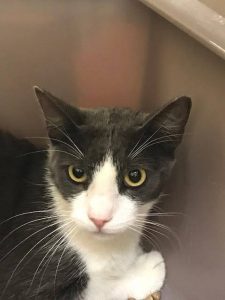
Little No Name

Little No Name is one of 12 kittens who just arrived at the shelter this past Saturday.

They arrived at a good time. All cats previously at the shelter had been adopted. These 12, plus a teenager and an adult who arrived with them, are all ready to go home. Many are bottle babies, most have been reared with dogs and all have been in foster homes and not another shelter. Be sure to look at the shelter’s Facebook page for their adorable photos.

All are spayed/neutered, microchipped, tested for FIV, and vaccinated. They are at the El Dorado County Animal Services shelter in Meyers, along with many other dogs and cats who are waiting for their new homes. Go to the Tahoe animal shelter’s Facebook page to see photos and descriptions of all pets at the shelter.

Call 530.573.7925 for directions, hours, and other information on adopting a pet. For spay-neuter assistance for South Tahoe residents, go online, or call the animal shelter. Vouchers are available there also: bring $25 and a copy of a photo ID and a local utility bill.

— Karen Kuentz


Study: Environmental impact of feeding meat to cats, dogs

By Amina Khan, Los Angeles Times
 
You’ve heard about the carbon footprint, but what about the carbon pawprint? According to a study, U.S. cats’ and dogs’ eating patterns have as big an effect as driving 13.6 million cars for a year.

The findings, published in the journal PLOS ONE, reveals how our furry, four-legged companions’ consumption of meat and other animal products adds a sizable, and largely overlooked, climate cost.

When it comes to environmental effects, meat-eating takes the cake. A 2014 study in the Proceedings of the National Academy of Sciences found that producing a kilogram of chicken results in about 3.7 kilograms of carbon dioxide, while a kilogram of pork comes with 24 kilograms of carbon dioxide. The same amount of beef, however, can be responsible for up to 1,000 kilograms of CO2 — a worrisome figure given that this greenhouse gas is largely responsible for the significant warming of the Earth’s climate. That’s not even counting the livestock’s water usage footprint, which dwarfs that of agricultural crops.

Read the whole story


More mice may mean more Lyme disease

By Amy Harmon, New York Times

It is August, the month when a new generation of black-legged ticks that transmit Lyme and other diseases are hatching. On forest floors, suburban estates and urban parks, they are looking for their first blood meal. And very often, in the large swaths of North America and Europe where tick-borne disease is on the rise, they are feeding on the ubiquitous white-footed mice and other small mammals notorious for harboring pathogens that sicken humans.

But it doesn’t have to be that way. A new study suggests that the rise in tick-borne disease may be tied to a dearth of traditional mouse predators, whose presence might otherwise send mice scurrying into their burrows.

If mice were scarcer, larval ticks, which are always born uninfected, might feed on other mammals and bird species that do not carry germs harmful to humans. Or they could simply fail to find that first meal. Ticks need three meals to reproduce; humans are at risk of contracting diseases only from ticks that have previously fed on infected hosts.

Read the whole story


Nature becomes a prescription for healthy living

By Molly Coolidge

Recovering from a major joint surgery doesn’t usually inspire the idea of snowshoeing by moonlight, but that’s exactly what Carol Bennis, age 75, was asked to do during her recovery last February.

Bennis had never been on snowshoes before, or hiked at night, but when she heard her surgeon and other patients at a similar stage of recovery would be there, she decided to try it out.

On a clear night at Tallac Historic Site, she and 12other patients joined Barton Health clinicians and U.S. Forest Service rangers on a “wellness walk” through the snow. Bennis loved the experience.

“This opportunity enabled me to step out of my comfort zone, make new friends, and learn the history of the area from the ranger,” she said. “Lucky me.”

This winter “wellness walk” and the idea of “nature as medicine” spurred the creation of Wellness Outings, one of Barton Health’s newest wellness programs. Orthopedic surgeon, Stephen Bannar noticed that while South Lake Tahoe is surrounded by public land and plenty of opportunities to enjoy nature, his patients were often too nervous to head outside and incorporate physical activity into their recovery.

Research indicates that time in nature lowers blood pressure, heart rate, and cortisol levels. It increases concentration, memory, and attention spans. It has been shown to boost immunity and is particularly beneficial for at-risk populations, such as those recovering from surgery, who often spend less time outside. These benefits were something Dr. Bannar wanted his patients to experience.

“Can I prescribe nature as medicine?” he asked.

Indeed, he can. In fact, there are a number of researchers and medical providers who support this idea. Nature prescriptions have been commonly used in Japan since 1982 to reconnect people with the outdoors. Bannar and Khristy Gavigan, a registered nurse, saw an opportunity and partnered with the Lake Tahoe Basin Management Unit to provide a unique healing experience for their patients.

“Our idea was to unite health providers with public land managers to facilitate health benefits for those at-risk populations,” said Gavigan. “Partnering with the Lake Tahoe Basin Management Unit rangers provided that interpretive piece where they could support the logistics, help identify the appropriate outings, and deliver a message about the connection between community wellness and ecosystem health.”

Participants were inspired by their experience, not only reconnecting with nature, but connecting with other people. Isolation is often an issue for those who are recovering at home, especially if they’re concerned that they may injure themselves further by heading out.

“Having Barton’s medical professionals on-hand gave folks the confidence to come out and join the walk, whereas they previously may have been worried about leaving home,” said Bannar.

Though the program just launched, it has already been recognized as an innovative way for the U.S. Forest Service and health care organizations to improve community health. In June, Bannar, Gavigan, and Joseph Flower from the U.S. Forest Service, were asked to share their idea at RecX, a conference run by the U.S. Department of the Interior in Washington, D.C.

The focus of the conference was Great Ideas for the Outdoors and the Barton team shared the successes of the Wellness Outings and the implications for health across the country.

“We need to change our mindset from treating disease to promoting wellness,” said Bannar. “A prescription for nature can enable accessibility for at-risk groups as well as preventive medicine for other members of the community.”

For Bennis, she saw both the physical and emotional health benefits.

“Public lands are special treasures and not to be taken for granted…but appreciated and respected, not only for their beauty, but for their power to heal,” she said. “The land is truly a gift that must be re-gifted to each generation.”

Wellness Outings are scheduled monthly with Barton Health and the Lake Tahoe Basin Management Unit.

Molly Coolidge works for Barton Health.


Writers have become a community at Squaw Valley

By Stephanie Taylor, Sacramento Bee
 
There’s something infectious about 150 or so creative people, all chattering at once. This is a weeklong annual conference of writers, established and aspiring, who come from all over to Squaw Valley, some every summer, year after year. If ideas and genius are tangible molecules floating in the air, I can only hope they’ll land on me.

The operative word is “community,” chosen on purpose by the founders in 1969, when the novelists Oakley Hall and Blair Fuller gathered to build an institution that’s thrived ever since. Some of the writers have passed – sort of. I say sort of because their spirits linger. Some are declining gently into old age. Their children carry on, and their children’s children. It’s an honor to be here, to be included in what has evolved as a family.

It’s also difficult not to be intimidated by those who have been here before, studying and discussing the craft of poetry, fiction, nonfiction and screenwriting: Peter Matthiessen, Richard Ford, Michael Chabon, Robert Hass and Ann Rice, to name a few. In 1985, Amy Tan arrived with stories that became “The Joy Luck Club.” This year, Janet Fitch’s novel “Paint It Black” is her second movie. Anne Lamott’s “Bird by Bird” is every writer’s classic.

Read the whole story


Stuart Merrill — 1923-2017

Stuart Merrill

Former Alpine County Sheriff and Supervisor Stu Merrill died Aug. 1, 2017, at his home in Woodfords.. He was 94.

Stuart was born to Grant Perry Merrill and Angie Tibbetts Merrill in Gardnerville in January 1923. He was raised in Woodfords, the third generation of the pioneer Merrill family.

He spent his later grade school and high school years in Mojave after his father was transferred there to serve as the state highway superintendent. Stu always returned to Alpine County during the summers and school vacations.

After high school he attended Sacramento Junior College. He divided his time between studies, ski racing and ski instructing at Sugar Bowl.

College was interrupted when Stu served in the Air Force in the European theater during WWII. After the war he enrolled at San Jose State, pledged Delta Sigma fraternity, continued his intercollegiate ski racing. He met Eileen Hunter, who he declared to be “the girl he would marry.” They were married on Sept. 11, 1948.

After graduation the couple moved to Woodfords where they assumed management of the family’s Woodfords Store & Resort. In 1958 Stu was elected sheriff of Alpine County. He served five terms until his retirement in 1978. Stu continued his public service for several years serving as an Alpine County supervisor.

In retirement Stu rekindled his passion for ski racing (senior division). He joined Eileen golfing. Together they traveled and went on reunion adventures with close friends. He was an avid fisherman (he always kept his fly rod in the trunk of the car), knowing every fishing hole in the Eastern Sierra but never divulged his favorites. In later years he would teach his three grandchildren to fish, how to drive the golf cart and use the stick shift in the old truck.

Stu was a people person known for his sociability, admired for his compassion, generosity and willingness to help others. He was a member of the Veterans of Foreign Wars, California Peace Officers Association, Carson Valley Freemasons, Sirs and the Alpine County Historic Society.

He was preceded in death by his brothers Austin and Robert Merrill.

Stu is survived by his wife, Eileen; children, Eric (Michele) and Cathy; grandchildren, Grant, Ian and Hanna; nephews and nieces, Greg Merrill, Linda Merrill, Sandra Merrill, Warren Merrill, Barbara Merrill Moore and their children.

The memorial service will be Aug. 27 at 11am at Turtle Rock Park Community Center in Markleeville. Burial will be private.

The family requests that in lieu of flowers or sympathy gifts, memorial contributions may be made in his name to the Alpine County Historic Society, PO Box 517, Markleeville, CA  96120.


Slew of activities to replace South Shore fireworks

By Kathryn Reed

STATELINE – Fireworks are out, lasers are in. A single event on one night has been traded for multiple activities on four days.

Labor Day Lake Tahoe is being reinvented.

Earlier this year the Tahoe Douglas Visitors Authority decided to scrap the annual fireworks show on the Sunday of Labor Day weekend. This is because lodging establishments said it had become a non-starter.

While plenty of locals are disappointed the sky won’t be lighting up in a couple weeks, the TDVA is about driving tourism, not entertaining locals.

At the board’s meeting this week it was revealed that the TDVA is allocating almost $58,000 on a four-day carnival, art, and music festival at Heavenly Village, along with an event at Lakeview Commons that Sunday afternoon and evening.

This expenditure is less than 50 percent of what the 20-minute fireworks show cost.

Mike Frye, who handles events for TDVA, gave the board an overview of what to expect. The goal is to provide easy, fun, free events for people.

The fun will start that Friday at Heavenly Village. The carnival will go from 6-9:30pm. It will include all the usual rides except for a Ferris wheel. Games, stilt walkers, jugglers, caricaturists and the standard fair food will be offered.

On that Saturday and Sunday the events go from 1-9:30pm. The headliner music acts start at 6pm both days, though there will be music in the afternoon. Bands include Hit Parade, Steele Breeze, 3 Musicole, Failure Machine, Merry Gold, Dead Winter Carpenters, Jelly Bread, Shanda and the Howlers, Cameron Calloway, and Grace Hayes.

Art and classic car exhibits will be part of the mix.

Over at Lakeview Commons on Sept. 3 the activities go from 4:30-9pm. A disc jockey will be spinning tunes, while various vendors peddle their wares, people imbibe at the beer garden, get something to eat from the food trucks, and hang out in the hammock lounge.

UV99, the same group that does the laser events for Burning Man, will be coming to put on a show from 8:30-9pm. This will be something boaters will be able to see from the water.

TDVA has some “extra” cash to devote to luring people to the South Shore for these events.

“We paused some of our summer advertising in Northern California,” TDVA Executive Director Carol Chaplin told the board. She said the weather combined with July 4 and the celebrity golf tournament were bringing people without any sales pitch. “We put some of that into Labor Day specific advertising; about $40,000 was shifted.”

This isn’t all that will be going on that weekend. There’s always the Heavenly tent sale, Eric Church has two shows slated to wrap up the Harveys Outdoor Concert Series, Tahoe Beach Retreat is having a luau on Sept. 1 and the usual outdoor fun Tahoe has to offer including TAMBA’s Rose to Toads bike ride on Sept. 2.


Spine specialist joining Barton Health

Spine specialist Zachary Child has returned to South Lake Tahoe as a physician at Tahoe Center for Orthopedics and Tahoe Orthopedics and Sports Medicine.

Zachary Child

Child is a board certified orthopedic spine surgeon and musculoskeletal oncologist. He is skilled in addressing back pain and finding surgical and non-surgical options that help patients reach optimal spine health.

Child grew up in South Lake Tahoe. He attended medical school at UNR and did his residency at the University of New Mexico. For his postdoctoral training, Child completed fellowships in spine surgery at Harborview Medical Center (University of Washington) as well as orthopedic oncology at Massachusetts General Hospital (Harvard Medical School).

Most recently, Child has played an active role in the research concerning complex spine surgery and oncology. He taught courses in orthopedic surgery, spine surgery, and musculoskeletal oncology at the University of Texas Health Science Center in San Antonio and was on the adjunct faculty at the University of Washington in Seattle. His research and illustrations have been published on multiple occasions.


Family hopes son’s drowning prevents more deaths

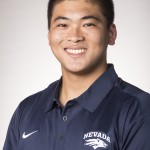
Marc Ma

By Vicki Gonzalez, KCRA-TV

The father of a UNR football player who drowned in Lake Tahoe wants his son’s death to send a powerful message of safety on the water.

Marc Ma, 20, was recovered in the water off the Homewood shore last week, after going missing in June 2016 during a paddleboarding trip with friends.

The Nevada Wolf Pack defensive lineman was not wearing a life jacket.

Read the whole story


Keeping it fresh from the garden to the table

By Melinda Myers

You spent the summer weeding, watering and tending to your vegetable garden. Now all your effort has paid off with a bountiful harvest.  Maximize the flavor and nutritional value of your homegrown vegetables with proper harvesting and storage.

For the freshest flavor, always prepare and serve vegetables immediately after harvest. But let’s face it, most of us are living busy lives and lucky to get the vegetables picked and eventually cooked. Plus, all the extras will need to be shared, preserved or stored for future enjoyment. Here are a few things you can do to keep the flavor fresh.

Handle produce with care. Nicking, breaking and bruising the vegetables during harvest decreases storage life and quality. Harvest leafy crops such as lettuce, kale, and collards last as they quickly wilt after harvest. And with the wilting goes the ascorbic acid (vitamin C).

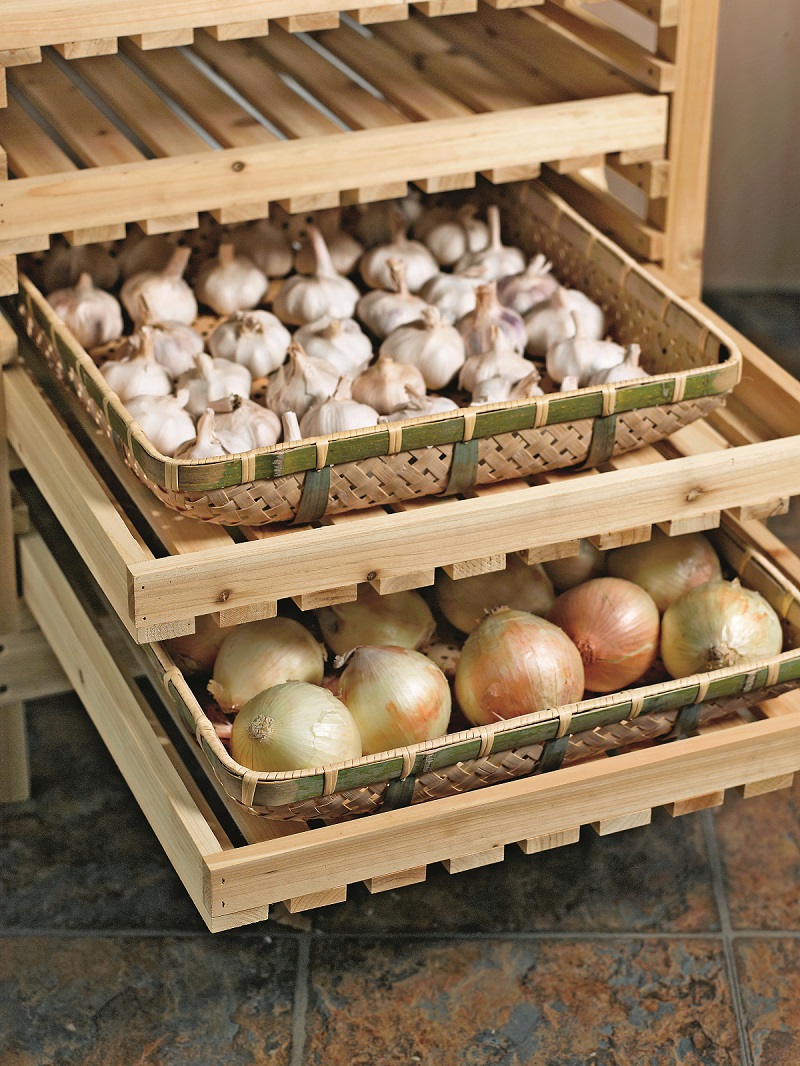
Orchard racks and other storage solutions for fresh produce increase storage longevity while maximizing space. Photo/Gardener’s Supply Company

Ideally, vegetables you plan to prepare immediately should be cleaned outdoors. You’ll keep garden soil out of the kitchen sink and in the garden where it belongs. Collect your veggies in an open weave wire or plastic harvest basket like the Mod Hod. Its fold out legs allow the produce to dry before bringing it indoors. Rinse off the soil with the hose, drain excess water and carry your veggies into the kitchen to prepare.

Clean your counters and cutting boards before you start slicing, cutting and dicing your vegetables. Trim stems, remove damaged leaves and compost these in the garden or worm bin. They will have a second life as compost in next year’s garden.

Wait to wash, trim, and clean the vegetables you plan to store or prepare later. The scraping, cutting and slicing process increases the loss of vitamins and flavor and reduces storage quality.

Increase storage longevity by matching vegetables with their preferred storage conditions. The closer you come to this, the longer your produce will last.

Store roots crops like beets, turnips and radishes as well as cabbage and Brussels sprouts in a cold, moist condition. A spare refrigerator works great for these. Those in colder climates can store their carrots and parsnips right in the garden. Once the soil gets a bit crunchy, cover them with straw or evergreen boughs for easier digging in winter. Then dig as needed or harvest during the first winter thaw.

Keep potatoes in a cool, humid and dark location like a cool corner in the basement. Sunlight causes the exposed portions to produce green chlorophyll and solanine, a glycoalkaloid toxin. The solanine gives the potatoes a bitter flavor and can cause vomiting and diarrhea if enough green potatoes are eaten. Just cut away any green portions before using.

Store winter squash in a cool location as well. They can tolerate a bit lower humidity and last for four months or more when properly harvested and stored.

Use slatted crates or other vegetable storage solutions to maximize storage space and increase storage longevity. These systems provide ample storage space, so fruits and vegetables do not touch. Keeping stored fruit separated prevents rot from spreading from one fruit to the next. Plus, the slatted sides allow airflow to extend storage longevity.

A few simple changes in handling your harvest will improve its storage life, flavor, and nutritional quality. Better quality means less waste and more abundance for cooking and sharing.

Follow these harvesting tips to enjoy garden-fresh meals throughout the remainder of the growing season. Then continue creating tasty meals reminiscent of the garden season with properly stored produce long after your harvest is past.

Melinda Myers has written more than 20 gardening books, including “Small Space Gardening.” She hosts The Great Courses “How to Grow Anything: Food Gardening For Everyone” DVD set and the nationally syndicated “Melinda’s Garden Moment” TV and radio segments.