Road Beat: 2017 Hyundai Ioniq elevates hybrid class
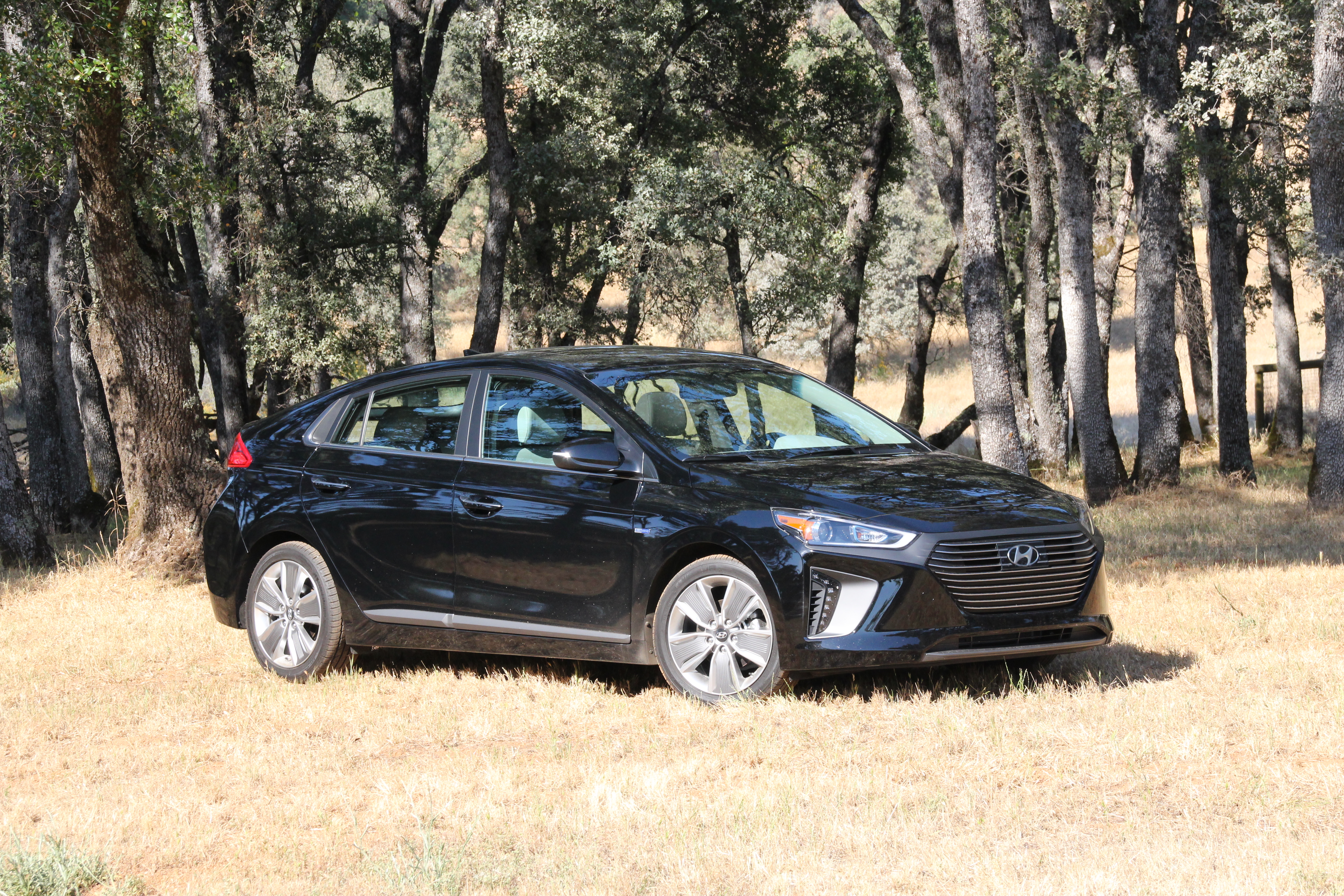
The 2017 Hyundai Ioniq is like saving the best for last. Photos/Larry Weitzman

By Larry Weitzman

It’s ironic that the new Ioniq is a late entry into what I now call a conventional hybrid. And while it may be late to the party, it might be, no it is, the best of the lot.

It claims to be the most economical hybrid ever. Even though only in certain drives could I achieve those lofty mpg numbers, it is certainly the best-looking car ever designed as a hybrid. And Ioniq will soon offer itself as a pure EV and a pull-in hybrid (PHEV).

Ioniq is a great looking vehicle in its own right, with an aggressive front end, a sweeping roof and window line, sizable fender flares and strong hips ending is a higher, slight kamm tail. A single character line flows from the rear disappearing into the massive front fender flares. Its wide stance accentuates its muscle at 72 inches on a compact body of just 176 inches on a long 106-inch wheelbase. It stands 56-inches tall. Co-efficient of drag is an incredibly low 0.24.

For such a small car, the Ioniq, even with its 1.5 kWh L-I polymer battery stuffed under the rear seat, has the interior volume of a large car at nearly 123 cubic feet with 26.5 cubes under the roomy hatchback with the rear seats up. It’s not just a great looking design, its clever as well.

Open the driver’s door and the first thing that catches your attention is the flat-bottom racing style steering wheel. Nice. I like it already. Please don’t get the idea Ioniq is a race car, but it will finish last in most races to the gas station. Under hood combined power systems, a 1.6L, direct injected Atkinson cycle inline four that makes just 104 hp at 5,700 rpm but it has an electric kicker, a 43 hp and 125 pounds of twist electric motor but because of limitations regarding rpm and battery output, the combined motive force directed to the six speed DCT automated manual driving the front wheels is 139 hp.
Specifications
Price
Loaded Limited $31,460
Powertrain
16 valve, DOHC direct injected inline four 104 hp @ 5,700rpm
109 lb.-ft. of torque @ 4,000 rpm
Electric motor 43 hp
125 lb.-ft.
Combined system hp 139 hp
Battery 1.56 kWh L-I polymer
Transmission
Six speed dual clutch automated manual
Configuration
Transverse mounted front engine/front wheel drive
Dimensions
Wheelbase 106.3 inches
Length 176.0 inches
Width 71.7 inches
Height 56.9 inches
Wheels 17X7 inch alloys
Tires 225/45X17
Passenger volume 96.2 cubic feet
Trunk volume 26.5 cubic feet
Weight 3,172 pounds
Fuel capacity 11.9 gallons
Co-efficient of drag 0.24
Performance
0-60 mph 8.91 seconds
50-70 mph 4.56 seconds
50-70 mph uphill 8.60 seconds
Top speed Well into triple digits
Fuel economy EPA rated 55/54/55 city/highway/combined Expect 50-55 mpg in rural country driving and 55 mpg on the highway at legal speeds.

Performance is good for a hybrid, handily besting a Prius by a second or two in all categories. Zero-60 mph came up in an average of 8.91 seconds, while passing times from 50-70 mph averaged 4.56 seconds on level ground expanding to 8.60 seconds up a 6-7 percent grade. The tranny is very responsive and overall this is a snappy car. Even running pure electric, you can feel the push on your back side. Impressive. And this is the first hybrid with a tach which appears when in Sport mode and manual shifting. It turns just 2,100 rpm at 70 mph but in Sport manual mode it will not run pure electric which it seemed to do all the time in automatic. Many times, Ioniq would cruise at 70 plus mph while cruising down the highway in pure electric.

Fuel economy as rated by EPA standards is 55/54/55 city highway/combined mpg. My highway mileage averaged 54.7 mpg or right at the EPA numbers, but overall fuel economy averaged somewhere between 46 mpg and 58 mpg depending on the type of driving which for me was fairly aggressive as the Ioniq begs to be driven hard. It is responsive. My round trip to Carson City averaged 51 mpg with the run from Carson City to Placerville (4,700 feet to 7.382 feet at Echo Summit and back to 1,800 feet) averaged an amazing 61.5 mpg. I would expect most drivers to achieve 50 mpg or better or about what a Prius returns.

How does this Ioniq drive? One word answer is fun! Not only does it scoot right along with plenty of vigor, it corners like a sports sedan. It flat out handles and it will certainly outperform 98 percent of drivers. Suspension is fully independent, steering is quick and in my Limited version standard 17 x 7 inch alloys were shod with some serious 225/45 rubber. With a curb weight of under 3,200 pounds it can tango in the twisties. Steering is nicely weighted with good feedback and a crisp turn-in. I flat out enjoyed Ioniq and that’s again ironic as it surprised the hell out of me time and time again in its smooth transitions and flat attitude. It certainly delivers everything its fabulous looks inspire.              

Of course, Ioniq is church mouse quiet, even the tires. However, you pay a small price for the handling as the ride is not cushy soft but more on the firm side. My kind of ride actually. Almost perfect especially considering the paragraph above. There is no wind noise.

Safety doesn’t take a back seat in Ioniq. All the acronyms are present, as are a plethora of airbags, rear view camera, blind stop, lane change assist and HID headlights which are fabulous and are adaptive on low beam, meaning they follow the steering wheel when turning. The $3,000 Ultimate package also adds automatic emergency braking, lane departure and smart cruise which would sense cars in other lanes in the curves and put the brakes on requiring a canceling and resetting the cruise. A minor annoyance. I am not sure I would opt for the package. I can live without auto braking and a few of the other items.

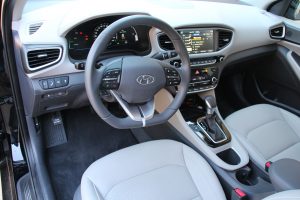
Inside is a beautiful, quality and purposeful interior. In the Limited leather and most everything else is standard. Seats are on the firm side, but offer good support and comfort, especially for the long haul. Power on the driver’s is standard with a two-position memory. Rear seat legroom is copious.

Instrumentation is very complete including the first tach ever in a hybrid. Yeah for Hyundai. I reckon they recognize the sporty nature of this gas sipper. The trip computer is also easy to use and complete. I drove 450 miles and still have an easy quarter tank of gas and it only holds 11.9 gallons. If the gauge were accurate and perfectly linear, that would be about 50 mpg. Most midsize and above motorcycles can’t do that.

Pricing is so good, this is a car you buy for its quality, looks and features and not because it’s a hybrid. Figure the hybrid part is a free lunch from an already delicious menu. Sticker on this top of the line Limited is $27,500 and the boat ride from Ulsan, South Korea, adds an obligatory $835. If you opt for the Ultimate as in my tester adds another three grand. Now here’s the rub, there is a charge of $125 for the fancy floor mats making the total for my ride $31,460. This car is a good deal, hybrid or not and perhaps that’s the beauty of it. It’s like Diet Coke, you drink it for the taste of it.

Larry Weitzman has been into cars since he was 5 years old. At 8 he could recite from memory the hp of every car made in the U.S. He has put in thousands of laps on racetracks all over the Western United States.



Review: ‘Belgravia’ a bit disappointing

By Kathryn Reed

The predictability of “Belgravia” had my book club giving it mediocre scores when it came to whether we liked it and would we recommend it. My ratings were lower than the group average.

The Julian Fellowes (Grand Central Publishing, 2016) novel is mostly set in London in the mid-1800s. While it is considered an historical novel, it’s more like a period piece. Only the first chapter has a real sense of anything historical.
Those who watched “Downton Abbey” had better things to say about the book than the rest of us. Fellowes was the creator-writer of that television series. He has also won an Academy award in 2002 for best screenplay for “Gosford Park.”

Clearly, Fellowes has writing credentials. But from his efforts with “Belgravia” this would have seemed more like an early attempt at writing. 

Secrets and lies that link two disparate families are woven throughout the book. While at times it seems like the lies will unravel everything, ultimately it is a lie that binds them together.

Nobility, money, social climbing, adultery and love are part of the book.

Society’s various classes are a central theme – from those born with titles and money, to the working person striving to rise to the next level, to the ranks among the servants. Each seems to have a jealousy of the other, a certain disdain and somewhat of a desire to be something they aren’t.

“Belgravia” is a fairly quick read, and good for a bit of escapism, but it is also a bit repetitive.


Energy conservation urged during eclipse

Liberty Utilities is encouraging customers to conserve energy during the solar eclipse on Aug. 21.

While the eclipse will last for less than three minutes on Monday morning, California is asking residents to conserve from 9am-10:30am. The state’s “Do Your Thing for the Sun” campaign is designed to reduce energy demand on the electrical grid when solar energy sources will be affected during the eclipse.

Liberty is not anticipating any lapse in power during the eclipse.

Liberty Utilities offers these year-round no-cost energy conservation tips:

  • Turn off lights and appliances when not in use, including computers.
  • Charge your electric vehicle and other electronic devices in the late evening, preferably after 10pm.
  • In warm months, set the thermostat to 78-80 degrees when home, and 5-10 degrees warmer at night or when you’re not home.
  • In the cooling season, close blinds and drapes during the day to keep heat out.
  • Use your electric dishwasher, clothes washer and dryer after 10pm when demand is lowest. Cook as late in the evening as possible.
  • Barbecue outdoors when practical.
  • Set your water heater to 120 degrees.
  • Vacuum refrigerator coils, underneath and in the back. They need air space to work.


Artists sought for Calif. bird stamp contest

The California Department of Fish and Wildlife is conducting an art contest to select the design for the state’s 2017-18 upland game bird stamp.

The contest is open to all U.S. residents ages 18 and over. Entries will be accepted from Oct. 30 through Nov.15.

This year’s stamp will feature the Wilson’s snipe (Gallinago delicate), a game bird.

Entries must include at least one Wilson’s snipe, preferably in a setting representative of its natural habitat in California. Entries will be judged on originality, artistic composition, anatomical accuracy and suitability for reproduction as a stamp and a print.

The contest will be judged by a panel of experts in the fields of ornithology, conservation, art and printing. The winning artist will be selected during a public judging event, with the date and location to be announced.

The money generated from stamp sales must be spent on upland game bird-related conservation projects, education, hunting opportunities and outreach.

For contest information and entry forms, go online.


Warning for those driving during the eclipse

Nevada Department of Transportation officials are reminding motorists to drive safely as an eclipse darkens Nevada skies on Aug. 21.

In Northern Nevada, the sun will be as much as 90 percent eclipsed during mid-morning hours of Aug. 21.

Approximately 200 million people, nearly two-thirds of the country’s population, live within a day’s drive of the path of the full solar eclipse, according to the Federal Highway Administration.

While Nevada is not in the path of the total eclipse, neighboring states will be. The federal agency is warning drivers of potential increased traffic as viewers travel to states directly impacted by the eclipse.

Expect potential traffic changes as people travel to eclipse viewing areas:

  • Do not pull over to the side of the highway to view the eclipse as that could pose a great danger to you and other motorists.
  • Do not try to take pictures or video of the eclipse while driving.
  • Do not look directly at the eclipse without proper eyewear.
  • Allow plenty of time to reach your destination.


Road Beat: Kia jolting the EV market

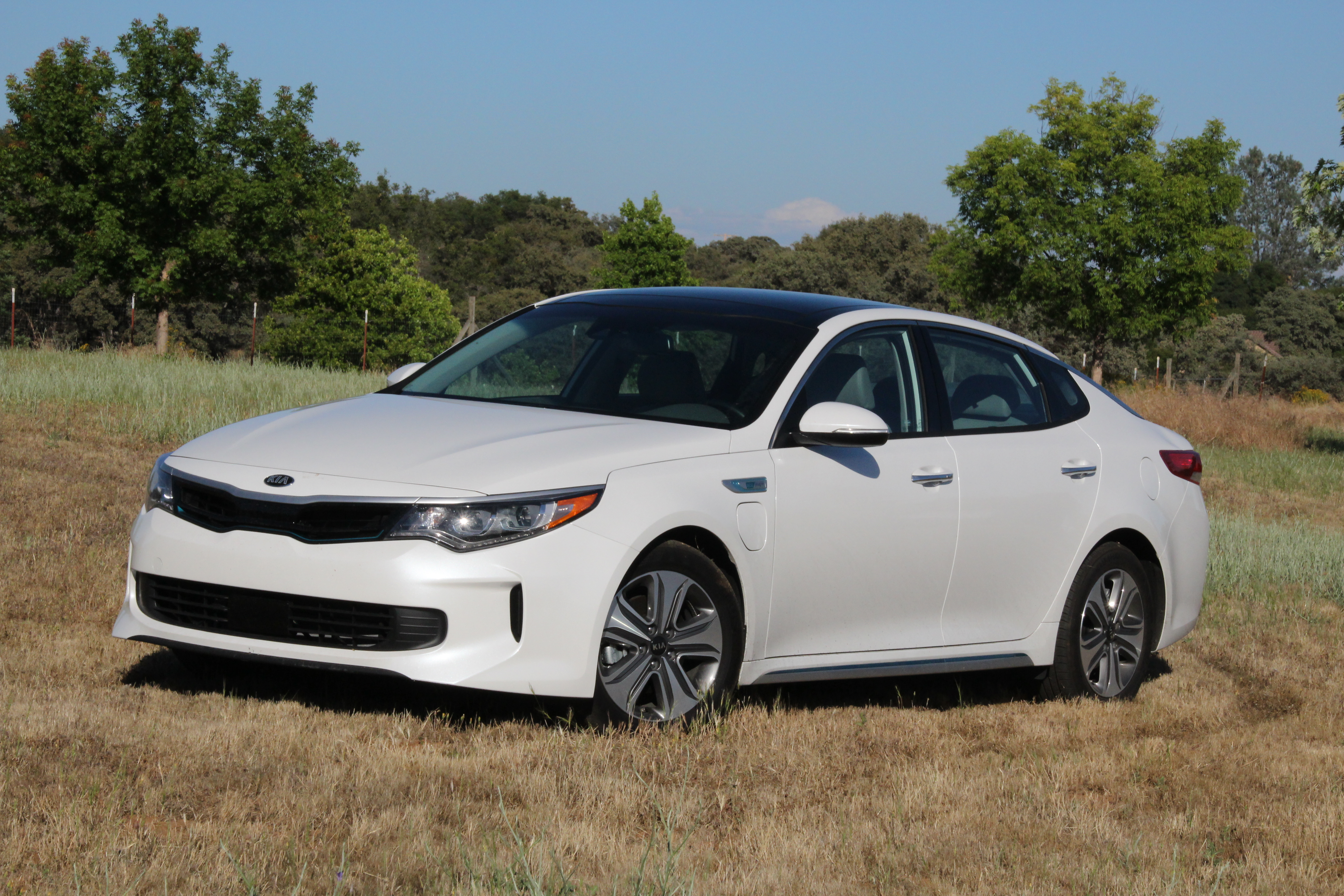
The 2017 Kia Optima PHEV is impressive to drive. Photos/Larry Weitzman

By Larry Weitzman

While electric vehicles seem to be all the rage, sales are still dismal with sales being about one-half of 1 percent of the entire automobile market. Pure electric cars are expensive and suffer from limited range and range anxiety. Cars aren’t for pushing, they are for driving.

Kia has taken the beautiful and stylish Optima body, stuck another small spring-loaded door on the left front fender to access a port for the plug-in receptacle, added a 9.8 kWh L-I battery behind the rear seat and tire well (to increase trunk space) and 67 hp electric motor mounted to the six-speed automatic cog-swapper. Modifications to the body, such as active grille doors to smooth airflow in front and a diffuser in the rear, reduce wind resistance to a co-efficient of drag of 0.24 equaling a Tesla S.

Optima is a true midsize riding on a 110-inch wheelbase supporting a 191-inch body that stands 58 inches tall with an aggressive 73-inch width.

Power comes obviously from two sources, a 2.0L Atkinson Cycle, DOHC, 16 valve direct injected inline four that cranks out 154 hp at 6,000 rpm and 140 pounds of twist at 5,000 rpm. If the numbers seem slightly depressed from other 2.0L high performance four bangers, it’s because this is a higher efficiency Atkinson cycle engine. The electric motor with the L-I battery at full charge is the main motive source for this PHEV. Combined they push out 202 hp and 276 pounds of twist. And it certainly feels like it.

Specifications
Price $36,105 to $41,750
Engine
2.0L DOHC, 16 valve, direct injected inline four cylinder 154 hp @ 6,000 rpm; 140 lb.-ft. of torque @ 5,000 rpm
67 hp electric motor
9.8 kWh L-I battery, max output 91 hp
Combined Max hp 202 hp @ 6,000 rpm
276 lb. ft. of torque @ 2,330 rpm
Transmission
Six speed torque converter automatic
Configuration
Transverse mounted front engine/front wheel drive
Dimensions
Wheelbase 110.4 inches
Length 191.1 inches
Width 73.2 inches
Height 57.5 inches
Ground clearance 5.1 inches
Track (f/r) 63.1/63.4 inches
Weight 3,788 pounds
Fuel capacity 13.4 gallons
Trunk capacity 9.9 cubic feet
Passenger capacity 104.8 feet
Steering lock to lock 2.78
Turning circle 35.8 feet
Wheels 7.0X17 inch alloys
Tires 215/55X17
Co-efficient of drag 0.24
Performance
0-60 mph 7.52 seconds
50-70 mph 4.01 seconds
50-70 mph uphill 5.65 seconds
Top speed plenty fast
Fuel economy EPA rated 103 MPGe/40 mpg gasoline only. Overall in rural country driving expect 60 mpg. On the highway at legal speeds should net 46 mpg.

You cannot run the battery down to zero. It always holds some charge so it can operate as a regular hybrid. When I plugged in after 40 miles the battery showed a 19 percent charge or about double the energy in a fully charged regular hybrid battery.

Performance is above average for this class of cars with 0-60 mph arriving in 7.52 seconds, certainly equal or better than the Chevy Volt. Passing times are also good with a level 50-70 mph pass of 4.01 seconds and the same exercise uphill slows that time by a second and a half to 5.65 seconds.

What makes the Optima EV outstanding is the pure electric performance. Even with what would seem a modest power output of just 67 hp from the electric motor alone, it is very responsive and acceleration is strong, so strong I kept looking for the engine to be running but it never lights off, even with half throttle which will push you back in the seats with authority. Transitions between the EV and the integration of the gas engine is absolutely seamless. This Optima is fun to drive.

I just finished a 40-mile trip with many stops and the Optima was able to remain in full electric up to the last mile, 39 miles, basically the EV driving range. Optima says the system should yield about 29 miles. Pure electric speeds exceeded 70 mph even up a slight grade.

I plug it in nightly and even during the day if my trips are spaced out and for the last 300 miles, which includes a one-day round trip to Carson City of 198 miles where it averaged 52.4 mpg. Optima average is 62 mpg for that 300 miles. At 70 mph on the highway in HEV mode, Optima PHEV will return 46 mpg. EPA numbers which are a bit confusing rated the Optima at 103 MPGe and 40 mpg only on gasoline. In overall driving the average will easily exceed 50 mpg. Amazing, especially with the kind of performance this Optima can produce. Fuel tank is 5 gallons less at 13.4 gallons, so highway range will be less than a conventional Optima.

But there is a rub, especially here in California, electricity is very expensive. I am paying 30 cents a kWh meaning even at four miles a kWh it costs me 7.5 cents a mile for energy. Gasoline only costs about 6 cents a mile. I understand there are some incentives offered by utilities to subsidize that cost, but it doesn’t really lower the overall cost, it just shifts the cost burden to someone else.              

 But California is the anomaly, as the average cost of electricity across the U.S. is about 12 cents a kWh meaning the cost per mile is about 3 cents a mile or about one half of gasoline. The average in California is about 16 cents a kWh, but as with El Dorado County rates increase as you use more. If the U.S. were more nuclear, the cleanest and cheapest form of power, costs would drop even further.

The other negative with a PHEV is the additional weight, although Kia has done a great job of adding a second power system (battery, electric motor and system components) with just a 300-pound weight penalty. Not bad, Kia.

In comparison to the Volt, which is supposed to run almost 50 miles as an EV before the engine lights off, the Optima PHEV has more performance and a much larger cabin as the Volt is a compact car with a much smaller cabin. While I haven’t tested the Volt, overall mileage might be just a bit better as it has twice the battery capacity.

Other than carrying an extra 300 pounds, suspension is similar to other Optimas, with all four corners sprung independently, roll bars at both ends and coil springs in all the corners. Steering is a quick electric rack at 2.8 turns lock to lock. It rides on 17 x 7 inch alloys which must have been designed for aerodynamics and not looks, shod with 215/55 tires. Nothing special here. While a Miata would smoke the Optima PHEV in the twisties and it might not set any Nürburgring records it handles predictably with descent cornering power, certainly more cornering power than any of its drivers will ever demand. I pushed it pretty hard and it complied, changing directions without complaint. Turning circle is reasonably tight at 36 feet.            

If you expect a soft floaty ride, look elsewhere. In fact, while the ride is well controlled and incredibly quiet, especially when operating as an EV, over bumps it is firm, not harsh or jolting, just firmer than anticipated. There is no tach, so no 70-mph rpm. There is also no wind noise and little tire noise.

Safety begins with the driver, but to help you along, Optima PHEV has all the acronyms, rear camera and air bags plus with the EX Tech ($5,250) package comes blind spot detection, lane departure warning, auto high beams, forward collision warning, emergency braking and more.

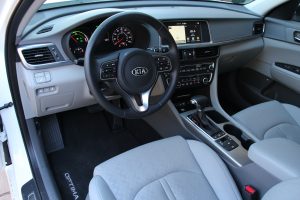
Leather is the material of choice in the high-quality interior. There is no tach but the rest of the instruments are front and center including a couple of trip meters and a battery level meter to tell you how much you have left. Seating is comfortable, if not on the firm side and the rear seating is good for three adults with plenty of shoulder and leg room. The supposedly large trunk is still small by mid-size car standards at a well-shaped 10 cubic feet also down by about 5 cubes over the conventional Optima.

Pricing starts at $35,210 plus $895 for the boat ride from South Korea. My tester has the tech package plus a special snow-white pearl paint ($395). This is a remarkable ride demonstrating just how good the technology is. Imagine 60 mpg and 0-60 mph is 7.5 seconds. How do they do that?

Larry Weitzman has been into cars since he was 5 years old. At 8 he could recite from memory the hp of every car made in the U.S. He has put in thousands of laps on racetracks all over the Western United States.


Treatment options for low back pain

By Zachary Child

Back problems can be severe. A natural alarm in the body signals a sudden, debilitating onset of gripping back pain. It not only hurts, but interferes with your ability to work, play, and participate in your daily activities.

Most adult Americans, between 80 and 100 percent, will experience severe lower back pain at least once in their adult lives. Fortunately, only a small percentage will need attention from a spine surgeon. Below are options to address lower back prior to considering surgery.

Zachary Child

Heat or ice can be very effective at relieving some acute pains and spasms. Depending on your preference and area of pain, try an ice pack, a hot shower, or a heating pad.

Nonsteroidal anti-inflammatories, NSAIDs, are another core treatment. They act in two ways. One, they are a pain reliever usually bringing relief within 30 minutes to an hour. Two, NSAIDs break the biochemical chain of inflammation, or cyclooxygenase (COX) pathway. This requires a sustained treatment from several days to two or three weeks. Ulcers can be common if NSAIDs are not taken with an antacid or food. Specific dosage amount and schedule should be obtained from your primary care provider.

Renewed attention has been placed on the non-pharmacologic therapies for lower back pain. Several recent meta-analysis studies show yoga and mindfulness-based stress reduction have the best outcomes reported by patients. These approaches were compared to exercise, psychological therapies, multidisciplinary rehabilitation, massage, chiropractic care, and acupuncture. However, some scientific data shows positive results for patients who tried the other options described above.

My advice is try different options and focus on treatments that work well for you.

Finally, a physician or rehabilitation specialist may recommend steroid anti-inflammatories. These can be taken orally or through injections, but require a prescription or referral. Steroid anti-inflammatories work best for sciatica, a radiating arm or leg pain. This treatment takes about six weeks to see results.

Addressing lower back pain will take a “tincture of time.” Watchful waiting and pain monitoring should be implemented throughout the treatment process. An MRI and other screenings may also be necessary during this period. If symptoms remain unresolved after other treatment options are taken, a referral to the spine surgeon is the last step.

Zachary Child is a board certified orthopedic spine surgeon who specializes in spine surgery and orthopedic oncology. He recently joined Barton Health’s Tahoe Center for Orthopedics to expand care for spine health throughout the Lake Tahoe and Carson Valley regions. 


Later start times in Calif. schools could save sleep, complicate life

By Hawken Miller, Sacramento Bee

Knikki Royster starts her workday as a juvenile court teacher in San Diego at 7:30 a.m., and she’s not sure what to do if her two kids can’t start high school until an hour later.

“I don’t like the idea of my kids having to walk to school. I prefer to drop them off,” Royster said. They would have to walk a mile to school. “I want that supervision in the morning. … When you don’t allow parents to do their job, we start making systems that don’t work for parents and hurt the family.”

Working parents like Royster are wondering about new routines as the idea of later school starting times gains traction in California. Sen. Anthony Portantino’s Senate Bill 328, which would prohibit middle schools and high schools from starting earlier than 8:30am, is cruising through the Legislature and faces final votes when lawmakers return next month. The debate also is playing out in school board meeting rooms around the state. In the area, some schools in Davis and Sacramento have already moved to the later start time.

Read the whole story


Foam Fest benefits adaptive sports program

Achieve Tahoe (formerly Disabled Sports USA Far West) will host its 28th annual Foam Fest fundraiser Sept. 2 from 2-6pm on the KT Sundeck at Squaw Valley.

Foam Fest brings people together for an afternoon of beer tasting and live music; this year featuring Ozomatli.

Proceeds from the event support Achieve Tahoe’s yearlong one-to-one adaptive sports program serving individuals with disabilities (physical, sensory, intellectual) of all ages. The nonprofit also serves disabled veterans.

Foam Fest showcases a variety of regional breweries serving samples of their craft beers, and includes raffle prizes.

Foam Fest tickets are $30 in advance and $40 at the door for unlimited beer tasting and live music. Non-samplers: $20 donation for the concert. Kids under 12 are free. Tickets are available online.


ColorBlast run benefits Tahoe youth organization

Tahoe Youth & Family Services’ annual ColorBlast 5K Run is Aug. 19 during Carson Valley Medical Center’s Health Fest 2017.

Runners get covered from head to toe in different colors at each 1K marker while running or walking the course. Each section has a different color. All of the colors are safe because they are corn starch based.

The race is non-competitive and runners from all ages and ability levels are encouraged to participate.

Wearing white is encouraged to show off the color.

The race starts at 9am in the Carson Valley Medical Center parking lot at 1107 Highway 395 North in Gardnerville. 

Cost is $40 for adults, $30 for ages 11-17, and free for children 10 and under. Register online.