More Americans are embracing RVs as their home

By Tom Gorman, Las Vegas Sun

The recreational vehicle industry is flourishing, thanks to folks like Tom Adams, a retired Air Force pilot flying for Southwest Airlines out of Las Vegas, and Elizabeth Fuentes, a construction project coordinator for the city of Henderson. Their contrasting styles are emblematic of the evolving world of RVing.

Adams and his wife, Yong, are in their 50s and cherish their 45-foot-long motor home. It has slide-out walls to accommodate a king-size bed, two bathrooms, leather couches, big-screen TVs, a ducted air-conditioning system, a well-equipped kitchen, washer and dryer, temperature-controlled storage bays and a windshield that’s more like a 4-foot-by-8-foot picture window.

Fuentes, 40 and single, shuns such extravagance. She wants to take advantage of her four-day workweek by traveling around the Southwest in an RV the size of a van that can take her deeper into forests on narrow dirt roads. But she still wants some niceties to provide a glamping (that’s glamour camping, for the uninitiated) experience “with everything I need, including a TV and a clean bathroom.”

Read the whole story


Suicide — it doesn’t have to be the final answer

By Kathryn Reed

“How can I support you to be here tomorrow?”

That one sentence could make someone realize they have a reason to live. Listening, being there – those are two of the more powerful antidotes to death by suicide.

So often when someone wants to end it all they believe they are a burden and that everyone around them would be better if they weren’t in the picture. That person in distress needs to know they are loved, they would be missed, that they bring something wonderful to this world.

Still, as Alisa Merino with the Suicide Prevention Network said, “It’s not your job to save them. You are not responsible if they die by suicide.”

That’s the sad reality. For some people, they will seek the lethal way out no matter the other options presented, no matter what someone else says or does.

Suicide is nothing new. What is new is how people are talking about it. It’s more out in the open. The stigma is slowly being erased. Help no longer involves a straightjacket and being locked up.

About 70 people showed up last week at Lake Tahoe Community College to hear what Merino had to say.

Most people who choose death by suicide have been depressed. It could be the loss of a loved one, the loss of a job, financial problems, drug issues – the triggers are limitless.

Merino stressed that it is imperative to ask direct questions – even asking the person if they are contemplating suicide. Don’t be worried about giving them ideas; you aren’t, she said. And if they say, “yes” – don’t leave that person. Call a hotline, get them to a behavioral specialist. If they are in imminent danger of hurting themselves, call 911.

Noticeable changes to eating habits, sleep changes and giving away possessions are signs someone may be thinking about suicide. They might start talking about death. Pulling away, becoming isolated is a normal precursor. Unusual risky behavior – which could even be driving under the influence – is another red flag.

Ask about how best you can support them. Be calm, neutral and non-judgmental.

“Suicide is messy, complex and it’s hard to understand,” Merino said.

It’s something that touches every community. And when it does happen, those left behind often feel a tremendous amount of guilt and are left with questions that may never be answered. To help get people through this grief there is now a survivors of suicide support group that meets the fourth Thursday of the month at Barton Health’s PR office in South Lake Tahoe from 6-8pm.

—–

Notes:

·      Walk for Hope in memory of Emily Alessi is Sept. 10 at Lakeview Commons in South Lake Tahoe. Registration is at 9am, walk at 10am, barbecue at noon. Cost $20 adults, 12 and younger free. All proceeds go to local suicide prevention services. (Alessi, a South Lake Tahoe resident, died by suicide three years ago at the age of 24.)

·      Suicide Prevention Awareness and Mental Health 101 will be presented entirely in Spanish on Sept. 12, 5-7pm at the Family Resource Center on Spruce Avenue in South Lake Tahoe.


Portion of Heavenly dedicated to 96-year-old

By Vicki Gonzalez, KCRA-TV

Martin Hollay

Heavenly Mountain Resort honored a longtime employee and skier by dedicating a special portion of the mountain just shy of his 97th birthday.

Martin Hollay moved to South Lake Tahoe in 1957, building his home up the street from the resort. The 96-year-old still skis at Heavenly, completing 100 runs last winter.

“My life is the mountain, and it still is today,” he said.

His home is a museum of Heavenly collector items. Hundreds of skis line his backyard and ski boots are used as flower pots — along with dozens of apparel, photos, and trophies.

Read the whole story


Is radio becoming obsolete?

By Mark Austin, Digital Trends

A study from New York University paints a grim picture for the future of radio. Larry Miller, head of the Steinhart Music Business Program, says that traditional radio, by failing to adapt to the rise of digital formats, has not engaged with Generation Z — people born after 1995. He also warns that radio will continue to decline in popularity and relevance unless substantial changes are made.

The problem for the industry, in a nutshell, is that young people don’t listen to the radio. Young millennials only spend 12 percent of their listening time on radios, according to a 2016 Music Business Association study. On-demand streaming, such as Spotify or Apple, account for more than half of Generation Z’s daily listening.

People have been predicting the demise of radio forever,  but there’s no denying that the quality and selection digital music is far superior to analog FM.

Read the whole story


Money Matters: Financial planning for unmarried domestic partners

By Nic Abelow

Today’s “modern family” is decidedly nontraditional. According to the latest Census data, less than 25 percent of American households currently consist of married couples with dependent children, while more than 40 percent of unmarried couples have children under the age of 18. Even the term “married” can be defined differently depending on where you live. Some states allow and recognize same-sex marriage, but the majority of states and federal government do not. Therefore, it’s important for domestic partners to ensure they have legal protections in place to protect their families and themselves.

Nic Abelow

Legal protections

Unmarried partners lack many of the legal protections granted to spouses in the event of divorce or death. Although most states will consider a claim by an unmarried partner, there is no specific legal precedent in the absence of a written contract. Domestic partners may wish to consider creating a domestic-partnership agreement that details the sharing of expenses as well as the ownership and distribution of assets should the relationship end. Unmarried couples with children should consider signing a written agreement acknowledging parental rights and responsibilities and having each partner name the other as primary guardian in wills.

Retirement considerations

Unmarried couples are not eligible for their partner’s Social Security benefits and, in some cases, employer-sponsored retirement plan distributions. The IRS allows a nonspousal beneficiary of an IRA to take required distributions over his or her lifetime rather than in a lump sum, allowing for potential tax-deferred growth over a longer period of time. Domestic partners who can afford to do so may want to contribute the annual maximum to an IRA to capitalize on this benefit.

Estate planning issues

If an unmarried individual dies without a will, the state may distribute assets to his or her closest blood relatives, leaving the surviving domestic partner out in the cold. To help rebut a challenge to a will, domestic partners may want to videotape their wishes in the presence of an attorney.

Federal tax law allows all assets to pass to a spouse tax free and no applicable estate taxes are due until the second spouse dies. Unmarried couples, however, do not enjoy this tax advantage. For those with significant taxable assets, it will be necessary to pursue other avenues to avoid estate tax. One strategy is to purchase life insurance to pay any potential federal and state estate taxes. The surviving partner must own the insurance to avoid it becoming part of the estate of the deceased. Therefore, each partner should own enough insurance to pay anticipated taxes on the assets of his or her partner.

Nic Abelow is a LPL financial advisor with Abelow, Pratt & Associates Financial Advisors and Wealth Management in Lake Tahoe.


Stinging things in the Sierra subject of talk

How does the 2017 yellow jacket population compare to previous years? Will a changing climate mean more regular population increases of these stinging things?

Lynn Kimsey from the UC Davis Department of Entomology and Nematology will give an overview of yellow jacket diversity and biology, and how to distinguish them from other wasps. Kimsey will also discuss effects and treatments of stings, and even more importantly, how to prevent or treat outbreaks.

The program will begin at 6pm Sept. 21, with refreshments and no-host bar from 5:30-6pm at the Tahoe Environmental Research Center on the campus of Sierra Nevada College in Incline Village.

Seating is open at 5:30pm to guests who have pre-registered, open seating starts at 5:50pm, and the program begins at 6pm. A $5 suggested donation will be collected at the door.


Sitting — it’s not a healthy choice

By Mary Duenwald, Bloomberg

Many health experts think the most dangerous thing most of us do every day is sit down. Like smoking, they believe, prolonged sitting is deleterious, and not something that can be balanced out by vigorous exercise when sitting time is done.

Dozens of studies have drawn connections between sitting too long and diabetes, hypertension, some forms of cancer (especially in women), anxiety and a generally greater probability of early death. There’s also the risk of a weak, flat backside.

It’s no wonder then that more and more people are raising their computer monitors to work standing up. But anyone with a dusty big blue ball in the attic knows that unconventional desk trends don’t necessarily last.

Read the whole story


Road Beat: Mazda 6 has looks, performance

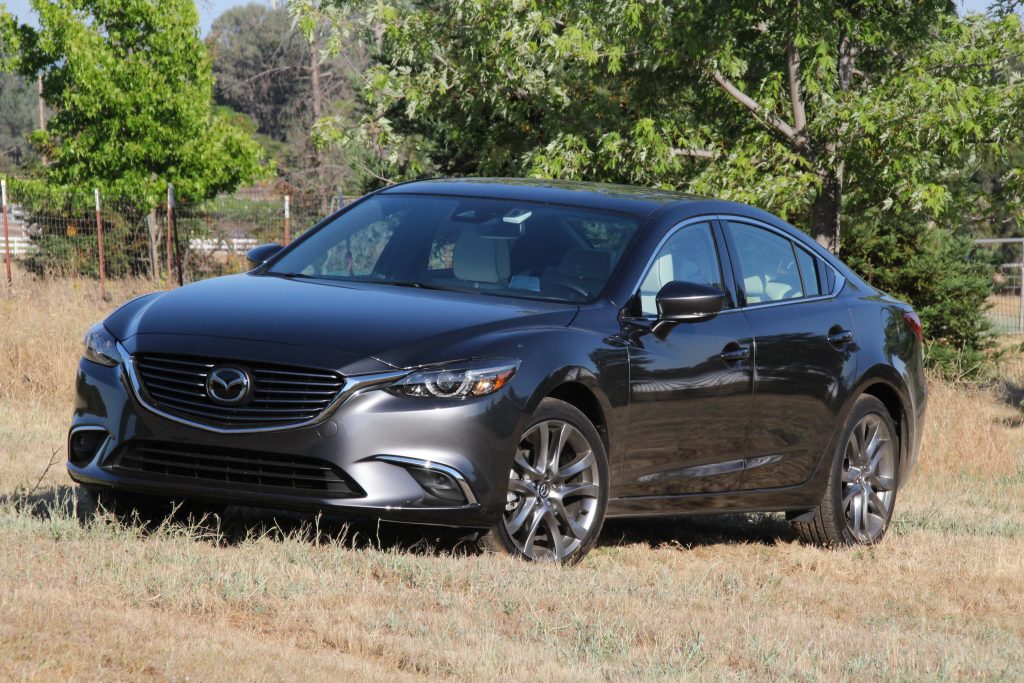
Mazda 6 is more than a great looking car. Photos/Larry Weitzman

By Larry Weitzman

Mazda has almost always designed brilliant cars. Perhaps the new Mazda 6 is their best yet and one of the best-looking cars ever put in mass production. Stand back and look at the lines. An aggressive front end, sharp character lines shape the vehicle which terminates in a softer, smooth rounded rear. The window line lowers the vehicle by stretching the cabin size and making the dog house look sleeker (Toyota Avalon has almost the identical window line, and while still an attractive car, probably Toyota’s best, the front end fails it).

If you go back to another great design, the sixth generation 929 or HD edition, you can see similarities in the smooth rear end and strong hips. It is disguised somewhat on the new 6 by a small trunk lip. You can even see some of the rear of the third generation RX-7 (FD) in the new Mazda 6 and the third gen RX-7, which was built from 1992 to 2002, is a modern-day classic.

But does it deliver? In spades, and hearts, clubs and diamonds, too. It remains the best mid-size ride in the class and that includes some serious and heady competition, especially from the Kia Optima. But be advised, there are almost no bad choices in this category of vehicles which is the bread and butter of all car sales. Mazda’s size is pure midsize at a length of 192 inches, a width of 72 inches while standing 57 inches tall.

Introduced as a 2014 model, not much has changed in the mechanicals as well. The wonderful 2.5L DOHC 15 valve with Skyactiv technology (Mazda’s name for what is basically direct injection) still pumps out 184 hp at 5,700 rpm and 185 pounds of twist at a low 3,250 rpm meaning it makes flexible power, up high and down low. It drives the front wheels via a six-speed torque converter auto cog swapper. If Mazda were to improve this power train it would be a world beater vehicle with their 2.5L blown 250 hp low pressure turbo motor found in the CX-9 with an all-wheel drive system. It would make the Mazda 6 a virtual supercar. Hint, hint.
Specifications
Price $22,780 to about $34,530
Engine
DOHC, 16 valve inline 2.5L four 184 hp @ 5,700 rpm
185 ft-lb of torque at 3,250 rpm
Transmission
Six speed torque converter automatic, with paddle shifters
Configuration
Transverse mounted front engine/front wheel drive
Dimensions
Wheelbase 111.4 inches
Length 191.5 inches
Width 72.4 inches
Height 57.1 inches
Track (f/r) 62.8/62.4 inches
Ground clearance 6.7 inches
Weight 3,305 pounds
Weight distribution (f/r) 58/42%
Fuel capacity 16.4 gallons
Cargo capacity 14.8 cubic feet
Passenger volume 99.7 cubic feet
Steering lock to lock 2.81 turns
Turning circle (curb to curb) 36.7 feet
Wheels 19X7.5 inch alloys
Tires 225/45X19 all season radials
Co-efficient of drag 0.26
Performance
0-60 mph 7.36 seconds
50-70 mph 4.15 seconds
50-70 mph uphill 6.09 seconds
Top speed 140 mph electronically limited
Fuel economy 27/35/30 mpg city/highway/combined. Expect 32-33 mpg in rural country driving and over 40 mpg on a level highway at legal speeds.

Performance remains identical to the prior 6 test two years ago with 0-60 mph coming up in 7.36 seconds and passing from 50-70 mph on the level and up a six percent grade taking 4.15 seconds and 6.09 seconds respectively. That is top of the class performance for a 4-cylinder non-blown mid-size sedan.

My tester also came with the GT premium package ($2,500) which includes nine special features including i-ELOOP which is “hybrid” system that stores electric power in a capacitor for later use in place of the alternator which takes a load off the engine. It also provides a lower final drive ratio with an overall improvement in economy of a claimed five percent. It works.

EPA rates the i-ELOOP 6 at 27/35/30 mpg and as you might expect, it does better, much better. At 70 mph on a level highway it returned an average of 42.3 mpg and overall about 32-33 mpg during my 400 miles of testing. On my round trip to Carson City in very aggressive driving the 6 averaged 32.1 mpg. Fuel economy as you can see is excellent, especially for such a high-performance car.

But that performance doesn’t end in a straight line, it continues when the road bends, no matter how sharply or whether left or right or in quick transitions. Mazda 6 flat out gets it done in style. Suspension is state of the art four-wheel independent, the electric power rack is a quick 2.81 turns lock to lock, 19 x 7.5 inch wheels are shod with serious 225/45 rubber and the track is a wide 63 inches up front and 62 inches in the rear. This all adds up to handling like water in a hose with a flat attitude. And it does it effortlessly and tirelessly in the tradition of a Miata. Perfectly weighted, quick steering and a crisp turn-in makes the 6 one of the most communicative, confident sedans on the market.

Ride quality is equally good, soft enough not to break any teeth with a supple compliance that creates what is an almost perfect ride quality, at least for guys like me who love to drive. It is also a quiet ride with no wind, road or engine noise, unless you’re at full tilt boogie trying to imitate the Space Shuttle at liftoff and then some engine noise enters the otherwise serene cabin. Engine speed at 70 mph is a low 2,000 rpm.

New for 2017 with the Grand Touring is Lane Keep Assist, besides the other acronyms which are standard like blind spot, rear camera and smart braking. LED headlights turn night into day with adaptive front lighting which turn with the steering wheel.

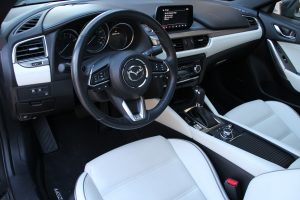
Inside is another improvement in this generation Mazda 6, with better looking, more comfortable seats. The contrasting piping with the soft Nappa leather gives the Mazda 6 an upscale luxury look and feel. Instrumentation is complete with a big tach left flanking a centered speedo and a right flanking trip computer and other ancillary gauges. With its big wheelbase, rear seating is copious and comfortable as well. The trunk is huge at nearly 15 cubic feet.

While the large info screen sits planted on top of the dash, its operation is controlled by a mouse like knob on the console. After several Mazda’s with this control system, I am finally up to speed. While it still is more difficult than some other systems especially with buttons and knobs, it has become tolerable and reasonable usable. 

Pricing for the 6 Sport starts at $21,945 with a 6-speed manual, adding $1,050 for the auto cog swapper. The upscale Touring can also be had with a manual while my Grand Touring is auto only. Mazda is one of the few midsize sedans to offer a manual tranny. My tester was a Grand Touring automatic only issue that stickered for $30,695 plus the obligatory $835 for the boat ride from Hofu, Japan. Add the GT Premium pack which has the i-LOOP for another $2,500 plus $75 for the cargo mat, $125 for the door sill trim plates and $300 for the Machine Gray Metallic paint and the Monroney totals $34,530 for a max loaded top of the line Mazda 6. Still the best of the best.

Larry Weitzman has been into cars since he was 5 years old. At 8 he could recite from memory the hp of every car made in the U.S. He has put in thousands of laps on racetracks all over the Western United States.



Dining program helps Tahoe-Truckee students

More than 40 restaurants are participating in the Excellence in Education Foundation’s Dining for Schools fundraising program this year.

Each cardholder receives 50 percent off an individual dinner entrée at participating restaurants in the Truckee and North Tahoe area. Some restrictions apply.

The Tahoe Truckee Excellence in Education Foundation is a private, a nonprofit organization that was created to enhance public education within the Tahoe Truckee Unified School District. The foundation’s mission is to raise money and provide grants, resources and unique partnerships to benefit students, teachers and the overall educational community.

Dining for Schools cards are available starting Sept. 15 for $50 per card, and are non-transferable, with all proceeds benefiting the Excellence in Education Foundation. Cards are valid Sunday through Thursday only (holidays excluded) from Sept. 24-Dec. 14 and April 15-June 14.

Several restaurants offer an extended period that makes the card valid from Jan. 7-April 5.  Cards may be used an unlimited number of times at any participating restaurant during the valid period.

Cards will be available for purchase at Safeway (Truckee and Kings Beach), Save Mart (Truckee and Tahoe City), Mountain Hardware and Sports (Truckee), The Store (Tahoe City), and online.


Opportunity to give blood in S. Lake Tahoe

BloodSource will have a blood drive in South Lake Tahoe on Sept. 29 to meet the community need for blood and blood products.

The drive is sponsored by the Barton Memorial Hospital Auxiliary. Walk-ins are welcome. 

Donors must weigh at least 110 pounds, be at least 16 (16 and 17 year olds will need a signed BloodSource Parental consent form) and be generally healthy. There is no upper age limit for blood donations. Bring a photo ID and drink plenty of fluids before donating.

The blood drive will be that the city’s park and recreation center on Rufus Allen Boulevard from noon-5pm.

For more information, call 916.453.3039.