Tahoe Truckee Foundation asset growth tops in state

Reno Gazette-Journal

Truckee Tahoe Community Foundation reported the highest growth of assets of all community foundations in the state of California during the 2008 fiscal year.

The foundation’s assets grew 25 percent, from $12 million in 2007 to $15 million in 2008.

“As the TTCF passes its 10th anniversary, it has become known for effective stewardship, a commitment to important issues in the region,” said Lisa Dobey, TTCF’s chief executive officer. “Importantly, it’s a vehicle for helping individuals and families give back to important causes.”

Read the whole story


Torch takes long way to Vancouver

torchThe 2010 Winter Olympics’ torch relay has had some interesting moments with its windy Canadian route.

A polar bear passed in front of the convoy during a visit to appropriately-named Alert (Canada’s most northern inhabited community). And more recently, elephants, reindeer and camels walked along-side the relay.

There was the time a young man proposed to his girlfriend in front of a torchbearer exchange.

As far as firsts, the torch made its way for an inaugural visit to the House of Commons with the flame being carried by a surfer in Tofino.

A touching moment ensued when Sidney Crosby of the Pittsburgh Penguins received the flame in Halifax from long-time fan Kirk Boudreau in front of thousands of cheering fans.

The relay will travel 45,000km in 106 days through every province and territory. When planning the route, communities were selected because of their population and geographic location to ensure as many Canadians as possible were reached.

The torch relay has been and will be within a one-hour drive of more than 90 percent of Canadians.

The 2010 Olympic Torch Relay will connect some of Canada’s farthest points: Cape Spear on the east coast to Old Crow in Yukon – the route’s northernmost stop, Canada’s southernmost point Point Pelee, Ontario to the world’s northernmost inhabited community of Alert, Nunavut.

Daily highlights can be found here.

Click here to see the torch route.

Compiled by Susan Wood.

Publisher’s note: Read about Daron Rahlves’ quest for gold in skiercross on Jan. 10.


Hagar tickets on sale Jan. 9

hagarTicket go on sale Jan. 9 at 10am for Sammy Hagar and The Wabos, who will play at Harrah’s South Shore Room May 7-8.

Tickets are only available through TicketMaster outlets. They are $75 plus tax, general admission. Must be 21 to attend.

Hagar returns to Lake Tahoe with The Wabos to help celebrate the sixth anniversary the Cabo Wabo Cantina, his restaurant and bar inside Harveys.


LTCC art gallery update

In addition to their duties here at the college, many of the Lake Tahoe Community College Art Department faculty and staff are practicing artists in their own right.

An exhibit of their work will go on display in the Student Gallery, located in the LTCC commons, Jan. 9 and run through March 20. This exhibition highlights their talent by revealing the broad spectrum of media, techniques, and styles being explored. There will be an artists’ reception Jan. 14 from 6-8.

Haldan Gallery — “The Contemporary Figure: Drawings by CSULB Art Dept. Faculty”

This group exhibition highlights the figurative drawings of seven artists who teach at CSU Long Beach. Classical drawing techniques combine with contemporary content to present an exhibition of stunning figural studies from nationally and internationally recognized artists. This exhibit will open Jan. 14 and through March 18.

A talk with one of the participating artists: Yu Ji is scheduled for March 18, 5-6pm, in the Aspen Room.

New Gallery Hours:

T-W-Th: 11am–5:30pm

F: 11am-2:30pm


Second liger at Sierra Safari Zoo

By Victor Calderon, Reno Gazette-Journal

Napoleon Dynamite was right: a liger does exist.

The animal, a mix between a male lion and a female tiger, that the fictional movie character likes to draw has come to life with a young female liger that arrived in Reno last week at the Sierra Safari Zoo.

Officials there say the unnamed 8-month-old liger was donated by its owner from Illinois.

Read the whole story


Abstract art exhibit at LTCC starts Jan. 9

artistsSouth Shore artist and poet Yasmin Sayyed will display her abstract paintings in Lake Tahoe Community College’s Foyer Gallery starting Jan. 9.

Born in New York of Cape Verdean and Caribbean ancestry, much of her professional life has been spent as an educator, researcher and psycho-educational therapist. Sayyed has had a lifelong passion for making art in the service of spirituality, peace, and truth-telling inform these colorful and magical paintings.

The exhibit runs through March 20.

An Artists’ Reception is Jan. 14, 6-8pm.


New headquarters for Sierra Wildlife Rescue

By Cathy Locke, Sacramento Bee

Sierra Wildlife Rescue, an El Dorado County-based volunteer group that rescues and rehabilitates injured and orphaned wild animals, begins the new year in new quarters.

With its 2010 class offerings for current and prospective volunteers scheduled to begin Jan. 14, volunteers will hold a work day Jan. 9 to put finishing touches on the new center at 3030 Newtown Road, on Placerville’s eastern edge, said volunteer Barbara Barker.

Read the whole story


Casting call for “The Laramie Project”

“The Laramie Project” is a docu-drama about the 1998 hate-crime murder of Matthew Shepard, a gay University of Wyoming student who was brutally beaten by two young men, tied to a fence, and left to die.

Writer-director Moisés Kaufman and actors of New York’s Tectonic Theatre Project journeyed to Laramie to interview townspeople about the horrific murder. After 400 hours of interviews, what emerges is an unusual and powerful theatre piece focusing on the citizens of Laramie, how they were affected and ultimately changed by this act of brutality within their community.

Mature themes and content – may not be suitable for children under 15.

A series of events, including panel and post-show discussions, will be held in conjunction with this production, culminating in a Candlelight Vigil Against Hate following the final Saturday evening performance on March 20.

Auditions are: Jan. 5 at 7pm in the Duke Theatre at Lake Tahoe Community College, South Lake Tahoe.

Peformances: March 12, 13,18,19,20 at 7:30pm, March 14 and 21 at 2pm


Squaw — from a rope tow to Olympic mountain

squawBy Kathryn Reed

Alex Cushing left his East Coast law practice to move to Squaw Valley in the 1940s, soon convinced PanAm pilot Wayne Poulson to sell him 600 acres in what is now Olympic Valley and then spent $100,000 to build a ski lodge near what is KT-22.

By 1954, Cushing was entertaining the notion of Squaw hosting the 1960 Olympics.

Lake Placid officials were furious he won the U.S. Olympic Committee’s approval. He went on to beat out Innsbruck, St. Moritz and Garmishe-Partenkirchen. (Innsbruck was selected four years later and again in 1976. Lake Placid hosted the game in 1932 and 1980.)

In 1955, when the International Olympic Committee chose Squaw, the North Shore resort had one chairlift, a rope tow and a 50-room lodge.

Construction on Olympic-quality facilities started the next year — $8 million worth. This set an Olympic record. (By contrast, the Vancouver Olympic Committee says the expense of this year’s Games is in the billions of dollars.)

The abundance of snow in Lake Tahoe was one of Cushing’s selling points. The problem in 1960 was the snow was sparse. There was talk of trucking in snow or moving the events to Slide Mountain (now part of Mt. Rose ski resort).

But Mother Nature cooperated; with the snow seeming to fall by the bucket load that February just as the Games were to begin.

So much fell that Walt Disney – who was putting on the opening ceremonies – feared all of the white stuff and nasty weather would ruin his festivities. (Disney helped found Sugar Bowl ski resort 70 years ago.)

Richard Nixon, then vice president and one-time congressman from California, was 90 minutes late because of the storm. The 15,000 people in attendance had to wait for his arrival.

With 10 inches falling in the valley and even more on the mountain, the men’s downhill was pushed to the first Monday.

Seven hundred athletes from 33 countries competed in 27 events in 1960. The bobsled event was canceled because there wasn’t enough money to finish building the route, though officials at the time said it was because not enough countries wanted to participate.

Leading up to the Games, Buddy Werner was one of the country’s potential medalists in skiing, but he had broken his leg earlier in the season. If that name sounds familiar, youth ski programs now carry his name.

Jean Vuarnet stunned the world by winning the men’s downhill on metal skis – the first time metal skis had been used. The French also didn’t wax their skis.

It wasn’t just the slopes that were catching people’s attention. These VIII Winter Olympics were the first time any skating event was contested inside and therefore the first on manmade ice. Ponds of frozen ice were the norm before Squaw.

However, the speed skating was outdoors on a 400-meter oval.

They were also the Games to usher in electronic timing.

The Squaw Games were the first to have daily television coverage. Walter Cronkite was the voice of those Games for CBS.

About 300 people worked security at Squaw. This pales in comparison to the number Vancouver is employing — 15,000 police, private security and military personnel at a cost of nearly $1 billion.

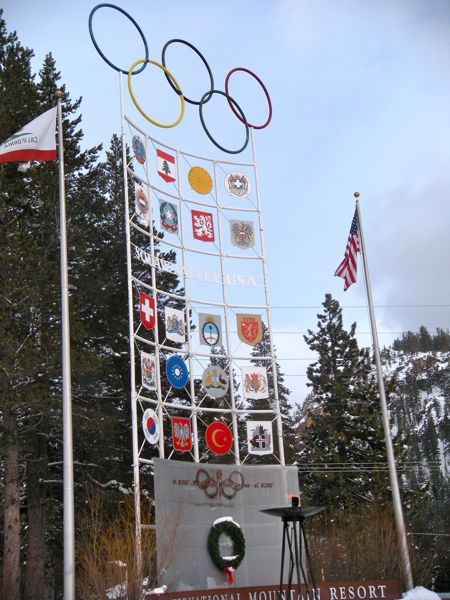
Other than the Olympic flame and those famous five rings at the entrance to Squaw off Highway 89, relics of 50 years ago are hard to find.

The roof of Blyth Arena – the ice rink – collapsed in the 1980s. Condos near Red Dog replaced the torch tower and podium. The ski jump sat unused for a couple decades until it, too, was removed. The Nevada Visitors Center is now the Far East Center and the California Visitors Center serves as the members’ locker building.

Although most of the structures are long gone, the memories of those 1960 Games at Squaw seem to burn as bright as the Olympic flame.

Publisher’s note: Read about potential Olympian Elena Hight on Jan. 5.



Nevada brothel to start servicing women

By Henry Brean, Las Vegas Review-Journal

In as little as three weeks, the Shady Lady Ranch brothel plans to launch a live-action sociology experiment that could open a whole new market for the state’s legal bordellos or destroy the industry altogether.

So go the predictions for what might be the biggest change to hit the brothel business since the credit-card reader: male prostitutes.

By as early as mid-January, Shady Lady owner Bobbi Davis plans to hire two men to start servicing women at her cathouse 150 miles northwest of Las Vegas.

Read the whole story