Olympics — part athleticism, part political intrigue

By Susan Wood

The modern Olympic Games have come a long way over the last 100-plus years, with moments that standout vividly and lessons that remind us how fragile, yet courageous, humanity from across the planet to the streets of Tahoe can be.

The Games — which were dedicated to Olympian Gods — can be traced back to 776 BC, with the first Olympiad isolated to ancient Greece featuring a stadium race. They continued for nearly 12 centuries until Emperor Theodosius decreed in 393 A.D. that all such “pagan cults” be banned.

The modern international Olympics opened in 1896 in Athens, the origin of the Olympic torch. The symbolic gesture burned at the altar of Zeus, signaling the beginning and end of the event. Many myths aside, the Greeks were fiercely competitive and enjoyed a good contest.
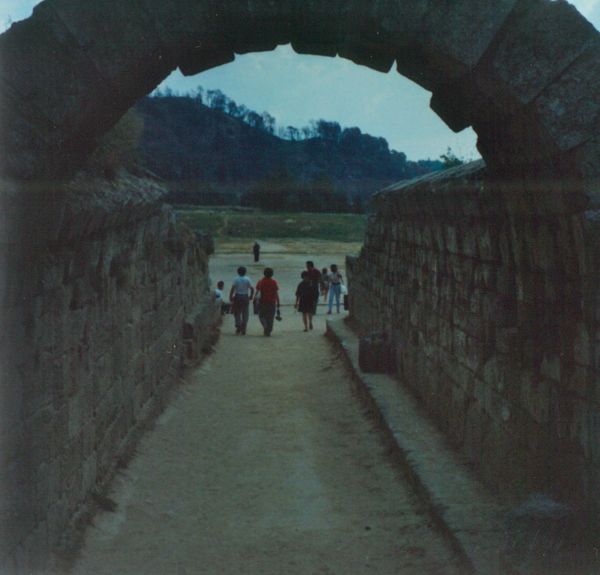
Track at the original Olympics in Olympia, Greece. Photo/Kathryn Reed/1990

Walkway leading to the track at the original Olympics in Olympia, Greece. Photo/Kathryn Reed/1990

The addition of various sports through the years demonstrates that quest for athletic entertainment. Even the Greek calendar was based on the concept of the four-year Olympiad.

One of the most dramatic feats of the modern Olympics includes the triumph of the U.S. track and field team in 1896. The 10-man squad barely reached Athens in time to participate. They won nine out of a dozen events.

In 1912, Jim Thorpe — a Native American — became the only man to win the decathlon and pentathlon in one year. His medals were ripped away when officials learned he had played professional baseball. This was not the era of “the dream team.” They were later restored in 1982.

In 1936 in Berlin, Jesse Owens made his mark in history by taking home four gold medals, including a team medal. Being black, especially competing in Germany, was a feat in itself.

Four decades later, Nadia Comaneci of Romania received three gold medals and seven perfect scores — a first for Olympic gymnastics.

In 1972, the Summer Games were rocked by tragedy in Munich, West Germany, when Palestinian terrorists murdered 11 Olympic team members from Israel. Protests and boycotts over political skirmishes ensued through 1984 when the Games were staged in Los Angeles. The U.S. and some allies boycotted the 1980 Moscow Games, and Russia and other Eastern Bloc countries returned the gesture four years later.

But in the spirit of the Games, 1972 also marked a major year for milestones. U.S. swimmer Mark Spitz won a record seven gold medals at a single Olympics — only to witness Michael Phelps beat the record in Beijing in 2008.

Being an Olympian means overcoming adversity with the world watching. After having set six world records in 1982, U.S. sprinter Mary Decker took a heartbreaking fall when she collided with Zola Budd two years later during the 3,000-meter final. The photo of the young sprinter became one of Time-Life’s most recognized shots of the century.

Speed skater Dan Jansen confronted heartache head-on when the favored athlete lost his chance of bringing home gold in 1988 — the same day his sister died of leukemia. A stumble four years later kept him from earning any hardware. When he finally won gold and set a world record in 1994 on the Lillehammer, Norway, track, a tearful Jansen looked up as though his sister was watching. (He has retold that story as a competitor in the annual celebrity golf tournament on the South Shore of Lake Tahoe.)

Tahoe’s slice of history

It was the Olympic Games of 1960 that placed Lake Tahoe on the map in both a gesture of bravery on the North Shore, and as some would put it, bravado on the South Shore.

South Lake Tahoe historian Betty Mitchell recalls how inspiring it was for the Tahoe region to host the games and for her to see them — sitting on a rooftop to watch ski jumping at Squaw and listening to the music of Walt Disney that still accompanies the Olympics of today.

“Having the Olympics in your country is always exciting, but (Alex) Cushing getting them here is a story in itself. It was a brave thing to do. I think he had a unique idea,” she said of the late founder of Squaw Valley. At the time it was a modest ski area with one rope tow and one chairlift.

Mitchell contends the South Shore should have embraced the Olympics around the lake instead of jacking up prices and “charging an arm and a leg” for lodging.

“The funny thing was, we were not very crowded during the Olympics,” she said. “It’s sad. We don’t have the best reputation around the world you know.”

Still, the longtime resident admits to being enthusiastic about the prospect of a bid in 2022, and more timely, Squaw’s 50-year anniversary falling on the Olympics’ return to the West Coast in Vancouver beginning Feb. 12.

“I hope our kids do well,” she said, adding praise to Sierra-at-Tahoe’s contribution of sponsored athletes to the Olympics. The Tahoe region features a slew of athletes vying for a spot on the ski and snowboard teams — with Squaw’s Jonny Moseley headed to the NBC broadcast booth to give color on his Tahoe buddy Daron Rahlves in skiercross, among other sports.

“We should take pride. This is what this community does in winter. We used to wrap ourselves around skiing,” Mitchell said.

Timing is everything

Tahoe City historian David Antonucci is keeping the spirit and motivation alive by recently releasing a chronicle of the VIII Olympic Winter Games. The book, “Snowball’s Chance,” highlights the quest for gold and green at Squaw Valley.

Antonucci remembers the 1960 Winter Games as the first “techno” Olympics with updated electronic timers to clock the events.

Skating rinks also came into the picture at Squaw.

“Before, we used to have these events on frozen lakes,” he said. “We would have had to have them on Echo or Caples (lakes).”

Fifty years ago, the Games also featured the first biathlon — a sport Northstar-at-Tahoe this season put its weight behind by opening the only official course on the West Coast.

“This is fantastic and will do so much for this sport,” Antonucci said.

South Lake Tahoe resident, Martin Hollay, 89, who volunteered his efforts to build the 1960 cross country ski course in Tahoe City said the addition is inspiring to him.

“You know, I’ve gone out there and found shells from that time,” Hollay said.

Some parts of history never go away.

Publisher’s note: Find out on Feb. 2 what a non-Olympian thinks about skiing the women’s and men’s downhill courses in Whistler.

Inn by the Lake dazzles judges with light display

The South Shore was a little brighter this holiday season, thanks to Leadership Lake Tahoe and the enthusiasm of the local business community. More than 40 local businesses participated in the first Light Up Lake Tahoe.

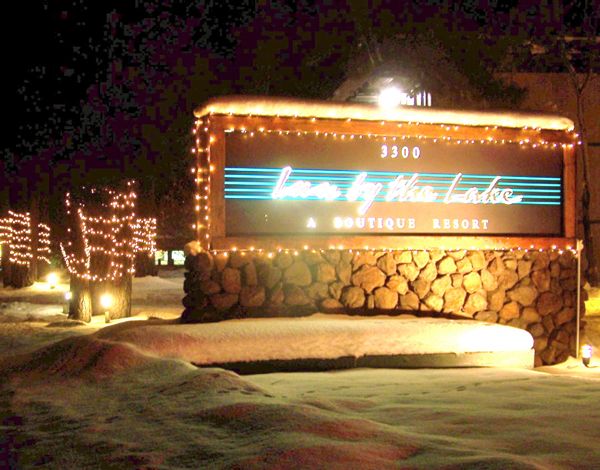
Judging of the lighting displays was conducted Jan. 4-15. The title of Best Lights on the Lake goes to Inn by the Lake (3300 Lake Tahoe Blvd). Judges weighed in on creativity, coverage, and overall impact.

Inn by the Lake wins lights contest. Photo/Provided

Inn by the Lake wins lights contest. Photo/Provided

“The brightly lighted trees really make a statement and stand out on what would otherwise have been a dark corner along Lake Tahoe Boulevard,” judges said in a press release.

The lights program was conceived with two primary goals in mind: to give lights to businesses that would not have purchased them on their own, and to encourage businesses that can to put up more creative lighting displays.

The project received initial funding from Lake Tahoe Visitors Authority, the South Lake Tahoe Lodging Association, the Tahoe Douglas Visitors Authority, Barton Health, Heavenly Ski & Snowboard Foundation, and Harrah’s-Harveys. In addition, several businesses that received lights made donations.

Sponsorship covered the cost of the lights, and all proceeds benefit Tahoe Turning Point. Tahoe Turning Point is a private, nonprofit agency that provides group care and residential treatment for young men ages 12 to 18.


Bereavement groups in South Tahoe, Carson Valley

By Denise Sloan Smart

Are you dealing with a major loss such as the death of a loved one? Perhaps you’re grieving over a divorce after many years of marriage? It’s normal to feel that your whole life is shattered and that you are alone. Barton Health can help.

Barton’s Hospice offers monthly “Memory Dish Bereavement Groups.”

In South Lake Tahoe, the group meets the first Thursday of each month from 3:30-5pm at the South Lake Tahoe Senior Center, 3050 Lake Tahoe Blvd.

Dates are Feb. 4, March 4, April 1 and May 6.

Call (530) 543.5581 or (530) 307.0288.

In the Carson Valley, the bereavement group meets from 3:30-5pm in the Carson Valley Medical Center Administration Building, second floor, the fourth Wednesday of each month.

Dates are Feb. 17, March 17, April 21 and May 19.

Call (775) 782.1510.

Trained facilitators and group counselors will be in attendance. There is no cost to attend the group but it is helpful to know who is coming.

Barton’s Bereavement Groups can help people pick up the pieces and rebuild their lives. A bereavement group is a safe place for individuals to feel empowered to express grief and sorrow and receive help in re-creating a rewarding life filled with authentic happiness.

Taking good care of yourself helps your body heal from the physical signs of grief. Try to stick with healthy exercise, sleep and eating routines. Having family around can help you feel loved. Or you might need a walk or see a movie with friends to take your mind off things for a little while.

Joining the world again is part of healing. These tips may help:

·Stay in touch with family and friends, even if it’s hard to talk.

·Tell people how they can help. It can be as simple as running an errand for you. Attend a support group for people who have been through the same type of loss.

You may find yourself asking: “Why?”

It’s normal to seek meaning by asking questions, but there’s not always an answer for loss. With time, your loss will still be part of your life, but not the only thing in it. You’re not alone and remember that grief healing is a process.

Denise Sloan Smart is a communications specialist for Barton Health.


Former Placer County TB sanatorium full of memories

By Mike Dunne, Sacramento Bee

Edgar Allan Poe, Stephen King or some other master of the macabre must have planted the notion in my head:

I walk into a cemetery and find my name and birthdate on a gravestone. The date of death is there, but it doesn’t matter. The plot is set.

I even know the cemetery where this scenario takes place: an isolated and rarely visited graveyard some 2,000 feet up the Sierra foothills, just outside Colfax.

It’s on the grounds of what historically has been Weimar Joint Sanatorium, 450 acres of manzanita, pine and oak whose central cluster of buildings is now Weimar Institute, a campus of Seventh-day Adventists studying religion and health.

Read the whole story


Rescue helicopter brings on two RNs

CalSTARBy Kathryn Reed

South Lake Tahoe’s Calstar base is now fully staffed at eight with the arrival of Stephen Poehls and Nathan Schwab.

Poehls and Schwab joined the Tahoe outfit late last year. Poehls had been doing the same type of work in Montana, while Schwab had worked between the Calstar bases in Salinas and Gilroy since September ’08.

“I went to Northstar-at-Tahoe (in December) and transported a patient that hit a tree. It was the first time I came into a very snowy landing zone,” Schwab said.

Winter is the busiest time of year for Calstar’s Tahoe base because of all the ski related injuries. Landing at a resort – on snow or in a parking lot – is not uncommon.

Assault victims are who Schwab was used to treating when working at the bases south of San Jose.

One of the reasons Poehls wanted to work in Lake Tahoe is because he would be in a similar mountain environment compared to where he came from. He and his fiancee, who is a nurse practitioner at Carson Tahoe Hospital, were also ready for a change. They are living in Minden.

Poehls said the crew in Tahoe works well together and is tight knit.

“We communicate with one another so we can overcome a lot of things having to work in a helicopter,” Poehls said. “We decide things before we put the patient in the aircraft to be efficient.”

The registered nurses work two 24-hour shifts each week. When they aren’t on a call, they are training. They have sleeping facilities at Lake Tahoe Airport so they never leave when on duty. It’s similar to a firehouse.

The Tahoe crew has traveled as far south as Mammoth, into eastern Nevada, west to about Georgetown and north to Susanville.

The next closest Calstar helicopter is in Jackson. It can be moved to Placerville to act as backup for Tahoe and Vacaville. It takes that bird 18 minutes to get from Placerville to South Tahoe.

The Tahoe crew regularly transports people to Barton Memorial Hospital, but also to Reno hospitals that have more advanced medical facilities.

Calstar, which stands for California Shock/Trauma Air Rescue, started in 1984 in San Mateo. The operation at Lake Tahoe Airport began in 2001. The fixed wing and helicopter air ambulances have eight bases in Northern California.


Tahoe’s talk of Vancouver, Jan. 27 pm edition

Publisher’s note: This is the final installment of Tahoe’s talk of Vancouver.

By Kathryn Reed

WHISTLER, British Columbia — I’m a convert.

I’ve never been a fan of ski villages. They seem like a make believe, developer construed, concrete morass with little attention paid to the locals and dollar signs the end goal.

Much of this might be true for Whistler Village, but the feel is so much different.

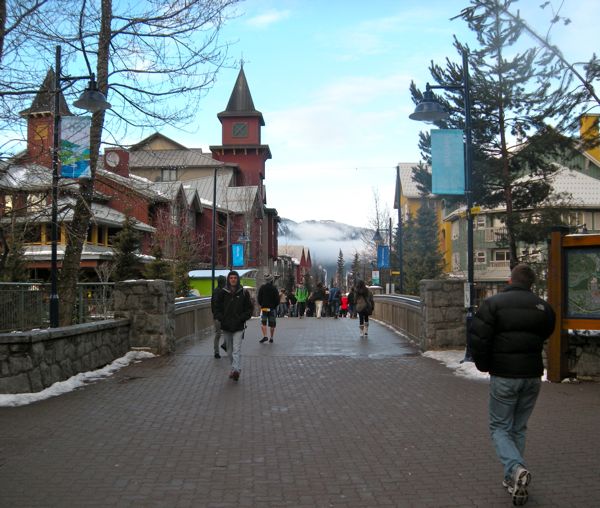
Whistler Village is all about pedestrians. Photos/Kathryn Reed

Whistler Village is all about pedestrians. Photos/Kathryn Reed

For starters, the size of the village is in proportion to the mountain that looms above. It’s huge by California standards. There are 134 restaurants and bars in Whistler Village, 164 hotels-condos-B&Bs and 218 retail shops.

All of these businesses rely on 9,877 full-time residents, 2,500 seasonal residents and 11,522 second home owners.

Whistler Village is a place to be — to walk. Yes, walk. It’s all about pedestrians. California villages are for walking, too, but the limited lodging at some of them make it easier to drive to the village, necessitate crossing a state highway, or the walk to the village is cumbersome in some other way.

At Whistler, skis and snowboards are sitting outside restaurants-bars that are slopeside as well at ones in the interior of the village.

This doesn’t happen at Mammoth because the village is a drive or bus ride from the resort.

It doesn’t happen at Heavenly because just the gondola empties into the village and there aren’t many places to eat-drink there. And that village has nothing lively like what’s going on at Whistler —  and its mid-week here.

Northstar with all of its single-family residences and focus on family isn’t that upbeat.

Squaw had eateries at the base long before the village went in. But the addition of the village hasn’t made it much of a happening place.

One can’t say Tahoe skiers are more serious and therefore less likely to indulge in apres ski fun. I saw more excellent skiers at Whistler-Blackcomb in the past few days than I ever do at any Tahoe resort in a season.

A major difference is locals frequent Whistler Village.

Many travelers like to go where the locals are. They want to be part of the scene, part of the in crowd, to live like a local if only for a short time.

Whistler Village has a combination of chain and independent stores and restaurants. Storefronts are of various sizes. It’s a mix of T-shirt shops (nice ones), souvenir shops, a grocery store, theater, ski shops, restaurants, clothing, ice cream, cigar and other specialty shops.

Street signs and lights are fun and easy to read.

An information booth has a real person in it.

Bear-proof garbage and recycling bins are everywhere.

All ages are out and about — though mostly adults. It’s couples, groups of friends — men and women.

Every Sunday night through March is a free event called Fire and Ice — where riders do tricks and then do them again through a ring of fire. Fireworks go off. It’s all on the lower part of the run. Hundreds are huddled outside. More are sitting outside or in nearby bars.

Apparently, non-weekend events are a draw for people in Whistler.

ngg_shortcode_0_placeholder


EDC answers ‘Call of the Wild’

The El Dorado Arts Council, Libraries and County Office of Education will launch The Big Read in celebration of “The Call of the Wild” with a proclamation by the county Board of Supervisors followed by a reception at the Main Library in Placerville on Feb. 2.

The kick-off event will feature the Board of Supervisors reading a proclamation announcing the start of The Big Read:WILD in El Dorado County. Become enchanted with the words of Jack London by listening to dramatic readings from the book. Then, cross the street to the Main Library for a program on wolves, featuring live wolves, book giveaways and snacks.

The Big Read is an initiative of the National Endowment for the Arts designed to restore reading to the center of American culture.

El Dorado County is one of 268 communities nationwide participating in The Big Read through June.

During February and March the county will celebrate “The Call of the Wild” with a full calendar of events including “Jack London’s Alive and Well and Visiting El Dorado County,” dynamic portrayals by actor/scholar Michael Oakes in El Dorado Hills, Placerville, and South Lake Tahoe; Iditarod racer Jeanne Ashcraft; and The Battle of the Gold Rushes at the El Dorado County Museum.

For more information on this event, contact El Dorado Arts Council at edac@eldoradartscouncil.org or  go to www.eldoradocountybigread.org.


Tahoe’s talk of Vancouver, Jan. 26 pm edition

By Kathryn Reed

WHISTLER, British Columbia — No matter what an Olympic committee does, it can’t improve the mountain. And that’s OK when it comes to Whistler-Blackcomb.

Franz’s and Dave Murray’s runs – where the women and men Alpine skiers will race – were already there. Details about those runs will be divulged on Lake Tahoe News next week.

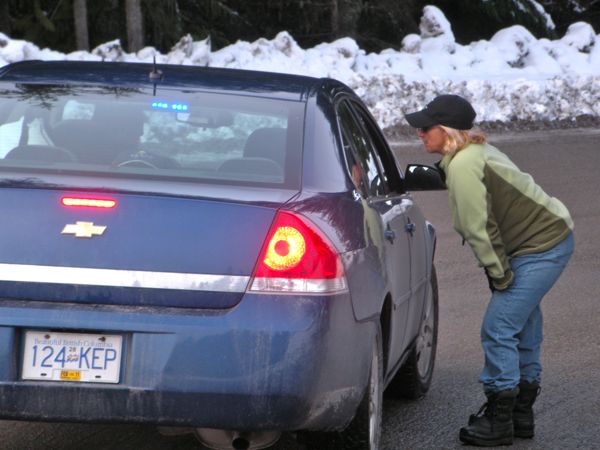
LTN's Susan Wood on Jan. 26 explains to the officer why she is in a secure area.

LTN's Susan Wood on Jan. 26 explains to the officer why she is in a secure area.

New to Blackcomb is the Sliding Centre. It was closed to the public Sept. 1 after a summer of letting people experience the Olympic venue.

It will open again Feb. 5 when the Olympic torch arrives in Whistler. There is a community cauldron at Skiers’ Plaza in Whistler where the unofficial flame will flicker.

(Vancouver is where the real cauldron and the five rings will be; after all, these are the Vancouver Games, not the Whistler Games.)

“The flame lights the Olympic Cauldron at the close of the Opening Ceremony. That signifies the start of the Games. How the cauldron is lit, what it looks like and where it’s located stays a closely guarded secret until the ceremony,” Suzanne Walters, Vancouver Organizing Committee spokeswoman, told Lake Tahoe News.

Of course people with tickets to the Opening Ceremony probably know where it’s located. Actually, the opening and closing ceremonies are at BC Place Stadium, which had $150 million in renovations. This will be the first time any Opening Ceremony has been inside.

Lake Tahoe News was able to get a glimpse of where the bobsleigh (what the Canadian’s call it), luge and skeleton events will begin. The area where spectators will be and tents are being erected.

The Canadian Royal Mounted Police stopped us just before we could get a good view of the venue. We were promptly told it was a secure construction zone. Apparently not that secure.

The facility will remain a permanent part of the resort after the Games in what is being called the Legacy Program.

Celebration Plaza, which is under construction on the southwest end of Whistler Village, is where the medal ceremonies will be. Organizers for a while thought about giving medals out at the venues, but then switched back to the plaza idea.

Crews are out there at all hours of the night and day. The Games start Feb. 12. Presumably everything will be done before the nearly 2,500 athletes from more than 80 nations compete for 258 medals.

A platform for Canada Television has been going up for days at what seems like a painfully slow pace with little movement despite a gaggle of workers night and day.

From Monday to Tuesday a platform was put up in front of the village grocery store for purposes unknown.

Kiosks that will dispense information to tourists are scattered about the village – though shuttered right now.

A lift at Whistler Creekside is new this season. It’s not open to skiers now. It’s there to haul spectators to the grandstands at the base of the downhill courses. The men’s and women’s end at the same point.

Whistler Olympic Park, site of the cross country-biathlon-ski jump events, is all new. It, too, will be open to the public after the Games as one of the Legacy venues.

In Richmond, near Vancouver, an ice rink – the speed skating variety – is one of the new structures.

Some hotels, spas and restaurants have arrived in Whistler since Vancouver was awarded the games. But for the most part, the area is just like it was.

The Olympic Village for the athletes will be turned into workforce housing – something locals say is greatly needed.

ngg_shortcode_1_placeholder


Utah v. Lake Tahoe — readers get to vote

The Travelocity Roaming Gnome is continuing his search for a cure to winter cabin fever, and from a recent vote, it appears Banff locals are doing the same.

Not letting frigid temperatures or tightened budgets stop him from experiencing a one-of-a-kind adventure this winter, the Roaming Gnome is taking advantage of the amazing seasonal deals and hopping on a plane to one of the most popular ski destinations in North America – Banff. Hoping to inspire others, the Roaming Gnome is letting his fans map out his winter tour and follow his journey online, so they too will be compelled to choose an adventure of their own.

Tour details

On Jan. 12, the Travelocity Roaming Gnome started a winter adventure relying heavily on the social media networks of Facebook and Twitter to spread his message. Each week, the Roaming Gnome’s fans vote on Facebook between two rival ski destinations to decide where he travels to for his next great adventure:

* Whistler vs. Banff (Winner: Banff)

* Utah vs. Lake Tahoe (Voting starts Jan. 27 and ends Feb. 3 at 9am)

Whistler and Banff was the first pair of rival destinations up for voting, with Banff the winner with 69 percent of the vote.

Voting details

Through Travelocity’s Facebook fan page, as well as the Travelocity (@Travelocity), Travelocity.ca (@TravelocityCA) and Roaming Gnome (@RoamingGnome) Twitter pages, the online travel agency announces when a ski resort pair is up for voting. Voting on the Travelocity Facebook fan page lasts one week, and the winning resort is revealed on the Wednesday voting ends.

Immediately following the results of each contest, the Travelocity Roaming Gnome will travel to the winning destination to visit friends and locals, pose for pictures and participate in some of the most popular activities that resort has to offer, including skiing, ice skating, snowmobiling, flying down the luge, and snow tubing. As with all celebrities, he will have a “personal assistant” who accompanies him along the way.


Bumper sticker helps fuel nonprofit art groups

stickerIn an effort to support nonprofits in the Lake Tahoe Basin, Becky Bell has released a new bumper sticker — “Keep Tahoe Culture”.

Every four months, Bell will donate a percentage of every sticker sold to a new local nonprofit organization in Lake Tahoe or Truckee.

To kick off the long-term charitable initiative, Bell selected the Arts & Culture Council of Truckee Tahoe and the Tahoe Arts Project in South Lake Tahoe as the January-March beneficiaries. “Keep Tahoe Culture” stickers can be purchased for $3 online at www.TahoeCulture.com.

Bell uses her website to promote the local artists, individuals, businesses, nonprofits and events that give the mountain destination life and distinction. Regular features include the burgeoning Tahoe-Truckee art scene, resident artists, cultural heritage, community events and performances, locally made products, hidden hot spots, green businesses, eco-tips, mountain health, local profiles, and outdoor recreation.