Historic rail engine chugging back into action in foothills

By John Holland, Modesto Bee

JAMESTOWN — Steam locomotive No. 3, a Sierra Railroad workhorse that found fame in movies and television, will return to the limelight next month.

After a 14-year absence, the engine is set to debut July 3 at Railtown 1897 State Historic Park. It will pull passenger trains that day and July 4, then enter limited service on the excursion schedule.

“A lot of engines came and went, but someone had a soft spot for this one,” said George Sapp, restoration lead worker at the park.

Railtown employees and volunteers have worked for three years to overhaul the 119-year-old locomotive, which was pulled from service in 1996 because of wear and tear.

Read the whole story


Independence fun at Zephyr Cove library

The Douglas County Public Library in Zephyr Cove presents Fourth of July Stories and Crafts on July 2 at 1:30pm. Miss Carol will read stories celebrating Independence Day. Children will make a red, white, and blue holiday craft. For ages 3 and up; young children should be accompanied by an adult. Sign up by July 1.

The Douglas County Public Library is located at 233 Warrior Way in Zephyr Cove. For more information, call (775) 588.6411 or visit douglas.lib.nv.us.


Home tour proves life is thriving in Angora burn area

Publisher’s note: See the Voices section to read about reporter Susan Wood’s experience three years ago covering the Angora Fire.

By Kathryn Reed

Windows to a world that changed their lives are everywhere.

This is one of the common themes of the seven houses on the AAUW’s biennial home tour – openness in design, with natural light filtering in from all corners, and sometimes the ceiling. “From the Ashes” was the appropriate name of Saturday’s event, as all houses and the demonstration garden have been rebuilt because the 2007 Angora Fire reduced the original structures to ash.

These houses represent the 86 that have been completely rebuilt. Fourteen are ready for their final inspection. Another 86 are in some stage of the application or rebuilding process, while 68 of the 254 homeowners who lost their houses are letting their lot sit idle for now.
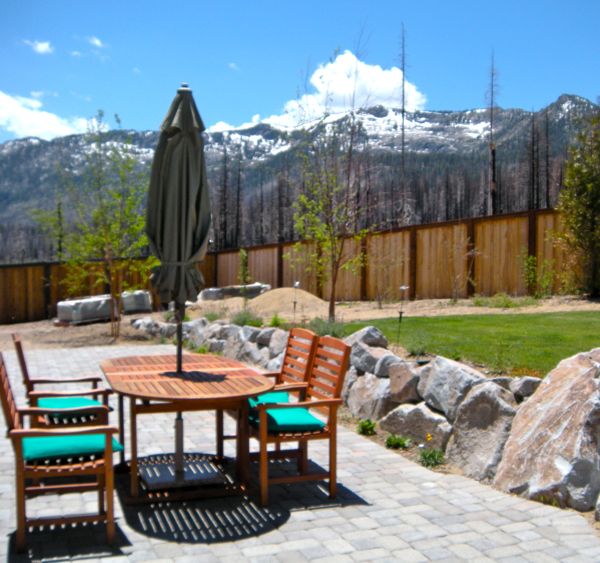
Driveway paving stones survived the Angora Fire to be used as a patio. Photos/Kathryn Reed

Driveway paving stones survived the Angora Fire to be used as a patio. Photos/Kathryn Reed

Though each of the homes is clearly distinct and reflects the individual owners, a few similarities can be found. Granite is used extensively in many of the homes – from kitchens, to bathrooms, to fireplaces.

Wood floors are everywhere. Plenty of carpet exists, but so do a lot of throw rugs and tile flooring. Some have heated floors.

Islands in the kitchen are almost a given. Some have a utility sink, the gas range, and many have stools to belly up to the counter in what is so often the main congregating area.

Decks and outdoor stairs are made of non-flammable products. Depending on when building permits were filed, wood decking was not permitted based on fire code changes that took effect Jan. 1, 2008.

Wide staircases that would make it easy to haul furniture without marring the walls are the norm.

Master bedrooms mostly come with walk-in closets – some the size of a small bedroom. Master bathrooms accommodate three at once, with the shower, bathtub and toilet (often in a cubbyhole) as separate entities.

Behind the home tour

The American Association of University Women’s South Lake Tahoe chapter has been putting on a home tour for decades. Every two years they try to pick a different area of the South Shore to feature. This year’s tour came three years, and two days after the Angora Fire wiped out a large swath of homes lived in mostly by full-time middle class residents, burning more than 3,100 acres and bringing “defensible space” into the vocabulary of many, and the realization insurance policies should be reviewed annually.

“The focus is on the care, thought and love all the people in the neighborhood put in. Some houses are small, but all contain interesting features,” Kay Henderson, one of the organizers, said.

More of the $25 tickets were sold this year than for some of the more recent tours.

Proceeds from the tour stay in the community to help locals. Scholarships are given to two female graduates of Lake Tahoe Community College to continue their education, with $1,500 being given to each in recent years. The money also pays for two or three middle school girls to go to California’s Tech Trek each summer, which is designed to encourage them to consider careers in science and math.

The homes

Some of the homeowners stayed to greet people. Names of local contractors and businesses that were used were available. Most who rebuilt tried to spend their money locally or regionally.

The Granite Mountain Circle house was a 1974 A-frame the family had lived in since 1991. The design is much more modern and larger by about 500 square feet.

A dumbwaiter carries items from the garage to the kitchen.

Some of the pictures on the walls were saved when the two teenage daughters grabbed what they could in the 15 minutes they had to evacuate.

Designed to be the family gathering spot, the couple never thought twice about rebuilding. It’s where their children and grandchildren can call home. A wrap-around deck gives views of everything but the rawest part of the devastation leading to Angora ridge.

A couple on Mule Deer Circle built their dream home twice. Days before they were to move into the home, it burned to the ground in the Angora Fire. The good thing was their belongings were not inside.

The rebuild allowed them to do some things differently. The master suite is upstairs instead of down, and the spiral staircase – which is a focal point of the main room – is smaller.

A European feel is throughout. Clearly the owners like to cook based on the attention to detail in the kitchen, the appliances and unique hood with its glass and stainless steel design.

High ceilings and large windows offer views of the blackened forest, with trees that are a combo of white and black – signifying just how hot the fire burned in this area.

Norma and Warren Sprague were some of the first people to move back to the burn area – doing so a week before the one-year anniversary of the fire, and months before celebrating their 50th wedding anniversary.

Views from their Lake Tahoe Boulevard house are designed to direct the eye above the burn area.

“I looked at this and it was not the worst thing that could happen to me,” Norma Sprague said of losing everything.

With a smile and laugh, she can talk about her 40-year-old house that needed a lot of work.

Capturing her ancestry, certificates from her Italian parents and grandparents coming to the United States via Ellis Island are in one room.

The single-story home on Pyramid Circle is the most modest of the ones on the tour. A glass display case in the entry has the bottom two shelves filled with items that were retrieved from the rubble. Pottery, a hose sprayer, candleholder and teapot are some of the memorabilia.

Tube or tunnel lights have been installed on the roof to provide sunlight into various rooms. One bedroom looks like a light is on, when in fact it is natural light filtering in from this type of skylight.

Hopefully, the next owners like dogs because a paw print has been designed into the front entry’s rock pattern.

Despite the back yard being the destroyed forest, the owner has chosen an open fence that allows that area to seem larger than it is – though it is already a nice size lot.

Driving up to the house on Snow Mountain Drive the windows are most prominent, then the deck area above the entrance that is like a mini garden this time of year. It’s easy to stop before the front door because a small, covered deck beckons one to sit and enjoy summer in Tahoe.

Angles of the roofline are eye-catching. The nooks of the interior create an architectural design not often found in Tahoe.

A major difference in this home is the kitchen is distinctly separate from the great room.

The master bedroom, bath and office are on the first floor. Upstairs is what could be a mother-in-law unit with efficiency kitchen, bath and bedroom.

On the other end of the second floor is a sewing room that any seamstress, in this case embroiderer, could find inspiration from working in.

With 45 minutes to evacuate, all the pictures in the Mount Olympia Circle home were saved.

As the fire passed by it cooled a bit, with flowers on one side able to be saved. Creating a garden was their first priority – having brought water in to begin the rebirth process.

Looking out the upstairs bedroom windows that front the street a row of green, healthy looking pine trees is in the foreground. Farther up is another row – on the ridge – where the fire stopped.

The family started working on plans to rebuild two weeks after the fire, and moved in in October 2008.

The wood burning fireplace is one of the few in the new homes – most people went with gas. This one can heat the whole house.

Around the corner on this street is a demonstration garden. The lot belonged to Owen Evans. His daughter, Leona Allen, also lost her house in the fire. To honor her father, who has since died, and her mother, Esther, Allen donated this parcel to be a resource for the neighborhood and community at-large.

Jennifer Cressy with the Tahoe Resource Conservation District was giving tours of the lot on Saturday, explaining vegetation that is good for wet soil, infiltration basins, native wildflowers, erosion control techniques and other nuances to landscaping in the mountains.

The garden is still a work in progress, with the hopes of developing a community vegetable and herb garden and other aspects. Volunteers are always needed to help – call (530) 543.1501, ext. 118 for information.

The last house on the tour belongs to Solange Schwalbe, one of the more vocal residents during the community meetings three years ago. On this day she is welcoming everyone to her home, talking about what it was like then compared to today.

A boulder in the back yard was part of the foundation for the old deck. The Willy Jeep survived the fire, while the newer one essentially melted into the heap of debris.

Upstairs is all new, while downstairs is where she spends most of her time. Furniture she picked up from the community center that was set up for Angora survivors fills this living area.

One day she might rent that section out. Upstairs most of the walls are yellow –- inspiration from Miami, with an accent wall in black. It works. The gold Emmy she earned for her sound work on “Black Hawk Down” sits on the mantle above the gas fireplace – a striking contrast to the black wall.

She looks around and tells the visitors, “Nothing here is mine.”

ngg_shortcode_0_placeholder (Click on photos for full size.)


Reno Artown raising money to keep events free

By Forrest Hartman, Reno Gazette-Journal

Artown is launching a fund-raising campaign this week to develop additional revenue for its summer arts festival.

The program, Give $3 Keep Artown Free, encourages patrons to donate small sums of money for the organization that promotes hundreds of arts activities in Reno each July.

Beth Macmillan, Artown executive director, said more than 60 percent of the events at this year’s festival are being offered at no charge.

“If you enjoy the events, you can make a small contribution to continue to keep Artown free,” Macmillan said. “I know of two other festivals that have done a similar program, and it’s been very successful.”

Read the whole story


Workshop on Sierra Nevada geotourism project

The public is invited to learn about the Sierra Nevada Geotourism Project and get an insider’s view on how to submit a nomination, navigate the website, and learn how geotoursim benefits the community.

The workshop will be at the Emergency Operation Center, 1694 County Road, Minden at 5:30pm June 28.

A variety of project partners and residents of the Sierra Nevada are working together to create a National Geographic map that features geotouristic assets and attracts as well as encourages sustainable tourism. The Geotourism Project seeks to celebrate the Sierra Nevada as a world-class destination, while contributing to its economic health and promoting long-term stewardship of the region.

Geotouristic assets are authentic and distinctive to the region and sustain or enhance the geographic character of the Sierra Nevada. Examples include local restaurants and shops, historic hotels, museums, local artists, hiking trails, festivals and events, volunteer and recreational opportunities. To view assets that have been selected in the first phase region and/or to submit a nomination, go to www.sierranevadageotourism.org.

For more information, contact Becky Bell at the Sierra Business Council, sierrageotourism@sbcouncil.org, (530) 582.4800 or visit the county’s website at www.douglascountynv.gov.


Lego competition at Douglas County libraries

Douglas County Public Library invites everyone to join the Summer Reading Lego Building Challenge. Use your Lego bricks and elements to create an original work of art. Bring your creation to the Minden or Zephyr Cove library between July 1 and noon on July 21 and fill out an entry form.

Winners of the contest will be announced July 26. Lego prizes will be awarded to first and second place winner in each age category. Children and adults may participate. Children 2- to 3-years-old must use Lego Duplo bricks to build their creation.

The Lego Challenge is sponsored by the Friends of Douglas County Library. Both branches of the library are participating in the challenge. Winning entries will be displayed at the Minden library through July 31. Complete rules and entry form are available at the Minden and Zephyr Cove libraries.

The Douglas County Public Library is located at 1625 Library Lane in Minden and 233 Warrior Way in Zephyr Cove. For more information, call the library at (775) 782.9841 or visit douglas.lib.nv.us.


Tony Rowell exhibit at Sorensen’s

“Images of Adventure” by photographer Tony Rowell will be June 26 at Sorensen’s Resort in Hope Valley.

A wine-cheese reception will be form 5-7pm, with the slide show from 7-8pm.

Rowell is the son of renowned high-country photographer Galen Rowell. Showing his father’s famous works and sharing images taken by three generations of the Rowell family along the John Muir Trail, Tony Rowell will include his own photos at the Arctic Circle, China, and Tibet and his astro-photographs taken in Yosemite and the Eastern Sierra.

Books and fine art prints will be available for purchase at this event. Reception with wine-tasting included.

Cost is $15 per person. All proceeds, matched by Sorensen’s Resort, support the Rowell Award for the Art of Adventure.

For information, call 800.423.9949


Tahoe’s illegals struggle to find purpose of college degree

By Austin Fay

Alejandra Delgado’s journey began when she walked to this country.

She walked with her family, carrying only water in the blistering Sonora Desert sun for five days and nights when she was 12 years old.

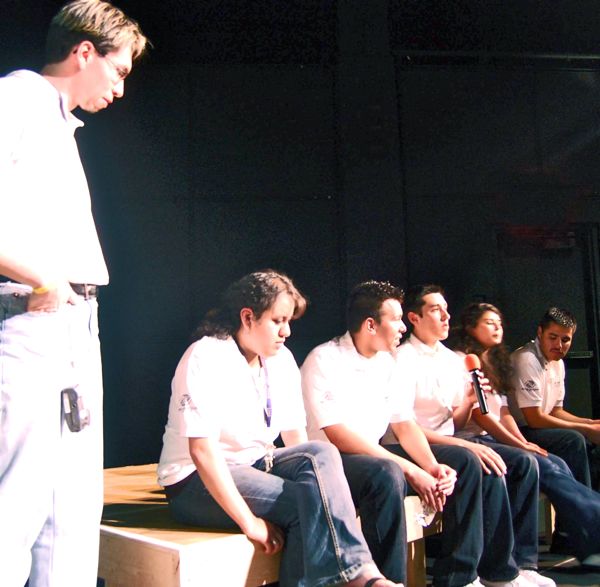
Arturo Rangel, LTCC's HOPE Club adviser, talks to members. Photo/Austin Fay

Arturo Rangel, LTCC's HOPE Club adviser, talks to members. Photo/Austin Fay

She and her three sisters, mother and father were on their long journey from a colonia called Golondrinas southwest of Mexico City into the United States to escape the slum they lived in. The 21-year-old’s journey continues at Lake Tahoe Community College where next year she will graduate with three associate’s degrees – Spanish, psychology, and liberal arts, with a concentration in social Sciences.

(The student’s name has been changed to protect the family.)

Delgado is the first person in her family to attend college.

However, any business she might apply to work after graduating cannot legally hire her because of her immigration status.

“I could either give up on my education or look for private scholarships for college. (I have received) a lot of support through teachers and friends pushing me to not give up,” Delgado said.

In addition to private scholarships to help pay her way through college, she works at Samurai restaurant on Highway 50 in South Lake Tahoe. That’s on top of taking anywhere from 12 to 20 credit hours and being the president of two collegiate clubs.

Her dream was to attend UC Berkeley next year, then pursue a graduate degree in psychology.

“I just found out it’s impossible without the DREAM Act. It’s just not a possibility right now, so I’m settling to go to San Francisco State,” Delgado said.

The difference in tuition between the UC and CSU system is the deciding factor. She doesn’t have the money or access to financial aid that people born in this country have.

For Delgado and thousands of other students across the nation, surviving on private scholarships keeps higher education out of reach because there isn’t enough of those dollars to pay the bills.

Delgado, along with 312 other students at LTCC are Assembly Bill 540 status students. This means they do not have documentation proving their citizenship. They are able to attend public universities with no state or federal financial aid. In California they pay in-state tuition. They are not eligible for federal financial aid like the Pell Grant or FAFSA.

AB540 students are not just undocumented residents. They are students who attended a California high school and moved out of state. They are allowed to go to colleges at in-state tuition rates because of AB540. LTCC has a large number of AB540 students because many have just moved to Nevada and come back to LTCC.

AB540 benefits less than 1 percent of students attending state universities in California. At LTCC in 2008-09, 313 students were AB540 eligible, which is 10.2 percent of 3,067 (732 full-time, 2,335 part-time) students. The state average is 1 percent. ngg_shortcode_1_placeholder (Click on graphic to see in full.)

Even with a two- or four-year degree, graduates cannot legally gain employment in the United States.

“Most of them came to this country through no fault of their own. They’ve gone through the educational system, they have American values, the only country they know is this country, the only country they respect is this country. It’s punishing students for something their parents did. They’re the future of the country,” Arturo Rangel said.

Rangel is the adviser of LTCC’s Hispanicos Orgullosos Preparándose para la Excellencia – Proud Hispanics Preparing for Excellence (HOPE) Club.

Delgado is a member of the HOPE Club. It consists of 17 LTCC students, with the mission of community service as well as providing financial and educational support to LTCC students. The group has raised about $1,000 since its inception a year ago.

The HOPE Club’s priority is passage of the 2009 Development, Relief and Education for Alien Minors (DREAM) Act, which would create a path to citizenship using secondary education as leverage. Members of the HOPE Club traveled to Sacramento in February to lobby, network and collaborate with students, legislators, and community leaders from around the state.

Because the DREAM Act will likely be considered along with a comprehensive immigration reform bill, AB540, as well as the federal and California DREAM Acts will dictate the future of undocumented students. Each year it’s estimated 65,000 undocumented students graduate from U.S. high schools, with 20,000 of them in California. About 5-10 percent go on to higher education.

The DREAM Act

The idea behind the DREAM Act is relatively simple, but for 10 years, the bill has hit a wall in the California Legislature and Congress.

A central tenet of the bill is granting students who came to the United States years ago the tools of a college degree and steady employment. Currently, the options for a college graduate who is here illegally are minimal. The DREAM Act will open the door to the American Dream for the undocumented college graduate. Through a six-year post-graduation process students will also have the opportunity for U.S. citizenship.

If the DREAM Act passes, criteria to be part of it includes a student must have entered the country before the age of 16, have been in the United States for five years prior to the passage of the bill, and the student must graduate from high school or obtain a GED. Also, the student must have good moral character, meaning no criminal record.

Rangel believes the passage of the DREAM Act will also lower rates of gang violence, teen pregnancy and delinquency in California communities “because people will have a hope, a sense of belonging, a sense of future.”

Last month, the latest congressional version of the bill was referred to the House Subcommittee on Higher Education, Lifelong Learning, and Competitiveness, according to OpenCongress. It is not known when the bill will come out of subcommittee. Democrats will reportedly take up larger immigration reform later this year.

According to a U.S. Census Bureau estimate, of the 309.5 million people in the country, 11.9 million are undocumented immigrants. Although most undocumented migrants are young adults, there is also a sizeable population of children. About one-sixth of the population — 1.7 million people — are under 18.

Looking forward

Students who have gone through the public higher education system in California fall through the cracks. They either continue on the employment path they’re on, are hired illegally or they go back to where they have residency.

Enrique Caro, a member of the HOPE Club, graduates with 64 of his classmates at LTCC tonight. Caro wants to be a clinical technologist and now has his associate’s degree in business.

Caro’s prospects look as good as any college graduate new to the job market. He is a U.S. citizen.

But still, as immigration reform fervor escalates, many students continue to fall into the opportunity gap.

“It seems like it’s getting harder and harder with what’s happening in Arizona. It seems like it’s going to get better, but before that I think it’s going to get a lot worse,” Caro said. “I sometimes think the U.S. has ‘cool-kid syndrome’ where the cool kids choose who can sit at their table and who can’t, we think we’re better than we actually are.”

While they attend school and work to make ends meet, Delgado and Karina Morales, another member of the HOPE Club, plan to live together in San Francisco in a year, envisioning a bachelor’s degree in their future.

Seeing her sister make sacrifices for her education, Delgado has inspired her younger sister to pursue higher education and will be attending LTCC this fall.


Wooden Statue of Liberty to grace Tahoe’s shoreline

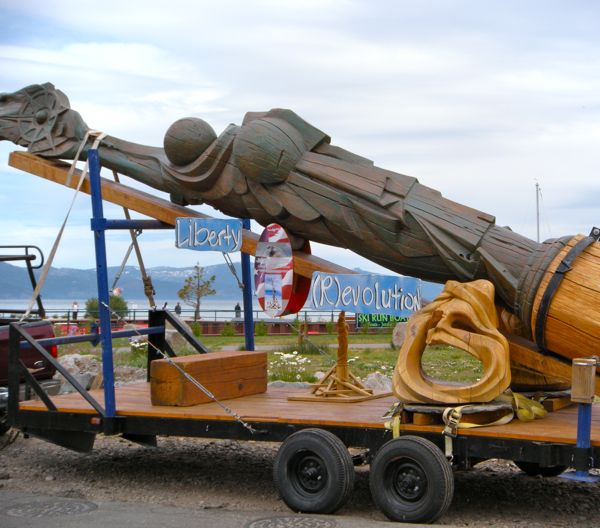
A 30-foot contemporary version of the Statue of Liberty arrived at Ski Run Marina on Thursday morning.

Sculptor Matthew Welter created the work from cedar.

It will be erected on June 30 and it will be on display through October. For the next week the artist will be creating the pedestal.

Lady Liberty -- the modern version -- is hauled into the Ski Run Marina on June 24. Photo/Kathryn Reed

Lady Liberty -- the modern version -- is hauled into the Ski Run Marina on June 24. Photo/Kathryn Reed

At different times this summer Welter will be carving sculptures at the South Lake Tahoe marina.


Tahoe-Baikal Institute celebrating 20th year

Born as the Cold War ended, the Tahoe-Baikal Institute celebrates its 20th year of bringing together young people dedicated to preserving two of the world’s greatest lakes, Tahoe and Baikal.

For the past two decades, this nonprofit organization has been promoting peace, international and cultural understanding, and scientific exchange between the Lake Tahoe region and the Lake Baikal region in Siberia, Russia.

The idea for a joint Russian-American organization focused on scientific exchange about ecological issues at these two unique lakes was first discussed at an international youth conference in Helsinki, Finland, in 1989. During the conference, Presidents Regan and Gorbachev encouraged youth leaders from around the world to find ways to work together on common issues.

Upon returning from the conference, youth delegates from California and Irkutsk took the idea to their regional governments.

The first Summer Environmental Exchange program was in 1990, and has run annually ever since. The participants, most who come from the United States and Russia, learn about the science, policy-making and management challenges at the two lakes.

Since the first exchange, more than 300 young leaders, scientists, policy-makers and other professional delegates have participated in the SEE and other educational or cultural exchange programs organized by the Tahoe-Baikal Institute. Each year, the Tahoe-Baikal Institute’s exchange participants make significant contributions to the environmental conditions at Lake Tahoe and at Lake Baikal.

“The experience that participants gain through the Tahoe-Baikal Institute’s interdisciplinary approach to conservation is exactly what it will take to solve the problems that these lakes, and the global environment, face,” board member and TBI founder Charles Goldman said in a statement.

The 12 participants of the 20th Annual Summer Environmental Exchange arrived in Tahoe this month and are enjoying a rigorous curriculum of meetings with local agency representatives, scientists, and environmental advocates.

The Tahoe-Baikal Institute is inviting all community members to attend the 20th Anniversary Gala at Heavenly’s Lakeview Lodge on July 2. The evening will include a buffet dinner, live music and dancing, a silent auction fundraiser to support our future programs, and an opportunity to meet our exchange participants from Russian, Mongolia, and the U.S.

To learn more this opportunity or about the Institute, www.tahoebaikal.org or contact Jennifer Smith-Lee at jsmith@tahoebaikal.org or (530) 542.5599.