Dangberg Ranch historic clothing exhibit

Nevada State Parks invites the public to attend an exhibit of historic clothing from the Dangberg Home Ranch’s extensive collection. The exhibit will be during Nevada Day weekend and the first weekend in November.

The exhibit will feature clothing worn by three generations of the Dangberg family. Included are the 1898 wedding gown worn by Gertrude Dangberg, casual and formal clothing worn by Gertrude and her four daughters in the 1920s through the 1960s, and children’s clothing from the 1910s and 1930s worn by the daughters and Gertrude’s grandson, C. Stephen Achard Jr.

A highlight of the exhibit is the christening dress first worn in 1866 by Fred Dangberg Jr., that was recently donated to the park by Achard. Visitors will also see a range of men’s and women’s hats, shoes, jewelry and accessories from throughout the 20th century.

What: Historic Clothing Exhibit

When: Oct. 29-31 and Nov. 6-7, noon–4pm.

Where: The park is located at 1450 Highway 88, one-half mile south of the Carson Valley Swim Center. A map and further information can be found at parks.nv.gov/hr.htm or by calling (775) 783.9417.

Cost: $3 for adults, free for children under 13.


Scientist reveals intricacies of cloud seeding in Sierra

By Stephen Ward

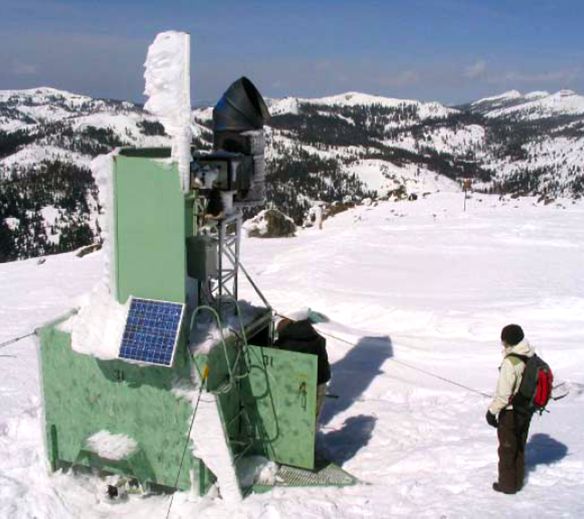
INCLINE VILLAGE – Using a propane flame to shoot silver iodide into the sky with a unit that resembles a prison watchtower with a trash barrel aimed at the sky attached to the top is how the Desert Research Institute is helping Mother Nature produce more moisture.

Ground tactic cloud seeding is the only type of seeding being done by DRI this year.

Arlen Huggins

Arlen Huggins

Arlen Huggins addressed his area of study with a swiftness that marginalized the nearly 23 years of research he has devoted to the project. And with each slide projected on the screen underpinning the complex procedure he was presenting, Huggins offered observers a detailed look at cloud seeding – a method local scientists use to augment rain and snowfall in Lake Tahoe.

The lecture last week at the Tahoe Center for Environmental Sciences on the campus of Sierra Nevada College before roughly 50 began with an array of definitions for words meant to bridge the gap between the scientist and the public’s disparate lexicons. Words like cloud drops, or small water spheres, and the ice nuclei silver iodide were among the highlighted expressions.

From there, Huggins briefed the crowd on the history of cloud seeding, with its genesis being in the late 1940s with studies conducted by scientists Vincent Schaefer and Bernard Vonnegut, the older brother of the popular American novelist.

“Cloud seeding helps enhance rainfall during the growing season, as well as reduce the damaging effects of hail,” he said. “It also has the capability to increase runoff in the spring for power generation, and has potential for increasing water supply.”

Although no studies have been conducted, Huggins said there are no health effects to cloud seeding.

“It would be a concern if the mass were a lot,” he said. “But we’re nowhere close to EPA levels.”

Cloud seeding in the Sierra brings more moisture to the area. Photo/Provided

Cloud seeding in the Sierra brings more moisture to the area. Photo/Provided

Not everyone was convinced cloud seeding is an effective process. Steven McQuinn of Incline Village believes DRI might have ulterior motives.

“I didn’t get a sense of any conclusive evidence,” he said. “The nature of their statistical studies … doesn’t achieve proof of cause and effect. There could be other motivations, such as a water manager under pressure. Moreover, I feel there’s more evidence for climate change. Compared to (climate change), cloud seeding evidence is negligible.”

The effectiveness of cloud seeding has been measured by instrumented aircrafts with probes on the wings that count the ice crystals and plume in a cloud. In addition, DRI uses radars and its own process of snow sampling, where they push snowfall through a cheese grater-like apparatus, collect it and examine it in a lab.

The silver iodide particles rise into the clouds at minus 5 degrees Celsius, causing cloud moisture to freeze and create ice crystals. This process takes about 20 to 30 minutes. Once the ice crystals grow big enough, they fall as snow.

The entire process is done through a generator that took nearly a decade to get. Each generator costs about $30,000 to build, between $40,000 to $50,000 to run for a year.

Loren Rupp, a 10-year Incline Village resident and graduate student at Sierra Nevada College, received answers to the questions he brought with him to the meeting.

“I came here with two questions: effectiveness and how it’s measured,” he said. “I see how they gather their results through blind and parallel studies.”

Airplanes have also been used in the past for cloud seeding by flying over clouds and dispersing silver iodide through nozzles attached to the wings of planes. This was done by the DRI west of Lake Tahoe for most of the past decade before losing state funding because of the sagging economy.

DRI conducts the majority of its cloud seeding research with the help of Truckee Meadows and Southern Nevada Water authorities.


Dorothy Gillemot leaves legacy of philanthropy

By Guy Clifton, Reno Gazette-Journal

Dorothy Gillemot never sought the spotlight, but when someone needed help, she was always the first to step up.

“She always had a smile, and she was always diving in to help everybody,” said Kathleen Kamille, a longtime Lake Tahoe neighbor.

Gillemot, a philanthropist who, along with her husband, George, pledged millions of dollars to the University of Nevada, Reno and other charities, died last week after a long battle with Alzheimer’s disease.

She was 83.

Read the whole story


Woodstock Inn — A landmark for the season and the ages

By Susan Wood

WOODSTOCK, Vt. – The red carpet Vermont throws out in fall lies beyond the ground beneath its world-renowned maple trees.

In the heart of central Vermont, Woodstock boasts a AAA four-diamond rated hotel as rich with history and iconic to the quaint, colonial-style village as the Rockefeller name and the origin of its agricultural and railroad traditions.

Service and style are all a part of the Woodstock Inn & Resort, which operates under the Laurance Rockefeller-spawned Woodstock Foundation. The inn’s early beginnings date back as far as 1793. The Inn as it’s known today was built a century later with $120,000 of the citizenry’s money to keep up with the demand for the Vermont lifestyle.

Woodstock Inn

Woodstock Inn

The Woodstock Inn has transformed to reflect the growing needs of local residents and tourists. In the early 1900s, each guest received a heavy fur coat in winter.

Recreation touches every season here – from alpine skiing at the nation’s first rope tow on Clinton Gilbert’s pasture in 1934 and cross country skiing in the hills behind the Inn’s Racquet & Fitness Club to the early years of tennis and golf inspired by Boston resident D.B. Harrington. In 1895, the doctor brought his clubs on one stay to play in a cow pasture behind the Inn. An 18-hole, Robert Trent Jones-designed golf course sits there now to entice summer and fall visitors.

But it’s the fall that prompts visitors to flock in droves to witness the splendor of the vivid red, pink, orange and yellow foliage. They’re welcomed by pure New England hospitality, and this year was no exception. Staffers greet guests with an open door and friendly hello. (Don’t be surprised if at least one doorman remembers what your plans are and asks you later how they were.)

A month ago, the 142-room grand hotel covering one square block celebrated the addition of a 10,000-square-foot, full service spa costing $10 million. It is next to the inn’s scenic back courtyard that is lined with maple trees. But no need for guests to walk outside; it’s also accessed via the Inn.

From the minute one arrives at the front entrance of the Inn, it’s easy to see the visual Rockefeller was going for after buying the property in 1967 and rebuilding a grander version farther off the Village Green. (Prior to 1967, an older inn sat next to the Green, as shown in artwork hung in one of the hotel’s hallways that this reporter’s uncle painted years ago.)

The Woodstock Inn spans more than 9 acres, embracing its history and incorporating it into modern times where tourists insist on amenities and the perfect blend of relaxation and things to do. It perfectly complements the town of Woodstock.

The front desk even prints an activity list if it’s a rainy day.

The hotel is an ideal launching pad to a hike through Faulkner Park and up Mount Tom, which “towers” over the village. Although only a few hundred feet up through a series of switchbacks, it’s steep in one section. But the nearly 360-degree view is well worth the jaunt.

At lower elevations, an easier stroll can be had around the village, which touts long-lasting retail establishments such as an independent bookstore that has stood since 1935.

For those who appreciate the historic, the interior of the hotel’s library – one of several seating areas in the Inn – was built with barn wood.

Some rooms are equipped with wood stoves for a cozy atmosphere. A large stone fireplace sits square at the main entrance and looks inviting enough to tell stories around, but in the peace and quiet of the late hours of the evening the blaze represents mesmerizing comfort. Lamp stands resembling maple tree bark flank the fireplace, showing the importance of the region’s sugarhouses.

For the modern-day guest, furnishings made of solid wood allow a guest to set up an office or lounge around in style to watch the high-definition flat-screen television or read in the comfy king-size bed adorned with a high wooden headboard. A half-dresser half-hutch includes a contemporary coffee maker with a plentiful stash of Vermont’s own Green Mountain Coffee.

Instead of increasing the nightly room fee upfront, guests are greeted in their room with the news a $4 housekeeping fee will be added to the bill. No chance of opting out, unlike what we encountered at the Sheraton in Boston.

A marble floor uses Vermont’s signature stone in the guest bathrooms. Wall tiles look so clean it appears the military came in to scrub the premises. Nice touches include a small oil candle on the counter. A vanity mirror assists in getting the guest ready for an evening out at one of the Inn’s varied dining choices.

The Red Rooster is the fine dining option – with its entryway marked by a bar that even locals use to satisfy their appetites. The restaurant’s food, in particular the prime rib, is excellent, but reservations come with a recommendation to request your waiter. A server may be disengaged or slow as the tables fill up during the Inn’s demanding peak season. (Another suggestion: If wanting to dine with a group in the alternative, less expensive Richardson’s Tavern, stake out your sofa, booth or bar stools early. It may fill up faster and even if five in your gathering were born in Woodstock and two are guests, you may never get a place to sit. And waiters will not find the time or inclination to serve you in the outside seating area.)

Woodstock Inn dining options may change down the road. Marketing director and hospitality veteran Courtney Lowe wants to bring more special events to the hotel, including wine dinners and culinary demonstrations.

“This is only the tip of the iceberg. We’d like to not just offer them during the off season, but we’d also like to maximize on the peak seasons when the people are here,” Lowe said earlier this month while lounging in one of the comfy chairs near the front desk with Chef Jason Lawless steps away hosting a cheese sampling.

Lowe has worked for the Inn since March and has grand plans to expand on its offerings for foodies and increase partnerships with local businesses. One example would be teaming up with a local winery for late-night dessert wine tastings.

The Inn gets the word out on its offerings through mostly electronic means such as email blasts to its feeder markets of New York City and Boston. Packages are provided, and Lowe expects to extend them. One has a romantic theme. Another includes the full breakfast buffet in the dining room’s cheery, open-air environment.

Lowe said after a few years in a downturn for tourism, business has started to pick up.

“It’s been a good year. We started to see the group business come back, and the wedding business went up while everything else was down,” Lowe said.

Of all the features of the Inn, none accomplishes its full service goal and comes as heralded as its spa and salon that opened in September. More than 300 people showed up for its grand opening.

Spa Director Michelle Adams told Lake Tahoe News the reception of it has exceeded “all expectations” – with a clientele ranging from 75 percent tourists to a quarter of the users being local residents.

According to Lowe, the spa answers the quest of entertaining guests who don’t ski.

“Every day is good for a spa day,” Adams said during a tour of the facilities, which are open from 10am to 7pm.

The treatment menu is extensive – from the standard Swedish massage to a “hot chocolate firming body wrap.” Treatments in one of the 10 rooms can run more than $300 for a couple. For $25 guests may use the spa’s tranquil and holistic-style facilities that include a Eucalyptus-scented steam room. A dip in the hot tub is an experience with a wood fire blazing in the pit steps away from the tub and an attentive staffer checking in with guests. A Japanese lilac growing nearby marks the passages of the seasons, a critical part of life for Vermonters.

Those attending weddings and other special occasions are apt to enjoy the VIP room for relaxation upstairs, along with a full salon for hair styling, pedicures and manicures. Polishes come under names like “Get Off My Cloud.” Adams anticipates offering the spa’s own line of bath products in the near future.

Even the soundproof, calming acoustics suggest a harmonious balance between complete relaxation and isolation. Design aficionados will also appreciate accent touches from the likes of glassworks artist Simon Pearce and furniture maker Charles Shackleton, both local to central Vermont.

If you go:

The Woodstock Inn & Resort is located on South Street, taking up one square block of real estate in Woodstock where Routes 4 and 12 intersect at the town’s Village Green.

Call for reservations at 800.448.7900 or visit online. A Woodstock single with a king-size bed can run $317 a night for double occupancy in the fall.

ngg_shortcode_0_placeholder (Click on photos to enlarge.)



Heavenly introduces GM; ready to make snow Tuesday

By Kathryn Reed

STATELINE – Pete Sonntag made himself more real Friday night than most executives ever do.

At his “coming out” party of sorts at Edgewood Tahoe, he talked about how great it is to be general manager of Heavenly Mountain Resort, joked a bit with his predecessor and boss Blaise Carrig (who introduced him), and delved into the importance of living every day to the fullest. An athletic friend dying at age 40 of a heart attack and his first born nearly dying the first week of his life helped instill into Sonntag the appreciation for life.

He intends to — and according those at the Oct. 22 event already is — bringing that zest for life to work. The packed room (most of whom don’t work for Sonntag) welcomed him. He has been on the job since late summer.

Pete Sonntag

Pete Sonntag

The only boos to his speech came when he admitted to being at AT&T ballpark the previous night to watch his Phillies beat the Giants.

Casey Blann, vice president of mountain operations, is exuberant about the two Pirnoth snowcats that will arrive next week.

“They are more efficient, cover more acres, have less emissions and are a better quality groomer,” Blann said. The nickname for these snowcats is “The Beast.”

Sonntag said two more would join the fleet for the 2011-12 season.

At the Tamarack Lodge, which is scheduled to open in early February, construction is still ahead of schedule. That may change with snow in the forecast for the next few days.

Steve Turner, director of food and beverage at the California-Nevada resort, is eager to get his crew into that kitchen. It’s bigger and has more components, like a fryer that might be able to dish up some garlic fries (no promises) that Sonntag devoured in San Francisco.

With only 2 percent of the skiers being vegetarian, don’t expect an abundance of choices. But Turner said a salad bar and other veggie options would be on the menu at the new lodge.

For the carnivores, expect the smoker to be well used this season.

John Wagnon, director of marketing, said the threat of snow in the forecast is helping sell season passes.

If weather experts are right, Sonntag may have an epic first year.

With the snowmaking guns ready to start making white stuff Tuesday in anticipation of the Nov. 19 opening day, he is eager to get the South Shore resort open for the season.


Reality of domestic violence brought home by prosecutor

By Kathryn Reed

Domestic violence. It’s not an isolated issue. It’s not a private issue. It’s a community issue.

That was the message Lisa Serafini, El Dorado County deputy district attorney, drilled into the women gathered for the Thursday meeting of Soroptimist International Tahoe Sierra.

Serafini, who has prosecuted domestic violence cases, said the number of people on the South Shore dealing with alcohol or some other substance abuse problem, as well as mental health issues is high based on the population. Those factors often lead to domestic violence.

EDC Deputy DA Lisa Serafini talks Oct. 21 about domestic violence. Photo/Kathryn Reed

EDC Deputy DA Lisa Serafini talks Oct. 21 about domestic violence. Photo/Kathryn Reed

“We have a lot more (cases) than we should. You can’t blame the casinos for it. You have to blame the people who conduct themselves that way,” Serafini said.

The key criminal issues are the threat of physical abuse, actual physical abuse and sexual abuse. But emotional abuse, financial abuse, isolation – they all come under domestic violence.

Serafini said it’s a horrible myth to believe someone, usually a woman, chooses to stay in an abusive situation. Fear is often what keeps her in the relationship. Potentially losing custody of her children, even the love she once had for her abuser, and possible financial security are other reasons women stay.

It has been proven that leaving the abusive person can be the most life-threatening moment, Serafini said.

She pointed to two cases in the past few years – one in South Lake Tahoe, the other Stateline – where the woman left the man who was abusing her. The first case almost ended with the perpetrator fatally slashing the victim’s neck with a machete in front of her child. She lived. The woman in the second case died after she was beaten with a hammer at her casino job where her ex showed up.

Although these women did what authorities and social agencies advise – get out of the abusive relationship – they prove Serafini’s point that leaving can be dangerous.

It’s a community problem because the victim and abuser live here. They work here. They shop here. Their children go to school here.

Millions of children each year in the United States witness some forum of abuse in their home – verbal or physical – and may be one of the victims. Those children are then likely to repeat the abuse or seek out abusive relationships.

Behavioral issues with these students often crop up at school – potentially taking time away from classmates.

Domestic violence calls can take a lot of time for law enforcement. Serafini recommends people call the cops if they hear abuse going on, to document fights they hear neighbors having, give officers a statement, and show up in court so the victim is not alone in a potential he said, she said situation.

With October being Domestic Violence Awareness month, the Soroptimist are trying to bring awareness to the issue.

Leanne Wagoner, executive director of South Lake Tahoe Women’s Center, is a member of the club. Her agency is partnering with Heavenly Village today for Shop to Stop Domestic Violence. Ten percent or more of proceeds from the 16 participating stores/eateries will be donated to the women’s center.


Ads, social networking, environmental activism all at once

By Todd Woody, New York Times

SAN FRANCISCO — In a city passionate about the environment and technology, commuters are using their smartphones to check in at a popular social networking service to help keep a critter threatened by climate change from checking out.

“What does it take to help save the endangered pika? About 20 seconds,” read ads from Earthjustice, a nonprofit environmental law firm, that line San Francisco transit stations and feature the cute rabbitlike American pika in its Sierra Nevada mountain redoubt. “Check in now at Foursquare at ‘Earthjustice ad.’ Every time you check in, an Earthjustice donor will donate $10 to protect endangered species.”

Foursquare, a rapidly growing social network, lets people use their mobile phones to announce their location to friends. When they arrive at a restaurant, bar or another site, they “check in” and can broadcast their whereabouts through other social networking sites like Facebook and Twitter.

The Earthjustice campaign appears to be among the first to let people check in at a physical billboard, a tactic that has proved successful for the firm and could be attractive to other advertisers, according to industry analysts and Foursquare executives.

Read the whole story


LTCC Geology Club brings speakers to campus

The Geology Club at Lake Tahoe Community College has teamed with the Tahoe-Baikal Institute to present the Fall Speaker Series.

The presentations will be in the Aspen Room at the Lake Tahoe Community College in South Lake Tahoe.

They are free.

· Lake Tahoe Aquatic Invasive Species: Oct. 27th 7:30-8:30pm presented by Sudeep Chandra, UNR professor, and Nicole Cartwright of TahoeRCD

· After the Angora Fire: Nov. 3 from 6:30-7:30pm, presented by Susie Kocher and Daylin Wade, California Tahoe Conservancy.

· Bringing Environmental Education to Lake Baikal: Nov. 10 from 6:30-7:30pm, presented by Joy Barney Lake Tahoe Basin Management Unit.


Death by bullying — a topic gripping the country

By Jessica Bennett, Newsweek

It started with rumors, a love triangle, and a dirty look in a high-school bathroom. Soon jokes about an “Irish slut” cropped up on Facebook, and a girl’s face was scribbled out of a class photo hanging up at school. One day, in the cafeteria, another girl marched in, pointed at her, and shouted “stay away from other people’s men.” A week later, as the girl walked home, a car full of students crept close. One kid hurled a crumpled soda can out the window, followed closely by shrieks of “whore!”

bullyingIf your children had behaved like this, how would you want them punished? Certainly a proper grounding would be in order; computer privileges revoked. Detention, yes—maybe even suspension. Or what about 10 years in jail? Now what if we told you that the girl had gone home after the soda-can incident and killed herself—discovered by her little sister, hanging in a stairwell. Now which punishment fits the crime?

This is the conundrum of Phoebe Prince, the 15-year-old South Hadley, Mass., girl the media have already determined was “bullied to death”—her alleged “mean girl” tormentors charged with felony crimes. Bullied to death is the crime of the moment, the blanket explanation slapped on suicide cases from Texas to California, where two 13-year-olds recently killed themselves, bullied for being gay. The most twisted example yet came last week, when Tyler Clementi, an 18-year-old New Jersey college student, threw himself off the George Washington Bridge after his roommate and a friend allegedly streamed a Webcam video of his tryst with a man.

Cases like these are being invoked as potent symbols for why, in the digital age, schools need bullying policies and states need legislation. But do they? Is the notion of being bullied to death valid? No one would deny that Clementi’s roommate did the unconscionable; the alleged crime is all the more disturbing because of the specter of antigay bias. Yet he couldn’t have known how badly the stunt would end. (He and his friend now face up to five years in prison for privacy invasion; there is also talk of additional bias charges.) In the case of Prince, the answer of who’s to blame might change if you knew that she had tried to kill herself before the epithets, was on medication for depression, and was struggling with her parents’ separation. So where is the line now between behavior that’s bad and behavior that’s criminal? Does the definition of old-school bullying need to be rewritten for the new-media age?

Read the whole story

Videos worth seeing:

1. From Hillary Clinton

2. Texas councilman


NLTRA looking for board members

Each November, members of the North Lake Tahoe Resort Association elect and/or re-elect members of the board of directors.

This year, there are three open seats, including small lodging, recreation and general. All are three-year terms. The filing deadline for interested candidates is Nov. 5 at 5pm.

Nine of the 11 seats on the NLTRA Board of Directors represent a category of chamber/NLTRA membership. Those interested in running for a seat must be an owner or manager of an active member in good standing or the designated representative of that member, of the membership category that he/she represents. According to the organization’s bylaws, one business may not have more than one board seat at a time, regardless of the number of membership categories for which that member may qualify.

For election purposes, consistent with the bylaws, a qualified board candidate must be from a business, which has a primary office or location within the Placer County portion of the North Lake Tahoe membership area. The business must also have a Placer County business license.

Ballots will be mailed to voting members by Tuesday, Nov. 9, and are due to the office of McClintock Accountancy Corporation no later than Nov. 30. The results will be announced Dec. 1 at the NLTRA Board of Directors meeting at 8:30am at the Tahoe City Public Utility District Board Room.

For more information about the election or to file for nomination of a board seat, call Kym Fabel, North Lake Tahoe Chamber of Commerce manager, at (530) 581/8764 or kym@puretahoenorth.com.