Providing health care in Africa tests S. Tahoe doctor’s skills

bannar-3Yesterday I literally had to fight back tears after the first hour. I am not ashamed to say that, but their suffering was very emotional and they have been waiting for some hope.

One patient was seventeen and looked seven. She had terrible deformities from previous burns, but also a belly full of ascites. I think it is the fist case of kwashiorkor I have ever seen.

By Kathryn Reed

Steve Bannar sent several emails like this to family and friends when he was in Tanzania in November administering health care to people who don’t often see doctors with his skills.

The surgeon with Tahoe Orthopedics & Sports Medicine in South Lake Tahoe spent a month with Health Volunteers Overseas in this remote outpost of Africa. It was a test in many ways – in ingenuity, creativity, resolve, and medical know-how.

Though fixing clubfeet is not something he does in his everyday practice, at least it involves orthopedics. For one case the child sucked on his mother’s bosom – that was his anesthetic.

Much of what Bannar was doing in this village near the shores of Lake Victoria had nothing to do with his specialty.

“The basic concepts are the same. The science is the same. It’s more adapting to what is available. You certainly can’t rely on technology,” Bannar said.

Deformities run rampant. They are the result of poor nutrition, parasites and neglect.

Bones stick out. Burns are common. Infections normal. Trauma constant. Mosquito nets help prevent the spread of malaria.

Bannar divided his time between two hospitals – one government run, the other a Catholic facility. The latter being significantly cleaner.

“I have never felt so dirty in my life. I try to be as clean as possible but that is impossible. I saw over thirty patients without soap or towels, nasty. I return to the room to shower and a cockroach the size of a mouse is in there with me,” he writes in an email home.

He had to practice medicine in facilities that are nowhere near what he is used to.

It was a bit of a struggle to get all of his goods through customs, but eventually he made it. Barton Health provided many of the tools he left behind for the medical community to use after his departure. He took lower-tech equipment, but even some of that was more modern than anyone in this village was used to.

“I took the tools to the machine shop to sharpen them for surgery,” Bannar told Lake Tahoe News. “I used a hand drill to put pins in.”

He spent some time with a witch doctor who most of the people believe in. He, too, is a believer.

“I’m not sure how well it works, but it’s been around for a couple thousand years, so it has some validity,” Bannar said of the various potions.

But it was his modern tools that helped an albino be able to feed himself by creating a better pinch on his arm. In this part of the world albinos are said to have magical powers. Their body parts are harvested – even while they are alive. This particular boy had one arm missing and fingers of the other hand cut off.

Despite being steps from Lake Victoria, Bannar couldn’t cool off by swimming in the refreshing looking water. A parasite that goes through the skin lurks beneath the surface.

Rice and fried minnows was a normal meal. Bananas are everywhere and seemed to be put in nearly every dish. Fried grasshoppers are another delicacy of sorts.

“The small intestines [of some unknown creature] was the nastiest, slimiest, chewiest piece of meat I have ever had,” Bannar sends home in an email.

Despite the poverty, the ravaging of forests for fuel, the injuries from motorcycle accidents on roads he decided not to venture out on with two wheels, and the overwhelming need for Western doctors to visit more than once a year, Bannar is ready to go back.

He’s been a member of Health Volunteers Overseas for 15 years, having traveled to Vietnam and St. Lucia.

“It’s really rewarding. I like adventure, to see new cultures,” Bannar said, sitting in the confines of his spacious, clean office. “You eat and live like a national. Instead of going as a tourist and taking, you are giving. You leave something.”

ngg_shortcode_0_placeholder (Click on photos to enlarge.) Photos provided by Steve Bannar.


Keeping Truckee Meadows clean through nonprofit

By Maggie O’Neill, Reno Gazette-Journal

Christi Cakiroglu has learned a lot about trash over the years.

As a result, the 38-year-old executive director of Keep Truckee Meadows Beautiful has an intense love-hate relationship with that thing called litter.

She loves to pick it up, but she hates to find it — especially in open spaces where people illegally dump it.

She also can’t stand the sight of cigarette butts — not only are they the most common piece of trash found at park cleanups, they also take an average of seven years to biodegrade. The plastic filters found in most cigarettes take even more time: hundreds of years, if not longer, she said.

One thing that has changed for Cakiroglu during her years as executive director of Keep Truckee Meadows Beautiful is her tolerance for what is acceptable. It has a mission of creating a cleaner and more beautiful region.

Read the whole story


‘Two Million Minutes’ to air in Sierra Nevada College

The second presentation in the Discussions on Education series, a collaboration between Sierra Nevada College and Lake Tahoe School Parents Association, will be Jan. 13 at 6:30pm in rooms 139/141 of the Tahoe Center for Environmental Sciences on the SNC campus. The film, “Two Million Minutes”, takes a startling look at how the three superpowers of the 21st Century — China, India and the United States — are preparing their students for the future.

Based on the premise that regardless of nationality, as soon as a student completes the 8th grade, the child has approximately 2 million minutes until high school graduation. How this time is spent will affect their intellectual foundation, their preparation for college, and ultimately, their on-going economic prospects. The film follows two students, a boy and a girl, from each of these countries and describes the different emphasis students, parents, and teachers put on socialization, academic rigor, and discipline.

According to the film, less than 40 percent of U.S. students take a science course more rigorous than general biology, and a mere 18 percent take advanced classes in physics, chemistry or biology. Only 45 percent of U.S. students take math coursework beyond two years of algebra and one year of geometry. And 50 percent of all college freshmen require remedial coursework. These statistics give rise for concern when compared to the dramatic leaps India and China have made in educating their middle classes.

The SNC-LTS discussion series is exploring depictions of the American school system from provocative, at times opposing, perspectives with the intent to start and support an on-going dialogue among the audience. Facilitators from both schools lead post-film discussions designed to create positive dialogue about the challenges facing education reform in the U.S.

All events in the series are free and open to the public but please register your attendance at: http://2mmsierranevada.eventbrite.com. Seating is limited. For more information, contact Katrina Midgley at (775) 831.1314, ext. 7517, kmidgley@sierranevada.edu, or Mary Danahey at marydanahey@gmail.com.


North Shore leadership program seeks participants

For the past eight years, the North Lake Tahoe-Truckee Leadership Program has been creating opportunities for potential leaders to broaden their understanding of the region and its issues while developing and honing their leadership skills.

Led by Shannon Beets, vice president for Institutional Effectiveness and associate provost at Sierra Nevada College, the program tasks participants with designing a one-year action plan to improve Tahoe with less than $5,000 to work with, culminating in real-world projects that benefit their communities.

Beets, and a veteran team of SNC professors, use books, workshops, lectures and applied learning activities to enable participants to explore current ideas in the field of leadership and give them the skills to implement those ideas in their jobs and in their community. The program provides a structured and supported environment for the necessary phases of project development and execution, including program rationale, needs assessment, proposed budgeting and time line, community outreach and collaboration, and strategic communication plans.

The five-month program runs from January through May, with meetings scheduled Jan. 12, Feb. 2, March 2, April 6 and May 11.

The North Lake Tahoe-Truckee Leadership Program is a collaborative project of the Truckee Donner Chamber of Commerce, North Lake Tahoe Chamber of Commerce, and the North Tahoe Business Association.

For more information about the program, contact Katrina Midgley at (775) 831.1314, ext. 7517 or kmidgley@sierranevada.edu.


History: A tour through the former Camp Chonokis

Publisher’s note: This is from the September 1973 Lake Tahoe Historical Society newsletter.

By Lorene Greuner

A group of fortunate Historical Society members met at the home of Mr. and Mrs. Robert Whitney on Sunday evening, August 19th. They were fortunate because they experienced a guided tour of the former Camp Chonokis which was operated on the Whitney property from 1927 to 1953, and they later enjoyed refreshments and visiting in the Whitney’s charming “log cabin”, it is really a quite spacious rustic house, and every log and rock used in the building came from the adjacent land. Most of the furniture was made at the site, too. All the ironwork, including handmade hinges and latches, was fashioned by a Mr. Pigeon, now deceased, in the Meyers Blacksmith Shop – years ago.

historyWhen the camp began, Mrs. Whitney was Mabel Winter, a young California school-teacher. Her goal was to give young girls an opportunity to live in the out-of-doors and to develop a love and appreciation of nature. A more suitable location for the purpose would have been hard to find. Camp Chonokis was situated on a beautifully forested hillside behind the present Crescent V area. Huge boulder, flower-filled mountain meadows, and natural springs added to the charm, and just below – a spectacular view of Lake Tahoe.

First stop on the tour was the site of the main lodge, a large building destroyed by fire about ten years ago. The area has since revegetated, largely healing the scar of the “nightmare” which occurred during the Owners’ absence.

Next, the tour group walked through the “slumber yard”, then scrambled over rocks to find “seats” in the camp’s open air theatre. Where the girls had watched their plays and theatricals, Historical Society members watched an eerie sunset over Lake Tahoe, for it was one of the August forest fire days with the smoke haze turning the sun to a red ball of fire.

Next, a peaceful walk through “the lower pasture” full of wildflowers, shrubs, trees and grasses brought the group to a weathered turnstile and a path leading up to the house. By then, flashlights were in use and punch and cookies a welcome treat.

When the visitors left, they were given large Sugar Pine cones gathered from the Whitney property – a fitting reminder of a delightful evening, for “Chonokis” means “Sugar Pine”!


Scott Hudson — 1957-2011

South Tahoe Middle School’s beloved PE teacher, Scott Hudson, died Jan. 2 after a courageous battle against cancer.

Mr. Hudson Scott passed away at home with his family.

A graduate of Cal Poly, San Luis Obispo, he joined the staff at Tahoe Valley Elementary School in 1985 as a fourth-grade teacher. He went on to become the elementary physical education specialist from 1989 through 2003, and taught PE at STMS since 2004.

Mr. Hudson was 53.

Services will be Jan. 15 at 11am at Sierra Community Church, South Lake Tahoe. A bank account has been established at U.S. Bank in Mr. Hudson’s name to assist his family.

STMS Principal Beth Delacour said, “We will miss him so much. He graduates life with honors.”


Tahoe Tails — Adoptable Pets in South Lake Tahoe

Cheech and Chong are cute little beagle-Chihuahua mixes who came into the shelter together. They are house trained and have good manners. They like to play with other dogs and didn’t chase the cats they met at the shelter. They are very affectionate, and would like to go home together.

cheechCheech and Chong are neutered, microchipped, and vaccinated.

They are at the El Dorado County Animal Services shelter in Meyers, along with many other dogs and cats who are waiting for their new homes.

Call (530) 573.7925 for directions, hours, and other information on adopting a pet. For spay-neuter assistance for South Tahoe residents, go online.

— Karen Kuentz


V-Day organizers recruiting participants, volunteers

2011 will be the eighth year South Lake Tahoe will have a V-Day celebration.

This year our community has once again been granted the privilege of producing an Eve Ensler production. It’s especially exciting because after a two-year break, local organizers are bringing back “The Vagina Monologues”, after a successful two years of “A Memory, A Monologue, A Rant and Prayer”. This community event raises money for local organizations: The South Lake Tahoe Women’s Center, Tahoe Youth & Family Services, and Court Appointed Special Advocates.

The fundraising is important, but even more so is the awareness and message that V-Day brings.

A casting call and volunteer meeting for all men and women interested in participating will be Jan. 7 at 6pm. For those who are interested, call or email nategoddess@yahoo.com or (775) 843.7142 for more information about the meeting location and details. V-Day is a worldwide organization spreading awareness, raising money for local organizations, and fighting violence against women and girls.

V-Day’s three core beliefs are:

Art has the power to reach, transform, and inspire to act.

Empowered women are unstoppable leaders and lasting social and cultural change is spread through their experience.

You cannot end violence against women without looking at the intersection of poverty, racism, the environment and war.

V-Day dreams of a world in which women and girls will be free to thrive, rather then merely survive.


Northstar COO not planning major changes in initial season

By Kathryn Reed

TRUCKEE — Driving into Northstar-at-Tahoe and schussing down the slopes it doesn’t seem like anything is different. For now, the experience is the same.

But with Vail Resorts buying the North Shore resort in October and Bill Rock coming on board in December as chief operating officer, change is inevitable.

The first noticeable change will be this month when Northstar starts serving the Epic Burger – which sounds like a Big Mac based on the description on Vail’s website as “two fresh Angus quarter pound patties, lettuce, tomato, onion, pickle, organic white cheddar cheese, and a special sauce.”

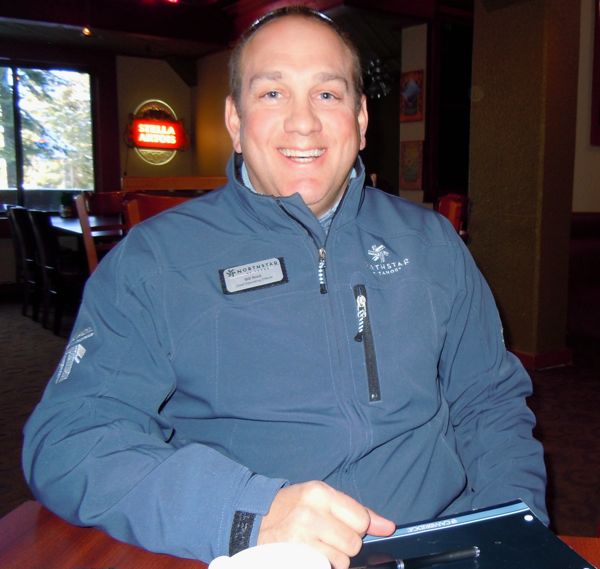
Bill Rock has been at the helm of Northstar-at-Tahoe for about a month. Photo/Kathryn Reed

Bill Rock has been at the helm of Northstar-at-Tahoe for a month. Photo/Kathryn Reed

Other dining changes will be assessed as all the players become more familiar with one another.

All the employees have been retained, with some of the mountain hosts becoming full-time workers.

Jessica Van Pernis, communications manager for Northstar, said, “The Vail team was surprised how lean we were.”

In regards to staffing, Rock said, “There may be structural changes down the road.”

Vail also owns Heavenly Mountain Resort on the South Shore, so it’s possible some blending of resources in Tahoe may occur besides the extra help that is in Colorado.

The man in charge

Rock, who with his wife and twin 5-year-old son and daughter moved to Truckee in early December, is in observation mode at the resort.

His kids are eager to ski in Lake Tahoe. Each got in 25 days of skiing last season.

Rock said his daughter was ecstatic to be moving to California – already having a sense of style at a young age. And only after a couple laps around the outdoor ice rink in the village she apparently is a natural on skates.

Until moving here from West Virginia the only Tahoe area resort Rock had skied was Kirkwood. He had been to Squaw in the summer.

He quickly went all over Mount Pluto – Northstar’s mountain with its summit of 8,600 feet.

“This mountain is laid out well. My first day it was easy to figure out,” Rock said during a wide-ranging interview with Lake Tahoe News.

Dressed in his gray Northstar jacket Rock doesn’t look like a corporate executive. With a radiant smile, he jokes about probably not needing another cup of coffee, but he opts for java instead of the alcohol that is being poured at the bar in the pub at the Northstar Village.

He seems energized by the prospect of taking over a mountain much larger than where he came from in West Virginia or in Durango.

But similarities abound between the resorts he’s worked at – one being experience with homeowners.

The first month he spent mostly getting to know the mountain and employees. With the holidays behind him, Rock plans to reach out to the community this month.

Addressing issues

It’s Dec. 27 and the parking lot is full. Parking is one of the problems skiers and riders have with Northstar. Rock said recent surveys of guests show less frustration with parking, but he said there is room for more improvement.

“We know where we fall short. There are days like today where people will not get the experience of a lifetime,” Rock said. “Sometimes it’s hard to find a place to park and sometimes it’s hard to find a place to eat. We will address it for next year.”

There was a time when Northstar restricted the number of skiers allowed on the mountain. That has not happened for at least five years. Rock isn’t sure quotas would be reintroduced.

For now, Rock said, “We are dedicated to providing the experience of a lifetime for guests.”

LTN asked how that is possible when Northstar seems to be struggling with its identity because it used to be a laid back family-friendly resort before it tried transforming itself with a village like other resorts, and eventually had a Ritz-Carlton open mid-mountain in December 2009.

“We are going to be a place for people to connect,” Rock said. “They create their own memories.”

He said Northstar caters to everyone. With lodging that runs the gamut from hotel-like offerings to studios to the Ritz, he said it’s possible to be all things to all people.

It’s also possible on the mountain, Rock said, with what he described as a world-class terrain park, and a variety of skiable acreage for all levels.

Besides being a ski resort, Northstar has a well-known mountain bike park that for the last few years has been host to the national collegiate championships.

In May, the resort is the end point for the first stage of the Amgen Tour de California road bike race that starts in South Lake Tahoe.

Rock is looking forward to getting out on his bike. The 42-year-old used to do some racing – including as a triathlete.


Top political buzz words of 2010

By Leslie Savan, The Nation

For decades now, there’s been a gap between the left’s and the right’s ability to talk populist. Liberals tend to trip over their own subtlety, uncertainty and/or ambivalence (an example of which you maybe just read), while the right produces categorical words that stick: media elite, death tax, and of course Democrat as an adjective, emphasis on rat.

And 2010 was no different. Not all of this year’s top political buzzwords were born in 2010, but this is the year they’ve been popularized. And when it comes to rhetoric that evokes strong imagery, rouses emotion, and can roll over inconvenient facts and memories, the Red State words (many elevated into a kind of American sign language by Sarah Palin) tend to outshout the Blue ones.

Read the whole story