California looks to another gold rush

By Jessie McKinley, New York Times

SUTTER CREEK — Standing in a cramped, slanted and slippery crevice some 500 feet below the earth’s surface, David Cochrane turned his eyes to a ribbon of marbled quartz — mainly gray, amber and white — and found the one hue he was actually looking for.

“Right there, see? It’s small but it’s very colorful,” Mr. Cochrane said, pointing at a shiny speck no bigger than a seed. “It’s got that nice yellow color.”

It was gold, and if people like Mr. Cochrane have their way, gold will soon be big business again in California’s Mother Lode, in the same area of the Sierras — and occasionally the same mines — where the old-time prospectors once used pick axes, ore carts and burros to chase their riches.

“People say the Mother Lode’s mined out,” said Mr. Cochrane, a vice president with Sutter Gold Mining Inc., based in Colorado. “But that’s not the case.”

Indeed, Sutter Gold is just one of several companies seeking to reignite a long-dormant industry in California, a state whose early history and growth were intimately intertwined with gold’s discovery, excavation and exploitation.

Most of California’s large mines closed after World War II as price controls made the business model unappealing. But with controls gone, and gold now selling at more than $1,300 an ounce, the math makes sense again.

Read the whole story


History: Ex-TRPA member’s memories of Lucky Baldwin

Publisher’s note: This is reprinted from the January 1974 Lake Tahoe Historical Society newsletter.

By Sheryl Morris

Ray Knisley relived some of his personal experiences at Lake Tahoe during the early part of the century and recalled stories about the settlers of some of the big estates on the Southwest Shore of the lake last week when he addressed members of the Lake Tahoe Historical Society.

historyKnisley, a Nevada business executive and member of the Tahoe Regional Planning Agency, was involved with the Tahoe area in the early 1900’s because of his position as general manager of the ranch properties belonging to E.J. “Lucky” Baldwin.

Baldwin not only owned property in the Tallac area of Tahoe, but had holdings throughout the state of California. In fact, Knisley noted, Lucky was the largest individual property holder in all of California’s five largest counties, including Los Angeles County by the 1920’s.

Knisley traced Baldwin’s exploits from his home state of Ohio to California at the age of 19. It was the Gold Rush that beckoned Baldwin west and it was the thousands of people making the trek that helped him get his start in business.

In 1851 Baldwin went to Salt Lake City with six wagon loads of trade goods. He sold the wagon and team, bought a buckboard and four horses, and then traveled down the south fork of the Humboldt River through Lovelock, to Tahoe and on to Placerville and San Francisco.

“When Baldwin went through here, he was determined he’d come back,” Knisley said, adding that at that time there were only two small places in Lake Valley.

Operating a brickyard in San Francisco, Baldwin got enough money ahead to invest in the Virginia City mines. Because of his success in the Nevada mining operations, he was given the nickname of “Lucky.”

When he moved to Southern California, Baldwin had some $20 million in cash. He bought Rancho Santa Anita, which is now the Santa Anita Racetrack.

He also became involved in the financial world, making loans at 12 per cent interest and starting the National Bank of the United States in that area.

“Then came the panic of the 1880’s. The squeeze was being put on the leading people of the community and Baldwin had developed such a reputation as a scoundrel and thief that they were after him,” Knisley said.

Baldwin became interested in the Tahoe Basin in 1914 when the federal government announced plans to drive a tunnel through Incline mountain 12 feet below the normal low level of the lake. They wanted to take the water out and send it on its way over to the Nevada valleys.

“This would have spoiled Lake Tahoe, cut off the Truckee River, and caused numerous problems,” Knisley explained.

The few families living in Lake Tahoe at that time banded together and fought the project. Knisley recalled, adding that they included mainly the Baldwin and Bliss families.

“Baldwin was undoubtedly the earliest conservationist in California,” Knisley said. Baldwin bought Yank’s Station, the first commercial place at Tahoe, when he began acquiring property in the Tallac area. He had a violent dislike for the cutting of trees. In fact, Knisley continued, Baldwin made a stipulation in his will that the Tallac property was never to be logged.

Knisley first saw Baldwin’s Tallac House and other Tahoe properties in 1921 to familiarize himself with all the Baldwin holdings. It was from that time on that he became involved with Tahoe area and came to know the other families who were early landowners here.

The Tevis Family owned what later became known as the Pope Estate. Tevis was an English banker who moved to California and financed he undertakings such as the Moffit Tunnel in Colorado. When the Tevis Family was forced to dispose of its Tahoe property, the estate was sold to George Pope.

The Popes were originally from Maine. They came to California with their friends, the Talbot and Walker families. The three families acquired holdings in San Francisco, Puget Sound and the Sierra. They were steamship people and for many years they ran ships to South America and the Orient.

Descendants of the Pope family are still in the forestry business today, Knisley noted. In fact, he said, Pope-Talbot lumber was used in front of the new Waystation in South Lake Tahoe.

The original owners of the Valhalla Estate, were of the Walter Hellers of San Francisco and the Copelands were the original owners of Camp Richardson.

Knisley pointed out that the historic old estates on the West Shore have been bought up by the Unites States Forest Service. “This acquisition has not only created a beautiful area, but it has brought the wilderness in touch with Lake Tahoe,” Knisley added.

Following his address on the estates, Knisley was asked to comment on the Tahoe Regional Planning Agency on which he presently serves as the governor’s appointee from Nevada.

“I think it is still possible for people to use Lake Tahoe, enjoy it and for it still to be protected so long as the Tahoe compact exists and is accurately administered,” he said.

When questioned about his vote on the proposed construction of a Raley’s Shopping Center at Tahoe Vista, Knisley explained that the developer had met all the requirements so there was not one legislative reason for denial.


Best of Basin winners to be honored

Today the Tahoe Regional Planning Agency will recognize recipients of the 2010 Best in the Basin Awards at its Governing Board meeting at the North Tahoe Event Center in Kings Beach.

This is the 21st  Best in the Basin awards program, recognizing projects demonstrating exceptional planning, design, and compatibility with the Lake Tahoe environment.

Local professionals in the fields of landscaping, planning, engineering, water quality and resource management judged each category.

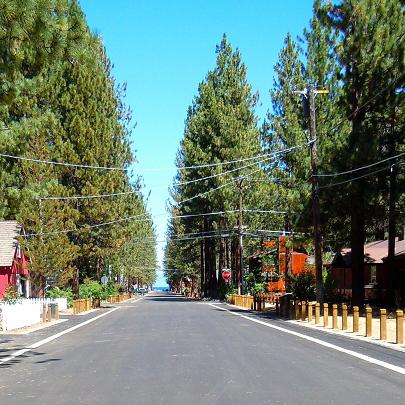
Pasadena Avenue in South Lake Tahoe is an award winner. Photo/LTN file

Pasadena Avenue in South Lake Tahoe is an award winner. Photo/LTN file

The 2010 Best in the Basin project winners are:

Sustainable Maintenance

Nevada Department of Transportation and Washoe County Decant Basins, Spooner Summit and Washoe County Incline Village Maintenance Yard

Erosion Control

City of South Lake Tahoe Al Tahoe Project 1, Pasadena and Lakeview avenues

Restoration

Homewood Mountain Resort Road Restoration, Homewood

BMP Retrofit

Village Shopping Center, Incline Village

BMP Retrofit Honorable Mention

Hagy Residence, 690 David Drive, Incline Village

Commercial Modification

The DIY Center, 1875 Lake Tahoe Blvd., South Lake Tahoe

Residential Modification/Shorezone

Houghton-Berry Residence, Rubicon Bay.


‘Vagina Monologues’ returning to South Tahoe

On March 5 at 7pm, V-Day South Lake Tahoe will present a one-night only benefit reading of Eve Ensler’s award winning play “The Vagina Monologues” at the Loft at the Blue Angel Café.

Last year there were more than 5,400 V-Day benefits around the world raising funds and awareness toward ending violence against women. These events raised more than $4 million through performance of Eve Ensler’s award-winning plays including. South Lake Tahoe has again joined this global movement as part of the V-Day 2011 Campaign.

For the eighth year in a row South Lake Tahoe will present a benefit production. This year is special in that “The Vagina Monologues” are returning after a two-year break, as performances in 2009 and 2010 were readings from “A Memory, a Monologue, a Rant, and a Prayer.”

V-Day is a global activist movement to stop violence against women and girls.

The V in V-Day stands for Victory, Valentine and Vagina.

Admission to the South Tahoe event is $15. Tickets are available at the door and the Family Resource Center on Spruce Avenue. Proceeds will benefit Family Resource Center Mother’s Support Group, South Lake Tahoe Women’s Center Emergency Services, and Tahoe Youth & Family Services Little Latinas Program.

To learn more about V-Day Tahoe call Natalie Yanish at (775) 843.7142 or e-mail natalie@realtordeb.com. To learn more about V-Day and its campaigns visit www.vday.org.

Other related invents include:

• “The Sex Show”, a jeopardy based sex education game show on Feb. 24 at 7pm at The Divided Sky in Meyers, $5 tickets at the door.

• “HONK”, a rally to raise awareness on Feb. 25 from 5-6pm at the Y in South Lake Tahoe.

• The Dress Rehearsal showing of “The Vagina Monologues” March 3 at 7pm at The Divided Sky, $5 tickets at the door.


Reserve deputy sheriff’s needed in El Dorado County

El Dorado County Sheriff’s Office is now accepting applications for reserve deputy sheriff. Reserve deputies are volunteers used to supplement patrol operations and special events within El Dorado County. Applicants must be 21, possess a valid California driver’s license, have a high school diploma or GED, and have a clean criminal background.

Reserve Deputy Sheriff applicants must meet California P.O.S.T. training requirements; pass a psychological evaluation, polygraph examination, background investigation, and medical evaluation.

Reserve deputy sheriff’s are expected to:

• Interact with the community in a positive manner to cooperatively reach resolution of community needs and to foster positive, effective, and lasting relationships between the community and sheriff’s office.

• Give advice on laws and ordinances and general information to the public.

• Exercise powers of arrest and control; defend self, other officers, and use force up to deadly force if required.

• Arrest, search, transport, and confine offenders.

• Maintain good physical condition, agility, and coordination to allow performance of the essential tasks of a deputy sheriff.

• Achieve, demonstrate, and maintain minimum department standards of proficiency and performance in accordance with policies, procedures, rules and regulations of the sheriff’s office.

• Respond to all calls for service; secure crime scenes; assist in investigations; gather evidence; obtain statements.

For an informational flyer, requirements and to apply, go online.


Tahoe Tails — Adoptable Pets in South Lake Tahoe

BamBam is a 16-month-old Saint Bernard mix. He is house and crate trained and would love to go to training classes to learn more leash manners. He knows sit, come and down.

dogHe likes most dogs, but would like to meet yours before going home with them. He didn’t chase the cats that he met here, but they didn’t run either.

He is a very energetic boy and would be a great hiking partner.

BamBam is neutered, microchipped, and vaccinated.

He is at the El Dorado County Animal Services shelter in Meyers, along with many other dogs and cats who are waiting for their new homes.

Call (530) 573.7925 for directions, hours, and other information on adopting a pet. For spay-neuter assistance for South Tahoe residents, go online.

— Susan Baumflek


Mancuso, Bahrke star in California tourism ad

By Lori Weisberg, Sign On San Diego

Olympic skier Julia Mancuso is among winter athletes featured in a new California tourism ad campaign airing on cable TV.

California tourism officials have turned to celebrity athletes and chefs to promote the state as an ideal destination for skiing and snowboard enthusiasts, as well as vacationers with a hankering for fine food and wine.

Its new “Friends in High Places” television advertising campaign employs such notables as Olympic ski champions Julie Mancuso and Shannon Bahrke, both of whom grew up on the slopes of Lake Tahoe, to showcase California’s top skiing and snowboarding locales. The ad is not devoted just to skiing but also highlights such activities as dog sledding, tubing and ice skating.

California ski resorts last year attracted 8.1 million snow enthusiasts and typically generate $700 million in direct visitor spending annually, according to the California Ski Industry Association.

Read the whole story


UNR site of Nevada autism conference

The Center for Autism and Related Disorders Inc., the world’s largest autism treatment center that provides state-of-the art therapy, is hosting a CARD Nevada Autism Conference for parents, educators, medical and behavioral practitioners, researchers, and students.

The one-day, comprehensive conference will be in Reno March 4 from 8am-4:30pm at the Whittemore Peterson Institute’s Center for Molecular Medicine, located at UNR on 1664 N. Virginia St.

According to the Centers for Disease Control and Prevention, one in 110 children in America is diagnosed with autism, making the neurological disorder more common than childhood cancer, juvenile diabetes and pediatric AIDS combined. The objective of the conference is to provide information on the most effective autism interventions, to inform on the latest advances in autism research, and to showcase hands-on, groundbreaking technology used to assess and treat developmental disorders. Attendees will also learn how to strategically access insurance funding for autism treatment.

Featured speakers include: keynote speaker and CARD Executive Director Doreen Granpeesheh on “Applications of Behavior Analysis to the Treatment of Autism”, CARD Research and Development Director Jonathan Tarbox on “Practical Solutions for Addressing Challenging Behaviors”, Co-Creator and Director of Skills Adel Najdowski on “Skills: A Comprehensive, Web-based Assessment, Curriculum, Training Package and Progress Monitoring System” and CARD Contracts Director Bryce Miler on “Nevada’s New Autism Mandate-Assembly Bill 162”. A panel discussion with the featured speakers will follow the series of workshops.

For more information about the CARD Nevada Autism Conference call (818) 345.2345, ext. 270.


Plow drivers deal with un-fun part of Tahoe snowstorms

By Kathryn Reed

Bouncing. Snowplows can do this even though the machines literally weigh a ton and then some. Even with chains on all six tires, if they are carrying enough snow, especially uphill, it’s far from a smooth ride. And these monsters also slide.

Operating heavy equipment isn’t easy under the best of conditions. Best of conditions for a plow driver would be adequate visibility, no obstacles and a road surface that doesn’t resemble a Zamboni having just cleared a sheet of ice.

It’s Feb. 17 and the snow is dumping in South Lake Tahoe. Visibility is less than ideal. Vehicles are coming and going, and this contraption is supposed to zig and zag to accommodate them. Mailboxes are on the edge of driveways looking like targets.
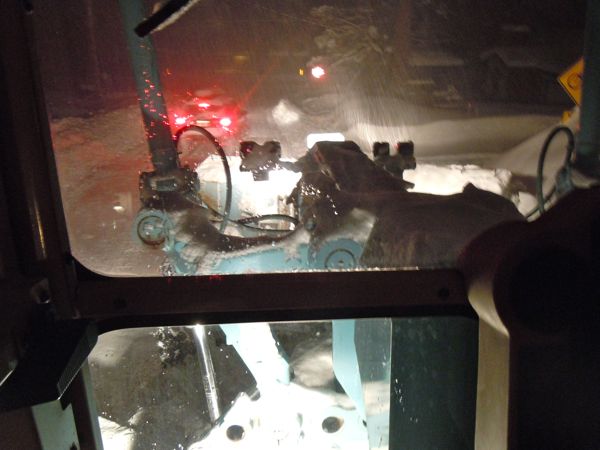
Visibility is lacking for snowplow drivers during a storm. Photos/Kathryn Reed

Visibility is lacking for snowplow drivers during a storm. Photos/Kathryn Reed

With 130 miles of streets to clear in the city limits, the 16 plow drivers work 12-hour shifts (6 to 6) at times when it’s dumping like it has been for the past few days. The city is divvied up into routes, with a team working a particular route.

It’s a little before 6pm in the employee room at the snowplow yard. Dennis Hillyard is telling Bobby Maxwell what the day shift was like, what he accomplished, how the machine is operating. Something isn’t quite right with big blue so Maxwell takes an older machine that rattles onto the streets of South Lake Tahoe.

Before he leaves the yard Maxwell tests the hydraulics. It’s a bit like a pilot going through a checklist.

The instrument panel is not as complex as that of an airplane, but there is certainly more to do at all times while the machine is in motion. No autopilot on this rig.

Five controls on the left, six on the right and the foot pedals require dexterity, concentration and quick thinking. Plus, there are levers to the right dealing with front wheel drive and being able to lock the rear axels. Windshield wipers clear – though not well – the moisture from the glass on top and below. The radio to home base is to the left.

There’s the plow in front, the belly blade and the gate to contend with on the machine.

That’s what these guys, and it is a male dominated profession, contend with just in their small sphere that is not designed to carry a passenger.

Outside their sphere of influence are driveways, intersections, drainage areas, street signs, mailboxes and vehicles.

And then there’s the public. Some don’t know how to drive in the snow. Some don’t care their vehicle is on the edge of the driveway looking close to losing a front bumper. Some people come out to stare. Others throw their arms up in disbelief about the berm that just got left.

“There’s never anything positive from the public when you’re plowing,” Maxwell says.

He’s had people chase him in their vehicles. He doesn’t stop; thinking nothing good could come of the confrontation.

But that doesn’t mean he is callous about leaving a berm. He said he and co-workers do their best, but when it’s coming down as fast has it has been with this storm, the accumulation means the snow has to go some place.

“You can only carry so much snow,” Maxwell explains. “The gate really only reduces the berm. It does not eliminate it.”

Headed up Bode Drive off Pioneer Trail the machine is resisting, it’s bouncing a bit. That driveway is going to be bermed. The gate, the device that is used to avoid berms, has to be released. And simple physics prove plows can only carry so much snow before it spills over.

Houses on the right corner of an intersection are apt to receive the biggest berms. Such are the hazards of the plows having to clear an intersection, with some of that snow from the street getting dumped right away.

People who plow their snow into the street – which violates a city ordinance – are apt to get a larger berm because it’s just more snow that has to be moved out of the street.

It’s not one pass that Maxwell makes on what is called the Heavenly route. He said he and Hillyard are about quality, not the distance.

Other operations

South Tahoe plow drivers are responsible for all the city streets, while Caltrans contends with all state highways, just as NDOT does the highways in Nevada.

In El Dorado County, the main arterial roadways and school bus routes are the priorities when it comes to clearing the 158 miles on the South Shore. The county also has 35 miles of pavement in the Tahoma area to contend with.

“We have been hit by the budget to some degree, but it is not affecting snow removal operations,” said Tom Celio, El Dorado County deputy director of maintenance and operations.

The county also runs two 12-hour shifts and breaks the work into zones.

Douglas County is only responsible for a handful of streets at the lake, which is done by two private contractors. The rest of the South Shore is either covered by homeowners associations (like in Glenbrook) or general improvement districts (like the streets off Kingsbury Grade). Douglas County School District plows Warrior Way for the schools along there.

Once the streets all get plowed, then the blowers come out in all the jurisdictions. The guys driving the blowers are the same ones who had been in the plows.

ngg_shortcode_0_placeholder  (Click on photos to enlarge.)


Lady Antebellum booked at Harveys in July

Harveys Lake Tahoe and Another Planet Entertainment are bringing America’s hottest country group, Lady Antebellum, to the South Shore.

The group’s “Need You Now” tour going to be part of the Lake Tahoe Summer Concert Series at Harveys Outdoor Arena on July 29.

antebellumTickets go on sale March 7 at 10am via Ticketmaster outlets and apeconcerts.com.

Opening acts will be announced soon.

After selling out headlining concerts in New York, Los Angeles and Nashville, and fresh from their five wins at the recent Grammy Awards, ACM and CMA Vocal Group of the Year, Lady Antebellum is headed to Stateline.

Lady Antebellum first took country music by storm in 2008 with the release of their self-titled Platinum certified debut album, which generated the hits “Love Don’t Live Here,” “Lookin’ for a Good Time” and their No. 1 hit, “I Run to You.”

Tickets are $39.50, $59.50, $69.50, $89.50 and $125.50, plus applicable fees. Show time is 7:30pm.