Rent your life — a quick way to make a buck or two

By Rob Baedeker, Newsweek

There’s a strange woman in our shower.

She and her boyfriend arrived late last night, and she’s slipped into our bathroom, which adjoins the office where my wife, Laura, and I are working. We can hear her flossing.

“Did you meet them?” Laura whispers. “Are they nice?”

I don’t know if they’re nice — but does it matter? They’re paying $135 to stay with us!

Meanwhile, I’m waiting for a nurse named Amy to return my electric sander. She paid me $4 to rent it for a day and said she’d be back this morning.

I’ve got lots of other deals cooking, too: $5 to rent my 4-year-old’s bike; $150 for a weeklong rental of our 1992 Saab. I’m renting my old guitar to the tune of $50 a month.

This is huge. The fact that complete strangers are willing to pay me to rent my belongings-—the fact that I can make money from stuff I wasn’t using anyway—is a breakthrough discovery on par with penicillin, the second law of thermodynamics, or the Snuggie.

Did I mention I’m making money from renting stuff I wasn’t using anyway? And that I can continue to cash in, again and again, on the same stuff? Take our backyard deck and barbecue. I’m charging a group of people $18 to use it while I’m not even home. I’ll be away meeting someone who’s renting our dog for $3 an hour.

Call me a rentrepreneur, one of the growing ranks of Americans who, in a postbinge economy, are finding creative ways to make a quick buck by hiring out their personal belongings. The movement is being fueled by a slew of new startups catering to what some are calling “collaborative consumption.” There are now sites to connect people who want to rent out their cars, couches, personal services, dinosaur costumes or clay-pigeon launchers ($12 per day on Zilok.com). For renters, the sites offer goods and services for a relative bargain (weekly rates for a rental car where I live in Berkeley, can be twice what I charged). More than that, they’re a chance to bypass corporate America at a time when corporate America is in the dog house. Why endure the long waits, high prices, and surly staff at your big-box tool-rental counter when you can pick up Rob Baedeker’s electric sander for a song—and go home with a smile?

There’s a virtue in this business, too, part of a postrecession shift from a throw-away society to a new economy of reuse. My customers might be in the 99 percent, but they’re not broke or unemployed. Same goes for my fellow rentrepreneurs. Yet after witnessing the fallout from a half-century-long frenzy of conspicuous consumption, a whole generation of us is now reexamining the long-forgotten “waste not” maxim exemplified by the sugar-packet-saving thriftiness of our grandparents. I can almost hear my Depression-hardened Nana speaking to me from the grave: “You’ve got all this crap lying around, man. Put it to use!”

Read the whole story


Artie Smith — 1940-2011

South Lake Tahoe lost a dear friend on Christmas Day. Arta Ann (Larsen) Smith, better known as Artie, left this world on Dec. 25, 2011, after a long, courageous battle with heart disease and ultimately a brown recluse spider bite.

Born in Tremonton, Utah, on Oct. 16, 1940, to Myron Tanner Hansen and Arta Josephine (Larsen) Hansen, Artie was predeceased by her two older children, Suzanna Jo and Cynthia Lee. She is survived by her brother Brent Myron Hansen, son Steven Andrew Smith, and six grandsons.

Artie moved from the Bay Area to South Lake Tahoe in the early 1990s when she worked at the Tahoe Daily Tribune for nearly five years; later for many years through the Substitute, at Kingsbury Crossing, and at the Holiday Lodge.

She leaves dear family, countless friends and many co-workers who miss her friendly, out-going personality.

Community services are set for Jan. 6 at 11:30am at the South Lake Tahoe Recreation Center on Rufus Allen Boulevard, with internment to follow at Happy Homestead Cemetery.


History: S.S. Tahoe made substantial contribution to lake’s maritime lore

Publisher’s note: This is reprinted from the June 1988 Lake Tahoe Historical Society newsletter.

Her deep penetrating whistle could be heard for miles across the water, echoing against the surrounding mountains. Her arrival was the highlight of the day as she brought visitors, supplies, news, mail and, above all, excitement to each community at whose pier she stopped. She was a lifeline, a connecting link between Glenbrook and Carnelian Bay, Tahoe City and Tallac House, Brockway and Homewood. She was a fixture, as much at home on the lake as the fish in the rivers or the trees on the nearby slopes.

She was not the only steamer on the lake. Before her launching in 1896, there had [been] two small steamers, Governor Blaisdel and Emerald, both launched in the 18060s. The larger Governor Stanford, Niagara, Tod Goodwin, and Meteor, all appeared in the 70s and 80s. They had carried passengers and mail, or they had been workboats, tugs and tow-boats, some fulfilled all three roles. All, except the Meteor were gone by 1896.

When the Tahoe came along, she caught the fancy of residents, guests, travelers, writers and photographers. She was almost twice the length of her predecessors. Her slim hull was as graceful as a deer. Her lavish mahogany, silken tassels and gleaming brass complements her glistening white hull. She was less than wonderful to ride in adverse weather because she rolled uncomfortably. Yet those who rode her often bragged about the experience for years.

She was as reliable as clockwork on her passage around the lake. She called at most of the communities starting for Tahoe Tavern on the west shore at 9:10 every morning and returning there at a predictable 5:00 p.m. She was delayed only once in her forty years of service when a clogged smoke stack prevented operation until repaired several hours later.

In her first quarter century, Captain E.J. Pomin, with a six man crew, guided her on her rounds, followed by Captain Edmund Hunkin for another decade and a half. Around 1910, her boilers were converted from wood to oil to increase her efficiency. Already her days were numbered.

The first automobile roads were being built up to and around the lake at this time making access easier, less expensive and more adventurous. Residents, businessmen and tourists could travel around the lake without the expense or inconvenience of waiting for the steamer. When the Tahoe lost the mail contract to the Marion B, a forty-footer equipped with a gasoline engine, it spelled the end of the era of the steamboat.

The S.S. Tahoe lies today in her natural element, sixty fathoms down in the clear, cold water in the southeast part of the lake. She is still cherished by those who saw her, rode in her or worked on her. She is also remembered by those who wish they had been so privileged.


LTCC grooves to the beat of 3-day outdoor music festival

By Kathryn Reed

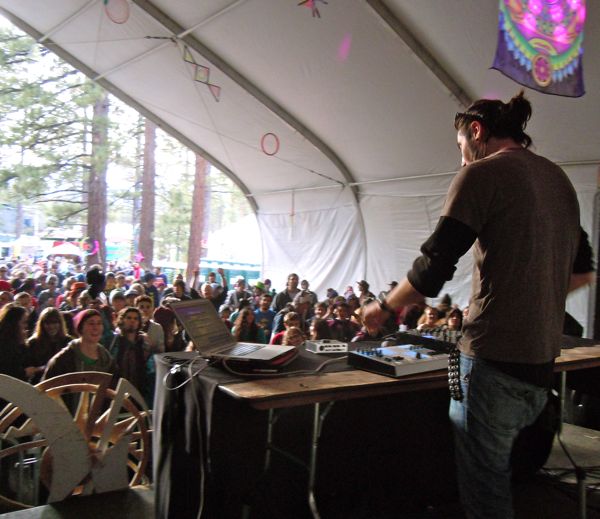
One day SnowGlobe might legitimately be used in the same sentence of Woodstock or Day on the Green. More than 9,000 people – mostly younger than 30 – swayed, danced, bounced and moved to the sounds of bands like their parents’ and grandparents’ generations did decades ago.

Only this music isn’t rock ’n’ roll. It’s techno. It’s hip-hop. It’s crunk. It’s a whole lot of drum machine and bass. Sometimes a band isn’t even on stage – it’s a disc jockey putting the sounds together in a mix that becomes original music. They are artists in their own right, not like the disc jockey putting someone else’s song on the radio.
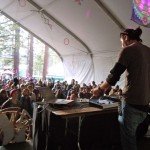
Stephan Jacobs keeps a throng of SnowGlobers moving to the music. Photos/Kathryn Reed

It’s got a beat that makes everyone listening want to dance. It’s a party. It’s people having fun.

South Tahoe evolves

Kindred Murillo has a smile on her face as she surveys the crowd. She is used to this age group. After all, she is president of Lake Tahoe Community College; which is doubling as a concert venue for two more nights.

“It’s better than I expected,” she said looking at a line of people waiting to get in.

On the job less than six months, she is doing something no one in the history of the 30-plus-year-old college has done – turning the campus into a music venue. If everyone determines SnowGlobe was successful, Murillo envisions the college being more of a partner in the future.

She’s well aware of the publicity the event has already brought to the campus and hopes to be able to capitalize on it in the future.

The college is getting about $10,000 from the concert promoters for use of the site. The city will get about the same from the business license fee and reimbursement of hard costs like overtime for employees.

It’s a potential shot in the arm to local businesses, too – money in pockets of hotels, vacation rental owners, and other businesses that are smart enough to tap into the needs of this crowd. Like food when the festival is over. Souvenirs to take home. Warm clothes for these flatlanders.

Tickets: Dec. 30 $65, available at Horizon in Stateline noon–6pm; Dec. 31 $75, available at Horizon in Stateline noon–6pm Age: Anyone Times: Dec. 30 2:15-11pm; Dec. 31 4:15pm-1am Info: SnowGlobe online

It was South Lake Tahoe City Manager Tony O’Rourke who shook his head a year ago when he heard the city did nothing on New Year’s Eve except pay police officers overtime to help patrol the Stateline casino corridor. His idea was give those twenty-somethings something to do and get them to open their wallets.

They are here and they are spending money. Three-day tickets cost about $150, with Saturday-only being $75.

Vendor Village is a tented area where jewelry, hats, glasses, clothes, leather goods and organic food are being old. On the outskirts of the shopping area is SpiritHoods. They sell those animal hats with long ears, so to speak, that can be scarves of sorts. At the concert they sell for $100 — $35 less than online or at their Los Angeles headquarters.

A slew of women and men have this style of hat on. They seem to be everywhere.

SnowGlobe is giving people who might usually stand around in the cold at Stateline on New Year’s Eve something to do other than question why they are standing around in the cold. It will give people who can stay out past 9pm on New Year’s Eve a place to be on the South Shore – which includes a fireworks show.

It’s about putting South Lake Tahoe on the map as a place to be this time of year that doesn’t involve being in a casino.

It may even be good business for the three marijuana dispensaries in South Tahoe.

With the smell of pot wafting between the three stages on opening night of the three-day event and no line for Sierra Nevada brew, it was obvious the drug of choice for this crowd is weed.

The cops are ignoring them. After all, it’s just an infraction in California – like getting a speeding ticket.

But South Lake Tahoe police officers make their presence known at the get-go. And SnowGlobe officials alerted their followers that undercover cops would be on the grounds, too.

“Their security handles everything,” Sgt. Shannon Laney told Lake Tahoe News as he watched people funnel in. “They bring the problems to us.”

It’s all about the music

Dillon Francis – on the Sierra stage – is who Robert Bunnett, 19, was most excited to see Thursday.

He and 14 friends made it a road trip from Los Angeles for three days of music. They are staying – all of them – in a one-room cabin. Usually it’s the LA-San Bernardino music fests they follow. The lineup and the opportunity to be in Tahoe for New Year’s led them north.

Even though Sherose Renck, 17, and Serena Gafford, 16, didn’t have to drive far, the best friends from Gardnerville are staying in a hotel overnight on the South Shore – going to SnowGlobe all three days.

They are moving to the beat of Stephan Jacobs who is making techno music on the Igloo stage. This is the biggest music event either one has been to.

It’s the atmosphere that captivates Renck. “I love the energy,” she says.

With goggles on her forehead, Lorene Carlston of Santa Cruz waits to get in. She’s most excited to see Pretty Lights, one of the headliners on the SnowGlobe stage Dec. 29.

Frustrated with the people who work at the Horizon casino in Stateline for not knowing where the shuttle to LTCC was, this led her and a friend to a hitch a ride.

At 28 and her friend 31, she says, “We find it to be a young crowd.”

Despite their hiccup, most people were getting to LTCC via the 30 buses bringing them to and from LTCC for free.

Eran Afmer, 34, of Seattle is a bit disappointed with no fresh snow, especially considering she left powder in the Cascades. Still, she’s excited to be in Tahoe – a first for her – with friends from various states. They rented a huge house for the long weekend.

South Lake Tahoe local Anthony Davis put in six hours volunteering at the event Thursday.

“I did it so I can get a feel for the event and know what it’s all about before I judge it,” Davis said. “I’m liking it. I like the vibe.”

ngg_shortcode_0_placeholder (Click on photos to enlarge.)


Tales of hiking Mount Everest

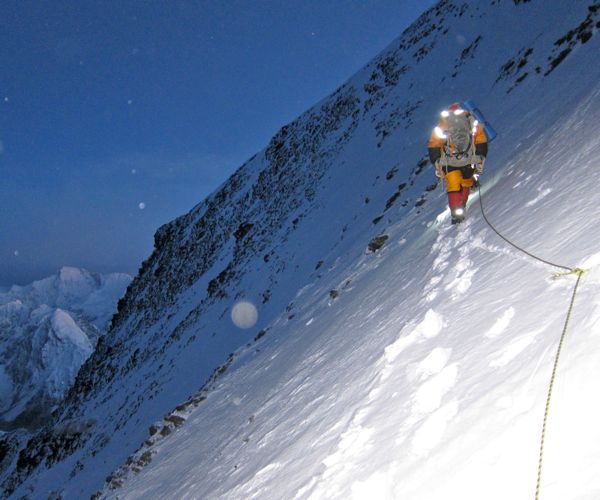
In spring 2011, local mountain guide Adrian Ballinger became the first person to summit three 8,000-meter peaks within a three-week period.

Adrian Ballinger will talk Jan. 12 about climbing Mount Everest. Photo/Provided

Ballinger summitted Mount Everest (29,029 feet) twice in two weeks, first while fixing ropes to the summit with an elite group of the world’s strongest sherpa, and then again while guiding a group of climbers to the top of the world’s largest peak.

Alpenglow Sports’ third installment of the annual Winter Film Series is Ballinger’s tales of his Himalayan adventure.

The event is Jan. 12 at 7pm at Sawtooth Ridge Cafe in Tahoe City.

With one week left in the season, Adrian, Phurba and Tashi again left basecamp to guide and summit Lhotse (27,940 feet), Mount Everest’s neighbor and the fourth highest mountain in the world.

From deep within the Himalaya, this story is one for the climbing history books.

The free event will be a night of photography, video, and stories from the roof of the world.

Call Alpenglow Sports at (530) 583.6917 with questions.


Grass Roots to expand product line at new location

By Kathryn Reed

Three-foot wide aisles with shelves packed from floor to ceiling are not the ideal shopping conditions – for consumer or storeowner.

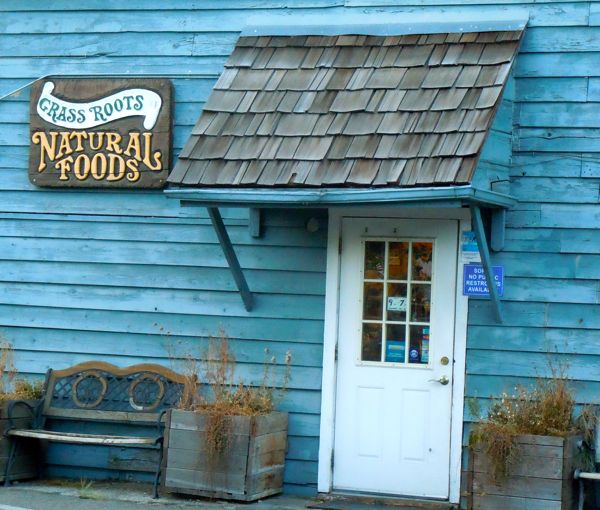
That’s why Jon McElroy is moving out of the location Grass Roots has been in since 1973 and moving across the driveway to the old Blockbuster building. With 1,200-square-feet of retail space today, when the new store opens in the spring it will have 4,000-square-feet devoted to natural foods.

“You will be able to see the products,” McElroy said of the new site. “Now you can’t stand back far enough to see what’s on the bottom shelf. And if gets crowded, it is annoying.”

Grass Roots will be moving almost next door in spring 2012. Photo/LTN

Through the years McElroy and wife Sandra have thought about moving into a bigger place than their Dunlap Drive location in South Lake Tahoe, but the right place never came along.

Then earlier this year everything clicked. They bought the building that is next door, which also fronts Highway 50 at the Y. The Grass Roots sign is in place even though the moving date isn’t likely to be until March.

“One reason we wanted to expand is there are a lot of new products, fun things (on the market). We go to trade shows and say we wish we could carry this and that, but where would we carry it?” McElroy said.

The McElroys look forward to being able to carry more products, expanding the produce section and creating a better shopping experience. He envisions it being a mini Whole Foods Market.

With the tight quarters of the current store, it’s not possible to introduce a new product without taking one away.

Although the size of the store is much larger, with doubling the aisle space to 6 feet, much of the room will be used in cosmetic ways instead of devoted to sales. But at the same time, a more pleasant environment with more choices may keep the cash register ringing louder and more often.

Like most businesses, Grass Roots saw its bottom line take a hit in 2009 and 2010. McElroy said things have been on the upswing this year.

“People’s shopping habits have changed. We have a sales flyer that comes out every month. They will look for specials and walk around with the flyer in hand,” McElroy told Lake Tahoe News.

While people are price conscious, they are also turning their attention to better nutrition. This is one area where Grass Roots is attracting new customers – those who care about what’s in a product and where their food comes from.

Lots of things need to be done to the building to convert it from a video store to a grocery store. Gone are the blue carpet and yellow walls. Wood will be on the walls and the floor will be stained concrete.

Today’s store has four little freezer doors. The new place will have 10.

Grass Roots is forming a partnership with Freshies for that South Tahoe restaurant to provide soup at the new location. It will be self-serve, with people able to get lunch on the go.

McElroy is talking to some people about turning the current Grass Roots spot into a café. The owner, who lives out of state, is likely to convert the upstairs back into apartments. Now it’s used as office space and storage.

The bakery, which McElroy knows well, will remain in the current location because the process to create a commercial kitchen is too involved. It means the fresh breads will be sold at the new property.

McElroy first went to work at Grass Roots as a baker in 1978 when Karen and Jeff Miner owned the natural foods store. The Miners had opened it five years earlier. McElroy bought them out in 1985 – the same year he got married. The McElroys have been operating it ever since then.


Even small amount of exercise is good for the heart

By Janice Lloyd, USA Today

More research shows that even small amounts of aerobic exercise help lower coronary heart disease risk, according to a review published Monday in Circulation, the journal of the American Heart Association.

The mega-study is part of a growing body of research showing that some physical activity provides health benefits — even when levels fall below the recommended federal guidelines of 150 minutes of moderate-intensity physical activity a week. For the first time since 1998, the American College of Sports Medicine updated its exercise guidelines in June, including information on how little exercise is needed to achieve health benefits.

“The biggest health benefits we saw were for those who went from doing nothing to those doing something small,” says Jacob Sattelmair, author of the new AHA study. “Even a little bit of activity makes a significant difference.”

A little bit means 10 to 15 minutes a day. Sattelmair says the new findings are the first to make quantitative assessments of the amount of physical activity a person needs to reduce risk.

Read the whole story


Tahoe Tails — Adoptable Pets in South Lake Tahoe

Rudolph and his buddies Prancer, Donner and Vixen are all biding their time at the shelter, playing and generally acting very cute until their new families come to adopt them.

There are five kittens at the South Shore animal shelter, plus several other adult cats who are all hoping the holiday season brings them good luck and good homes.

Rudolph is neutered, microchipped, and vaccinated. He is at the El Dorado County Animal Services shelter in Meyers, along with many other dogs and cats who are waiting for their new homes.

Call (530) 573.7925 for directions, hours, and other information on adopting a pet.

For spay-neuter assistance for South Tahoe residents, go online.

— Karen Kuentz


Ticket prices lower for New Year’s Eve weekend in Tahoe-Reno

By Mel Shields, Sacramento Bee

New Year’s Eve in Northern Nevada casinos is usually a pretty good barometer of the state of the economy. In prosperous and optimistic times, major stars perform for tickets prices of $100 and up. When the outlook is less rosy, the prices come down. Few shows this year have high prices.

That does not mean there are not plenty of shows, and it certainly does not mean they aren’t good ones. It’s just that there are no Liza Minnelli concerts at $250; even when she was here in October the top ticket was only $75. The Silver Legacy has the best weekend lineup, with shows on Thursday, Friday and Sunday, leaving New Year’s Eve to parties.

In fact, sometimes it’s better to avoid the big night altogether, stay away from the teeming masses (especially the mobs on Reno’s Virginia Street and Stateline’s Highway 50 at midnight), and take in a show on Thursday, Friday or next Sunday. The rowdy revelry can be avoided, and tickets are easier to obtain.

Comedian Katt Williams is not for everyone, but he’s become more and more skilled over the past decade. He started as an unknown in places such as the Improv and the Comedy Club in Los Angeles, then built a loyal following in his own room at the Hollywood Park Casino, giving him a greater sense of the atmosphere than many of his contemporaries.

Williams expanded his base with his role as Money Mike in “Friday After Next” and other movie parts (none of them exactly stellar but all reasonable successes) and with his appearances in MTV’s “Wild ‘n’ Out” and in videos by Outkast, Lil’ Kim and others. He’s in the Grande Exposition Hall at the Silver Legacy on Thursday (8pm; 407 N. Virginia St. in Reno; $65, $80; 800.687.8733).

Read the whole story


Could this be the end of cancer?

By Sharon Begley, Newsweek

By all rights, Shari Baker should have said her final goodbyes years ago. In 2005, more than a year after three doctors dismissed a lump under her arm as a harmless cyst, she was diagnosed with stage IV (metastatic) breast cancer, which takes the lives of at least 80 percent of patients within five years; it killed Elizabeth Edwards in 2010. Half of those diagnosed with breast cancer that has spread—in Baker, it had reached her spine—die within 39 months. But the 53-year-old jewelry designer in Scottsdale, Ariz., wasn’t ready to die. “I’ve been a competitive athlete and a body builder, I take care of myself and eat right,” she says. “I was going to fight this.”

Click here to find out more!

Baker began searching for a clinical trial, and through the International Cancer Advocacy Network (ICAN) found an intriguing possibility: a cancer vaccine. In May 2006, she traveled to the University of Washington. The vaccine was injected into her upper arm; she got five more shots over the next five months. Today, with scans detecting no cancer anywhere, Baker seems to have beaten some extremely stiff odds.

Short of a sci-fi nano-camera to capture what was going on at the cellular level, it’s impossible to know exactly what the vaccine did. But based on studies of lab animals and cells in petri dishes, scientists have a pretty good idea. The vaccine contained fragments of a molecule called her2/neu, which, perched on the surface of tumor cells, fuels the growth and proliferation of some breast cancers. Baker’s immune system treated the flood of injected her2/neu like an invading army and mounted a counterattack. Cells called CD4, acting like biological Paul Reveres, sounded the alarm, rousing white blood cells called T cells. The body’s Minutemen, they invaded Baker’s tumor, summoning reinforcements called cytotoxic (“killer”) T cells, which destroyed the tumor cells in Baker’s breast as well as her spine. Enough of the other 21 women who received the experimental vaccine against metastatic breast cancer are doing so well that its inventor, immunologist Mary (“Nora”) Disis of UW, dares to envision a future in which vaccines “control or even eliminate cancer.”

Read the whole story