Elder Options expands services to include handyman work
Recognizing that older people are increasingly remaining in their homes as they age, Elder Options has expanded services to the community by adding a handyman component to the Care Management and Home Care services already in place.
Sample handyman services include outside yard clean up including weed eating, pruning, burning and mowing. Minor repairs can include repairing a leaky faucet, replacing a garbage disposal, installing grab bars, handheld showers, installing additional safety lighting, changing furnace filters, and minor electrical repairs.
Additional services can include cleaning out the garage, taking unused-discarded materials to recycling or thrift stores, cleaning gutters, stacking wood, spraying for insects and other tasks that the older person needs help with.
The handyman can also take the family pet to the veterinarian for shots or grooming.
Other services may be available as requested.
As an employee of Elder Options, handymen will be covered for all payroll taxes, liability and workers’ compensation as well as completing a background investigation and orientation.
For more information or to arrange for Handyman Services, call Elder Options at (530) 626.6939.
California taking the lead with self-driving cars
By Tony Bizjak, Sacramento Bee
California is quietly positioning itself at the leading edge of what could be the biggest revolution in daily travel since the day the buggy was unhitched from the horse.
The self-driving, or autonomous, car, seen by many as a “Jetsons”-like futuristic dream, may be less than a decade from commercial reality, some researchers now say, pushed forward in good part by an unlikely California company – Web giant Google.
“We may be at a historic cusp where driverless cars share the road,” said Carroll Lachnit, an editor at the car information site Edmunds.com. “The (technological) pieces are all there.”
The concept excites many who say the technology will lead to fewer crashes and less wasted commute time. There will be less stop-and-go traffic, they say. Self-driving vehicles won’t slow down to gawk at things beside the road, a major cause of congestion.
Intrigued by the idea of eliminating human error from driving, a California legislator has introduced a bill to clarify that driverless cars are street legal.
Researchers, notably Google, more known for Web search engines than car components, already are producing test cars that drive on their own in traffic on city streets and freeways.
But the push is generating concerns about the reliability of the technology and questions about whether Californians, known for their love of driving, will turn over control of their cars to computers and sensors.
To highlight the technology, Google recently produced a video that follows a seeing-impaired man as he heads out on a taco run in Google’s fully autonomous Toyota Prius. He sits in the driver’s seat, but only as a passenger, as the car takes him to a Taco Bell drive-through lane.
Gov. Brian Sandoval peered down into a spawning run at Pyramid Lake and turned to Lt. Gov. Brian Krolicki.
“Hey Brian,” Sandoval said. “I see your dinner.”
He turned to a reporter and, with a chuckle, said: “There’s a dead fish down there.”
When he’s traveling, Sandoval walks around with a couple of honorary gubernatorial coins in his pocket in case he meets some children. He likes to go to museums but has to go by himself because, as a history buff, he likes to read all the information, and that’s a drag for the rest of his family.
After the day at Pyramid Lake, 37 miles north of Reno, meeting members of the Paiute Tribe and watching workers squeeze trout for eggs and semen at the hatchery, he declared it one of his favorite days as a governor.
There might be no other way to say it: Sandoval is a dork.
Or, at the very least, he has a nerdy side that goes with the ambition that has led him to the state’s highest elected office.
Since becoming governor, Sandoval has become the most popular politician in the state. He has done this by weaving himself as a fiscal conservative, but not extreme, with a moderate tact on potentially explosive issues like gay rights and immigration.
Day in Incline devoted to learning about ham radio
The Sierra Nevada Amateur Radio Society invites the community to learn about Amateur Radio on Field Day 2012 at Sky Tavern on June 23 from 11am-6pm.
Meet and talk with Reno’s ham radio community, check out their radio equipment, and see what Amateur Radio is all about. A special “Get-On-The-Air” station will be set up so people can try ham radio — including kids.
Reno’s Amateur Radio operators, or “hams,” will join other hams across the country in setting-up radio stations in unusual locations, using only emergency power, and then try to make radio contact with as many of those other hams as they can.
The Sierra Nevada Amateur Radio Society will be operating from the parking lot at Sky Tavern, 21130 Mount Rose Highway, 10 miles up Highway 431 from Highway 395.
For more information, call Jim Deahl at (775) 741.6937, or email field-day@snars.org.
Rotarians want to send someone to India
The Rotary Club of Tahoe Douglas is looking for young professionals who want to travel to India during January and February 2013.
Each year Rotarians throughout the world sponsor Group Study Exchange Teams made up of four young professionals and an experienced Rotarian team leader who travel to another country to learn about the culture and the practice of their professions. This year, our team will be traveling to Andhra State in South Eastern India, home of the city of Hyderabad. While the exact travel dates have not been set, the team will leave in early to mid-January and return approximately four weeks later.
Team members must be: employed for at least two years in business or profession; be between 25 and 40 years old; work or live in Rotary District 5190 (which includes El Dorado and Douglas counties); and be able to travel, with their employer’s permission, for the entire four-week trip.
Team members are chosen by a competitive process that includes an application and interview.
Transportation, housing, and food are paid for by the Rotary Foundation and Rotarians.
Is this photo of Rudy or Tigger? It’s hard to be sure, since these orange kittens look so much alike.
These very cute little boys have only been in the shelter a few days, and they probably won’t be here much longer. They are very playful and energetic, as you might expect. If they are adopted by the time you make it to the shelter, please consider one of the other many cats at the shelter who are waiting for their new homes.
Rudy and Tigger are neutered, microchipped, and vaccinated. They are at the El Dorado County Animal Services shelter in Meyers, along with many other dogs and cats who are waiting for their new homes.
Go online to see photos and description of all pets at the shelter.
Call (530) 573.7925 for directions, hours, and other information on adopting a pet.
For spay-neuter assistance for South Tahoe residents, go online.
— Karen Kuentz
Hitchhiking filmmaker makes trek on outskirts of Tahoe
By Scott Oxarart, Reno Gazette-Journal
Campo owners Mark Estee and his wife, Aly, didn’t plan on picking up a hitchhiker on May 21. But he wasn’t an ordinary stranger.
It was filmmaker John Waters with a cardboard sign that read “80-W San Francisco.”
Waters concluded his 11-day hitch hike from Baltimore to San Francisco last week, and part of his trip down Interstate 80 was a stop in Reno. Estee, who was driving to Napa, for a few days of vacation, taxied Waters about 160 miles from Truckee to Vallejo, as part of the journey Waters planned to document in his upcoming book called, “Carsick.”
“We couldn’t believe he was standing there,” Estee said. “It was crazy.”
Free concerts 6 nights of the week on North Shore
North Lake Tahoe takes its music outdoors with a variety of live concerts, festivals and headliner events – all part of High Notes: North Lake Tahoe Summerlong Music series running through September.
The lake’s live music campaign also has a designated website that covers all the free events and ticketed performances.
There are free concerts every day but Mondays.
Sundays rock out at Tahoe City’s Concerts at Commons Beach beginning June 24. It’s Bluesdays every Tuesday at the Village at Squaw Valley starting with Chris Cain July 3, and live music every Wednesday with Music in the Park at the Truckee Regional Park beginning June 20. Head to Commercial Row as part of Truckee Thursdays beginning June 14 for live tunes. Kings Beach is lakeside Fridays with the 6th annual Music on the Beach starting July 6. Free live music every Friday and Saturday is at the West Shore Café & Inn in Homewood.
A job to do as community burns, friends lives unravel
By Susan Wood
When the Lake Tahoe sky turned orange and black over the North Upper Truckee area five years ago, our land of blue was changed forever.
June 24, 2007, started out like any other late-spring Sunday. People were out and about. Some ventured out of town to get an early taste of summer. Of course I remember thinking it was breezy on the South Shore. So when the call later known as the Angora Fire came over the police scanner at 2:14pm, I soon learned what wind mixed with an unattended campfire could do as it rolled over slash piles, trees, brush and hundreds of homes.
Angora Fire -- 5 years later
As the reporter on duty, I threw on the fire suit in the Tahoe Daily Tribune’s newsroom and headed down Highway 50 toward the Y and onto Lake Tahoe Boulevard. The huge plume of smoke told me this was no ordinary fire. It was indeed unprecedented.
In my many years of being a news reporter, including at large papers, I’ve responded to several fires. Nonetheless, being first on the scene brings a lot of responsibility. My truck raced by Sawmill Pond, beating a police barricade erected later. I parked east of the much-destroyed Mule Deer Circle after turning my truck around for a quick escape between Clear View Drive and Coyote Ridge Circle. Embers were blowing everywhere, and houses erupted in flames around me as I walked up Lake Tahoe Boulevard to North Upper Truckee Road — a neighborhood known for its permanent residents. My heart sank.
Homeowners were desperately throwing belongings in their vehicles. People were screaming, and others were running east. I peeked through the houses at what appeared to be a wall of fire mowing down everything in its path. Hot and determined, the fire crackled, groaned an eerie sound and filled the air with smoke.
Stopping to call in updates to the newsroom made it challenging. For one, a microscopic ember curled its way around my safety goggles, burning my left eye. With my good right eye, I saw small fires starting around my truck. As I contemplated leaving, the person I wanted to see most drove up in a U.S. Forest Service truck. It was Kit Bailey, Lake Tahoe Basin Management Unit fire management officer. Bailey is often serious, but the steadfast concerned expression across his face said it all. The fire was in control and taking many homes on its path as it headed over Tahoe Mountain Road and Gardner Mountain.
I needed to get in front of the fire so I drove back down to Sawmill Road where an El Dorado County sheriff’s deputy was holding back a resident wanting to get her cat out of the house and was willing to risk arrest to do so. I felt bad. So many brave stories of neighbors rescuing trapped animals were told later. Some pets didn’t make it.
My thought at the time was: What if the fire rolled over Tahoe Mountain and the Angora Ridge to the Fallen Leaf Lake community? Getting out of there would be a nightmare.
I picked up Sierra Nevada Media Group photographer Kat Allison, whose bravado is larger than her logic. I decided to drive back to Highway 89 and go up Fallen Leaf Lake Road, where another deputy stopped my progress before reaching Tahoe Mountain Road. We turned around, parked and scampered up the ridge in our hiking boots in time to see an army of firefighters from an onslaught of agencies awaiting its fierce arrival. Fire burns faster up hill, and this one was extremely hot as it roared over boulders and houses. Part of the fire had already arrived, consuming at least one Uplands Way house in my peripheral vision.
Upon my return to my office, my heart poured out again. Many homeowners were already emailing me to see if I knew whether their houses were standing. Even my fellow writer, then Sports Editor Steve Yingling, saw me open a topographical map and asked about his home on Boulder Mountain Road. I didn’t want to jump to conclusions, but my anxiety rose because I knew the path mowed through that area. And by that time, it was hot and unrelenting.
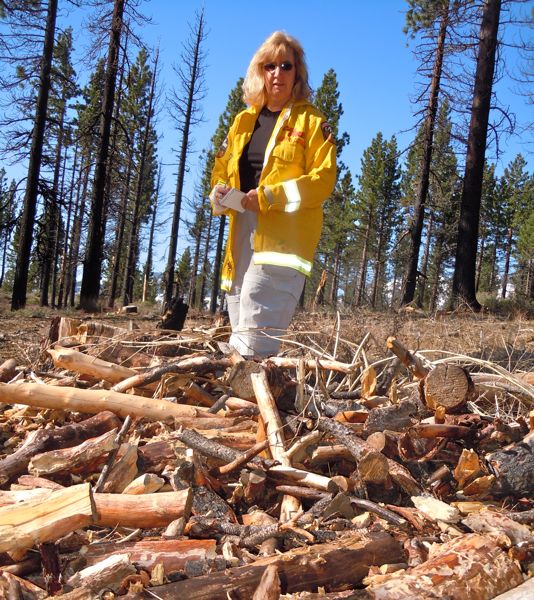
Susan Wood was the first reporter on the scene of the Angora Fire on June 24, 2007. Photo/LTN
My colleague lost his home, but found his black cat, which returned days later to the burned-out fireplace hearth.
Randy Peshon, Norma Sprague, Keith Cooney, Solange Schwalbe, John and Louise Simon — so many stories like these with names we know were shared for days, weeks, months and years after the Angora Fire, which consumed 254 homes, caused more than $160 million in damage and consequently prompted swift changes to stringent environmental regulations and cooperative emergency communication systems. (No local radio reports came over the airwaves, and calls from Lake Tahoe Golf Course were quickly dismissed by the California Highway Patrol dispatch center in Truckee as a “control burn”.)
The hope is we’ve learned a lot from the experience. (Hence, a first-of-its-kind study examining the communication, prevention and recovery of wildfires is being drafted by the University of Colorado. Read about it June 17 as this writer took part in the study’s questionnaire.)
The aftermath resembled ‘the last days’
After a near sleepless, emotionally draining night, I returned Monday morning to what seemed like the scene of a crime. As I drove up Lake Tahoe Boulevard to North Upper Truckee, power lines were down. Ash filled the air and blanketed the ground. A few people were out sifting through debris. So many sites were simply marked by a fireplace or burned out vehicle. I talked to homeowners, but felt as though I wanted to back off and just take it all in. The scene was nothing short of devastating. The neighborhood was gone.
How would we recover? Would the fire take more with it as it mowed through Gardner Mountain and threatened South Tahoe High School structures before making its way down to Highway 89?
Placing priority on home
Tuesday was marked as yet another day of picking up the pieces of our community and writing about it. I was emotionally drawn to the point of the fire’s origin and arranged a special visit with the Forest Service’s law enforcement team. I stood motionless and quiet at the illegal fire site near Seneca Pond – a favorite party spot for teens — with utter amazement as I was told how the fire from Saturday night had sparked up and was carried in the wind the next day. My thought was: Whoever did this would have to live with themselves and could they?
That afternoon I was tested as the scanner in the busy newsroom erupted again. A backfire jumped Highway 89 and landed in the West Way area. I gulped to think of the inadequate Lukins Water system serving that area. Evacuations in a heavily populated area leading into Tahoe Keys were under way. I had to get home to evacuate. I live outside the Keys.
Getting home was much of the adventure that afternoon as motorists found plenty of curbs, fences and easements to roll over in their haste. Tahoe Keys Boulevard resembled a parking lot as yet another round of panicked residents felt displaced. Surely, an emergency evacuation plan was in order for an area I later learned was deemed in the red as an extreme fire hazard, according to the California fire marshal’s office. (To this day, there is no designated evacuation route for the South Shore. It depends on the emergency.)
You know what people ask: What would you take if you had to evacuate in a matter of minutes? The answer for me was clear: Things I couldn’t replace. Bailey, our black Labrador, went into my truck camper bed first. She was later surrounded by documents, photo albums and even the Olympic torch that I carried on Sierra Boulevard in 2002. I threw in camping gear to be mobile. But which bicycle was a more perplexing question.
There’s indeed a psychological benefit to watering down your house, fence and trees with a garden hose waiting for a fire to arrive, but that’s about it. You can bet a fire of this magnitude would dry out whatever I doused as it forced me out, and I knew this.
I remember being ever so thankful that my neighbor John Poell is a very skilled firefighter with Lake Valley Fire. He fought it at the highway before that danger was diminished.
Frayed nerves — that’s how I would describe my community’s initial reaction in the first few weeks of the most significant disaster on the South Shore of Lake Tahoe. After the fire was mopped up, community meetings showed angst, anger and concern.
Still, even in the face of trying to find those responsible, working through insurance plans, dealing with survivor’s guilt, clearing debris and avoiding unscrupulous contractors, the community pulled together with donations, moral support and even a bistate Blue Ribbon Commission headed by then Republican California and Nevada Govs. Arnold Schwarzenegger and Jim Gibbons tasked with making constructive changes to handling fire fuel reductions in the basin.
As part of a small effort to clear our hearts and minds, a makeshift parade was organized to celebrate the living spirit of our town.
For me, the catharsis of the disaster was encapsulated by a visit down Coyote Ridge with Tribune colleague John Simon and his wife, Louise, a longtime teacher with Lake Tahoe Unified School District.
I drove the two of them beyond the police barricade days after the fire, so they could see their home. As they surveyed the wreckage of their completely destroyed home, they found solace in little items and minor things that survived. I’d never see John cry. But in such a brave, cleansing act, he felt OK to embrace Louise in front of me and sob like a baby. I wrapped my arms around both of them, and tears came streaming down my face. They were looking for her wedding ring (which later was miraculously found).
I wished my tears could have drowned this fire. I sobbed thinking of so many displaced, scared and without essentials. I had held it together until then. There was so much to grieve and little time to allow for it. One of my nephews had also died on that fateful day.
You can bet I won’t forget it.
Series of dinners at Sugar Bowl benefit various nonprofits
Sugar Bowl’s Lake Mary Cabin Dinner Series returns to Donner Summit this summer featuring Chef Alan Davis’ French-inspired California cuisine.
Dining will be offered most Saturday and Sunday evenings from July 22-Sept. 16, with seating offered from 5:30 to 9pm.
In addition, each Sunday evening will showcase a different local nonprofit partner from the Truckee-Tahoe community, with a portion of the evening’s proceeds benefiting that cause.
This summer’s Lake Mary Cabin Dinner Series dates:
July 22 Benefiting Donner Summit Historical Society
July 29 Benefiting Young Life
Aug. 12 Benefiting Truckee Trails Foundation
Aug. 19 Benefiting the Tahoe Institute for Natural Science
Aug 26 Benefiting the Truckee Donner Land Trust
Sept. 2 Benefiting Donner Summit Area Association
Sept. 16 Benefiting the Tahoe Forest Health System Foundation.
Every evening is open to the public, and reservations, strongly recommended by calling (530) 426.7002.