Science institute for high school students accepting applications

High school students interested in science have until Jan. 4 to apply for the Youth Science Institute program.

This afterschool program is offered on Wednesdays from 4-6pm at the Tahoe Center for Environmental Sciences in Incline Village beginning Jan. 30 and running through May 22.

UC Davis Tahoe Environmental Research Center and Space Science for Schools will be hosting the seventh annual Youth Science Institute. This 16-week program is for high school students in grades 9 through 11 who have an interest in exploring different scientific disciplines. Students will conduct science experiments and activities including stream monitoring, fish dissection, earth science geology hikes, astrobiology, biochemistry, green building demonstrations, lake science on the UC Davis Research Vessel John Le Conte and more.

Students will also receive opportunities for paid internships, fulfill community service hours, and receive letters of recommendation.

Eligible students must have a minimum GPA of 3.0, and have a commitment to the program. All applicants will go through an interview process and accepted students will need to pay tuition of $250.

Send applications or any questions to Kylee Wilkins at knwilkins@ucdavis.edu or (775) 881.7560, ext. 7474.

Additional details and the application are available online.


Tahoe Tails — Adoptable Pets in South Lake Tahoe

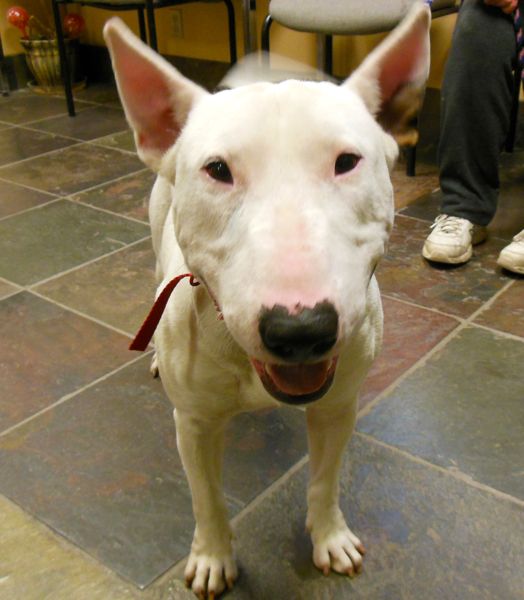
Jupiter is a pure bred bull terrier with all the fun and challenges that breed provides.

He is about 3-years-old and is house trained. Jupiter likes to play with other dogs and would like to meet any that are already in your family. He has lived with children and cats.

Bull terriers are fun, comical, people-loving dogs, and have lots of energy. They can be a bit independent and stubborn, and the shelter suggests that potential adopters research their personality traits before considering adopting Jupiter.

Jupiter is neutered, microchipped, and vaccinated. He is at the El Dorado County Animal Services shelter in Meyers, along with many other dogs and cats who are waiting for their new homes. Go online to see photos and description of all pets at the shelter.

Call (530) 573.7925 for directions, hours, and other information on adopting a pet.

For spay-neuter assistance for South Tahoe residents, go online.

— Karen Kuentz


South Shore behavioral therapist helps resolve issues with 4-legged family members

By Kathryn Reed

Ignore her. Don’t look her in the eye. And, here, put these treats in your pocket.

That’s what we are supposed to tell everyone who comes over.

With a desire to keep dogs in their homes, especially rescue dogs, Karin Schuller is all about making canines comfortable in their new homes, with their new people, and with whomever enters the house.

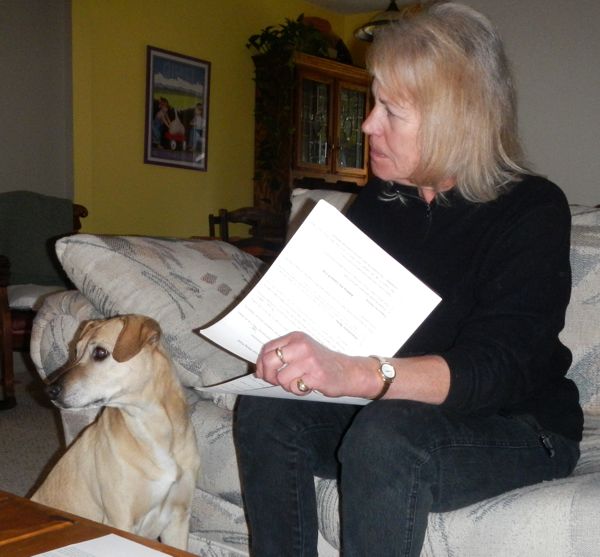
Karin Schuller goes over homework with AJ’s people. Photo/Kathryn Reed

It doesn’t take Schuller long to figure out this dog is a bit nervous and overprotective of her people. AJ had been super protective of Joy – especially the last year of her life – so it’s not a surprise she is protective of Sue and me.

And it doesn’t take long for Schuller to see why she has been summoned. Sue is on the floor and Schuller reaches down to get the paperwork. AJ doesn’t like this and makes it known.

If only dogs could talk – tell us what is going on, what they’re thinking, why they feel threatened by an innocent gesture.

Well, that’s not going to happen. And that’s why we decided to enlist help to figure out how to make our new family member more secure. Joy rescued AJ – so there is a period of her life that is a mystery. The 9-year-old is part yellow Lab, part greyhound, and other stuff.

I’ve known AJ for several years. Honestly, she is so incredibly sweet and loving. But she has some attitude.

Schuller’s business is aptly named – Dogs with Issues.

“Female dogs are a lot more bossy,” Schuller says. But she adds, “Old dogs can learn new tricks.”

Schuller has been working with dogs for years, having worked for two veterinarians when she lived in San Diego and one in Zephyr Cove. She had her certificate to be a veterinarian technician and has taken classes in animal behavior.

Personal experience has also taught her what works. Schuller has rescued 70 dogs, worked with a malamute rescue association, and had a team of them when she lived at Fallen Leaf Lake.

For the past two years it’s been all about working with dogs to create a harmonious environment. Her approach is “less is more.”

“Dogs mostly live in the moment, but they do have a long memory,” Schuller said. “When people spoil or baby them too much, it can make them more aggressive.”

Schuller works on making the people have control. She gives us homework. We sign an agreement that says without working on the training daily, we will have failed – not AJ, not Schuller.

We’ve added the phrase “leave it” to our vocabulary. Schuller says there are at least a hundred ways to use it.

We are starting with just a couple. More will come on future visits from Schuller. Next time we’ll all go for a walk together.

We learn that it’s best to have AJ outside (or in a room if the weather is not ideal) when people first come over so the commotion at the door is eliminated. She doesn’t know someone hugging us hello isn’t hurting us.

It’s amazing how much information Schuller gives us in a little more than an hour. She leaves handouts to reinforce the lessons we’ve learned.

Now it’s time to get back to training.

Tips from Schuller:

• People leave the house first, then the dog. Otherwise the dog is in control.

• If the treat is too big, by the time she finishes it, she will have forgotten why she was given it.

• On a leash, keep her close to your side.

• Don’t sleep with dogs. It teaches them they are equals.

• Corn-based dog foods make the animal aggressive.

• Don’t give her rawhide because it would swell in her stomach.

• Bones are bad. The splinters can cause her to bleed out.

• Don’t come over the top of the head of a dog. This is threatening; especially for dogs that have been hit.

Notes:

• Phone: (530) 577.0263

• Email: highsierramtdogs.att.net

• Facebook: search Dogs with Issues

• Schuller also works with puppies.


Be wary when shopping online

The dramatic increase in cyber shopping on the Monday following Thanksgiving has increased the number of deals available to online shoppers on Nov. 26. This is also an important time for shoppers to increase their awareness of the risks associated with shopping online.

Washoe County sheriff’s Sgt. Dennis Carry, who investigates online fraud as supervisor of the Northern Nevada Cyber Center, knows the risks of online shopping all too well.

“You can take every step to protect yourself online but consumers must understand that providing credit card information to others is always a risk,” Carry said in a statement. “The most effective way to protect yourself from fraud is to shop locally with cash or tamper proof checks.”

Carry recognizes the convenience and options of online shopping will always make it popular with consumers and encourages the public to be safe and observant with all online purchases.

Carry recommends making sure you have an up-to-date security suite (firewall, anti-virus and anti-spyware) installed with the most current information before shopping online. Also, keep your operating system and Web browser up-to-date.

Before entering personal and financial information for an online transaction, look for signs that the site is secure. This includes a closed padlock on your Web browser’s address bar or a URL address that begins with shttp or https. This indicates the purchase is encrypted or secured. Never use unsecured wireless networks to make an online purchase.

Before providing personal or financial information, check the website’s privacy policy. Make sure you understand how your information will be stored and used.

If you’re using wireless Internet, make sure it’s secured and not left open for just anyone. Use caution when using free Internet at a hotspot as you have no control over who might be intercepting your passwords and account information.

Print and save records of your online transactions, including the product description, price, online receipt, terms of the sale, and copies of any email exchange with the seller. Read your credit card statements as soon as you get them to make sure there are no unauthorized charges. If there is a discrepancy, report it immediately.

Never send cash through the mail or use a money-wiring service because you’ll have no recourse if something goes wrong.


Asian-themed children’s books cross cultural lines

By Kathryn Reed

When I read the promotional material about Eileen Wacker’s children’s books, I expected the books to have a heavy Asian feel that might not cross all cultural borders. I expected these to be geared toward Asian kids. Though, at the same time, I have no idea what an Asian-centric book looks or reads like.

After all, Wacker wrote, “Asian cultures take immense pride in their customs and traditions. The characters in the books represent this in a way that strives to honor those traditions and share the wonder of Asian culture with children everywhere.”

Reading the four books (story lines for eight more have been created) led me at first to wonder what was so “Asian” about these books. Then I had to take a step back and laugh. I realized if I had read these books as a kid (they are geared toward preschool through first grade), that I might not have connected with them. But in today’s more ethnically diverse world, at least reading them as an adult, I wasn’t thrown by sushi eating penguins to Taekwondo practicing bunnies.

And, really, with pandas in the storyline, I probably would have been all over these books as a kid because to this day I have a thing for pandas.

I’m sure as a Caucasian I don’t see the “white” storyline through so much of literature – whether it’s children’s stories or adult books. I’m sure it also helps that growing up in the Bay Area and going to a university where I was a minority helped make me a bit more colorblind.

I can only see good coming from books like Wacker’s that go beyond the stereotypical Caucasian influence to deliver messages. And as with any good children’s book, there are messages for youngsters – like lying is bad – even if kids can’t articulate the underlying theme.

“Fujimini Island is home to a cast of fun and silly animal groups, each of which reflects a different Asian inspiration,” is how the promotional material describes the books.

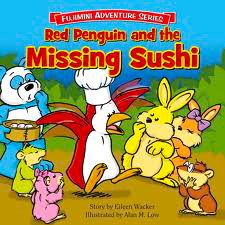
I would recommend all four – “Green Hamster and the Quest for Fun”, “Red Penguin and the Missing Sushi”, “Silent Samurai and the Magnificent Rescue”, and “Pink Hamster and the Big Birthday Sunrise”.


A bit of history about how Black Friday came to be

By John Tozzi, Bloomberg Businessweek

A century ago “Black Friday” referred to the market crash of Sept. 24, 1869, which was caused by two financiers’ failed attempt to corner the gold market. Today we know Black Friday as the country’s busiest shopping day, falling right after Thanksgiving. How did that happen?

One popular but false explanation is that the name marks the day retailers end an 11-month stretch of red ink and harvest profits for the first time all year. Others say it refers to the dark day thousands of retail workers will spend greeting shoppers, stocking shelves, folding garments and ringing registers.

In fact, factory owners in the 1950s coined Black Friday to lament the high number of workers who didn’t show up for work, as linguist Ben Zimmer pointed out last year. The connection between Black Friday, crowds and shopping came in the early 1960s from some Philadelphia cops, he explained. They used the phrase to describe the mad traffic downtown on the day holiday shoppers converged with football fans arriving for the Army-Navy game, traditionally played in Philly on the Saturday after Thanksgiving.

The name Black Friday, picked up by the press, presented a branding problem from the start. Zimmer quotes a 1961 story from Public Relations News that called the label “hardly a stimulus for good business,” and notes city spinmeister Abe Rosen’s efforts to replace it with the anodyne “Big Friday.” The Philadelphia newspapers refused, and Black Friday stuck.

It’s not exactly clear when, in the decades since, retailers across the country embraced the name. By the time they did, it came with the reassuring myth that Black Friday was the day they turned a profit to be “in the black.” (A quick look at retailers’ quarterly earnings should put that canard to rest.) The retail industry shed any queasiness it had about the Black Friday brand in recent years, as big-box stores and shopping malls embraced “doorbuster” sales that got shoppers to line up for discounts before opening time.

Although Black Friday has long been called the busiest shopping day of the year, that’s only become true in the past decade, according to data from retail analyst ShopperTrak. Before 2004, holiday shopping generally peaked on the Saturday before Christmas, the International Council of Shopping Centers reported. But after enough years of retailers and reporters and shoppers repeating that Black Friday was the busiest day, the myth eventually became true.

More recently, the hoopla has spread throughout the week. Cyber Monday was invented in 2005 by the National Retail Federation’s digital division in an attempt to promote online shopping when office workers get back to their desks after the holiday; it was not the highest-volume day for e-commerce sales. In 2010, American Express made up Small Business Saturday, with promotions and rebates aimed at getting gift seekers to swipe their AmEx cards at local merchants’ shops. Note to retailers: Three days of Thanksgiving week remain unbranded. Or four, if Thanksgiving itself is not off limits.

And, of course, it’s not. Black Friday has been creeping earlier, from dawn to midnight to Thursday evening. Walmart opened its doors on Thanksgiving Day at 8pm this year, two hours earlier than last year. Perhaps the earlier hour is an attempt to avoid the sometimes unruly crowds that door-buster sales attract. Last year, a Walmart shopper in Southern California reportedly pepper-sprayed fellow customers to reach coveted merchandise. But even that’s not Black Friday’s darkest moment: In 2008, Jdimytai Damour, a 34-year-old Queens man who took a seasonal job at a Walmart in Valley Stream, N.Y, was killed when a predawn Black Friday mob broke the glass doors and trampled him to death.

Long before such deadly excess, some activists seized the symbolism of Black Friday to make people think twice about consumer culture. Since the 1990s, the day after Thanksgiving has also been dubbed Buy Nothing Day, an idea championed by Adbusters magazine and, lately, the Occupy movement. The thought of getting masses of consumers to stay home on what has become the biggest shopping day of the year may sound like a pipe dream. But Black Friday only holds its current place in our culture through miracles of marketing, spin and rebranding. Those celebrating Buy Nothing Day, at least, don’t have to explain the name.


Tips for how to keep the holiday pounds off

By Mandy Kendall

So, another Thanksgiving has come and gone but there may be more than turkey leftovers. It is estimated that the average person will eat at least twice their usual calorie intake on Thanksgiving, gaining about 1 pound in extra weight. Although that might not sound like very much, unfortunately we generally never tend to lose that pound and year after year they all add up.

Christmas is still more than a month away, but the supermarkets and commercials will do their best to make us feel like we are already headlong into the next holiday season. We will be constantly tempted by beautifully packaged foods and candies, so it could be easy to get carried away and let the holiday spirit encourage us to indulge more than we should over the next few days, or weeks, with leftovers and all the holiday fare stocking the shelves and enticing us.

Mandy Kendall

So, here are some Qwik-e tips to help reduce the gains.

Recruit some help — Ask friends and family to support you in your quest to eat healthily over the holidays by not bringing you tempting food or party dishes.

Avoid white carbs as much as possible — Refined white flour, that tends to make up the majority of white carbohydrate type foods like bread and pasta, etc., tends to have more calories than nutrition. Instead, aim for most of your plate to contain mostly nutrition-dense foods. (Pretty much any food that has not been processed in any way.)

Hydrate — Thirst is often mistaken for hunger, so drink some water before reaching for a snack. A large glass of water a few minutes before a meal will also help you not overeat.

Rehydrate — Our systems may well have leftovers of their own, including unhealthily high salt levels from holiday indulgences. Flushing the body with plenty of water will help counterbalance the remnants of salt left in our system. (And don’t forget that high levels of salt can cause water retention; making you feel bloated.) Alcohol levels may well have been exceeded, too, so give your liver a rest and have a few days without alcohol.

Cleanse — After the carb, fat and sugar overload, your body might be in need of something a little lighter. Try a few days of vegetables, fruits and maybe a few whole grains to help clean your system out.

Keep on track — Let’s face it, we are all likely to have overindulged at least a little over the holiday season. Don’t beat yourself up. You’re only human after all. Just get back on track and plan to keep up with good healthy habits even during the holiday season. You don’t have to wait until Jan. 1 to get that new gym membership or start a new healthy regime. Make a deal with a buddy to hold each other accountable and have some fun keeping in shape.

Until the next time … wishing you all happy and healthy holidays.

Mandy Kendall operates Health Connective in South Lake Tahoe, which aligns wellness seekers with their ideal wellness provider. If you have questions, would like some advice, or would like to request some Qwik-e tips on any health and well-being topic, drop her an email at connect@healthconnective.com or keep an eye out on Lake Tahoe News for regular Qwik-e tips on how to make healthy changes one Quick and Easy step at a time.


Historic railway captures holiday spirit

By Anne Knowles, Northern Nevada Business Weekly

Candy canes have proven to be a sweet dessert for the V&T.

With its main tourism season over, the Virginia & Truckee Railroad Co. moves into holiday events such as its Christmas-themed ride starting this week as well group trips for businesses, nonprofits and families.

“Our main business to keep the doors open is our summertime excursion trains,” says Tom Gray, who with his 91-year-old father Robert, owns the historic steam engine line.

But a secondary revenue stream, especially during the colder months, is provided by specialty routes such as the Candy Cane Express, where elves serve hot chocolate and deliver letters to Santa. Another popular trip is the Polar Express, based on the children’s movie, in which parents and kids board one of three evening trains in their pajamas for an hour-long ride from Carson City to the North Pole. “This is our second season and it’s sold out,” says Gray. Group rentals for fundraisers, wine tasting, tourism promotion, weddings and other corporate or personal events make up a third stream of revenue. The rail line is often used by the Nevada Commission on Tourism, which has found Virginia City’s old west authenticity to be a major draw to visitors.

“We had Chinese travel writers who wanted to see the West, specifically Las Vegas and the Grand Canyon,” says Gray, who served a Chinese meal on the train and stopped for photos with gunfighters and wild horses. “This was six years ago and it was then hard to tell what the Chinese knew about the United States, but they loved the gunfighters, the west. They did exit surveys of the Chinese visitors and Virginia City ranked as high as the Grand Canyon.”

The V&T, for example, has hosted events for AAA to help its managers better recommend the area to customers, NV Energy is showing appreciation to employees who volunteered with the United Way and as a prize auctioned off for PBS fund raiser, says Gray. A few of the railroad’s seven passenger cars have been used as backdrops for calendars produced by motorcycle makers Harley Davidson and Yamaha as well for movies including “Water for Elephants.”

The Candy Cane Express runs Nov. 23 and 24, Dec. 1-2 and 8-9, at the F Street Station in Virginia City at noon and 2pm.


Study: Teens taking steroids to turn fat into muscle

By Nancy Shute, NPR

Six percent of teenagers say they’ve used steroid drugs in the past year, according to a study in the journal Pediatrics.

Many teens aspire to have lean bodies and big muscles, like the professional athletes they so admire. But they don’t always want (or know how) to sweat to get them. A new study finds a surprisingly high number of teens have used steroids to try to slim down and bulk up.

Six percent of teenagers say they’ve used steroid drugs in the past year, which is a lot higher than the 1.1 percent reported in a 2011 survey.

And it’s not just boys who are trying to bulk up. Girls say they are using steroids, too, although they’re using the illegal drugs less often than boys, according to researchers at the University of Minnesota and Columbia University.

They surveyed 2,793 middle and high schoolers in the Minneapolis area in 2009 and 2010. Their results appear this week in the journal Pediatrics.

The students were most likely to have used steroids if they were on a sports team, particularly if it involved a weight-conscious sport like gymnastics or ballet.

But perhaps the biggest surprise is that a lot of the kids trying to bulk up weren’t necessarily jocks – they were overweight or obese. And they were’t just trying steroids. About one-third of the teenagers said they’ve tried protein powders and shakes, perhaps thinking (incorrectly) the products alone can transform fat into muscle. Overweight girls were especially likely to try that.

It’s an interesting finding, especially given how many teens have weight issues these days: The number of overweight kids and adolescents in the U.S. has almost tripled since the 1980s.

Teens of Asian ancestry were also more likely to turn to steroids than Caucasians. The study authors said their 6 percent number might be higher because about 20 percent of the study participants were Asian.

Steroids pose a big health risk for teenagers, because they can permanently stunt growth. They also cause health problems like severe acne and jaundice.

The good news is most of the teenagers did also try the two proven, and healthy, ways to build muscle. They exercised more, and changed their eating habits.

Both parents and pediatricians need to be aware that teenagers may consider steroids a legitimate way to gain muscle. Encouraging them to be active would be great, the authors conclude, but only if they “focus on skill development, fitness, and general health rather than development of a muscular appearance.”


Online hotel reviews may not reflect the whole truth

By Hugo Martín, Los Angeles Times

If you choose a hotel based on glowing online comments — “OMG, I love this place!” — you may be relying on bogus or insufficient information.

That assessment came from Market Metrix, a San Francisco Bay Area hotel market research company, in a study that found as much as 40 percent of reviews could be made up or even paid for by the hotels.

And even if those online comments are genuine, the study said the reviews could be skewed because hotel guests with bad experiences are three times more likely to write a review than those who had a good or neutral experience.

The study also argued that young people are overrepresented in online reviews. Only 20 percent of adults older than 50 submit such reviews, according to a survey by the Pew Research Center.

“There is a big segment that doesn’t play in that area,” said Jonathan Barsky, co-founder and chief research officer for Market Metrix.

But Market Metrix may be biased on the subject. The company is in the business of offering hotels what it says is a better way to gauge guest sentiments: guest surveys.

Last week TripAdvisor, one of the world’s largest travel websites, defended the value of online reviews with a survey that found 98 percent of those questioned said TripAdvisor hotel reviews accurately reflected their experience. The study was conducted by PhoCusWright.

The survey of 2,739 visitors to the website also found that 74 percent said they write reviews, not to critique, but to share good experiences with other travelers.