Lack of oxygen in Lake Tahoe could adversely affect people who have heart conditions

By Kathryn Reed

Living at higher elevations has health benefits and drawbacks.

Thin air means an increase in red blood cells, which is one reason athletes like to train at high altitudes. They tend to perform better when they return to sea level. But mountain sickness hits some who gain too much elevation or do so too fast. Then there is the issue with the inability to get enough oxygen.

David Young with Barton Cardiology spoke before a crowd of more than 80 people Wednesday night at Lake Tahoe Community College about issues of the heart when it comes to living at 6,200 feet and higher.

The South Lake Tahoe doctor said he started seeing signs of sleep apnea with many of his patients. But these weren’t overweight people who would be more prone to that condition. These were fit Tahoe-ites.

David Young with Barton Cardiology talks Feb. 6 about how sleep apnea affects the heart. Photo/Kathryn Reed

“Clearly there was something happening to their respiration at night,” Young said.

Signs of central sleep apnea include:

• Restless sleep

• Poor concentration

• Nocturnal angina

• Frequent urination at night

• Awakening with sensation of gasping-choking

• Mood swings.

Not getting adequate oxygen can affect people who have a heart condition. People with severe sleep apnea are nearly three times more likely to have hypertension, Young said.

“Treatment of sleep apnea abolishes bradyeardia and asystole,” Young said. These are two types of heart conditions.

Atrial fibrillation is the most common malfunction with the heart. Between 32 and 82 percent with it also have sleep apnea.

“There’s a high rate in particular with what we see in Lake Tahoe,” Young said. “If I don’t correct the apnea, there is an 82 percent likely recurrence of the atrial fibrillation.”

He went on to say, “Sleep apnea is present in 76 percent of the patients with heart failure.”

It used to be that overnight sleep studies were the only way to deal with sleep apnea. Now people can use at-home monitors that are strapped to a finger and include being hooked to oxygen.

Young said the sure-fire ways to stay healthy living at higher elevations are to not be overweight, don’t smoke because that puts even more stress on the lungs, stay hydrated, limit alcohol and caffeine intake, and get a CalStar membership just in case.

—-

Note: Young will be repeating this lecture Feb. 13 at Sierra Nevada College in Incline from 6-7pm.


What happens to your virtual things when you die?

By Katy Steinmetz, Time

Consumers are spending an unprecedented amount buying things they will never actually touch. Shoppers shelled out an estimated $4.5 billion last year for e-books and billions more for music, movies and other stuff that exists only on a computer or in the cloud. The benefits of this digital shift are enormous, but so are the unanswered questions. Among the biggest: As more of the things you buy, make and cherish cease to be tangible, what happens to them all when you die?

It’s a problem lawmakers are just beginning to deal with–and one that grows in urgency as we move more and more of our lives into the digital realm. There’s money at stake: a dedicated iTunes user could easily amass a collection worth $5,000. But there are sentimental concerns too. By one estimate, nearly 600,000 U.S. Facebook users died last year, yet the rules governing what happens to all their photos, notes, messages, videos and other digital memories are muddled.

In legal parlance, our e-things are called digital assets. Problems arise when beliefs about what we or our survivors should be able to do with digital assets conflict with terms of service agreements, those novella-length contracts everyone approves and no one reads. Providers like Yahoo and Amazon often state that accounts are nontransferable or that what you “buy” is not technically sold to you, just licensed for your personal use.

Legislators are trying to bring some clarity to the high-tech confusion. Five states have laws intended to give executors easier access to certain digital assets, and lawmakers are crafting similar bills around the country. Companies like Facebook, wary of violating users’ privacy even after they’re gone, have resisted calls to release content. In Massachusetts, Google lobbied against a digital-assets bill. The matter may have to be settled in court. “The first big case on this issue will be a very interesting one,” says attorney Katie Zulkoski, who worked on a digital-assets bill in Nebraska. “It’s really unclear, and someone will test it.”

In the meantime, the prospect of leaving your virtual goods to the grandkids remains a tricky proposition. “We won’t ever own digital assets in the way we own tangible ones,” says Rutgers law professor Greg Lastowka. User, beware.


Childhood scare with power line in Tahoe leaves scars, changes electric company’s policy

By Kathryn Reed

South Shore children had to die and become severely burned before the utility company would take responsibility for cutting back trees near power lines.

It was on Sept. 29, 1969, when 9-year-old Dan Cook was climbing trees with his 7-year-old sister near their Echo View Estates home that he nearly died after becoming entangled in the electrical wires.

“We sued Sierra (Pacific) Power. If you see trees trimmed by power people, that is why,” his mother, Bea Cook said. The Cooks were one of three families to sue the electric company.

The power company is responsible for tree trimming.

In less than a decade in that era, five children were singed to varying degrees by power lines. Two died and three lived.

Dan had grabbed onto a 14,000-volt power line. It was the main source of power coming through the area near Sawmill Road. Kids would play in the sand pits in the area – with climbing trees one of the main activities.

“A neighbor boy came up and said Dan’s leg was smoking and he was hanging 30 feet in air,” Cook recalled.

This is Burn Awareness Week and Shriners Hospitals for Children is putting on a yearlong education campaign.

It wasn’t until 1997 that the Shriners burn center in Sacramento opened.

Dan Cook spent almost two months at Barton Memorial Hospital. He had two surgeries before being released in time for Thanksgiving in 1969. From his right hand that had touched the wire, the burn crossed his body, leaving third-degree burns on his upper left side that went down to his ankle.

His mom has wonderful things to say about Barton. (Bea and Bruce Cook still live here, while Dan, his wife, and their children are in Florida.)

But about a year after the incident three more surgeries were required. This time at St. Mary’s Hospital in Reno.

Not much has changed since the 1960s because Barton sends patients with severe burns to the nearest designated burn center, according to doctor Warren Withers. Patients can also be flown directly to a burn facility from the scene if first responders deem that appropriate.
The most common burns Barton sees are usually due to cooking or fireplace accidents. In 2012,
Barton’s emergency room saw 59 burn patients:
• 53 were treated and released; 12 were children
• 3 were admitted to Barton
• 3 were transferred to a designated burn center.

At age 12, it was recommended Dan go to the burn center in Texas because what was being done regionally was not working. At that time Shriners had facilities in Galveston and Boston.

“For us, Shriners is just incredible in what they do, have done and continue to do,” Cook said.

Shriners paid for mother and son to travel to Texas, put her up in a hotel for a month and performed six surgeries on the boy. Shriners provides care for children up to age 18. The treatment is free.

On the bottom floor of the Texas facility they were raising pigs for the grafting material. It was a 30-bed facility, with Dan on the reconstructive side.

Dan Cook when he got out of Barton Hospital. Photo/Provided

Using Jobst bandages for burns was new at the time. But they were too rough for Dan, so once he got home his legs were wrapped with Ace bandages to keep pressure on the skin grafts. He was also having to wear shorts to school, which some of the kids didn’t think was right. Apparently his little sister set them straight.

On the back of his left knee the doctors put in grow darts with the thinking Dan would not need more surgeries – that the grafts would grow as he did.

“He is 6-4 now and has never had another surgery because of those grow darts,” Cook told Lake Tahoe News.

Dan Cook

When the Coast Guard saw his scars they said there would be no admittance without a doctor’s clearance. Shriners obliged and the young man became a Coastie for four years.

“When I see a Shriner, I give them hug,” Cook said, knowing they made sure his son was able to live a normal life.


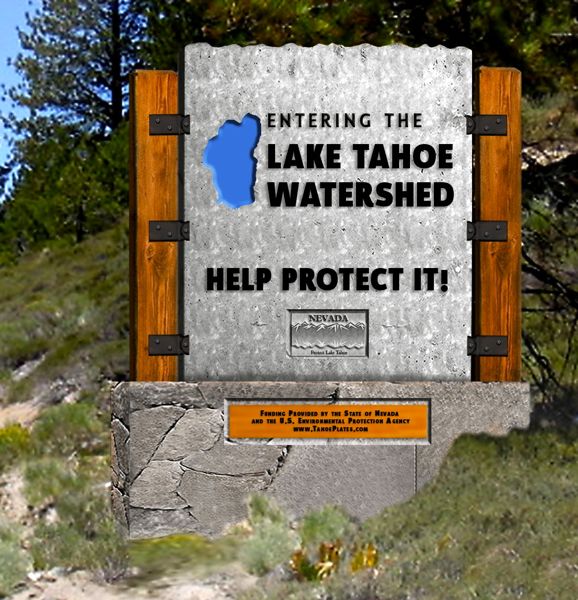
Signs welcoming people to Tahoe basin to be installed

By the end of summer there will be signs at three of the seven gateways into the Lake Tahoe Basin to let people know where the watershed boundary is.

Contractors are being sought for the project that the Tahoe Regional Planning Agency is overseeing.

This is what the signs entering the Lake Tahoe Basin are likely to look like. Rendering/Provided

“We have been awarded two grants from Nevada agencies to complete the first phase, which includes all three of the Nevada roadways. We used local designers and engineers to develop the sign design and signage plans and have the necessary permits from NDOT and building departments and are ready to begin construction this spring-summer,” Jeff Cowen, TRPA spokesman, told Lake Tahoe News.

The face of the signs will be 6 feet by 8 feet. While they won’t be made of granite, they must look like they are. There is $12,000 budgeted for each sign.

With funds from the Nevada license plate program helping pay for the signs, an image of the plates will be incorporated into the sign design.

The signs will be east of Tramway Drive on Daggett Summit, east of the Tahoe Rim Trail parking lot on Spooner Summit, and at the entrance to Incline Lakes on Mount Rose Highway.

The goal is to find funding to put signs on the California side, too.

— Lake Tahoe News staff report


Future farms in U.S. may not include much family

By Jessica Stoller-Conrad, NPR

It may sound like a line from “The Godfather”, but some agricultural specialists advise that farming isn’t personal; it’s business. And family farms need to think and act more like a business to survive in a competitive world, says Bernie Erven, professor emeritus in the department of agricultural economics at Ohio State University.

Last week, Erven spoke to farmers at the Growing Michigan Agriculture Conference about how to improve their practices to recruit, hire and keep the best employees by using modern methods, like social media.

But the message may be a tough sell. Family farms are an iconic American institution, and they make up nearly 96 percent of farms in America, according to the U.S. Department of Agriculture. And it’s hard for some folks to hear that the best hire might not be your sister’s kid who needs a summer job baling hay.

“If you hire a family member who isn’t qualified, who doesn’t fit the position, and maybe doesn’t even want the position, then it’s … unlikely the person would succeed,” Erven says. “Thus [it’s] not helping the business and not helping the family.”

If family farms don’t approach hiring in a professional way, there are some uncertainties for both the farm and its employees, he says. “[Will] they treat adding employees as a family matter or is it a business decision?” he says.

According to the 2007 USDA Census of Agriculture, U.S. farms spend a total of $21.9 billion per year employing 2.6 million hired workers. Streamlining and standardizing hiring processes on family farms could have a significant economic impact.

New outside hiring practices could even help farm families alleviate the expectations of both parents and children. “This argument that you owe it to your children to have a place for them in the farm business, I have trouble with that. Because the other side of that coin is that then your children owe it to you to stay home, even if they don’t want to,” Erven says.

Additionally, a diverse labor force can help boost the farm’s main goal: efficient food production. For example, dairy workers who have experience working with different cattle breeds may bring fresh perspectives and new techniques — additions that can improve farming practices, Erven said.

But pushing the family out of family farms can have disadvantages, too, Jennifer Fahy, communications director at Farm Aid, says in an email. “The family farm is a place where kids grow up and learn responsibility and skills … they’re also learning values and traditions,” she says.

Fahy says that the American farming workforce is aging and in desperate need of young farmers to carry on the tradition. “A major factor in young people being interested in becoming farmers is the exposure they receive on their family’s farm,” she says. “That process of farmers passing down their life’s work and traditions to the next generations is so important to the fabric of our food production system and culture.”

Farm managers might be able to find the most qualified employees outside of the family, but Fahy says that family tradition is also an important consideration. “There’s something beyond experience and skills at work when a family farmer can involve the next generation,” she says.


Outdoors writer to speak in Incline

Author Tracy Ross will be part of Sierra Nevada College’s ongoing Writers in the Woods series on Feb. 8.

Ross is an award-winning journalist and contributing editor at Backpacker magazine. She recently published a memoir “The Source of All Things”, which was chosen for inclusion in Best American Sports Writing and Best American Magazine Writing.

The 7-9pm reading is free. It will be at Sierra Nevada College’s Tahoe Center for Environmental Sciences, room 139-141.

Ross will also conduct a writing workshop (free to SNC students; $50 for community members) from 2-5pm that same day. Register online for the workshop.


Love isn’t priceless

By Tiffany Hsu, Los Angeles Times

If there was any doubt that Valentine’s Day is as much about consumption as it is about amour, consider this: Americans will shell out $20.8 billion on Feb. 14 this year.

That’s 3.2 percent more than in 2012, or $134.08 a person, according to a report from research group IBISWorld.

Much of that spending will come on conventional gifts such as candy and flowers as they weather the higher payroll taxes originating from the government’s fiscal cliff negotiations, according to IBISWorld.

“Although overall spending will increase slightly, consumers are still watching their wallets, and spending on expensive items will suffer as a consequence,” said IBISWorld analyst Lauren Setar in a statement.

Lovers will drop the most money on meals out, collectively paying out $9.9 billion – a 2.9 percent increase.

Sweets will be the next major purchase, swelling 4.3 percent to $2.9 billion in sales. Flowers will get a 5.7 percent bump.

Both categories will get a boost from Valentine’s Day falling on a weekday. More blooms will be delivered to paramours in the workplace, while students will buy candy to give to schoolmates and teachers.

Consumers will also increase spending overall on romantic getaways, lingerie, and jewelry.


Tahoe Tails — Adoptable Pets in South Lake Tahoe

Wesley is a nice 2-year-old Dachsund mix. He is a bit shy, but bonds really closely with his people. He likes other dogs, but because of his shyness he would be happiest in a house with older kids.

Wesley is house trained and very affectionate.

Wesley is neutered, microchipped, and vaccinated. He is at the El Dorado County Animal Services shelter in Meyers, along with many other dogs and cats who are waiting for their new homes.

Go online to see photos and description of all pets at the shelter.

Call (530) 573.7925 for directions, hours, and other information on adopting a pet.

For spay-neuter assistance for South Tahoe residents, go online.

— Karen Kuentz


Tahoe residents to take part in One Billion Rising

On Feb. 14, V-Day South Lake Tahoe and the Zawadisha Fund will join with activists around the world for One Billion Rising, the largest day of action in the history of V-Day, the global activist movement to end violence against women and girls.

One Billion Rising began as a call to action based on the staggering statistic that 1 in 3 women on the planet will be beaten or raped during her lifetime. With the world population at 7 billion, this adds up to more than 1 billion women and girls.

On Feb.14, V-Day’s 15th anniversary, V-Day South Lake Tahoe and the Zawadisha Fund will join activists, writers, thinkers, celebrities, and women and men across the world to express outrage, demand change, strike, dance, and rise in defiance of the injustices women suffer, demanding an end at last to violence against women.

Jen Gurecki of the Zawadisha Fund will kick off One Billion Rising by asking the people of Nairobi, “What are you doing to rise-up against violence?” As the day comes to an end in East Africa and begins in Lake Tahoe the cast of “The Vagina Monologues” will hit the streets and ask Tahoe, “What are you doing to rise-up against violence?”

Prepare for the social media blitz that will ensue as pictures hit the web via Facebook and Instagram. As each person is asked how they will rise up, we’ll snap a photo of them and their answer and include in the frenetic celebration to end violence across the globe via words, song, and dance. Follow Zawadisha and V-Day South Lake Tahoe on Facebook and Instagram and be a part of the One Billion Rising.


Obermeyer at 93 still a visionary in outerwear industry

By Suzanne S. Brown, Denver Post

He laughs. He yodels. He talks to everyone from the new kids just getting started to industry kingpins. At age 93, Klaus Obermeyer is a snow-sports veteran with no thoughts of retiring.

An estimated 19,000 people will file through the Colorado Convention Center this weekend buying and selling ski parkas and snowboards, boots and poles at the annual Snow-Sports Industries America trade show, and many of them will make a point of stopping by Sport Obermeyer’s showroom to show their respect.

While a brigade of sales reps shows the brand’s collections, Obermeyer acts as the company’s genial ambassador, greeting buyers with a hearty handshake or hug and honest interest in finding out what’s on their minds. Sometimes he’ll wear lederhosen or an embroidered shirt as a nod to his native Germany, where he learned to ski as a child in the Bavarian village of Oberstaufen.

Obermeyer’s now-legendary story goes like this: He was teaching skiing in Aspen in 1947 when he got tired of being cold during long days on the slopes. In those days, people skied in wool coats and suits. Looking for a solution, Obermeyer cut up a down comforter his mother had insisted he bring with him when he moved to America, and fashioned part of it into a crude parka.

“I looked like the Michelin Man and had feathers in my cereal for weeks,” he said with a laugh. But the jacket was warm. And one of his students paid the unheard-of sum of $250 to buy it off his back. “A new Buick was $1,250 in those days!”

Next, he had to design a better prototype and figure out how to manufacture it. Obermeyer persuaded a friend in Bavaria to do so. “But he told me I’d have to supply the zippers and knit cuffs,” Obermeyer recalled.

Sixty-five years and many innovations later, the crafty German is still in business in Aspen. The privately held company sells its men’s, women’s and children’s apparel at 600 specialty retailers in the United States and Europe, and is moving into such markets as Russia and China.

“He’s the patriarch of the industry,” said David Ingemie, who has known Obermeyer since the 1960s. Now president of SIA, Ingemie worked in a New York retail ski shop back then and remembers Obermeyer as a friendly guy who looked out for what would be good for the industry as well as his own business.

“He was funny, always smiling and yodeling,” Ingemie said.

But beyond the joviality, Obermeyer had solid plans for his company.

“He was looking long-range,” Ingemie said. “In those days there were a bunch of egotists, but Klaus wasn’t that way. He knew the importance of making the industry grow.”

Retailers today say the same thing.

“He is one of the most forward thinkers I’ve met — he’s always thinking of the retailer and what our needs are as well as his own business,” said Linda Klein, who with her husband and son owns six Willi’s Ski and Snowboard Shops in Pennsylvania and Virginia. She has known Obermeyer since 1970.

“When you have a meeting with him,” she said, “you don’t have to feed his ego. He just wants to know what he can do to make the line better and improve business.”

That simple philosophy continues to be a driving influence in the company, according to Robert Yturri, who joined Sport Obermeyer as senior vice president for product and brand management three years ago after working for such companies as Spyder and North Face.

“Klaus just wants to get all kinds of people outdoors, which is why we fit everyone from a kids size zero to adults size XX,” Yturri said.

The company is also staying current by using eco-friendly and sustainable fabrics, such as recycled polyester made from textiles and bottles, and Cocona, made from coconut shells. It has also instituted practices to be more environmentally conscious in its manufacturing processes, such as using water-based dyes.

Yturri describes Obermeyer as a big family and says Klaus often walks around the office with a basket of apples, which he hands out as he checks in with employees.

Obermeyer takes it all in stride and tries not to work so hard that he forgets to enjoy the mountains. In Aspen, he skis every winter day the weather is good, and company policy is that if it snows more than 6 inches, employees can hit the slopes in the morning and come to work later in the day. Obermeyer broke his leg in an accident on Buttermilk two years ago, but with surgery and physical therapy, he was back on the slopes the next season.

He swims in the company’s solar-heated pool and plays tennis in the summer, but skiing remains his first love. And you won’t find him on the gentle or intermediate runs.

“The steeper, the better,” he says with a hearty laugh.