Smart phones change how hotels do business

By Jessica Davies, ehotelier.com

Intercontinental Hotels Group’s mobile revenue will overtake web revenue in the next few years, according to VP of web and interactive marketing Michael Menis.

Speaking at Mobile World Congress in Barcelona Menis said the hotel group generated $40 million in mobile revenue last month, and although it accounts for a small percentage of overall revenue exponential growth in mobile revenue will see it top the hotel group’s web revenue in the next few years.

“In 2009 we booked $2 million through mobile for the year – at the time that was a really big number. Last month we generated over $40 million just for that month and I’m sure in five years we will look back and think that is small,” he said.

“It already represents 30 percent of our web traffic and we anticipate mobile will overtake web revenue in the two to three years,” he said.

The rapid evolution of mobile technology provides more opportunities for IHG to connect with its guests across their entire journey, according to Menis.

“The phone of yesterday is becoming extinct. Today’s smartphone can do almost anything. In the hotel space people expect to be able to research their hotel, check prices, check reviews, a hotel’s location, check-in and make bookings – they want to be able to do everything.

“We are exploring the role the smartphone can play within the guest journey. We must figure out the right ways to market and communicate with them via mobile and enhance the travel experience and overall customer satisfaction,” he said.

Part of its strategy to provide guests with a seamless mobile customer journey will include developing mobile check-in services. “One of the big things for us is how to bypass the front desk and enable guests to check in on mobile and go straight to their room. We are also looking at integrating in-hotel services like food and drinks and room service,” said Menis.

It is also exploring how to incorporate its loyalty schemes into its guests’ mobile experience. This includes a service it calls “micro burn” which lets customer redeem loyalty points for small purchases such as drinks they may order at a hotel bar, according to Menis.


College students teach LTUSD kids environmental lessons

By Aaron Hussmann

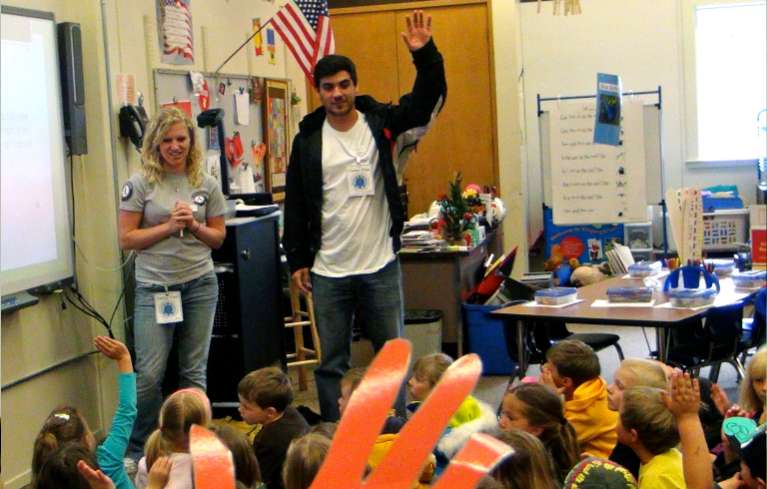
Students in Lake Tahoe Unified School District are getting a course in energy and resource efficiency this week from a group of college students who have eschewed normal spring break shenanigans to spread the word on environmentalism.

Members of the San Diego State University student group CALPIRG Energy Service Corps kicked off their alternative spring break by teaching youngsters about energy and how best to conserve it. Older children in the district got a more rigorous curriculum examining specific kinds of resource-conserving technologies and the origins and consequences of fossil fuels.

LTUSD youngsters learn about the environment from college students. Photo/Provided

LTUSD youngsters learn about the environment from college students. Photo/Provided

“This is a perfect tie-in to get them started,” Beth Quandt, science outreach coordinator for LTUSD, said while at the environmental elementary school. “We’ve been teaching environmental science education here for years and what we’ve found is that when you present to kids, they take it home to their parents. So it spreads. It’s part of the idea of the founding of this school.”

The effort is one of five trips run through the Energy Service Corps, a project of the California Public Interest Research Group — better known as CALPIRG — and AmeriCorps, a service organization that sends teams around America to complete community projects.

Ten students from San Diego State University will reach 1,700 children in LTUSD this week, teaching them how to save energy and cut down on home bills through simple swaps and practices. Those include making buildings, which account for roughly 30 percent of U.S. energy use, more efficient by making repairs to better insulate walls and windows, installing more efficient light bulbs and unplugging appliances when not in use.

That last one is a hidden power suck, which can account for between 5 and 10 percent of residential electricity used in developed countries and may account for 1 percent of global carbon dioxide emissions, according to the Lawrence Berkeley National Laboratory.

That’s because many devices — including televisions, audio receivers and even CD players — use standby energy, which means they’re constantly drawing power even when they’ve been turned off. The only way to bring their energy use to zero is to unplug. While it might not seem like much savings for all the hassle, consider this: The typical American has 40 such devices plugged in at any given time.

“Knowing now that you can save lots of money on electricity tends to inspire,” said Rafael Guerrero, a student AmeriCorps member with CALPIRG Energy Service Corps. “Numbers like that can really resonate.”

It’s important to reach children early because it’s more difficult to change those habits when they reach adulthood, she said.

The week of education kicked off at Bijou Community School and the Lake Tahoe Environmental Science Magnet School.

The Energy Service Corps volunteers will spend the rest of their time teaching classes in South Tahoe High School, Tahoe Valley Elementary, LTESMS, and Bijou. They’ll also be weatherizing local nonprofits and residences, including the League to Save Lake Tahoe and Tahoe Youth & Family Services. That process involves simple fixes that may seem overwhelming or expensive to families and nonprofits, but will, in the end, save them money on their energy bills.

Aaron Hussmann is the campus organizer for CALPIRG at San Diego State University. He was born and raised in South Lake Tahoe.


John Muir Trail subject of library talk

To kick off the new season of presentations, on April 16 at 6pm, the South Lake Tahoe Friends of the Library will present Suzanne Roberts.

Roberts is the author of the memoir “Almost Somewhere: Twenty-Eight Days on the John Muir Trail”, winner of the 2012 National Outdoor Book Award.

Learn about the John Muir Trail, told with humor, friendship and photos.

The event at the library (1000 Rufus Allen Blvd., South Lake Tahoe) is free.

There will be a reading, followed by a book signing with books available for purchase.

For more info, email Tahoe.Programs@gmail.com, or call (530) 573.3185.


Parents using electronics to muffle kids

By Nick Bilton, New York Times

I recently watched my sister perform an act of magic.

We were sitting in a restaurant, trying to have a conversation, but her children, 4-year-old Willow and 7-year-old Luca, would not stop fighting. The arguments — over a fork, or who had more water in a glass — were unrelenting.

Like a magician quieting a group of children by pulling a rabbit out of a hat, my sister reached into her purse and produced two shiny Apple iPads, handing one to each child. Suddenly, the two were quiet. Eerily so. They sat playing games and watching videos, and we continued with our conversation.

After our meal, as we stuffed the iPads back into their magic storage bag, my sister felt slightly guilty.

“I don’t want to give them the iPads at the dinner table, but if it keeps them occupied for an hour so we can eat in peace, and more importantly not disturb other people in the restaurant, I often just hand it over,” she told me. Then she asked: “Do you think it’s bad for them? I do worry that it is setting them up to think it’s OK to use electronics at the dinner table in the future.”

I did not have an answer, and although some people might have opinions, no one has a true scientific understanding of what the future might hold for a generation raised on portable screens.

“We really don’t know the full neurological effects of these technologies yet,” said Gary Small, director of the Longevity Center at UCLA, and author of “iBrain: Surviving the Technological Alteration of the Modern Mind.” “Children, like adults, vary quite a lot, and some are more sensitive than others to an abundance of screen time.”

But Small says we do know that the brain is highly sensitive to stimuli, like iPads and smartphone screens, and if people spend too much time with one technology, and less time interacting with people like parents at the dinner table, that could hinder the development of certain communications skills.

So will a child who plays with crayons at dinner rather than a coloring application on an iPad be a more socialized person?

Ozlem Ayduk, an associate professor in the Relationships and Social Cognition Lab at UC Berkeley, said children sitting at the dinner table with a print book or crayons were not as engaged with the people around them, either. “There are value-based lessons for children to talk to the people during a meal,” she said. “It’s not so much about the iPad versus nonelectronics.”

Parents who have little choice but to hand over their iPad can at least control what a child does on those devices.

A report published last week by the Millennium Cohort Study, a long-term study group in Britain that has been following 19,000 children born in 2000 and 2001, found that those who watched more than three hours of television, videos or DVDs a day had a higher chance of conduct problems, emotional symptoms and relationship problems by the time they were 7 than children who did not. The study, of a sample of 11,000 children, found that children who played video games — often age-appropriate games — for the same amount of time did not show any signs of negative behavioral changes by the same age.

Which brings us back to the dinner table with my niece and nephew. While they sat happily staring into those shiny screens, they were not engaged in any type of conversation, or staring off into space thinking, as my sister and I did as children when our parents were talking. And that is where the risks are apparent.

“Conversations with each other are the way children learn to have conversations with themselves, and learn how to be alone,” said Sherry Turkle, a professor of science, technology and society at the Massachusetts Institute of Technology, and author of the book “Alone Together: Why We Expect More From Technology and Less From Each Other.” “Learning about solitude and being alone is the bedrock of early development, and you don’t want your kids to miss out on that because you’re pacifying them with a device.”

Turkle has interviewed parents, teenagers and children about the use of gadgets during early development, and says she fears that children who do not learn real interactions, which often have flaws and imperfections, will come to know a world where perfect, shiny screens give them a false sense of intimacy without risk.

And they need to be able to think independently of a device. “They need to be able to explore their imagination. To be able to gather themselves and know who they are. So someday they can form a relationship with another person without a panic of being alone,” she said. “If you don’t teach your children to be alone, they’ll only know how to be lonely.”


‘Motherhood Out Loud’ launches Valhalla’s season

“Motherhood Out Loud” received its triumphant premiers in New York, Los Angeles and Connecticut. Now it comes to the South Shore via the Tahoe Tallac Association.

The three performances are May 9 and May 10 at 7:30pm and May 12 at 3pm.

The Mother’s Day performance includes a glass of Champagne or sparkling cider for every mom.

The play opens the Valhalla Festival of Arts and Theatre 2013 season.

Each show is at MontBleu in Stateline. Tickets are $20/adult. (This is not recommended for young children due to language.) Purchase tickets online, by phone at (530) 541.4975, at the casino box office, or at the door.


Guard takes role in Drug Store Project seriously

Publisher’s note: This is the 10th anniversary of the Drug Store Project. Today’s event at Lake Tahoe Community College is designed to teach sixth-graders that they have choices and what can happen if they choose to use drugs.

By John K. Holihan Jr.

The California National Guard’s Drug Demand Reduction Team mission is to coordinate statewide the utilization of National Guard resources and personnel in direct support of community based organizations, law enforcement agencies, and educational institutions in their illegal drug awareness and prevention efforts-programs, such as the Drug Store Project in South Lake Tahoe.

California National Guard’s DDR members act as role models, mentors, student guides, and setup and tear down crew for the Drug Store Project.

The California National Guard’s Drug Demand Reduction members are a part of the community. Our children face the same challenges that all California youth face with bullying, self-esteem and alcohol and drugs.

The California National Guard DDR has been partnering with Lisa Huard’s Drug Store Project for the past 10 years. The Tahoe program has been the model that other cities and Arizona’s National Guard’s DDR program has used to develop their own Drug Store Project.

Some of the youth who attended Tahoe’s first Drug Store Project are now volunteers who help with the Drug Store Project. They talk to the youth about how the project has impacted their life.

The students who participate in the Drug Store Project are given a pre-test and post-test to document the effect the Drug Store message and what valuable information the youth have gained. The goal is for the youth to remember what they have learned and put it into practice should they be faced with a similar situation.

With the lack of funding for drug awareness and with state budget issues, things like this are threatened in terms of potentially not being able to participate in the future.

John K. Holihan Jr. is a master sergeant with the California National Guard.


History: Looking back at South Shore of yesteryear

Publisher’s note: The following is a walk through history by South Lake Tahoe resident John Spinola.

Walk with me … Farfy’s Fundominiums, Cantina Los Tres Hombre (they had one in North Shore, too), The Cook Book, 89th St. Bar and Grill, The Egg Works (hats everywhere), Accurate TV at the Y by what used to be AAA, Marlee Crafts (both at the Y and in the Rural Squirrel building), Al’s Chevron Way, Handy Andy, Frank’s, Straw Hat, Winchell’s, Happy Steak, Tahoe Records and Tapes, Sierra Bookshop, Sports LTD (at the Y only), Lampson’s Plaza, 25 cents ice cream at Thrifty, San Francisco Deli, Nautilus, Sprouse-Reitz, Miller’s Outpost, no Blockbuster, no Staples, 50’s Drive In, Holland’s Donuts (one in Harrah’s too), Kinney Shoes, Los Aquires, Juicy’s Burgers, Tahoe Bike Shop, The Jewelry Factory, The Outdoorsman, the superslide with burlap bag and wax paper, The Cuckoo’s Nest, Long John Silver’s, Flukey’s arcade with highball, Poor Pedro’s, Hoss Hog’s, Rico’s Pizza, Max’s Market (I knew Max), Tep’s (Samurai location), Wienerschnitzel, Orophino’s, Killer Chicken (this was a garage at one time), Lake Tahoe Community College, Bayer’s Bagel Bakery (this was also a hi-fi store, shoe store and auto repair), Chapel of the Bell’s was at one time a fruit stand and record store, only one Red Hut, Whittlesea taxi, Payless/Lucky with the inside connection, The Dead Head, New York Pizza on the end of their building, main post office at Cork and More, STI (South Tahoe Intermediate), Women’s Center was a church, Tag’s Toys, Sutton and Son, Hot Dogger, Steve’s Deli, Tawny’s Naturally, The Fresh Apple, Sambo’s, Lyon’s, Pet N Co, Tahoe Savings, Swensen’s with the indoor connection to the bookshop, Shakey’s (Teps’), The Drive-In (yes kids Tahoe had a drive-in), Fantasy Inn with their “local flood rates”, Chevron and Mc D’s in different locations, Mt. High Records, Bandanas, Two Guy’s from Italy, “Lake Wildwood”, The Tiltin’ Hilton, Keno Bob’s, Crescent V Center, Lawrence’s, Monks Pizza, Greyhound Bus Station(all by itself), Bob’s Big Boy, Cecil’s Deli, Paul Kennedy’s Steakhouse, Harrah’s parking lot on the California side(Embassy), Turtle’s, Sahara Tahoe, High Sierra, Lily’s, Barney’s, Park Tahoe, The Nugget, First Draft Choice, Midnight Mine, After Dark, The Warehouse, no traffic lights at 3rd Street, Black Bart or Al Tahoe.


Workshop focuses on using LinkedIn

Business owners, entrepreneurs, employers and managers who need the tools to join the LinkedIn conversation are invited to attend Using LinkedIn and Social Media, Drive Business Leads and Potential Employees to Your Company Page on April 8 from 9am-noon at the Hampton Inn located at 11951 Highway 267 in Truckee.

The world of recruiting is changing. Prospective employees search LinkedIn by keywords too. Be prepared if you want to hire these social media savvy candidates.

At this seminar sponsored by the North Lake Tahoe and Truckee Donner Chambers of Commerce in partnership with the Sierra Human Resources Association, participants will also learn six ways to attract high-quality business leads, build relationships and earn referrals.

If your LinkedIn profile isn’t generating sales, clients or attracting employees, register by April 7 and pay safely online; at $39 for SHRM members, $49 for chamber members, $59 for non-members.

Beverages and snacks will be provided at 8:30am.

As founder and CEO of ChristineHueber.com, workshop speaker Christine Hueber has been assisting organizations to improve their marketing productivity and performance since 1997 and currently has 20,000 members in her online and offline programs worldwide.

For more information about the workshop, call Laura Moriarty of SHRA at (530) 573.0224.


Mom’s Morning Out — a day of relaxation

Moms of all ages are invited to enjoy a free morning of education, inspiration and relaxation on May 4 from 8am-12:30pm in the Commons Area at Lake Tahoe Community College.

This is the third annual Mom’s Morning Out is sponsored by Barton Health.

Beyond providing a place where moms can relax for a few hours, the event also provides opportunities to learn about the importance of taking care of themselves at all stages of their lives.

The line-up of events:

· 8:15am – Yoga, by The Studio Lake Tahoe

· 9am – Coffee and Brunch, by Blue Angel Café

· 9:30am – “What Happened to My Sweet Child?” Tracy Protell, Barton Pediatrics & Psychiatry

· 10:30am – “In-Shape Motherhood” by Kenneth Spielvogel, Barton Women’s Health

· 11:30am – “Jump Start your Day!” with KAIA Fit.

Beginning at 9am attendees will have the opportunity to browse nearly 30 booths, relax in the Zen Room and enjoy a little pampering.

For more info, call (530) 543.5537.


Strokes not limited to older adults

By Richard Knox, NPR

Most people (including a lot of doctors) think of a stroke as something that happens to old people. But the rate is increasing among those in their 50s, 40s and even younger.

In one recent 10-year period, the rate of strokes in Americans younger than 55 went up 84 percent among whites and 54 percent among blacks. One in 5 strokes now occurs in adults 20 to 55 years old — up from 1 in 8 in the mid-1990s.

These are people like Melissa McCann, a nurse in Maine who spends most days on a helicopter, accompanying sick and injured patients to a distant hospital.

McCann had a stroke at age 37. It began with a weird sensation.

“I had a very euphoric feeling,” she tells Shots. “It’s hard to explain, but everything felt very cartoonish to me. It felt very bizarre.”

Then she found she couldn’t dial the number to respond to a page. Light began to hurt her eyes. She couldn’t speak. Because she’s a nurse, she realized she was having a stroke.

“It was very scary, really,” McCann says, “because I know what could possibly happen.” She could die, as her father-in-law did, or be permanently disabled.

New data show that younger stroke survivors are at great risk of premature death. Within two decades, 1 in 5 stroke survivors will die, according to a study in the March 20 issue of the Journal of the American Medical Association. The death rate is even higher among those with the most common kind of stroke, caused by a blood clot in the brain.

Dr. Frank-Erik de Leeuw of Nijmegen Medical Center in the Netherlands, who led the study, says the results surprised the research team.

“We had the impression that [younger stroke survivors] were doing quite well,” de Leeuw tells Shots. “But now that we have followed all of them — and also the patients who didn’t show up in our outpatient clinic anymore — it turns out that their prognosis was poor. To me, it was a true surprise.”

He says it means doctors should pay a lot more attention to these patients. They should make sure their blood pressure and cholesterol are under control, and work harder to get them to lose weight and stop smoking. Increases in obesity and diabetes are thought to be factors in the rising incidence of young-adult stroke — though not the only ones.

“The risk is increased for decades after their stroke,” de Leeuw says. “So we can’t just send them back to their homes and say, ‘Well, we’ve seen you now for one or two times after your stroke — take care.’ I think that’s not possible anymore.”

His warning applies to this side of the Atlantic as well.

“It’s extremely alarming,” says Lee Schwamm, a stroke specialist at Massachusetts General Hospital. “These data suggest to me that we still have a sort of cavalier attitude toward secondary prevention — particularly among younger patients.”

Secondary prevention means preventing another stroke, heart attack or other catastrophe in someone who has survived a first one.

Schwamm says laypeople and doctors alike need to realize that young adults can suffer strokes. The new study shows that even a minor stroke, called a transient ischemic attack, or TIA, can increase later odds of an early death to 1 in 4.

“Many of the young patients who end up in my office either dismiss those symptoms themselves, or when they sought emergency medical care [they] were told that it was likely not a stroke,” Schwamm tells Shots. Often they “had only a CAT scan, which didn’t show any injury, and were sent home. So stroke is still underdiagnosed in young patients.”

By one estimate, 1 in 7 strokes in young adults is misdiagnosed.

In Melissa McCann’s case, it was clear she suffered a stroke. And fortunately the symptoms cleared pretty quickly without treatment. But doctors couldn’t find any reason for her stroke at age 37.

“I wasn’t satisfied with that response,” she says. “‘Take one aspirin a day and hope it doesn’t happen again’ is not an acceptable answer to me.”

So McCann sought out Dr. Schwamm in Boston for a second opinion.

“She came to me with a list of questions,” Schwamm remembers. “She knew what the right questions were to ask. She really wanted to understand was there a treatable, preventable cause here that could be modified so that her risk in the future would be lower.”

An ultrasound scan of her heart revealed an abnormal hole between the two upper chambers. She’d had the congenital abnormality all her life. Doctors think that eventually it allowed a blood clot to move to her brain, causing the stroke.

A surgeon repaired the hole, and she went back to work six weeks later. That was almost three years ago.

“I’m working full-time,” she says. “I have a grandson that’s 3 years old. I’m watching my youngest son go through college. Yeah, you might have to take some medications. But you can get yourself back to your normal life.”

And now that she has addressed the probable cause of her stroke, McCann hopes that life will be a long one.