Whales play to the tune of human chorus

By Robert S. Wood

BAJA, Mexico – Do whales seek human playmates?

The adventure company brochure didn’t quite claim they did, but it intriguingly reported that many a mama gray whale saw fit to bring her newborn 1 ton baby up to visit small open boats in a Mexican lagoon, even sometimes allowing the babies to be “petted.”

My wife, Deanne, and I had been in the ocean with dolphins and swam with sharks, manta rays, seals, turtles and schools of friendly toe-nibbling fish. So why not whales? We signed up.
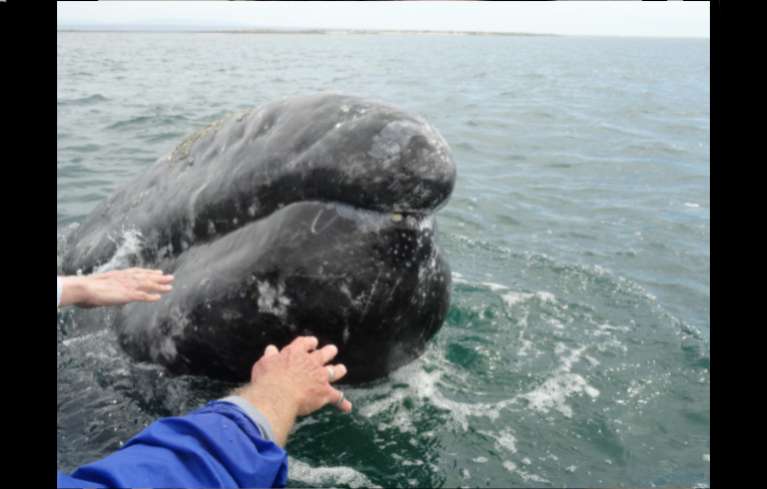
Reaching to touch whales near Baja, Mexico. Photos/Robert S. Wood

Reaching to touch whales near Baja. Photos/Robert S. Wood

After departing from San Diego, it took our old Mexican bus two days to descend the Baja peninsula of Mexico 500 miles to the salt company mining town of Guerrero Negro near Scammon’s Lagoon, halfway down Baja. The next morning we drove on roads paved with salt past evaporating salt ponds to the waiting boats. Twenty-four of us piled out of the bus, donned life jackets and climbed into two 18-foot open fishing boats called pangas, powered by big outboard motors. We then set off at high speed to look for playful whales, feeling a little silly about what we were doing.

The lagoon was nothing like I’d imagined. There wasn’t so much as a cactus in sight, never mind grass or trees, just salt, sea and gleaming white sand dunes sandwiched between blue water and sky. The glare was terrific. When we reached the whale watching grounds, the lagoon looked more like open ocean with only one distant shoreline in sight. But the whales were there – 1,600 of them had been counted the previous week, including a white whale, great-grandson of Moby. They were peacefully cruising at a respectable half-mile distance. We saw their spouts, we saw sleek black backs emerge for a few seconds when they came up for air. But the closest was probably 300 yards away. Big deal.

After two hours of bobbing, waiting and watching — our allotted viewing time almost up — some of us in frustration began to jokingly call out to them, “Come on, whaleys. Don’t be afraid. We’re your friends. We won’t bite. Look, no harpoons. Bring us your pretty babies!” We were feeling more foolish by the minute.

Then suddenly a huge black streaming back, twice the size of the boat, reared up from the deep, not 10 feet away, and looked us over. We gasped in awe. It was as big as our bus. As we gaped, the Mexican captain beside me tapped my shoulder, pointing down and said “Baby! Mama and baby.”

Not 3 feet from the boat lay the head of a 2-ton “baby” whale, also bigger than the boat.

I lunged to the rail, dropping to my knees, yelled “Baby here!” and reached out as far as I could. Incredibly, I touched smooth, soft wet whale forehead. It felt like hard wet rubber. Immediately, my 11 companions joined me at the rail, which tipped the boat alarmingly and we shipped a little water. I glanced at the captain but he just smiled and started bailing.

About half of us had touched at least once before the whales moved away and it was time to go. We rocketed back to the dock and our bus. The other boat, it turned out, had not even seen a whale up close, but its envious grumbling occupants admitted they hadn’t resorted to calling for them.

After a night in the date palm oasis of the nearby village of San Ignacio, we set forth for another lagoon favored by calving grays. This time conditions were less inviting. We rose in the chilly dark and rode the bus on a bumpy dirt road to San Ignacio Lagoon, a hundred miles south of Scammon’s. It was barely light when we reached the end of the road at a lonely shell beach. The sky was solid cloud and windy. There was no boat ramp or dock. The tide was out and there were white caps. Pangas were bobbing in the shallows a hundred yards offshore. So we rolled up our pants and waded out to the boats to begin another high-speed ride to the whales.

When we stopped, there wasn’t a whale in sight and our boat was lurching uncomfortably, so we promptly proceeded to get silly. We chanted nursery rhymes, sang songs from kindergarten, substituting whale lyrics. We rendered rounds of “Row, row, row your boat, gently down the lagoon.” We yelled, we begged, we laughed at each others puns and entreaties, we flattered and pleaded, called out endearing terms. Deanne in the bow delivered a continuous stream of melodious welcome. Even the Mexican captain, smiling at our antics, sang a whale song in Spanish.

This time we didn’t have to wait. Whales have good hearing and they quickly appeared around us. Always mamas with babies, never males. It was a clear case of, “If you call, they will come.”

Before our two hours were up, three mama whales had brought us their babies, one brought a pair. Though we couldn’t help ridiculously personifying and judging their actions and intent, it seemed clear that the mamas somehow wanted their babies to meet us, to connect, to be touched, strange as that seemed.

Though these huge creatures often touched the boat, it was never more than a gentle nudge. They could easily have turned us over or sunk us with ease, with a flick of that gigantic tail, as the whalers of yesteryear well knew when their boats were smashed to splinters. I asked the captain if that ever happened. “Nunca” (never) he assured me.

When our time was up and we returned to shore, we again found the other boat had had only one brief encounter and were even more envious, vowing that tomorrow they were going with Deanne. Someone called her the Whale Whisperer.

For our third and final voyage we returned to Scammon’s Lagoon. On the way a lively young Mexican guide named Edgar verified our growing suspicions that whales wanted to interact with us but were highly sensitive to vibes given off by boaters, dependably drawn to the happy ones.

“Otherwise, why would they come to us?” he asked, “They seem to like excited children best, then expressive women. They seem to prefer higher voices. I’ve come to believe they love open, free independent creatures like themselves. Remember, they’re wild and unspoiled, unrestrained even joyful.

“So your best chance of making contact is to be happy like them. You can attract them from far away with a simpatico frequency of happy vibrations. I find they stay away from people who are angry, rigid or unhappy. Can you blame them? I often see the mamas actually push their babies up to the boats they like. They seem to want their calves to make human contact before they leave the lagoon to begin that 4,000-mile swim to the arctic to feed. Don’t ask me why.”
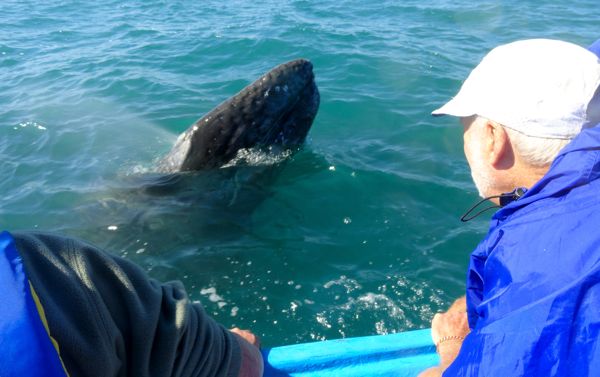
Whales come to boats -- once beckoned to do so.

Whales come to boats — once beckoned to do so.

He added, “But one thing I do know, if they didn’t want our company, you’d never see more than a distant spout. ”

Remembering that last voyage brings tears to my eyes, not just for the whales but for the wonderful group camaraderie that developed. Everyone wanted to be in the boat with Deanne who outdid herself in a continuous welcoming, loving out reach to the whales. Now that we knew how to attract them, they quickly came. Boy, did they come! We soon lost count of the numbers of touches we enjoyed. Baby whales were with us for most of our two hours.

Thirty-five ton mothers the size of locomotives swam directly at us and smoothly dove beneath the boat, missing it by inches, coming up on the other side, but we felt no anxiety. Instead we felt a wonderful sense of harmony, wellbeing, even love freely exchanged with our massive fellow creatures. Whales stood on their tails, 10 feet of their heads sticking out of water, in an amusing pose called “spyhopping,” recalling sentinel Meer cats or lookout prairie dogs. It was thrilling to make eye contact with a whale eye the size of a bowling ball.

In the course of two hours I looked down into blowholes, marveling at the workings of that intricate dinner plate sized muscle. Babies teased us by spouting in our faces. Mothers blew from just underwater, sending up gushing fountains of seawater. More than once a whale blew within 3 feet, sending rainbows of spray over us, wetting us and our cameras with an earthy smelling warm whale exhaust. But we didn’t care.

Everyone was laughing, exclaiming at the miracle taking place. We were torn between the desire to touch and rub and stroke — and taking pictures. Since whale movements were sudden and unpredictable, good pictures were rare. Before we were done I shook hands with a baby whale fluke the size of a car door, caressed soft whale lips, stroked whale backs, rubbed the rough looking but smooth rings of barnacles that already decorated the backs of two ton babies. I held my hand above a blowhole to feel the heat before it closed, all the while jabbering my appreciation of what was happening.

The whales seemed to reciprocate our glee. They seemed to be playing with us, teasing us, sometimes holding themselves 2 or 3 inches beyond our reach, as though laughing at us. I countered this gambit by reaching about 6 inches short of full extension to foil the tease, then suddenly extending to make contact, laughing when I succeeded. You could feel the mutual trust and deep enjoyment. It was a high-energy orgy of physical and emotional connection between two not so distant species. It was like playing with giant kittens or puppies. It was thrilling in ways hard to understand, much less convey. And we weren’t the only lucky ones. From a passing boat, a woman jubilantly called out, “I kissed a whale!”

Then suddenly it was time to go. We called and waved goodbye to our wild friends from the deep who promptly sank out of sight. Back in the bus for the long drive home — still high — we compared impressions. Even the most skeptical agreed the whales had indeed been playful, apparently enjoying themselves as much as we did. I found myself imagining them discussing the welcoming siren song of Deanne.

Looking back as we drove north we had come to them and reached out, and they had responded. They came to us because they wanted to, for whatever reason. Perhaps they had some dim racial memory of that distant time when they walked the land on legs and interacted with other creatures. Maybe that somehow stirred in them an urge to connect. Whatever it was, we were deeply grateful for the chance to frolic with descendents of our common ancestors, gaining a wider perspective on the kinship of life on earth.

Robert S. Wood and his wife spend half the year in Lake Tahoe and the other half in Sedona. He is the author of a dozen books, including the original trail guide to Desolation Wilderness.
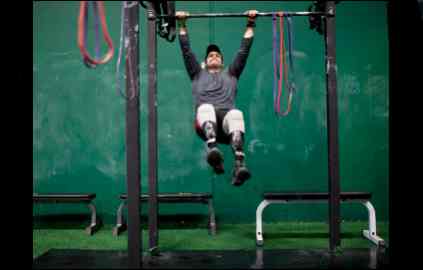



Sports, war transform artificial limbs

By James Dao, New York Times

John Kremer, a Navy explosives expert, lost both his legs below the knee after stepping on a mine in Afghanistan in 2010. In his San Diego hospital bed, he assumed he would be chained to a wheelchair for a year or more. Walking seemed a distant goal. Running? He could barely comprehend the concept anymore.

But with the encouragement of therapists at the Naval Medical Center, Kremer was walking in two months, running in five and skydiving after nine. He did his first 10-kilometer race, about six miles, one year after stepping on the mine. Today he runs, swims or bikes almost daily and competes for the Navy’s wounded warrior team in swimming, shooting, seated volleyball and wheelchair basketball.

“For me, being able to compete was a big morale boost,” said Kremer, 29, a former explosive ordnance disposal technician first class, who was medically retired from the Navy last year.

 Todd Heisler/The New York Times John Kremer, an explosives expert, lost both his legs below the knee.

John Kremer, an explosives expert, lost both his legs below the knee. Photo/Todd Heisler/New York Times

Like Kremer, more than 1,600 American service members lost limbs in Iraq or Afghanistan, mainly to homemade bombs not unlike the ones that maimed scores of people in Boston on Monday. Now, the vast body of knowledge gained from treating those troops is likely to help speed and improve the recovery of people whose limbs were amputated after Monday’s attack, experts say.

Over the past decade, prosthetic technology has advanced significantly, with computerized knees and ankles that adjust to terrain and activity. Lighter and more malleable materials have allowed amputees to wear synthetic legs longer — and even run marathons. And devices have been customized for a dizzying array of activities, from golfing and skiing to scuba diving, backpacking and even rock climbing.

Perhaps most significantly, doctors know more about treating and salvaging limbs, making recovery faster than a decade ago. Thousands of therapists have also been trained to care for wounds like those sustained in Boston. And groups that organize athletic events for disabled athletes have popped up across the country, serving both civilians and military veterans.

“What’s so great now is that there are literally thousands of trained instructors all over the country who know how to teach the disabled,” said Kirk Bauer, the executive director of Disabled Sport USA and a disabled Vietnam veteran.

“And there is state-of-the-art equipment that levels the playing field,” he said. “That’s been a revolution.”

Part of that revolution has been the view, now widely accepted, that athletic endeavor — whether competitive or recreational — helps amputees recover emotionally, psychologically and physically, even if they were not athletic before their injuries.

“It provides a sense of accomplishment and bonding,” said Richard Stieglitz, a physical therapist who is executive vice president at the Wounded Warrior Project, a nonprofit group created in 2003 to assist wounded veterans. “Very often doing something you never did before the injury is huge. It teaches people that life goes on.”

Seth D. Messinger, a University of Maryland anthropologist who has studied rehabilitation programs for the military, said training for athletics gives amputees a clear way of measuring the incremental progress of recovery.

“Rehab for traumatic limb loss is not a short thing, and patients want to know what they have to do next,” he said. “A sports model offers people a set of stages. You’ll walk between parallel bars, then walk with canes, then learn to run.”

But he and Stieglitz warned that athletics alone are not sufficient to address the less obvious problems that may accompany limb loss, like traumatic stress disorder or anxieties about employment.

“Dealing with those things could be more difficult than the amputations themselves,” Stieglitz said. “And just as they are for warriors, they may be hard to spot.”

For people not in the military, paying for care and prosthetic limbs may also be a major issue. The military provides almost unlimited therapy and multiple prostheses. Some wounded troops have three or four: one for walking, one for running, another for biking and other sports.

But private insurance, for those who have it, may limit visits to therapists and cover only a single, basic prosthetic leg. Buying an advanced device can cost more than $30,000; customizing them for various sports costs thousands more.

Still, Bauer, who lost his left leg above the knee to a grenade in Vietnam, says the world is far different from when he was injured in 1969.

Then, his first prosthetic leg was made of balsa wood with plastic laminate; today they contain carbon fiber, titanium and microprocessors. Then, orthopedic surgeons scoffed at the idea of skiing on an artificial leg. Today, his organization organizes expeditions to climb mountains and other strenuous athletic endeavors.

He has climbed Mount Kilimanjaro in Tanzania and attempted Mount McKinley in Alaska. He recently finished a grueling 26-mile hike through the desert of New Mexico and has completed marathons, including Boston’s.

“It was the greatest high in the world,” he said of finishing that race, in 2000. “This is what sports does for us, it gives us that confidence. You feel you can tackle the world.”


Loren Abbott — 1935-2013

Former Tahoe Daily Tribune Publisher Loren Abbott died April 9. He was 77.

Abbott was born in Eureka on Dec. 31, 1935.

He graduated from Humboldt State University with a bachelor’s degree in industrial arts. It was there that he met the love of his life, Shirley Samuelson. They married in 1957 and just recently celebrated their 56th wedding anniversary.

Loren Abbott

Loren Abbott

Abbott began his newspaper career at the Arcata Union at age 10. He was in the newspaper business for more than 50 years, having retired from the Tribune.

He spent most of his time at small papers, mostly owned by Swift Newspapers — Hanford Centennial, Herald Journal in Logan, Utah, Herald and News in Klamath Falls, Ore., Sierra Sun in Truckee, Greeley Tribune in Colorado and Nevada Appeal in Carson City.

His background was in advertising.

Most recently Abbott was living in Roseville, where he was a member of the Roseville Elks Club.

Abbott is survived by his wife, Shirley; his son, Loren Abbott Jr. and wife Didier of Lincoln; daughter, Lori Brown and husband Robert of Edwards, Colo.; his daughter, Lisa Smoot and husband Mike of Roseville; daughter, Leslie Coe and husband Dan of Rocklin; and several grandchildren.

A celebration of life will be April 28 at the Clubhouse at Diamond K Estates in Roseville. In lieu of flowers the family requests donations be made to the organization closest to your heart in remembrance of Abbott.


Dogs provide deputies with another tool

By Ted Long

This week’s Sheriff’s Citizens Academy was a presentation by the K-9 unit. Two K-9 officers brought their dogs and all the equipment that they use working with them. The presentation featured a demonstration of the dogs apprehending a suspect and a drug search.

The dogs were born and bred in Germany, which seems to be law enforcement’s first choice for dogs. The dog is purchased and owned by the handler and typically when the dog retires in eight to 10 years the handler is rotated out of the K-9 unit and another officer comes in.

Ted Long

Ted Long

The use of a dog is a matter to be taken seriously. The dogs are bred and trained to bite. That is to say, if the dog is let loose, he will bite you and bite you hard. There are rules and guidelines about when a dog can be used. They are motivated by the general “use of force” principles – the severity of the crime, the threat of violence by the offender and the use of alternative methods.

For example, a violent crime suspect in a building fleeing from capture would be a good opportunity to use a dog. The officer is required to give warning that the dog will be let free, prior to releasing the dog.

The question came up about language: What if the suspect does not speak English? There is no requirement to know what language the suspect might speak and the officers reported that because the dog makes so much noise prior to release it is difficult to not know what is about to happen.

The presence of the dog is a threatening experience and it is easy to see that it would be a useful tool in gaining cooperation. The dogs are often used in this manner. They can calm a situation.

There is a K-9 on duty for each shift and is often called in to back up an officer.

The dog lives with the handler who has the ultimate decision on the use of the dog. Both officers like the fact that while they have ownership and control of the dog, it has meant additional expense for them. It also has given them the rights over the dogs’ use. One got a clear sense of the handlers’ close relationship to the dogs and their genuine concern for the dogs’ well being

Like the use of a gun, use of a dog requires careful supervision and an effective review as a deterrent to abuse.

I commented on the fact that we often hear about administrative reviews of the use of shootings by police, but I have never heard of a case concerning the use of a dog. I do believe this speaks well of their use. I suspect it has a lot to do more with the relationship the officer has with the dog as compared to that of his gun.

Ted Long is a South Lake Tahoe resident participating in the El Dorado County Sheriff’s Citizens Academy.


Alcohol Awareness Month focuses on preventing teen drinking

“Help for Today. Hope for Tomorrow” is the theme of this year’s National Alcohol Awareness Month.

The April campaign encourages individuals and families to get help for alcohol-related problems and to take steps to prevent alcohol use among youth.

“Alcohol remains the drug of choice for young people and is something we are concerned about in our communities,” said Shirley White, manager of the El Dorado County Alcohol and Drug Programs, said in a press release.

According to the most recent California Healthy Kids Survey, alcohol is the most frequently used substance among youth in grades 9-12 in El Dorado County.

“Our mission is to work with youth, schools, parents and community groups to help give youth the skills and opportunities to prevent alcohol use and to choose healthy behaviors,” said White.

ADP supports numerous substance abuse prevention projects throughout the County including a local community substance abuse prevention coalition, Club Live/Friday Night Live, Police Activities League programs and Teen Court. ADP offers substance abuse educational materials, assessments and referrals to local resources.

Data from the National Council on Alcoholism and Drug Dependency show that the sooner a child starts drinking, the more likely he or she is to develop a dependency and to graduate to other drugs. Children who begin drinking before the age of 15 are five times more likely to develop alcoholism than those who start at the age of 21.

According to White, parents have a profound influence over their children’s decisions about alcohol use. “Parental attitudes and messages around alcohol use make a lasting difference in their children’s lives,” said White. “While it may be common to think of drinking as a ‘rite of passage’ for youth, it is important for parents to emphasize that underage drinking is not only illegal and but often results in dangerous and life altering consequences. Alcohol use places teens at very high risk for developing chemical dependency, being involved in motor vehicle crashes, and other serious issues such as depression and increased risk of suicide.”

These tips can help prevent teen drinking:

• Know where your children are and who they are with. Teens are less likely to get into trouble if parents are aware of what they are doing.

• Don’t allow teens to drink in your home. Coordinate with parents to make sure parties and other social events your teen attends are alcohol- and drug- free.

• Lock up liquor cabinets at home. Some kids may drink after school when adults are at work.

• Try to get your child involved in school or recreational activities, and work with other parents and community leaders to provide safe alternatives for fun in the community.

• Provide consistent rules and boundaries, and enforce them.

• Talk with your child early about the importance of making good choices, not just for you but for themselves. Help them understand that the choices they make today can affect them for the rest of their lives.

More information, call (530) 621.6146.


Artists sought to design wine poster

Soroptimist International South Lake Tahoe has opened its annual poster art contest.

Artists have until June 1 to submit original artwork.

The design must be on 11 inches by 17 inches. The theme is Tahoe and Wine Tasting.

The winning artist will receive $250, and local recognition.

The original art piece will become property of Soroptimist and will be used to advertise the 43rd Wine Tasting at Harrah’s Tahoe in November.

Entries may be dropped off at Skin & Hair, 1017 Carson St., No. 6, South Lake Tahoe.

For more info, contact Valerie Conners at (530) 544.8545 or valerieconners@yahoo.com.


Business seminar in health care reform changes

Business owners, employers, HR managers, controllers, and managers who need to move forward in addressing the issues associated with health care reform are invited to attend “Health Care Reform – What Employers Need to Know” on April 23 from 9am-noon at the Chateau at Incline Village, 955 Fairway Blvd., Incline Village.

This is an opportunity for employers to assess best-practice programs and make the decisions necessary to develop plans that work with the new requirements. At this seminar sponsored by the North Lake Tahoe and Truckee Donner Chambers of Commerce in partnership with the Sierra Human Resources Association, participants will also learn about the new reporting requirements and when they need to comply, how the new legislation interacts with state laws, and how health care reform affects their current benefit plans.

The speaker, Lauren Yurick, has been in the insurance industry since 1989. Yurick co-founded Benefit Resource Group in 2003 which services employers in both the public and private sector. She has served as local president as well as a state board member for the National Association of Insurance and Financial Advisors, and currently sits on the broker advisory committee of a local HMO in the Reno area.

Register online. It is ree for SHRM and SHRA members, $15 for chamber members, $20 for non-members. Beverages and snacks will be provided at 8:30am.

For more information about the workshop, call Laura Moriarty of SHRA at (530) 573. 0224.


Tahoe Tails — Adoptable Pets in South Lake Tahoe

Tattoo is a beautiful 7-year-old purebred dappled Dachshund who would like nothing better than to sit in your lap all day.

dogHe likes to play with other dogs and is excellent at keeping cats and other small furry things out of his yard. He also likes well-mannered children.

Tattoo is neutered, microchipped, and vaccinated. He is at the El Dorado County Animal Services shelter in Meyers, along with many other dogs and cats who are waiting for their new homes.

Go online to see photos and description of all pets at the shelter.

Call (530) 573.7925 for directions, hours, and other information on adopting a pet.

For spay-neuter assistance for South Tahoe residents, go online.

 — Karen Kuentz


Gun enthusiast embraces craftsmanship

By Thomas Curwen, Los Angeles Times

CARSON CITY — For Terry Tussey, a gun is the perfect marriage of form and function, a carefully crafted machine that can contain an explosion delivering 20,000 pounds of pressure per square inch and drive a bullet through a barrel at 1,000 feet per second.

Every spring, catch, plunger, plug, pin and cap must work for it to fire properly. Dirt, rust and abuse lead to jams, misfires and parts breaking.

This morning, he’s holding a .45-semiautomatic, popularly known as a 1911. Built in the 1970s with military surplus parts, it has a plastic opalescent grip and a slide engraved with what looks like the tendrils of a climbing rose.

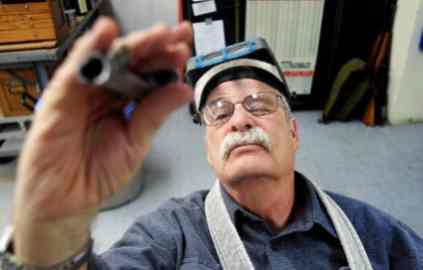
 Brian van der Brug / Los Angeles Times Gunsmith Terry Tussey checks details on a 1911 pistol barrel at his bench, March 26, 2013, in Carson City. Tussey moved to Nevada when he realized that gun legislation in California would affect his business. At 73, he is one of the most reputable gunsmiths in the West, practicing a vanishing craft.

Gunsmith Terry Tussey checks details on a 1911 pistol barrel  in Carson City. Photo/Brian van der Brug/Los Angeles Times

The design’s too garish for Tussey, but right now looks don’t matter. He drops the magazine, pulls back the slide to make sure there isn’t a cartridge in the chamber and soon has the gun in three pieces: barrel, slide and frame.

Like a puzzle cast in three dimensions, a 1911 has almost 50 parts, and each needs to fit together with a tolerance of less than a hair’s breadth. Any play leads to the inaccuracy that Tussey found at the range this morning.

The best measure of a pistol’s worth, he believes, comes at 20 yards when he tries to group five shots within the space of a nickel. This .45 didn’t come close.

He goes to his workbench and grabs a magnifying visor for a closer look.

Tussey, 73, began working with guns more than 50 years ago in Southern California and can restore or repair most any firearm brought to him. He describes himself as a gun mechanic and has a reputation for the 1911s that he builds from scratch.

“This isn’t a job,” he says. “This is who I am.”

He calls his business Tussey Custom, and it sits on the outskirts of Carson City on a road that leads to a brothel known as the Moonlite Bunnyranch and a stone marker that honors the Pony Express route that passed nearby.

Lawmakers in Washington and in state capitals across the country are arguing over gun control legislation, but at Tussey Custom, there is no debate.

Instead there is an appreciation — aesthetic, mechanical and even constitutional — for these machines that have become such an intrinsic part of American life.

A warm afternoon breeze blows through the roll-up door. Dvorak’s New World Symphony is playing as a lathe purrs through the inner circumference of a barrel bushing. Workbenches are crowded with tools, parts and yellow plastic trays holding guns in need of repair.

The front door chimes, and Tussey maneuvers his wheelchair to the office. A mountain bike accident eight years ago left him paralyzed from the chest down.

Rodney Ricks, a 56-year-old construction manager, has stopped by to pick up a 1911 that Tussey restored. A few new parts, rust and pitting sanded down, bluing added, and the gun, which dates to World War I, looks almost new.

Tussey specializes in 1911s, named for the year the Army approved the pistol as standard issue. “The best handgun ever made,” he says with the conviction car enthusiasts save for their favorite ride.

Just a few weeks ago, he finished building a new 1911 for Ricks, who placed the order last summer.

“Terry is putting out work that no one can compete with,” Ricks says. “In this day and age of instant gratification, it’s nice to have someone to put the time and effort into making something like this.”

The pistol, which cost $4,000, is made of stainless steel and has a black trigger and hammer, blued safety and slide stop, and a grip made of mastodon ivory. It gleams in the light.

Tussey builds only about four of these guns a year. The parts come from across the country: frame and slide from Vermont, trigger from California, barrel from North Carolina, hammer from Missouri and grip from Carson City. He then makes sure everything fits.

“There are guys who can make them pretty, and there are guys who can make them shoot,” Tussey says. “But there are not too many who can make them pretty and shoot.”

He is one of 61 gunsmiths registered with the American Pistolsmiths Guild. The trade group promotes the work of elite customizers, whose pistols must pass standards for accuracy and artistry established by senior members of the guild.

Enrollment in the guild has held steady through the years, says its president, Marc Morganti, but most of the members are in their 60s.

It takes time to learn the craft, he says, and it’s hard to make a living on the wages of a pistolsmith.

“It’s a sign of the times,” Morganti says. “The old-school guys are getting left behind.”

There are 86 guns in Tussey’s shop awaiting repairs or modifications. Nearly 20 percent of his customers are from Southern California.

Like the clock, sewing machine and typewriter, the mass-produced gun was a triumph of the Industrial Revolution: dependable, reliable and manufactured in quantities that amaze Tussey.

He points to an 1863 Colt revolver that he’s restoring. The model came out in 1861, when only one gun was manufactured; two years later, the factory had churned out 15,000 of them.

History flows through these firearms. The owner of the Colt traces it to his great-great-grandfather, a surgeon for the Union Army, who learned his profession in Chicago before heading south after the siege of Vicksburg.

Once, one of Tussey’s apprentices was taking apart a 1911, and black sand poured out of the grip. Its owner explained that the pistol belonged to his father, a Marine who had fought on the beaches of Iwo Jima.

After World War II, workmanship began to decline. Too often, Tussey says, manufacturers today favor dependability over accuracy.

“What makes a good gun?” he wonders. “Good sights, good triggers and good reliability — and none of the guns on the market today hits all those marks.”

He is often asked to make new guns better, and when a customer stops by with two revolvers purchased online, Tussey can’t make any promises.

The complaint is common: The trigger springs are too heavy, making it too difficult to pull the trigger and stay on target.

Tussey tries not to be dismissive, but the revolvers cost less than $400 apiece. Made of polymer and metal, these types of guns are flooding the market, and their owner knows they’re cheap, referring to them as “Tupperware” or “plastic” guns.

A well-made gun of steel and of similar caliber would cost twice as much.

“Assault rifles and plastic guns are machines that shoot bullets,” Tussey says. “There is a big difference between machines that shoot bullets and firearms that shoot quickly, accurately and are beautiful.”

Tussey took apart his first pistol when he was a teenager growing up in Orange, not far from where the Crystal Cathedral would be built.

As a boy, he would go into the groves and practice on oranges, leaving his mother to wonder how juice stains got on his trousers.

He wanted to master the quick draw and entered competitions at Big Bear Lake. He is a southpaw and is deaf in his left ear from having shot, by his estimate, a million rounds by the time he turned 35.

He worked for a gun store in Culver City, then a sporting goods store in Orange County, and eventually became a representative for Colt and Smith & Wesson. During the recession in 1982, he opened his shop on Main Street in Santa Ana.

In 1999, he and his wife, Teresa, left California. Gov. Gray Davis had signed legislation requiring handguns — made, imported or sold in the state — to pass a safety test. Once approved and listed with the Department of Justice, the firearm cannot be altered in any manner other than cosmetic.

The law was meant to protect consumers from poorly made guns — Saturday night specials — but it had a chilling effect on custom manufacturers who could not afford to build the extra guns needed for testing.

“It gave the advantage to inexpensive, mass-produced pistols,” says Gary Smith, sales manager for a Vermont-based company that provides Tussey with parts.

Tussey is sympathetic to efforts to restrict gun ownership, but he doesn’t believe any legislation would stop gun violence.

He favors background checks and hunter safety courses, and he can’t see a purpose for assault weapons or large-capacity magazines, but he is a passionate supporter of the Second Amendment. He keeps a loaded 9mm Glock on his workbench and a 9mm Rohrbaugh in his pocket.

If owning a gun wasn’t important, he argues, it wouldn’t have been listed second in the Bill of Rights.

“Guns,” he says, “keep you free.”


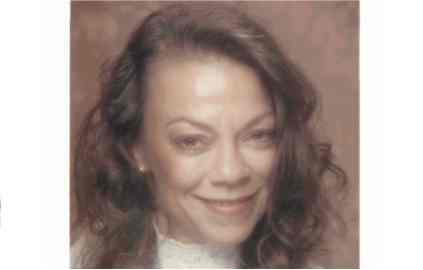
Pamela Ross-Osinski — 1950-2013

Pamela Ross-Osinski passed away suddenly March 24, 2013. She was 62.

She was born June 29, 1950.

Before coming to South Lake Tahoe, she worked for AT&T in the Bay Area. Pam lived in South Lake Tahoe for 15 years, and was perhaps best remembered for the tireless, smiling manner in which she responded to members in her position as membership services director for the South Lake Tahoe Chamber of Commerce. She was well known as the friendly face of the chamber, always with a smile and a twinkle in her eye as she truly listened to the people who visited the chamber and was constantly focused on how to help others.

Pamela Ross-Osinski

Pamela Ross-Osinski

She was instrumental in starting the Chamber Ambassadors and the first Leadership Lake Tahoe program. She planned dozens of mixers, including the favorite holiday celebration with Santa and sleigh rides.

Pam continued to help the South Tahoe Chamber of Commerce in recent years and was a valued member of Soroptimist International Tahoe Sierra.

She worked on the political campaigns of Jerry Birdwell and Claire Fortier, and was campaign manager for JoAnn Conner.

Recently, she spent much of her time caring for her mother.

Her family and friends remember her as someone who was always thinking of others and would often give of herself to help someone else or a good cause. Her last act on this earth was the epitome of her spirit. She will be sorely missed.

Pam was passionate about cheering for her favorite teams, the San Francisco Giants and the 49ers.

Pam left behind her beloved husband of 15 years, Andrew Osinski of South Lake Tahoe; mother Nancy Sullivan, two sons and a daughter-in-law — Angus Ross, Andy Ross and his wife Julie, all Bay Area residents. She also had a new grandson.

A celebration of life is planned for a warm day in June.