Author shares reality of citizens being imprisoned without a trial during WWII

By Kathryn Reed

“Crimes of the government can become sins against the innocent, especially in the mind of a child.”

“In 1942, all three branches of the government violated the Constitution.”

“Immigrants are often scapegoats.”

Those are some of the thoughts Jeanne Watatsuki Houston shared with nearly 200 people who listened to her speak this month in South Lake Tahoe. She, with husband James Houston, wrote “Farewell to Manzanar” – a story about her three-year internment at the Eastern Sierra “prison” during World War II.

She was a 7-year-old living in Southern California in 1942 when the government started posting posters on telephone poles telling those who were of Japanese heritage to turn up at bus depots and train stations on a certain day. It didn’t matter if they were U.S. citizens.
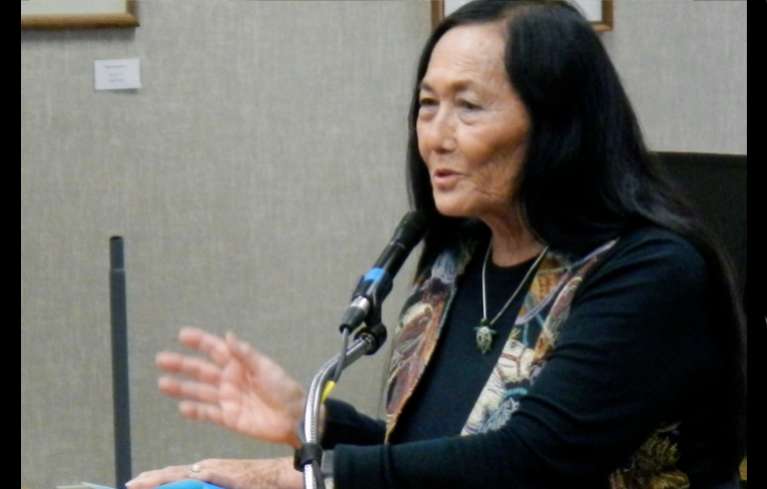
Jeanne Houston tells her story about being forced to live in an internment camp during World War II. Photo/Kathryn Reed

Jeanne Houston tells her story about being forced to live in an internment camp during World War II. Photo/Kathryn Reed

“We looked like the enemy,” Houston said.

Soldiers with guns herded them onto their transport. While not confrontational, at least for Houston’s family, it was still a military act.

Her father had already been whisked away. He was arrested the first day after Pearl Harbor because he was not a citizen. He had come to the United States with his parents in 1904 when he was 17.

“He was considered a dangerous person,” Houston said. He was a fisherman by trade. Her dad was sent to a federal prison in Bismarck, N.D.

The laws didn’t allow him to become a citizen until 1952.

“There had already been 100 years of anti-Asian laws,” the author said.

And while the United States was at war with other countries at this time, it was only Japanese who were rousted from their homes. Those other countries were in Europe where the people looked more like those in Washington, D.C., who were making the decisions.

It has been 40 years since Houston published the book. It took her more than two decades after being released from what was essentially a prison – not a camp in any sense of the word – to begin writing her story. It was a story that her husband did not know before they married.

“I don’t want others to feel guilty, it is understanding we want,” Houston said.

She realizes this segment of U.S. history is still unknown to many. People don’t realize the government rounded up 120,000 people – 70 percent of who were born in the United States – and sent them to one of 10 internment camps. That is why she continues to tell her story. (The May 14 talk was sponsored by the South Lake Tahoe Friends of the Library.)

“I don’t think it will happen again, but I think it could,” Houston said.

Today, Manzanar is a National Historic Site. It’s a bit like a ghost town. While Manzanar means apple orchard in Spanish, the dusty outpost in the Owens Valley with decaying remnants of the past and a visitors center with stories of the country’s racist act, sits in the middle of nowhere as a reminder of what the government can do to its own people.


Day of fun launches Wildfire Awareness Week

Lake Tahoe fire protection agencies all agree defensible space isn’t a bunch of hot air. To back up the importance of defensible space, they’re organizing a free Wildfire Awareness Week kick-off event that includes free tethered Smokey Bear hot air balloon rides (weather permitting), firefighter photo opportunities, a pancake breakfast and more on May 25 from 8am–noon outside MontBleu in Stateline.

Galvanizing around raising awareness of reducing fuels to reduce the risk of wildfire, local fire protection agencies including the U.S. Forest Service, regional fire districts, Tahoe Regional Planning Agency and Nevada Division of Forestry are hosting the free kick-off event to mark the start of Lake Tahoe’s 2013 Wildfire Awareness Week, May 26–June 2.

“Fire Chiefs around Lake Tahoe are concerned about an extraordinarily dry summer and the high risk of wildfire this year,” says Eric Guevin, fire marshal of the Tahoe Douglas Fire Protection District, said in a press release. “There are easy steps homeowners can take to reduce the fuels and reduce the risk of wildfire invading their property while increasing the safety of their family, and we have an exciting event planned to help them learn how.”

The kick-off event will feature free family activities including tethered hot air balloon rides (weather permitting), photos with Smokey Bear, a pancake breakfast, information booths and defensible space demonstrations geared to provide Lake Tahoe homeowners with tips and money saving tricks to create defensible space around their property.

For more information, call (530) 542.2571.


LTCC literary publication needs writers

The “Kokanee” literary journal is accepting submissions of poetry and prose for its 2014 edition.

Lake Tahoe Community College students, former students, faculty, and staff are encouraged to submit up to five poems and/or 10 pages of prose (fiction or literary nonfiction/memoir) for consideration.

Include a 50-word bio written in the third person.

Submit as an attachment (Word or rtf) to kokanee@ltcc.edu by June 21. Write “Kokanee Submission” in the subject box.

A monetary prize will be awarded to the best student piece.


7 performances of ‘Rent’ at LTCC

The Pulitzer Prize and Tony Award-winning musical “Rent” is coming to Lake Tahoe Community College.

Shows are June 14, 15, 20, 21, 22 at 8pm, with 2m shows on June 16 and 23.

Set in New York City’s East Village, “Rent” follows the lives of a group of impoverished young artists and musicians as they struggle to survive and create in Manhattan’s Lower East Side during the thriving days of Bohemian Alphabet City, and under the shadow of the AIDS epidemic. With music ranging from pulsating rock to gospel style ballads, “Rent” is a pop culture phenomenon about love, friendship, finding your voice, and living for today.

“We have a remarkable cast for this production,” Susan Boulanger, LTCC’s theater director, said in a press release. “Not only are they talented, but their connection to the material takes the show to an incredible level.”

Tickets for “Rent” are $15 for general admission, $12 for seniors, groups of eight or more, students with a valid student ID and children under 13. Tickets may be purchased in advance at LTCC’s bookstore Monday through Thursday, 9:30am to 7:30pm., and Friday, 9:30am to 2:30pm starting June 3. The Box Office will be open for ticket sales one hour prior to performances. Seating is limited, so advanced ticket purchases are recommended.

This show is for mature audiences only and not recommended for children under 18.

For information, call (530) 541.4660, ext. 207.


Slightly Stoopid ready to rock Tahoe

Slightly Stoopid is returning to the South Shore this summer.

The San Diego-based headliner, with a legion of followers known as the Stoopidheads, will bring its folk, rock, reggae and blues fused with hip-hop, funk, metal and punk to MontBleu on July 18.

The last time the band was here was in 2011 at Harveys.

The show begins at 6pm.

Tickets are $37.50 online or at the MontBleu box office 888.829.7630.


Hospice provides sensitive life-ending care

By Rebecca Wass

Enjoying life to the fullest may be difficult for a terminally ill person without help. Hospice care provides physical, emotional, spiritual, and social support for those who need health care associated with a terminal illness.

“Barton Hospice is attentive, sensitive, and responsive to patients’ and families’ needs, from information to reassurance and presence as they move through this difficult period,” says Rebecca Phillipsen, licensed clinical social worker from Barton Home Health & Hospice. “In addition to addressing the physical needs of the patient, hospice understands the importance of listening to and supporting the emotional and spiritual needs of the patient and family together.”

Patients who qualify for hospice care usually have a life expectancy of less than six months.

“Patients must be referred by a physician to qualify, but we’re always here to help answer any questions,” says Jason Collin, director of Barton Home Health & Hospice. “Most hospice care is covered by Medicare, private pay, private insurance, Medi-Cal, Medicaid, and, for those who qualify, Barton’s Helping Hands program.”

Care in the comfort of home

The Barton hospice team works with individuals, their family, and their physician to determine the most beneficial treatment. Care is provided in the comfort of the patient’s own home.

“We also provide care at our skilled nursing facility at Barton Memorial Hospital,” says Collin.

The type of care provided is dependent on the patient’s needs.

Hospice services include:

• Physician services

• On-call nursing care, 24 hours a day

• Dietitians

• Home health aides

• Symptom and pain management

• Social services and case managers

• Medical supplies

• Inpatient care for acute care and short-term respite

• Physical, occupational, and speech therapy

• Spiritual care

• Bereavement follow-up for family

Family involvement

Family members are encouraged to take an active role in providing supportive care to the patient. In doing so, the family experiences fewer feelings of helplessness.

“Participating in a loved one’s care not only allows a family member to provide love and support—it also reduces any feelings of guilt or regret that may be experienced later,” Phillipsen says, “and it enables everyone to get through it together.”

If you or a loved one is interested in learning more about Barton Hospice, call (530) 543.5581.

Rebecca Wass is the communications specialist for Barton Health.


Tahoe orchestra-chorus sets summer concerts

TOCCATA Summer Solstice Serenade concert series is June 20-25.

The program includes works by CPE Bach, J.S. Bach, Vivaldi, and Reinberger with guest flutist Josue Casillas; tenor, Daniel Paulson; and organist, David Brock.

Tahoe Symphony Orchestra and Chorus performances are:

June 20 at 7pm at St. Patrick’s Episcopal Church in Incline Village (341 Village Blvd.)

June 21 at 7pm at Trinity Church in Reno (200 Island Ave.)

June 23 at 5pm at St. John’s Lutheran Church in Sacramento (17th and L streets)

June 25 at 7pm at St. Theresa Church in South Lake Tahoe (1041 Lyons Ave.).

Tickets are available at the door or online. General admission is $25 adults, $20 seniors, and $5 students (19-23). Preferred seating is $35 and $15 for youth/students. Youth under 19 years of age are admitted free in non reserved seating. Contact TOCCATA at toccatatahoe@gmail.com or (775) 313.9697.


Meditation can be an easy route to relaxation

By Mandy Kendall

Gone are the days when it was thought that in order to meditate you had to spend hours crossed legged on a hill somewhere in the middle of nowhere focusing on trying to relax.

Studies have shown that even just a few minutes of concentrating on something (pretty much anything that isn’t stressing you out at that moment) can positively change your brain, increase your energy and reduce the physiological and damaging effects of stress on the body. So much so that meditation is being likened to going to the gym for your brain. Research is also suggesting that meditation can help reduce blood pressure and improve cellular health.

Meditation is like exercise. There is something for everyone and I highly recommend trying a few techniques to find one that fits you. There are no rules. You can sit, stand or lie down. You can have your eyes open or closed. You can say things in your head or out loud. You can listen to a guided meditation, be on your own or take a class … whatever works for you.

Mandy Kendall

Mandy Kendall

Like getting physically fit, meditation takes practice. It can be frustrating at first but is ultimately worth every minute.

So, here are a few Qwik-e (quick and easy) meditation tips:

Visualizing

Your thoughts – In this technique you do focus on the thoughts that crowd your mind. However, you visualize them as words or images drifting by on individual clouds. You don’t judge them (or yourself) or rationalize them. You just let them drift on as you watch the next cloud float by. The intention here is to be an objective observer and not get emotionally involved.

Fire – For this one you can either sit in front of an actual fire or imagine you are. Then you imagine you are throwing whatever worries, or pieces of emotional baggage you want to get rid of into the fire and watch them disappear in smoke.

Laughter – Spending five to 10 minutes imagining humorous things that make you smile, or, even better, laugh out loud, can do wonders for your state of mind.

Your happy place – Imagine you are in a wonderfully serene place. Maybe it’s somewhere you’ve been before or it could be a place you have made up in your imagination. Spend some time imagining how it feels, smells and sounds. If you visit this place in your mind often enough it can be an extremely good antidote to stressful situations, or even a great way to help yourself drift off to sleep.

Focusing

Candlelight – Try focusing on a flame for as long as possible without letting any thoughts come into your mind. This definitely takes practice, but when a thought does drift or come barging into your head, just acknowledge it and then imagine it drifting away on a cloud without paying it any further attention.

Working through a maze – By totally distracting yourself with a mundane task like navigating your way through a maze, you may find that your subconscious is able to reveal the solution to another problem you have been facing.

Breathing

Counting breathes – This is a very simple way of focusing on something and helping preventing unwanted thoughts from entering your head. Just simply count each breath as it comes and goes. Imagine each number as you count, changing size and color and pattern with each number to really focus your thoughts.

Accepting and releasing – This is by far one of my favorite techniques. It’s quick and easy and can be very effective at diffusing those tense moments when your emotional temperature starts rising and you need to let off some steam. The basic version is to simply breathe in thinking about accepting (maybe the situation you are in, anything or nothing … whatever works for you) then as you breathe out just think about releasing (maybe the way you’re feeling about the situation or anything at all). After a few breaths you should feel the stress pressure dropping. You can do this anywhere and no-one will be any the wiser. The more you do this the more you may find that seemingly unrelated thoughts pop into your head when thinking about accepting and releasing. However you might find that these thoughts may be at the root cause of the stress you are feeling.

Until next time.

Mandy Kendall operates Health Connective in South Lake Tahoe, which aligns wellness seekers with their ideal wellness provider. If you have questions, would like some advice, or would like to request some Qwik-e tips on any health and well-being topic, drop her an email at connect@healthconnective.com or keep an eye out on Lake Tahoe News for regular Qwik-e tips on how to make healthy changes one Quick and Easy step at a time.


Crime scene work nothing like what’s on TV

By Ted Long

Crime scene investigation was the focus of this week’s sheriff’s citizen group. We were educated on the role and procedures of the El Dorado County sheriff’s crime scene team. We saw everything from beginning of an investigation to the use of evidence in the courtroom.

El Dorado County does not have a dedicated crime scene team, it instead has deputies trained in CSI, and they perform normal patrol functions until there is a need for at crime scene investigation. Some counties, we were told, contract out CSI, or use civilian trained investigators. This way they only pay them when they are working.

The first thing we were told is that the reality is nothing like television, other than the crime scene taping. One might get the impression from the drama shows that it is an exciting, hands-on operation that makes or breaks most cases. The description we heard is more of a detailed, take your time kind of a job where much of the results are generated in a lab a long way away, with the dramatic results disclosed in months not hours.

Ted Long

Ted Long

They have a van dedicated to their use, which carries all their equipment. They must identify the scene, protect it, and then painstakingly search it including a high-tech vacuum cleaner. The obvious are the shell casings, the knife or other weapon and the victim. They photograph everything and carefully mark locations and time.

Unlike TV, evidence is put in paper bags, not envelopes or plastic bags; the reason is that the paper breaths and controls the determination and condition of the evidence. We did a fingerprint taking exercise, which went poorly for me, demonstrating the need for training and practice.

As usual, the officers were friendly and answered questions. We saw pictures of the process of investigating, collecting of evidence and even the examination of a dead body. The need for a “chain of custody” to allow admissibility of evidence was demonstrated and the need for a careful, accurate handling was underlined.

Contrary to popular belief, it is not a speedy process, fingerprints and DNA evidence as well as fibers and other particular evidence must be sent to Sacramento for processing and identification. We were told that physical crimes come first and property crimes may never get done. The officer explained that all property crime evidence goes to the back of the line, to the point where they may get a phone call four or five months later from the lab asking if they still need the work done. Given that defendants have a right to a speedy trial it may be useless to ever expect processing and use in a court case in property cases, such as burglary.

Another interesting evening in Placerville, learning that television crime shows make be just drama and not much reality.

Ted Long is a South Lake Tahoe resident participating in the El Dorado County Sheriff’s Citizens Academy.


Tahoe residents serve their country with pride

By Kathryn Reed

STATELINE – Ask someone what Armed Forces Day is and they’ll probably respond with a puzzled look.

It was created in August 1949 to have one day dedicated to the men (mostly at that time) and women serving in every branch of the U.S. military. At the same time, it was also instituted to replace the separate days of recognition the various branches had in place. And while the Marines take part in Armed Forces Day, they have also retained a day unto themselves.

Memorial Day is to honor those who have died serving their country, while Veterans Day recognizes all former members of the military.

armed forces dayArmed Forces Day is always the third Saturday in May – which is May 18 this year.

A few women from the Lake Tahoe area who have served in the military spoke at the May 15 Soroptimist International South Lake Tahoe meeting at Harrah’s Lake Tahoe.

Throughout the Lake Tahoe Basin there are about 4,000 veterans.

Carol Olivas, who is the secretary for the American Legion Auxiliary in South Lake Tahoe, described a veteran as someone who wrote a blank check to the military that could be paid with their life.

One of the things Auxiliary members do is spend time with the vets who are living at the Barton Skilled Nursing Facility. Two are there now, while last year nine called the South Tahoe center home.

Olivas said four vets who have served in Afghanistan are now attending Lake Tahoe Community College.

“All come back with post-traumatic stress,” Olivas said. “You don’t go to war and come back the same.”

Pat Bailey, who lives in Gardnerville and served in the Army as a dental specialist from 1975-78, told the group, “When people thank me for my service, I thank them for my college education.”

The GI Bill, which pays for college tuition, has long been one of the benefits of serving in the military.

All of the women who spoke Wednesday had positive things to say about their time in uniform. None got into the nitty-gritty of what life was really like, though.

Communication is one of the big things that has changed. There was a time when letters would be months apart between the service member and their loved ones who were in the States. Now computers allow for instantaneous emails and at times Skyping is available. And while this isn’t possible for all of the men and women serving overseas, it is a modern convenience even in times of war.

Francine Turner was in the Air Force during the Vietnam era. She was one of the first women to go through the jet mechanics course.

Locally, though, what she is known for is playing “Taps” on her bugle. She says it’s an honor. It’s also something Turner has done since was she a teen on a base in Texas.

Veronica Hawkins moved to Tahoe in 1978 with her parents. She graduated high school from the Carson Valley in 1995. From there she went right into the Air Force. She got out in 2000.

Hawkins served in Operation Desert Storm and was in the Bosnia conflict. One of her jobs was to tell people about their next deployment; which she said did not make her popular.

Patience Wenck, who is now a nurse practitioner with Barton Health, joined the Army Reserves in 1983. Her one weekend a month and two-week summer commitment grew as her rank and time served increased.

She was on active duty from 1987-90 before joining the Reserves again. From January 2005 to March 2006 she was in Germany helping wounded soldiers.

And while she met her husband, Fritz, through the military, he spent less time on a ship as a member of the Navy than she did going from island to island in Fiji administering medical care.

—-

Notes:

• The annual Memorial Day service is at Happy Homestead Cemetery in South Lake Tahoe on May 27 at 11am.