Book launch, artist reception combo in Truckee

Truckee artist and designer Sara Zimmerman will be celebrating her newest artworks and book release with her “Tahoe Macro and Micro” exhibit on July 5 from 4-8pm at Riverside Studios in Truckee.

The works emphasize the idea of what energy looks like in Tahoe, showcasing how energy at all levels exhibits similar behaviors. Additionally, Zimmerman will be signing copies of her first comic book “Unearthed Comics: Un-earthing the Universe, One Comic at a Time” at the show.

For more information about Zimmerman, call (530) 587.7492 or email sara@sarazimmerman.net.


Plane travel has long history at Lake Tahoe

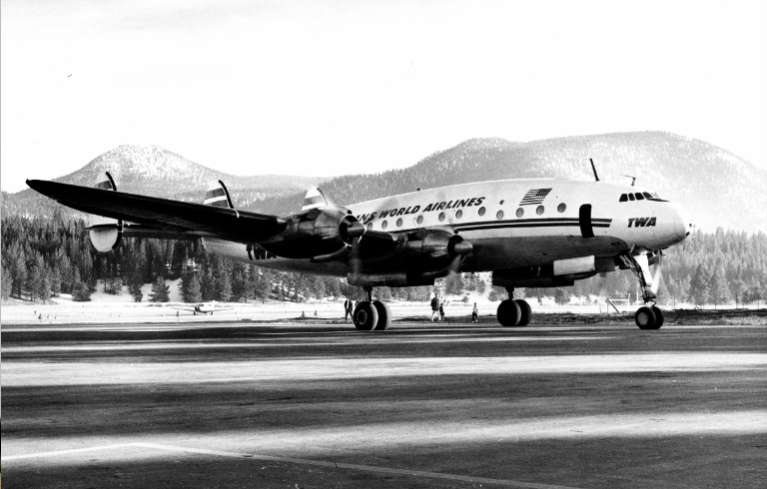
TWA was one of several airlines that used to fly into Lake Tahoe Airport. Photo/Del Laine

TWA was one of several airlines that flew into Lake Tahoe Airport in South Lake Tahoe. Photo/Del Laine

By Kathryn Reed

STATELINE – Aviation on the South Shore is nearly 100 years old, with the first recording of planes landing in the 1920s on the water. It was a bi-wing floatplane near Camp Richardson.

Swaths of land have served as air strips, plans were drawn up that never came to fruition, and some airfields are talked about but historians are not exactly sure where they located.

Local historian Dave Borges gave a brief history of Lake Tahoe aviation during the June 19 Soroptimist International South Lake Tahoe lunch at Harrah’s. He is a past history instructor at Lake Tahoe Community College and is on the board of the Lake Tahoe Historical Society.

It was the 1960 Squaw Valley Olympics that led the charge to develop what is now Lake Tahoe Airport. It was completed in 1959. The land was home to the Barton dairy before it was paved over for planes.

The runway was extended and the current terminal added as the years went by.

“It was paid for with a lot of casino money,” Borges said.

It was in 1983 that South Lake Tahoe bought it from El Dorado County for $1.

Several commercial airlines flew in and out of the airport. The highest passenger count was in 1978 at 294,188. The last commercial flight was in 2000.

Borges showed an ad for a flight from the Bay Area to South Lake Tahoe costing $11.95. A pamphlet claimed that a DC-3 could bring passengers from Oakland to Lake Tahoe Airport in 50 minutes.

The deadliest crash at the airport was on March 1, 1964, when 85 people died. The flight originated in Oakland, went to Salinas, and then San Jose before heading to Tahoe. While officials claim the weather was good when they took off, it was stormy in the Sierra, plus mechanical issues contributed to the crash.

Before Lake Tahoe Airport opened most of the planes flew in and out of Sky Harbor Airport in Stateline. This strip is essentially what the mobile home park on Kahle Drive now sits on. It operated from 1946-56.

“They would fly from the mountain side to the lake to alert the cattle. The planes made so much noise,” Borges said. Then they would go out to the lake and circle around to land. “From a pilot’s perspective it looked like they were going into the mountain because Kahle Drive goes uphill.”

A fence had to be erected so the cows would not eat the fabric on the wings.

In the area was also the Sky Harbor Casino.

Johnson Field existed in the 1930s and ’40s, but where exactly is not known because old maps don’t have it pinpointed. But the old drive-in is said to have moved to the Johnson Field. The Johnson family used to own much of the Bijou area.

The Dunlap Ranch-Tamarack Dairy near what is now the Tahoe Keys was going to be an airfield in the 1930s, but never came to fruition.

Borges showed plans from 1938 for the Meyers Lake Tahoe Airport.

“I’ve talked to a few people. A Meyers airport would be horrible,” Borges said, explaining that the current airport is already challenging for pilots.

In 1951 there was a proposal by the California Aeronautics Commission for a tarmac that could hold 400 aircraft near Pope Beach.

“It’s what the Tahoe Keys would have been if the Tahoe Keys didn’t happen,” Borges said.

—-

Note:

For more information about Lake Tahoe Airport, revisit the three-part series Lake Tahoe News published in July 2012:

• Part 1

• Part 2

• Part 3.


Wyland to visit S. Tahoe gallery

Environmental artist Robert Wyland, who is better known just by his last name, will be at his South Lake Tahoe outlet June 28-29.

Wyland Galleries expand across the United States, from Hawaii to Florida.

His Tahoe visit is the only Northern California appearances.

These appearances coincides with his 35th anniversary as a professional artist and the 20th anniversary of the Wyland Foundation, which uses art and science education to inspire kids to be interested in ecology and water conservation.

Wyland will be at the Tahoe store June 28 from 5-9pm and June 29 from 3-7pm. The gallery is at 4000 Lake Tahoe Blvd., South Lake Tahoe.


Tahoe Tails — Adoptable Pets in South Lake Tahoe

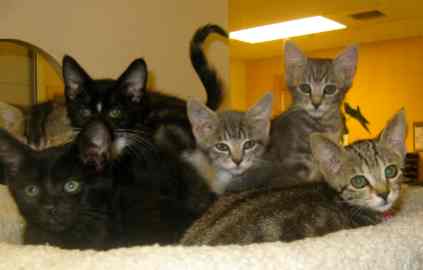
Kitties at the Meyers shelter.

Kitties at the Meyers shelter.

It’s kitten time at Tahoe. The shelter is overflowing with about 25 crazy, rambunctious, energetic kittens that were transferred to the Meyers shelter from other shelters in the Central Valley.

Every possible color, males and females, long and short hair are ready for adoption. Several have been adopted already, so come out to the shelter soon to pick your favorite. (And if you’d prefer an adult cat, we have several nice adults, too!)

All of the kittens are spayed or neutered, microchipped, and vaccinated. They are at the El Dorado County Animal Services shelter in Meyers, along with many other dogs and cats who are waiting for their new homes.

Go online to see photos and descriptions of all pets at the shelter.

Call (530) 573.7925 for directions, hours, and other information on adopting a pet.

For spay-neuter assistance for South Tahoe residents, go online.

— Karen Kuentz


Study: Reading novels makes people better thinkers

By Tom Jacobs, Salon

Are you uncomfortable with ambiguity? It’s a common condition, but a highly problematic one. The compulsion to quell that unease can inspire snap judgments, rigid thinking, and bad decision-making.

Fortunately, new research suggests a simple anecdote for this affliction: Read more literary fiction.

A trio of University of Toronto scholars, led by psychologist Maja Djikic, report that people who have just read a short story have less need for what psychologists call “cognitive closure.” Compared with peers who have just read an essay, they expressed more comfort with disorder and uncertainty—attitudes that allow for both sophisticated thinking and greater creativity.

“Exposure to literature,” the researchers write in the Creativity Research Journal, “may offer a (way for people) to become more likely to open their minds.”

Djikic and her colleagues describe an experiment featuring 100 University of Toronto students. After arriving at the lab and providing some personal information, the students read either one of eight short stories or one of eight essays. The fictional stories were by authors including Wallace Stegner, Jean Stafford, and Paul Bowles; the non-fiction essays were by equally illustrious writers such as George Bernard Shaw and Stephen Jay Gould.

Afterward, each participant filled out a survey measuring their emotional need for certainty and stability. They expressed their agreement or disagreement with such statements as “I don’t like situations that are uncertain” and “I dislike questions that can be answered in many different ways.”

Those who read a short story had significantly lower scores on that test than those who read an essay. Specifically, they expressed less need for order and more comfort with ambiguity. This effect was particularly pronounced among those who reported being frequent readers of either fiction or non-fiction.

So how does literature induce this ease with the unknown? Djikic and her colleagues, Keith Oatley and Mihnea Moldoveanu, have some ideas.

“The thinking a person engages in while reading fiction does not necessarily lead him or her to a decision,” they note. This, they observe, decreases the reader’s need to come to a definitive conclusion.

“Furthermore,” they add, “while reading, the reader can stimulate the thinking styles even of people he or she might personally dislike. One can think along and even feel along with Humbert Humbert in Lolita, no matter how offensive one finds this character. This double release—of thinking through events without concerns for urgency and permanence, and thinking in ways that are different than one’s own—may produce effects of opening the mind.”

The researchers have no idea how long this effect might last. But their discovery that it is stronger in frequent readers suggests such people may gradually become programmed to respond in this way. “It is likely that only when experiences of this kind accumulate to reach some critical mass would they lead to long-term changes of meta-cognitive habits,” they write.

Their results should give people “pause to think about the effect of current cutbacks of education in the arts and humanities,” Djikic and her colleagues add. After all, they note, while success in most fields demands the sort of knowledge gained by reading non-fiction, it also “requires people to become insightful about others and their perspectives.”

If their conclusions are correct, that all-important knowledge can be gained by immersing yourself in a work of literature. There’s no antidote to black-or-white thinking like reading “It was the best of times, it was the worst of times.”


Study: Social networking dominates smartphone, tablet use

By Dawn C. Chmielewski, Los Angeles Times

A new report from Nielsen examines a fast-evolving segment of the media landscape: viewing on smartphones and tablets.

Consumers are taking advantage of their portable devices to watch videos, access news and information, check sports, engage in social networking and shop. The time devoted to social networking dwarfs that of streaming video or accessing sports, Nielsen found in its cross-platform report for June.

Smartphone users spent 9 hours and 6 minutes a month on social networks — say, posting status updates on Facebook, tweeting their thoughts to followers on Twitter or checking-in on Foursquare. Apple iPad users devoted 3 hours and 41 minutes a month to social networks.

By comparison, smartphone users spent about 1 hour and 15 minutes a month streaming video on the device, and around 1 hour and 11 minutes engaged in sports, Nielsen reported. IPad users invested more time watching video on the device’s larger screen — about 1 hour and 48 minutes a month, (with 50 minutes on sports), Nielsen found.

Peak usage of these mobile devices coincides with TV’s prime time: with iPad app usage cresting at 9pm, Nielsen found.

Time invested in mobile apps surpasses usage of the mobile Web on smartphones and tablets.

Nielsen found smartphone users spent about 87 percent of their “app/Web” time engaged in mobile apps, with just 13 percent of that time on the Web, the researchers found. The same trend is true of iPad users, who spent 76 percent of their time using mobile apps, according to Nielsen.

U.S. viewers seemed to find more time for entertainment in the first quarter of the year: TV viewing rose, compared with the same time a year earlier, as did the amount of time-shifted TV viewing of previously recorded programs, and viewing of video via the Internet and on a mobile phone.

Only the time spent using a game console fell in the first three months of the year, Nielsen found.

Nielsen drew its mobile device research from a panel of 5,000 smartphone and 1,300 iPad users, whose browser and app activity was electronically measured in March.


Boathouse Theater to be home to live music

The South Shore’s Boathouse Theater will be full of live music throughout the summer.

The evening concerts begin at 7:30pm and tickets are $18 for each show.

July 8: Z.O.O.M. (a.k.a. Zydeco On Our Mind) is Zydeco, blues and jazz with captivating melodies and intense rhythms.

July 10: AFRO-CUBAN-FUNK Band (ACF) bring a blend of funk-infused world music dance grooves.

July 22: Joni Morris, a Tribute to Legendary Ladies of Country is known for her tribute to Patsy Cline. She will also perform hit songs by Kitty Wells and Tammy Wynette, along with other classic hits.

July 29: Solid Air is an original Americana folk-rock music group.

July 31: Jonathan Smart on classical guitar.

Aug. 5: Bill Mize is a Tennessee fingerstyle guitarist and composer.

Aug. 7: Local soft rock musician Devin Wright.

Aug. 14: Anna Helwing and Electra Schmidt perform on with classical vocal/piano.

Aug. 15: Irish, Scottish folk band Men of Worth.

For more details and tickets, go online or call (530) 541.4975.


Artists to work at South Shore historic site

The annual Valhalla Arts, Music and Theatre Festival’s artist-in-residence program begins June 19.

Artists will be on hand on scheduled dates in the Viking Room from 11am-4pm at the Valhalla Grand Hall.

Here’s the line-up of artist appearances:

June 19-26: Addie Chernus — a creative silk artist for 20 years.

July 3-10: John Holland has been in the mural business for more than 30 years.

July 31-Aug. 6: Lyn Twitchell is an artist from the Carson Valley and she works primarily in oil and watercolor.

Aug. 8-18: Kit Knight is an award-winning painter.

Aug. 21-28: Millicent Meng will feature paintings of recognizable objects such as Tahoe area landscapes.

Aug. 28-Sept 4: Dee Meyer.

For more details, call (530) 541.4975.

The historic Tahoe Tallac Site is located two miles past the intersection of highways 50 and 89.


Divided Sky keeps the beat alive in Meyers

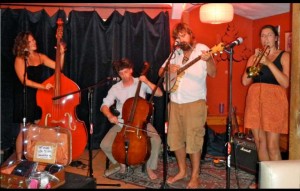
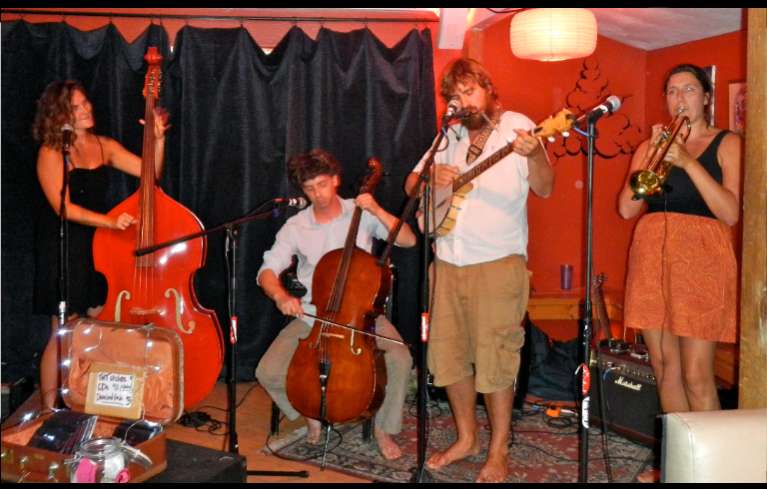
The New Thoreaus play at Divided Sky on June 8. Photos/Kathryn Reed

The New Thoreaus play at Divided Sky on June 8. Photos/Kathryn Reed

By Susan Wood

MEYERS – They say music is the universal language.

If that’s indeed true, then Divided Sky would be understood by many to be a unifying business in the Tahoe region. The restaurant-bar located above the Downtown Café west of South Lake Tahoe has brought in several musical acts during the 10-plus years it has been open, and it shows no signs of slowing down.

“We have not survived off our music, but people associate us with music,” owner Brian Levy told Lake Tahoe News. “Every year we feel a little busier. Fortunately, people took to it right off the bat.”

Levy admits milestones in years one, three and then 10 prompted him to evaluate the business, which began with three staffers. Now eight people work there.

“We thought: Well, we made it to one year, then three. Then, we felt established at 10 years,” he said.

But there’s no letting the guard down. He believes in “keeping the game up.”

The customer base on a given weekend night may range significantly from 20 to 100 people for the after-dinner bands, which often take the small stage around 9 or 10pm. (Hint: get there at a decent hour to be assured a seat. Or, stand in the middle of the room and sway with others.)

Small, nightclub lights are strung around the room. By the time a band takes the stage, dinner tables are moved to make room for those who want to dance or stand. A curtain is hung behind the band to give it that cozy look – and keep the neon lights from being a distraction.

The bar is busy and some of the conversations in the booths are so focused the music serves as background for a locals’ gathering. The place has Meyers written all over it.

The locals’ joint has developed such a reputation that bands seek it out to play there. Levy will get at least a few emails a week from prospective bands looking to simply cash in on the small bar cover at the door. It averages $5 to $10. It appears the venue is small enough for startup bands with no fan base.
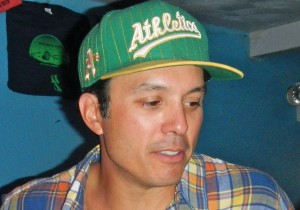
Divided Sky owner Brian Levy mixes music, food and drinks into a successful business in Meyers.

Divided Sky owner Brian Levy mixes music, food and drinks into a successful business in Meyers.

These bands now have other venues to play in around town like Lakeview Commons on Thursday night. And, Levy notes this.

“Now we have the luxury of sorting through them. The bands will play for the door – enough to pay for their gas,” Levy said. One band went quasi professional. ALO – known to cater to the hippie-beatnik circuit – got its start at Divided Sky and now plays larger arenas.

“We’re waiting for the day Bob Dylan comes in to play,” Levy joked.

Stranger things have happened. Legendary singer-songwriter Van Morrison spent years popping in to small pubs in San Francisco.

“These aren’t the bands making a living of this, but it’s what they love to do,” Levy said.

Indeed, this is how guitar-banjo player Ian Patton may characterize his band that played there this month.

The New Thoreaus, as in writer Henry David, consist of a group of special education teachers from Oakland who play music when they’re out of school for the summer. As English majors, the band of five members values reading. There’s one philosophy major.

A barefoot Patton, who leads the indie-folk band with a bluegrass twist, returned to the South Shore with his wife, stand-up bass player Lauren Hernig. While they played into the hours of the night, their daughter, 2-year-old Izola, was being babysat by his father who still lives in Tahoe.

Levy could relate. His parents were in town to witness his baby (the business) thriving.

Patton told Lake Tahoe News he fondly recalls going to Divided Sky when he lived here seven years ago. He and his wife enjoyed seeing Victor Barnes Insurgent Bluegrass. A year later, his band formed in Oakland. Now, bluegrass has experienced a resurgence – with “Mumford and Sons” and “Lumineers” leading the airwaves.

“It’s great to hear that type of music on the radio. Now you can hear bluegrass on four different stations (in the Bay Area),” he said. Still, he admits the band aims for an original sound, with a chance to make its own path.

Like Levy, Patton and the rest of the New Thoreaus are enjoying relative success these days. The band has a debut album, “Neon Americana”, just released this year.

“When we started, I didn’t think we’d get this far,” Patton said.

In the meantime, the band seeks to remember its roots. To Patton, that means coming back to Tahoe, where he met his wife and developed a love of music.

“(Divided Sky) has a sentimental place in my heart. It’s where I always wanted to play,” Patton said.

The music venue’s success has not gone unnoticed. The Meyers Community Alliance, which is responsible for a genuine revival of the western South Shore enclave, has gotten in on the act.

“There are many ways to build a community. The easiest way is through music,” said Josh Welch of the Alliance.

Apparently, the strategy has worked for Divided Sky, according to longtime Tahoe resident Julie Threewit.

“The Divided Sky is one of the reasons we are lucky to call Meyers home. It is one of my favorite places to see live music,” Threewit said, also mentioning local bands that have either gotten their start there or made it part of their concert circuit. They are Blue Turtle Seduction – a Tahoe favorite, Huckle, Wisebirds, Trespassers, Delta Nove and more recently Birds of Chicago. “As we travel, we look for the local bar that feels like the Divided Sky; the place where locals meet to visit, eat and hear great music – where visitors feel comfortable and welcome. Brian (Levy) told us if we did that, we’d always feel like we were home.”

And more events are on tap for all to experience those homespun values.

Divided Sky is hosting a mountain bike festival on Aug. 18 – with demonstrations, a shuttle, beer garden and a stage where bands can play.
Markleeville musician releases album

Markleeville’s Patterns of Perfection this week release its latest album “The Chronicle”.

Jacob Lovell is the artist Patterns of Perfections.

Lovell had bad and lucid dreams as a kid, and he often wondered what that was about. After realizing that music was his one true passion, he decided to take his dreams to a whole new level and share his music with the rest of the world.

The album “The Chronicle” features a varied selection of hip-hop and R&B tracks.

Produced by Tate Music Group, the album offers 17 tracks.