Counties honored at California State Fair

Placer, El Dorado and Amador counties won awards at the State Fair.

Counties throughout the state compete for best exhibit. Glenn County took the best in show award.

The 2013 Counties Exhibits Competition includes two new awards: Best of Division for Community Built Exhibits and Best of Division for Professionally Built Exhibits. Although the builders from the communities may be experts, they do not build exhibits for a living.

Here are the results:

Best of Division – Community Built Exhibits – Lake County

Best of Division – Professionally Built Exhibits – Placer County

Best Content Award – Amador County

Best Marketing Presentation Award – Glenn County

Best Craftsmanship Award – Tuolumne County

Best Agricultural Presentation – Yolo County

Best Design Award – Sacramento County

Best Use of Special Effects/Animation Award – Placer County

Best Use of Products, Produce or Artifacts – Mono County

Best Visitor Experience Award – Calaveras County

Superintendent’s Award – Sierra County.

Gold awards went to: Amador County, Butte County, Calaveras County, Colusa County, Glenn County, Humboldt County, Inyo County, Lake County, Mendocino County, Modoc County, Mono County, Nevada County, Placer County, Sacramento County, Santa Cruz County, Sierra County, Solano County, Sonoma County, Stanislaus County, Tuolumne County, Yolo County and Yuba County.

Silver awards were garnered by: El Dorado County, San Joaquin County and Shasta County.

The State Fair in Sacramento runs through July 28 in Sacramento.


Simplifying the Health Care Reform Act

By Mandy Kendall

I recently decided to immerse myself into finding out more about the Health Care Reform that comes into effect next year. Working on the premise that there is “no such thing as too much information” I decided to pass on the facts and recommendations that I discovered.

Here are some of the key points:

• Health insurance rates can no longer be based on risk, and can only be based on age, residency, and tobacco use.

• You cannot be denied coverage, have coverage excluded for a specific condition, or be charged higher premiums due to health history.

• Insurance companies will no longer be allowed to set lifetime limits on an individual’s medical bills so people will no longer get into debt when the coverage runs out.
Mandy Kendall

Mandy Kendall

As of Jan. 1, 2014, all individual and small business health plans must offer a comprehensive package of benefits that includes: emergency services, hospitalizations, laboratory services, maternity care, mental health and substance abuse treatment, outpatient care, pediatric care, prescription drugs, preventative care vision and dental care for children.

Some statistics:

• Nearly 50 percent of the 850,000 of U.S. physicians are over the age of 50.

• There are 51.8 percent fewer medical students going into primary care since 1997.

• There will be approximately $718 billion in cuts in reimbursement for Medicare.

• The Association of American Medical Colleges predicts a shortage of nearly 40,000 primary care physicians by 2020.

• 32 million Americans expected to be newly insured over the next decade.

• Medicare enrollment is growing at a rate of 10,000 per day.

• Result – Fewer Doctors + more patients = longer wait times.

Considerations — Thinking of canceling your insurance? Be aware that there will be penalties for not having insurance. “If someone can afford it, but doesn’t have health insurance coverage in 2014, they may have to pay a fee. They must also pay for all of their care.” (Healthcare.gov)

Recommendations — If you have a grandfathered plan, keep it. All plans purchased after March 23, 2010, are non-grandfathered plans and must change.

Agencies are advising people to act now to avoid reform related premium increases for as long as possible.

Lock in a new premium based upon current rates and members ages to keep through 2014

Subsidies will be available and you can determine if you are eligible online at the Kaiser Family Foundation (www.kff.org).

There are ways to offset increased costs through a Health Reimbursement Arrangement (HRA).

Contact a licensed insurance agent as soon as possible who can help navigate you through these very complicated new rules and regulations.

Look into telemedicine or concierge medical services to reduce wait times and increase your chance of getting an appointment with your doctor when you need it.

More information can be found online. This site provides useful information about insurance options available to you and changes created by health-care reform.

Kaiser Family Foundation has info online.

This site has in-depth information on key health policy issues, plus interactive tools to determine how health-care reform will impact you. It also provides information about the exchange in your state.

Consumer Reports offers a range of resources from understanding health insurance and reform to help navigating Medicaid and Medicare to advice on maximizing your insurance options.

Mandy Kendall operates Health Connective in South Lake Tahoe, which aligns wellness seekers with their ideal wellness provider. If you have questions, would like some advice, or would like to request some Qwik-e tips on any health and well-being topic, drop her an email at connect@healthconnective.com or keep an eye out on Lake Tahoe News for regular Qwik-e tips on how to make healthy changes one Quick and Easy step at a time.

2-time breast cancer survivor conquers Mt. Shasta

Linda Kazmar climbs Avalanche Gulch after sunrise June 22. Photo/Jeff Kazmar

Linda Kaczmar of South Lake Tahoe climbs Avalanche Gulch on Mount Shasta after sunrise June 22. Photos/Jeff Kaczmar

By Kathryn Reed

Today will be Linda Kaczmar’s last reconstructive surgery. It is one of many milestones for her in 2013.

It was not a decision she thought she would have to make again. When she went through all the breast cancer treatments 10 years ago she believed she was done with oncology wards.

But a lump in the same breast, discovered by a self-exam – like the first – that also didn’t show up on an X-ray, was enough to get her to see her doc.

It was back. And this time she was going in for a double mastectomy.

However, Kaczmar wasn’t about to let cancer get in the way of plans she had already made.

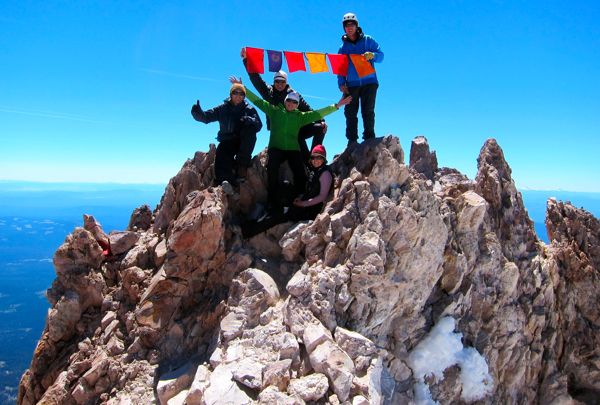
 At the summit -- 14,179 feet.  Jeff Kaczmar, from left, Steve Bannar, Linda Kaczmar, Chris Kozlowski, and John Dayberry (standing). Photo/Jeff Kazmar


At the summit — 14,179 feet. Jeff Kaczmar, from left, Steve Bannar, Linda Kaczmar, Chris Kozlowski, and John Dayberry (standing).

Before the January diagnosis she decided that same month to climb Mount Shasta – again. On the first attempt 10 years ago she didn’t summit. Her friend Chris Kozlowski said absolutely she would be alongside her on the trail this time. Then Stella Ortega joined in on the training.

And so began the South Lake Tahoe women’s – Quest for Shasta, 3 Girls and a Mountain.

Kaczmar credits her doctors at UC San Francisco for arranging their schedules to work with her training and desire to conquer the 14,179-foot mountain.

On June 21 (the summer solstice) – what had become an expedition of three girls and three guys – reached Helen Lake base camp at 10,000 feet. Ortega was not feeling well the next day and ended her quest there.

The others headed out about 2:30am June 22 with headlamps on. Soon those were put in packs and the five were walking under the light of the super moon.

The men along on the ascent were Kaczmar’s 28-year-old son Jeff, Steve Bannar – who two years ago performed knee replacement surgery on Kaczmar, and John Dayberry.

All five had their own stories about why they wanted to climb this mystical mountain that is the No. 1 Earth chakra. But the overriding reason was to accompany Kaczmar on her path to the top.

“The mountain was good to me that day. She helped me summit,” Kaczmar told Lake Tahoe News. She is the first to admit the climb was not easy – “it was very, very hard.” After all, it was 7,000 vertical feet.

At one point Bannar gave her a stern pep talk. Her son spoke words of encouragement. Kozlowski knew their training would pay off.

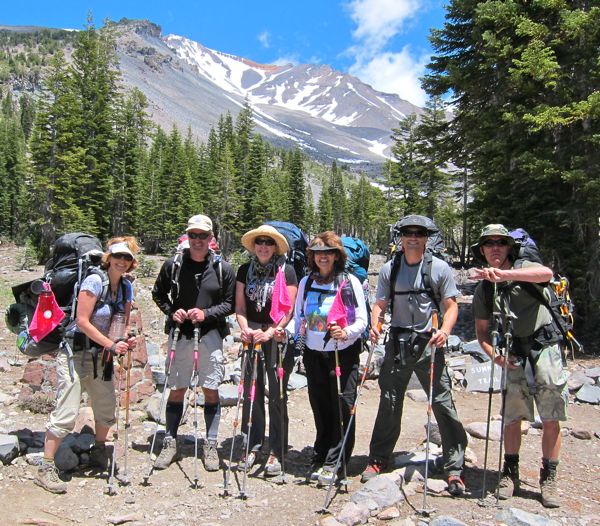
Going to base camp, from left,  Chris Kozlowski, Steve Bannar, Linda Kaczmar, Stella Ortega, Jeff Kaczmar and John Dayberry.

Going to base camp, from left, Chris Kozlowski, Steve Bannar, Linda Kaczmar, Stella Ortega, Jeff Kaczmar and John Dayberry.

“She was really struggling. We both agreed it was more than just us there. There’s a lot of energy on that mountain,” Dayberry said. “We had those discussions about heavy power points like Cave Rock and other sacred places. You have to tap into that. You gain healing and you gain energy from that and you go with that.”

Then, about 500 feet from the top they came across a woman “stuck” on the trail, saying she couldn’t make it. Bannar said, “Oh yes, you can” and took her pack. Kaczmar told her about being a two-time breast cancer survivor and she was going to the top and pulled the woman along. The woman, in her 20s, was there for her brother’s girlfriend who was diagnosed with breast cancer.

This Northern California mountain calls to many who have been touched by cancer. It’s the spirituality of the peak, the energy it emits. When Kaczmar was on the mountain 10 years ago she was with a group from the Breast Cancer Fund.

This time the fivesome did the climb without a guide.

A woman on the first expedition told Kaczmar, “It isn’t about the summit, it’s the journey on the mountain.”

And while today that is true for all of them, the Champagne Kozlowski popped open at the top flowed just as freely as the congratulatory hugs. There was something powerful about summiting – an accomplishment that the healthiest of climbers can be proud of.

Kaczmar turns 60 in November. The next adventure for this two-time cancer survivor is to have a voyage of some kind with her younger son who was not able to make the Shasta Climb.


Social media makes people feel like they’re missing out

By Justin White, Washington Post

Have you heard about FOMO — “fear of missing out”? Most common among the under-30 crowd, it happens when someone feels nervous about not attending social events, like that awesome party everyone else enjoyed last weekend.

People have always been concerned about their social standing, but the explosion of social media has made FOMO a bigger issue, for everyone from middle schoolers newly toting smartphones to adults. Now researchers have developed a quiz to test just how fearful people are about missing out.

Among the questions the FOMO quiz asks are how often someone checks social media (“when eating breakfast?” “when eating lunch?” “in the 15 minutes before you go to sleep?”) and how worried he or she feels when friends are hanging out without them. As the intro to the quiz puts it, “FOMO . . . is a relatively new concept where people are concerned that others may be having more fun and rewarding experiences than them. It is characterized as the desire to stay continually connected with what others are doing.”

FOMO is often associated with a perceived low social rank, which can cause feelings of anxiety and inferiority. When someone misses a party, vacation or other social event, he or she can feel a little less cool than those who showed up and snapped photos. In some cases, people are even afraid to miss out on bad stuff. FOMO is most common in people ages 18 to 33 — in one survey, two-thirds of people in this age group said they experience these fears. The survey also suggests FOMO is more common among guys than ladies, though it’s unclear why.

Research suggests FOMO can take a negative toll on psychological health. Constant fear of missing events can cause anxiety and depression, especially for young people.

Over the past few years, there’s been a lot of research on the way social media influences FOMO. Recent research suggests people who experience FOMO are most likely to value social media as part of their social development. Status updates and tweets (“OMG best night ever!”) let us know about all the exciting activities happening while we’re home catching up with the “Jersey Shore” crowd. Some psychologists even suggest FOMO helps drive the success of social media platforms, since we feel we need to use the technology to let us know what’s happening elsewhere. But in some cases, FOMO might actually be a motivator, encouraging us to socialize with friends.

Some argue that the feelings associated with FOMO strengthen connections with others, encouraging people to be more socially active. While it might be antisocial to sit around checking out the Facebook pages of

pseudo-strangers, it’s possible to use social media in a constructive way, like keeping in touch with friends and planning activities. (Maybe it’s time to reconnect with an old buddy who lives nearby?)

Psychologists say fears about missing out may be a type of cognitive distortion, causing irrational thoughts — such as believing that friends hate you if you didn’t get an invite to last week’s party — associated with depression. For people prone to such thoughts, modern technology may just exacerbate their fears about missing out. So experts say unplugging all those gadgets might not solve the problem as well as engaging in cognitive behavioral therapy or another kind of talk therapy might.

Whatever you do, remember when scoping out other people’s plans, especially online, that many people project their most idealized selves on the Web. So spy with a skeptical eye. And to those who are confident enough in their plans for this Friday night … well, hats off.


Younger readers prefer print over e-readers

By Aron Chilewich, New Republic

A study from the Pew Research Center on young Americans’ library habits defies the conventional narrative of today’s youth as a generation who has abandoned print. Despite being heavy Internet users, the press release states that “Americans under age 30 are strong supporters of traditional library services,” including in-person assistance and — yes — books.

Pew found that Americans between the ages of 16 and 29 were actually more likely to have read a book in print in the past year than their 30-and-up counterparts; the breakdown was 75 percent to 64 percent, respectively. (Americans in this younger age bracket were also more likely to have visited a library in the past year, about as likely to have received assistance from a librarian in the past year, more likely to utilize a library’s quiet space and more likely to be “strongly opposed” to the idea of automated check-out services than older Americans.)

And, despite growing popularity of e-books among all age ranges, Americans aged 30 to 49 are more likely than Americans aged 16 to 29 to own an e-reader or tablet computer.

So what’s going on here? In part, it’s that young people who are still in school tend to stick to pretty conventional research methods.

As Kathryn Zuckuhr, one of the authors of the study, told me in an email, “The need to do reading and research for school are definitely part of what’s keeping print the base of many younger Americans’ reading habits.” (The same team of researchers found in 2011 that between ages 16 and 29, 81 percent of readers gave school or work as their reason for reading, 76 percent said they read for pleasure, 73 percent to keep up with current events and 81 percent to research a topic of interest.)

Another possible reason is that schools have not switched over to e-readers and e-books. Cost is likely a major factor here — and also probably explains why adults are more likely to own e-readers. Young people who are reading e-books were “more likely to read their e-books on a computer (55 percent) or cell phone (41 percent),” Zuckuhr said.

Perhaps, then, the continued prevalence of print books has less to do with their popularity than with the ease with availability. Young people may be in the process of transitioning to e-books and e-readers, only at a slower pace due to their more limited resources. For now, at least, we have paper.


Study: Exercise lowers anxiety

By CBS News

Exercise can lower anxiety, but how it does so remains a mystery. Now, a new study conducted at Princeton University, published in the Journal of Neuroscience, may offer clues as to what happens in the brain.

Conducted on mice, the study was done on two groups of the animals. The first group was was given a good amount of exercise and the other was more sedentary. Upon studying their brains, researchers found both groups had formed new brain cells called neurons, but the exercisers formed more neurons that release the neurotransmitter GABA, which has a calming effect on the brain.

Dr. Holly Phillips noted on “CBS This Morning,” that GABA is known to reduce anxiety. In fact, many prescription anxiety drugs cause the brain to release GABA. “These cells help to calm down the brain and hence fight anxiety,” she said.

It’s also likely, Phillips said, that the results will translate very well into humans. She said, “We’ve suspected for a very long time that GABA would, of course, be involved and now, there’s just extra (evidence) of that.”

Exercise actually changes the brain permanently, Phillips pointed out. It changes the types of cells that are there. Phillips added, “This is important because then it has lasting effects. Even 24 hours after exercise, you’re less prone to experience anxiety symptoms.”

Phillips says exercising 30 minutes four days a week can help, based on other studies on exercise.

She added, “For anxiety in particular, high-intensity exercise is really important and also we’re always looking for natural alternatives. Some of the anti-anxiety medications can be habit-forming and anytime we can do something where we don’t need to take a medication, of course, is a good thing.”


Music camp in Tahoe for grades 8-12

UNR is putting on the 57th Lake Tahoe Music Camp July 21-27 at the Nevada State 4-H Camp in Stateline.

Each year, nearly 200 students in grades 8-12 participate in a week of music activities, rehearsals, team building exercises and recreation time, all on the shores of beautiful Lake Tahoe.

The camp is filled with jazz and classical music workshops, clinics, performances, mentoring and instruction with award-winning University faculty, guest conductors, professional chamber singers and jazz musicians and more.

This year, the guest star of the camp is conductor Paula Crider, past president of the National Band Association and a member of the prestigious American Bandmaster’s Association in which she was only the third woman to have been honored as a member, will conduct the Lake Tahoe Music Camp Symphonic Band. She will also provide musical insight and direction to all students, serving as a role model for young musicians by teaching them the importance of being active citizens in their community and active participants in music groups at their schools.

A new addition to the camp is a team-building dance activity. Students will learn fun and simple moves to include in the mid-week lip-sync and end-of-the-week dance event.

For students looking to continue music as a major or minor at the university level, Lake Tahoe Music Camp provides leadership skills and is staffed with musicians and music majors who teach lessons, music classes and provide mentorship throughout the week.

For more info, go online.


Phone-charging kiosks become public gathering areas

By Joshua Brustein, Bloomberg Businessweek

Urban designers take note: If you want to create modern-day public squares that encourage strangers to cross paths, try offering outlets at which passers-by can plug in their phones.

AT&T has begun installing solar-powered phone-charging stations on locations around New York City. The thin towers are topped by solar panels and contain batteries to collect energy for nighttime use.

The company bought 25 charging stations priced around $8,000 each from Goal Zero, a solar-power company that worked with the design consultancy Pensa on the devices. AT&T began installing them a few weeks ago and was hoping to have them all up and working by this month.

In a pilot project last summer, Pensa said it was able to persuade people to congregate in a vacant plot of asphalt in Brooklyn’s Dumbo neighborhood. The designers believe that once you build these things, people will come.

“We’re looking to create something that complements its surroundings and invites people to hang out and recharge. We have also found that where people gather, opportunities develop for street vendors and retail, and neglected urban areas come alive,” says Marco Perry, co-founder of Pensa.

If you needed proof of our addiction to mobile communications, pay attention to the places where people can charge their smartphones.

Bartenders, for instance, will often agree to charge customers’ phones behind the bar – so long as they’ll sit there and buy drinks while they do so. A company called GoCharge has also installed charging stations in dozens of New York bars, paid for by advertisers.

At Brooklyn’s new Barclays Arena, crowds tether themselves to phone-charging stations in the concourse, watching the Nets play basketball on television screens while they’re paying to be there in person.

Last year, when the city faced widespread power failures in the wake of Hurricane Sandy, available outlets in ATM kiosks, coffee shops, and the odd adapters yoked to bicycle-powered generators helped sustain desperate crowds.

Creating mini-public spaces to feed popular demand for wireless communication became part of New York’s attempt to reinvent its pay phones.

Last year, after the city turned several pay phone stations into wireless hotspots, officials found that people who connected to the networks stayed in place for more than half an hour. The winning design in a contest the city ran earlier this year to reimagine pay phones included a Wi-Fi hotspot, while rival designs called for charging stations to be built-in.

The city renegotiates the franchises for its pay phones next fall. Don’t be surprised if, in the years to come, they’re the most popular places in town.


Tahoe Tails — Adoptable Pets in South Lake Tahoe

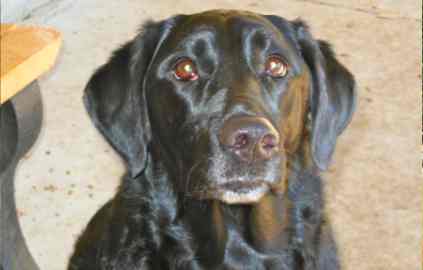
Bella

Bella

Bella is a 3-year-old black Labrador who is a bit confused at being in the shelter – and no wonder, she was surrendered because she barked at night while her owner was at work.

She is a very sweet dog who will do better in a home where her people are with her at night, and who give her plenty of exercise (and maybe a companion dog or cat) so she isn’t lonely during the day. She is house trained and very polite and affectionate.

Bella is spayed, microchipped, and vaccinated. She is at the El Dorado County Animal Services shelter in Meyers, along with many other dogs and cats (including lots of kittens) who are waiting for their new homes.

Go online to see photos and descriptions of all pets at the shelter.

Call (530) 573.7925 for directions, hours, and other information on adopting a pet.

For spay-neuter assistance for South Tahoe residents, go online.

— Karen Kuentz


Sierra Nevada Ballet to be in Incline, Reno

Sierra Nevada Ballet has selected the famed Coppelia ballet for its summer performances which are scheduled for July 27 at Nightingale Hall as part of the Artown Festival and July 29 on the outdoor stage at Sand Harbor State Park in conjunction with the Lake Tahoe Shakespeare Festival.

A comic love story, Coppelia is filled with fantasy and reality as it tests the relationship of the heroine, Swanilda, and hero, Franz, through the romantic device of a beautiful lifeless doll created by the obsessive Dr. Coppelius. The ballet showcases series of comic mishaps that end in a happy marriage celebration.

Based upon the original choreography with a modern twist, is choreographed by Rosine Bena and presented by some of the finest performers in the business.

For more information and to purchase tickets, visit the ballet’s website.